

Forehead Lift Incisions Explained: Hairline, Coronal and Pretrichial Approaches Compared
Key Takeaways
- A coronal incision runs ear to ear across the crown and raises the hairline by roughly the width of scalp removed, which is why it suits low hairlines rather than tall foreheads.
- A pretrichial incision at the front edge of the hair removes forehead skin instead of scalp, so it can keep or even lower a high hairline at the cost of a scar on that boundary.
- Endoscopic lifts use three to five short scalp incisions and rely entirely on fixation devices or sutures, not tissue removal, to hold the brow up.
- Scalp numbness is most extensive after coronal incisions and can persist for months according to Mayo Clinic; endoscopic and temporal approaches usually spare more sensory nerves.
- Brow lift and forehead lift are names for the same family of operations; the incision and fixation method tell you more than either label.
- Results are long-lasting but not permanent, because the brow resumes its slow descent from its new, higher starting point as skin continues to age.
Forehead lift incisions fall into three main groups. A coronal incision runs ear to ear across the top of the scalp, hidden in hair. A pretrichial incision sits just in front of the hairline and can shorten a tall forehead. Endoscopic approaches use several small scalp incisions and a camera. Each has distinct trade-offs in scarring, numbness and hairline position, and the choice rests with the treating surgeon.
A reader wrote to us after a consultation that left her with a diagram she could not decode. Three dotted lines were sketched across a cartoon head: one arcing over the crown, one tracing the front edge of the hair, and a scatter of short dashes in between. The surgeon had explained each one, she said, but by the time she reached the parking lot the lines had blurred together.
That confusion is common, and understandable. The surgery itself, a forehead lift, is conceptually simple: loosen the soft tissue of the forehead, lift the brows to a more rested position, and secure them there. What differs between operations is where the surgeon enters, and that single decision shapes the scar, the hairline, the sensation of the scalp and part of the recovery.
This explainer walks through the main forehead lift incision types in plain language, compares them honestly, and lists the questions worth bringing back to your care team.
What actually happens during a forehead lift
Start with the anatomy, because the incision only makes sense once you know what sits beneath it. The forehead is a layered sandwich: skin, a fat layer, a sheet of muscle, a thin connective layer and then the bone. The frontalis muscle is the one you use to raise your eyebrows. Between the brows sit the corrugator and procerus muscles, small bands that pull the brows inward and down and carve the vertical frown lines. Over the years, the brow drifts lower as the supporting tissue loosens, so the frontalis works overtime to keep the eyes open, which deepens the horizontal lines above.
A forehead lift, sometimes called a brow lift, works by separating that soft-tissue sandwich from the bone through a chosen incision, repositioning the brow upward and outward, and fixing it in place while it heals. Mayo Clinic describes the goal as raising the eyebrows and softening the creases that gather across the forehead and between the eyes. Many surgeons also weaken or partially remove the corrugator muscles during the same operation to ease the frown crease.
Fixation is the part patients rarely hear about. Once the brow is lifted, something must hold it until scar tissue matures and takes over. Depending on the approach, that might be a strip of excised scalp closed under slight tension, stitches anchored to deeper tissue, or small absorbable devices placed on the bone. The incision type largely dictates which fixation method is practical.
Surgery is usually performed under general anesthesia or sedation with local anesthetic, and most people go home the same day according to Cleveland Clinic. Dressings or a soft head wrap are common for the first day or two. Everything that follows, from the shape of the scar to the length of scalp numbness, flows from which line the surgeon drew.
Where are the incisions for a brow lift? The main forehead lift incision types
People searching for where the incisions are placed usually find a jumble of brand-like technique names. Strip those away and the forehead lift incision types reduce to a handful of positions on the head, each chosen for what it hides and what it changes.
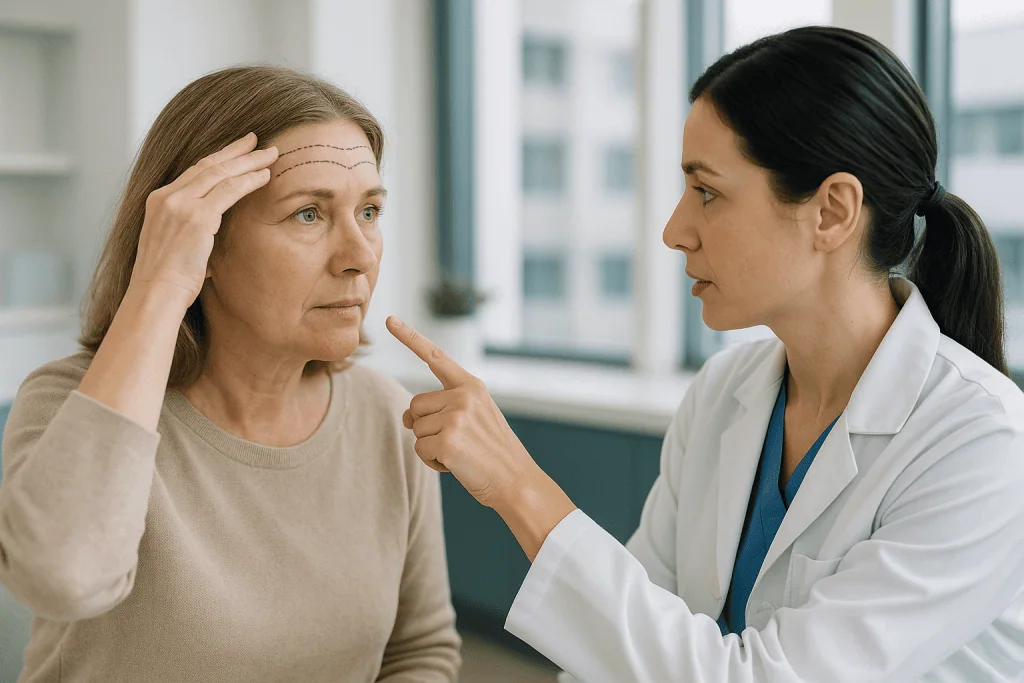
The coronal incision is the oldest of the three. It runs from the top of one ear, across the crown, to the top of the other ear, several centimeters behind the hairline. Because the whole scar lives inside hair, it is well concealed in people with dense, stable hair growth.
The pretrichial incision, also called a hairline or trichophytic incision, sits right at or a few millimeters inside the front edge of the hair. Pretrichial simply means “in front of the hair.” It allows the surgeon to remove a strip of forehead skin instead of scalp, so the hairline moves forward or stays put rather than retreating.
The endoscopic approach does not use one long line at all. Instead, three to five short incisions, each typically a couple of centimeters, are placed behind the hairline. A slender camera, the endoscope, lets the surgeon see and release the tissue through those openings.
Two smaller players round out the list. A temporal incision sits in the hair at the temples and lifts only the outer third of the brow. A direct brow incision is placed in the skin immediately above the eyebrow itself, or inside an existing deep forehead crease, and trades visibility for precision. Mayo Clinic groups these broadly as classic, endoscopic and limited-incision approaches.
Which line a surgeon chooses depends on hairline height, hair density, scalp mobility, how much lift is wanted, skin thickness and the person’s willingness to accept a particular scar. None is universally best; each is a bargain struck between concealment, control and consequences.
The coronal incision: hidden in the hair, longest scar
Think of the coronal approach as the headband route. The incision follows roughly where a wide headband would sit, buried in hair from ear to ear. Through it, the surgeon can lift the entire forehead flap down to the brows under direct vision, release the muscles between the eyebrows, and then remove a strip of scalp before closing. That excised strip is the fixation: the remaining scalp is drawn back and sutured, holding the brow in its new position.
The advantages are real. The surgeon sees everything directly, the lift can be substantial, and the scar is fully concealed in people whose hair is thick and whose hairline is unlikely to recede. For a low or normal hairline with a short forehead, it is a reasonable fit.
The trade-offs are equally concrete. Removing scalp behind the hairline raises the hairline, often by the width of the strip removed. On someone whose forehead is already tall, that can look unbalanced. The incision also crosses the paths of the sensory nerves that supply the scalp behind it, so numbness or tingling of the crown is expected and, according to Mayo Clinic, may persist for months, occasionally longer. Hair along the scar can thin, a complication called alopecia, and the scar is the longest of all the approaches.
Men with a receding or unpredictable hairline are often steered away from this option, because a scar that was hidden at 45 may be exposed at 60. That is not a judgment, simply pattern-of-hair-loss arithmetic that a thoughtful surgeon weighs out loud.
Many surgeons now reserve the coronal lift for people who need a large correction, have heavy brows, or have a low hairline that can afford to move up. Whether it suits you is a conversation for your treating team, not a rule.
The pretrichial (hairline) incision: when the forehead is already tall
A tall forehead changes the math. If the distance from eyebrows to hairline is already generous, lifting the brows by moving the hairline further back makes the forehead look taller still. The pretrichial incision was designed for exactly this problem.

Here the surgeon places the cut along the front edge of the hair, often with a slight zigzag or bevel so that hair follicles behind the line can grow through the scar and soften it. The soft tissue is lifted in the same way as the coronal approach, the brow repositioned, and then a strip of forehead skin, rather than scalp, is removed before closure. The result is a brow that sits higher while the hairline either stays where it was or comes slightly forward, shortening the forehead.
The appeal is obvious for anyone with a high hairline, and it also tends to spare more of the sensory nerves to the back of the scalp, so numbness behind the incision is often less extensive than with a coronal cut, though the skin just in front of the hairline can be numb for a time.
The cost is a scar at the hairline edge. In most people it fades to a fine pale line, but it sits on a boundary that is visible when hair is pulled back, swept into a ponytail or thinned by age. People with very fine or sparse frontal hair, or who style hair off the face, may find it less forgiving. Skin quality matters too; thicker, oilier skin can heal with a wider or more noticeable line than thin, fair skin, although individual healing varies widely.
Cleveland Clinic lists hairline incisions among the standard brow lift options. As with every approach on this list, the right question is not “is it good” but “is it good for this forehead, this hairline and this hair.”
Endoscopic brow lift scars: small incisions, a camera and fixation
The endoscopic approach changed the conversation in the 1990s, and it remains the most common method many surgeons describe to patients. An endoscope is a thin tube with a light and camera that transmits a magnified view to a screen. Through several short incisions behind the hairline, usually three to five of them, the surgeon slides the scope and fine instruments beneath the forehead tissue, releases it from the bone, and weakens the frown muscles under camera guidance.
Because nothing is excised, the brow must be held up another way. Options include sutures anchored to the deep tissue, small absorbable anchors placed into the outer surface of the skull bone, or temporary screws that are removed later. The anchors dissolve over months while scar tissue forms and takes over the job.
Endoscopic brow lift scars are the smallest of any approach, each roughly the width of a fingertip, and all hidden in hair. Scalp numbness is typically less widespread than after a coronal lift because the main sensory nerves are visualized and protected, although temporary numbness or itching is still common. The hairline does not move, which is why this approach suits people with a normal or low hairline and good hair density.
Limitations exist. The lift relies entirely on fixation, so there is a modest chance that one or both brows settle back over time; Mayo Clinic notes that brow asymmetry can occur after any brow lift and may need adjustment. Very heavy brows, thick skin or a very high forehead may be harder to correct this way, and the forehead itself is not shortened. For people who want their frown lines addressed and their brows lifted without a long scar, it remains a frequent first suggestion, with the final call sitting with the surgeon who has examined you.
Temporal and direct brow incisions: the smaller players
Not every drooping brow needs a full forehead lift. Sometimes the problem is confined to the outer third of the eyebrow, the part that sags first and gives the eyes a tired, hooded look. Two more limited incisions address that.
A temporal brow lift uses a single incision on each side, hidden in the hair above the temple. Through it the surgeon lifts and resuspends the outer brow and the soft tissue of the upper outer eyelid region. It does nothing for horizontal forehead lines or the central frown muscles, but it can rebalance the arch of the brow with a short recovery and a well-concealed scar. Surgeons sometimes combine it with upper eyelid surgery, called blepharoplasty, when the two problems coexist.
A direct brow lift is the most visible option and the most precise. The incision is placed in the skin immediately above the eyebrow hairs or within a deep horizontal forehead crease, a strip of skin is removed and the brow is lifted by direct closure. It leaves a scar that is not hidden by hair, so it is usually offered to people in whom concealment matters less than control: older patients with deep creases, people with asymmetry after facial nerve weakness, or those with thick brows that mask the line well.
A related variant, the mid-forehead lift, places the incision inside an existing deep crease in the middle of the forehead. It depends entirely on having a crease deep enough to swallow the scar.
These approaches rarely top a search list, yet they illustrate the central point of this article: the incision is chosen for the problem, not the other way around. A surgeon who offers a single technique to every face is worth questioning.
Forehead lift incision types compared side by side
Patients asking us to compare approaches usually want three things at a glance: where the scar sits, what happens to the hairline, and how much lift is possible. The table below summarizes the mainstream picture drawn from Mayo Clinic and Cleveland Clinic descriptions. Individual outcomes vary, and the surgeon who has examined your forehead may weigh these factors differently.
| Approach | Incision location | Effect on hairline | Scalp numbness | Typical fit |
|---|---|---|---|---|
| Coronal | Ear to ear across the crown, inside hair | Raises hairline | Most extensive, often months | Low hairline, heavy brows, large correction |
| Pretrichial | Along the front edge of the hairline | Keeps or lowers hairline | Moderate, mostly in front of the line | High forehead, dense frontal hair |
| Endoscopic | Three to five short cuts behind hairline | No change | Usually less, often temporary | Normal hairline, mild to moderate droop |
| Temporal | In hair above the temples | No change | Minimal | Outer brow droop only |
| Direct or mid-forehead | Above the brow or in a deep crease | No change | Minimal | Deep creases, asymmetry, thick brows |
Two things the table cannot show deserve mention. First, scar length and scar visibility are not the same quality. A coronal scar is long but invisible under thick hair; a direct brow scar is short but on display. Second, the degree of lift a surgeon can achieve and the degree the face can tolerate are different numbers. Overcorrection produces a startled look that no incision choice can fix cheaply, and most experienced surgeons aim for a rested rather than lifted appearance.
Use the table as a vocabulary sheet for your consultation, not as a menu. The anatomy you bring into the room narrows the choices far more than preference does.
Brow lift vs forehead lift: is there a difference?
Short answer: usually not. Mayo Clinic, Cleveland Clinic and most surgical literature treat “brow lift” and “forehead lift” as names for the same family of operations. The forehead and the brows are one continuous unit of tissue; you cannot lift one without affecting the other.
That said, surgeons sometimes use the words with a lean. “Brow lift” tends to emphasize the position and shape of the eyebrows, especially the outer arch, and may describe smaller procedures such as the temporal lift. “Forehead lift” often signals a broader operation that also addresses horizontal lines and the frown muscles, which usually means a coronal, pretrichial or full endoscopic approach. When a patient hears both terms in one consultation, the surgeon is probably describing the scope of the lift rather than two different surgeries.
Confusion also arises from procedures that sit next door. Upper eyelid surgery, blepharoplasty, removes excess eyelid skin but does not raise the brow; in fact, removing too much eyelid skin in someone whose real problem is a low brow can pull the brow down further. A facelift addresses the cheeks, jawline and neck and leaves the forehead alone. Botulinum toxin injections, a prescription medicine class that relaxes muscles temporarily, can relax the brow depressors and give a subtle lift of a millimeter or two, but they do not reposition tissue and wear off within months according to Mayo Clinic.
Why does the vocabulary matter? Because a search for “brow lift” returns pages on everything from thread lifts to coronal surgery, and the risks and recovery of those options are not remotely comparable. When you talk to a care team, ask them to name the incision and the fixation method. Those two details tell you far more than either umbrella term.
Who a forehead lift is usually for, and who is asked to wait
The typical candidate is an adult who finds that the eyebrows have settled low enough to crowd the upper eyelids, who looks tired or stern in photographs when they feel neither, or whose horizontal and frown lines have deepened beyond what skin care can touch. Mayo Clinic frames a brow lift as an option when a low or sagging brow contributes to that appearance. Many people in their 40s to 60s ask about it, but age alone is not the criterion; brow position, skin quality and expectations are.
Equally important is who is usually asked to pause. Surgeons commonly ask people who smoke or vape nicotine to stop for a period before and after surgery, because nicotine constricts small blood vessels and impairs wound healing, raising the risk of skin loss along the incision. Uncontrolled high blood pressure increases bleeding and the chance of a hematoma, a collection of blood under the skin. Some blood-thinning medicines and certain supplements affect clotting; the decision to adjust any medicine before surgery belongs to the prescribing clinician and the surgical team, never to the patient alone.
People with active skin infection on the scalp, poorly controlled diabetes, or a history of problematic scarring such as keloids are usually evaluated more carefully. Those with unrealistic expectations, or who are seeking surgery during a period of major life stress, are often encouraged to wait, because satisfaction depends as much on expectation as on technique.
Pattern hair loss deserves its own line. A hairline that is still moving changes where a scar will sit in ten years. Surgeons may suggest an approach that avoids the frontal hairline, or suggest deferring until the pattern stabilizes. Honest discussion here prevents the most common long-term regret: a once-hidden scar that time uncovers.
What is the least invasive brow lift?
Among surgical options, the endoscopic and temporal lifts are the least invasive in the ordinary sense: shortest incisions, least tissue removed, least disruption to the sensory nerves and no change to the hairline. The endoscopic approach lifts the whole brow through fingertip-sized openings; the temporal approach lifts only the outer brow through one hidden cut on each side. Recovery tends to be quicker, and Cleveland Clinic notes that endoscopic procedures generally involve less scarring than the classic coronal lift.
Less invasive, however, does not mean less consequential. A smaller incision shifts the burden from excision to fixation, and fixation can relax. The surgeon also operates with less direct access, so very heavy brows or a very high forehead may be harder to correct fully. For some anatomy, the “bigger” operation is the more reliable one.
Beyond surgery sit the nonsurgical approaches people often mean when they type this question. Botulinum toxin, by relaxing the muscles that pull the brow down, can produce a modest lift measured in millimeters; it is temporary and must be repeated. Thread lifts, in which barbed absorbable sutures are placed under the skin to hitch tissue upward, carry evidence that is still limited and mixed, and results are generally described as short-lived. Energy-based skin tightening devices using radiofrequency or ultrasound heat deeper tissue to stimulate collagen; effects are subtle and variable, and the published evidence does not support presenting them as equivalent to surgery.
The honest framing is this: the least invasive option that reliably solves your specific problem is the right one, and that depends on how far the brow has dropped and why. A consultation that measures brow position, assesses skin and discusses all tiers, surgical and not, is the one worth having.
What the first days and weeks usually look like after a forehead lift
The first 48 hours are about swelling and a tight, heavy feeling across the forehead. A soft dressing or elastic wrap is often placed and removed within a day or two. Sleeping with the head elevated helps fluid drain downward; many people are surprised that swelling and bruising migrate into the upper and lower eyelids by day two or three, which is gravity rather than a complication. Cold compresses, kept off the incisions and used as directed, are commonly suggested.
Pain is usually described as moderate and manageable with the medicines your team prescribes or recommends; follow their instructions rather than any article. Itching, tingling and patches of numbness across the scalp are expected, and some people notice an odd “wooden” sensation when brushing hair over the crown, particularly after coronal incisions.
Sutures or staples in the scalp are typically removed about one to two weeks after surgery according to Mayo Clinic, and many people feel presentable with makeup and hair styling by the end of the second week. Cleveland Clinic suggests most people return to work within about two weeks, although anyone whose job involves heavy lifting or bending is often asked to wait longer because straining raises pressure in the head and can provoke bleeding.
Hair washing usually resumes within a few days once the surgeon confirms the incisions are sealed, with gentle technique and no hair dye for several weeks. Strenuous exercise is typically deferred for several weeks. Residual swelling can take weeks to months to settle completely, and the final brow position is best judged after that, not in the mirror on day five.
Numbness along the scalp is the slowest thing to resolve. Mayo Clinic notes that it can persist for months, and in a minority of cases some patches remain. Follow-up visits are usually scheduled across the first few months to check healing and symmetry.
How long does a forehead lift last?
This is the question almost everyone asks and the one that deserves the most careful answer. A forehead lift resets the position of the brow; it does not stop the aging process that lowered it. Cleveland Clinic describes the results as long-lasting but not permanent, and Mayo Clinic notes that as skin ages it may continue to sag so that brows gradually lower again over time. Surgeons commonly speak of results lasting many years, and no reputable guideline offers a precise number because durability depends on so many variables.
Which variables? Technique matters; approaches that remove tissue and close under tension, such as the coronal and pretrichial lifts, rely less on fixation holding than the endoscopic approach does. Skin quality matters more; thin, sun-damaged skin with weak elastic fibers loosens faster. Smoking accelerates skin aging through reduced blood flow and collagen breakdown. Weight fluctuation, genetics, sun exposure and how animated your forehead is all contribute.
Patients sometimes interpret early relaxation as failure. Some settling in the first months is normal as swelling resolves and the tissue finds its position; a slightly overcorrected look in week two often becomes a natural one by month three. A brow that drops noticeably within the first year, or one side that falls while the other holds, is a reason to go back to the surgeon, and revision is sometimes discussed.
A fair way to think about longevity: you will likely always look somewhat more rested than you would have without surgery, because you started from a higher position, but the clock keeps running from that new point. Anyone promising a fixed number of years or a permanent result is speaking from marketing, not evidence.
What people often get wrong about forehead lift incisions
Myth one: a smaller scar means a safer operation. Scar size and risk profile are different things. Every forehead lift carries the general surgical risks of bleeding, infection, poor wound healing and anesthesia reactions, plus procedure-specific ones that Mayo Clinic lists: scalp numbness, hair loss along the incision, asymmetry, a surprised expression from overcorrection, and rarely injury to the nerve branch that lifts the eyebrow, which can cause temporary or persistent weakness. These apply across incision types; the mix shifts, but nothing disappears.
Myth two: an endoscopic lift leaves no scar. It leaves several short ones hidden in hair. They are inconspicuous in most people, but anyone who shaves the head or has thinning crown hair should know they exist.
Myth three: the hairline incision is only for women. It is chosen for forehead height and hair density, not gender. A man with a stable, dense frontal hairline and a tall forehead may be a reasonable candidate; a woman with fine, sparse frontal hair may not be.
Myth four: a forehead lift fixes hooded eyelids. It helps when the hood is caused by a low brow. When excess eyelid skin is the main problem, eyelid surgery is the relevant procedure, and the two are sometimes combined after careful assessment.
Myth five: nonsurgical lifts are just a gentler version of the same thing. Botulinum toxin relaxes muscle; thread lifts and energy devices work on different, less predictable mechanisms, and the evidence for durable brow elevation with threads or energy devices remains limited. They are alternatives for some people, not interchangeable equivalents.
Myth six: the surgeon decides everything. The surgeon decides what is technically appropriate; you decide whether the trade-offs are acceptable. Alternatives always include doing nothing, and a good consultation says so out loud.
Questions to ask your care team about forehead lift incision types
Bring a list. Consultations move quickly, and the most useful questions are specific rather than open-ended. These are the ones we would ask.
- Which incision are you recommending for my forehead, and what about my hairline, hair density and skin led you there?
- Where exactly will the scar sit, and can you show me on my own head rather than a diagram?
- Will my hairline move, and by roughly how much?
- How will the brow be held in place, and what happens if that fixation relaxes?
- How much scalp numbness should I expect, and what proportion of your patients still have some after a year?
- Are you planning to treat the frown muscles between the brows, and what are the trade-offs of doing so?
- Would upper eyelid surgery be part of this plan, and if not, why not?
- What nonsurgical or less extensive options did you consider for me, and why did you set them aside?
- Which of my medicines or supplements need review before surgery, and who will coordinate that with my prescribing clinician?
- What is your plan if one brow settles lower than the other?
- What signs after surgery should make me call you the same day?
- How many follow-up visits are usual, and over what period?
Notice what is missing: nothing here asks the surgeon to rank techniques in the abstract. The useful information is how a given approach meets your anatomy and your tolerance for scarring, numbness and revision. If a surgeon answers in generalities, or offers only one technique for every face, it is reasonable to seek a second opinion. The NHS guidance on cosmetic procedures encourages exactly that kind of unhurried, questioning approach before any elective surgery.
When to call your doctor
Most recoveries are uneventful: swelling, bruising, tightness and patches of numbness that improve week by week. A short list of signs, however, should prompt a same-day call to your surgical team, and a few warrant emergency care.
Call your surgeon promptly if you notice swelling that is suddenly larger on one side than the other, a firm or tense area under the skin, or pain that escalates rather than settles, particularly in the first 24 to 48 hours. These can indicate a hematoma, a collection of blood under the forehead tissue, which Mayo Clinic lists among brow lift complications; it may need to be drained to protect the overlying skin.
Call if an incision becomes increasingly red, warm, swollen or begins to leak cloudy or foul-smelling fluid, if the edges separate, or if you develop a fever. These are signs of infection or wound breakdown. Report any area of skin along the incision that turns dusky, pale or dark, since that can signal compromised blood supply.
Tell your team about new vision changes, an eyelid that will not close fully, or a brow that cannot move on one side. Some forehead weakness from swelling is common early on, but persistent inability to raise one eyebrow needs assessment.
Seek emergency care immediately for chest pain, sudden shortness of breath, calf pain or swelling in one leg, a severe headache unlike any you have had, confusion, or heavy bleeding that soaks through dressings and does not slow with gentle pressure. Blood clots in the leg or lung are rare after facial surgery but are medical emergencies when they occur.
When in doubt, call. Surgical teams would rather hear about a concern that turns out to be nothing than miss one that is not. Every decision about treatment, including whether a finding needs intervention, rests with the clinicians who operated on you and know your case.
Frequently asked questions
Where are the incisions for a brow lift?
They sit in one of three main places: ear to ear across the top of the scalp inside the hair (coronal), along the front edge of the hairline (pretrichial), or as several short cuts behind the hairline for an endoscopic lift. Smaller variants use incisions in the hair at the temples or directly above the eyebrow. Your surgeon selects the location based on hairline height, hair density and how much lift is needed.
Is there a difference between a brow lift and a forehead lift?
Not in any meaningful surgical sense; the terms describe the same family of procedures. Some surgeons use “brow lift” to emphasize eyebrow position, including limited temporal lifts, and “forehead lift” for broader operations that also address horizontal lines and frown muscles. When comparing options, ask about the specific incision and fixation method rather than relying on either umbrella term.
What is the least invasive brow lift surgery?
Among surgical approaches, the endoscopic and temporal lifts involve the smallest incisions, the least tissue removal and no change to the hairline. Nonsurgical options such as botulinum toxin injections produce only a modest, temporary lift by relaxing muscles that pull the brow down. Less invasive is not automatically better; heavier brows or very high foreheads may be more reliably corrected with a more extensive approach, a judgment your treating surgeon makes.
How long will a forehead lift last?
Results are described by Cleveland Clinic and Mayo Clinic as long-lasting but not permanent, commonly many years, because skin continues to age and the brow slowly descends again from its new position. Durability depends on technique, skin quality, sun exposure, smoking and genetics. No guideline gives a fixed number of years, and any promise of permanence should be treated with skepticism.
Will endoscopic brow lift scars be visible?
They are usually not noticeable because each incision is short and placed behind the hairline within hair. They do exist, however, and can become visible if the head is shaved or if hair over the crown thins significantly later in life. Temporary numbness or itching around the incisions is common while nerves recover, and the lines generally fade over months.
Does a hairline incision shorten the forehead?
It can. Because the pretrichial approach removes a strip of forehead skin just in front of the hair rather than scalp behind it, the hairline stays in place or moves slightly forward, reducing forehead height while lifting the brow. This makes it a frequent suggestion for people with a tall forehead, provided their frontal hair is dense enough to help conceal the scar.
How long does scalp numbness last after a forehead lift?
Numbness or tingling is expected after every approach and is most extensive after coronal incisions because that cut crosses the main sensory nerves to the back of the scalp. Mayo Clinic notes it can persist for months and occasionally longer; most people see steady improvement, though some retain small patches. Endoscopic and temporal lifts typically cause less widespread numbness.
Can a forehead lift be combined with eyelid surgery?
Yes, surgeons often combine a brow lift with upper eyelid surgery when both a low brow and excess eyelid skin contribute to a hooded appearance. Assessing which problem dominates matters, because removing eyelid skin alone in someone with a low brow can pull the brow further down. Whether to combine procedures is a decision for the treating team after examination.
Why do surgeons avoid the coronal incision in men with receding hair?
The coronal scar is hidden only as long as hair covers it. In a hairline that is still receding, a scar concealed at surgery may become exposed years later, and the incision also raises the hairline further. Surgeons often suggest endoscopic, temporal or direct approaches in these cases, or recommend waiting until the hair loss pattern has stabilized.
What are the alternatives to forehead lift surgery?
Alternatives include doing nothing, botulinum toxin injections that relax the muscles pulling the brow down for a temporary modest lift, and upper eyelid surgery when eyelid skin is the main issue. Thread lifts and energy-based skin tightening are marketed as alternatives, but evidence for durable brow elevation is limited. A thorough consultation should discuss all tiers and their trade-offs.
References
This article is for general information only and is not a substitute for professional medical advice. Please consult a qualified doctor about your individual situation.

More from the Blog

Buccal Fat Removal Risks: Asymmetry, Nerve Injury and Salivary Duct Problems Explained
Buccal fat removal risks include facial asymmetry, injury to the buccal branches of the facial nerve (causing temporary or occasionally lasting weakness of the…

When Liquid Rhinoplasty Results Disappoint: Dissolving Filler and Planning the Next Step
Yes, nose filler made of hyaluronic acid can be dissolved with hyaluronidase, an enzyme injected into the treated area that breaks the gel down,…

Does Zygoma Reduction Suit Every Face? Bone Structure, Age and Face Shape Considerations
Zygoma reduction does not suit every face. Surgeons usually consider it for adults with finished bone growth whose cheekbones project more than the rest…

Is Otoplasty Painful? Anesthesia Choices for Children and Adults and Managing Ear Discomfort
Otoplasty, the operation that reshapes or repositions prominent ears, is usually described as uncomfortable rather than severely painful. Children are almost always given a…

Nasal Hump, Bulbous Tip or Crooked Nose: How Each Concern Shapes a Rhinoplasty Plan
A nasal hump, a bulbous tip and a crooked nose are three different structural problems, so each shapes a rhinoplasty plan differently. Hump reduction…
Male Rhinoplasty: How Nose Surgery Differs for Men: Goals, Angles and Healing
Male rhinoplasty uses the same surgical techniques as any nose surgery but pursues different targets: a straighter bridge, a tip rotated to roughly 90–95…