

Are Buccal Fat Removal Results Permanent? How Cheeks Age After the Fat Pad Is Reduced

Key Takeaways
- The portion of the buccal fat pad that is surgically removed does not grow back, which is why Cleveland Clinic describes the result as permanent.
- Facial fat compartments, midface bone and skin elasticity all decline with age, so a deep-cheek reduction tends to become more visible rather than less over the decades.
- There is no true reversal; fillers and fat transfer can camouflage a hollow but sit in a different plane and do not rebuild the original anatomy.
- Cleveland Clinic notes that swelling can hide the final contour for several months, so judging the result at three weeks is a recognized route to a second, over-corrected operation.
- People with slender faces, naturally hollow cheeks or early midface volume loss are generally advised against the procedure because of the risk of a gaunt appearance.
- Long-term outcome data beyond a few years are sparse, which is itself a reason to favor conservative removal and adjustable alternatives when uncertain.
Buccal fat removal is generally considered permanent because the portion of the buccal fat pad that is taken out does not grow back, according to Cleveland Clinic. Permanent is not the same as unchanging, though. Cheeks keep losing fat, bone support and skin elasticity with age, so a reduction that looks subtle in a person's thirties can read as hollow decades later. Reversal options are limited and imperfect.
She is 29, standing in the bathroom with her phone propped against the mirror, tilting her chin to catch the overhead light. In some photos her face looks round in a way she dislikes; in others, taken outdoors, the shadow under her cheekbones is already there. A consultation is booked for Thursday. The question she keeps typing into her phone at night is the one that matters most: is buccal fat removal permanent, and what does her face do with that decision at 45, 55, 65?
It is a good question, and the honest answer has two halves that are easy to confuse. The surgical change is lasting. The face it sits in is not. Fat, bone and skin all shift with age, and the cheek is one of the places where those changes show first.
This explainer walks through what the operation actually removes, why surgeons describe it as permanent, what long-term evidence does and does not show, and how a reduced cheek tends to age. None of it replaces a conversation with a treating team, which is where every decision belongs.
What buccal fat removal actually does, in plain language
Buccal fat removal is a short operation that takes out part of a deep pocket of fat in the lower cheek. The buccal fat pad is a walnut-sized lobe of fat that sits between the cheek muscles, deeper than the fat you can pinch under the skin. Its job in infancy is thought to be mechanical: it cushions the muscles of sucking and chewing and helps the cheek glide over the jaw.
The procedure is usually done from inside the mouth. A small incision is made in the lining of the cheek, opposite the upper back teeth. The surgeon presses gently on the outside of the face, which encourages the fat to present itself through the opening. A measured portion is then teased out and trimmed. The incision is closed with stitches that dissolve on their own. Cleveland Clinic describes the operation as taking roughly 30 minutes to an hour, and it is often performed under local anesthesia with or without sedation, though the choice depends on the surgeon and the patient.
What makes this different from liposuction matters for the permanence question. Liposuction thins a layer of fat; it leaves cells behind. Buccal fat removal takes out a discrete lobe. The pad has several extensions that reach toward the temple and the jaw, and only the part that bulges into the lower cheek, called the buccal extension, is usually reduced.
The intended visual effect is a modest narrowing of the lower face, a slight deepening of the hollow beneath the cheekbone, and a more defined transition from cheek to jaw. The key word is modest. The pad is small, and removing more than a conservative amount is widely considered a risk rather than a bonus.
Where is buccal fat on the face, and why does its location matter?
Place a finger just in front of the back of your jaw, roughly level with the corner of your mouth, then move it a little toward the ear. That soft, deep fullness is where the buccal fat pad lives. It sits in a space bounded by the buccinator, the flat muscle that forms the wall of the cheek and lets you blow out a candle, and the masseter, the thick chewing muscle you can feel bulge when you clench your teeth.
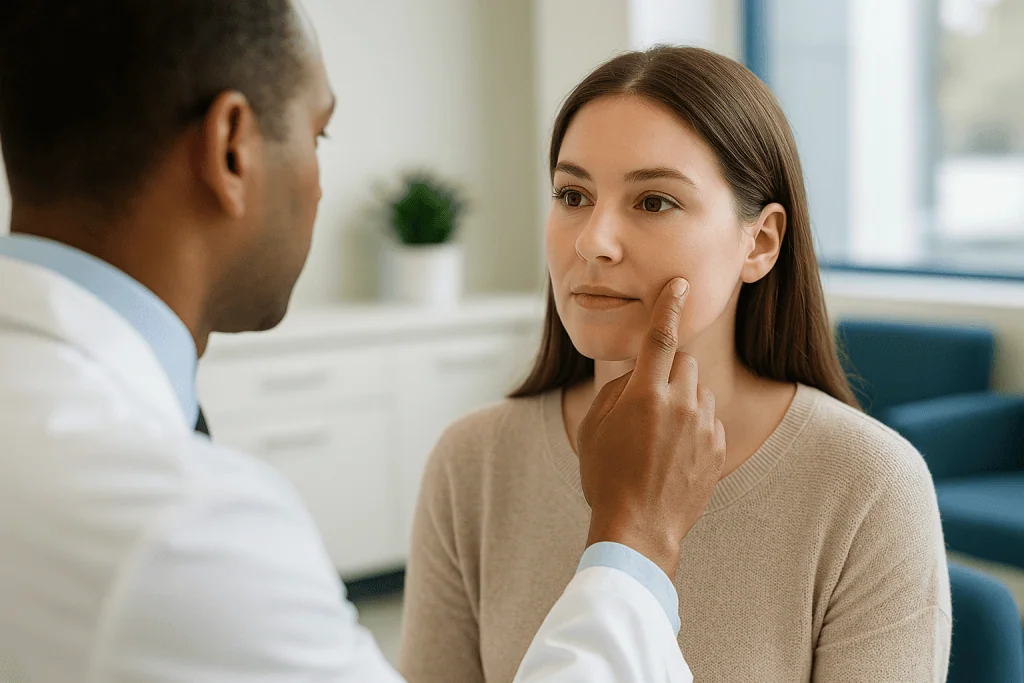
The location explains both the appeal of the surgery and its risks. Because the pad is deep, removing some of it changes the lower cheek’s volume without touching the skin. That is why the surgical scar is hidden inside the mouth. Two structures run close by, however. The parotid duct, which carries saliva from the large gland in front of the ear into the mouth, passes across the buccinator near the pad. The buccal branches of the facial nerve, the nerve that powers the muscles of expression, also travel through this neighborhood.
Where the pad sits also shapes how cheeks age. Harvard Health notes that facial fat is arranged in compartments, and as we age those compartments lose volume and shift downward. The buccal pad is deep, so it contributes to a plumpness that reads as youthful. When it is reduced, the lower cheek relies more on the superficial fat and the skin for softness, and those are the very layers that thin with time.
One practical point follows from anatomy. Fullness in the lower cheek is not always buccal fat. Overall body fat, prominent chewing muscles, fluid retention and even bone shape can all give a similar look from the outside, and a surgeon will usually examine the cheek with a gloved finger inside the mouth to judge how much is actually fat pad.
Is buccal fat removal permanent? What the word really means
Yes, in the sense that matters surgically. The lobe of fat that is removed does not regenerate. Cleveland Clinic states plainly that the results are permanent because the fat cells do not grow back. Fat cells elsewhere in the body can enlarge or shrink with weight change, and the remaining portions of the pad can do the same, but the piece that was excised is gone.
That is also the reason the operation deserves more hesitation than its short duration suggests. There is no natural recovery mechanism, no waiting it out. A reduction that feels slightly too strong on day one will, for the most part, still be too strong in twenty years, and may be amplified rather than softened by aging.
Permanent does not mean the face is now fixed. Three things keep changing around the surgical site. The remaining fat compartments of the cheek lose volume gradually. The bones of the midface, particularly the cheekbone and the area around the eye socket, lose a small amount of mass and change shape with age, which MedlinePlus lists among normal aging changes of the face. The skin loses collagen and elastin, becoming thinner and less able to spring back.
So the right mental model is a fixed subtraction from a moving total. If a person’s cheek volume is, say, a bucket slowly draining through adulthood, buccal fat removal takes a cup out at the start. The cup never returns, and the bucket keeps draining.
Weight gain later in life will not undo the surgery either. Weight tends to add fullness to the superficial fat and the jowl area rather than restoring the specific deep hollow created by the operation, which is why some people describe a face that looks both heavier and more sunken at once.
Can buccal fat be reversed if someone changes their mind?
Not in the literal sense. The removed fat cannot be put back, and the pad does not regrow. What exists instead is a set of ways to add volume to the area, each with limits worth understanding before the original operation rather than after.

The most common approach is injectable filler. Dermal fillers are gel-like substances, often made of hyaluronic acid, a sugar molecule the body already produces, injected under the skin to restore volume. Cleveland Clinic notes that filler results are temporary and that the duration depends on the product and the area treated. Fillers can soften a hollow in the lower cheek. They sit in a different plane from the deep pad, so the result is an approximation rather than a restoration, and the effect has to be repeated.
The second option is fat transfer, also called fat grafting. A small amount of the person’s own fat is removed from the abdomen or thigh by gentle liposuction, processed, and injected into the cheek in tiny threads. Fat that survives the first weeks develops its own blood supply and can last for years, but a portion is always reabsorbed in the months after injection, and the surviving amount is hard to predict. Repeat sessions are sometimes needed, and the grafted fat behaves like body fat afterward, changing with weight.
Neither method rebuilds the original anatomy. Both add surface or mid-depth volume over a deep deficit, which is why experienced injectors talk about camouflage rather than reversal. A person who already has thin skin and limited superficial fat has less to work with, and the correction may look less natural.
The practical conclusion is uncomfortable but important: the reversibility of this surgery is low, and the decision deserves the same weight as any other irreversible one.
How cheeks age after the fat pad is reduced: bone, fat and skin
Every face ages in three layers at once, and buccal fat removal changes the starting point of one of them. Understanding the other two makes it easier to predict what a reduced cheek will look like later.
Bone comes first because it is the scaffold. MedlinePlus describes loss of bone mass and changes in bone shape as part of normal aging of the face. In the midface, the cheekbone and the rim of the eye socket recede slightly, which reduces the support beneath the cheek fat. Picture a tent whose poles have been shortened by an inch; the fabric sags not because there is more fabric, but because there is less holding it up.
Fat is the second layer. Harvard Health explains that facial fat is held in distinct compartments that lose volume and slide downward with time. The deep compartments, including what remains of the buccal pad, tend to deflate. The superficial fat drifts toward the jawline, contributing to jowls. A person who had a cup removed from the deep cheek now has a smaller cushion over a receding frame.
Skin is the third. It thins, produces less collagen, and loses elasticity, so it drapes rather than clings. Mayo Clinic lists sun exposure and smoking as major accelerators of these changes.
Put together, this is why the same operation can look different on two people of the same age. Someone with strong cheekbones, thicker skin and a full superficial fat layer may look defined for decades. Someone with a slender bone structure, fine skin and little surface fat can move from defined to gaunt faster, because the layers that would have compensated for the deep loss are the ones aging removes first.
Is buccal fat removal permanent years later? What long-term evidence shows
Here honesty requires admitting a gap. Buccal fat removal has been performed for decades, but the long-term evidence is thin. Most published series are small, follow patients for months rather than decades, and rely on surgeon assessment or patient questionnaires rather than standardized measurement. Cleveland Clinic notes that the final result takes several months to appear as swelling resolves, and that is as far as many reports go.
What can be said with reasonable confidence is limited to a few points. The removed fat does not return; that is an anatomical fact rather than a study finding. The narrowing effect persists. Complication rates in the hands of surgeons who do the operation regularly appear low in the available series, though the absence of large registries means rare harms may be undercounted.
What cannot be said is how often people are happy with the result at 10 or 20 years, or how many go on to seek volume replacement. Searches for buccal fat removal years later are common precisely because that evidence is missing, and most of what fills the gap is anecdote: individual accounts of faces that looked striking at 30 and drawn at 45, alongside others who report no regret at all. Neither kind of story is data.
A sensible reading of this uncertainty is conservative. If the only reliable fact is that the subtraction is permanent, and the only reliable prediction is that the surrounding tissue will thin, then the appropriate response is to remove less rather than more, and to be skeptical of before-and-after images taken when swelling has just settled and the face is at its fullest adult volume.
Patients can reasonably ask a surgeon what their own long-term follow-up looks like, and whether they have seen their patients a decade on. A candid answer to that question is worth more than any photograph.
Who buccal fat removal is usually for, and who is usually asked to wait
Surgeons tend to describe a narrow group of people for whom this operation makes sense. Cleveland Clinic lists adults in good general health, at a stable weight close to a healthy range for their height, who have persistent fullness in the lower cheeks that does not change with diet or exercise. The fullness should be traceable to the fat pad itself on examination, not to overall body fat, muscle bulk or bone shape. Some people seeking facial feminization also consider it as part of a broader plan.
Equally important is the list of people who are often advised to wait or to reconsider. Those whose faces are already slender or whose cheeks are naturally hollow are generally discouraged, because removing deep fat from a thin face tends to exaggerate rather than refine. Older adults who have already begun to lose midface volume fall into the same category; Cleveland Clinic specifically notes the risk of an aged or gaunt appearance in people with narrow faces.
Young adults deserve particular caution. Facial fat often reduces naturally through the twenties as the childhood roundness of the cheeks settles, and a face that looks full at 21 may look quite different at 28 without any intervention. Surgeons frequently suggest waiting for facial maturity before committing to an irreversible change.
People with uncontrolled medical conditions, those who smoke, and those taking medicines that affect bleeding are usually asked to address those factors first, in discussion with the prescribing clinician, since both healing and bleeding risk are affected. A history of body dysmorphic disorder, a condition in which a person is preoccupied with perceived flaws others do not see, is a reason for a careful psychological conversation before any cosmetic surgery, as the NHS advises.
None of these are rules a patient applies to themselves. They are the questions a treating team works through, and the decision rests there.
What the following days and weeks usually look like
The first evening is mostly about swelling and a strange sense that the cheeks have grown rather than shrunk. That is expected. The tissue has been disturbed and fluid collects quickly, so the lower face often looks fuller than before surgery for the first several days. Cold compresses, keeping the head elevated when resting, and a soft diet are the standard advice; a surgeon will give specific instructions on mouth care, because the incision sits in an environment that is never sterile.
Pain is usually described as moderate and manageable with whatever the surgeon prescribes or recommends. Stiffness when opening the mouth is common in the first week, since the chewing muscles are adjacent to the surgical site. Dissolvable stitches typically disappear on their own.
Cleveland Clinic describes recovery as taking around three weeks for most people to feel back to normal, with most returning to desk work within a few days and to exercise once cleared by the surgeon. Bruising inside the mouth and on the outer cheek fades across the first two weeks.
The slower timeline is the one patients find hardest. Residual swelling in the deep cheek can take several months to resolve fully, according to Cleveland Clinic, and the contour that emerges at three weeks is not the final one. People who judge the result early sometimes conclude too little was removed, and some then seek a second operation. Surgeons generally advise waiting until swelling has fully settled before forming any opinion, and certainly before considering further surgery, since the direction of error is one-way.
A sensible plan for those weeks includes gentle mouth rinses as directed, avoiding hard or sharp foods that could disturb the incision, no smoking, and a follow-up appointment so the team can check healing and address any asymmetry early.
Buccal fat removal versus the alternatives: a side-by-side summary
People asking whether the surgery is permanent are often really asking whether it is the right tool. The table below sets the operation beside the approaches most commonly discussed in the same consultation. It is a summary of general clinical knowledge, not a ranking; which option suits a given face is a judgment for the treating team.
| Approach | What it changes | Reversible? | Typical duration of effect | Main caution |
|---|---|---|---|---|
| Buccal fat removal | Removes part of the deep cheek fat pad | No | Permanent; removed fat does not regrow (Cleveland Clinic) | Hollowing may become more visible as the face ages |
| Waiting for facial maturity | Natural reduction of childhood cheek fullness through the twenties | Not applicable | Ongoing | Requires patience; change is gradual and not guaranteed |
| Weight change | Shrinks superficial fat across the face and body | Yes | Lasts as long as weight is maintained | Does not target the deep pad specifically |
| Cheekbone filler | Adds volume over the cheekbone, creating a shadow beneath by contrast | Yes, largely | Temporary; depends on product (Cleveland Clinic) | Repeat treatments; result is an illusion of narrowing, not actual reduction |
| Fat transfer to the face | Adds the person’s own fat to hollow areas | Partly | Surviving fat can last years; some is reabsorbed early | Unpredictable take; may need repeating |
| Masseter-directed treatment | Reduces bulk of the chewing muscle when muscle, not fat, causes width | Yes | Temporary | Only useful if muscle is the cause, as judged on examination |
Two observations follow. Every option other than the surgery is adjustable, which is a quality that matters more when the long-term evidence is sparse. And several of them, particularly waiting and weight stability, cost nothing in terms of risk, which is why many surgeons raise them first even with a patient who arrived wanting the operation.
What are the risks of buccal fat removal, in neutral clinical terms?
Every operation carries risk, and the ones specific to this procedure follow directly from the anatomy described earlier. Cleveland Clinic lists the main concerns, and they fall into three groups.
The first group concerns the structures next to the pad. The parotid duct can be injured during removal, which can cause saliva to leak into the tissue and produce swelling or a persistent collection; this usually needs assessment and sometimes a further procedure. Branches of the facial nerve can be bruised or, rarely, cut, leading to weakness of the muscles around the mouth. Most nerve bruising recovers over weeks to months; a divided nerve branch may not. Numbness of the cheek or lip from irritation of sensory nerves is also reported and is usually temporary.
The second group is common to most surgery. Bleeding into the cheek can form a hematoma, a collection of clotted blood that may need draining. Infection is possible, and the mouth is a bacteria-rich environment; signs include increasing pain, fever, foul taste and spreading redness. Trismus, a limited ability to open the mouth, can occur from muscle spasm or scarring and usually eases with gentle stretching as healing progresses, though persistent cases exist.
The third group is aesthetic. Asymmetry between the two cheeks is the most frequently discussed, since the two pads are rarely identical and swelling resolves unevenly. Over-removal leading to a sunken appearance is the risk patients fear most and the one that is least correctable. Under-removal is more easily addressed but means a second operation.
Anesthesia carries its own small risks, which an anesthesia clinician will discuss. The NHS advises that anyone considering cosmetic surgery should have a clear, written explanation of the possible complications and what would be done if they occurred, before consenting.
What people often get wrong about buccal fat removal
Several beliefs circulate so widely that they are worth correcting one at a time.
The first myth is that the fat grows back. It does not. The remaining portion of the pad can enlarge modestly with weight gain, which is sometimes mistaken for regrowth, but the excised lobe is gone, as Cleveland Clinic confirms.
The second myth is the mirror image of the first: that because the result is permanent, it is also stable. A permanent subtraction from a face that keeps losing volume is not stable at all. It is a head start on hollowing, and whether that head start looks good at 60 depends on bone, skin and the rest of the fat, none of which the surgery controls.
Third, many assume the operation slims the whole face. It does not touch the jowls, the jawline, the area under the chin, or the fullness over the cheekbone. It affects a specific zone of the lower cheek. People hoping for a smaller face overall are often better served by discussing weight, muscle bulk, or simply time.
Fourth, there is a belief that more removal means better definition. Surgeons who perform the procedure regularly tend to argue the opposite, removing a conservative portion and accepting a subtler result, because the error is only correctable in one direction.
Fifth, a common assumption is that the visible result at three weeks is final. Cleveland Clinic notes that full results can take several months to appear as deep swelling resolves, and judging early is a known route to regret.
Finally, some people believe the surgery is a fix for cheeks that look full in photographs taken with a wide lens from close range. Phone cameras exaggerate the center of the face. An examination in person, including palpation from inside the mouth, is the only reliable way to know whether the fat pad is actually the cause.
Buccal fat removal regret: what drives it and how to think ahead
Regret after cosmetic surgery is rarely about a single bad outcome. It tends to arise when expectations, timing and anatomy do not line up, and this operation has features that make each of those easy to misjudge.
Expectations go wrong when the imagined result is drawn from faces with different bone structure. A sculpted hollow beneath a prominent cheekbone is as much about the bone above it as the fat below. Removing fat from a face with a flat midface produces a different shape, and photographs of other people cannot show what the operation will do to one’s own.
Timing goes wrong in two ways. Operating young, before facial fat has settled naturally, risks removing volume the face was about to lose anyway. Judging the outcome early, before swelling has resolved, risks a second procedure that overshoots. Both errors push in the same direction.
Anatomy goes wrong when the face has less compensating tissue than expected. People with thin skin and little superficial fat have the least margin, and the aging changes described by Harvard Health and MedlinePlus reduce that margin further.
Thinking ahead means asking three concrete questions. What will the oldest relative who shares my bone structure look like, and would a slightly hollower version of that face be welcome? If I disliked the result, would I accept repeated filler as a long-term maintenance plan? Is the fullness I dislike genuinely the deep pad, or could it be something adjustable?
The NHS encourages anyone considering a cosmetic procedure to take time, seek a second opinion, and avoid deciding during a period of emotional stress. That advice applies with unusual force to an operation whose main downside is irreversibility and whose long-term evidence base remains thin.
Questions to ask your care team before buccal fat removal
A good consultation leaves a person knowing not only what the surgeon plans to do but why that plan fits their face. These questions tend to produce the most useful answers.
- On examination, how much of the fullness I dislike is actually buccal fat, and how much is superficial fat, muscle or bone?
- Given my age, skin thickness and bone structure, how do you expect this cheek to look in ten and twenty years?
- How much of the pad do you intend to remove, and why that amount rather than less?
- What proportion of your patients have you seen several years after surgery, and what have you observed?
- What would you do if one side healed differently from the other?
- How would you manage injury to the salivary duct or a facial nerve branch if it occurred?
- What type of anesthesia do you recommend for me, and who will be responsible for it?
- Which of my medicines, supplements or habits should I discuss with my prescribing clinician before surgery?
- What does your follow-up schedule look like, and how long should I wait before judging the result?
- If I decide against surgery, what adjustable alternatives would you consider for my face?
Two additional questions concern the surgeon rather than the operation. The NHS advises checking that any surgeon performing a cosmetic procedure is appropriately qualified and registered, and that the facility is licensed for the type of anesthesia used. Asking directly about training in facial surgery and about where and how the procedure will be done is reasonable, and a confident team will answer without hesitation.
The purpose of the list is not to interrogate anyone. It is to make sure the conversation covers the long-term questions the operation raises, rather than stopping at the short recovery it offers.
When to call your doctor after buccal fat removal
Most recoveries are uneventful, and some swelling, bruising, mild stiffness and discomfort are expected in the first weeks. Certain signs are not expected, and they warrant a prompt call to the surgical team, or emergency care if the team cannot be reached.
Seek urgent help for any difficulty breathing or swallowing, rapidly enlarging swelling on one side of the face, or bleeding from the mouth that does not stop with gentle pressure. These can indicate a hematoma or airway compromise and need immediate assessment.
Contact the team the same day for signs of infection: fever, chills, increasing rather than decreasing pain after the first few days, spreading redness or warmth of the cheek, a foul taste or discharge from the incision, or the incision opening. The mouth is never sterile, and infection in this space can progress.
Also call promptly for new weakness of the mouth or lip, such as an uneven smile or difficulty puckering, which may suggest facial nerve irritation, and for persistent or worsening numbness beyond what the team described. A sudden soft swelling that enlarges when eating can indicate saliva collecting from a duct injury.
Inability to open the mouth that worsens rather than eases, or that persists beyond the timeframe the team gave, should be reviewed. So should marked asymmetry that increases after the first week, since early assessment offers more options than late.
In the longer term, anyone who becomes distressed about the shape of their face, or who finds themselves considering further surgery to correct a result that others cannot see, should raise this with their doctor. Body image concerns deserve the same care as any physical complication.
Every one of these situations is a judgment for the treating team. Describing symptoms early, in plain terms, gives them the best chance to help.
Frequently asked questions
Is buccal fat removal permanent?
Yes. The fat that is removed from the buccal pad does not regrow, so the reduction in deep cheek volume is lasting, as Cleveland Clinic notes. What continues to change is everything around it: remaining fat, bone support and skin all lose volume and elasticity with age. The surgical change is permanent, but the appearance of the cheek will keep evolving throughout life.
Can buccal fat be reversed?
Not literally. The removed fat cannot be returned and the pad does not regenerate. Volume can be added over the area with injectable filler, which is temporary, or with fat transfer, which uses the person’s own fat and partly survives long term. Both approaches approximate the lost fullness rather than restore it, and results are less predictable in people with thin skin and little surface fat.
Where is buccal fat located on the face?
The buccal fat pad sits deep in the lower cheek, between the buccinator muscle that forms the cheek wall and the masseter muscle used for chewing, roughly level with the corner of the mouth and slightly toward the ear. It lies beneath the fat you can pinch, close to the parotid duct and branches of the facial nerve, which is why surgical care in this area matters.
What does buccal fat removal look like years later?
The honest answer is that long-term evidence is limited, with most published follow-up lasting months rather than decades. Anatomically, the reduction persists while surrounding fat, bone and skin decline with age, so the hollow tends to deepen over time. How noticeable that becomes depends on bone structure, skin thickness and the amount removed, which is why surgeons generally favor conservative removal.
How much does buccal cheek fat removal cost?
This magazine does not publish prices or quotes for any procedure, and costs vary widely by setting, anesthesia and surgeon. Cosmetic procedures of this kind are generally not covered by health insurance or public health systems, as the NHS notes for cosmetic surgery in general. A written, itemized explanation of what is included should be part of any consultation before consent.
How long does fat transfer to your face last?
Fat that survives the first weeks after transfer gains its own blood supply and can last for years, behaving like ordinary body fat and changing with weight. A portion of the injected fat is always reabsorbed in the early months, and the surviving amount is difficult to predict, so repeat sessions are sometimes planned. Longevity depends on technique, the recipient site and individual healing.
Does buccal fat grow back if you gain weight?
No. The excised portion is gone and does not regenerate. Weight gain can enlarge the remaining parts of the pad and the superficial fat of the cheek and jowl, which may partly mask the hollow, but it does not restore the specific deep volume that was removed. Some people describe a face that looks heavier at the jaw yet still sunken beneath the cheekbone.
Is buccal fat removal regret common?
There are no reliable figures, because long-term satisfaction has not been measured in large studies. Regret described in individual accounts usually involves one of three issues: surgery at a young age before facial fat settled naturally, judging the result before swelling resolved, or removal on a face with little compensating tissue. Each is a reason for careful selection and conservative surgery rather than a prediction for any individual.
How long does the swelling last after buccal fat removal?
Cleveland Clinic describes most people feeling recovered within around three weeks, with bruising and visible swelling fading over the first couple of weeks. Deep swelling in the cheek can take several months to resolve fully, and the final contour only becomes clear once it has. Surgeons generally advise against forming an opinion, or considering further surgery, before that point.
Who should not have buccal fat removal?
People with naturally slender faces or hollow cheeks, those who have already begun losing midface volume with age, and young adults whose facial fat is still settling are generally advised to wait or reconsider, because removal can produce a gaunt look. Uncontrolled medical conditions, smoking, medicines that affect bleeding and body image disorders are also reasons for further discussion. The treating team makes the final judgment.
References
This article is for general information only and is not a substitute for professional medical advice. Please consult a qualified doctor about your individual situation.

More from the Blog
Who Is a Candidate for Cheek Augmentation? Flat Midface, Volume Loss and Skin Thickness
A typical cheek augmentation candidate is a healthy nonsmoking adult whose facial growth is complete and who has a flat or under-projected midface, age-related…
Which Facial Rejuvenation Treatment Fits Which Concern? Lines, Volume Loss and Skin Texture
Facial rejuvenation treatment options are usually matched to the underlying change rather than to age. Lines caused by muscle movement are commonly treated with…

What to Disclose Before a Liquid Facelift: Blood Thinners, Supplements and Cold Sore History
Before a liquid facelift, tell the injector about every blood-thinning medicine (anticoagulants and antiplatelets, including low-dose aspirin), all supplements and herbal products, any history…

How Nasal Reconstruction Rebuilds the Nose in Stages: Forehead Flaps and Cartilage Grafts
Forehead flap nasal reconstruction rebuilds a missing part of the nose using a strip of forehead skin that stays attached to its own blood…

When Is It Safe to Fly Home After Facial Aesthetic Surgery? Stay Length and Follow-Up Abroad
Most people are asked to wait at least a week before flying home after facial aesthetic surgery, and often longer for a facelift or…

Does Revision Rhinoplasty Take Longer to Heal? Swelling, Splints and a Realistic Timeline
Yes, revision rhinoplasty usually heals more slowly than a first nose operation. The early steps look similar: the external splint typically comes off after…