

Dimple Creation Surgery Recovery: Swelling, Mouthwash Routine and When the Dimple Softens

Key Takeaways
- Dimpleplasty is done through a small incision inside the cheek, so there is no external scar, but the wound sits in a bacteria-rich environment that makes rinsing the central recovery task.
- The early dimple is meant to be static and visible at rest; it softens into a smile-only dimple as the suture loses tension and internal scar tissue matures over weeks to months.
- Swelling normally peaks in the first days and then improves steadily; swelling that is tense, rapidly growing, or that worsens again after several days needs prompt review.
- Recognized downsides include asymmetry, fading of the dimple, a persistent dent at rest, infection, hematoma, and uncommon injury to facial nerve branches or the parotid duct.
- No guideline or systematic review provides reliable success percentages for dimpleplasty; the evidence is small surgeon case series, so quoted rates reflect individual experience.
- Research on cosmetic surgery suggests satisfaction with a specific treated feature is common, while broad gains in happiness are not well supported, so realistic, feature-specific goals matter.
Dimpleplasty recovery is usually short and mostly about the inside of the cheek: mild swelling and soreness for the first several days, a saltwater or antiseptic mouth rinse after meals while the small incision heals, soft foods at first, and a dimple that looks pinned or too deep early on, then softens over weeks to months as internal scar tissue matures. Your surgeon sets the exact timeline.
The first look in the mirror is rarely the one people expect. The cheek is puffy, the new dent sits there even with a completely straight face, and the inside of the mouth feels like the aftermath of an accidental bite. Most people who have just had dimple creation surgery ask the same quiet question that evening: is this how it is supposed to look?
Usually, yes. Dimpleplasty recovery is less about pain than about patience, and about a wound you cannot see, because the incision sits on the inside of the cheek rather than on the skin. That single fact shapes almost everything: why rinsing matters more than bandages, why soup replaces sandwiches for a few days, and why the dimple that looks carved at first gradually learns to appear only when you smile.
This explainer walks through what the procedure does under the skin, what the following days and weeks typically look like, what the evidence can and cannot tell you, and the handful of signs that mean you should stop reading and call your surgeon.
What actually happens during dimple creation surgery
A natural dimple is a small anatomical quirk: a gap or split in the buccinator, the flat cheek muscle you use to whistle and chew, lets the skin get pulled inward when you smile. Dimpleplasty imitates that quirk on purpose.
The procedure is almost always done under local anesthetic, meaning the cheek is numbed while you stay awake. The surgeon marks the spot from the outside, then works from inside the mouth. A small incision is made in the buccal mucosa, the moist lining of the inner cheek, and a tiny core of muscle and fat is removed or loosened. A suture, the surgical thread used to hold tissue together, is then passed between the underside of the skin and the muscle and tied so the two layers are tethered.
That tether is the whole idea. In the first weeks it holds the skin down all the time, which is why an early dimple is visible even at rest. As the body lays down scar tissue between skin and muscle and the suture weakens or dissolves, the permanent attachment is meant to be the scar itself, which pulls only when the muscle contracts. There is no skin incision, so there is no external scar to manage.
Published descriptions of the technique come mainly from surgeon case series indexed in PubMed rather than from randomized trials, so the details vary between operators: some remove a plug of tissue, some only place a suture, and some use slightly different knot placements. When you read about “the” technique online, remember that it is one surgeon’s version, and your own surgeon’s method is the one that determines your instructions.
Who dimpleplasty is usually for, and who is usually asked to wait
Dimpleplasty is a purely elective cosmetic procedure. Nobody needs it medically, which is exactly why the screening conversation tends to focus on expectations and timing rather than on illness.

People who tend to be considered reasonable candidates are adults in good general health, with stable weight, realistic goals about a subtle change, and enough time to let a slow-maturing result settle without pressure. Many surgeons also want to see that the wish for the change is your own and has been stable for a while, a point the NHS makes in its general guidance on cosmetic surgery, which recommends taking time, asking questions and avoiding decisions made under stress or pressure.
Common reasons to be asked to wait or to reconsider include:
- An active mouth infection, dental abscess, cold sore outbreak or untreated gum disease, because the incision sits in the same environment.
- Smoking or vaping, which slows mucosal healing and raises infection risk; many surgeons ask for a smoke-free window before and after.
- A tendency toward thick or raised scarring, since the result relies on controlled internal scar formation.
- Any condition or medicine that impairs clotting, healing or immune function; these are discussed individually with the prescribing clinician, never adjusted on your own.
- Planned major dental work, orthodontic changes or significant weight change, all of which can alter how the cheek drapes.
- Being under the age at which the face has finished changing, or seeking the procedure primarily to please someone else.
None of these is an automatic no. They are prompts for a longer conversation, and the decision about whether and when to proceed sits with the treating team, ideally after a consultation that ends without a booking.
Dimpleplasty recovery timeline: what the first days and weeks usually look like
Because the wound is inside the mouth and there is no skin cut, the visible part of dimpleplasty recovery is short. The invisible part, the scar maturing between skin and muscle, takes considerably longer. The stages below describe what surgeon case series and general wound-healing guidance commonly report; your own surgeon’s timeline overrides all of it.
| Stage | What people commonly notice | What usually helps |
|---|---|---|
| Day of surgery | Numb cheek, mild bleeding inside the mouth, dimple visible at rest | Rest, cool compress outside the cheek, soft or liquid food |
| First few days | Swelling and tenderness peak, slight bruising possible, dimple looks deep | Rinsing after meals, sleeping propped up, avoiding hot or spicy food |
| First two weeks | Swelling settles, incision closes, dissolvable stitches loosen | Gentle brushing, continued rinses, no smoking |
| Weeks to a few months | Static dimple gradually fades at rest and appears more with smiling | Patience, keeping follow-up appointments |
General guidance on surgical wounds from MedlinePlus describes the same broad arc for any incision: early swelling and discomfort, closure over the first two weeks, then a much longer remodeling phase in which the tissue keeps changing. Mucosa, the lining of the mouth, tends to close faster than skin, which is why the sore-mouth phase is brief.
What the table cannot tell you is your own speed. Age, smoking status, how much tissue was removed and how deep the suture was set all shift the timeline. Treat the ranges as a map, not a schedule.
How long does dimpleplasty swelling last, and how much is normal?
Swelling is the body’s first response to any cut: blood vessels near the wound widen and leak fluid so that clotting factors and immune cells can reach the area. In the cheek, which has loose tissue and a rich blood supply, that fluid has plenty of room to gather, so even a small incision can produce a noticeably rounder face for a few days.
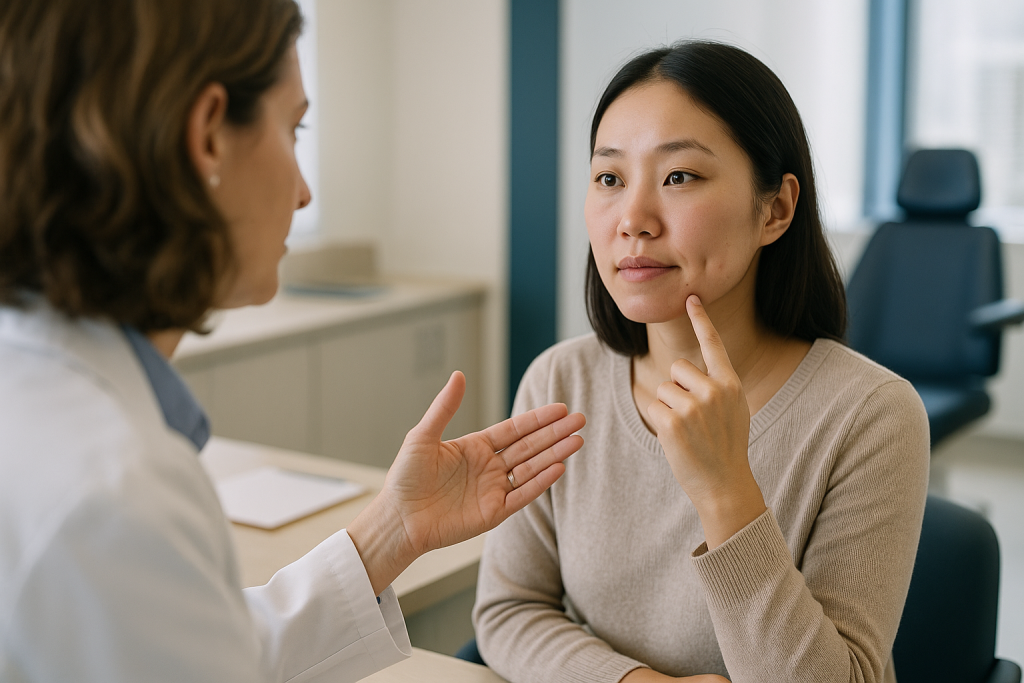
Surgeons who publish on the procedure and general surgical wound guidance describe the same pattern: swelling builds over the first couple of days, plateaus, then drains away over the following one to two weeks. The dimple often looks dramatically deep during this phase, partly because the surrounding cheek is puffed up around it. As the puffiness leaves, the dent looks shallower, which alarms some people who assume the result is “disappearing.” It usually is not; the frame around it is simply shrinking back.
A few features distinguish ordinary swelling from something that needs attention:
- Ordinary swelling is soft, roughly symmetric to how the procedure was done, and improves a little each day after the early peak.
- Swelling that is tense, rapidly enlarging, purple and hard suggests a hematoma, a pocket of blood collecting under the tissue, which needs prompt review.
- Swelling that improves and then worsens again after several days, especially with heat, throbbing or a bad taste, can signal infection.
Cool compresses applied to the outside of the cheek in the first day or two, sleeping with the head slightly raised, and avoiding very hot food are the usual low-tech measures. Anti-inflammatory or pain-relieving medicines are sometimes discussed; how and whether to use them, and what is compatible with your other prescriptions, is a decision for the surgeon who knows your history.
Is dimple surgery painful? What people usually describe
“How painful is dimpleplasty?” is one of the most searched questions about the procedure, and the honest answer is that it sits at the milder end of surgical discomfort, with an important caveat about where the discomfort lives.
During the operation itself, local anesthetic numbs the cheek, so most people describe pressure and tugging rather than pain. Once the anesthetic wears off, over the following hours, the sensation people most often compare it to is having bitten the inside of the cheek hard, combined with the ache of a bruise. Chewing, wide yawning and big smiles pull on the incision and the tethered tissue, which is why those movements are the ones that sting in the first week.
Pain scores published in surgeon case series are generally low, but these are small, unblinded reports without control groups, so they cannot promise your experience. What they do show consistently is that discomfort is expected to fall day by day rather than build. Pain that climbs after day two or three is a signal to call, not to wait.
Numbness deserves a mention because it surprises people. The cheek may feel oddly wooden or tingly for a while after surgery. Local anesthetic explains the first hours; after that, minor stretching of small sensory nerve branches during the procedure is the usual cause, and it typically settles as swelling resolves. Persistent weakness of the cheek when you try to smile or puff your cheeks is different, and is discussed in the risks section below.
Managing pain is a conversation with your surgeon. Some medicines that ease pain also affect bleeding, and the right choice depends on your health and other prescriptions, so nothing here should be read as a recommendation to take or skip anything.
The mouthwash routine: why rinsing matters when the wound is inside your cheek
If dimpleplasty had a single recovery ritual, it would be the rinse. The reason is simple: the mouth is one of the most bacteria-rich environments in the body, and the incision sits directly in it. Every meal deposits food particles against a fresh wound, and unlike a skin wound, you cannot cover it with a dressing.
The CDC’s guidance on surgical site infections stresses keeping a wound clean and following the surgeon’s specific care instructions rather than improvising. For an intraoral wound, that translates into a routine that surgeons commonly describe along these lines:
- Rinsing gently after each meal and before bed with the solution your surgeon has specified. A warm saltwater rinse is often suggested for its mild cleansing effect; some surgeons prefer an antiseptic mouthwash for a defined period instead of or as well as salt water.
- Letting the liquid wash over the cheek rather than swishing forcefully or spitting hard, both of which can disturb the stitches or the clot in the first days.
- Avoiding alcohol-containing mouthwashes if your surgeon advises against them, because alcohol can sting and dry the healing lining.
- Not rinsing at all for the first few hours if your surgeon asks you to wait, so the initial clot can form.
The routine matters because infection is the complication most within your control. A mouth kept clean and free of trapped food gives the mucosa what it needs to seal within days. Rinsing does not speed up the deeper process of the dimple maturing, and doing it more often or more vigorously than instructed does not help; it can loosen a suture that is meant to hold the tether while scar forms.
If a prescribed antiseptic rinse is part of your plan, the length of time to use it, and what to do if it causes staining or taste changes, are questions for the prescribing clinician.
Eating, brushing, talking and smiling in the first two weeks
The practical questions arrive at the first mealtime. Most surgeons suggest soft, cool or lukewarm foods for the first several days: yogurt, soup that has cooled, mashed vegetables, eggs, smoothies sipped rather than sucked through a straw. Crunchy, crusty, very spicy or very hot foods are typically held back because they can scrape or irritate the incision or provoke bleeding. Chewing on the opposite side, if only one cheek was treated, keeps pressure off the wound.
Straws are often discouraged in the earliest days for the same reason they are after tooth extraction: the suction creates pressure changes in the mouth that can disturb a clot or fresh stitches.
Tooth brushing continues, because a clean mouth is protective. The usual advice is a soft-bristled brush, care around the incision, and a gentle rinse afterward. Skipping brushing to “protect” the wound tends to backfire by increasing bacterial load.
Talking is fine. Wide, exaggerated smiling, laughing hard and yawning stretch the tethered skin and can be uncomfortable, and some surgeons ask people to avoid deliberately exercising the dimple in the first days. Later, they may encourage normal expression so that the scar forms in a way that suits movement. This varies, so follow your own instructions rather than a forum.
Two habits deserve blunt language. Smoking, vaping and chewing tobacco reduce blood flow to the healing mucosa and are consistently associated with slower wound healing and higher infection risk across surgical guidance, including the NHS’s general advice on cosmetic surgery. Alcohol in the first days can increase bleeding and interacts with some medicines. Neither is compatible with the short, clean recovery this procedure is designed to have.
Makeup on the skin over the dimple is usually allowed once any bruising has settled, since the skin itself was not cut. Ask before applying anything if the outside of the cheek is tender.
When does the dimple soften? Why it looks pinned at first
This is the question behind most anxious messages to surgeons in the first month. The early dimple is static: it is there whether you smile or not, sometimes with a faintly puckered look, and it can seem deeper than anyone asked for. That appearance is not a mistake. It is the suture doing its temporary job of holding skin to muscle while the body builds a more natural attachment.
Softening happens in stages. As swelling drains over the first two weeks, the surrounding cheek flattens and the dent looks less severe. Then, as the suture dissolves or loses tension and the internal scar matures, the skin stops being held down at rest and is pulled in only when the buccinator contracts, which is what a natural dimple does. Surgeon case series generally describe this shift from static to dynamic over a period of weeks to a few months, with individual variation that depends on technique, tissue thickness and how the person heals.
General wound guidance from MedlinePlus and Mayo Clinic explains why this takes so long: scar tissue remodels over many months, softening and becoming more flexible long after a wound looks closed. A dimple is, in effect, a deliberately created internal scar, and it follows the same slow calendar.
Two outcomes at the extremes are worth knowing about. In some people, the tether weakens too much and the dimple fades or vanishes, which is one of the recognized downsides of the procedure. In others, the static phase lasts longer than expected or never fully resolves, leaving a dent at rest. Neither can be predicted precisely beforehand, and neither should be judged in the first weeks. Your surgeon will usually want to see the cheek at intervals before any conversation about adjustment or revision.
Dimple surgery risks and downsides worth knowing before you start
Dimple surgery risks are usually described as low, and the procedure is small. Small is not the same as risk-free, and the downsides include a few that are specific to this operation and rarely appear in promotional descriptions.
- Infection. The incision sits in the mouth, so contamination is constant. Signs include worsening pain, heat, pus, a bad taste or fever. The CDC notes that most surgical site infections show up within the first weeks after a procedure.
- Bleeding and hematoma. The cheek bleeds readily; a firm, enlarging, discolored swelling needs review.
- Asymmetry. Two dimples rarely heal identically. Natural dimples are often asymmetric too, but a mismatch you did not ask for can be disappointing.
- Loss of the dimple. If the internal tether does not hold, the dimple fades. Revision is possible but is another procedure with the same risks.
- Persistent static dimple or dent. The opposite problem: a dimple that stays visible at rest, or looks like a scar or tethered pit rather than a smile line.
- Injury to nearby structures. The buccal branches of the facial nerve, which move the cheek and lip, and the parotid duct, which carries saliva from the cheek gland into the mouth, run through this region. Injury is uncommon but can cause weakness of expression or saliva pooling.
- Scarring inside the mouth. Usually unnoticeable, occasionally a firm lump you can feel with your tongue.
- Numbness or altered sensation of the cheek, typically temporary.
- Regret. Faces change with age and weight, and a dimple created in one decade may sit differently in the next.
Alternatives are limited and equally unproven: makeup contouring is temporary and harmless; there is no evidence that suction devices or “dimple trainers” marketed online create lasting dimples. Doing nothing is always an option. A neutral risk discussion, in your surgeon’s own words and specific to their technique, is part of proper consent.
Why the dimple you see at week one is not the final result
People often judge cosmetic procedures by photographs taken soon after surgery, and dimpleplasty is uniquely unsuited to that habit. The week-one face is swollen, the dimple is at its most exaggerated, and the internal attachment has barely begun to form. Any judgment made then is a judgment about a construction site.
Three processes overlap in the months that follow, each on its own clock. Swelling resolves first, over days to a couple of weeks. The dissolvable suture loses tension next, over weeks, depending on the material used. Scar maturation is last and longest: the collagen laid down between skin and muscle is initially disorganized and stiff, then gradually realigns and softens over many months, the same remodeling that Mayo Clinic and MedlinePlus describe for any healing wound.
What this means in practice:
- A dimple that looks too deep early on will usually shallow out; a dimple that looks faint early on may still be present with smiling once swelling leaves.
- Comparing your cheek to someone else’s result online tells you little, because their photo may be at a different stage, in different lighting, or after revision.
- Surgeons commonly hold off on any decision about revision until the tissue has settled, because operating on immature scar is unpredictable.
No source in the medical literature offers reliable percentages for how many dimples hold, fade or stay static, because the evidence consists of small case series without long-term, independent follow-up. That is worth saying plainly: anyone quoting a success rate is quoting their own experience, not a guideline. The reasonable approach is to keep the follow-up schedule your surgeon sets, take your own photographs in consistent light if you want to track change, and reserve conclusions for the point your surgeon considers the tissue mature.
What people often get wrong about dimpleplasty recovery
Because the procedure is small and heavily discussed on social media, dimpleplasty recovery attracts a particular set of confident myths. Correcting them saves worry and, occasionally, a complication.
“The dimple is supposed to look natural immediately.” It is not. The early static phase is expected. Judging the result before the tether matures is like judging a haircut mid-cut.
“Swelling means something went wrong.” Swelling is the ordinary first stage of healing. The pattern matters more than the presence: gradual improvement after an early peak is normal; rapid, tense or late-worsening swelling is not.
“Rinsing more often heals it faster.” Rinsing keeps the wound clean; it does not accelerate scar formation. Over-rinsing or vigorous swishing can loosen stitches and disturb the clot.
“You can do this at home with a suction device.” There is no credible evidence that suction, piercings or pressing tools create lasting dimples, and piercing the cheek carries real risks of infection and duct injury. Surgical dimples work because tissue is tethered internally, which no external device replicates.
“Smoking a little is fine as long as I rinse.” Rinsing removes debris; it does not restore the blood flow that nicotine constricts. Guidance on cosmetic surgery from the NHS consistently flags smoking as a healing risk.
“Once it is done, it is permanent either way.” Dimples can fade if the tether fails, and they can change with weight gain, weight loss and aging of the cheek. Permanence is the goal, not a guarantee.
“If one side looks different, the surgeon made an error.” Swelling is rarely symmetric, and healing speeds differ between sides. Asymmetry is one recognized downside, but early asymmetry is usually not the final picture.
The thread connecting these misunderstandings is timing. Almost every myth comes from expecting the final result on a schedule the biology does not follow.
Is dimpleplasty the hardest cosmetic surgery to recover from?
Search engines are full of the question “what is the hardest cosmetic surgery to recover from?”, and dimpleplasty is nowhere near the top of that list. Understanding why helps set expectations for the dimple surgery healing time and puts the discomfort in proportion.
Recovery difficulty across cosmetic operations tends to track a few variables: whether general anesthesia is used, how much tissue is cut or moved, whether muscle or bone is involved, and how long normal activity is restricted. Mayo Clinic’s overview of cosmetic surgery notes that recovery varies widely by procedure and that larger operations can take weeks to months for a return to normal activity. Procedures involving abdominal muscle repair, body contouring after major weight loss, or bone reshaping of the face are generally described as among the more demanding recoveries because of pain, drains, limited mobility and long swelling.
Dimpleplasty sits at the other end: local anesthetic, a single small incision inside the mouth, no external wound, and most people back to desk work within a day or two by their surgeon’s account. The phase that requires effort is measured in days, not weeks.
That comparison has a caution built in. A quick physical recovery can encourage a casual decision, and the parts of dimpleplasty that go wrong are usually not about healing pain but about appearance: asymmetry, fading, a dent at rest, or simply not liking how a permanent change sits on a face that keeps aging. The NHS’s guidance on cosmetic procedures recommends the same deliberate process for small procedures as for large ones: a proper consultation, a cooling-off period, and clarity about who will look after you if something goes wrong. Easy to recover from is not the same as easy to undo.
Are people happier after plastic surgery? What the evidence actually shows
It is a fair question to ask before any elective change to your face, and the honest answer is more textured than either the enthusiasts or the skeptics suggest.
Research on psychological outcomes after cosmetic surgery, summarized in reviews indexed in PubMed, generally finds that many people report improved satisfaction with the specific feature that was treated, and some report modest improvements in body image and confidence. The same body of research is much less convincing that cosmetic surgery changes overall life satisfaction, mood, relationships or self-esteem in a broad sense. Studies are mostly observational, rely on self-report, and follow people for limited periods, so the findings are best described as suggestive rather than settled.
Two consistent signals matter for anyone considering dimpleplasty:
- Expectations predict outcomes. People who want a specific, modest change to one feature tend to report higher satisfaction than people who hope a procedure will fix how they feel about themselves, their relationships or their life.
- Body dysmorphic disorder, a condition in which a person is intensely preoccupied with a perceived flaw that others barely notice, is associated with poor satisfaction after cosmetic procedures and with requests for repeated surgery. Guidance from the NHS on cosmetic surgery advises clinicians to screen for it and advises patients to reflect carefully on their motivations.
None of this argues for or against having a dimple created. It argues for the right framing. A dimple is a small, visible detail that some people simply like on their own face; wanting one is not evidence of a problem. Expecting it to make you happier as a person is asking a suture to carry a load it was never designed for. If the desire feels urgent, tied to a recent loss or criticism, or part of a pattern of seeking procedures, a frank conversation with your primary care clinician before a surgical consultation is a reasonable step.
Questions to ask your care team
A good consultation should leave you with fewer questions than you arrived with, and no pressure to book on the spot. These prompts are drawn from what people most often wish they had asked.
- Which technique do you use, and do you remove tissue or rely on the suture alone? How does that affect how long the dimple looks static?
- What does your typical recovery timeline look like for your patients, and how does that compare with what I have read?
- Exactly which mouth rinse do you want me to use, how often, for how long, and when should I start after surgery?
- What can I eat in the first days, and when can I return to normal chewing on that side?
- Which of my current medicines or supplements need discussing with my prescribing doctor before surgery? (Do not stop anything on your own.)
- How will I recognize infection or a hematoma, and what number do I call after hours?
- How often do you see dimples fade, stay static or come out asymmetric, and how do you handle revision?
- Where is the parotid duct in relation to where you will work, and how do you protect the facial nerve branches?
- What is your policy if I am unhappy with the result once the tissue has matured?
- Who provides my follow-up, and what happens if I develop a problem when the clinic is closed?
- What would make you advise me against this procedure or ask me to wait?
Write the answers down or ask permission to record them. The NHS’s cosmetic surgery guidance suggests taking time between consultation and decision and, where possible, bringing someone you trust. If any answer is vague, particularly on complications or aftercare access, treat that as information in itself.
When to call your doctor
Most dimpleplasty recoveries pass without any of these, but knowing them means you will not lose a day wondering. Contact your surgeon promptly, or seek urgent care if you cannot reach them, if you notice:
- Bleeding inside the mouth that does not slow with gentle pressure over a clean gauze pad, or that restarts hours after surgery.
- A swelling that becomes tense, hard, purple and rapidly larger, which can indicate a hematoma.
- Pain that increases after the second or third day rather than easing, or pain not controlled by what your surgeon advised.
- Signs of infection: spreading redness or warmth on the outer cheek, pus or a foul taste at the incision, swelling that improves and then worsens, or fever. The CDC describes these as typical features of a surgical site infection.
- New weakness when you smile, puff your cheeks or purse your lips, or one side of the mouth drooping, which could involve a facial nerve branch.
- Saliva pooling or a persistent watery discharge inside the cheek, which can point to a parotid duct problem.
- Difficulty opening the mouth that worsens rather than eases, or swelling extending toward the throat or affecting breathing or swallowing; the last two are emergencies.
- Stitches that come out early leaving an open wound, or a dimple that suddenly disappears with bleeding.
Call the emergency number in your area for any breathing difficulty, swelling that affects swallowing, a very high fever with confusion, or heavy bleeding you cannot control. For anything less urgent but still worrying, err on the side of calling. Surgeons expect these calls; a false alarm costs a phone conversation, while a missed hematoma or infection can compromise the result and your health.
Keep your written aftercare instructions and the clinic’s out-of-hours contact somewhere you can find them quickly, and take them with you if you attend an urgent care service that does not know your history.
Frequently asked questions
How long does dimpleplasty swelling last?
Swelling after dimpleplasty usually builds over the first couple of days and then settles over one to two weeks, according to general surgical wound guidance and surgeon case series. The dimple often looks deeper than expected during this phase because the surrounding cheek is puffy. Swelling that becomes tense, purple and rapidly larger, or that improves and then worsens again, is not part of normal healing and should be reported to your surgeon.
Is dimple surgery painful?
Dimple surgery is generally described as mildly uncomfortable rather than painful. The procedure is performed under local anesthetic, so most people feel pressure rather than pain during it. Afterward, the sensation is commonly compared to having bitten the inside of the cheek, worse with chewing, yawning and wide smiling for the first week. Discomfort should ease day by day; pain that increases after the first few days is a reason to call your surgeon.
What is the typical dimple surgery healing time?
The visible healing time for dimple surgery is short: the incision inside the cheek typically closes within about two weeks, and most people return to routine activity within days. The full result takes far longer, because the dimple relies on internal scar tissue that matures over weeks to months, shifting from a dent visible at rest to one that appears mainly with smiling. Your surgeon’s own timeline applies to your case.
What mouthwash routine is usually recommended after dimpleplasty?
Most surgeons ask for a gentle rinse after each meal and before bed while the incision heals, using either warm salt water or a specified antiseptic mouthwash, and sometimes a short delay before the first rinse so the clot can form. The purpose is to clear food debris from a wound that cannot be covered. Rinsing should be gentle, never forceful, and the exact product and duration should come from your surgeon, not from general advice.
What are the downsides of dimpleplasty?
The main downsides of dimpleplasty are cosmetic rather than medical: asymmetry between sides, a dimple that fades if the internal tether fails, or a dent that stays visible at rest. Medical risks include infection, hematoma, numbness, a firm lump inside the cheek, and uncommon injury to facial nerve branches or the parotid duct. Faces also change with age and weight, so a dimple created now may look different later. Revision is possible but carries the same risks.
Why does my new dimple look too deep or unnatural?
A new dimple usually looks too deep because it is in the static phase: the suture is holding skin to muscle constantly while scar tissue forms, and the surrounding swelling exaggerates the dent. As swelling drains and the suture loses tension, the skin is pulled in mainly when you smile, which is how a natural dimple behaves. This softening takes weeks to months. Surgeons generally advise against judging the result in the first month.
Can a surgically created dimple disappear?
Yes, a surgically created dimple can fade or disappear if the internal attachment between skin and muscle does not hold as scar tissue matures. This is one of the recognized downsides of the procedure and cannot be reliably predicted beforehand. Surgeon case series describe it occurring in a minority of cases, but there is no guideline-level figure. If a dimple fades, the surgeon may discuss revision once the tissue has fully settled.
What are the main dimple surgery risks to nerves or glands?
The two structures of concern are the buccal branches of the facial nerve, which move the cheek and lip, and the parotid duct, which carries saliva from the cheek gland into the mouth opposite the upper molars. Injury to either is uncommon but possible because they run through the working area. New weakness when smiling or puffing the cheeks, or persistent saliva pooling inside the cheek, should be reported to your surgeon promptly.
Is dimpleplasty the hardest cosmetic surgery to recover from?
No. Dimpleplasty is among the least demanding cosmetic procedures physically, because it uses local anesthetic, a single small incision inside the mouth and no external wound. Operations that involve general anesthesia, muscle repair, bone reshaping or large areas of tissue are generally described as far harder to recover from, with weeks of restricted activity. The caution is that an easy recovery does not make a permanent change to the face easy to reverse.
Are people happier after plastic surgery?
Research suggests many people are satisfied with the specific feature treated, and some report modest improvements in body image, but evidence for broad gains in overall happiness, mood or relationships is weak and mostly based on short-term, self-reported studies. Realistic, feature-specific expectations predict better satisfaction. People with body dysmorphic disorder, an intense preoccupation with a perceived flaw, tend to do poorly after cosmetic procedures, which is why screening and honest reflection on motivation are recommended.
References
- NHS: Cosmetic surgery
- MedlinePlus: Plastic and Cosmetic Surgery
- MedlinePlus: Surgical wound care – open
- CDC: About Surgical Site Infections
This article is for general information only and is not a substitute for professional medical advice. Please consult a qualified doctor about your individual situation.

More from the Blog

Are Buccal Fat Removal Results Permanent? How Cheeks Age After the Fat Pad Is Reduced
Buccal fat removal is generally considered permanent because the portion of the buccal fat pad that is taken out does not grow back, according…
Who Is a Candidate for Cheek Augmentation? Flat Midface, Volume Loss and Skin Thickness
A typical cheek augmentation candidate is a healthy nonsmoking adult whose facial growth is complete and who has a flat or under-projected midface, age-related…
Which Facial Rejuvenation Treatment Fits Which Concern? Lines, Volume Loss and Skin Texture
Facial rejuvenation treatment options are usually matched to the underlying change rather than to age. Lines caused by muscle movement are commonly treated with…

What to Disclose Before a Liquid Facelift: Blood Thinners, Supplements and Cold Sore History
Before a liquid facelift, tell the injector about every blood-thinning medicine (anticoagulants and antiplatelets, including low-dose aspirin), all supplements and herbal products, any history…
How Nasal Reconstruction Rebuilds the Nose in Stages: Forehead Flaps and Cartilage Grafts
Forehead flap nasal reconstruction rebuilds a missing part of the nose using a strip of forehead skin that stays attached to its own blood…

When Is It Safe to Fly Home After Facial Aesthetic Surgery? Stay Length and Follow-Up Abroad
Most people are asked to wait at least a week before flying home after facial aesthetic surgery, and often longer for a facelift or…