

How Do You Get Used to a Prosthesis? Wearing Schedules, Skin Checks and Early Training

Key Takeaways
- Early wearing schedules typically begin with sessions of an hour or two, and are lengthened only when a skin check shows redness that fades quickly after removal.
- A pressure mark that persists beyond roughly 15–20 minutes after taking the prosthesis off is a common signal to hold or shorten the next session and ask about socket adjustment.
- The residual limb shrinks over months after surgery, so early sockets are adjusted repeatedly and replaced; prosthetic socks in graded ply thicknesses manage the daily changes in between.
- Above-knee prostheses generally take longer to master and cost more energy per step than below-knee ones because the mechanical knee must be controlled through the hip.
- Phantom limb pain arises in the brain's body map rather than in the residual limb, and Mayo Clinic notes it often improves over time for many people.
- Rehabilitation programs describe adaptation as a weeks-to-months process shaped by amputation level, healing, fitness and the health of the other leg, not a fixed number of days.
Getting used to a prosthetic leg is gradual and supervised. Most rehabilitation programs begin with short wearing sessions of an hour or two, a skin check after every session, and walking practice between parallel bars before progressing to walking aids. Comfortable all-day wear typically develops over weeks to months, and the pace depends on healing, limb volume changes, general fitness and the guidance of your rehabilitation team.
The first time the socket goes on, most people stare at it for a moment. It is heavier than expected, or lighter. The knee sits a little forward of where a knee used to be. Someone in the room says, gently, that nobody walks out of this appointment. That is not a failure. That is the plan.
Getting used to a prosthetic leg is less like learning to ride a bicycle and more like learning to trust a new floor. The residual limb (the part of the leg that remains after amputation) has to tolerate pressure it has never felt. The skin has to adapt. The brain has to rewrite a movement it once ran on autopilot.
This explainer walks through what actually happens in those early weeks: wearing schedules, skin checks, first steps and the honest reasons progress moves at different speeds for different people. Every decision along the way sits with your rehabilitation team, but knowing what they are watching for makes the process feel less like waiting and more like working.
What getting used to a prosthetic leg actually involves
Adapting to a prosthesis is three separate jobs happening at once, and it helps to name them.
The first job is tissue tolerance. A socket is the custom-shaped shell that holds the residual limb. Inside it, a liner (a soft sleeve of gel or foam) spreads pressure across skin, fat and muscle that were never designed to carry body weight. That tissue thickens and toughens with graded exposure, in the same way a runner’s feet adapt to new shoes. Rushing it produces blisters, abrasions and pressure sores rather than progress, which is why MedlinePlus and NHS rehabilitation guidance describe a gradual build-up of wear rather than immediate full-day use.
The second job is volume management. After surgery the residual limb is swollen. Over weeks and months it shrinks, sometimes noticeably from morning to evening. A socket that fitted at breakfast can feel loose by dinner. Early prostheses are therefore often described as temporary or preparatory, because the shape they are built around will change.
The third job is motor learning. Walking is a chain of small automatic events: heel strikes, weight rolls forward, the opposite leg swings through. A prosthetic foot does not feel the ground, and a prosthetic knee does not report where it is in space. Your brain has to learn those positions through the socket, the hips and the eyes instead. This is what physiotherapists call gait training, the structured practice of walking patterns.
Put together, these three jobs explain why the early weeks feel slow. The team is not holding you back. They are letting skin, swelling and nervous system catch up with each other at the pace the slowest of the three allows. When all three align, the prosthesis stops being a device you wear and becomes something you simply stand on.
Who is fitted early, and who is usually asked to wait
Not everyone meets a prosthetist on the same timeline, and the difference is rarely about motivation.
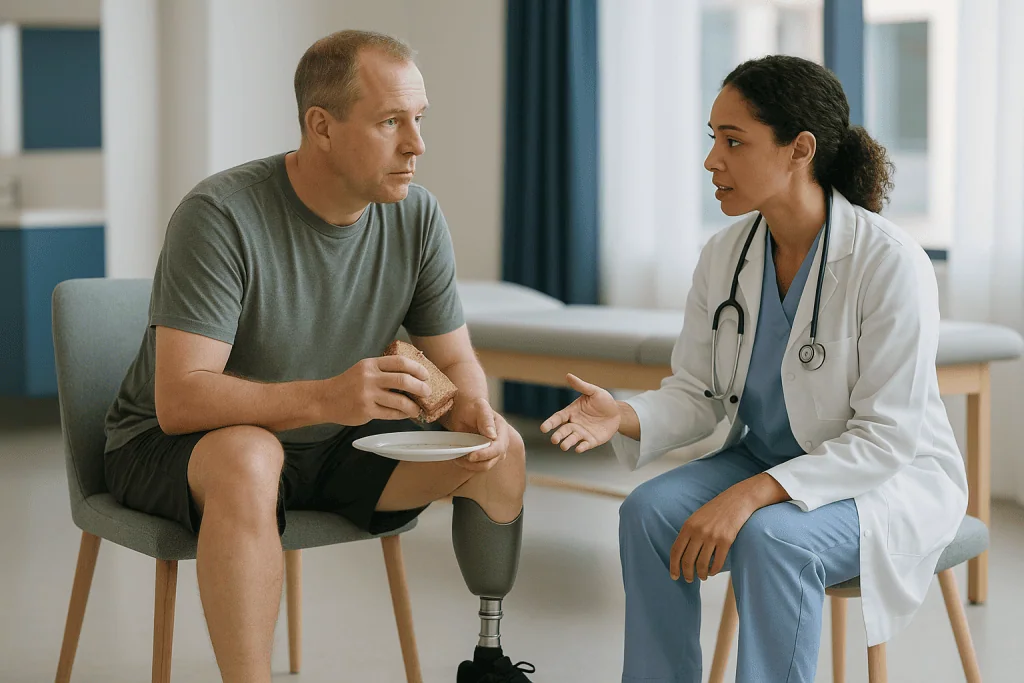
Fitting usually begins once the surgical wound has healed and swelling has settled enough for a socket to be shaped. The NHS notes that this process commonly starts several weeks after surgery, though it varies widely. Before that point many people wear a compression garment, sometimes called a shrinker, that helps reduce swelling and begin shaping the limb. Some programs use an early walking aid, an inflatable or adjustable temporary device used with a physiotherapist, to practice standing and stepping before a definitive socket exists.
People who are usually fitted sooner tend to share a few features: the wound has closed without infection, circulation to the residual limb is adequate, they can stand with support without dizziness, and they have the arm strength and balance to manage a walking frame or crutches during training.
Others are asked to wait, and the reasons are protective rather than punitive. A wound that is still open or weeping will break down further under socket pressure. Uncontrolled diabetes slows skin healing and reduces sensation, so damage can occur without pain warning. Heart or lung conditions may limit the effort a person can safely sustain, since walking with a prosthesis demands more energy than walking on two biological legs. Severe joint contractures at the hip or knee, where the joint cannot straighten fully, can make a safe standing position difficult until physiotherapy has improved range.
A smaller group, particularly those with significant frailty or memory difficulties, may be advised that a prosthesis for walking is not the safest route, and that wheelchair mobility offers more independence with less risk. That decision belongs to the person and their rehabilitation team, weighing goals against realistic risks, and it is revisited if circumstances change.
How long does it take to get used to wearing a prosthetic leg?
Honest answer: longer than most people hope, and shorter than they fear on the worst day.
There is no single number that applies to everyone, and reputable sources are careful not to offer one. MedlinePlus describes prosthetic rehabilitation as a process measured in weeks to months, and the NHS frames recovery after amputation the same way. Within that range, a few patterns are consistent across rehabilitation programs.
Tolerating the socket for a full day, without the skin complaining afterward, is the first milestone. For many people this develops over the opening weeks of graded wear. Walking indoors with a single aid on flat floors typically follows. Confident walking outdoors, on slopes, curbs and uneven ground, takes longer and depends heavily on the level of amputation.
Level of amputation matters more than almost anything else. A below-knee prosthesis lets your own knee do the thinking. An above-knee prosthesis replaces the knee joint, which means learning to control a mechanical or microprocessor knee through hip movement. People with above-knee amputations generally take longer to feel secure and use more energy to walk, a point noted in Johns Hopkins patient guidance on amputation rehabilitation.
Age, fitness before surgery, the reason for amputation and the health of the other leg all shift the timeline. Someone who lost a leg to injury while otherwise well tends to progress differently from someone whose amputation followed years of vascular disease, where the remaining leg may also be vulnerable.
Perhaps the most useful reframing is this: getting used to a prosthetic leg is not one finish line but several. Each one, from first standing to first stairs, is worth marking. Comparing your week six to someone else’s week six on an internet forum is rarely informative, because their leg, their surgery and their body are not yours.
A typical prosthetic leg wearing schedule for the first weeks
Wearing schedules are the backbone of early adaptation. The principle is simple: short sessions, a skin check after each one, and an increase only when the skin has passed the test. The specifics below reflect the graded approach described in MedlinePlus and NHS rehabilitation guidance; your own team will set the actual numbers, and they may differ.

| Stage | Typical pattern | What the team is checking |
|---|---|---|
| First days | Brief sessions, often an hour or two, once or twice daily, mostly sitting and standing | Skin redness that fades quickly; no blisters; socket seats fully |
| Following one to two weeks | Sessions lengthen gradually as skin tolerates; standing and stepping between parallel bars | Volume change through the day; sock ply adjustments; balance |
| Later weeks | Building toward wear for most of the waking day, with rest breaks and removal at night | Persistent pressure marks; gait pattern; endurance |
Two rules sit underneath every version of this schedule. The prosthesis comes off overnight, without exception, so skin can recover and be inspected. And time in the prosthesis is not the same as time walking on it. Early sessions include a great deal of sitting with the socket on simply to accustom the tissue to contact and mild pressure.
The increase between stages is not automatic. If a check reveals a red patch that has not faded within roughly 15–20 minutes of removal, a common threshold taught in rehabilitation, the next session is usually kept at the same length or shortened, and the prosthetist may adjust the socket. Going backward for a day protects weeks of progress.
One more practical point: wearing schedules assume a consistent routine. Skipping several days and then wearing the prosthesis all afternoon undoes the adaptation the skin has built. Steady and unremarkable beats heroic.
Prosthetic leg skin problems: what to look for after every session
Skin is the honest witness in prosthetic rehabilitation. It reports exactly how the socket is loading the limb, and it does so before anything more serious develops. Learning to read it is a core skill.
After every wearing session, the routine is the same. Remove the prosthesis and liner. Wash and dry the residual limb. Then look, using a hand mirror for the back and underside, and touch, feeling for warmth or tenderness.
Rehabilitation guidance, including MedlinePlus discharge advice after amputation, describes the changes to watch:
- Redness that fades within a short time is normal loading. Redness that persists, or that has a sharp outline matching a socket edge, suggests a pressure point.
- Blisters, especially over bony areas such as the end of the shin bone or the fibular head at the side of the knee, mean shear or friction the liner is not controlling.
- Broken or weeping skin is a stop sign. The prosthesis is not worn again until the team has seen it.
- Rash, small pimples or itching often relate to sweat, liner hygiene or a reaction to materials, and are usually manageable with cleaning routines the team will describe.
- Increased warmth, swelling, spreading redness or discharge raise the possibility of infection and need same-day contact with the care team.
Hygiene does much of the preventive work. Liners are typically washed daily, socks are changed when damp, and the limb is washed with mild soap and dried thoroughly. Moisturizers, if used, are generally applied at night rather than before donning, since damp skin under a liner is more prone to breakdown.
People with diabetes or reduced sensation face a particular challenge: the skin can be damaged without pain. For them, the visual check is not optional or occasional. It is the primary safety system, and the team may recommend inspecting more than once daily.
Why sock ply and limb volume change everything
New wearers are often surprised to learn that the most important tool in their kit is a drawer of socks.
Prosthetic socks are worn over the liner or directly on the limb to fine-tune how snugly the socket fits. They come in graded thicknesses measured in ply, where one ply is the thinnest and thicker socks combine multiple layers. Adding a ply tightens the fit; removing one loosens it. This matters because the residual limb is not a fixed shape.
In the months after amputation, swelling recedes and muscle that is no longer used shrinks. MedlinePlus and NHS guidance both describe this ongoing change in limb size as normal and expected. The limb may also swell slightly overnight and shrink through the day as standing pushes fluid out, so a socket that felt right in the morning can feel loose by afternoon. Heat, salty meals and a long day on your feet can shift volume too.
A loose socket is not a minor inconvenience. It allows the limb to move up and down inside the shell with each step, a motion prosthetists call pistoning. Pistoning creates friction, and friction creates blisters. It also makes the knee feel unstable, because the socket is no longer transmitting your movements cleanly. A socket that is too tight causes a different problem: pressure at the brim, restricted circulation and a throbbing ache at the end of the limb.
Teams teach a simple feedback loop. If the limb feels like it is dropping deeper into the socket than usual, add a ply. If the brim is biting or the end feels crushed, remove one. Over time, most people learn their own pattern, such as starting the day with fewer plies and adding one after lunch.
When sock changes no longer solve the problem, the socket itself needs adjustment or replacement. That is a normal, anticipated part of the first year, not a sign that anything has gone wrong.
How long to walk with a prosthetic leg: the first steps and beyond
First steps usually happen between parallel bars, and they usually happen in a physiotherapy gym rather than at home. There are reasons for both.
Parallel bars let you offload weight through your arms while learning where the prosthetic foot is and how much pressure the socket will accept. Physiotherapy after amputation, as described in NHS guidance, often begins within days of surgery with exercises for balance, strength and range of motion, well before a prosthesis exists. Once the socket arrives, that groundwork pays off.
Early gait training follows a sequence. Standing and weight shifting comes first: rocking side to side, feeling the socket load and unload. Then stepping in place. Then stepping forward with the prosthetic limb, then the sound limb, with the therapist correcting the length and timing of each step. Only when the pattern is reasonably even do most people progress from the bars to a walking frame, then to two crutches or sticks, then to one, and for some, to none.
How long each stage takes is individual, and no reputable source promises a date. Johns Hopkins patient guidance describes rehabilitation as a process spanning weeks to months, shaped by the level of amputation, general health and the condition of the other leg. Walking on flat indoor floors with an aid is a realistic early goal for many. Outdoor walking, slopes, stairs and uneven ground are later goals, and for some people, walking aids remain a permanent and sensible part of moving safely.
Distance builds slowly. Many programs count steps or minutes rather than meters in the first weeks, because the limiting factor is skin tolerance and energy, not enthusiasm. A short walk done well, with an even pattern, teaches more than a long walk done with a limp that later has to be unlearned.
Is walking with a prosthetic leg hard? What early training really feels like
Yes, at first it is genuinely hard, and pretending otherwise does new wearers a disservice. The difficulty has specific, describable causes.
Missing sensation is the biggest. On a biological foot, thousands of nerve endings report where the ground is and whether it is tilting. A prosthetic foot reports nothing directly. Information arrives second-hand, through pressure inside the socket and through the position of the hip. Until the brain learns to interpret those signals, every step on an unfamiliar surface requires conscious attention, the way driving in a new city requires reading every sign.
Energy cost is the second. Walking with a prosthesis uses more oxygen than walking on two legs, with higher demand at higher levels of amputation, a pattern noted across rehabilitation literature summarized by Johns Hopkins and MedlinePlus. In practice, a walk that once felt like nothing now feels like a brisk climb. This improves with fitness and with a smoother gait, but it does not disappear.
Fear is the third, and it is rational. Nobody enjoys the sensation of a knee that might not hold. Above-knee users in particular describe the early weeks as a negotiation with a joint they cannot feel. Training deliberately includes learning how the knee behaves, how to load it so it stays stable, and how to recover if it starts to bend unexpectedly.
What makes it easier is repetition in a safe setting, and a therapist who names what is happening. Learning to keep steps equal in length, to avoid vaulting up on the sound-side toes, and to let the prosthetic side accept full weight rather than hurrying past it, are the core early lessons. Each one turns a conscious effort into a habit, and habits are what eventually make walking feel ordinary again.
Phantom sensations, residual limb pain and socket pain: telling them apart
Pain in the weeks after amputation comes in several varieties, and they are not treated the same way. Sorting them is one of the first conversations most people have with their team.
Phantom sensation is the feeling that the missing limb is still present: an itch on a toe that no longer exists, a sense of the foot’s position. Mayo Clinic describes this as very common after amputation and notes that it is not the same as pain. Many people find it fades or becomes unremarkable over time.
Phantom limb pain is pain that feels located in the missing part. Cleveland Clinic describes it as originating in the brain and spinal cord, where the map of the body has not yet updated, rather than in the limb itself. It can be burning, cramping or shooting. Mayo Clinic notes it often improves over time for many people, though the course varies. Treatments a team may discuss include non-drug approaches such as mirror therapy and desensitization, and, where appropriate, medicines from classes used for nerve-related pain. Decisions about any medicine sit with the prescribing clinician.
Residual limb pain is pain in the limb that remains. Causes include the healing wound itself, a neuroma (a sensitive tangle of nerve endings at the cut nerve), bone spurs or poor circulation. It is investigated on its own terms.
Socket pain is the one the prosthetist owns. It is pain that appears when the prosthesis is on and settles when it is off, usually at a predictable spot. It signals a fit problem, and adjusting the socket, liner or sock ply typically addresses it.
Why does the distinction matter? Because pushing through socket pain causes skin damage, while stopping all activity for phantom pain can delay adaptation without helping the pain. Describe the pain precisely to your team: where, when, and whether the prosthesis changes it.
What the following weeks usually look like
Progress in prosthetic rehabilitation rarely looks like a straight line. It looks more like a staircase with a few steps missing, and knowing that in advance saves a good deal of discouragement.
In the early phase, appointments are frequent. The prosthetist checks fit and adjusts the socket as the limb changes shape; the physiotherapist advances the wearing schedule and gait training; a nurse or doctor may review the wound and skin. NHS guidance describes this period as one of frequent review precisely because the limb is changing quickly.
Through the middle phase, wear time approaches most of the waking day and walking moves off the parallel bars. This is also when many people hit their first plateau. The novelty has worn off, the skin has adapted but the socket now feels loose because the limb has shrunk, and walking still tires them faster than they expect. Plateaus are normal. They usually signal that something needs adjusting, whether socket fit, sock ply, or the difficulty of the exercises, rather than that progress has stopped.
Later, attention shifts from whether you can walk to how you walk. Therapists work on uneven ground, slopes, stepping over objects, getting up from the floor, and for many people, stairs. A definitive prosthesis, built once the limb has stabilized in size, often replaces the preparatory one during this period.
Emotionally, the weeks are just as variable. Grief, frustration and pride can arrive on the same afternoon. The NHS specifically highlights that psychological support is part of amputation rehabilitation, not an optional extra, and that talking to others who have been through it can help.
Setbacks happen: a skin breakdown that means a week without the prosthesis, an illness that drains energy, a fall that shakes confidence. None of these erase what has been learned. The skin re-toughens faster the second time, and the walking pattern returns more quickly than it was first built.
Energy, fatigue and the rest of your body
People expect the residual limb to be the story. Often it is the rest of the body that has the most to say.
Start with fatigue. Because walking with a prosthesis demands more oxygen and effort than walking on two legs, early sessions leave many people far more tired than the distance covered would suggest. This is physiology, not weakness. Fitness improves it: cardiovascular training on a stationary bike or arm ergometer, strengthening the hips and trunk, and simply accumulating walking time all lower the effort of each step over the weeks. The NHS notes that exercise and staying active are part of long-term recovery after amputation.
Next, the sound leg. It now does more work: bearing extra weight, providing the stable side during turns, absorbing the effort of standing from a chair. In people whose amputation followed vascular disease or diabetes, that leg may already be vulnerable, and protecting it becomes a priority. Well-fitting footwear, daily foot checks and prompt attention to any skin problem on the sound side are part of the same routine as checking the residual limb.
Then the back and hips. An uneven gait, a leg-length difference in the prosthesis, or hours of standing with the pelvis tilted to one side can produce low back pain. This is one of the reasons therapists are exacting about step length and posture in the first weeks: habits formed early are hard to break later, and the spine pays the bill.
Finally, the hands and shoulders. Crutches and frames load the wrists and shoulders in ways they are not built for over long periods. Pain there should be mentioned, since aid selection and technique can usually be adjusted.
None of this is a reason for alarm. It is a reason to treat rehabilitation as a whole-body project, with the prosthesis as one part of it.
What people often get wrong about getting used to a prosthetic leg
Some beliefs about prosthetic adaptation are so common they deserve direct correction.
Pain means it is working. It does not. Socket pain that appears when the prosthesis is on and settles when it is off signals a fit problem, and pushing through it produces skin breakdown that then costs days or weeks without the limb. Mild pressure awareness is expected; pain is information for the prosthetist.
Wearing it longer speeds things up. Skin adapts to graded exposure, not to overload. Doubling the schedule because the first session went well is the most common route to a blister in the second week. The team sets increases based on what the skin shows, not on how confident you feel.
The first socket should fit perfectly. It cannot, because the limb is still changing shape. MedlinePlus and NHS guidance both describe ongoing volume change after amputation. Early sockets are adjusted repeatedly and eventually replaced. That is the design, not a defect.
Phantom pain means something is wrong with the residual limb. Cleveland Clinic and Mayo Clinic describe phantom limb pain as arising in the nervous system’s map of the body, not in the limb. It needs its own approach, and it does not usually mean the wound or socket is at fault.
Needing a stick or frame is failure. For many people, particularly those with above-knee amputations or other health conditions, a walking aid is a permanent and sensible part of safe mobility. The goal is moving safely and independently, not moving without visible help.
Someone else’s timeline applies to you. Online accounts of walking unaided within weeks are real for some people and irrelevant for others. Level of amputation, reason for surgery, age, fitness and the other leg’s health all differ. Your team’s assessment is the only comparison that matters.
Questions to ask your care team
Rehabilitation appointments move quickly, and it is easy to leave with questions unasked. A written list helps. These are the ones that tend to matter most in the early phase.
- What is my wearing schedule for this week, and what specifically would make you shorten or lengthen it?
- What should a normal skin check look like for me, and which changes mean I should stop wearing the prosthesis and contact you the same day?
- How should I clean and care for the liner, socks and socket, and how often?
- How do I know when to add or remove a sock ply, and how many plies is too many before the socket needs adjusting?
- Is this a preparatory prosthesis, and when might a definitive one be considered?
- Which walking aid should I use at home right now, and what would need to change before I progress to the next one?
- What exercises should I be doing on days I am not in the gym, and for how long?
- How do I tell phantom pain, residual limb pain and socket pain apart, and who do I contact for each?
- What should I do if I fall, and can you teach me how to get up safely?
- How do I protect my other leg, and should I be checking it daily too?
- Who is the right contact if I have a problem between appointments, and how quickly can I usually be seen?
- Is there a peer support group or someone with a similar amputation I could speak to?
Bring a family member or friend if you can. Two sets of ears retain more, and the person who helps at home benefits from hearing the skin-check routine explained directly.
Write down the answers, especially anything with a number in it. The wearing schedule and the sock-ply guidance are easy to misremember after a long appointment, and both matter for keeping skin intact.
When to call your doctor
Most problems in early prosthetic use are fit problems, handled by the prosthetist at a routine appointment. A smaller number need prompt medical attention. Knowing the difference protects both the limb and the progress you have made.
Contact your care team the same day, and stop wearing the prosthesis until advised, if you notice any of the following, which MedlinePlus and NHS post-amputation guidance flag as reasons to seek care:
- Broken, blistered or weeping skin on the residual limb, or a pressure mark that has not faded within roughly 15–20 minutes of removing the prosthesis.
- Spreading redness, increasing warmth, swelling, pus or an unpleasant smell from the limb or wound, or a wound edge that has opened.
- Fever or chills alongside any change in the limb.
- New, severe or rapidly worsening pain in the residual limb, especially with a change in skin color, coolness or numbness.
- A sudden increase in swelling of the residual limb that does not settle overnight.
Seek urgent or emergency care for chest pain, sudden shortness of breath, or a swollen, painful calf in the other leg, since blood clots can occur after major surgery and reduced mobility. Seek urgent care too after a fall with a head injury, a suspected fracture, or if you cannot bear weight on the sound leg.
Also let the team know, at the next available appointment rather than urgently, about persistent low back pain, wrist or shoulder pain from walking aids, a socket that no longer fits despite sock changes, phantom pain that is disrupting sleep, or low mood and anxiety that are not lifting. These are not emergencies, but each is treatable, and each is more treatable early.
The general rule: if the skin is intact and the prosthesis is comfortable off, it can usually wait for the next appointment. If the skin is broken, the limb is hot, or you feel unwell, do not wait. Your rehabilitation team would far rather hear from you about a small problem than treat a large one.
Frequently asked questions
How long does it take to get used to wearing a prosthetic leg?
Rehabilitation guidance describes it as a process of weeks to months rather than a fixed number of days. Tolerating the socket for a full day usually develops first, over the opening weeks of graded wear. Confident walking, especially outdoors and on uneven ground, takes longer and depends on amputation level, healing, fitness and the condition of the other leg. Your team’s assessment matters more than any general timeline.
How long does it take to walk again with a prosthetic leg?
First steps usually happen between parallel bars in a physiotherapy gym soon after fitting. Progressing to a walking frame, then crutches or sticks, and for some to no aid, unfolds over weeks to months according to NHS and Johns Hopkins guidance. People with above-knee amputations generally need longer. Some people continue to use a walking aid permanently, which is a safe and reasonable outcome.
How many hours a day can you wear a prosthetic leg?
In the first days, sessions are typically short, often an hour or two once or twice daily, with a skin check after each. Wear time increases gradually as skin tolerates it, working toward most of the waking day over the following weeks. The prosthesis is removed overnight so skin can recover. Your team sets the specific schedule based on what your skin shows, not on a fixed rule.
Is walking with a prosthetic leg hard at first?
Yes, genuinely. The prosthetic foot cannot feel the ground, so the brain must learn position through socket pressure and hip movement. Walking also uses more energy than on two legs, more so with above-knee prostheses. Fear of the knee giving way is common and rational. Difficulty eases with supervised repetition, better fitness and a smoother gait pattern, but the early weeks are demanding.
What should a prosthetic leg wearing schedule look like in the first two weeks?
Most programs start with brief sessions of sitting and standing in the socket, followed by a skin check. If redness fades quickly, sessions lengthen gradually and include stepping between parallel bars. If a mark persists beyond roughly 15–20 minutes, the next session is held at the same length or shortened. The prosthesis is always removed at night. Your prosthetist and physiotherapist set the exact pattern.
What prosthetic leg skin problems should I look for?
Check after every session for redness that does not fade, blisters over bony spots, broken or weeping skin, rashes or small pimples from sweat or liner contact, and any warmth, swelling, discharge or spreading redness suggesting infection. Broken skin means stopping wear until the team has seen it. People with diabetes or reduced sensation should check more often, since damage can happen without pain.
Are prosthetics painful when you first get them?
Pressure awareness and mild aching are common early on; sharp or persistent pain is not expected and usually signals a fit problem. Pain that appears with the prosthesis on and settles when it is off points to the socket or sock ply. Phantom limb pain is a separate issue arising in the nervous system, described by Cleveland Clinic and Mayo Clinic, and it needs its own approach from the team.
Why does my prosthetic socket feel loose by the end of the day?
The residual limb loses fluid volume through the day as standing and walking push swelling out, so a socket that fit at breakfast can feel loose by afternoon. Adding a sock ply tightens the fit. Over months, the limb also shrinks permanently, which MedlinePlus and NHS guidance describe as normal, eventually requiring socket adjustment or replacement by the prosthetist.
What is phantom limb pain and does it go away?
Phantom limb pain is pain felt in the part of the limb that is no longer there. Cleveland Clinic describes it as arising from the brain and spinal cord’s map of the body rather than from the residual limb. Mayo Clinic notes it often improves over time for many people, though the course varies. Non-drug approaches and, where appropriate, prescribed medicines are decided by your clinician.
Should I stop wearing my prosthesis if I get a blister?
Yes, in most programs a blister or broken skin means stopping wear until the rehabilitation team has assessed it, since continued pressure can turn a small blister into a wound that costs weeks. Contact the team the same day. They will usually look for the cause, often a socket pressure point, pistoning from a loose fit, or liner friction, and adjust before you resume a graded schedule.
References
- MedlinePlus: Artificial Limbs
- MedlinePlus Medical Encyclopedia: Leg or foot amputation
- NHS: Amputation
- Cleveland Clinic: Phantom Limb Pain
This article is for general information only and is not a substitute for professional medical advice. Please consult a qualified doctor about your individual situation.

More from the Blog
How a Prosthetic Limb Is Designed and Fitted: Casting, Gait Analysis and Adjustments
The prosthetic fitting process usually begins once the surgical wound has healed and swelling has settled. A prosthetist captures the shape of the residual…
Walking, Cycling, Massage, Chiropractic: What Helps Sciatica
Yes, walking is generally good for sciatica. Gentle, regular movement keeps the spine and hips mobile, eases muscle guarding, and is recommended by national…

The First Neurological Rehabilitation Assessment: What the Team Measures and Why It Sets Goals
A neurological rehabilitation assessment is the structured first evaluation a rehabilitation team makes after a stroke, brain or spinal cord injury, or a progressive…

What a Neurological Rehabilitation Program Includes: Movement, Speech, Swallowing and Thinking
A neurological rehabilitation program is coordinated therapy for people whose brain, spinal cord or nerves have been injured by stroke, trauma, multiple sclerosis, Parkinson's…

How Much Does Physical Therapy Cost? Session Pricing Explained
A single private physical therapy session typically costs EUR 30–130 in our guide range for international patients, compared with roughly GBP 45–120 at private…

What Recovery Usually Looks Like After Stroke Rehabilitation: Honest Expectations by Stage
Stroke rehabilitation results vary widely, but most measurable change happens in the first three months, when the brain's natural recovery is fastest and therapy…