

How Doctors Confirm Orchitis: Scrotal Ultrasound, Urine Tests and Finding the Cause
Key Takeaways
- Doppler ultrasound shows increased blood flow in an inflamed testicle and reduced or absent flow in torsion, which is why the scan sits at the center of orchitis diagnosis.
- Testicular torsion is a surgical emergency; MedlinePlus notes the testicle can usually be saved when surgery happens within about 6 hours of pain starting.
- In sexually active men under about 35 the usual bacterial causes are chlamydia and gonorrhea, while older men more often have gut bacteria from a urinary source.
- A first-catch urine sample tested by NAAT detects chlamydia and gonorrhea, and a urine culture identifies other bacteria and which antibiotic classes work against them.
- Mumps orchitis typically appears four to seven days after parotid gland swelling and is managed with supportive care, since antibiotics do not act on viruses.
- The CDC advises reassessment if symptoms have not improved within about 72 hours of starting antibiotics, because that can signal the wrong organism or an abscess.
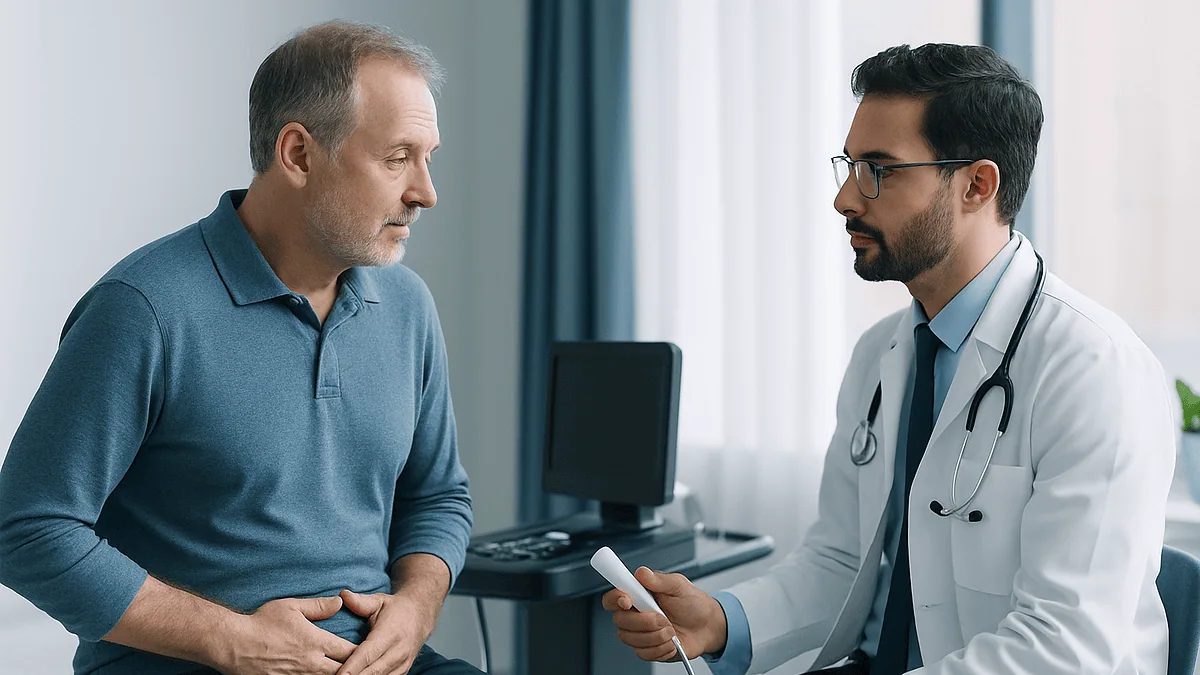
Doctors confirm orchitis with a physical examination, a urine test and, in most cases, a scrotal ultrasound with Doppler flow. The ultrasound shows swelling and increased blood flow in an inflamed testicle and, crucially, rules out testicular torsion, which cuts off blood supply. Urine tests and swabs then point to the likely cause, usually bacteria from the urinary tract or a sexually transmitted infection, less often a virus such as mumps.
It usually starts with a man standing in a bathroom, trying to decide whether the ache he noticed yesterday is now something he can point to. One side of the scrotum feels heavier. Walking is uncomfortable. He has already searched his symptoms twice and found the word orchitis, which he cannot quite pronounce, sitting next to the words testicular torsion, which he can.
That pairing is exactly why clinicians take a painful, swollen testicle seriously and move quickly. Orchitis ultrasound diagnosis, the use of a scrotal scan to confirm inflammation of the testicle and check its blood supply, has become the backbone of the workup, with urine tests and a careful history doing the rest.
This article walks through what actually happens in the exam room, what the scan can and cannot tell you, how doctors narrow down the cause, and what the first few weeks usually look like once treatment begins.
What orchitis is, and why the epididymis is almost always involved
Orchitis means inflammation of a testicle. The epididymis is the coiled tube behind each testicle that stores and carries sperm, and inflammation there is called epididymitis. In adults the two conditions rarely travel alone. Infection tends to reach the epididymis first, then spreads into the neighboring testicle, so the combined picture, epididymo-orchitis, is what doctors most often see and treat. Isolated orchitis, inflammation of the testicle without the epididymis, is less common and usually viral, with mumps the classic example.
Why does that distinction matter to a patient? Because the cause steers the test. According to the Mayo Clinic, bacterial orchitis is typically the result of epididymitis, and the bacteria that start the process depend heavily on age and sexual activity. In sexually active men under about 35, chlamydia and gonorrhea are the usual culprits. In older men, or in anyone with a history of prostate enlargement, catheter use or recent urinary tract surgery, the organisms are more often the same gut bacteria that cause bladder infections.
The testicle itself is an unforgiving place to be inflamed. Each one sits inside a tough fibrous capsule called the tunica albuginea, which does not stretch easily. Swelling inside a rigid container raises pressure, and pressure is what produces the deep, dragging pain most men describe. It is also why a small amount of inflammation can feel disproportionately severe, and why the scrotum on that side can look red, feel warm and sit noticeably lower.
Understanding this anatomy helps explain the two central questions a clinician is asking from the moment you describe your symptoms: is the blood supply to this testicle intact, and where did the inflammation come from? Everything that follows, including the ultrasound, is built to answer those two questions in that order.
How do you diagnose orchitis? What happens in the first ten minutes
The workup begins before any machine is switched on. A clinician will ask when the pain started, whether it came on over hours or over days, and whether it arrived with urinary burning, discharge, fever or recent illness. Sudden pain that woke you from sleep worries doctors more than pain that crept up over three days, because abruptness is a hallmark of torsion rather than infection.
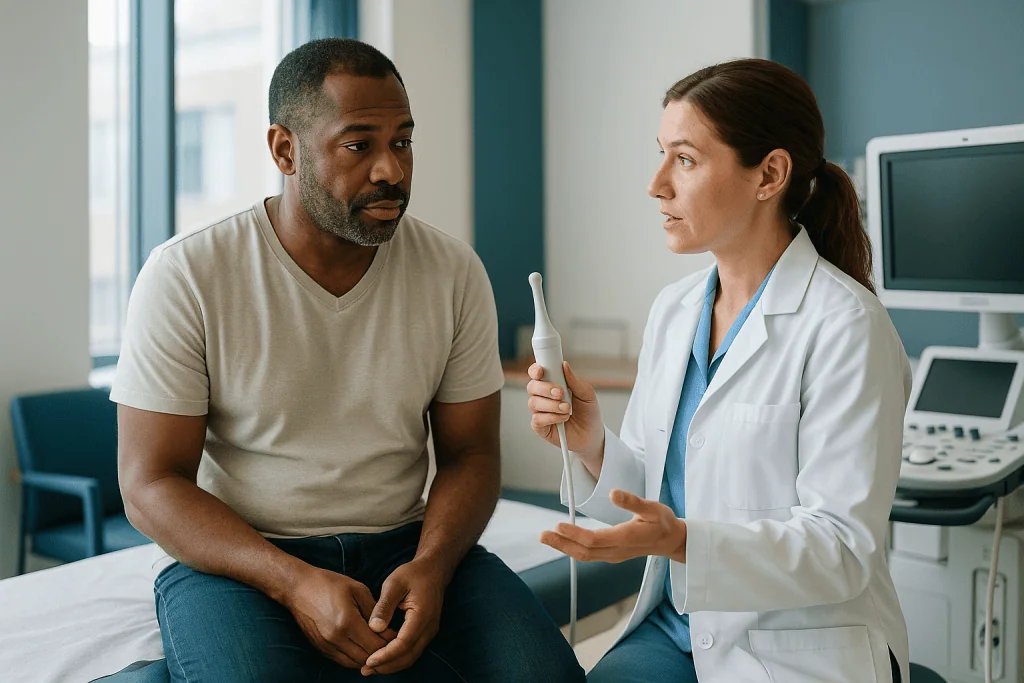
Then comes the examination. The clinician looks for swelling, redness and warmth, and gently feels the testicle and the epididymis behind it. In epididymo-orchitis the epididymis is often tender and thickened, and the whole testicle may be enlarged. Two bedside observations carry weight. The first is the cremasteric reflex: lightly stroking the inner thigh normally makes the testicle on that side lift briefly. The reflex is usually preserved in orchitis and often absent in torsion. The second is the position of the testicle, since a twisted testicle can sit higher or lie horizontally.
Neither sign is reliable enough to act on alone. The Mayo Clinic notes that the examination may also include checking the groin for enlarged lymph nodes and a rectal exam to assess the prostate when a urinary source is suspected. A urine sample is usually collected at this stage, and in sexually active men a swab or first-void urine sample is taken to test for sexually transmitted infections.
Many men are surprised by how much a clinician decides in these first minutes. If torsion is a serious possibility, the plan shifts immediately toward urgent imaging or direct surgical assessment, and no one waits for urine results. If the story and examination point clearly toward infection, the ultrasound confirms the picture and the lab work identifies the cause. The sequence is deliberate: exclude the emergency, then explain the inflammation.
What is a testicular ultrasound used for, and how orchitis ultrasound diagnosis works
A scrotal ultrasound, also called a testicular ultrasound, uses high-frequency sound waves to build a moving image of the testicles, epididymis and surrounding tissue. There is no radiation. The addition of Doppler imaging, a setting that maps blood flow as color on the screen, is what makes the scan so valuable for a painful scrotum. MedlinePlus lists its uses as evaluating pain and swelling, checking for infection, looking for a mass, and assessing blood flow when torsion is suspected.
In orchitis the images follow a recognizable pattern. The inflamed testicle appears enlarged and often slightly darker or more mottled than its partner because fluid has collected in the tissue. The epididymis, when involved, looks thickened. Doppler shows increased blood flow, sometimes described by sonographers as a hot or hyperemic testicle, because inflamed tissue draws more circulation. A small collection of fluid around the testicle, called a reactive hydrocele, is common and not alarming on its own.
Torsion produces the opposite picture: reduced or absent blood flow on the affected side. This is the contrast the whole scan is built around. The Mayo Clinic describes ultrasound with Doppler as the test that both confirms orchitis and rules out torsion, and that dual role is why clinicians order it so readily.
Ultrasound has limits worth knowing. It cannot identify which bacterium or virus is responsible; that is the job of the urine tests. It can occasionally miss intermittent torsion, where the testicle twists and untwists, so a convincing story still matters even after a normal scan. Rarely, an area that looks like focal inflammation needs a follow-up scan after treatment to be sure a mass is not hiding behind the swelling. Most men never need that second scan, but it is one reason the treating team may ask to see you again.
What actually happens during a scrotal ultrasound
The scan itself is quick and, for most men, more awkward than uncomfortable. You lie on your back on an examination couch. The sonographer or radiologist places a towel to lift and support the scrotum, applies warm gel, and moves a small handheld probe across the skin. MedlinePlus notes that the test typically takes about 20 to 30 minutes, and that the only discomfort is usually from pressure on an already tender area. There is no preparation, no fasting and no needle.

Both sides are scanned, even if only one hurts. The healthy testicle serves as the comparison for size, texture and blood flow, and the Doppler reading is far more meaningful as a side-by-side than as an isolated number. You may hear a whooshing sound when the machine converts blood flow into audio; that is normal and often reassuring, because it means flow is present.
Patients frequently ask whether they will get the result straight away. In many emergency settings the clinician looks at the images immediately, because the decision about torsion cannot wait. In an outpatient clinic the formal report may follow later the same day or the next. Either way, a scan showing good blood flow and the typical signs of inflammation generally allows treatment for infection to begin without further imaging.
A few practical points help the scan go smoothly. Mention any recent injury, since a bruise or small tear can look different from infection. Say if the pain has changed character, especially if it has suddenly become much worse, because that changes the urgency. If you have had a vasectomy, a hernia repair or a previous scrotal problem, tell the sonographer, as old surgical changes can be mistaken for new ones. Afterward there are no restrictions, and the gel wipes off easily.
Orchitis vs testicular torsion: why speed matters more than certainty
Testicular torsion happens when the spermatic cord, the bundle carrying blood vessels to the testicle, twists and shuts off the supply. It is a surgical emergency. MedlinePlus explains that the testicle can usually be saved if surgery takes place within about 6 hours of the start of pain, and that the chance of saving it falls sharply after that. Orchitis, by contrast, is painful but does not threaten the testicle’s blood supply, and it is treated with medicine rather than an operation.
The two can look alike. Both cause a swollen, tender, red scrotum, and both can produce nausea. The differences lie in the details clinicians collect. Torsion favors adolescents and young men and tends to start suddenly, often at night or during exertion, with pain reaching its peak within hours. Epididymo-orchitis more often builds over one to three days and is more likely to arrive with urinary symptoms, fever or discharge. On examination, an absent cremasteric reflex and a high-riding testicle lean toward torsion; a tender, thickened epididymis leans toward infection.
Because no single feature is decisive, the rule in emergency departments is simple: when torsion is genuinely possible, the surgeon is involved early, sometimes before the ultrasound, because a scan that delays an operation can cost a testicle. Doppler ultrasound is excellent at showing absent flow, but a borderline or technically difficult scan is not allowed to override a strongly suggestive story.
For patients, the message is practical rather than frightening. A gradual ache with urinary burning in a man in his forties is very unlikely to be torsion, and the ultrasound will almost certainly confirm inflammation. Sudden, severe pain in a teenager is a different situation that justifies an immediate trip to emergency care, not a next-day appointment. The symptoms overlap; the timelines rarely do.
Which urine tests help with epididymo-orchitis diagnosis
If the ultrasound answers the question is this infection, the urine answers the question which infection. Several tests may be run on the same sample or on a swab, and each looks for something different.
A urine dipstick and microscopy give a rapid first impression. White blood cells, called leukocytes, and nitrites, chemicals produced by many gut bacteria, suggest a urinary tract source. A urine culture then grows the bacteria in the laboratory over one to two days and tests which antibiotic classes they respond to, which lets the treating team adjust medicine if the first choice was not ideal.
For sexually active men, the key test is a nucleic acid amplification test, or NAAT, which detects the genetic material of chlamydia and gonorrhea with high sensitivity. The CDC’s epididymitis guidance recommends NAAT on a first-catch urine sample, meaning the first part of the stream rather than a midstream sample, because that is where the organisms concentrate. A urethral swab may be used instead. In men who practice insertive anal sex, the CDC notes that enteric bacteria, the gut organisms more typical of older patients, become more likely, and testing is adjusted accordingly.
Blood tests play a supporting role. A full blood count may show raised white cells, and inflammatory markers can indicate how much the body is reacting, but neither identifies the cause. When mumps is suspected, a blood test for mumps antibodies or a saliva sample sent for viral testing can confirm it, usually alongside a history of jaw swelling.
Results do not all arrive together. The dipstick is immediate, the NAAT often returns within a day or two, and the culture takes longest. Treatment for suspected bacterial infection generally starts before the culture is back, which is why the treating team may telephone with a change of plan once the laboratory reports.
Finding the cause: the questions that point to a source
Cause-finding in orchitis is less about exotic tests and more about an honest conversation. The CDC frames the likely organisms around a handful of factors, and clinicians work through them in roughly this order.
Age comes first. In men younger than about 35 the probability of a sexually transmitted cause is high enough that STI testing is routine. In older men, a urinary source is more likely, and the clinician will ask about a weak stream, night-time urination or a known enlarged prostate, since a partially blocked bladder allows bacteria to flourish and then travel backward toward the epididymis.
Sexual history comes next, asked without judgment because the answer changes the treatment. New or multiple partners, a partner with symptoms, and the type of sexual activity all shift the odds between sexually transmitted organisms and gut bacteria. Honesty here spares a man from being treated for the wrong infection.
Recent medical events matter too. A urinary catheter, cystoscopy, prostate biopsy or any urinary tract surgery in the preceding weeks is a recognized route for bacteria. So is a recent vasectomy, which can cause a non-infectious inflammation that looks similar on ultrasound but needs a different approach.
Finally, the clinician asks about illness elsewhere in the body. Fever with swollen glands near the jaw raises mumps. A long history of cough, weight loss or exposure to tuberculosis points, rarely, toward a tuberculous cause that behaves more slowly and may need tissue sampling. Certain medicines, notably one class of heart-rhythm drugs, are a recognized non-infectious cause of epididymitis, and a medication review is part of a thorough history.
Put together, these questions usually identify a plausible source within the first visit. The urine and swab results then confirm or redirect it.
Mumps orchitis symptoms and how doctors confirm a viral cause
Mumps is the best-known viral cause of orchitis, and it behaves differently enough from bacterial infection that clinicians recognize the pattern quickly. Mumps itself causes fever, headache and painful swelling of the parotid glands, the salivary glands just in front of the ears. According to the Mayo Clinic, orchitis in affected males typically develops four to seven days after that gland swelling appears. The CDC reports that orchitis occurs in a meaningful minority of post-pubertal males who contract mumps, making it the most common complication in that group.
The testicular picture is often one-sided but can affect both testicles. Pain and swelling can be marked, and fever is common. Because the virus attacks the testicle directly rather than arriving through the epididymis, the ultrasound may show inflammation of the testicle with a relatively spared epididymis, a pattern that itself hints at a viral cause.
Confirming mumps rests on the history, the characteristic facial swelling and laboratory testing. A blood sample can be checked for mumps-specific antibodies, and a saliva or buccal swab can detect the virus itself. Vaccination history is relevant but not decisive, since the CDC notes that mumps outbreaks still occur among vaccinated populations, usually with milder illness.
There is no antibiotic for a virus, so care centers on comfort: rest, scrotal support and pain relief as advised by the treating team, with the illness running its course over one to two weeks. The question most men ask afterward is about fertility. The Mayo Clinic describes testicular shrinkage after mumps orchitis as possible, and reduced fertility as an uncommon consequence that is more likely when both testicles were involved. A clinician may suggest a follow-up examination or, where appropriate, a semen analysis months later. Vaccination remains the only reliable way to prevent mumps orchitis in the first place.
Who is sent straight for imaging, and who is usually asked to wait
Not every tender testicle needs a scan within the hour, but a surprising number do, and the triage logic is worth understanding so that the pace of your care makes sense.
Men sent straight for urgent ultrasound, or directly to a surgeon, are those in whom torsion cannot be excluded on history and examination: typically adolescents and men under about 30 with sudden severe pain, especially without urinary symptoms. In this group the clock is running, and the Mayo Clinic and MedlinePlus both describe immediate assessment as the standard. Severe pain with fever, vomiting or a very swollen, dusky scrotum also moves a patient to the front of the queue, because an abscess, a pocket of pus inside the scrotum, is an uncommon but serious complication of infection.
Men who are usually asked to wait, meaning a same-day or next-day appointment rather than an emergency visit, are those with a gradual onset over days, clear urinary symptoms, a preserved cremasteric reflex and a tender epididymis on examination. For them the ultrasound confirms what the clinician already suspects, and it can be done in an outpatient radiology department.
A third group is asked to wait in a different sense. When symptoms are mild and the scan is clear, some men are reviewed after a course of treatment rather than scanned repeatedly. Others are asked to return for a follow-up scan in several weeks because residual swelling made part of the testicle hard to assess; the treating team will say so explicitly if that applies.
Children sit in their own category. In boys the differential includes torsion of a small appendage on the testicle and, less often, infection, and pediatric clinicians lean toward early imaging because a child’s description of pain is harder to interpret. Whichever group you fall into, the person who examined you should be able to explain why the timing was chosen.
How the common causes of a painful, swollen testicle differ
Seen side by side, the conditions that bring men to the clinic with scrotal pain separate more clearly than they do in a frightened late-night search. The table summarizes the features clinicians weigh, drawn from Mayo Clinic, MedlinePlus and CDC descriptions. It is a guide to understanding the workup, not a tool for self-diagnosis; the overlap between columns is precisely why examination and imaging are needed.
| Feature | Bacterial epididymo-orchitis | Mumps orchitis | Testicular torsion |
|---|---|---|---|
| Typical onset | Gradual, over 1–3 days | 4–7 days after parotid gland swelling | Sudden, often within minutes to hours |
| Usual age | Any adult; cause varies with age | Post-pubertal males, often unvaccinated | Mostly adolescents and young men |
| Accompanying features | Urinary burning, discharge, fever | Fever, swollen jaw glands, headache | Nausea, vomiting, no urinary symptoms |
| Ultrasound blood flow | Increased | Increased, testicle more than epididymis | Reduced or absent |
| Key lab test | Urine culture, NAAT for STIs | Mumps antibodies or viral swab | None; imaging and surgical assessment |
| Main treatment approach | Antibiotics guided by likely source | Supportive care | Emergency surgery |
Two patterns in the table deserve emphasis. First, blood flow on Doppler ultrasound is the single most useful dividing line, which is why orchitis ultrasound diagnosis sits at the center of the pathway. Second, the laboratory tests do very different jobs: culture and NAAT identify a treatable organism, whereas in torsion there is nothing to culture and no time to wait for results.
A fourth possibility, injury, is left out of the table because its history is usually obvious. Trauma can nonetheless cause bleeding inside the capsule that mimics infection on imaging, so a knock or sporting collision in the previous days is always worth mentioning.
What treatment for acute epididymo-orchitis usually involves
Once torsion is off the table and infection is likely, treatment begins before the laboratory has named the organism. This is called empirical treatment, meaning a choice based on the most probable cause for a person of that age and history. The CDC’s epididymitis guidance pairs antibiotic classes to likely sources: regimens that cover chlamydia and gonorrhea for men whose history points to a sexually transmitted cause, and regimens that cover gut bacteria for men with a urinary source or who practice insertive anal sex. The treating clinician selects, and may later adjust, based on culture results. Those decisions sit entirely with the prescriber.
Antibiotics work by killing bacteria or stopping them from multiplying; they do nothing for a virus, which is why confirming the cause matters. The CDC advises that men whose symptoms have not improved within about 72 hours of starting treatment should be reassessed, because that may signal the wrong organism, an abscess or a non-infectious cause. Improvement before the course ends does not mean the course should be shortened; finishing it as prescribed is what prevents relapse.
Supportive measures are not an afterthought. Rest, elevating the scrotum with supportive underwear or a folded towel when lying down, and cold packs wrapped in cloth all reduce the pressure inside that unyielding capsule. Over-the-counter pain relief may be suggested; the treating team will advise what is suitable alongside any prescribed medicine.
When a sexually transmitted infection is confirmed, recent partners need to be informed and tested, and the CDC recommends avoiding sex until both the patient and partners have completed treatment and symptoms have resolved. For viral orchitis, including mumps, care is supportive only. For the rare tuberculous or medication-related cases, treatment addresses the underlying cause rather than the testicle itself.
What the following days and weeks usually look like
Recovery from epididymo-orchitis follows a fairly predictable arc, and knowing it in advance saves a good deal of worry. In bacterial infection treated appropriately, the NHS describes pain usually starting to ease within a few days, while the Mayo Clinic notes that tenderness and swelling may take several weeks to settle fully. The CDC’s 72-hour reassessment point is the first milestone: by then most men feel the fever lifting and the sharp edge of the pain blunting, even though the scrotum still looks swollen.
The swelling lags behind the pain. The epididymis in particular can stay firm and slightly enlarged for weeks, and some men notice a small, hard area that lingers for months. That residual thickening is scar tissue from the inflammation and is usually harmless, but it is also the reason some clinicians arrange a follow-up ultrasound: to confirm that the shrinking lump is healing epididymis rather than something that needs separate attention.
Activity returns gradually. Supportive underwear helps during the first week or two. Heavy lifting, cycling and contact sports are generally deferred until the testicle is no longer tender, a judgment best made with the treating team. If a sexually transmitted cause was identified, sexual activity resumes only after treatment is complete for everyone involved.
Mumps orchitis runs its own course over roughly one to two weeks of acute symptoms, followed by slower resolution of swelling. A later check of testicular size is sometimes offered because the Mayo Clinic lists shrinkage as a possible aftereffect.
Complications are uncommon but have warning signs: a scrotum that grows more painful rather than less, fever that returns after settling, or skin over the scrotum that becomes tight, shiny or discolored. Any of those changes should prompt a same-day review, not a wait for the next scheduled appointment.
What people often get wrong about orchitis
Misconceptions cluster around this condition, partly because it touches on fertility, sex and an organ men would rather not discuss. A few deserve correcting.
The first is that orchitis always comes from a sexually transmitted infection. It often does in younger men, but in men over about 35, and in anyone with a urinary catheter or prostate enlargement, the usual cause is gut bacteria from the urinary tract, and viral causes exist at any age. Assuming an STI can lead to the wrong treatment and unnecessary strain on relationships.
The second is that a normal ultrasound means nothing is wrong. Ultrasound is highly sensitive for established torsion and for marked inflammation, but early or intermittent torsion can leave a scan looking reassuring. A convincing story of sudden severe pain still earns surgical review even after a clear image.
The third is that orchitis routinely causes infertility. The Mayo Clinic describes reduced fertility as a possible but uncommon outcome, more associated with mumps orchitis affecting both testicles than with treated bacterial infection. Most men recover without any effect on fertility.
The fourth is that feeling better means the antibiotic course can stop. Symptom improvement within a few days is expected and welcome, but stopping early risks relapse and resistant bacteria. Any change to the prescription belongs with the prescriber.
A fifth error is the opposite of panic: dismissing a lingering lump after the infection has settled as just scar tissue without mentioning it. Residual thickening is usually benign, but the treating team should know about any lump that persists or grows, because imaging can distinguish healing epididymis from a problem that needs its own assessment.
Finally, orchitis is not something a man caused by exercise, tight clothing or cold weather. Those may make an inflamed testicle more uncomfortable; they do not start an infection.
Questions to ask your care team
A diagnosis of orchitis or epididymo-orchitis usually arrives in a busy setting, and the questions that matter come to mind in the car park. Writing them down beforehand helps.
- Has torsion been ruled out, and what in the examination or ultrasound makes you confident of that?
- Did the ultrasound show inflammation of the testicle, the epididymis or both, and was blood flow normal?
- Which tests have been sent on my urine or swab, when will the results be back, and how will I be told if the treatment needs to change?
- Based on my age and history, what do you think the most likely cause is, and does that mean my partner should be tested?
- What should I expect to feel better first, and by roughly when should I be noticeably improved?
- Which signs would mean I need to come back the same day rather than wait for a routine review?
- Do I need a follow-up ultrasound, and if so, why and when?
- Are there activities, including sex, cycling or heavy lifting, that I should avoid until I am reviewed?
- Could any medicine I already take be contributing to this inflammation?
- If this was mumps, is there anything you would like to check later regarding testicular size or fertility?
Two of these questions carry more weight than the others. The first is the one about torsion, because it is the only genuinely time-critical issue in the whole pathway and you are entitled to hear the reasoning. The second is the one about what should prompt an urgent return, because recovery is usually steady and the exceptions announce themselves clearly if you know what to listen for.
Bring a list of your current medicines and note any recent urinary procedures or illnesses. If you were given a diagnosis in an emergency department, ask who will see you for follow-up and how to reach them if results arrive after you leave.
When to call your doctor
Scrotal pain is one of the few symptoms where erring on the side of urgency is the sensible default, because the condition that mimics orchitis most closely is the one that cannot wait.
Seek emergency care immediately, without waiting for an appointment, if testicular pain begins suddenly and severely, particularly in a teenager or young man; if the pain is accompanied by vomiting; if one testicle appears to sit much higher than the other or has turned sideways; or if the scrotal skin becomes dusky, purple or very tight. MedlinePlus is unambiguous that suspected torsion is an emergency measured in hours.
Call your doctor the same day if you have a swollen, tender testicle together with fever, chills, burning on urination or discharge from the penis. These are the features that make infection likely and that justify an examination, a urine test and a scrotal ultrasound to confirm orchitis ultrasound diagnosis and exclude anything else.
If you have already been diagnosed and started treatment, contact the treating team promptly if you are not improving after about 72 hours, if pain or swelling increases rather than decreases, if fever returns after settling, or if you develop a new area that feels fluctuant, meaning soft and fluid-filled under the skin. The CDC flags failure to improve within that window as a reason for reassessment, since it can signal the wrong antibiotic, an abscess or a non-infectious cause.
Arrange a routine, non-urgent review for a lump or thickening that persists in the weeks after the infection has resolved, for ongoing dull discomfort, or for questions about fertility after mumps orchitis. None of these is an emergency, but each deserves a conversation with someone who can examine you and, if needed, arrange a follow-up scan. Every decision about further testing or changes to treatment rests with the clinicians caring for you.
Frequently asked questions
How do you diagnose orchitis?
Orchitis is diagnosed through a physical examination, urine tests and usually a scrotal ultrasound with Doppler blood-flow imaging. The examination assesses swelling and tenderness of the testicle and epididymis, the ultrasound confirms inflammation and rules out testicular torsion, and urine or swab tests identify the likely bacterium or, in suspected mumps, blood or saliva tests confirm the virus.
What is a testicular ultrasound used for?
A testicular, or scrotal, ultrasound is used to evaluate pain and swelling, check for infection, assess blood flow when torsion is suspected and look for lumps or fluid collections. It uses sound waves rather than radiation, takes roughly 20 to 30 minutes according to MedlinePlus, and involves no needles or preparation. Both sides are scanned so the healthy testicle can serve as a comparison.
What does a testicular ultrasound for orchitis show?
In orchitis the affected testicle usually appears enlarged with a mottled texture from fluid in the tissue, and Doppler imaging shows increased blood flow compared with the other side. The epididymis often looks thickened when it is involved, and a small reactive fluid collection around the testicle is common. Reduced or absent blood flow would instead suggest torsion rather than infection.
What are the symptoms of an inflamed testicle that doctors look for?
Clinicians look for swelling, redness and warmth of the scrotum, tenderness of the testicle and especially the epididymis, and the testicle’s position and reflexes. They also ask about fever, urinary burning, discharge and recent illness such as mumps. Because these features overlap with testicular torsion, any new scrotal pain should be assessed by a doctor rather than judged at home.
How is epididymo-orchitis diagnosis different from orchitis alone?
Epididymo-orchitis means both the epididymis and the testicle are inflamed, which is the usual adult pattern because bacteria reach the epididymis first and spread inward. Isolated orchitis, affecting the testicle alone, is less common and usually viral. On ultrasound the distinction shows as a thickened epididymis in epididymo-orchitis versus a relatively spared epididymis in viral orchitis.
How do doctors tell orchitis vs testicular torsion apart?
The main dividing line is blood flow on Doppler ultrasound, which is increased in orchitis and reduced or absent in torsion. Clinicians also weigh the history, since torsion starts suddenly and mostly affects adolescents and young men, while orchitis builds over days and often brings urinary symptoms. When torsion is a real possibility, surgical assessment proceeds urgently regardless of scan availability.
What is the treatment for acute epididymo-orchitis?
Acute epididymo-orchitis of bacterial origin is treated with antibiotics chosen by the clinician according to the most likely source, such as sexually transmitted organisms in younger men or gut bacteria in older men, then adjusted if culture results suggest a change. Rest, scrotal support, cold packs and pain relief as advised help with comfort. Viral orchitis, including mumps, receives supportive care only.
What are mumps orchitis symptoms and how is it confirmed?
Mumps orchitis typically develops four to seven days after painful swelling of the parotid glands near the jaw, bringing fever and a swollen, tender testicle on one or both sides. It is confirmed through the history, the characteristic facial swelling and laboratory tests for mumps antibodies in blood or the virus in a saliva swab. There is no antibiotic treatment for a viral cause.
How long does orchitis take to improve after treatment starts?
With appropriate antibiotics for a bacterial cause, pain and fever usually begin to ease within a few days, and the CDC advises reassessment if there is no improvement after about 72 hours. Swelling and tenderness can take several weeks to settle fully according to the Mayo Clinic, and some residual firmness in the epididymis may persist for months as it heals.
Can orchitis affect fertility?
Reduced fertility is a possible but uncommon consequence of orchitis, and the Mayo Clinic links it mainly to mumps orchitis, particularly when both testicles are involved, which can lead to testicular shrinkage. Most men with treated bacterial epididymo-orchitis recover without any effect on fertility. Anyone concerned can ask the treating team about a follow-up examination or semen analysis later.
References
- MedlinePlus: Orchitis
- MedlinePlus: Scrotal ultrasound
- MedlinePlus: Testicular torsion
- CDC: Sexually Transmitted Infections Treatment Guidelines, Epididymitis
This article is for general information only and is not a substitute for professional medical advice. Please consult a qualified doctor about your individual situation.

More from the Blog

Life During Incontinence Treatment: Bladder Training, Exercises and Follow-Up Adjustments
Living with urinary incontinence during treatment usually means a structured stretch of bladder training, daily pelvic floor exercises, changes to fluids and caffeine, and…

Preparing for TURP: Why Any Urine Infection Is Treated First and What Else Comes Before
Preparing for TURP usually means a pre-operative assessment several weeks ahead, a urine test to rule out infection, and a medicine review with your…

Recurrent UTI Work-Up: Urine Cultures, Imaging and When a Urologic Evaluation Is Added
A recurrent UTI work-up starts with a proper urine culture taken during symptoms, repeated with each new episode, so the organism and its antibiotic…

Free PSA, PSA Density and PSA Velocity: How Urologists Refine a Borderline Result
Free PSA is the fraction of prostate-specific antigen that circulates unbound in the blood; total PSA counts the bound and free forms together. When…

Which Medicines Can Contribute to Urinary Retention? What Your Urologist Reviews First
Several common medicine classes can contribute to urinary retention, the inability to empty the bladder fully. The most frequently implicated are anticholinergics, sedating antihistamines,…

HUS in Children: How the Hospital Pathway, Comfort and Recovery Are Planned for Families
Treatment for HUS (hemolytic uremic syndrome) in children is mainly supportive hospital care: careful fluid and salt balance, close monitoring of blood counts and…