

How Does CoolSculpting (Cryolipolysis) Work? What Controlled Cooling Does to Fat Cells

Key Takeaways
- Fat cells crystallize and enter programmed cell death at temperatures that skin, nerve and muscle usually tolerate, which is the entire basis of cryolipolysis.
- Pooled clinical studies report the treated fat fold thins by roughly 10 to 28 percent depending on measurement method, a change in contour rather than in weight.
- The immune system, not the device, removes the fat, so visible change typically begins around three weeks and settles over two to six months.
- Cold-sensitive blood disorders such as cryoglobulinemia and cold agglutinin disease, Raynaud's phenomenon, cold urticaria and a hernia at the site are standard reasons to be declined.
- Paradoxical adipose hyperplasia, in which the treated area enlarges months later, is rare but of uncertain frequency and usually requires liposuction to correct.
- Removed fat cells do not regrow, but surviving neighbors can enlarge with weight gain, so cryolipolysis does not exempt anyone from ordinary energy balance.
CoolSculpting is the trade name for cryolipolysis, a non-surgical procedure that cools a pinch of fat through the skin. Fat cells are more sensitive to cold than skin, nerves or muscle, so controlled cooling can trigger a form of programmed cell death in the fat layer while surrounding tissue usually recovers. Over the following weeks the body gradually clears the damaged cells, modestly thinning that area. It is not a weight-loss treatment.
She had already done the hard part. Two years of steadier meals, a standing lunchtime walk, a wardrobe that finally fit. Yet in the mirror one stubborn roll above the waistband refused to follow the rest of her body, and a friend had mentioned a treatment that supposedly freezes fat away. Her first question, typed into a phone at the kitchen table, was the one most people start with: how does CoolSculpting work, and is any of it real?
The honest answer sits somewhere between the hype and the eye-rolling. Cryolipolysis, the medical name for the technique, rests on a genuine physiological quirk: fat cells give up at temperatures that skin cells shrug off. That quirk can be exploited to thin a small area of fat without an incision.
What it cannot do is shrink a whole body, replace a healthy routine, or promise a result. This explainer walks through what actually happens under the applicator, what the following months look like, who tends to be a poor fit, and what to ask before anyone cools anything.
How does CoolSculpting work? The short version
Strip away the branding and the idea is simple. A device grips a fold of skin and underlying fat, usually with gentle suction, and holds it against cooled plates for a set period. Fat, or adipose tissue, is the soft layer beneath the skin that stores energy. Its cells, called adipocytes, contain a droplet of lipid that behaves a little like butter in a refrigerator: it stiffens and crystallizes at temperatures where the water-rich cells of skin, nerve and muscle are still comfortable.
That crystallization is the trigger. A chilled adipocyte does not burst dramatically. Instead it begins a slow, orderly shutdown called apoptosis, the body’s built-in program for retiring cells that are damaged or no longer needed. Over the next several weeks immune cells arrive, dismantle the dying adipocytes and carry the remnants away through the lymphatic system, the network of vessels that drains fluid and debris from tissues. The treated fold becomes a little thinner.
Notice what is missing from that description. Nothing is cut. Nothing is injected. Nothing leaves the body faster than the immune system decides to move it. Studies pooled in a systematic review published in Plastic and Reconstructive Surgery reported reductions in fat layer thickness in the treated spot ranging from roughly 10 to 28 percent, depending on how the measurement was taken, which is why clinicians describe cryolipolysis as contouring rather than slimming.
So when someone asks how CoolSculpting works, the fairest one-line reply is this: it uses a temperature window in which fat is more fragile than everything around it, then lets your own biology do the removal. Whether that translates into a change you would notice depends on the area, the applicator fit, your starting point and, frankly, your expectations. The rest of this article unpacks each of those.
Why fat freezes before skin does: the science of cryolipolysis
The clue that fat is cold-sensitive came from children long before it came from laboratories. Dermatologists had described a curious dimpling in the cheeks of toddlers who sucked on ice pops for long stretches, later named popsicle panniculitis, and a similar pattern in the thighs of riders exposed to cold saddles. In each case the skin healed unremarkably while the fat beneath it shrank. Panniculitis simply means inflammation of the fat layer.
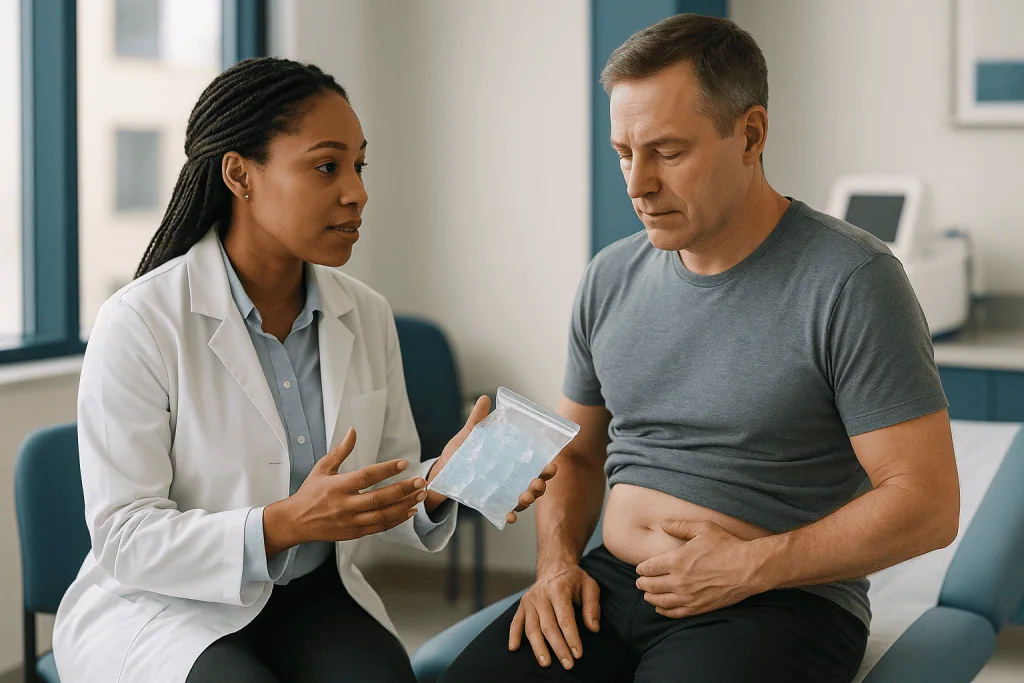
Why should fat be the weak link? Adipocytes are unusually rich in saturated lipid, which solidifies at a higher temperature than the water that dominates other cells. When the lipid droplet turns from liquid to crystal, it stresses the cell membrane and the machinery inside it. Cells of the epidermis and dermis, the outer and inner layers of skin, are far more water-based and tolerate the same chill with little lasting effect, provided the exposure is controlled and limited.
The word controlled matters. Frostbite is uncontrolled cold injury and it damages everything indiscriminately. Cryolipolysis devices are designed to hold tissue within a narrow band, cold enough to stress adipocytes yet warm enough to spare skin, with sensors that adjust the plates if temperatures drift. A gel pad or membrane placed between the skin and the applicator adds a further margin of protection.
Two further points flow from this biology. First, the effect is confined to the fat that is actually inside the cooled fold; fat a few centimeters away is untouched, which explains why edges and contour lines need careful planning. Second, the response is biological rather than mechanical, so it unfolds over weeks, not minutes. A clinician who understands both points will describe cryolipolysis as a tool for shaping a specific pocket, and will be candid that no device can freeze away a whole abdomen.
What actually happens during a cryolipolysis session
Most people are surprised by how uneventful the appointment feels. After a conversation about goals and medical history, the clinician marks the area and sizes an applicator to it. Applicators come in different shapes: cupped versions that draw the fold in with suction for softer, pinchable areas, and flatter versions that rest on firmer or curved surfaces such as the outer thigh.
A protective gel pad goes on first. The applicator is then positioned and, for suction models, the tissue is pulled into the cup. Expect a firm tugging, then intense cold for the first several minutes. Many people describe the sensation as pinching or aching that fades into numbness once the nerves in the area quiet down. Cleveland Clinic’s patient information puts a typical cycle at somewhere between about 35 minutes and an hour per area, during which you can read, scroll or nap.
When the cycle ends, the applicator comes off and the treated fold looks briefly alarming: a raised, reddened, firm block roughly the shape of the cup, sometimes compared to a stick of cold butter. The clinician massages this area for a couple of minutes. The massage is not cosmetic. Small studies summarized in the Plastic and Reconstructive Surgery review suggest that manual massage immediately afterward may increase the eventual fat reduction, possibly by adding a reperfusion injury as blood rushes back into the chilled tissue. That massage is frequently the most uncomfortable moment of the visit.
Then you dress and leave. No anesthesia, no stitches, no dressings. If several areas are planned, they may be treated the same day or across separate visits, a decision that belongs to you and your clinician rather than to a menu. Anyone who tells you a single session guarantees a particular look is describing marketing, not medicine.
What happens to fat cells in the weeks after controlled cooling
The interesting work begins after you have gone home. Within the first day or two, adipocytes that crossed the cold threshold start the apoptotic program. Their membranes signal distress, and the body’s cleanup crew, mainly macrophages, responds. Macrophages are large immune cells whose job is literally to eat debris.
Around the second and third week the treated fat shows a peak of inflammation on microscopy: swollen, dying adipocytes surrounded by macrophages and other immune cells. This is the same tidy, non-scarring process the body uses to remodel tissue every day, simply concentrated in one place. It is also why the area can feel tender, numb or oddly tingly during this window even though the skin looks normal.
From about the fourth week onward, the number of adipocytes in the treated fold begins to fall as digested lipid is carried off in the lymphatic fluid and eventually processed by the liver, the same route the body uses for dietary fat. Blood lipid levels have been measured in several of the pooled studies and did not show meaningful spikes, which addresses a common worry that freed fat might flood the bloodstream.
By two to three months the fat layer has visibly thinned in most people who respond, and Cleveland Clinic notes that changes may continue to settle for up to about six months. The adipocytes that were removed do not regenerate in adulthood in any meaningful number, which is where the phrase permanent comes from. The catch is that the neighbors remain. Fat cells that survived the session, and fat cells everywhere else, can still enlarge if energy intake rises. The number of cells in the pocket is lower; their capacity to store more is not gone.
How does CoolSculpting work on the stomach, flanks, chin and thighs?
The mechanism never changes; the fit does. Cryolipolysis needs a fold of subcutaneous fat, the pinchable layer directly beneath the skin, that can be drawn into or pressed against a cooling surface. Areas that meet that description tend to respond more predictably than areas that do not.
The lower abdomen and flanks, often called love handles, are the classic targets because they usually offer a generous, soft pinch. The chin and neck are treated with smaller cupped applicators designed around the jawline. Inner thighs are soft and suit suction; outer thighs are firmer and more curved, so flat applicators are often used there. Upper arms, the bra line, the area beneath the buttocks and the fat pad above the knee have also been studied, with results in the review literature broadly similar in scale to the abdomen when the applicator fits well.
Two anatomical facts limit what cooling can achieve. First, a protruding belly is frequently driven by visceral fat, the fat stored deep inside the abdomen around the organs. No external applicator reaches it, and visceral fat responds to lifestyle and medical management of weight rather than to contouring. Second, skin quality is unaffected. A fold that is loose because of stretched skin after pregnancy or weight change will still be loose after the fat beneath it thins, and occasionally looks looser.
Clinicians assess this by pinching. If they can lift a soft, well-defined fold, cryolipolysis is at least technically possible. If the abdomen feels firm and round without a pinch, or the skin hangs, they will usually steer the conversation toward other options. That pinch test is not a marketing gimmick; it is a rough proxy for whether there is anything under the skin for the cold to act on.
Who is cryolipolysis usually for, and who is usually asked to wait
The person who tends to do well is close to the weight they are comfortable maintaining, has a pocket or two of soft fat that persists regardless of routine, and understands that the outcome is a subtler contour rather than a different body. Cleveland Clinic describes the technique as intended for localized fat in people near a stable weight, not as a treatment for obesity or for weight loss.
Several groups are routinely advised against it or asked to postpone. Anyone with a cold-sensitive blood condition heads the list: cryoglobulinemia, where abnormal proteins thicken in the cold; cold agglutinin disease, where red cells clump when chilled; and paroxysmal cold hemoglobinuria, where cold triggers red cell breakdown. Raynaud’s phenomenon, in which small vessels spasm in the cold, and cold urticaria, a cold-triggered hive reaction, are also flagged. Cooling a large fold of tissue in someone with these conditions can provoke a reaction that is more than cosmetic.
Local factors matter too. A hernia at or near the treatment site can be worsened by suction. Active skin infection, eczema or open wounds in the area, recent surgery, or reduced sensation from nerve damage are reasons to wait. Pregnancy and breastfeeding are usually excluded simply because safety has not been studied in those groups, not because harm has been shown.
Then there is the less clinical question of fit. Someone hoping to lose a significant amount of weight is generally better served by addressing that first, since contouring a fold that later shrinks anyway wastes effort. Someone whose distress about their body is out of proportion to what others see may benefit from a conversation with a mental health professional before any procedure. A thoughtful clinician will raise these possibilities gently, and a good patient will not resent it.
Does fat freezing work? What the evidence actually shows
Cryolipolysis is one of the better-studied non-invasive contouring methods, and the evidence supports a real but modest effect. The most frequently cited synthesis, a systematic review of clinical studies in Plastic and Reconstructive Surgery, pooled trials measuring fat thickness with calipers and ultrasound. Caliper measurements fell by roughly 15 to 28 percent in treated areas; ultrasound, which is less operator-dependent, showed reductions of about 10 to 25 percent.
Put those numbers in everyday terms. If a flank fold measures the thickness of two stacked fingers before treatment, a typical response is a fold closer to one and a half fingers a few months later. That is noticeable in fitted clothing and in a mirror when you look for it. It is not a change in dress size, and it will not register on a bathroom scale, because the mass of fat removed from a single fold is small.
Where the evidence is thinner deserves equal honesty. Most published studies are small, many were funded or run by device manufacturers, follow-up rarely extends beyond a year, and there are few head-to-head randomized comparisons with other methods or with simply waiting. Patient-reported satisfaction figures appear in the literature but vary so widely with study design that quoting a single number would be misleading. Longer-term durability rests mostly on the biological argument that removed adipocytes do not regenerate, supported by a small number of follow-up reports rather than large trials.
The reasonable summary: controlled cooling reliably reduces the thickness of a treated fat fold in most people who fit the criteria, by an amount that is visible but limited. The question is rarely whether it does anything. The question is whether the size of that something is worth it to you, which is a judgment no study can make on your behalf.
How long does CoolSculpting take to show results? A realistic timeline
Patience is the price of avoiding surgery. Because cryolipolysis relies on the immune system to remove fat, nothing looks different when you leave the room, and people who expect an overnight change tend to be disappointed at the two-week mark. The typical arc, drawn from Cleveland Clinic’s patient guidance and the trial literature, runs as follows.
The first few hours bring redness, firmness and sometimes a raised, blanched rectangle where the applicator sat. Over the first week, expect bruising in suction-treated areas, swelling, tenderness and a numb or tingling patch. Some people describe a deep ache or a sensation like a pulled muscle. Most return to work and normal activity the same or next day.
Around weeks two and three, when inflammation in the fat peaks, sensation can be at its strangest: numbness alternating with itching or sharp twinges. This is uncomfortable but expected. Visible change is usually still absent, and this is the stretch where people quietly decide it did not work.
From roughly three weeks onward, early thinning may become noticeable to someone who knows where to look. By about two months the change is generally apparent, and by three months most of the response has arrived. Cleveland Clinic notes that final contour can continue to settle for as long as six months as the last of the cleared tissue is remodeled.
Repeat sessions, if wanted, are typically spaced so that the first response can be judged before more cooling is added. That interval is a clinical decision for your care team, not a fixed number to bring from the internet. Photographs taken by the clinic under consistent lighting are more trustworthy than bathroom mirrors for judging the difference, precisely because slow change is hard to perceive day to day.
Cryolipolysis vs liposuction vs other fat-reduction options
Cooling is one tool among several, and each trades invasiveness against scale. The table below summarizes the broad differences in neutral terms; none of the figures is a promise, and every option carries its own eligibility criteria that your treating team assesses.
| Approach | How it removes or reduces fat | Typical scale of change | Recovery pattern | Main limitations |
|---|---|---|---|---|
| Cryolipolysis (controlled cooling) | Cold triggers apoptosis in fat cells; body clears them over weeks | Roughly 10 to 28 percent thinning of the treated fold (systematic review) | No downtime; tenderness and numbness for days to weeks | Small pinchable areas only; results appear over months; rare paradoxical enlargement |
| Liposuction | Surgeon loosens and suctions fat through small incisions | Larger volumes across several areas in one procedure (Mayo Clinic) | Days to weeks of swelling and bruising; compression garments; activity limits | Anesthesia and surgical risks; not a weight-loss operation |
| Injection lipolysis (deoxycholic acid, generic) | A bile-acid derivative injected into fat disrupts cell membranes | Modest reduction in small areas, chiefly beneath the chin | Swelling and numbness for days to weeks | Multiple sessions; limited to specific sites; nerve irritation risk |
| Radiofrequency or ultrasound heating devices | Heat energy damages fat cells or tightens collagen | Variable; evidence base smaller and more heterogeneous | Little or no downtime | Fewer high-quality trials; effects depend heavily on device and operator |
| Sustained lifestyle change or medical weight management | Energy balance shrinks fat cells body-wide | Can be large and affects visceral fat | Ongoing | Cannot target one spot; skin laxity may remain |
A pattern emerges. Non-invasive methods spare you the operating room but confine you to small, gradual changes. Liposuction, described in detail by both Mayo Clinic and the NHS, handles more volume and more sites in a single sitting, at the cost of anesthesia, incisions and a real recovery period. Neither category treats general excess weight, and neither addresses loose skin, which is why some people end up discussing skin-tightening surgery instead. The right comparison is never device against device in the abstract; it is each option against your particular anatomy and tolerance for downtime.
What are the CoolSculpting side effects, common and uncommon?
Cryolipolysis has a reassuring short-term safety record, and it is worth separating the expected from the unwelcome. The systematic review that pooled the trial data found that nearly everyone experiences at least one transient local effect, and that these resolved without treatment in the overwhelming majority of cases.
Expected effects, appearing within hours and fading over days to a few weeks, include redness, swelling, bruising where suction was applied, tenderness, a firm or lumpy feel in the treated fold, and a patch of numbness or tingling. The numbness deserves a specific mention because it can outlast the visible signs. Cold temporarily stuns small sensory nerves, and in the pooled studies altered sensation typically settled within a few weeks, though occasional reports describe it lasting a couple of months.
Less common effects include a deeper, delayed pain beginning several days after treatment, sometimes described as sharp or burning, most often after abdominal sessions. It is thought to reflect irritated nerves within the inflamed fat and generally eases over one to two weeks. Skin changes such as blistering, darkening or lightening are rare when protective pads are used properly and temperatures are controlled. Vasovagal responses, the light-headedness some people feel during any uncomfortable procedure, have been noted during applicator removal.
The rare complication that has drawn the most attention is paradoxical adipose hyperplasia, in which the treated area enlarges rather than shrinks. It is discussed in its own section below because it changes the risk conversation more than any other item on this list.
What has not been demonstrated is systemic harm. Liver enzymes and blood lipids measured in study participants did not show clinically meaningful changes after treatment. Serious infection is not expected because the skin is never broken. None of this means risk-free; it means the risks are mostly local, mostly temporary, and occasionally, in the case of paradoxical enlargement, the opposite of what you hoped for.
Paradoxical adipose hyperplasia: the rare outcome worth understanding
Every cosmetic procedure has one complication that the fine print does not quite prepare you for. For cryolipolysis it is paradoxical adipose hyperplasia, usually abbreviated PAH. Adipose means fat; hyperplasia means an increase in tissue; paradoxical because the outcome is the reverse of the intent. Months after a session, the treated area grows firmer and larger, often taking on the rectangular outline of the applicator, so that a flank or lower abdomen looks as though it has been stamped with a raised block.
Nobody yet knows exactly why it happens. Leading hypotheses include an exaggerated repair response in which surviving fat cells or their precursors multiply after the cold injury, or an effect of suction on the tissue that alters how it heals. Reports suggest it is more frequent in men, in people with larger applicators, and in the abdomen, though the data are sparse.
How rare is rare? Early manufacturer-derived estimates put PAH at a very small fraction of one percent of treatment cycles. Several later clinic series and case reports have described substantially higher rates, and the systematic review literature acknowledges that the true incidence is uncertain and probably underreported, since patients who are unhappy often do not return to the treating clinic. The evidence-graded answer is therefore: uncommon, but not vanishingly so, and not fully characterized.
PAH does not resolve on its own in most described cases and does not respond to further cooling. The usual corrective approach is liposuction or, occasionally, surgical excision, typically delayed for several months until the tissue softens. That means a person who chose cryolipolysis specifically to avoid surgery can, in this scenario, end up needing it.
None of this is an argument against the procedure. It is an argument for informed consent that names PAH explicitly, for asking how the clinic handles it if it occurs, and for a written plan you can refer to later.
What people often get wrong about fat freezing
Myths gather around any treatment that promises to work while you lie still. A few deserve direct correction.
It melts fat away. Nothing melts. Fat cells are damaged by cold and then dismantled by immune cells over weeks. The word freezing is itself a simplification; the goal is crystallization of lipid inside the cell, not a frozen block of tissue.
It is a way to lose weight. A single fold holds a small amount of fat. Removing a quarter of it changes shape, not mass. Cleveland Clinic and the trial literature are unanimous that cryolipolysis is not a weight-loss method and is not intended for obesity, which is a medical condition managed through nutrition, activity, and where appropriate medication or surgery under a clinician’s care.
Results are permanent, so lifestyle no longer matters. The removed cells are gone, but the remaining ones can grow. Weight gain after treatment will show up in the treated area as well as everywhere else, sometimes unevenly.
The fat goes somewhere else. A common worry is that fat migrates to a new spot. Cleared lipid is processed by the liver like dietary fat, and studies did not show blood lipid spikes. New fat appearing elsewhere is almost always ordinary weight change, not relocation.
It tightens skin. Cold has no meaningful effect on collagen or skin laxity. Loose skin stays loose and can look looser once the fat under it thins.
More cycles at once mean better results. Response varies between people and areas, and the biological process needs time to unfold before anyone can judge whether more is warranted. Stacking sessions on the same fold before the first has declared itself adds cost and risk without adding knowledge.
It works on everyone. Some people respond little. Study averages hide individuals at both ends, and no clinician can tell in advance where you will fall.
Questions to ask your care team before agreeing to cryolipolysis
A good consultation should leave you with fewer questions than you arrived with. If it leaves you with more, that is information too. Consider raising the following, and pay attention to how comfortably each is answered.
- Who will assess me and perform the treatment, what is their training, and who supervises the clinic medically?
- Based on your examination, is my fat mainly subcutaneous and pinchable, or is some of it visceral or skin laxity that cooling will not address?
- Which applicators do you plan to use on which areas, and why those shapes?
- What degree of change do you consider realistic for me, and can you show me photographs of outcomes in people with similar anatomy, including modest and disappointing ones?
- Have you screened me for cold-sensitive blood disorders, Raynaud’s phenomenon, cold urticaria, hernia at the site, and pregnancy?
- How do you handle paradoxical adipose hyperplasia if it occurs, what does that pathway involve, and is it documented in the consent I will sign?
- What sensations should I expect during the first three weeks, and which ones would you want to hear about promptly?
- How will change be measured: photographs under fixed lighting, calipers, ultrasound, or just impression?
- When would you reassess before recommending any further session, and what would make you advise against one?
- What alternatives would you suggest for someone with my goals, including doing nothing for now?
Two things are worth watching for in the answers. A clinician who describes the outcome as a percentage of a fold rather than a body, who mentions PAH before you do, and who volunteers that some people respond poorly is speaking the language of evidence. A clinic that quotes guaranteed sizes, pushes multiple areas in one visit, or treats your hesitation as a sales objection is speaking a different language altogether. The decision remains yours and theirs jointly; but the information should flow toward you, not the other way.
When to call your doctor after fat freezing
Most people need no medical attention at all after cryolipolysis. Redness, bruising, swelling, a lumpy firm feel and a numb or tingling patch that eases over a few weeks are the normal aftermath, and a deep ache or occasional sharp twinge in the second and third week is expected as inflammation peaks. Reassurance from the treating clinic is usually enough for these.
Some signs, however, warrant a prompt call to the clinic or your own doctor rather than waiting for the next appointment:
- Skin that blisters, breaks open, turns very dark or very pale, or feels hard and cold well beyond the first day, which could indicate a cold injury to the skin rather than the fat.
- Pain that is severe, escalating after the first week instead of easing, or not controlled by simple measures your clinician has already agreed with you.
- Spreading redness, warmth, pus or a fever, since infection is unexpected without a skin break and needs assessment.
- Numbness that is worsening rather than improving after several weeks, or new weakness in a limb near the treated area.
- A hard, enlarging bulge in the treated zone appearing weeks to months later, which should be evaluated for paradoxical adipose hyperplasia or a hernia.
- Hives, faintness, breathlessness or a widespread rash during or soon after treatment, particularly if you have any history of cold-triggered reactions.
Seek emergency care immediately for chest pain, difficulty breathing, a swollen painful calf, sudden confusion or weakness on one side of the body, or a severe allergic reaction. These are not recognized consequences of cryolipolysis, but they are emergencies regardless of cause, and no cosmetic timeline should delay them.
If you are unsure whether what you are feeling is normal, the right answer is always to ask. Your treating team knows what was done, which applicator was used and what your skin looked like immediately afterward. They are far better placed to judge than a search engine, and every decision about further treatment or investigation sits with them.
Frequently asked questions
How does CoolSculpting work in simple terms?
It cools a pinch of fat through the skin to a temperature that fat cells tolerate poorly but skin and nerves usually survive. The chilled fat cells begin an orderly self-destruct process called apoptosis, and over the following weeks immune cells clear them away, leaving the treated fold thinner. Nothing is cut or injected, and the change appears gradually rather than at the appointment.
Does fat freezing work, or is it a gimmick?
It works in a measurable but limited way. A systematic review of clinical trials found treated fat folds thinned by about 10 to 28 percent, depending on whether calipers or ultrasound were used. That is visible in fitted clothing but does not change weight or dress size. Studies are mostly small and often industry-linked, so the size of the effect is better established than its long-term durability.
What is the typical fat freezing results timeline?
Expect nothing visible for the first two to three weeks, during which swelling, numbness and tenderness are common and inflammation inside the fat peaks. Early thinning may appear from about three weeks. Most of the change is present by two to three months, and Cleveland Clinic notes the contour can continue to settle for up to about six months as the last debris is cleared.
How long does CoolSculpting take per session?
A single applicator cycle usually lasts somewhere between about 35 minutes and an hour, according to Cleveland Clinic patient information, followed by a couple of minutes of firm massage over the treated fold. Treating more than one area lengthens the visit accordingly. There is no anesthesia or recovery room, so most people return to ordinary activity the same day or the next.
What are the most common CoolSculpting side effects?
Redness, swelling, bruising in suction-treated areas, tenderness, a firm or lumpy feel, and a patch of numbness or tingling are expected and typically fade over days to a few weeks. Some people develop a delayed deep or sharp pain in the second week, most often after abdominal treatment, which usually eases within one to two weeks. Serious systemic effects have not been demonstrated in studies.
Can cryolipolysis make fat bigger?
Rarely, yes. Paradoxical adipose hyperplasia is a complication in which the treated area becomes firmer and larger months after treatment, often in the shape of the applicator. Its true frequency is uncertain; early estimates were a small fraction of one percent, while some later reports describe higher rates. It does not resolve with more cooling and usually requires liposuction to correct.
Is cryolipolysis a way to lose weight?
No. It removes a portion of the fat in one small fold, which reshapes a contour without meaningfully changing body weight. Clinical guidance describes it as intended for people near a stable weight with localized pockets, not for obesity or general weight loss. Visceral fat inside the abdomen, which drives much of a protruding belly, cannot be reached by any external applicator.
Who should not have fat freezing?
People with cold-sensitive blood disorders such as cryoglobulinemia, cold agglutinin disease or paroxysmal cold hemoglobinuria, and those with Raynaud’s phenomenon or cold urticaria, are routinely excluded. A hernia at the site, active skin disease or infection in the area, reduced sensation, recent surgery, pregnancy and breastfeeding are also standard reasons to decline or postpone. Your treating team makes the final assessment.
Are cryolipolysis results permanent?
The fat cells that are destroyed do not regenerate in adulthood, so that part of the change is considered lasting. The remaining fat cells in the area and elsewhere can still enlarge if weight increases, and the treated zone may then grow unevenly. Long-term follow-up studies are limited, so the biological argument for permanence is stronger than the trial evidence for it.
How is cryolipolysis different from liposuction?
Cryolipolysis uses cold through intact skin, produces a modest thinning of small folds over months, and involves no anesthesia or downtime. Liposuction is a surgical procedure in which fat is suctioned out through small incisions, allowing larger volumes and multiple areas in one session, but with anesthesia, incisions and a recovery period of days to weeks. Neither treats general excess weight or loose skin.
References
This article is for general information only and is not a substitute for professional medical advice. Please consult a qualified doctor about your individual situation.

More from the Blog

How Long Do Fat Grafting Results Last? Graft Take, Volume Settling and Realistic Expectations
Fat grafting results are generally considered long-lasting once the transferred fat has survived, but not all of it does. Published reviews report that roughly…

When a Thigh Lift Needs Revision: Scar Migration, Residual Laxity and Timing of a Redo
A thigh lift revision is a second operation to correct problems left after an earlier thigh lift, most often a scar that has drifted…
CoolSculpting After Pregnancy: When It Helps, When It Does Not and Why Timing Matters
Cryolipolysis, the fat-freezing treatment sold under the CoolSculpting name, can reduce small, pinchable fat pockets that persist after pregnancy, but it does not tighten…

When Compression Is No Longer Enough: How Doctors Decide Lymphedema Surgery Is the Next Step
Lymphedema surgery is usually considered only after months of consistent conservative care, including compression, decongestive therapy and skin care, has failed to control swelling,…

Cycling, Running and Tight Clothing After Labiaplasty: A Realistic Return-to-Activity Guide
Exercise after labiaplasty is usually rebuilt in stages: short walks within days, light low-impact activity often from about two weeks, and strenuous exercise, running…

Arm Liposuction Risks: Contour Unevenness, Numbness and Which Signs to Report Early
Arm liposuction risks include contour unevenness (lumps, dents or asymmetry), temporary or occasionally lasting numbness, bruising, fluid collections called seromas, infection and, rarely, blood…