

How Does J Plasma Skin Tightening Work? Helium Plasma and Radiofrequency Explained Simply
Key Takeaways
- J Plasma is a brand name for helium plasma radiofrequency, a device that ionizes helium into a plasma to heat the underside of the skin through small incisions.
- The tightening comes from heat shortening collagen fibers immediately and from new collagen that fibroblasts build over months, so final results take time to appear.
- In practice it is almost always paired with liposuction, because liposuction removes fat but does not tighten skin, as Mayo Clinic notes.
- It cannot remove a hanging fold of excess skin or repair separated abdominal muscles; those remain the job of a tummy tuck or surgical lift.
- Risks include those of liposuction plus heat-specific complications such as burns, fat necrosis, prolonged numbness and, rarely, gas-related events.
- The published evidence is dominated by short-term, unblinded reports, so any precise percentage of tightening or guaranteed duration goes beyond what studies support.
J Plasma is a common name for helium plasma skin tightening, a procedure in which radiofrequency energy ionizes helium gas into a plasma that briefly heats tissue beneath the skin. The heat makes collagen fibers contract and, over months, stimulates new collagen, which can firm mildly loose skin. It is usually combined with liposuction, is not a substitute for surgical skin removal, and carries real risks.
The mirror moment usually comes after the hard part is over. Someone has lost forty pounds, or finished having children, or simply reached the age when skin stops springing back. The number on the scale is fine. The tape measure is fine. But the skin on the upper arms, the lower belly, or under the chin has a softness that no plank or lunge seems to touch.
That is when the phrase starts appearing in searches: how does J plasma work, and could it tighten skin without the long scar of a lift? The marketing is loud. The physics underneath it is actually quite simple, and so is the honest answer about what it can and cannot do.
This explainer walks through the helium, the radiofrequency, the collagen, the recovery, the risks, and the evidence, in the order you would want a thoughtful surgeon to explain them across a desk.
What does "J Plasma" actually mean?
“J Plasma” is a trade name that has drifted into everyday use, the way people say “Band-Aid” for any adhesive strip. The underlying technology has a mouthful of a generic name: helium-based plasma radiofrequency, sometimes shortened to helium plasma skin tightening or, in surgical circles, subdermal coagulation.
Each word in that phrase does a job. Plasma, in this context, is not the liquid part of blood. It is the fourth state of matter, a gas so energized that some of its atoms have lost electrons and the whole cloud can carry an electric current. Lightning is plasma. The glow inside a neon sign is plasma. Helium is simply the gas chosen to make it, because helium turns into plasma easily and cools quickly.
Radiofrequency, or RF, is a form of electrical energy that oscillates at rates similar to radio waves. Dermatologists have used RF for years to heat the deeper layer of skin, the dermis, in order to tighten it, as Cleveland Clinic describes in its overview of radiofrequency skin tightening.
Put the two together and you have a slim wand, roughly the width of a drinking straw, that a surgeon slides beneath the skin through a small incision. Out of its tip streams helium gas energized by RF into a glowing plasma beam. The beam delivers a brief, intense pulse of heat to the underside of the skin and the fibrous tissue that tethers it to the layers below.
One clarification matters before going further. Because J Plasma is a brand name for a device rather than a medicine or a procedure, this article discusses the technology as a class, helium plasma RF, and does not make claims about any particular product. The evidence, the cautions and the questions to ask apply to the whole category.
How does J Plasma work under the skin?
Picture the layers of the body wall like a mattress. The skin is the quilted top. Beneath it lies a layer of fat, held in place by a web of thin fibrous cords called septae, which run from the underside of the skin down to the muscle fascia. When skin looks loose, two things have usually happened: the dermis has lost some of its collagen and elastin, and those tethering cords have stretched.
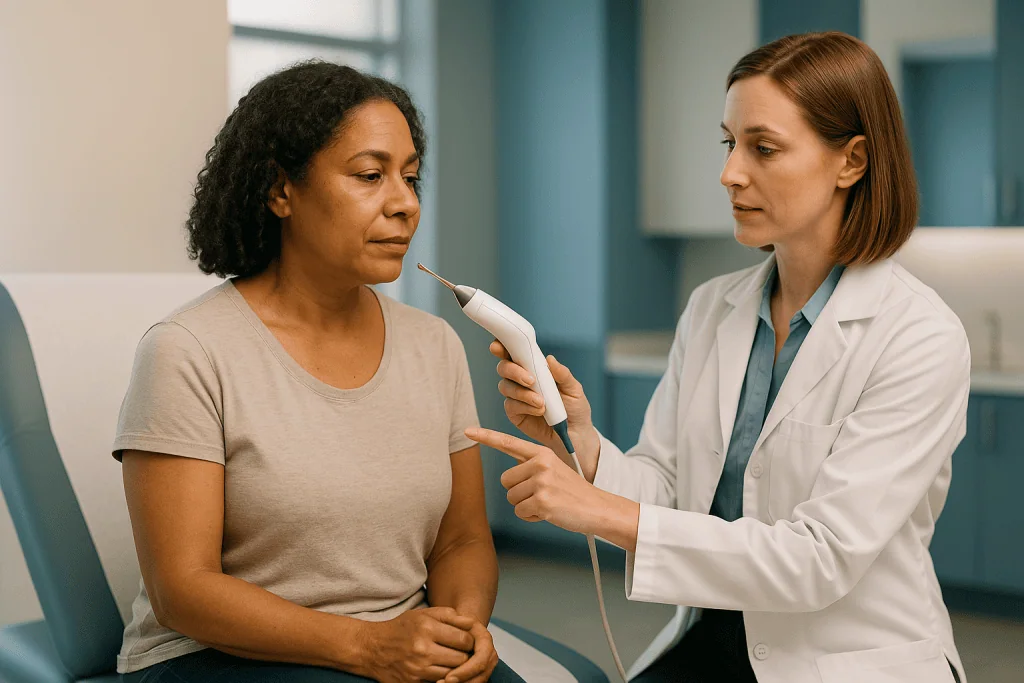
Helium plasma RF is designed to act on both from underneath. The surgeon first creates a small tunnel in the fat layer, almost always as part of liposuction. Then the plasma wand is passed back and forth through that space, tip pointing up toward the skin’s underside.
Each pass does three things in a fraction of a second. The plasma beam heats the deep dermis and the fibrous septae. The tissue contracts, the way a strand of hair curls when it passes near a flame. And the continuous stream of helium immediately cools the treated spot, so the heat does not linger and spread.
That rapid heat-then-cool cycle is the technology’s central selling point. Older subdermal heating methods, such as laser or plain RF probes, keep tissue warm for longer, which raises the odds of a burn reaching the skin surface. Helium plasma delivers its energy in a very short pulse and the gas carries excess heat away.
The immediate contraction a surgeon sees on the table is only part of the story. The controlled injury also signals fibroblasts, the cells that manufacture collagen, to begin repair work. That process unfolds over months and is what patients are really waiting for. Whether the final result matches the on-table contraction is a question we return to when discussing evidence.
Why does heat tighten skin? Collagen in plain terms
Collagen is the rope of the body. In the dermis it forms a dense, braided lattice that gives skin its strength and its ability to snap back. Each collagen fiber is a triple helix, three protein strands wound tightly around one another and held by molecular cross-links.
Heat those fibers past a certain threshold and the cross-links begin to break. The strands lose their ordered twist and bunch up, and the fiber shortens. This is denaturation, the same chemistry that turns a translucent egg white opaque and firm in a pan. Applied to skin, a shortened lattice means a tighter surface.
There is a catch, and it is the one that separates responsible practitioners from optimistic ones. Too little heat and nothing happens. Too much and the collagen does not merely shorten; it dies, along with the tissue around it, producing scarring, hard lumps, or a burn that reaches the surface. The window between “contract” and “destroy” is narrow.
Every energy-based tightening technology, from ultrasound to microneedle RF to helium plasma, is an attempt to sit inside that window reliably. Cleveland Clinic’s explanation of radiofrequency skin tightening notes that the goal is to heat the dermis enough to stimulate collagen production without damaging the surface layer, and that visible change builds gradually as new collagen forms.
The second act, new collagen, is slower and less predictable than the first. Fibroblasts respond to injury by laying down fresh fibers over weeks to months. How much they lay down depends on age, genetics, smoking, sun damage, nutrition, and how much elastic reserve the skin had to begin with. That is why two people treated identically can look different half a year later, and why no clinician can promise a specific outcome.
How does J Plasma work with liposuction?
In real operating rooms, helium plasma RF is rarely a stand-alone treatment. It is almost always the second half of a two-step procedure, and understanding why answers most of the confusion in the “J plasma vs liposuction” search results.
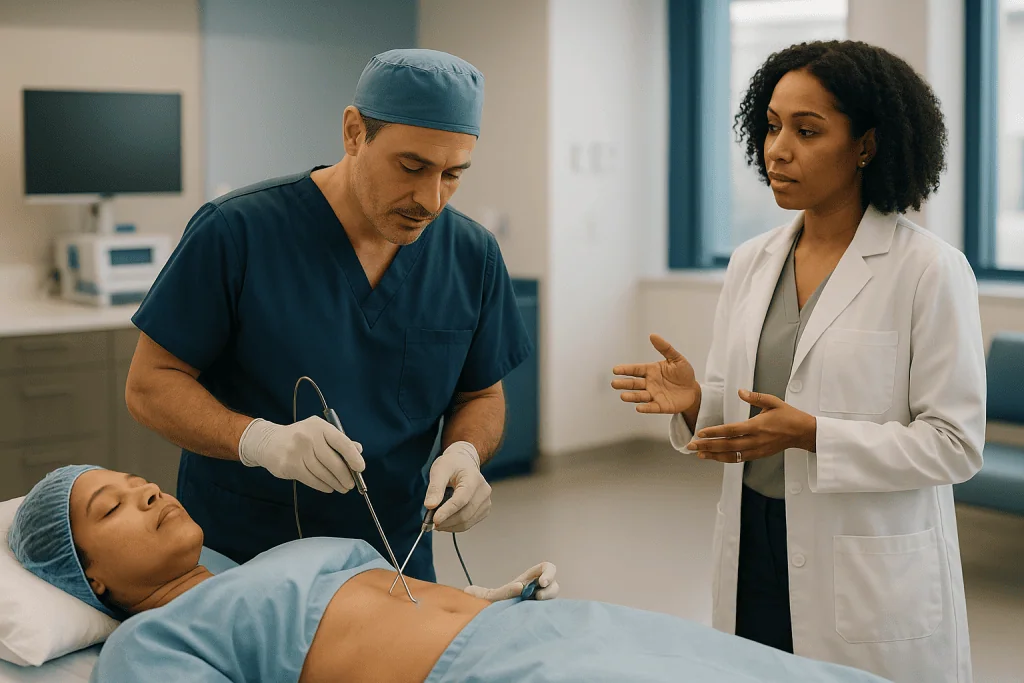
Liposuction removes fat. It does not tighten skin. Mayo Clinic is direct about this: liposuction is a body-contouring procedure that suctions fat through a thin tube called a cannula, and results depend heavily on having skin with good elasticity that can redrape over the new contour. When a large volume of fat is removed from under skin that has already lost its bounce, the skin can hang like a deflated balloon.
That gap is where the plasma wand comes in. After the surgeon has completed liposuction, the same tunnels used by the cannula give access to the underside of the skin. The plasma probe is passed through those existing channels, so no additional incisions are usually needed. The heat is applied to the freshly thinned tissue and the septae that liposuction has partly loosened.
Think of it as taking in the fabric after removing the stuffing. Liposuction reduces volume; the plasma step attempts to shrink the envelope to fit.
Three practical points follow. First, the tightening effect is modest and cannot substitute for excising skin surgically when there is a lot of excess. Second, the combination adds heat injury on top of the mechanical trauma of liposuction, so swelling and firmness typically last longer than after liposuction alone. Third, the technology is used on many body areas in practice, but its regulatory clearance history, the areas it was formally cleared for, and the settings used all vary. These are legitimate questions to raise with the surgeon rather than assume.
Who is helium plasma skin tightening usually for, and who is asked to wait?
The clearest candidate profile is someone with mild to moderate skin laxity in a defined area, who is close to a stable weight, and who understands that the goal is improvement rather than transformation. Common zones include the lower abdomen, the flanks, the inner thighs, the upper arms, the area beneath the chin, and above the knees.
Skin quality matters more than age. A forty-year-old with sun-thinned skin and stretch marks may have less elastic reserve than a fifty-five-year-old who has protected their skin. Surgeons often perform a simple pinch test in consultation: skin that snaps back briskly is more likely to respond to heat than skin that folds and stays.
People who are often asked to wait, or to consider a different approach, include:
- Anyone still actively losing weight, since results track body composition and further loss can loosen skin again.
- People with significant excess skin, for whom Mayo Clinic notes a tummy tuck or other surgical lift removes skin in a way that heating cannot.
- Those who are pregnant, breastfeeding, or planning a pregnancy soon.
- Smokers and vapers, because nicotine narrows blood vessels and slows the very healing that produces new collagen.
- People with uncontrolled diabetes, bleeding disorders, active skin infection in the area, or conditions that impair wound healing.
- Anyone with an implanted electrical device such as a pacemaker, since RF energy can interfere with it; this needs specialist clearance.
None of these is an automatic no. Each is a conversation between the person and the treating team, who can weigh the individual’s history, examine the skin in person, and decide whether the likely benefit is worth the risk. That decision cannot be made from a photograph or an online quiz.
J plasma vs liposuction vs tummy tuck: what each one actually does
These three procedures are often bundled together in search results as if they were competing brands of the same product. They solve different problems. Here is how they line up in plain terms, drawing on Mayo Clinic and NHS descriptions of liposuction and abdominoplasty.
| Question | Liposuction alone | Liposuction plus helium plasma RF | Tummy tuck or surgical lift |
|---|---|---|---|
| What it removes | Fat | Fat, with heat applied to tighten the skin envelope | Fat and excess skin; often repairs separated abdominal muscles |
| Best suited to | Good skin elasticity, localized fat | Mild to moderate laxity, stable weight | Significant excess skin, post-pregnancy muscle separation |
| Scars | Several small entry points | Same small entry points | Long hip-to-hip incision, plus around the navel |
| Anesthesia | Local with sedation or general | Usually general or deep sedation | General |
| Typical downtime | Days to a couple of weeks; swelling settles over months | Similar, with firmness and swelling often lasting longer | Several weeks off normal activity; months for full recovery |
| Key limitation | Does not tighten skin | Modest tightening only; added thermal risk | Major surgery with a permanent scar |
The honest summary: the plasma step is an add-on that shifts liposuction slightly toward the tightening end of the spectrum. It does not move it all the way to what excision achieves. A person who needs a tummy tuck and receives plasma instead may end up disappointed, and a person who only needs modest smoothing may not need the added heat at all.
The NHS reminds people that cosmetic surgery is a personal decision, that it carries risks, and that anyone considering it should take time and be clear about what they want to change and why. That advice applies across all three columns.
What happens on the day of the procedure?
Most helium plasma RF procedures are performed in an operating room or an accredited surgical suite rather than a clinic treatment chair, because they are paired with liposuction and usually require deep sedation or general anesthesia. The morning typically looks like this.
After consent is re-confirmed and photographs are taken, the surgeon marks the treatment areas while the patient stands, since fat and skin fall differently lying down. An anesthesia clinician reviews medical history, recent medications, and fasting.
Once the patient is asleep or sedated, the surgeon infuses the area with tumescent fluid, a large volume of dilute salt solution containing a local anesthetic and a medicine that constricts blood vessels. This numbs the tissue, reduces bleeding, and separates the fat layer, making it easier to work in. Mayo Clinic describes this tumescent technique as the most common approach to liposuction.
Liposuction follows. Through incisions of a few millimeters, the cannula is moved back and forth to break up and suction fat. Then the plasma wand replaces the cannula in those same tunnels. The surgeon activates the device in short bursts while moving it, feeling the tissue firm beneath the free hand and watching the skin surface for any sign of overheating. A steady flow of helium exits the tip throughout; some of it is vented back out of the incisions.
The entire session may take one to several hours depending on how many areas are treated. Afterward, the incisions are either left open to drain excess fluid or lightly closed, and a compression garment is fitted. Most people go home the same day with someone to drive them and stay overnight.
The specifics vary between surgeons, and the team should be willing to walk through their exact routine, including who monitors anesthesia and where the procedure takes place.
J plasma recovery time: what the following days and weeks usually look like
Recovery is where marketing and medicine diverge most sharply. “Minimally invasive” describes the size of the incisions, not how the body feels afterward. Beneath those small entry points, the tissue has been mechanically disrupted by liposuction and then heated.
The first two to three days usually bring soreness that many people compare to a hard workout, along with bruising and a steady weep of pink tumescent fluid from the incisions. Compression garments are typically worn around the clock. Walking gently around the house is encouraged from the first evening, because moving the calf muscles is the simplest defense against blood clots after any procedure done under anesthesia.
Swelling peaks over the first week and then begins a slow retreat. Mayo Clinic notes that after liposuction, swelling may take several months to settle before the final contour is visible. Adding heat tends to extend this. A firm, sometimes lumpy texture under the skin is common in treated zones for weeks and reflects healing tissue rather than a failed result; it usually softens with time and, when the surgeon advises it, gentle massage.
Numbness or odd tingling over the treated area is also expected, since small sensory nerves are disturbed by both the cannula and the heat. Most sensation returns gradually, though Mayo Clinic lists permanent numbness among liposuction’s possible complications.
Many people return to desk work within about a week and to light exercise within a few weeks, following their surgeon’s clearance. Skin tightening itself is the slow act: because it depends on new collagen, Cleveland Clinic describes results from RF-based tightening as developing over months rather than days. Judging the outcome at week two is like judging a loaf of bread while it is still in the oven.
How long does J plasma skin tightening last? What the evidence shows
This is the question people most want a crisp number for, and it is the one where honesty requires nuance.
Start with what is solid. Collagen that has been contracted by heat does not un-contract on its own. New collagen laid down during healing is real tissue that remains. In that narrow sense, the change produced by a single session is durable rather than temporary, more like a scar than a facial filler that the body absorbs.
Now the caveats. The skin continues to age. Sun exposure, smoking and time keep breaking down collagen regardless of what was done underneath. Weight changes stretch or loosen the envelope again; Mayo Clinic notes that liposuction results hold only as long as weight remains stable. So the tightened skin is a new starting point, not a freeze-frame.
The published evidence base for helium plasma RF specifically is thinner than the volume of advertising suggests. Much of it consists of manufacturer-supported studies, case series without comparison groups, and surgeon-assessed photographs, which are prone to optimism. Follow-up periods in many reports are measured in months rather than years. High-quality randomized trials comparing liposuction alone with liposuction plus plasma, judged by blinded assessors, remain scarce.
What can be said with reasonable confidence is that measurable skin contraction occurs, that it is modest, and that the on-table shrinkage a surgeon sees overstates what remains once swelling resolves. Beyond that, anyone quoting a precise percentage of tightening or a guaranteed number of years is going past the evidence.
A fair way to frame the question with a surgeon: ask what their own long-term follow-up shows, how they measure it, and how their patients with skin similar to yours have fared several years on.
J plasma side effects and risks, described neutrally
Because the procedure combines liposuction with subdermal heating, it inherits the risks of both. Mayo Clinic’s liposuction overview lists contour irregularities such as bumps and waviness, fluid pockets called seromas, numbness, infection, puncture of internal organs by the cannula, fat embolism in which loosened fat travels to the lungs, kidney and heart strain from fluid shifts, and toxicity from the local anesthetic in tumescent fluid. General anesthesia carries its own small but real risks.
The heat adds a distinct set. Burns to the skin surface can occur if energy is delivered too close to the underside or held too long in one spot; these may leave permanent marks or require wound care. Overtreatment can produce hardened areas of dead fat, known as fat necrosis, that feel like firm lumps and sometimes need drainage or removal. Sensory nerves near the surface can be injured by heat as well as by the cannula, and in some cases numbness is prolonged.
Helium itself introduces one uncommon but serious concern. The gas is delivered under the skin and must have a route out. If it accumulates, it can track along tissue planes far from the treatment site or, rarely, enter blood vessels. Case reports and regulator safety communications have described gas-related complications, including gas embolism, with subdermal use of helium plasma devices, which is why surgeons vent the incisions and avoid closed spaces. This is not a reason for panic, but it is a reason to choose an experienced team working in a properly equipped facility.
Longer term, scarring under the skin can tether it in ways that look worse than the original laxity, and asymmetry between treated sides is possible. Revision procedures are sometimes needed.
These are the risks a thorough consent discussion covers. If the conversation skips them, that is information too.
Is J plasma really worth it? An evidence-first way to decide
“Worth it” is a personal calculation, and this magazine does not publish prices, so the question here is framed the way a clinician would: is the likely benefit meaningful enough, for this person, to justify the risk and recovery?
Start with the size of the problem. If the loose skin is a soft, thin fold that pinches to a fingertip’s width and snaps back when released, heat-based tightening has something to work with. If it hangs as a distinct apron, drapes over a waistband, or has lost its elasticity to the point of feeling like tissue paper, no amount of heat will lift it. Mayo Clinic is explicit that a tummy tuck addresses excess skin in a way liposuction cannot, and the plasma step does not change that arithmetic by much.
Consider what “success” would look like in daily life. Fitting a favorite garment more smoothly is a realistic goal. A flat, taut surface with no visible skin excess is usually not.
Weigh the added heat honestly. It brings extra swelling, firmness, a longer wait for results, and a modest but real increase in complication risk over liposuction alone. For some people, that trade is worth a few extra points of tightening. For others, especially those with genuinely good skin, liposuction by itself may achieve most of what they want.
Finally, consider the evidence quality discussed above. A treatment supported mainly by short-term, unblinded reports deserves more modest expectations than one backed by long-term controlled trials. That does not make it worthless; it makes it an option to approach with clear eyes.
The person best placed to run this calculation is a board-certified surgeon who examines the skin in person and is willing to say, when true, that a simpler or larger operation would serve better.
What are the alternatives to helium plasma skin tightening?
Loose skin has a range of responses, and helium plasma RF sits somewhere in the middle of the ladder. Knowing the other rungs helps a person recognize whether they are being offered the right one.
At the gentlest end are non-invasive energy devices applied from outside the skin: external radiofrequency, focused ultrasound, and radiofrequency delivered through fine needles. Cleveland Clinic describes external RF tightening as an outpatient treatment with little downtime, results that build gradually over months, and effects that are subtle and best suited to mild laxity. These typically require several sessions and produce smaller changes than anything done from beneath the skin.
Liposuction alone, as discussed, removes volume and relies on the skin’s own elasticity to redrape. For people with good skin, it may be enough.
At the most invasive end sit excisional procedures: abdominoplasty, arm lift, thigh lift, neck lift, and after major weight loss, body lift. These physically remove skin and often tighten underlying muscle or fascia. The NHS describes a tummy tuck as major surgery, usually under general anesthesia, with a hospital stay and a recovery of several weeks, in exchange for the only method that reliably removes large amounts of excess skin.
The alternative that is easiest to overlook is doing nothing, or focusing on what maintains skin quality over time: stable weight, sun protection, not smoking, resistance training that builds the muscle beneath the skin, and giving skin that has recently been stretched a year or more to recover on its own, which it often partly does after pregnancy or weight loss.
Each option has a place. The right surgeon lays out the ladder and helps a person find the rung that matches their anatomy and their tolerance for scars, downtime and risk, rather than the one that happens to be on the menu.
What people often get wrong about J Plasma
“It’s a non-surgical treatment.” The incisions are small, but the procedure involves anesthesia, tumescent fluid, liposuction, and heating tissue from the inside. It is surgery, with surgical risks and a surgical recovery, and should take place in a facility equipped for surgical emergencies.
“It replaces a tummy tuck.” Heat shrinks collagen by a modest amount. It cannot remove a hanging fold, repair separated abdominal muscles, or relocate a navel. People with significant excess skin who choose plasma over excision because of the scar are the group most often disappointed.
“The results are immediate.” Some contraction is visible on the operating table, but swelling quickly hides it, and the meaningful part of the result depends on collagen remodeling that unfolds over months, as Cleveland Clinic describes for RF-based tightening in general.
“If a little heat helps, more will help more.” The relationship is not linear. Past a certain point additional energy stops tightening and starts destroying tissue, causing burns, necrosis and scarring. Restraint is a skill.
“It melts fat.” The plasma step is not designed to remove fat. Liposuction does that. The heat acts on the fibrous and dermal tissue that remains.
“It’s permanent.” The collagen change is durable, but skin keeps aging and weight can change. A tightened area is a new baseline, not a pause button.
“Helium is harmless, so the gas part doesn’t matter.” Helium is inert, but any gas introduced under the skin needs a way out. Proper venting technique is part of safe practice, and gas-related complications, though uncommon, have been reported.
The pattern across these myths is the same: the technology is real and does something useful, and the mistakes come from stretching that something into a promise it cannot keep.
Questions to ask your care team before agreeing to helium plasma RF
A consultation is not a sales appointment. The questions below are the ones a well-informed friend inside medicine would want asked, and the quality of the answers tells you as much as the answers themselves.
- Looking at my skin specifically, how much tightening do you realistically expect, and how do you measure it in your own patients over time?
- Would liposuction alone, or a surgical lift, serve me better? Why or why not?
- Which body areas do you treat with this technology, and what is the regulatory clearance status for each area you are proposing?
- What is your training and experience with subdermal energy devices, and how many of these procedures do you perform each year?
- Where will the procedure take place, is the facility accredited, and who will administer and monitor anesthesia?
- How do you prevent and manage heat injury to the skin, fat necrosis, nerve damage, and gas-related complications?
- What happens if I have a complication after hours or after I have gone home? Who do I call, and where would I be treated?
- What does your typical patient’s recovery look like week by week, and when do you expect to see the final result?
- What are the chances I might need a revision, and how is that handled?
- Can I speak with a patient of yours who had similar skin and is at least a year out?
- What would you advise me to do to protect the result, and what would undo it?
Notice that none of these questions asks the surgeon to sell the procedure. They ask the surgeon to think out loud about whether it fits. A team that welcomes them, answers plainly, and is comfortable saying “you might not need this” is demonstrating the judgment that matters far more than any device.
Write the answers down. Take them home. Decisions about elective surgery improve with a night’s sleep between the consultation and the signature.
When to call your doctor after helium plasma skin tightening
Most recovery is uncomfortable but uneventful. Some signs, however, mean the treating team should hear from you the same day, and a few mean emergency services rather than a phone call.
Call your surgical team promptly if you notice:
- Increasing rather than decreasing pain after the first few days, or pain concentrated in one spot.
- Spreading redness, warmth, or skin that looks dusky, blistered, or blanched white over a treated area, which may indicate a burn or compromised blood supply.
- Thick, cloudy or foul-smelling drainage from an incision, or a fever.
- A rapidly enlarging, tense swelling on one side, which may signal bleeding or a fluid collection.
- Numbness that is worsening, or new weakness in a limb.
- A crackling sensation under the skin when pressed, or swelling that has traveled well beyond the treated zone, which can indicate trapped gas.
Seek emergency care immediately for:
- Chest pain, sudden shortness of breath, coughing up blood, or a racing heartbeat, which can indicate a clot or embolism in the lungs.
- Calf pain, swelling or tenderness in one leg, a possible deep vein thrombosis, which Mayo Clinic notes can occur after surgery and periods of immobility.
- Confusion, fainting, sudden severe headache, difficulty speaking, or weakness on one side of the body.
- Severe abdominal pain, a rigid belly, or vomiting after abdominal treatment.
- Signs of a serious allergic reaction: swelling of the face or throat, hives, wheezing.
When in doubt, call. Surgical teams would far rather reassure ten people than miss one complication, and early treatment changes outcomes for infections, clots and burns. Keep the after-hours number somewhere you can find it without searching, and make sure the person staying with you has it too.
Frequently asked questions
How does J plasma work in one sentence?
Radiofrequency energy turns a stream of helium gas into a plasma that briefly heats the underside of the skin, making collagen fibers contract and prompting new collagen to form over the following months. The device is passed under the skin through small incisions, usually after liposuction, and the helium flow cools each spot as soon as it is heated.
Is J plasma really worth it?
It depends on how much loose skin you have and how elastic it still is. For mild to moderate laxity at a stable weight, adding helium plasma RF to liposuction can produce modest extra tightening. For significant excess skin, it is unlikely to satisfy, and a surgical lift addresses the problem more reliably. A surgeon who examines you in person can help weigh benefit against added risk.
How much does J plasma cost?
This magazine does not publish prices for any procedure, because they vary widely and because price is a poor guide to whether a treatment fits your anatomy. The more useful question is whether this approach, liposuction alone, or a surgical lift is most likely to achieve the change you want, which is something to work through with a qualified surgeon during consultation.
How long does J plasma last?
The collagen contraction and new collagen produced by a single session are durable tissue changes rather than temporary effects. However, skin keeps aging, sun and smoking continue to break down collagen, and weight changes can loosen the area again; Mayo Clinic notes liposuction results hold only with stable weight. Long-term controlled data on helium plasma specifically remain limited, so no one can promise a set number of years.
Is J plasma better than lipo?
They are not alternatives; the plasma step is usually added to liposuction. Liposuction removes fat and relies on skin elasticity to redrape, while helium plasma RF attempts to tighten the skin envelope afterward. For someone with good skin, liposuction alone may be enough. For mild laxity, the combination may help. Neither replaces skin excision when excess is significant.
What is the typical J plasma recovery time?
Most people manage desk work within about a week and light exercise within a few weeks, with their surgeon’s clearance. Bruising, drainage and soreness dominate the first days, swelling peaks in the first week, and firmness under the skin can persist for weeks. Mayo Clinic notes swelling after liposuction can take several months to fully settle, and heat tends to extend that.
What are the most common J plasma side effects?
Swelling, bruising, numbness, firm or lumpy areas, and fluid drainage are expected in the short term. Less common but more serious effects include skin burns, fat necrosis, prolonged nerve injury, infection, fluid collections, and contour irregularities. Rarely, gas introduced under the skin can cause complications, and liposuction itself carries risks such as clots and fat embolism.
Can J plasma be done without liposuction?
Technically the device can be used alone, but in practice it is almost always paired with liposuction because the cannula creates the tunnels through which the plasma wand is passed, and because thinning the fat layer helps the skin redrape. Stand-alone use is less common and the evidence for it is thinner, so ask your surgeon specifically what they are proposing and why.
Does J plasma work on the face and neck?
Helium plasma RF has been used beneath the chin and along the jawline, where a small amount of tightening can change the profile. Skin in these areas is thinner and nerves lie closer to the surface, which narrows the safety margin. Regulatory clearance for specific body areas has varied over time, so ask the surgeon about the status for the area they propose to treat.
What is the difference between J plasma and radiofrequency microneedling?
Radiofrequency microneedling delivers RF heat into the dermis from outside through fine needles, usually in several outpatient sessions with little downtime, and produces subtle tightening. Helium plasma RF delivers heat from beneath the skin through small incisions during surgery, producing a larger but riskier effect. Cleveland Clinic describes external RF results as building gradually over months, and the same slow timeline applies to plasma.
References
This article is for general information only and is not a substitute for professional medical advice. Please consult a qualified doctor about your individual situation.

More from the Blog
When an Arm Lift Needs Revision: Widened Scars, Residual Laxity and a Second Procedure
An arm lift revision is a second operation, or sometimes a smaller office procedure, that addresses problems left after a brachioplasty: scars that have…

What Are the Risks of Fat Transfer? Cysts, Fat Necrosis and Uneven Volume Explained
Fat transfer risks fall into two groups. At the liposuction donor site: bruising, numbness, fluid collections, contour dents and infection. At the recipient site:…

Fat Grafting Recovery: Protecting the Grafted Area While the Donor Site Heals
Fat grafting recovery runs on two tracks at once: the grafted area needs protection from pressure, heat and movement while transplanted fat cells form…

BBL Safety Explained: Why Fat Placement Depth Matters and How Surgeons Reduce the Risk
A Brazilian butt lift (BBL) is safest when fat is placed only in the subcutaneous layer above the gluteal muscle. Fat injected into or…
Laser Liposuction vs Traditional Liposuction: Incisions, Downtime and Skin Response Compared
Laser liposuction and traditional liposuction both remove fat through small skin incisions with a thin tube called a cannula. The laser version first heats…
Loose Skin After Weight Loss: What Improves on Its Own, and When Surgery Is the Answer
Mild skin laxity after weight loss often improves gradually over 12 to 24 months as collagen remodels, especially in younger people who lost a…