

How Does the Surgeon See Inside? Camera Ports and Gas in Gastric Laparoscopic Surgery
Key Takeaways
- The gas used to inflate the abdomen during laparoscopic surgery is carbon dioxide, chosen because it dissolves in blood, is exhaled through the lungs and does not burn near electrical instruments.
- Shoulder-tip pain after keyhole stomach surgery is referred pain from gas irritating the diaphragm, which shares nerve roots with the shoulder; the NHS notes it usually settles within a few days.
- MedlinePlus describes gastric bypass being performed through four to six small cuts, with one port for the camera, others for two-handed instruments, an assistant and a liver retractor.
- A sleeve gastrectomy removes about 80 percent of the stomach with one long staple line, while a Roux-en-Y bypass creates a walnut-sized pouch and two new intestinal joins, according to the NIDDK and Mayo Clinic.
- Weight on the scale in the first week largely reflects fluid shifts; the NIDDK notes most total loss occurs within the first one to two years, after which weight typically stabilizes.
- A resting heart rate that stays fast, fever, or worsening abdominal pain in the first two weeks are treated as possible signs of a staple-line leak and warrant immediate contact with the surgical team.
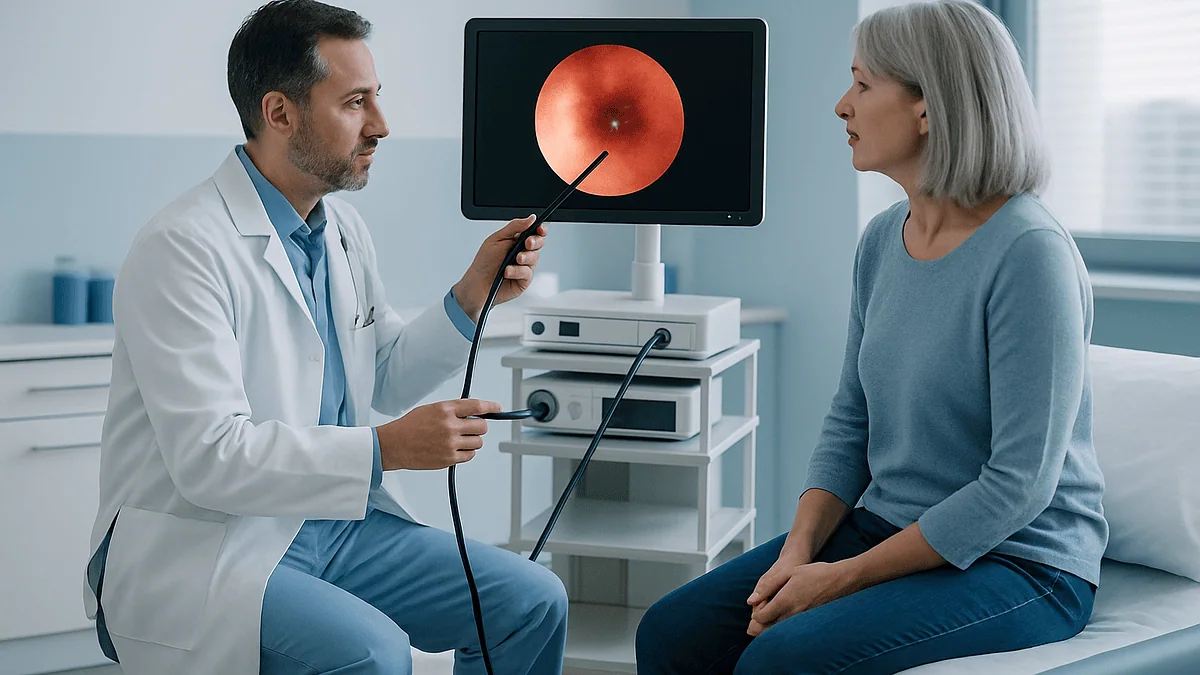
In laparoscopic gastric surgery, the surgeon works through several small cuts in the abdomen rather than one long incision. Carbon dioxide gas is pumped in to lift the abdominal wall away from the organs, creating a working space. A thin lighted camera passes through one port and shows the stomach on a screen, while long instruments through the other ports reshape or bypass it under general anesthesia.
The night before her operation, a woman in her forties sat on the edge of the bed turning the consent form over in her hands. She had read the word laparoscopic a dozen times. What she could not picture was the physics of it: how anyone could take away most of a stomach through cuts no longer than a paper clip, without looking directly at what they were doing.
It is a fair thing to wonder about. Most explainers skip straight from the waiting room to the recovery diet and leave out the part that actually happens on the table. Understanding how laparoscopic gastric surgery works, from the gas that makes room to the camera that does the looking, tends to make the whole experience less abstract and less frightening.
This article walks through that mechanics, what the following weeks usually feel like, and which worries are grounded in evidence and which are not. Every decision about whether surgery is right for you stays with your treating team.
How laparoscopic gastric surgery works: the view from a keyhole
Laparoscopy is surgery performed through small openings using a camera, instead of through one large incision. The word comes from the Greek for looking into the flank, and that is still the essence of it. The surgeon does not see your stomach with their own eyes. They see it on a high-definition monitor, magnified, lit from inside, often more clearly than an open view would allow.
Three things make this possible. First, a working space: your abdomen is normally a snug fit, with organs pressed against each other and against the abdominal wall. Gas creates a dome of room. Second, a camera: a laparoscope is a slim, rigid telescope with a light source and lens at the tip, connected to a camera that feeds the screen. Third, access ports: hollow tubes called trocars pass through the abdominal wall and act as fixed doorways, so instruments can slide in and out without repeatedly cutting tissue.
Once these are in place, the surgeon holds long, slender instruments whose tips are inside you while the handles sit outside. Graspers hold tissue, staplers divide it and seal it in one motion, and energy devices cut and control bleeding. Everything is done under general anesthesia, which means you are fully unconscious and a breathing tube is placed for the duration. MedlinePlus describes the same basic approach for gastric bypass, with the surgeon making four to six small cuts in the belly to place the scope and instruments.
The practical effect is that the operation on the inside is essentially the same as an open one. What changes is the size of the door you go through, and that difference shows up mostly in how your abdominal wall feels afterward.
Do they put gas in you for laparoscopic surgery?
Yes. This surprises many people, but the gas is the reason keyhole surgery is possible at all. Without it, the camera would be pressed against a wall of bowel and fat with nowhere to look.
The gas used is carbon dioxide, the same gas you exhale with every breath. Surgeons chose it for reasons that matter to safety. It dissolves readily in blood, so small amounts that reach the bloodstream are carried to the lungs and breathed out rather than forming a lasting bubble. It does not burn, which matters when electrical cutting instruments are in use. And the body already has a system for clearing it. The NHS laparoscopy guidance describes this step plainly: the abdomen is inflated with carbon dioxide so the surgeon can see the organs.
The process is called insufflation, which simply means blowing gas into a body cavity. A thin needle or the first port is placed near the navel, and a machine delivers gas at a controlled, monitored pressure. The abdominal wall rises like a tent, lifting away from the organs by several centimeters. Throughout the operation, the machine keeps the pressure steady and tops up gas as it escapes around the ports.
Because the raised pressure pushes on the diaphragm and the large veins in the abdomen, the anesthesia team watches breathing and circulation closely. In people with certain heart or lung conditions this pressure is a consideration in planning, which is one reason your pre-operative assessment covers those systems in detail.
At the end, the surgeon releases as much gas as possible through the ports before closing. A little always remains, and that leftover gas explains one of the most common post-operative complaints, which we will come to shortly.
What are camera ports, and why does the surgeon need several?
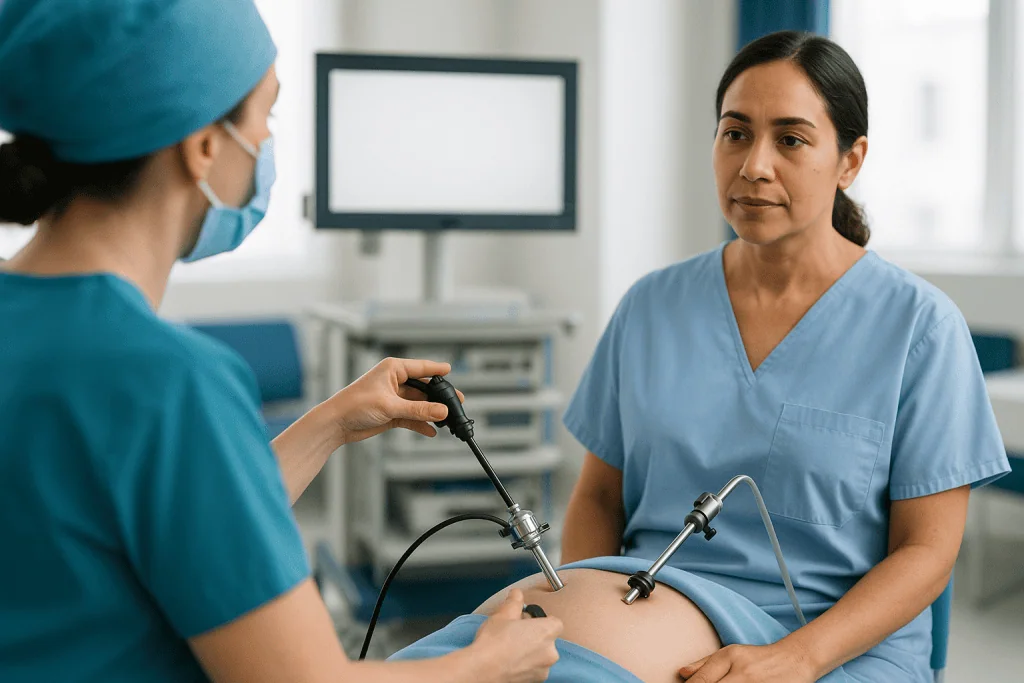
A port is a hollow tube, usually plastic, with a valve at the outer end that stops gas from leaking. The valve opens when an instrument is pushed through and seals again when it is withdrawn. Ports come in a small range of diameters. Narrow ones admit graspers and scissors; wider ones are needed for the stapler and for removing tissue.
Why not just one? Think of trying to tie a shoelace through a single keyhole with a torch held in your teeth. Surgery is a two-handed activity, and the camera needs its own steady position. A typical gastric operation uses one port for the laparoscope, two for the surgeon’s working hands, one for an assistant to hold tissue out of the way, and often one more for a liver retractor, a flat paddle that lifts the left lobe of the liver off the stomach. That liver sits directly over the top of the stomach and would otherwise block the view entirely.
The placement is not random. Ports are arranged in a rough arc so instruments approach the stomach from angles that avoid clashing, a principle surgeons call triangulation. The camera port is usually placed a little above and to the left of the navel for stomach work, so the scope looks up toward the top of the stomach where most of the reshaping happens.
Each port leaves a small scar. MedlinePlus notes four to six cuts for gastric bypass, and sleeve gastrectomy is similar. One incision is often slightly longer because the removed portion of stomach, in a sleeve operation, has to come out through it inside a protective bag.
Some centers use a single larger incision at the navel or a robotic platform where the surgeon controls the instruments from a console. The gas, the camera and the principle are identical; only the hardware differs.
How laparoscopic gastric surgery works, step by step, on the day
Here is the sequence a patient would see if they could watch their own operation, with the technical terms translated as they appear.
You arrive having fasted as instructed. In the anesthetic room you receive medicines through a drip and go to sleep; a breathing tube is placed once you are unconscious. Your legs may be fitted with pumping sleeves that squeeze the calves rhythmically to keep blood moving, a standard step against clots.
The team positions you with your head slightly higher than your feet, which lets gravity pull the bowel down and away from the stomach. The abdomen is cleaned and covered with sterile drapes.
The first port goes in, gas is introduced, and the camera confirms that nothing was injured during entry. The remaining ports are placed while the surgeon watches each one appear on the screen from the inside.
The liver is lifted, and the surgeon identifies landmarks: the junction where the esophagus meets the stomach, the curve of the stomach, and the blood vessels supplying it. In a sleeve gastrectomy, the vessels along the outer curve are sealed, a sizing tube is passed down the esophagus as a guide, and a stapler fires along the stomach in overlapping steps, cutting and sealing simultaneously. In a gastric bypass, the stapler creates a small pouch at the top of the stomach, and a loop of small intestine is brought up and joined to it. Mayo Clinic describes the pouch as roughly walnut-sized, holding about an ounce of food.
The surgeon checks the staple line for bleeding and often tests it for leaks with dye or air. Gas is released, ports are withdrawn, and each small cut is closed with dissolving stitches or glue. Mayo Clinic notes the whole procedure typically takes a few hours, including anesthesia.
Sleeve, bypass, band: what each operation changes inside
The camera-and-gas setup is shared. What differs is what the surgeon does once inside. The three operations people most often ask about are summarized below, drawing on descriptions from the NIH’s National Institute of Diabetes and Digestive and Kidney Diseases, MedlinePlus and Mayo Clinic.
| Operation | What is done | How it works | Reversible? |
|---|---|---|---|
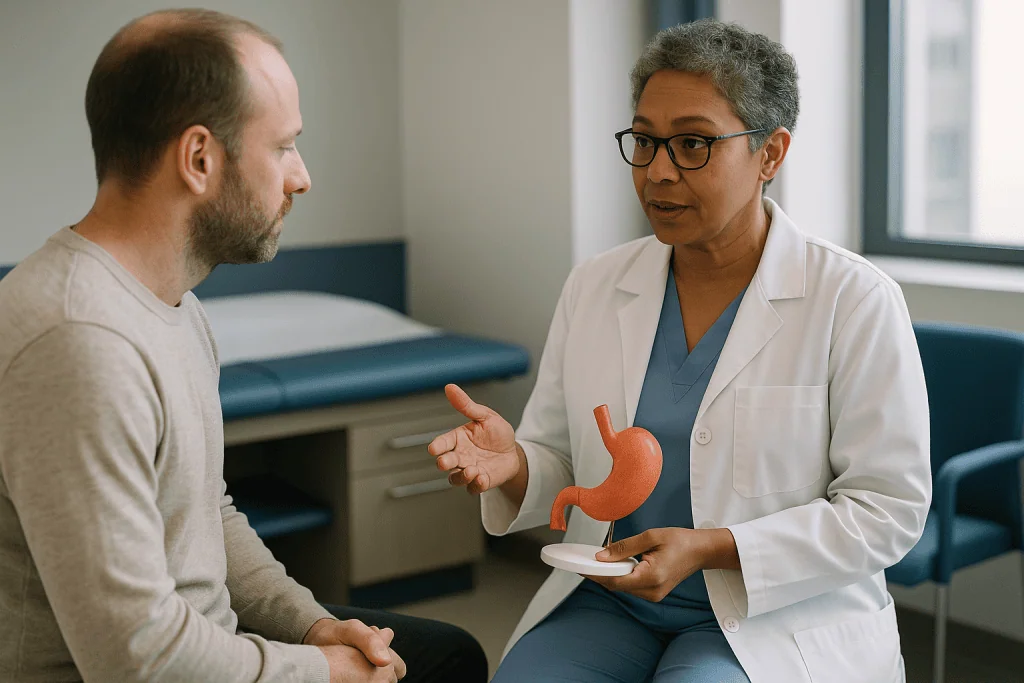
| Sleeve gastrectomy | About 80 percent of the stomach is removed along its outer curve, leaving a narrow tube | Smaller capacity; removal of the part of the stomach that produces much of the hunger hormone ghrelin | No, removed tissue cannot be replaced |
| Roux-en-Y gastric bypass | A small pouch is stapled off; a loop of small intestine is attached to it, bypassing the rest of the stomach and the first part of the intestine | Smaller capacity plus changes in gut hormones and nutrient absorption | Technically possible but complex; rarely done |
| Adjustable gastric band | An inflatable silicone ring is placed around the upper stomach and connected to a port under the skin | Creates a narrowing that slows food passing into the lower stomach | Yes, the band can be removed |
Two points deserve emphasis. First, the sleeve involves no rerouting of intestine, which is why it is often described as the simpler operation; the bypass involves two new joins, called anastomoses, each of which is a potential site of leak or narrowing. Second, the band is now performed far less often than it once was, because, as the NIDDK notes, it tends to produce less weight loss and has a higher rate of needing further surgery for slippage or erosion.
Which operation suits an individual depends on their medical history, particularly the presence of reflux, diabetes and prior abdominal surgery. That judgment belongs to the surgical team after assessment.
Who is laparoscopic gastric surgery usually for, and who is asked to wait?
Bariatric surgery, the umbrella term for operations that treat obesity by changing the digestive system, is not offered on request. Guidelines set thresholds and require that other approaches have been tried first.
The NHS describes candidates as adults with a body mass index of 40 or more, or between 35 and 40 with a condition that might improve with weight loss, such as type 2 diabetes or high blood pressure, who have tried other weight-loss methods and who commit to long-term follow-up. The NIDDK adds that some guidelines consider surgery for people with a lower BMI who have poorly controlled type 2 diabetes. BMI is a rough ratio of weight to height; it is a screening tool, not a verdict, and teams look at the whole picture.
Before a date is set, most programs require a multidisciplinary assessment. A dietitian reviews eating patterns, a psychologist or counselor discusses expectations and mental health, and the anesthetist assesses the heart and lungs, since the gas pressure and prolonged anesthesia place demands on both. Blood tests, an endoscopy to look at the stomach lining, and sleep apnea screening are common.
People are commonly asked to wait, or offered a different route, when there is untreated or unstable psychiatric illness, active substance dependence, a bleeding disorder that cannot be corrected, current pregnancy or plans to conceive within the next year or two, or a medical condition that makes anesthesia unusually risky. Smokers are often asked to stop well before surgery, because smoking impairs healing at staple lines and raises lung risks under anesthesia.
None of these is a moral judgment. They reflect the fact that a stapled stomach must heal quietly for weeks and that the person must be able to follow a demanding new eating pattern. If your team asks you to wait, asking exactly what would need to change is a reasonable question.
Why did surgeons stop opening the abdomen? Keyhole versus open, honestly
Gastric bypass existed long before the laparoscope. For decades it was done through an incision running from breastbone to navel. The stomach work was the same; the abdominal wall paid the price.
A long incision cuts through skin, fat, and the muscle sheath that holds the abdomen together. That sheath is strong but slow to heal, and every cough or step pulls on it. The consequences were predictable: more pain, more days in bed, more chest infections because deep breathing hurt, more wound infections in a large wound, and a higher chance of an incisional hernia, a bulge where the repaired sheath later gives way.
Keyhole surgery spreads that same access across several small punctures, each too small to weaken the wall meaningfully. Cleveland Clinic and MedlinePlus both list the consequences: less post-operative pain, shorter hospital stays, faster return to activity, and smaller scars. These are consistently reported advantages rather than marketing claims.
Honesty requires two qualifications. First, the internal operation carries the same intrinsic risks whichever way the surgeon gets in. A staple-line leak is no less serious because the scar is small. Second, laparoscopy has its own particular hazards: injury to bowel or blood vessels during the blind first entry, and the physiological effects of gas pressure. Both are uncommon, and both are the reason surgeons place the first port with such care and watch every subsequent one on screen.
Occasionally an operation that begins laparoscopically has to be converted to open surgery, because of dense scar tissue from earlier operations, unexpected bleeding, or an anatomy that cannot be safely seen. This is a judgment call made for safety, not a failure, and consent forms mention it for that reason. Ask your surgeon how often conversion happens in their practice and what would prompt it.
What is the safest weight loss surgery? What the evidence really says
This is among the most searched questions on the topic, and the truthful answer is that safety is not a property of the operation alone. It depends on the operation, the person, and the team.
That said, the evidence does show a pattern. The NIDDK and Mayo Clinic describe sleeve gastrectomy as technically simpler than bypass, with no intestinal rerouting and one staple line rather than two joins, and it is now the most commonly performed bariatric operation in many countries partly for that reason. Gastric bypass has more steps and a longer list of long-term nutritional consequences, but it tends to produce greater improvement in reflux and type 2 diabetes, so for some individuals it is the safer choice overall even though the operation itself is more complex. The adjustable band has the lowest immediate surgical risk of the three but, per the NIDDK, a higher rate of later re-operation.
Newer or less common operations, including single-anastomosis bypass variants and duodenal switch procedures, have narrower evidence bases, and any claim that one of them is the safest should be treated with caution until larger long-term studies exist.
Individual factors matter at least as much. Severe reflux pushes teams away from the sleeve, which can worsen it. Previous stomach surgery, certain medications that need reliable absorption, and a history of ulcers weigh on the bypass decision. Very high BMI or serious heart and lung disease raise the risk of any general anesthetic.
Team factors are real too. Accreditation programs exist because outcomes track with experience and with systems for spotting complications early. Rather than asking which operation is safest in the abstract, a more useful question for your consultation is: given my history, which operation do you think carries the lowest overall risk for me, and why?
Gas in laparoscopic surgery: why your shoulder may ache afterward
Few things puzzle recovering patients more than waking up from stomach surgery with a sore shoulder. The explanation is the leftover carbon dioxide.
The diaphragm, the sheet of muscle separating chest from abdomen, is supplied by the phrenic nerve, which arises from the same spinal levels as nerves to the shoulder and collarbone area. When residual gas collects under the diaphragm, or when the gas has irritated the diaphragm during the operation, the brain interprets the signal as coming from the shoulder tip. This is referred pain, the same phenomenon that makes a heart attack ache in the arm.
The NHS laparoscopy guidance lists shoulder pain among the expected after-effects and notes it usually settles within a few days as the gas is absorbed into the bloodstream and breathed out. Moving around, changing position, gentle walking and, in some cases, lying with the pelvis slightly raised can help the gas shift and disperse. Peppermint tea is often suggested for bloating, though evidence for its effect on shoulder pain specifically is thin.
Bloating and a feeling of pressure in the abdomen are also common in the first days and have the same cause. This is distinct from trapped intestinal gas, which comes from slowed bowel activity after anesthesia and passes as the gut wakes up.
Two points of reassurance and one of caution. The gas is not toxic and cannot cause an embolism in the recovery period; the body handles it routinely. It does not affect the healing of the staple line. But shoulder or abdominal pain that is severe, worsening after the first two or three days, or accompanied by fever, a racing heart or breathlessness is not gas pain and needs urgent assessment, as covered in the section on when to call your doctor.
Laparoscopic gastric bypass recovery time: the first days and weeks
Recovery from keyhole gastric surgery moves in two speeds. The abdominal wall heals quickly; the digestive system adapts slowly.
Most people are walking on the day of surgery or the following morning. The NHS advises that a hospital stay of one to three days is typical, and Mayo Clinic gives a similar range for gastric bypass. Early walking is not optional encouragement; it is the main defense against blood clots and chest infection, and it helps disperse residual gas.
Eating follows a staged plan. The NHS describes a progression that starts with liquids only, moves to pureed foods, then soft foods, and finally solid textures, over roughly the first six weeks. The stages exist to protect the staple line while it heals and to let you learn the new sensation of fullness, which arrives after only a few mouthfuls. Protein and fluid intake are the priorities during this period, and a dietitian usually sets the specific targets.
Pain from the port sites typically eases within the first week. Many people are back to light daily activity and desk-based work within two to four weeks, while lifting and strenuous exercise are commonly restricted for around four to six weeks, according to NHS aftercare guidance. These are typical ranges, not promises; individual recovery varies with age, fitness and any complications.
The slower adaptation continues for months. Food tolerances shift, some previously enjoyed foods become uncomfortable, and after bypass in particular the phenomenon called dumping syndrome, where sugary food entering the intestine too fast causes cramping, sweating and faintness, teaches most people quickly what to avoid. Lifelong vitamin and mineral supplementation is standard after bypass and often after sleeve, because absorption changes; the specifics are set and monitored by your team through regular blood tests.
How much weight do you lose immediately after gastric bypass?
The honest answer is that the scale in the first week mostly measures fluid, not fat. During surgery you receive intravenous fluids; afterward you eat almost nothing for days, your body burns through stored carbohydrate and the water bound to it, and the gas is absorbed. The number can swing several kilograms in either direction and means very little.
Meaningful weight loss unfolds over months. The NIDDK explains that people generally lose weight rapidly in the first months and that most of the total loss occurs within the first one to two years after surgery, after which weight typically stabilizes and some regain is common. Mayo Clinic makes the same point and stresses that long-term results depend heavily on lasting changes to eating and activity.
Why the early speed? A newly created pouch holds roughly an ounce, so calorie intake falls dramatically. Hormonal changes, especially after bypass, reduce hunger signals and alter how the body handles glucose. As the pouch and the intestine adapt over the following year, capacity increases slightly and appetite partly returns, which is why the curve flattens.
You will see specific percentage figures quoted in advertisements and forums. This article deliberately avoids them, because averages from studies conceal enormous individual variation and because promising a number is exactly the kind of claim a responsible team will not make. What your surgeon can reasonably do is describe the range seen in their patients and in published series, and explain which factors in your case might place you higher or lower in that range.
A more useful marker than the scale in the early weeks is function: how far you can walk, how well you are hydrating, whether nausea is settling. Those tell you whether recovery is on track.
What can go wrong: risks explained in plain language
Every operation carries risk, and gastric surgery has a specific profile worth understanding before you sign anything. The NHS, Mayo Clinic and MedlinePlus list broadly the same concerns.
In the first days, the most serious is a leak from the staple line or from a join in the intestine, allowing stomach or intestinal contents into the abdomen. It is uncommon but can be life-threatening, which is why fever, rising heart rate and worsening abdominal pain in the first two weeks are treated as emergencies. Bleeding, either into the abdomen or into the stomach, is another early risk, as is a blood clot in the leg that can travel to the lungs. Anesthetic complications and wound infection at port sites round out the early list.
Over the following weeks and months, narrowing at a join, called a stricture, can cause vomiting and difficulty swallowing and is often treatable by stretching from the inside with an endoscope. Ulcers can form at the join after bypass, particularly in smokers and in people who use anti-inflammatory painkillers. Gallstones are more common during rapid weight loss.
Long-term risks are mostly nutritional. Because the bypass reroutes food past the part of the intestine that absorbs iron, calcium and vitamin B12, deficiencies are common without supplements and monitoring. The sleeve carries a lower but real risk of the same, along with a tendency to worsen acid reflux. Both can lead to loose skin and, in some people, changes in mood or alcohol tolerance that need attention.
Alternatives exist and are part of any fair conversation: structured lifestyle programs, prescription medicines that act on appetite hormones, and endoscopic procedures that reduce stomach capacity without incisions. Each has a different balance of effect and risk, and the treating team is the right place to weigh them.
What people often get wrong about keyhole stomach surgery
A few misconceptions come up in almost every consultation. Correcting them changes how people feel about the operation.
The first is that keyhole means minor. The scars are minor; the surgery is not. The stomach is stapled and cut exactly as it would be through a long incision, and the internal healing timeline is identical. Treating the recovery diet casually because the wounds look small is the most common route to an avoidable complication.
The second is that the gas stays in you or can travel to the brain or heart. Carbon dioxide is absorbed into the blood and exhaled within days; it cannot persist as a bubble. The shoulder ache is nerve referral, not gas lodged in the shoulder.
The third is that the surgeon cannot see properly. In fact, the laparoscope magnifies and lights the operating field, and modern cameras give a clearer view of the top of the stomach than the naked eye can achieve through an open wound.
The fourth is that surgery does the work and willpower becomes irrelevant. The operation changes capacity and hormones, and those changes are powerful in the first year. Long-term results, as Mayo Clinic and the NIDDK both stress, depend on sustained changes to eating, activity and follow-up. The operation is a tool that makes those changes more achievable, not a substitute for them.
The fifth is that the sleeve is a lesser or temporary version of the bypass. It is a distinct operation with its own profile, permanently removes stomach tissue, and is the more commonly performed of the two in many countries.
The last is that a small scar means a fast return to lifting and sport. The abdominal wall may feel fine within days, but internal healing and the risk of hernia at port sites are why teams ask for restraint for several weeks.
Questions to ask your care team
Consultations are short and the information is dense. Bringing written questions helps, and these are ones that tend to yield useful answers rather than reassurance.
- Which operation are you recommending for me, and what in my history led you to it rather than the alternatives?
- How many ports will you use, roughly where will the scars be, and will one incision be larger than the others?
- How often do operations in your practice convert from keyhole to open, and what would prompt that decision?
- Do I have any heart or lung condition that makes the gas pressure or anesthesia a particular concern, and how will that be managed?
- What is your team’s approach to detecting a leak early, and what symptoms should make me call before my first follow-up?
- What does the staged diet look like week by week, and who do I contact if I cannot keep fluids down?
- Which supplements will I need, for how long, and how often will my blood levels be checked?
- How will my existing medicines be handled around surgery, and who is responsible for adjusting them afterward?
- What is the follow-up schedule for the first two years, and what happens if I move or change providers?
- What non-surgical options are still open to me, and how do their risks compare in my case?
Notice that none of these asks for a promised outcome. Questions about how much weight you will lose or how quickly invite numbers that cannot be guaranteed. Questions about process, safety systems and follow-up tell you far more about the care you will receive.
It is entirely reasonable to ask for a second consultation or to bring a family member. A team confident in its recommendation will not object to being asked why.
When to call your doctor
Some discomfort in the first week is expected: sore port sites, bloating, shoulder-tip ache, fatigue and mild nausea. The signs below are different. They are the ones surgical teams ask patients to report immediately, day or night, because they can indicate a leak, bleeding, a clot or an infection that needs prompt treatment. Guidance from the NHS, Mayo Clinic and MedlinePlus consistently lists them.
- A heart rate that stays fast at rest, particularly above about 120 beats per minute, even without pain; this is often the earliest sign of a leak.
- Fever, chills or shivering.
- Abdominal pain that is severe, worsening rather than easing, or spreading, especially with a rigid or very tender abdomen.
- Shoulder or chest pain that is worsening after the first few days, or breathlessness, rapid breathing or chest tightness.
- Pain, swelling, warmth or redness in one calf, which can signal a clot.
- Vomiting blood, black or tarry stools, or bright red blood from the back passage.
- Inability to keep down fluids for more than a few hours, dizziness on standing, very dark urine or no urine for many hours, all pointing to dehydration.
- Redness spreading from a port site, pus, foul-smelling discharge or a wound that opens.
- Persistent vomiting or inability to swallow saliva in the weeks after surgery, which may indicate a narrowing.
- Confusion, extreme drowsiness or a feeling of being profoundly unwell that you cannot explain.
If you cannot reach your surgical team and any of the first four symptoms is present, go to the nearest emergency department and tell them the date and type of your operation. Bring your discharge paperwork. Bariatric complications can progress quickly and are far easier to treat when caught early, and no team minds being called about something that turns out to be trapped gas.
Frequently asked questions
Do they put gas in you for laparoscopic surgery?
Yes, carbon dioxide gas is pumped into the abdomen at a controlled pressure to lift the abdominal wall away from the organs and create space for the camera and instruments. It is the same gas you exhale, dissolves in blood and is breathed out over the following days. Surgeons release most of it before closing; the small amount left behind causes temporary bloating and shoulder-tip ache.
How does the surgeon actually see the stomach during keyhole surgery?
Through a laparoscope, a slim rigid telescope with a light and lens at its tip, inserted through one of the ports and connected to a camera that displays a magnified image on a monitor. The surgeon watches the screen while manipulating long instruments through the other ports. An assistant lifts the liver out of the way with a retractor so the upper stomach is fully visible.
How long does it take to recover from laparoscopic gastric bypass surgery?
Hospital stays of one to three days are typical according to NHS guidance, with port-site pain easing over the first week. Many people return to light activity within two to four weeks, while heavy lifting is commonly restricted for around four to six weeks. The staged diet from liquids to solids takes roughly six weeks, and adaptation of eating habits continues for months. These are typical ranges, not guarantees.
What is the safest weight loss surgery?
There is no single safest operation for everyone. Sleeve gastrectomy is technically simpler with one staple line and no intestinal rerouting, while gastric bypass has more steps but may be the better overall choice for people with severe reflux or type 2 diabetes. Individual health, prior surgery and the experience of the team all affect risk. Ask your surgeon which option carries the lowest overall risk for you specifically.
How much weight do you lose immediately after gastric bypass?
Very little of the change in the first week is fat; it is mostly fluid from intravenous drips, fasting and the body using up stored carbohydrate. Meaningful loss builds over months. The NIDDK notes that weight falls fastest in the early months and that most total loss happens within one to two years, after which it stabilizes. Individual results vary widely, and no responsible team promises a figure.
Why does my shoulder hurt after laparoscopic stomach surgery?
Residual carbon dioxide gas irritates the diaphragm, the muscle under the lungs, and the diaphragm’s nerve shares spinal roots with nerves to the shoulder. The brain reads the signal as shoulder pain. The NHS lists this as an expected after-effect that fades over a few days as the gas is absorbed. Walking and changing position help. Worsening pain with fever or breathlessness is not gas pain and needs urgent review.
How many incisions are made in laparoscopic gastric surgery?
MedlinePlus describes four to six small cuts for gastric bypass, and sleeve gastrectomy is similar. Each accommodates a port: one for the camera, two for the surgeon’s instruments, one for an assistant and often one for a liver retractor. One incision is usually slightly longer so removed stomach tissue can be brought out in a protective bag. Single-incision and robotic techniques use the same principles with different hardware.
Can laparoscopic gastric surgery be converted to open surgery?
Yes, and consent forms mention this possibility. Dense scar tissue from previous operations, unexpected bleeding, or anatomy that cannot be seen safely may lead the surgeon to make a larger incision partway through. Conversion is a safety decision rather than a failure. It is reasonable to ask your surgeon how often it happens in their practice and what circumstances would prompt it.
Is laparoscopic sleeve gastrectomy explained the same way as bypass?
The access is identical: gas, camera and several ports. The difference is what happens inside. In a sleeve, the surgeon seals vessels along the outer curve of the stomach and staples off roughly 80 percent of it, leaving a narrow tube, with no intestinal rerouting. In a bypass, a small pouch is created and a loop of intestine is attached to it, producing two new joins and altered absorption.
What is the gas pressure like, and is it dangerous?
The insufflation machine delivers carbon dioxide at a set, continuously monitored pressure and tops it up as gas escapes. The pressure pushes on the diaphragm and the large abdominal veins, so the anesthesia team watches breathing and circulation throughout. In healthy people this is well tolerated. For those with certain heart or lung conditions it is factored into pre-operative assessment and planning, which is one reason those tests are done.
References
- MedlinePlus – Gastric bypass surgery
- NHS – Laparoscopy (keyhole surgery)
- NHS – Weight loss surgery: what happens and afterwards
- NIH NIDDK – Types of weight-loss surgery
This article is for general information only and is not a substitute for professional medical advice. Please consult a qualified doctor about your individual situation.

More from the Blog
Questions to Ask Your Bariatric Surgeon Before Signing the Consent Form
Before signing a bariatric surgery consent form, ask your surgeon how many of your specific operation they perform each year, why they recommend that…
Bile Reflux After Mini Gastric Bypass: An Honest Look at the Risk and How It Is Managed
Bile reflux after a mini gastric bypass (also called one anastomosis gastric bypass) happens when bile from the bypassed bowel loop flows back into…

What Happens When the Gastric Balloon Comes Out? Removal and Keeping Habits Afterward
Gastric balloon removal is a short endoscopic procedure, usually done under sedation about six months after placement: the balloon is punctured, drained, and drawn…

Gastric Bypass Recovery Stages: From the Hospital Bed to Your First Solid Meal
Gastric bypass recovery usually moves through stages: a hospital stay of roughly one to four days, a liquid-only diet for the first days, pureed…
When Is the Right Time for Bariatric Contouring? Weight Stability and Nutrition Checks
Body contouring after bariatric surgery is usually considered once weight has been stable for several months, most often 12 to 18 months or more…

Eating After Gastric Sleeve Surgery: Portion Sizes, Protein First and Foods That Cause Trouble
Long-term eating after gastric sleeve surgery settles into a pattern of small, protein-first meals, roughly a cup of food at a time for most…