

How Hi Def Liposuction Is Performed: Mapping Muscle Lines Before Fat Is Sculpted
Key Takeaways
- Hi def liposuction begins with the patient standing and flexing while the surgeon draws the borders of the rectus abdominis, obliques and other muscles onto the skin; lying down would shift those landmarks by a centimeter or more.
- The procedure removes fat in two layers, taking the deep layer broadly and then selectively thinning the superficial layer within roughly a centimeter of the skin so muscle contours show through.
- Ultrasound-, power- and laser-assisted devices are used by many surgeons but no randomized trial shows any of them is necessary for a defined result.
- The muscle definition is the person's own; the technique suits people at a stable weight with existing muscle and elastic skin, and it does not treat obesity or loose skin.
- Swelling conceals the fine lines for weeks, and the NHS puts full liposuction results at around six months, so early photographs are not a verdict.
- Working close to the skin raises the risk of visible dents and ridges compared with conventional liposuction, and fat grafting into the buttock muscle carries a recognized risk of fatal fat embolism.
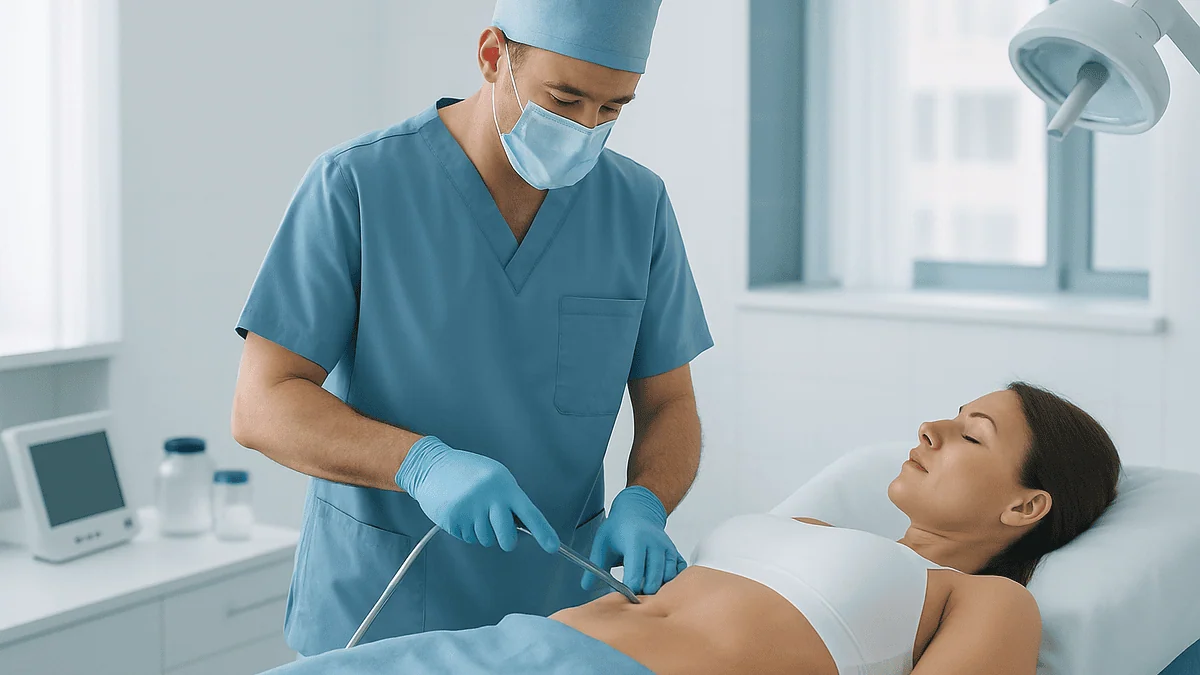
Hi def liposuction is performed by first marking the patient standing up, with muscles flexed, to map where the abdominal, chest and flank muscle lines sit beneath the skin. Under anesthesia, the surgeon fills the area with tumescent fluid, removes deeper fat through thin cannulas, then thins the superficial fat layer selectively along those marks so the underlying muscle shape shows more clearly. Results depend on stable weight and healing.
The marker comes out before the scalpel does. In a pre-operative room, a person who has spent years in the gym stands under a bright light, tenses their abdomen on request, and watches a surgeon trace lines onto their skin: two vertical strokes either side of the navel, a horizontal band or two, a curve along the lower rib. It looks a little like a tailor pinning a jacket. For anyone asking how is hi def liposuction done, that ten-minute drawing session is the real answer, and everything in the operating room follows from it.
This is a procedure that attracts confident marketing and a lot of confusion. Some people picture a machine that installs abdominal muscles; others assume it is ordinary liposuction with a bigger fee. Neither is right.
What follows is a plain account of the steps, the anatomy behind them, what mainstream evidence does and does not support, and the questions worth putting to a surgical team before agreeing to anything.
What is hi def liposuction, in plain language?
Hi def liposuction, sometimes written high-definition or “HD lipo,” is a variation of standard liposuction. Liposuction itself is a surgical procedure that removes fat through thin hollow tubes called cannulas, which are passed under the skin and connected to suction. MedlinePlus describes it as a way to reshape specific areas rather than a treatment for excess weight, and that distinction matters even more here.
Conventional liposuction aims to make an area smaller and smoother. The hi def approach adds a second goal: to leave a thin, uneven layer of fat on purpose, thicker over the grooves between muscles and thinner over the muscle bellies, so that the natural architecture of the rectus abdominis (the paired “six-pack” muscle), the obliques along the sides, or the pectoral and deltoid muscles becomes visible through the skin.
Surgeons who perform it describe two layers of fat under the abdominal skin. The deep layer sits close to the muscle and is removed much as it would be in any liposuction. The superficial layer, just beneath the skin, is where the detailing happens. Working in that shallow plane is technically demanding, because the margin between a crisp line and a visible dent or wave is a few millimeters.
A few points to hold onto. This is cosmetic surgery, not a medical treatment, so no guideline body recommends it for health. The published literature consists mainly of surgeon case series describing technique rather than randomized comparisons, so claims about how it performs against ordinary liposuction rest on lower-grade evidence. And the muscle definition it reveals is the patient’s own; the procedure does not create muscle that is not already there.
How is hi def liposuction done? The mapping stage
The mapping happens with the patient awake and standing, usually in the hour before surgery. Lying flat changes everything: fat pads flatten, the waist widens, and muscle edges shift by a centimeter or more. Standing markings preserve the relationships the person actually sees in a mirror.
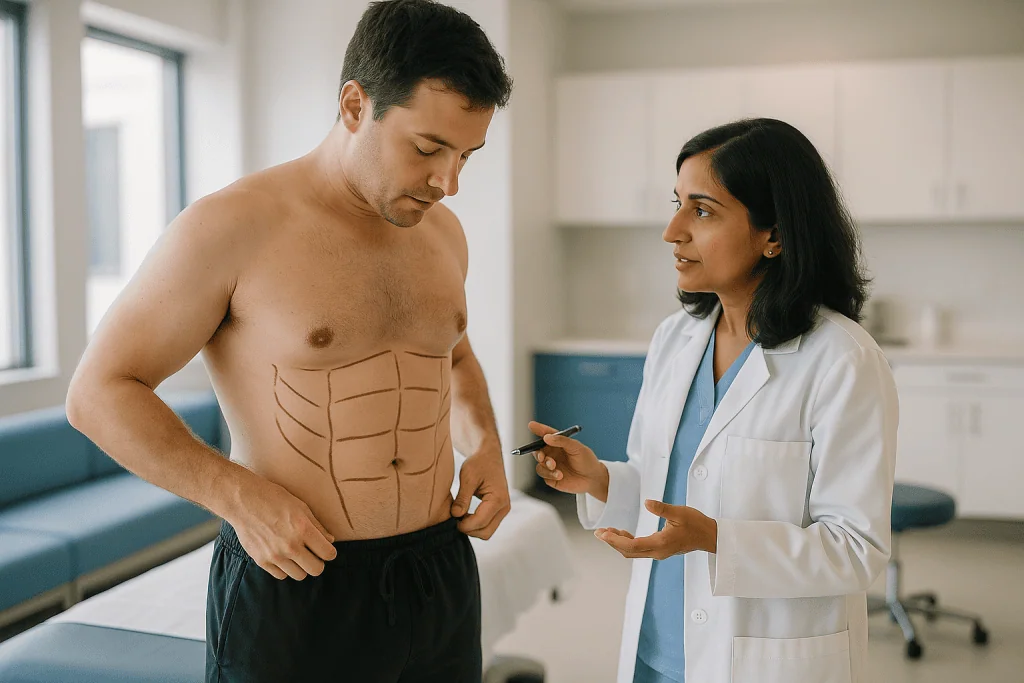
The surgeon asks the patient to contract the abdomen, twist, raise the arms and flex the chest. Each contraction makes a muscle border briefly more prominent, and that border is drawn with a surgical marker. Common landmarks include the linea alba (the vertical midline seam of connective tissue between the two halves of the rectus abdominis), the linea semilunaris (the curved line where the rectus meets the obliques on each side), the tendinous inscriptions that divide the rectus into its horizontal segments, the inguinal ligament running from hip to groin, and the lower edge of the pectoral muscle in the chest.
Different colors or hatching patterns typically denote different intentions: areas for aggressive deep removal, areas where the superficial layer will be thinned to reveal a groove, and areas the surgeon intends to leave alone or even add fat to. Photographs of the marked body are taken from several angles.
Two things about this stage deserve emphasis. First, the map is individual. A person with a wide rectus and shallow inscriptions will not be given the same lines as someone with a narrow, deeply segmented muscle, and a surgeon who promises a stock “six-pack” pattern is describing an outcome anatomy may not allow. Second, the standing assessment is also the moment when skin quality is judged. Skin that has been stretched by pregnancy or major weight change may not shrink evenly over a newly contoured surface, which is one of the main reasons some people are advised toward other procedures.
In the operating room: anesthesia and tumescent fluid
Once the patient is positioned, the procedure follows the general sequence Mayo Clinic and Cleveland Clinic describe for liposuction, with extra time spent in the shallow layer.
Anesthesia comes first. Depending on the number of areas and the surgeon’s practice, this may be general anesthesia, or sedation combined with local anesthetic. The choice belongs to the anesthesia and surgical team, who weigh the patient’s health history and the expected duration.
Next comes tumescent infiltration. “Tumescent” simply means swollen: the surgeon injects a large volume of dilute salt solution containing a local anesthetic and a medicine that constricts blood vessels into the fat. The tissue firms up like a water balloon, which does three useful things. It numbs the area, it reduces bleeding, and it separates fat cells so they release more easily from the surrounding connective tissue. Mayo Clinic notes that this fluid can also, rarely, be a source of complications if the anesthetic dose accumulates, which is one reason volumes are calculated carefully and why the team’s monitoring matters.
Small incisions, usually a few millimeters long, are then made in places chosen to be discreet: within the navel, in the natural fold of the groin, along the underwear line, or in the lower back. Because the hi def technique requires the cannula to approach a given line from several directions to avoid leaving ridges, there are often more access points than in a conventional procedure. Each will leave a small scar, a point worth raising when discussing hi def liposuction scars with a surgeon.
Only after infiltration has had time to take effect does fat removal begin, starting in the deep layer.
Deep layer, superficial layer, and where energy-assisted devices fit
The deep layer is treated in broad, fan-shaped passes to reduce overall thickness. Then the surgeon moves toward the skin. Superficial liposuction means working in the fat that lies within roughly a centimeter of the skin surface, following the marked lines with smaller cannulas and short, controlled strokes. Along a groove, more fat is taken; over the muscle belly on either side, a thicker cushion is deliberately preserved so the difference reads as a natural shadow rather than a carved trench.

Many surgeons use an energy-assisted device for this stage. Ultrasound-assisted liposuction passes a probe that vibrates at ultrasonic frequency through the tumescent fat; the vibration loosens and partially liquefies fat cells before suction, which practitioners argue allows more even removal in the shallow plane. Power-assisted liposuction uses a cannula that oscillates mechanically to reduce the effort of each stroke. Laser-assisted liposuction heats fat with a fiber before removal. Cleveland Clinic and Mayo Clinic list all three as recognized variants of the procedure.
What does the evidence show about them? Mainly that they are options, not proven upgrades. There are no large randomized trials demonstrating that any energy device produces a more defined result than skilled manual technique, and each adds its own considerations, notably the possibility of thermal injury to skin with ultrasound or laser if the probe dwells too long in one place. Surgeons who favor ultrasound in hi def work often cite reduced blood loss and easier passage in fibrous areas such as the male chest and upper back; those are plausible mechanistic arguments, supported by case series rather than comparative data.
Throughout, the surgeon repeatedly pinches and rolls the skin to check thickness and symmetry, sometimes asking the anesthesia team to adjust the table angle. The procedure commonly takes several hours when multiple areas are treated.
What is 4D liposuction and why fat is sometimes added back
“4D” is a marketing term rather than a medical one. Surgeons who use it generally mean two things: that the markings account for how muscles look in motion (the fourth dimension being movement), and that fat removed from one area may be purified and injected into another to build volume.
Fat grafting, also called lipofilling, is the transfer of a person’s own fat from where it is unwanted to where more fullness is desired. In hi def procedures the usual targets are the pectoral muscles in men, the deltoids at the shoulder, the buttocks, and occasionally the rectus muscle itself to exaggerate the bellies between the horizontal inscriptions. The harvested fat is filtered or spun to remove tumescent fluid, blood and damaged cells, then placed in small threads through a blunt cannula.
Grafted fat does not all survive. Some portion is reabsorbed over the first months as the body clears cells that failed to establish a blood supply, so the volume seen at three weeks is not the volume seen at six months. The proportion that persists varies with technique, location and the individual, and published figures come from heterogeneous series rather than a single guideline, so any specific percentage quoted in a consultation should be treated as that surgeon’s experience rather than an established norm.
Gluteal fat grafting deserves a separate word. Injecting fat into or beneath the buttock muscle has been associated with fatal fat embolism, where fat enters large veins and travels to the lungs. Professional plastic surgery societies have issued safety guidance restricting injection to the layer above the muscle. Anyone considering a hi def procedure that includes buttock grafting should ask directly how and where fat will be placed and how the surgeon confirms cannula depth.
Who hi def liposuction is usually for, and who is usually asked to wait
Because the technique reveals rather than builds, the people it suits best already have well-developed muscle under a modest fat layer. Surgeons commonly describe the ideal candidate as someone at or near a stable weight, with good skin elasticity, who exercises regularly but carries a persistent layer that hides definition. NHS guidance on liposuction generally is blunt on this point: it is not a treatment for obesity and works best in people who are otherwise a healthy weight.
Skin elasticity is the second gatekeeper. Skin that has been stretched and has lost recoil, whether through pregnancy, significant weight loss or age, tends to hang or wrinkle when the fat beneath it is thinned, and superficial work can make this worse rather than better. In that situation a surgeon may recommend a procedure that removes skin, such as an abdominoplasty (tummy tuck), either instead of or combined with liposuction.
Several groups are typically advised to postpone or reconsider:
- People whose weight is still changing, since a gain or loss after surgery redistributes fat unevenly around the sculpted lines.
- People who smoke or use nicotine, because nicotine narrows small blood vessels and impairs wound healing; most surgical teams ask for a nicotine-free period before and after.
- People with poorly controlled diabetes, bleeding disorders, or heart and lung conditions that raise anesthesia risk, as Mayo Clinic notes.
- Anyone planning pregnancy soon, since abdominal stretching will alter the result.
- People with a diastasis recti, a separation of the two rectus muscles, or an abdominal hernia; liposuction cannot repair either, and a surgeon working superficially over an unrecognized hernia risks injury.
A frank conversation about body image also belongs in the assessment. Cosmetic surgery is not recommended for people whose distress about appearance is disproportionate to what others see, and reputable teams screen for this.
Hi def lipo vs regular lipo: a side-by-side summary
People often ask whether the difference is real or a relabeling. The table below sets out what typically distinguishes the two approaches, drawing on the general descriptions of liposuction from Mayo Clinic, Cleveland Clinic and the NHS and on surgeon descriptions of the hi def technique. Individual practice varies, so treat it as a guide to questions rather than a fixed specification.
| Feature | Conventional liposuction | Hi def liposuction |
|---|---|---|
| Primary aim | Reduce volume, smooth contour | Reveal underlying muscle lines |
| Markings | Circles around fat deposits, often standing | Detailed muscle map drawn standing with muscles flexed |
| Fat layers treated | Mainly the deep layer | Deep layer plus selective thinning of the superficial layer |
| Fat left behind | Even cushion under the skin | Deliberately uneven: thinner over grooves, thicker over muscle bellies |
| Fat grafting | Uncommon | Sometimes added to chest, shoulders, buttocks or abdomen |
| Number of incisions | Fewer | Often more, to approach lines from several angles |
| Operating time | Shorter for the same area | Longer because of detail work |
| Typical candidate | Stable weight, localized fat | Stable weight, existing muscle, good skin elasticity |
| Sensitivity to weight change | Moderate | Higher; small gains blur the lines |
| Risk of visible irregularity | Present | Higher, because work is closer to the skin |
| Evidence base | Long clinical experience, established safety data | Surgeon case series; no randomized comparisons |
The honest summary is that hi def liposuction is regular liposuction with an additional, technically exacting layer of work and a narrower group of people it suits. It is not safer, and by working nearer the skin it carries somewhat more contour risk, in exchange for a result that conventional technique does not attempt.
High definition liposuction recovery: what the first days and weeks usually look like
Recovery follows the general pattern for liposuction, with a few emphases specific to superficial work.
The first two to three days bring the most swelling, bruising and leakage of pink tumescent fluid from the incisions, which is expected and is why absorbent dressings are placed. Soreness is often described as similar to a hard workout across the treated area. Walking around the house from the first day is encouraged; it lowers the risk of blood clots and helps fluid drain. Pain relief and any other medicines are prescribed by the surgical team, and their instructions, not general reading, govern what is taken.
By the end of the first week most people can manage light daily activities. The NHS advises that many people return to desk-type work within one to two weeks after liposuction, with more physical roles taking longer. Bruising typically fades over two to three weeks. Swelling is slower; Mayo Clinic notes it can take several weeks to settle and that the treated area may look uneven or lumpy during this period as fluid shifts around.
Exercise is reintroduced in stages. Gentle cardio is usually permitted after the first couple of weeks, while heavy lifting and core-loading work wait longer, both to protect healing tissue and because vigorous activity prolongs swelling. The surgeon sets the timeline.
Here is the part that surprises people: the muscle definition that motivated the surgery is usually the last thing to appear. Because the lines depend on a thin, evenly settled superficial layer, they remain blurred by swelling for weeks. The NHS describes it taking around six months to see the full result of liposuction, and Mayo Clinic similarly cautions that final contour emerges over several months. Photographs taken at two weeks are not a verdict.
Compression garments, drains and lymphatic massage: what is known
A firm elastic garment is fitted before the patient leaves the operating room. Its purpose is mechanical: it holds the loosened skin against the new contour while it re-adheres, limits the space in which fluid can collect, and reduces swelling. Because the hi def result depends on skin settling precisely along the marked lines, surgeons are often stricter about garment wear than in conventional procedures. The NHS notes that garments are typically worn for several weeks; the exact schedule, including when it may be removed for showering and whether a lighter second-stage garment follows, comes from the surgical team.
Some surgeons place small foam pads inside the garment along the etched lines, or use molded foam over the abdomen, to press the skin into the grooves during the first weeks. Others do not. This is a matter of practice rather than proven necessity.
Drains, thin tubes that carry fluid out through an incision into a collection bulb, are used by some surgeons when large volumes have been removed or when ultrasound energy has been applied, since both increase fluid production. They are usually removed within days once output falls. Mayo Clinic lists fluid accumulation, known as a seroma, among the recognized complications of liposuction, and it is one of the reasons drains are considered.
Manual lymphatic drainage is a gentle massage technique intended to move fluid toward lymph nodes. Many hi def surgeons recommend a course of sessions beginning in the first or second week. Patients frequently report that it eases tightness and reduces visible swelling sooner. Controlled evidence that it changes the final contour is limited, so it is reasonable to regard it as a comfort measure with a plausible mechanism rather than an established requirement, and to ask the surgeon whether they consider it essential for their technique.
Is hi def liposuction safe? Risks in neutral clinical terms
Liposuction is a well-established procedure, and Mayo Clinic, Cleveland Clinic and the NHS each publish a similar list of its risks. Hi def technique shares all of them and modestly raises a few.
Contour irregularities are the risk most specific to this approach. Working within a centimeter of the skin leaves little tolerance; too much removal in one spot produces a dimple, too little a ridge, and uneven healing can turn an intended shadow into a wave. Some irregularities soften as swelling resolves; others persist and may need revision.
Fluid accumulation (seroma) under the skin is more common after large-volume or energy-assisted work. Small collections are absorbed; larger ones may need to be drained with a needle in clinic.
Numbness or altered sensation in treated skin is common early and usually improves over months, though occasionally it is permanent. Skin discoloration, particularly where ultrasound or laser energy has been applied close to the surface, can occur, and thermal burns are a recognized hazard of heat-based devices.
Infection is uncommon but serious when it occurs. Internal organ puncture, when a cannula passes through the abdominal wall, is rare and is why an unrecognized hernia matters.
Fat embolism, where loosened fat enters the bloodstream, can be life-threatening and is the principal concern with fat grafting near large vessels, especially in the buttock. Blood clots in the leg veins, and their travel to the lungs, are risks of any surgery involving anesthesia and reduced mobility.
Finally, Mayo Clinic notes that shifts in fluid balance during large procedures can strain the kidneys and heart, and that the local anesthetic in tumescent fluid can reach toxic levels if volumes are miscalculated. These are the reasons the setting, the team’s monitoring, and the amount removed in a single session are legitimate questions for any patient.
Alternatives to hi def liposuction worth knowing about
Because hi def liposuction reveals what training has already built, the first alternative is not surgical at all. Reducing body fat through sustained diet and exercise lowers the superficial layer across the whole body, and for many people that is what makes muscle definition appear. It is slower, it cannot target one region, and genetics decide where fat leaves last, which is exactly the frustration that brings people to a surgeon. Still, every reputable liposuction resource, including the NHS and MedlinePlus, frames surgery as a step after those measures rather than instead of them.
Conventional liposuction remains an option for someone who wants a slimmer waist without etched lines, and it carries less contour risk. For a person whose main issue is loose skin rather than fat, an abdominoplasty removes the excess and tightens the abdominal wall; it is a larger operation with a longer recovery and a low horizontal scar, and it may be combined with liposuction.
Non-surgical fat reduction devices exist. Cryolipolysis cools fat to damage cells, which the body then clears over weeks; other devices use radiofrequency or focused ultrasound heat. These reduce a fat layer modestly in a treated zone and cannot be steered along muscle lines with the precision of a cannula, so they are not a route to the same result. Their evidence base is for small reductions in localized fat, not for definition.
Electromagnetic muscle stimulation devices, which contract muscles involuntarily during a session, are marketed for definition. Evidence for lasting visible change is limited to small industry-associated studies.
Last, the alternative of not proceeding is a genuine one. A surgeon who says the anatomy or skin is not suited to hi def work is offering information, not a challenge.
What people often get wrong about how hi def liposuction is done
“The surgeon carves in a six-pack.” Nothing is carved into muscle. Fat is removed from above it in a pattern that follows the muscle the person already has. Someone with an undeveloped rectus will not emerge with one, and a surgeon who etches lines where no muscle border exists creates a look that most people recognize as artificial.
“It is a weight-loss procedure.” MedlinePlus and the NHS are explicit that liposuction removes localized fat and does not treat obesity. In hi def work the volumes removed are often smaller than in conventional procedures, because the goal is shape, not size.
“The result is visible right away.” Swelling hides superficial detail for weeks. The NHS puts full results at around six months. Early photographs, especially those taken with flattering light and a flexed stance, reflect swelling as much as sculpting.
“Results are permanent.” Removed fat cells do not return, but remaining cells enlarge with weight gain. Because hi def lines rely on a thin superficial layer, a modest gain blurs them faster than it would soften a conventional result.
“Energy devices do the sculpting.” Ultrasound and other devices loosen fat; the surgeon’s hand determines where and how much is removed. No trial has shown a device to be necessary for definition.
“It is a minor procedure.” Multi-area hi def surgery typically runs several hours under anesthesia and carries the full list of liposuction risks. It is real surgery with a real recovery.
“Any liposuction surgeon offers the same thing.” Superficial liposuction is a distinct skill with a higher irregularity risk. Asking how often a surgeon performs this specific technique is a fair question.
Questions to ask your care team before hi def liposuction
A consultation is the moment to move from marketing language to specifics. The questions below are ones that experienced patients and surgeons say matter most; the answers belong to the treating team, and a willingness to answer them plainly is itself informative.
- Looking at my anatomy and skin, what degree of definition is realistic, and where would you not attempt lines?
- Will you mark me standing with muscles flexed, and may I see and discuss the map before surgery?
- What anesthesia do you plan, who administers it, and where will the procedure take place?
- Do you use an energy-assisted device, and what is your reason in my case?
- How many incisions will I have, where will they sit, and what will the scars look like?
- Is fat grafting part of the plan? If it includes the buttocks, how do you keep the cannula above the muscle?
- How much fat do you expect to remove, and what is your upper limit in one session?
- Have you examined me for a hernia or diastasis recti?
- How long will I wear the garment, and will you use foam or a second garment?
- Do you use drains, and do you recommend lymphatic massage?
- What is your revision policy if contour irregularities persist after six months?
- How often do you perform this specific superficial technique, and what complications have you seen?
- What weight change would compromise the result, and what should I do if I plan pregnancy later?
- Who do I call at night or on a weekend if something worries me?
Bringing a written list, and a second person to listen, is not excessive. Cosmetic decisions are elective by definition, which means there is time to consult more than one surgeon and to say no.
When to call your doctor after hi def liposuction
Most recoveries are uneventful, and some discomfort, bruising and fluid leakage are expected. Certain signs, however, should prompt a same-day call to the surgical team or, when severe, emergency care. Cleveland Clinic and Mayo Clinic list similar warning features for liposuction generally.
Call the surgical team promptly if you notice:
- Fever, or chills with sweating.
- Increasing redness, warmth, or spreading swelling around an incision, or thick or foul-smelling drainage.
- Pain that worsens after the first few days rather than easing, or that is out of proportion in one spot.
- A soft, sloshing swelling under the skin that grows over a day or two, which may indicate a seroma.
- Bleeding that soaks dressings and does not slow with gentle pressure.
- Skin that turns dark, blistered or mottled over a treated area.
- Nausea, vomiting, dizziness or fainting, or very little urine over many hours.
Seek emergency care immediately, without waiting to reach the surgeon, for:
- Sudden shortness of breath, chest pain, rapid heartbeat or coughing up blood, which can signal a blood clot or fat embolism in the lungs.
- Pain, swelling or warmth in one calf or thigh, which can indicate a clot in the leg.
- Confusion, severe headache, seizure or a racing or irregular heartbeat, which can be signs of local anesthetic toxicity in the first day.
- Severe abdominal pain with a rigid or distended belly.
Numbness, patchy bruising, a lumpy or uneven look in the early weeks, and low mood after surgery are common and usually settle, but they are still worth mentioning at follow-up visits. Whether any of these requires treatment is a judgment for the treating team, who know what was done and can examine the area. This article cannot replace that examination.
Frequently asked questions
How is hi def liposuction done differently from regular liposuction?
The difference is a second, shallow layer of work. Regular liposuction removes fat from the deep layer and leaves an even cushion under the skin. Hi def liposuction does that and then thins the superficial layer selectively along pre-drawn muscle borders, leaving fat thicker over muscle bellies and thinner in the grooves, so the underlying shape becomes visible.
What is 4D liposuction and is it a separate procedure?
It is a marketing label rather than a distinct medical procedure. Surgeons who use the term usually mean that markings account for how muscles look during movement and that fat removed from one area may be grafted into another, such as the chest or shoulders. The underlying technique is the same superficial liposuction described for hi def work.
How long does high definition liposuction recovery take?
Most people manage desk-type work within one to two weeks, according to NHS guidance on liposuction, while bruising fades over two to three weeks. Swelling takes longer, and the NHS describes full results appearing at around six months. Compression garments are usually worn for several weeks, with the exact schedule set by the surgical team.
Is hi def liposuction safe?
It carries the same risks as any liposuction, including infection, fluid collection, numbness, blood clots and, rarely, organ injury or fat embolism, plus a somewhat higher chance of visible contour irregularities because work is done close to the skin. Safety depends heavily on candidate selection, the amount removed in one session, and the setting and monitoring provided.
Hi def lipo vs regular lipo: which is better for someone who just wants a smaller waist?
Conventional liposuction is usually the more appropriate choice for straightforward volume reduction. It involves fewer incisions, a shorter operation and a lower risk of surface irregularities. Hi def technique adds detail work that only makes sense when the goal is visible muscle definition and the person already has developed muscle beneath a thin fat layer.
Does hi def liposuction create abdominal muscles?
No. It removes fat from above muscles that already exist so their edges show more clearly. A surgeon cannot add muscle, and etching lines where there is no underlying muscle border tends to look unnatural. Fat grafting can add fullness over the chest or shoulders, but that is added volume, not muscle.
Will the results of hi def liposuction last if I gain weight?
Fat cells that were removed do not regrow, but the cells that remain enlarge with weight gain. Because hi def results depend on a deliberately thin superficial layer, even a modest gain can soften or hide the lines faster than it would change a conventional liposuction result. Stable weight is the main factor within the patient’s control.
What kind of scars does hi def liposuction leave?
Incisions are typically a few millimeters long and are placed in the navel, groin folds, underwear line or lower back. Because lines are approached from several angles, there are often more incisions than in conventional liposuction. Scars usually fade over months but remain as small marks, and their number and placement are worth confirming beforehand.
Why do surgeons mark the body while the patient is standing?
Gravity changes the position of fat and muscle. Lying flat flattens fat pads, widens the waist and shifts muscle borders, so lines drawn on the table would not match what the person sees upright. Marking standing, with muscles flexed, records the true borders of the rectus, obliques and chest muscles that the surgery is meant to reveal.
Is lymphatic massage required after hi def liposuction?
Many surgeons recommend it in the first weeks and patients often find it eases tightness and swelling. Controlled evidence that it changes the final contour is limited, so it is best regarded as a comfort measure with a plausible mechanism rather than a proven requirement. Whether to include it is a decision for the treating surgeon.
References
This article is for general information only and is not a substitute for professional medical advice. Please consult a qualified doctor about your individual situation.

More from the Blog

Can Body Contouring Be Done in One Operation? How Surgeons Sequence Multiple Stages Safely
Body contouring after major weight loss can sometimes be completed in a single operation, but surgeons often split it into two or more stages…

Do You Need a Reverse Tummy Tuck? Upper Abdominal Laxity and Who Actually Qualifies
A reverse tummy tuck is usually considered only for people whose loose skin sits mainly above the navel, in the upper abdomen, while the…

How Fat Transfer Works Step by Step: Harvesting, Purifying and Injecting Your Own Fat
Fat transfer, also called fat grafting, is done in three stages during one procedure. A surgeon removes fat from an area such as the…

Is Body Aesthetics Surgery Right for You? Weight Stability, Skin Quality and Overall Health
A body aesthetics surgery candidate is usually an adult whose weight has held steady for months, who does not smoke, whose long-term conditions are…

Does Hi Def Liposuction Build Muscle? Separating Fact From Marketing on Sculpted Abs
No. Hi def liposuction does not build muscle. It removes fat from the thin layer under the skin and sculpts what remains so that…

CoolSculpting vs Liposuction: What Each Can Remove, Downtime and Who Suits Which Approach
Cryolipolysis (the technique widely known by the trade name CoolSculpting) and liposuction both target pockets of fat under the skin, but they differ in…