

How Is Orchitis Discomfort Managed Safely? Rest, Scrotal Support and Your Urologist’s Advice

Key Takeaways
- Orchitis pain is largely pressure pain: the testicle swells against a fibrous capsule that does not stretch, which is why rest, elevation and support help regardless of the cause.
- Cold packs wrapped in cloth for short periods are the temperature measure recommended by mainstream sources for acute orchitis; heat tends to increase early swelling.
- Antibiotics change the course only in bacterial epididymo-orchitis, with the class chosen according to the likely organism, and they do nothing for mumps orchitis.
- Mayo Clinic reports that roughly a third of males who get mumps after puberty develop orchitis, typically four to seven days after the salivary glands swell.
- Pain usually improves within days of starting antibiotics, but Mayo Clinic cautions that swelling and tenderness can take several weeks to resolve fully.
- Sudden severe testicular pain with nausea is treated as torsion until proven otherwise, and the chance of saving the testicle is highest within about six hours of onset.
Orchitis discomfort is usually managed with rest, keeping the scrotum supported and slightly elevated, cold packs wrapped in cloth for short periods, and clinician-directed pain relief. Bacterial cases also need antibiotics, while viral cases such as mumps orchitis settle with supportive care alone. Sudden severe testicular pain needs emergency assessment to exclude torsion, and every medicine decision belongs with the treating urologist or physician.
The first thing most men notice is not the pain. It is the walk. Stairs become a negotiation, a car seat feels wrong, and sitting down turns into a slow, careful lowering. By the time the ache in one testicle has a name, orchitis, the question has already changed from “what is this?” to “what can I actually do about it tonight?”
Orchitis pain relief is one of those subjects where folklore travels faster than evidence. Hot baths, tight jeans, loose jeans, “walking it off”, a cousin’s leftover antibiotics: all of it circulates, and most of it is either useless or risky. The reliable measures are quieter and less dramatic, and they work for a reason that has to do with anatomy, not willpower.
This explainer sets out what is happening inside an inflamed testicle, which comfort measures have a mechanism behind them, when antibiotics matter and when they do not, and the handful of warning signs that turn a sore testicle into an emergency. The decisions stay with your urologist or treating physician; the understanding is yours to keep.
What actually happens inside a testicle with orchitis?
Orchitis is inflammation of one or both testicles. In practice it rarely travels alone. The epididymis, the tightly coiled tube that sits along the back of each testicle and stores maturing sperm, is usually inflamed too, which is why clinicians often use the combined term epididymo-orchitis.
The pain has a mechanical explanation. Each testicle is wrapped in a tough fibrous capsule called the tunica albuginea. When infection or an immune reaction floods the tissue with fluid and white blood cells, the testicle swells against a covering that does not stretch much. Pressure rises inside a closed space, and that pressure is read by the brain as a deep, heavy, sometimes sickening ache. Nerves from the testicle share pathways with the lower abdomen, so the pain frequently radiates toward the groin or flank.
Two broad causes dominate. Bacterial orchitis most often spreads backward from the urinary tract or, in sexually active men, from a sexually transmitted infection that first settles in the epididymis. Viral orchitis is classically a complication of mumps; Mayo Clinic notes that roughly a third of males who get mumps after puberty develop testicular inflammation, typically four to seven days after the facial swelling begins.
Knowing which type you have shapes everything that follows. Bacteria respond to antibiotics. Viruses do not, and the body clears mumps on its own schedule. What both share is the swelling-against-a-capsule problem, and that is exactly the problem that rest, support and cooling are designed to ease. Understanding that mechanism makes the advice in the following sections feel less like a list and more like common sense.
Orchitis pain relief at home: rest, elevation and scrotal support
Three low-technology measures appear in every mainstream guide to orchitis and epididymitis, from the NHS to MedlinePlus, and each one has a reason behind it.

Rest means literally taking weight off the area. Standing lets the inflamed testicle hang from the spermatic cord, the bundle of blood vessels, nerves and the vas deferens that suspends it. Gravity pulls on tissue that is already stretched. Lying down removes that drag, and most men find the ache drops a notch within minutes of getting horizontal.
Elevation builds on the same idea. A folded towel placed under the scrotum while lying on your back lifts the testicles slightly, helping venous and lymphatic fluid drain away from the swollen tissue rather than pooling in it. It is the scrotal equivalent of propping up a sprained ankle.
Scrotal support covers the hours you have to be upright. Snug, supportive underwear or an athletic supporter holds the testicle close to the body so it is not swinging with every step. The aim is support, not compression; anything that digs in or restricts blood flow defeats the purpose. Many men find that switching from loose boxers to a supportive brief is the single most noticeable change in daytime comfort.
Add to these the ordinary business of recovery: drinking enough fluid, avoiding heavy lifting and strenuous exercise, and pausing sexual activity until the treating clinician says otherwise. None of this treats the underlying cause. Rest and support manage the symptom while antibiotics, or time in viral cases, deal with the inflammation itself. That division of labor is worth keeping in mind whenever a home remedy promises more than comfort.
Cold or warmth for a sore testicle? What the evidence supports
Ask a room of men what to put on an aching testicle and you will get a tie between an ice pack and a hot bath. The mainstream clinical sources come down on one side.
Cold is the measure consistently recommended. Mayo Clinic and MedlinePlus both describe applying ice or a cold pack to the scrotum to reduce swelling and pain. The mechanism is straightforward: cooling narrows small blood vessels, slowing the leak of fluid into inflamed tissue, and it numbs the pain fibers in the skin. Both effects take pressure off the capsule described earlier.
The caveats matter as much as the method. Never place ice directly on skin; wrap the pack in a thin towel. Keep applications short, generally no more than about 15–20 minutes at a time, with a break in between, because scrotal skin is thin and the testicles are sensitive to prolonged cold. If the skin becomes pale, numb or painful from the cold itself, stop.
Warmth has a more limited role. Heat widens blood vessels, which can increase swelling in the acute phase, so a hot bath in the first days is more likely to worsen the heaviness than relieve it. Some men with chronic, long-standing discomfort report that warm sitz baths relax the muscles of the pelvic floor and ease a dull ache, and a urologist may suggest this later in the course. That is a different problem from acute inflammation, and the distinction is the whole point.
The honest summary: cold has a mechanism and guideline backing for acute orchitis; warmth does not, and may be counterproductive early on. When in doubt, ask the clinician who examined you which phase you are in.
Who is usually treated straight away, and who is asked to wait and watch?
Not everyone with a sore testicle leaves the clinic with a prescription, and that is deliberate.
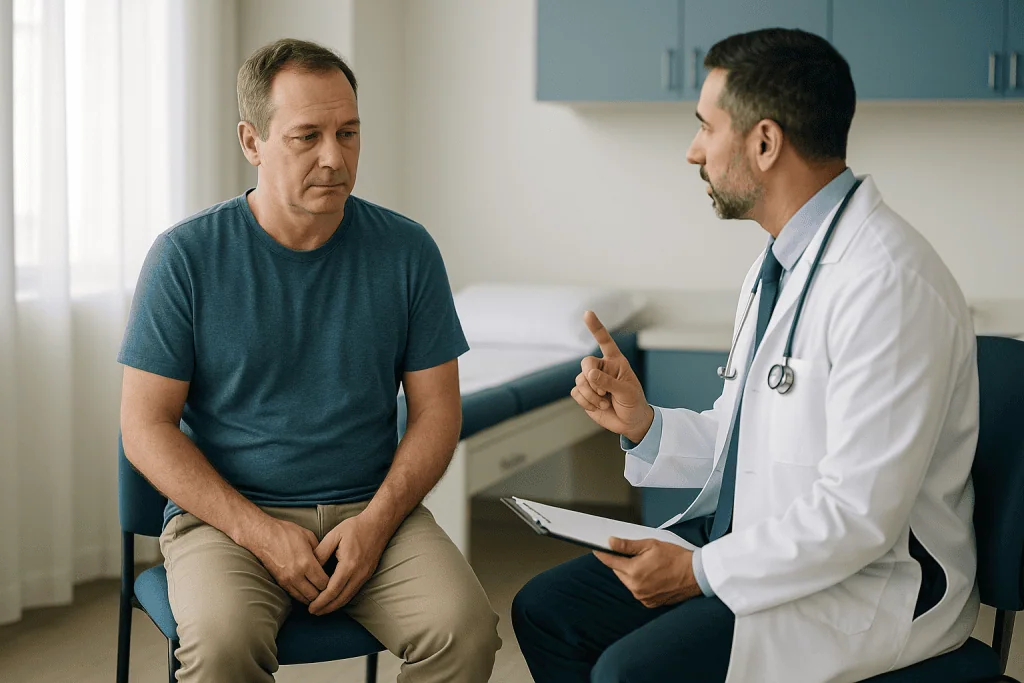
Men whose history and examination point to bacterial epididymo-orchitis are usually started on antibiotics the same day, often before laboratory results return. CDC guidance on epididymitis supports beginning empiric treatment, meaning treatment based on the most likely organism, so that infection is not allowed to progress while cultures grow. Urine tests and, in sexually active men, swabs for sexually transmitted infections are collected first so the regimen can be adjusted later if needed.
Men with a clear mumps picture, recent parotid swelling followed days later by testicular pain, are generally managed with supportive care alone. Antibiotics have no target in a viral infection, and prescribing them adds side effects without benefit. This is the “wait” group in the sense that the treatment is time, rest, support and cooling.
A third group is asked to wait for a scan. When the cause of pain is unclear, or when torsion cannot be confidently excluded on examination, a scrotal ultrasound with Doppler, a scan that shows blood flow in the testicle, is usually arranged. Inflammation tends to show increased blood flow; torsion shows reduced or absent flow. Treatment follows the result.
Finally, some men are sent not to a pharmacy but to an operating room. Testicular torsion, the twisting of the spermatic cord that cuts off blood supply, is a surgical emergency. Mayo Clinic notes that the chance of saving the testicle is highest when surgery happens within about six hours of pain beginning. No amount of rest or ice helps here.
Which group you fall into is a clinical judgment made at the bedside, and it can change as results arrive. That is why the follow-up appointment matters as much as the first visit.
Swollen testicle pain causes: what could be behind a swollen left testicle and pain?
One of the most common questions typed into a search bar is some version of “why is my left testicle swollen and painful?” The honest answer is that the side tells a clinician very little. Both testicles are equally vulnerable to the same conditions, and the left is not especially prone to orchitis. What distinguishes the causes is how the pain arrived and what travels with it.
Epididymitis and orchitis typically build over hours to a day or two. The testicle feels heavy and tender, the scrotal skin may be warm or reddened, and there may be fever, burning on urination or urethral discharge, depending on the source of infection.
Testicular torsion arrives abruptly, frequently waking a person from sleep, and is often accompanied by nausea or vomiting. The affected testicle may sit higher than usual or lie horizontally. This is the one cause where minutes genuinely matter.
A hydrocele, a collection of fluid around the testicle, produces painless or mildly uncomfortable swelling that transilluminates, meaning light shines through it. A varicocele, enlarged veins in the scrotum, feels like a soft “bag of worms” and is more common on the left because of how the left testicular vein drains. An inguinal hernia can push into the scrotum and cause swelling that changes with coughing or standing.
Less common but important, a testicular tumor usually presents as a painless, firm lump rather than diffuse tenderness, though some men do notice aching. Trauma, even a blow that seemed minor at the time, can cause bleeding and swelling.
None of this is a self-diagnosis tool. Its purpose is to show why a clinician asks about speed of onset, urinary symptoms, sexual history and nausea before touching the area, and why an ultrasound is often the fastest way to sort heavy from dangerous.
Epididymo-orchitis treatment: which antibiotic classes are used, and why age and exposure decide
When bacteria are the cause, antibiotics are the treatment that changes the course of the illness. Which class is chosen depends on the most likely organism, and that in turn depends on who you are.
CDC guidance divides adult epididymitis into two broad patterns. In sexually active men under about 35, the usual culprits are the sexually transmitted bacteria that cause chlamydia and gonorrhea. In older men, men who practice insertive anal sex, and men with urinary tract abnormalities or recent catheterization, enteric organisms such as Escherichia coli, bacteria from the bowel that reach the urinary tract, are more likely.
Those two patterns map to two antibiotic strategies. For the sexually transmitted pattern, clinicians commonly combine a single injected cephalosporin, which targets gonorrhea, with an oral tetracycline-class antibiotic such as doxycycline, which targets chlamydia. For the enteric pattern, a fluoroquinolone is often used because it penetrates the urinary tract and prostate well. Where both patterns are plausible, guidance describes covering both. The exact agent, duration and any adjustments after culture results belong to the prescribing clinician; this article describes classes and mechanisms, not regimens.
Two practical points follow. First, antibiotics do not switch pain off instantly. They stop bacteria multiplying, and the immune system then clears the debris, so comfort measures remain essential during the first days. Second, if the infection is sexually transmitted, recent partners need evaluation and treatment, and sexual activity should pause until the clinician confirms it is safe, otherwise reinfection is likely.
Finishing the course as prescribed, even once the testicle feels better, is standard advice across NHS and CDC sources, because symptoms fade before the bacteria are fully cleared.
Mumps orchitis: why antibiotics do nothing here, and what helps instead
Mumps has become uncommon in populations with high vaccination coverage, but it has not vanished, and orchitis remains its most frequent complication in post-pubertal males. Mayo Clinic describes testicular inflammation developing in about a third of males who contract mumps after puberty, usually four to seven days after the characteristic swelling of the salivary glands in front of the ears.
The pathology is different from bacterial orchitis. The mumps virus infects the testicular tissue directly, and the resulting inflammation is driven by the immune response rather than by multiplying bacteria. There is no bacterial target, so antibiotics offer nothing except their side effects. This is a point worth repeating to anyone who has a friend with “leftover” tablets.
Management is supportive, and it is the same toolkit already described: bed rest during the most painful days, scrotal elevation on a folded towel, wrapped cold packs for short periods, supportive underwear when upright, and clinician-directed pain relief. Fever is managed in the usual ways. Most men notice the acute pain easing over several days as the viral illness runs its course, with swelling and tenderness taking longer to settle completely.
Two features distinguish mumps orchitis in the longer term. First, it is bilateral, affecting both testicles, in a minority of cases. Second, some men are left with a degree of testicular shrinkage, and in a small proportion, sperm production can be reduced. MedlinePlus notes that infertility after mumps orchitis is uncommon, particularly when only one testicle is involved, but a urologist may suggest a follow-up examination or semen analysis for men who are concerned.
Prevention is the only measure that truly works here, and it happens years earlier: the measles, mumps and rubella vaccine. CDC guidance recommends two doses in childhood for exactly this reason.
How pain medicines work in orchitis, explained by mechanism rather than dose
Pain relief in orchitis typically comes from two over-the-counter classes, and understanding what each does helps the conversation with your clinician.
Non-steroidal anti-inflammatory drugs, the class that includes ibuprofen and naproxen, block enzymes called cyclooxygenases that produce prostaglandins. Prostaglandins are the chemical messengers that widen blood vessels, sensitize nerve endings and drive swelling. Dampening them does double duty in orchitis: less fluid in the tissue means less pressure on the capsule, and the nerves become less jumpy. This is why anti-inflammatories are frequently mentioned in NHS and Mayo Clinic guidance for epididymitis and orchitis. They are not suitable for everyone; people with kidney disease, stomach ulcers, certain heart conditions or on blood thinners are often advised to avoid them, and that call belongs to the prescriber.
Acetaminophen, known as paracetamol outside the United States, works centrally on pain and fever signaling and has little anti-inflammatory effect. It will take the edge off the ache and bring a temperature down, but it does less for the swelling itself. For men who cannot take anti-inflammatories, it is often the alternative suggested.
Neither class treats infection. Both manage the symptom while antibiotics or time address the cause, which is why a man who feels better after a day on pain relief has not necessarily finished recovering.
Prescription options exist for severe or chronic pain, including nerve-blocking injections of local anesthetic into the spermatic cord, which a urologist may offer when standard measures are not enough. These are specialist decisions. The useful principle for a patient is simpler: tell the clinician what you already take, including supplements, and ask which class fits your health history rather than reaching for whatever is in the cabinet.
Orchitis pain relief at a glance: comfort measures and treatments compared
The measures below appear across mainstream guidance from the NHS, Mayo Clinic, MedlinePlus and the CDC. The table shows what each one does, when it applies, and the catch that comes with it. It is a map of the conversation to have with your treating team, not a substitute for it.
| Measure | What it does | When it applies | Caution |
|---|---|---|---|
| Lying down and resting | Removes the pull of gravity on the inflamed testicle | All types, especially the first days | Prolonged immobility is not the goal; gentle movement around the home is fine |
| Scrotal elevation on a folded towel | Aids drainage of fluid from swollen tissue | All types, while lying down | Support, not pressure |
| Supportive underwear or athletic supporter | Limits movement and drag while upright | All types, during the day | Avoid anything that restricts blood flow |
| Wrapped cold pack, short applications | Narrows blood vessels and numbs pain fibers | Acute inflammation | Never ice directly on skin; stop if skin becomes numb or pale |
| Antibiotics | Stop bacteria multiplying | Bacterial epididymo-orchitis only | Class chosen by clinician based on likely organism; no effect on mumps orchitis |
| Anti-inflammatory or analgesic medicines | Reduce prostaglandin-driven swelling and pain signaling | All types, when suitable for your health history | Not appropriate for everyone; prescriber decides |
| Pausing sex and heavy exertion | Prevents reinfection and mechanical aggravation | Until the clinician confirms recovery | Partners of men with STI-related infection need evaluation |
Reading down the “when it applies” column makes the central message visible. The comfort measures apply to everyone; the one treatment that alters the course of the illness, antibiotics, applies only to bacterial infection. Reading down the “caution” column shows where men most often go wrong: compressing instead of supporting, icing without a barrier, and borrowing antibiotics for a problem they cannot touch.
How long does orchitis last? What the next days and weeks usually look like
Recovery from orchitis is rarely a straight line, and knowing the usual shape of it prevents unnecessary alarm.
In bacterial epididymo-orchitis, the first 48 to 72 hours after starting antibiotics are typically the worst for pain, because the medicine has stopped bacterial growth but the immune system is still clearing inflamed tissue. Fever and burning on urination usually settle first. The NHS notes that most men begin to feel better within a few days of starting treatment, and that is the window in which rest, support and cooling earn their keep.
Swelling lags behind pain. Mayo Clinic cautions that it can take several weeks for scrotal swelling and tenderness to resolve completely, and the epididymis in particular may stay firm and slightly enlarged for a time after everything else has returned to normal. A testicle that still feels a little heavy at week three is not, by itself, a sign that treatment has failed.
In mumps orchitis, the acute pain generally eases over several days as the viral illness fades, with tenderness subsiding over the following weeks. There is no antibiotic milestone to track; the follow-up question is whether the testicle has returned to its usual size and texture.
Return to normal activity is usually staged. Light walking resumes as comfort allows, heavy lifting and vigorous exercise wait until tenderness has largely gone, and sexual activity waits for the clinician’s confirmation, both for comfort and, in STI-related cases, to prevent reinfection. A follow-up appointment is standard, partly to confirm the infection has cleared and partly to re-examine the testicle once swelling has subsided, since a mass hidden by inflammation is easier to feel afterward.
If pain or swelling is clearly worsening rather than plateauing after the first few days of treatment, that trajectory, not the calendar, is what should prompt a call.
Chronic epididymitis symptoms, and congestive epididymitis years after a vasectomy
Not every scrotal ache follows the acute script. CDC guidance defines chronic epididymitis as discomfort or pain in the scrotum, testicle or epididymis lasting six weeks or longer, and it behaves differently from the infection described so far.
Men with chronic epididymitis typically describe a dull, intermittent ache rather than a hot, swollen emergency. The epididymis may feel firm or thickened on examination, discomfort often worsens with prolonged sitting, cycling or ejaculation, and there is usually no fever or urinary infection. Ultrasound and urine tests are frequently normal. Causes include incompletely treated infection, inflammatory conditions, prior surgery and, in a substantial share of men, no identifiable cause at all.
Vasectomy deserves specific mention because the question comes up so often. After a vasectomy, the testicles continue to produce sperm, but the vas deferens has been divided, so sperm accumulate in the epididymis and are broken down by the body. In most men this is uneventful. In a minority, the epididymis becomes congested and tender, which clinicians call congestive epididymitis. It can appear months or, less commonly, years after the procedure, and it is one component of what Mayo Clinic lists among vasectomy risks as chronic post-vasectomy pain. Treatment is directed at comfort and inflammation rather than infection, since no bacteria are involved, and a urologist may discuss further options if pain persists.
The management toolkit for chronic discomfort shifts accordingly. Scrotal support remains useful. Warm sitz baths, unhelpful in acute inflammation, sometimes ease the pelvic-floor muscle tension that accompanies chronic pain. Anti-inflammatory medicines may be tried under supervision, and specialist options such as spermatic cord nerve blocks exist for men whose pain does not respond.
The practical point is that chronic scrotal pain is a different condition with a different workup, and repeating antibiotic courses without evidence of infection is not a strategy any guideline supports.
What people often get wrong about orchitis
Myths about testicular pain are durable because the subject is embarrassing enough that men rarely compare notes. Here are the ones that cause the most harm.
“It will pass if I walk it off.” Walking is exactly what an inflamed testicle does not want. Gravity and movement increase the drag on swollen tissue. Rest and support are not weakness; they are the treatment.
“Antibiotics are the answer to any sore testicle.” Antibiotics help only when bacteria are present. Mumps orchitis, torsion, hydrocele and chronic non-infectious epididymitis gain nothing from them, and unsupervised courses breed resistance and mask the real diagnosis.
“A hot bath will soothe it.” In acute inflammation, heat widens blood vessels and tends to increase swelling. Cold is the measure that mainstream sources recommend early on; warmth has a place only in some chronic pain patterns.
“Tighter is better.” Support means holding the testicle close to the body, not squeezing it. Underwear that restricts circulation worsens the problem it is meant to ease.
“If the pain eases, I can stop the antibiotics.” Pain fades before bacteria are cleared. NHS and CDC guidance both stress completing the prescribed course, and incompletely treated infection is one route to chronic epididymitis.
“Only young men get sexually transmitted epididymitis, and only older men get the urinary kind.” Age shifts the odds, but exposure matters more than birth year, which is why a frank sexual history is part of the examination at every age.
“Sudden pain that eases on its own was nothing.” Intermittent torsion, where the cord twists and untwists, can present exactly this way and precedes a complete torsion in some men. Episodes of sudden, severe testicular pain warrant assessment even after they settle.
Each of these myths has the same antidote: a mechanism. Once you know why the testicle hurts, the advice stops sounding arbitrary.
Questions to ask your care team
A short appointment goes further when you arrive with questions that match the decisions being made. These are the ones that tend to change what happens next.
- Do you think this is bacterial or viral, and what makes you lean that way? The answer determines whether antibiotics have any role.
- Which tests have you ordered, and when will the results come back? Urine culture and STI testing can change the antibiotic class later.
- Has testicular torsion been excluded, and if an ultrasound was done, what did it show about blood flow?
- Which pain-relief class suits my health history, given any kidney, stomach, heart or bleeding issues and the other medicines I take?
- How should I apply cold, and for how long, and when would warmth become appropriate instead?
- What is the right kind of scrotal support for daytime, and should I continue it at night?
- When can I return to work, exercise, cycling and sexual activity, and what signs should make me stop again?
- If this is a sexually transmitted infection, who else needs testing, and how long should I avoid sex to prevent reinfection?
- What should improvement look like by the time I come back, and what would make you worried before then?
- Will you re-examine the testicle once the swelling is down, and is any follow-up imaging planned?
- If pain lasts beyond six weeks, how would the approach change?
- Should I be thinking about fertility, and would a follow-up examination or semen analysis be useful later?
Write the answers down or ask for them in the after-visit summary. Orchitis is painful enough that details slip, and the follow-up plan is the part most often forgotten. If something in the answers does not fit what you are experiencing at home, that mismatch is itself a reason to call rather than wait for the scheduled visit.
When to call your doctor
Most orchitis is uncomfortable rather than dangerous, but a few presentations need urgent attention, and the difference is usually in how the pain arrived and what accompanies it.
Go to an emergency department, or call emergency services, if testicular pain is sudden and severe, especially if it wakes you from sleep, comes with nausea or vomiting, or the testicle appears to sit higher or more horizontal than usual. These are features of testicular torsion, and Mayo Clinic notes that the chance of saving the testicle is highest when surgery occurs within about six hours of the pain starting. Do not wait to see whether it settles.
Seek same-day care if you develop a high fever or shaking chills, if the scrotal skin becomes rapidly reddened, dark, blistered or extremely tender beyond the testicle itself, or if you cannot pass urine. Spreading skin changes with fever can signal a deeper infection that needs hospital treatment.
Contact your treating clinician promptly if pain or swelling is clearly worsening after the first few days of antibiotics rather than easing, if a new lump appears or persists once swelling has gone down, if you notice blood in the urine or semen, or if you develop a rash or other reaction to a prescribed medicine.
Any testicular pain in a child or adolescent should be assessed urgently, because torsion is more common in that age group and is harder to distinguish from infection without examination and imaging.
Finally, pain that lingers beyond six weeks, even at a low level, deserves a scheduled review rather than quiet endurance. Chronic scrotal pain has its own workup and its own treatment options, and the treating team is the right place to start.
Frequently asked questions
What could be causing my swollen left testicle and pain?
A swollen, painful testicle on either side is most often epididymitis or orchitis, but testicular torsion, a hydrocele, a varicocele, an inguinal hernia, trauma or, less commonly, a tumor can all produce swelling. The side does not point to a specific cause. How quickly the pain arrived, whether there is fever or urinary symptoms, and whether nausea is present guide the clinician, and an ultrasound with Doppler usually settles the question.
Is it possible to have congestive epididymitis years after a vasectomy?
Yes, although it is uncommon. After vasectomy the testicles keep producing sperm, which collect in the epididymis and are reabsorbed. In some men the epididymis becomes congested and tender, and this can appear months or occasionally years later. It is not an infection, so antibiotics are not the answer; management focuses on support, anti-inflammatory measures under supervision and, if pain persists, specialist options discussed with a urologist.
What are the common antibiotics used to treat epididymitis caused by bacteria?
CDC guidance groups bacterial epididymitis by likely organism. For sexually transmitted infection, a cephalosporin injection targeting gonorrhea is commonly combined with an oral tetracycline-class antibiotic such as doxycycline for chlamydia. For enteric bacteria from the urinary tract, a fluoroquinolone is often used. Some men receive coverage for both patterns. The specific agent and duration are decided by the prescribing clinician and may change once culture results return.
What are the common symptoms of chronic epididymitis in men?
Chronic epididymitis, defined by the CDC as scrotal discomfort lasting six weeks or longer, usually causes a dull, intermittent ache rather than acute swelling. The epididymis may feel firm or thickened, discomfort often worsens with sitting, cycling or ejaculation, and fever and urinary infection are typically absent. Tests are frequently normal. It is managed differently from acute infection, and repeated antibiotic courses without evidence of bacteria are not recommended.
How long does orchitis last?
In bacterial cases, pain and fever usually begin to ease within a few days of starting antibiotics, while Mayo Clinic notes that swelling and tenderness can take several weeks to resolve completely. Mumps orchitis follows a similar pattern without antibiotics, with acute pain settling over days and tenderness over weeks. Pain that persists beyond six weeks is classed as chronic and needs a separate review with the treating clinician.
Can I use a heating pad or hot bath for orchitis pain?
Mainstream guidance recommends cold, not heat, for acute orchitis. Cold narrows blood vessels and reduces swelling against the testicular capsule, whereas heat widens vessels and can increase early swelling. Warm sitz baths are sometimes suggested later for chronic scrotal pain linked to pelvic-floor muscle tension, which is a different problem. Ask the clinician who examined you which phase you are in before switching from cold to warmth.
Should I wear supportive underwear to bed with orchitis?
Support matters most when you are upright, because that is when gravity pulls on the inflamed testicle. Lying down removes that drag, so at night many men are more comfortable without a supporter, using a folded towel under the scrotum for elevation instead. If you find a soft supportive brief helps you sleep, that is reasonable. Avoid anything tight enough to restrict circulation, and follow any specific advice from your treating team.
Can orchitis affect fertility?
It can, but the risk is modest for most men. Bacterial epididymo-orchitis that is treated promptly rarely affects fertility. Mumps orchitis can cause some testicular shrinkage and, in a minority of cases, reduced sperm production, though MedlinePlus notes that infertility is uncommon, especially when only one testicle is involved. If you are concerned, ask your urologist about a follow-up examination or semen analysis once the inflammation has settled.
Is orchitis contagious, and does my partner need treatment?
Orchitis itself is not passed from person to person, but its causes can be. If the infection is sexually transmitted, recent partners need testing and treatment, and sexual activity should pause until the clinician confirms it is safe, otherwise reinfection is likely. Mumps is contagious through respiratory droplets, and anyone unvaccinated in the household should seek advice. Epididymitis from urinary bacteria is not contagious.
When is testicular pain an emergency?
Sudden, severe testicular pain, particularly with nausea or vomiting or a testicle that sits higher or lies horizontally, is treated as torsion until proven otherwise and needs emergency care; Mayo Clinic notes the testicle is most likely to be saved when surgery happens within about six hours. High fever with rapidly spreading redness or dark skin, inability to pass urine, and any testicular pain in a child or adolescent also need urgent assessment.
References
- NHS: Epididymitis
- MedlinePlus: Orchitis
- CDC: Sexually Transmitted Infections Treatment Guidelines, Epididymitis
This article is for general information only and is not a substitute for professional medical advice. Please consult a qualified doctor about your individual situation.

More from the Blog
Living With Polycystic Kidney Disease: Salt, Hydration and Kidney-Protective Habits
For most people with polycystic kidney disease, the habits with the strongest evidence are keeping blood pressure in the range your kidney team sets,…
What If ESWL Does Not Break the Stone? Repeat Sessions, Ureteroscopy and What Comes Next
If ESWL did not break a kidney stone, or left fragments that will not pass, the usual next steps are a repeat shock wave…
Why Is My Pee Cloudy? Common Causes of Cloudy Urine and When It Needs a Test
Cloudy pee is most often caused by concentrated urine from drinking too little, harmless phosphate crystals after a meal, or a urinary tract infection,…

When Pelvic Pain Points to Prostatitis: Why Seeing a Urologist Early Shapes Treatment
See a urologist for prostatitis when pelvic, perineal or urinary symptoms last beyond a few weeks, keep returning after a course of antibiotics, or…

How Do You Prepare for a Day of Urology Tests? Full Bladder, Fasting and Medicines to Pause
Preparing for urology tests usually means three things: arriving with a comfortably full bladder if an ultrasound or urodynamic study is planned, fasting for…

Inside a Hypospadias Repair: How Surgeons Rebuild the Urethra and Straighten Curvature
Hypospadias surgery is usually a single outpatient operation under general anesthesia, most often done when a child is between about 6 and 18 months…