

How Is Robotic Bariatric Surgery Performed? From the Console to Closing the Small Incisions

Key Takeaways
- In robotic bariatric surgery the surgeon controls every instrument movement from a console in the same room; the system has no autonomous functions and stops when the surgeon's hands leave the controls.
- The incisions are the same handful of small ports used in conventional laparoscopy, described by MedlinePlus as typically two to five small cuts for a sleeve gastrectomy.
- The robotic platform adds articulating instrument wrists, tremor filtering and a magnified three-dimensional view, but removes most of the surgeon's sense of touch.
- Systematic reviews have generally found similar complication rates, hospital stays and weight loss between robotic and laparoscopic bariatric surgery, with robotic cases usually taking longer.
- The NHS describes a staged diet from liquids to pureed to soft foods, with a gradual return to a normal balanced diet at around six weeks, and lifelong vitamin supplements thereafter.
- A persistent fast heartbeat, fever or worsening abdominal pain after surgery can signal a leak and warrants same-day contact with the surgical team or emergency care.
Robotic bariatric surgery is a minimally invasive weight-loss operation in which the surgeon sits at a console a few feet from the patient and controls slim instruments passed through several small abdominal incisions. A camera provides a magnified three-dimensional view while the surgeon staples and sews the stomach or intestine, tests the join, removes any tissue, and closes the incisions. The robot never operates on its own.
The waiting room has a whiteboard. Someone has drawn a stick figure at a desk and a second one lying down, an arrow between them labeled “the robot.” The woman holding a folder of pre-op paperwork looks at it and laughs, then stops laughing, because that is more or less the question she came with: if her surgeon is sitting across the room, who exactly is holding the instruments?
It is a fair thing to want to understand before you agree to it. Most patients have seen the phrase on a consent form or heard it in a consultation, yet very few have had the actual sequence walked through for them, from the first incision to the last stitch. Knowing how robotic bariatric surgery is performed will not change your decision by itself, but it does change the quality of the conversation you can have with your team.
This explainer follows the operation in order, pausing where the technology helps, where it does not, and where the evidence is honestly still thin.
How robotic bariatric surgery is performed: the plain-language version
Strip away the hardware and the operation is a laparoscopic weight-loss procedure, meaning surgery done through small incisions using a camera and long, thin instruments rather than one large cut. The robotic platform is a different way of holding and moving those instruments. That is the whole idea, and it is worth keeping in mind while everything else is explained.
The sequence runs like this. You are given a general anesthetic, so you are fully asleep. The surgical team makes several small incisions in the abdomen, typically a handful of cuts each around a centimeter or so, and inflates the belly with carbon dioxide gas to create working space. Hollow ports called trocars are placed through the incisions, and the arms of the robotic system are attached to them. A camera goes through one port; the working instruments go through the others.
The surgeon then moves to a console in the same operating room, looks into a high-definition three-dimensional viewer, and places their hands on controls. Every movement of the surgeon’s fingers and wrists is translated in real time into the movement of the instrument tips inside the abdomen. Nothing happens unless the surgeon makes it happen; the system has no automated steps and does not make decisions.
From there the operation follows the same anatomical plan as its non-robotic counterpart. For a sleeve, the surgeon divides and removes most of the stomach along a line of surgical staples. For a bypass, the surgeon creates a small stomach pouch and connects it to the small intestine. The joins are checked for leaks, any removed tissue is brought out through one of the ports, the gas is released, and the incisions are closed. The rest of this article opens up each of those steps.
What the surgical robot actually is, and what it is not
The word “robot” does a lot of misleading work here. In everyday speech it suggests a machine acting on its own, following a program. In surgery it means something narrower: a set of mechanical arms that hold instruments and a camera, controlled moment by moment by a surgeon. MedlinePlus describes robotic surgery as a method of performing surgery using very small tools attached to a robotic arm that the surgeon controls with a computer. The platform is more accurately called a telemanipulator, a device that copies the operator’s hand movements at a distance of a few feet.
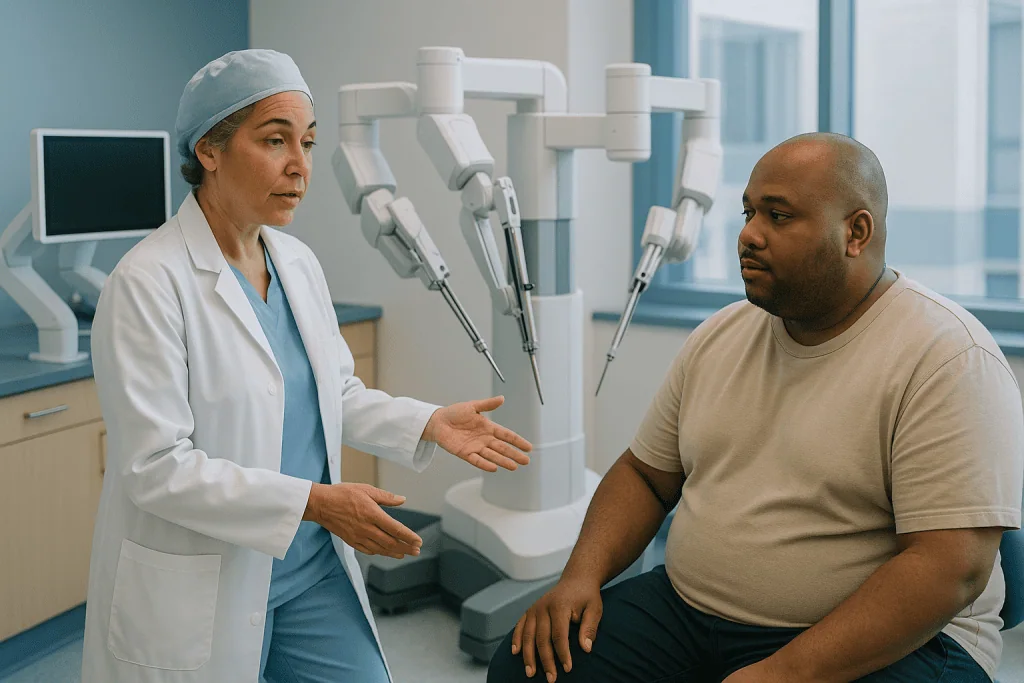
Three features distinguish it from conventional laparoscopy. First, the instrument tips have articulating wrists that can rotate and bend through a range wider than a human wrist, which matters when sewing around a corner deep in the abdomen. Second, the camera delivers a magnified, stereoscopic image, so the surgeon perceives depth rather than judging it from a flat screen. Third, the system filters out the natural tremor of the human hand and can scale movement down, so a larger motion at the console becomes a smaller, steadier motion inside the patient.
What it does not do is equally important. It does not think, plan or react. It has no independent sensors that stop it from cutting the wrong structure. It does not choose the type of operation or decide where the staples go. If the surgeon’s hands leave the controls, the instruments simply stop. Any safety it offers comes from giving a trained surgeon a better view and finer control, not from replacing that surgeon’s judgment.
A useful way to picture it: the robot is to the surgeon what a set of precision pliers is to a watchmaker. The tool extends the hand. It does not know what time it is.
Which weight-loss operations can be done robotically
Nearly any bariatric procedure that can be performed laparoscopically can be performed robotically, because the internal steps are identical. In practice, two operations account for the large majority of cases worldwide, and both are described in detail by the NIH’s digestive and kidney institute (NIDDK).
The sleeve gastrectomy removes most of the stomach, leaving a narrow, banana-shaped tube that holds far less food and produces less of the hunger-signaling hormone ghrelin. There is no rerouting of the intestine. It is currently the most commonly performed bariatric operation, and robotic sleeve gastrectomy is the version many patients are first offered.
The Roux-en-Y gastric bypass, usually shortened to gastric bypass, creates a small pouch from the upper stomach and joins it directly to a loop of small intestine, so food bypasses the rest of the stomach and the first section of the intestine. It involves two surgical joins, called anastomoses, which is where the robot’s suturing ability is most often cited as helpful.
Less common procedures include the duodenal switch and its single-anastomosis variant, which combine a sleeve with a longer intestinal bypass, and revisional surgery, meaning a second operation to correct or convert an earlier one. Revisions involve scar tissue and altered anatomy, and many bariatric surgeons regard them as a setting where enhanced visualization and wristed instruments are especially useful, though this is a clinical impression more than a settled finding.
The adjustable gastric band, a silicone ring placed around the upper stomach, is now performed far less often according to NHS and NIDDK descriptions of current practice, and is rarely done robotically. Which operation is right for a given person depends on their weight-related conditions, reflux history, prior surgery and preferences, and that decision sits with the treating team, not with the technology.
Who robotic bariatric surgery is usually for, and who is asked to wait
The eligibility rules for robotic bariatric surgery are the eligibility rules for bariatric surgery, full stop. The robot does not widen or narrow the door. The NHS describes weight-loss surgery as an option for people with a body mass index (BMI) of 40 or more, or a BMI between 35 and 40 together with a condition that would improve with weight loss, such as type 2 diabetes or high blood pressure, when serious attempts at other approaches have not worked. NIDDK gives broadly similar thresholds and notes that some programs consider people with lower BMIs who have poorly controlled type 2 diabetes. BMI is a crude measure and teams increasingly weigh it alongside health conditions rather than in isolation.

Beyond the numbers, most programs look for someone who understands the operation, has had a psychological and nutritional assessment, can commit to lifelong follow-up and vitamin supplementation, and is well enough to have a general anesthetic. Smoking cessation is typically required because smoking impairs healing at the staple line and increases ulcer risk after bypass.
Where the robotic approach specifically enters the conversation is in a few situations: very high BMI where thick abdominal walls make conventional instruments harder to angle, prior abdominal surgery with expected scar tissue, and revisional cases. Surgeon experience matters more than any of these; a team that performs the operation robotically every week is a different proposition from one that does it occasionally.
People are commonly asked to wait, rather than declined, when they have untreated sleep apnea that needs stabilizing, uncontrolled diabetes or blood pressure, an active eating disorder that requires treatment first, current pregnancy or plans to conceive soon, ongoing substance dependence, or a recent cardiac event. Some are asked to complete a supervised preparation program. Waiting is not a judgment about a person; it is about entering the operating room in the safest possible state.
Getting ready: the weeks before a robotic weight-loss operation
The preparation period tends to be longer and more structured than for most operations, and it is the same regardless of whether a robot is involved. A typical pathway begins with a multidisciplinary assessment: a bariatric surgeon, a dietitian, often a psychologist, and an anesthetist who reviews your airway, heart and lungs. Blood tests look at nutritional status, blood sugar and liver function; an ultrasound or endoscopy may be arranged to check for gallstones or reflux, since these can change the choice of operation.
Dietitians usually prescribe a pre-operative eating plan in the final one to two weeks. Its purpose is practical: shrinking the liver, which sits directly over the stomach and must be lifted out of the way during surgery. A large, fatty liver is heavier, more fragile and harder to retract, and reducing it even modestly improves the surgeon’s view. This is a short-term surgical measure, not a test of willpower, and its details come from your own team.
Medication review is part of the same visit. Some blood thinners, diabetes medicines and anti-inflammatory painkillers need to be adjusted or paused around the operation; the anesthetist and prescribing clinician make those calls, and patients should not stop or change anything on their own. If you use a CPAP machine for sleep apnea, you will usually be asked to bring it to the hospital.
The night before, you will be told when to stop eating and drinking. On the morning itself many programs give a carbohydrate-based clear drink and ask you to shower with an antiseptic wash. You may be fitted with compression stockings and given a small injection of a clot-preventing medicine before you go to theater, part of standard protocols that NHS guidance describes for reducing the risk of blood clots after surgery. Expect to sign a consent form that names the robotic approach and, importantly, the possibility of converting to standard laparoscopic or open surgery if needed.
In the operating room: anesthesia, positioning, and how the surgeon controls the instruments
You will not remember any of this section, which is exactly why it is worth reading. General anesthesia is given through a cannula in your hand, and a breathing tube is placed once you are asleep. Because bariatric patients can have more challenging airways, the anesthetic team plans this carefully and may use video-guided equipment.
Positioning takes real attention. You are secured to the operating table with padded straps and footplates, because the table will be tilted steeply head-up during the operation, letting gravity pull the intestines away from the stomach. Pressure points are padded to protect nerves and skin. Sequential compression sleeves on the calves squeeze rhythmically throughout to keep blood moving.
The abdomen is cleaned and draped. The surgeon makes the first small incision and introduces carbon dioxide gas, a step called insufflation, which lifts the abdominal wall like a tent and creates room to see and work. Further ports are placed under camera vision. The robotic cart, a tower with several jointed arms, is wheeled to the table and each arm is attached to a port. This is docking, and it is one of the reasons robotic cases can take somewhat longer than conventional ones, as MedlinePlus notes.
The surgeon now scrubs out and sits at the console. Their head rests against a viewer showing the three-dimensional image; their fingers slip into loops on two hand controllers; their feet rest on pedals that swap between instruments, adjust the camera, and activate energy devices that seal tissue. A bedside assistant, fully scrubbed, stays at the patient throughout, swapping instruments, passing stapler reloads, and managing suction. If the surgeon looks away from the viewer, the instruments lock in place. The system is built so that nothing moves without a human hand deliberately moving it.
Robotic gastric bypass procedure steps, and how a robotic sleeve differs
With the robot docked and the liver held aside by a retractor, the operation itself begins. For a sleeve gastrectomy, the surgeon frees the outer curve of the stomach from its attachments using an energy instrument that seals blood vessels as it cuts. A sizing tube is passed down the esophagus into the stomach by the anesthetist to act as a guide. The surgeon then fires a surgical stapler repeatedly alongside that guide, from near the outlet of the stomach up toward the esophagus, cutting and sealing in one motion. The result is the narrow tube described by NIDDK; the detached portion, most of the stomach, is placed in a retrieval bag and brought out through a slightly enlarged port. Many surgeons then oversew or reinforce the staple line, a step where wristed instruments make the sewing angle easier.
A gastric bypass has more steps. The surgeon staples across the upper stomach to create a small pouch, roughly the size of an egg, according to NIDDK, leaving the rest of the stomach in place but disconnected. Next comes the small intestine: a point is chosen a short way beyond the stomach, the bowel is divided, and the downstream end is brought up and joined to the pouch. This first anastomosis is often hand-sewn robotically, which is where enthusiasts of the technology make their strongest case. A second join reconnects the upstream intestine, carrying digestive juices, to the bowel further down, forming the Y shape that gives the operation its name. Any gap in the supporting tissue is closed to prevent internal hernia.
Before finishing, most surgeons perform a leak test: the anesthetist instills dye or air through a tube while the surgeon watches the staple lines and joins under water for bubbles or color. A drain is occasionally left, though many programs no longer use them routinely.
Closing the small incisions and the first hours awake
The last phase is quieter than the middle, but it is not an afterthought. Once the leak test is satisfactory and any bleeding points have been sealed, the surgeon inspects the whole operative field one final time under magnification. The robotic arms are detached from the ports, a process called undocking, and the cart is moved away. The surgeon returns to the patient’s side.
The carbon dioxide is released. Some inevitably remains and irritates the diaphragm, which is why many people wake with an ache at the tip of one shoulder for a day or two; MedlinePlus lists this referred gas pain among the common after-effects of laparoscopic procedures. The port through which the stomach specimen was removed is often the only one large enough to need a stitch in the deeper muscle layer, which reduces the risk of a hernia at that site. The skin incisions are closed with dissolvable sutures, surgical glue, or adhesive strips, then covered with small dressings. MedlinePlus describes the sleeve operation as typically involving two to five small cuts.
You wake in a recovery area with a nurse checking your breathing, blood pressure, pain and wound sites. Pain relief is usually multimodal, combining several classes of non-opioid medicine with opioids kept to a minimum, and the specifics come from the anesthetic team. Within a few hours you will be helped to stand and take a short walk. Early movement is one of the most effective measures against clots and lung complications, and it also helps disperse trapped gas.
Sips of clear fluid usually start the same day or the next morning once your team is happy. Nausea is common and treatable. Many people are surprised by how small the dressings look compared with the size of the operation that happened beneath them.
Robotic vs laparoscopic bariatric surgery: how do they really compare?
This is the comparison most people are actually trying to make, and the honest answer is that the two approaches are far more alike than different. Both are minimally invasive. Both use small incisions, carbon dioxide insufflation and a camera. The anatomy created inside the abdomen is the same. The differences lie in how the instruments are held, how the surgeon sees, how long setup takes, and what resources the operating room needs.
| Feature | Conventional laparoscopic | Robotic-assisted |
|---|---|---|
| Where the surgeon stands | At the patient’s side | At a console a few feet away, with an assistant at the bedside |
| Instrument movement | Straight, rigid instruments; limited wrist action | Articulating tips with a wide range of motion; tremor filtered |
| View | Two-dimensional screen, sometimes 3D | Magnified three-dimensional viewer |
| Setup time | Shorter | Longer, because of docking |
| Tactile feedback | Surgeon feels tissue resistance through instruments | Little or no direct sense of touch; relies on visual cues |
| Internal operation performed | Sleeve, bypass, revision, others | The same operations |
| Incisions and scarring | Several small cuts | Several small cuts, similar in number and size |
What does the research say about outcomes? Systematic reviews and meta-analyses indexed on PubMed have generally found that overall complication rates, length of hospital stay and weight loss are similar between the two approaches, with robotic cases tending to take longer in the operating room. Some analyses of gastric bypass suggest lower rates of staple-line or anastomotic problems with robotic suturing, but findings are inconsistent and many studies are single-center and retrospective. In plain terms: no high-quality evidence shows that one approach produces meaningfully better results for the average patient. Surgeon and team experience with whichever platform they use is likely the larger factor.
Is robotic bariatric surgery safe? The downside and the limits
The risks of robotic bariatric surgery are, first and foremost, the risks of bariatric surgery. The NHS and NIDDK both list bleeding, infection, blood clots in the legs or lungs, leaks from the staple line or joins, narrowing at a join, ulcers after bypass, gallstones, nutritional deficiencies and, rarely, death. These are serious and they belong in any honest explanation. Rates vary by operation and by center, and your team can give you their own figures.
The downsides specific to the robotic approach are more modest and more practical. Operating time is usually longer, largely because of docking, and longer anesthesia is not trivial for someone with obesity-related heart or lung conditions. The system removes most of the surgeon’s sense of touch; a rigid laparoscopic instrument transmits tissue resistance through the handle, whereas at a console the surgeon judges tension by watching how tissue deforms. Experienced robotic surgeons adapt to this, but it is a genuine limitation.
Equipment can malfunction. Arms can collide, instruments can fail, and a system fault can require the surgeon to switch to conventional laparoscopy mid-operation. Every consent form for robotic surgery includes this possibility, and it should be discussed rather than skimmed. A small additional concern is that the surgeon is physically away from the patient, which is why a fully trained bedside assistant is essential and why anesthesia teams plan for rapid access to the abdomen if bleeding occurs.
The learning curve is real as well. Skill built over many laparoscopic cases does not transfer completely to the console, and outcomes improve with the number of robotic cases a surgeon has performed. Asking how many robotic bariatric operations your surgeon does each year is a reasonable, non-hostile question. Finally, robotic platforms require significant institutional resources, which is a health-system consideration rather than a personal one, but it explains why the approach is not available everywhere.
Robotic gastric sleeve recovery time: what the first days and weeks usually look like
Recovery after a robotic sleeve or bypass looks very much like recovery after the laparoscopic version, because the incisions and the internal surgery are essentially the same. What follows describes typical patterns drawn from NHS and MedlinePlus guidance; your own team’s plan takes precedence.
The hospital stay. MedlinePlus notes that many people go home within about one to two days after a sleeve gastrectomy, once they can drink enough fluid, walk comfortably and have pain controlled with tablets. Bypass stays are often similar or a little longer.
Week one. Fatigue dominates. The wound sites feel bruised, shoulder-tip gas pain fades over a few days, and the main job is sipping fluids steadily to avoid dehydration, which is the commonest reason people return to hospital early. The NHS describes a staged diet beginning with liquids only, moving to pureed then soft foods over the following weeks, with a gradual return to a healthy, balanced solid diet at around six weeks. Short walks several times a day are encouraged from day one.
Weeks two to six. Energy returns unevenly. Most people with desk-based jobs discuss returning to work somewhere in this window; physically demanding work and heavy lifting are usually deferred until the team clears it, to protect the port sites from hernia. The NHS advises checking with your surgeon and insurer before driving again, and being able to perform an emergency stop comfortably.
Beyond six weeks. Follow-up visits check weight, blood tests and eating patterns. Hair thinning around months three to six is common and usually temporary, linked to rapid weight loss and protein intake. Lifelong supplements and annual blood tests, as the NHS and NIDDK both describe, begin now and do not end. The NHS also advises avoiding pregnancy for 12 to 18 months after surgery, during the period of most rapid weight change.
What people often get wrong about robotic weight-loss surgery
“The robot does the operation.” It does not, and no regulator anywhere permits autonomous surgery of this kind. A surgeon controls every movement. If that surgeon is inexperienced, the robot amplifies inexperience as faithfully as it amplifies skill.
“Robotic means smaller scars or no scars.” The incisions are the same small ports used in laparoscopy, similar in number and size. The specimen removal site in a sleeve is a little larger in both approaches.
“Robotic surgery is always the most advanced choice, so it must be better.” The evidence, summarized earlier, shows broadly equivalent outcomes with longer operating times. Newer is not a synonym for better, and a surgeon who is superb laparoscopically may be the safer pair of hands than a less experienced surgeon on a console.
“You can never eat normally again.” Portion sizes are permanently smaller and some people find certain textures difficult, but the NHS describes a return to a normal, balanced diet after the staged recovery period. What genuinely becomes lifelong is vitamin supplementation, follow-up blood tests, attention to protein, and caution with alcohol, which is absorbed faster and hits harder after bypass in particular. Anti-inflammatory painkillers are usually avoided after bypass because of ulcer risk; that is a discussion for your prescriber, not a blanket rule you should apply yourself.
“There is a single most successful type of bariatric surgery.” NIDDK notes that gastric bypass tends to produce somewhat greater weight loss and stronger effects on type 2 diabetes than the sleeve, but it also carries higher risks of nutritional deficiency and internal complications. Success depends on the match between operation and person, plus long-term follow-up and lifestyle change. No robot changes that equation.
“Recovery is dramatically faster with the robot.” Studies have not shown a consistent difference in hospital stay or return to activity. Recovery speed depends far more on the operation performed, your health before surgery, and early mobility.
Questions to ask your care team before robotic bariatric surgery
A good consultation should leave room for these. Write them down; most people forget half their questions once the conversation starts.
- Which operation are you recommending for me, and why that one rather than the alternatives?
- Why are you suggesting the robotic approach in my case? What would change if it were done laparoscopically?
- How many robotic bariatric operations do you perform each year, and how many of this specific procedure?
- What happens if the robotic system fails during my operation? Would you continue laparoscopically or convert to open surgery?
- Who is at my bedside while you are at the console, and what is their training?
- What are your program’s rates of leaks, bleeding, readmission and reoperation, and how do they compare with published national figures?
- How long should I expect to be in hospital, and what has to be true before I can go home?
- Which of my current medicines will change before and after surgery, and who manages that?
- What will the staged diet look like, and who do I call if I cannot keep fluids down?
- What lifelong supplements and blood tests will I need, and how often will I be seen in follow-up?
- How will this operation affect my reflux, my diabetes medicines, my contraception or my plans for pregnancy?
- What symptoms should make me come straight back rather than wait for a routine appointment?
You are entitled to clear answers in plain language. If a question is met with a vague reassurance rather than a number or a mechanism, ask it again or ask where the figure comes from. Teams that do this work well tend to welcome the scrutiny, because informed patients follow the plan more closely and recognize problems sooner. If you leave still unsure whether the robotic approach is the right one for you, say so; this is a decision your surgeon expects to make with you, not for you.
When to call your doctor after robotic bariatric surgery
Most recoveries are uneventful, and most worries turn out to be ordinary healing. Some symptoms, though, need a same-day call to your bariatric team or, if you cannot reach them, emergency care. The NHS and MedlinePlus both list the following as reasons not to wait.
Call emergency services or go to the nearest emergency department if you have:
- Sudden or severe abdominal pain, especially with a fast heartbeat or a fever, which can signal a leak from a staple line or join.
- Chest pain, shortness of breath, coughing up blood, or a racing pulse at rest, possible signs of a clot in the lungs.
- Vomiting blood or passing black, tarry stools, which suggest internal bleeding.
- Fainting, confusion, or a feeling that something is seriously wrong.
Contact your bariatric team the same day if you notice:
- A temperature above 38 °C (100.4 °F), or shaking chills.
- Persistent vomiting, inability to keep fluids down for more than a few hours, or signs of dehydration such as dark urine, dizziness on standing or passing very little urine.
- Redness, warmth, swelling, increasing pain or pus at any incision, or a wound that opens.
- New calf pain, swelling or warmth in one leg.
- Pain, swelling or a bulge at a port site, particularly when coughing or straining.
- Difficulty swallowing that is getting worse rather than better, or pain with every swallow.
A general rule that surgeons repeat: after bariatric surgery, a fast heart rate that will not settle is never something to sleep on. Trust your instinct, and never worry about being a nuisance. Your team would far rather see you for a false alarm than miss a leak. Keep the after-hours number somewhere you can find it before you leave the hospital, and make sure the person caring for you at home has it too.
Frequently asked questions
How long does it take to recover from robotic gastric sleeve surgery?
Recovery after a robotic sleeve is essentially the same as after a laparoscopic one. MedlinePlus notes many people leave hospital within about one to two days, and the NHS describes a staged diet that reaches normal solid food at around six weeks, with a return to light activities before that. Heavy lifting, driving and physically demanding work are resumed only when your team clears them, and follow-up continues for life.
What is the downside of robotic surgery?
The main downsides are longer operating and anesthesia time because of docking, loss of most tactile feedback for the surgeon, the possibility of equipment malfunction requiring a switch to conventional laparoscopy, and a learning curve that means results depend heavily on the surgeon’s robotic experience. The underlying risks of the bariatric operation itself, such as leaks, bleeding and clots, are unchanged by the robot.
Is robotic bariatric surgery safe?
Robotic bariatric surgery carries the same risks as any bariatric operation, including bleeding, infection, blood clots, staple-line leaks and nutritional deficiencies, as listed by the NHS and NIDDK. Published comparisons generally show overall complication rates similar to laparoscopic surgery. Safety depends far more on the experience of the surgeon and team, and on your preparation before surgery, than on whether a robotic platform is used.
What are the robotic gastric bypass procedure steps?
After general anesthesia and placement of small ports, the abdomen is inflated with carbon dioxide and the robotic arms are docked. The surgeon, at the console, staples the upper stomach to form a small pouch, divides the small intestine, joins the downstream bowel to the pouch, and reconnects the upstream bowel further down to form a Y. A leak test is performed, the arms are undocked, the gas released and the incisions closed.
How is robotic vs laparoscopic bariatric surgery different for the patient?
From the patient’s side the differences are small: the same small incisions, the same internal operation, a similar hospital stay and a similar recovery. The differences are inside the operating room, where the surgeon sits at a console with a three-dimensional view and wristed instruments rather than standing at the table with rigid ones. Operating time is usually somewhat longer with the robot.
What can you never do again after bariatric surgery?
Very few things are truly forbidden, but several become lifelong habits. The NHS and NIDDK describe permanent vitamin and mineral supplementation with regular blood tests, smaller portions, and caution with alcohol, which is absorbed faster after surgery. After gastric bypass, anti-inflammatory painkillers are usually avoided because of ulcer risk, though that decision belongs to your prescriber. The NHS also advises avoiding pregnancy for 12 to 18 months after surgery.
What is the most successful type of bariatric surgery?
There is no single best operation. NIDDK notes that gastric bypass tends to produce somewhat greater weight loss and a stronger effect on type 2 diabetes than sleeve gastrectomy, but it carries higher risks of nutritional deficiency and certain complications. The sleeve is simpler and now the most common. The right choice depends on your health conditions, reflux, prior surgery and preferences, and is made with your treating team.
Does the robot ever operate on its own during weight-loss surgery?
No. The system is a telemanipulator that copies the surgeon’s hand movements in real time and has no autonomous steps, no programmed sequence and no decision-making capacity. If the surgeon looks away from the viewer or releases the controls, the instruments lock in place. A scrubbed bedside assistant remains at the patient throughout to change instruments and respond immediately if needed.
How many incisions are made in robotic bariatric surgery?
Typically a handful of small incisions, each around a centimeter or so, through which ports for the camera and instruments are placed. MedlinePlus describes the sleeve gastrectomy as involving two to five small cuts, and the robotic version is similar. One port is usually enlarged slightly to remove the stomach specimen in a sleeve, and that site is often closed with a deeper stitch to reduce hernia risk.
Why does robotic bariatric surgery take longer than laparoscopic surgery?
Most of the extra time is setup: positioning the robotic cart, attaching each arm to its port, a process called docking, and the reverse at the end. MedlinePlus notes robotic procedures can take longer than conventional ones for this reason. As a team gains experience the gap usually narrows, but the anesthetic team will still factor the additional time into planning, particularly for people with heart or lung conditions.
References
- MedlinePlus: Robotic surgery
- MedlinePlus: Vertical sleeve gastrectomy
- NIH NIDDK: Types of Weight-loss Surgery
- NIH NIDDK: Side Effects of Weight-loss Surgery
This article is for general information only and is not a substitute for professional medical advice. Please consult a qualified doctor about your individual situation.

More from the Blog

Robotic vs Laparoscopic Bariatric Surgery: How Surgeons Decide Which Approach Fits You
Robotic and laparoscopic bariatric surgery are both minimally invasive; the difference is how the surgeon controls the instruments, not what is done to the…
Gastric Band vs Gastric Sleeve: Reversible Device or Lasting Reshaping, Compared Honestly
An adjustable gastric band is a removable silicone ring fitted around the upper stomach and tightened through a port under the skin; a gastric…
Robotic Bariatric Surgery: What the Robotic Arms Change Inside the Operating Room
Robotic bariatric surgery uses a surgeon-controlled console and wristed instruments to perform standard weight-loss operations, such as sleeve gastrectomy or gastric bypass, through small…

Gastric Balloon vs Gastric Sleeve: Temporary Device or Surgery, and How Doctors Compare Them
A gastric balloon is a temporary, saline-filled device placed in the stomach through the mouth and usually removed after about six months, while a…

Preparing for an Obesity Clinic Appointment: Weight History, Medicines and Questions to Bring
To prepare for an obesity clinic appointment, bring a written weight history (your weight at key life stages, past attempts, what helped and what…

Gastric Sleeve Results Over the Years: What Realistic Long-Term Expectations Look Like
Gastric sleeve results long term typically show the largest weight loss in the first one to two years, with a partial regain for many…