

How Laser Assisted Dental Procedures Work: Cleaning First, Then Precise Light Treatment
Key Takeaways
- Lasers do not remove hardened tartar reliably, so scaling and root planing with hand or ultrasonic instruments always comes before the light in a laser assisted dental procedure.
- Different laser families are absorbed by different substances: diode and neodymium beams target pigment and blood in gum tissue, while erbium beams are absorbed by water and mineral and are the only common type used to remove tooth structure.
- A healthy gum pocket measures roughly 1 to 3 millimeters when probed; deeper, bleeding pockets are what drive the decision to add laser treatment after cleaning.
- Systematic reviews find that adding a laser to thorough scaling produces small or inconsistent extra improvement in pocket depth, so mainstream references list it as an option rather than an upgrade.
- Cold sensitivity after treatment comes from newly exposed root surfaces created by the cleaning, not from the laser, and usually eases as the gum tightens back over the following weeks.
- Wavelength-specific protective eyewear is mandatory for everyone in the room during laser use because reflected light can injure the retina in a fraction of a second.
A laser assisted dental procedure uses a focused beam of light, chosen for the tissue being treated, after the tooth or gum has first been cleaned by conventional means. The cleaning removes plaque and hardened tartar; the laser then removes or reshapes small amounts of tissue, seals tiny blood vessels, or treats sensitivity. Lasers supplement, rather than replace, standard care, and suitability is decided by the dentist.
Marisol had rehearsed the question in the parking lot. Her dentist had just finished explaining that the pockets around three of her back teeth were deeper than they should be, and that after a thorough cleaning a laser might be used along the gum line. She nodded through the whole thing, then asked what she really wanted to know: “So the laser does the cleaning?”
It does not, and that misunderstanding sits at the heart of almost every question people bring to a laser assisted dental procedure. The light comes second. The unglamorous part, scraping mineral deposits off root surfaces with metal or ultrasonic instruments, comes first, and it is still where most of the benefit lives.
What follows is the version of that conversation Marisol wished she had heard: what the beam actually does to tissue, why the order matters, what the evidence honestly supports, and which sensations afterward are ordinary and which deserve a phone call.
What is a laser assisted dental procedure?
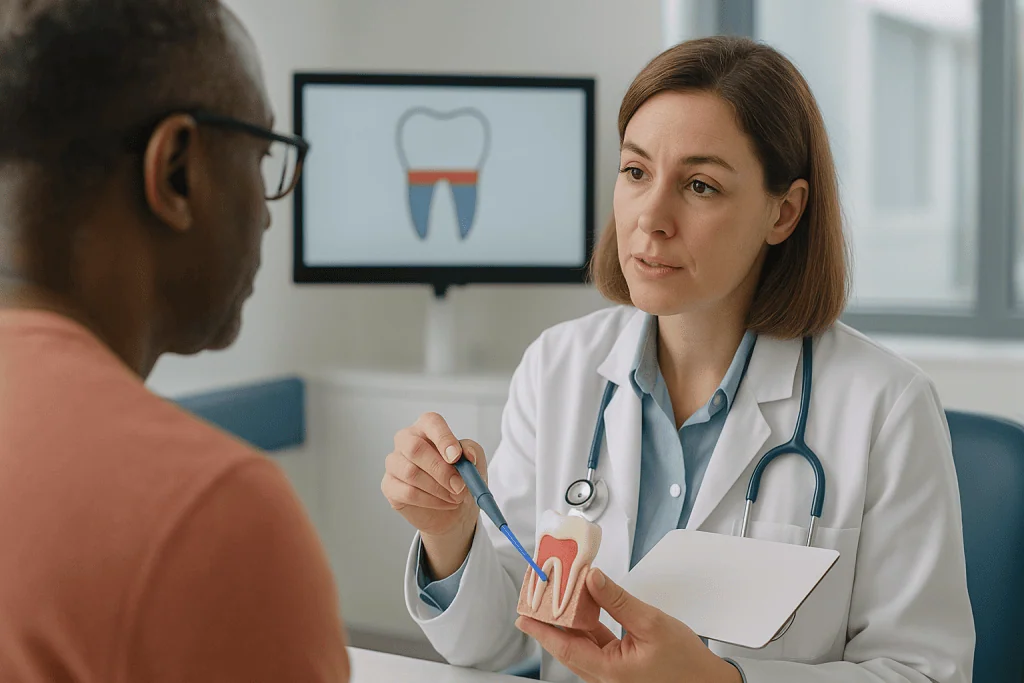
Strip away the marketing gloss and the definition is modest. A laser assisted dental procedure is any treatment in which a dentist uses a laser, a device that produces a narrow beam of light at a single wavelength, as one step in a plan that also includes conventional cleaning, examination, and follow-up. The word “assisted” is doing honest work. The laser assists; it does not carry the whole job.
Dentists reach for lasers in a handful of recurring situations. Along the gum line, a laser can remove thin layers of inflamed tissue inside a periodontal pocket, the gap that forms between tooth and gum when the attachment breaks down. On the gums themselves, it can reshape excess tissue or release a tight fold of skin under the tongue or lip. Inside a tooth, some lasers can remove decayed enamel and dentin, the softer layer beneath enamel, before a filling. On sensitive root surfaces, low-energy settings can dull the nerve response that makes cold water sting.
None of those uses is new. Dental lasers have been in clinical use for decades, and mainstream references such as the Mayo Clinic list them alongside hand instruments and ultrasonic scalers as tools for removing tartar and treating diseased tissue, not as a separate category of care. The distinction matters because the phrase “laser dentistry” can suggest an entirely different pathway. In practice you will still be examined, still have your pocket depths measured with a slim probe, still receive a cleaning, and still be asked to come back. The light is a refinement layered onto a standard visit, and the honest way to judge it is by what it adds to that standard, not by how modern it sounds.
Why the cleaning always comes first
Picture trying to paint a wall that still has old wallpaper glued to it. That is roughly what treating gums with a laser would be like if tartar were left in place. Tartar, also called calculus, is plaque that has hardened with minerals from saliva into a rough crust bonded to the tooth. Bacteria colonize its surface, and no amount of brushing dislodges it once it has set.

Removing that crust is the job of scaling and root planing. Scaling scrapes deposits from above and below the gum line; root planing smooths the exposed root so the gum can settle back against it and bacteria have fewer crevices to hide in. Dentists and hygienists do this with fine metal instruments, with ultrasonic tips that vibrate the deposits loose while flushing water, or with a combination. The Mayo Clinic describes this deep cleaning as the foundation of nonsurgical treatment for periodontitis, the advanced form of gum disease in which bone and the fibers holding teeth begin to break down.
Only after the root is clean does a laser make sense. Its beam works on soft tissue and bacteria at the surface it touches. If a layer of calculus sits between the beam and the pocket wall, the laser treats the calculus, not the disease. Worse, energy absorbed by mineral deposits can heat the root unpredictably.
There is a second, quieter reason the order matters. The cleaning itself is where the measurable improvement in gum disease comes from. Research summarized by mainstream sources consistently finds that mechanical debridement reduces inflammation and pocket depth; the question for lasers is whether they add anything on top. Skipping the first step to go straight to the second would abandon the part of the treatment with the strongest evidence in favor of the part with the weakest.
How dental lasers actually work on tissue
A dental laser is not a cutting blade made of light. It works by being absorbed. Every wavelength is soaked up more readily by some substances than others: water, the pigment in blood, the dark pigments in bacteria, or the mineral crystals in enamel. When a tissue absorbs the beam, the energy turns into heat in a very small volume, and that heat does one of three things depending on how much arrives and how fast.
At low energy, the tissue warms slightly. This is the setting used for desensitizing exposed roots, where the aim is to change how the tiny fluid-filled tubes in dentin respond to cold, and for reducing bacterial load along a pocket wall without removing tissue. At moderate energy, water inside cells vaporizes and the tissue separates, which is how lasers remove inflamed gum lining or reshape the gum edge. Small blood vessels seal as they are cut, which is why laser gum work often bleeds less than the same work done with a scalpel.
At higher energy, and with a wavelength that water absorbs very strongly, the beam can flash-boil the moisture inside hard tissue so that microscopic fragments of enamel or dentin pop away. A fine water spray cools the tooth and carries debris off. This is how some lasers prepare a cavity for a filling without a drill, though they work more slowly than a rotary bur and cannot remove old metal fillings or shape a crown.
The choice of wavelength is therefore not a technicality. A beam that soft tissue and blood absorb well will barely mark enamel; a beam tuned to water and mineral can remove tooth structure but is a poor choice for delicate gum contouring. Your dentist selects the device to match the tissue, which is the subject of the next section.
Which type of laser treats which tissue?
Patients often hear a laser described by its chemical name and assume the names are brands. They are not; they describe the material inside the device that generates the light, and each produces a characteristic wavelength measured in nanometers (nm), a billionth of a meter. The table groups the main families by what they are usually asked to do. It describes categories, not products, and no one device is being recommended.
| Laser family | Approximate wavelength | Absorbed mainly by | Typical dental uses |
|---|---|---|---|
| Diode | Roughly 810–980 nm | Blood and dark pigments | Soft-tissue trimming, pocket disinfection, releasing tight folds under lip or tongue |
| Neodymium (Nd:YAG) | About 1,064 nm | Pigment; penetrates soft tissue more deeply | Removing inflamed pocket lining, controlling bleeding |
| Erbium (Er:YAG, Er,Cr:YSGG) | About 2,780–2,940 nm | Water and hydroxyapatite mineral | Removing decay, preparing cavities, some bone and soft-tissue work |
| Carbon dioxide (CO₂) | About 9,300–10,600 nm | Water | Soft-tissue surgery; newer variants for hard tissue |
Two patterns are worth noticing. Diode and neodymium lasers are strongly absorbed by pigment, which is why they suit gum tissue and bleeding control but leave enamel essentially untouched. Erbium lasers are the only common family routinely used to remove tooth structure, because water and mineral soak up their beam so efficiently that the tooth material itself is what fragments.
The practical consequence is that a practice equipped with one type of laser may be able to offer some laser assisted procedures and not others. A dentist who uses a diode for gum work will still use a drill for fillings. That is not a shortcoming; it is physics, and a clinician who explains which laser they have and why it fits your treatment is giving you a good sign about how carefully the rest of your care will be handled.
What happens during a laser assisted dental procedure, step by step
The visit begins the way any gum-disease appointment does: with a probe. A slim, blunt instrument marked in millimeters is slipped gently between tooth and gum at several points around each tooth. According to the Mayo Clinic, a healthy pocket measures roughly 1 to 3 millimeters; deeper readings, especially those that bleed, suggest the attachment is breaking down. Those numbers, along with X-rays showing bone levels, decide whether a laser is even relevant.
If treatment goes ahead, the team will usually numb the area with a local anesthetic, a medicine injected into the gum that blocks nerve signals for a few hours. Some soft-tissue laser work at low settings is done with a topical numbing gel only, but that is a judgment the dentist makes based on how deep the pockets are and how much tissue is involved.
Cleaning follows. The hygienist or dentist scales the deposits from the root surfaces with hand and ultrasonic instruments and smooths the root. This is the longest part of the appointment and often the part people notice most, because of vibration, water spray, and the sound of instruments.
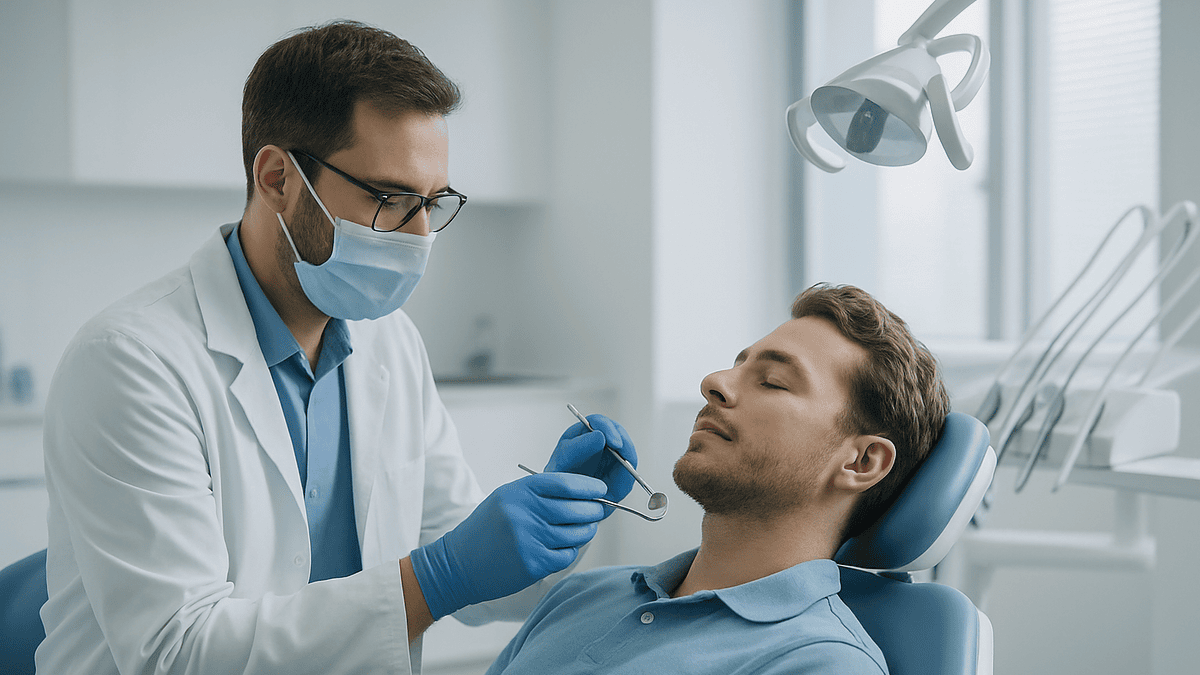
Then the laser. Everyone in the room, including you, wears protective eyewear, because the beam can injure the retina. A thin fiber or tip is introduced into the pocket and moved slowly along the inner gum wall. You may hear a faint clicking or popping from the pulsed beam and smell something faintly singed; that is vaporized tissue and water, not burning tooth. Each pocket takes a short time, and the team typically works around one section of the mouth per visit.
The appointment ends with instructions on cleaning, eating, and returning. Nothing about the sequence is exotic. The laser occupies perhaps a fifth of the chair time; the assessment and mechanical cleaning around it are what make the light worth turning on.
Is laser dental surgery painful?
This is the question people most want answered and the one most often oversold. The honest reply has two halves.
During the procedure, discomfort is usually controlled by local anesthetic, exactly as it would be for conventional scaling or gum surgery. The laser itself, when settings and technique are correct, tends to cause less mechanical pressure and vibration than a blade or a curette, and because small vessels seal as the beam passes, there is typically less bleeding to manage. Some patients describe warmth or a tapping sensation. Some soft-tissue trimming on the gum edge can be done with numbing gel alone. That said, “laser” does not mean “no anesthetic”: deep pocket work on inflamed tissue is still sensitive, and a dentist who offers numbing is being appropriately cautious, not old-fashioned.
Afterward, the picture is genuinely mixed. Because laser wounds seal as they form, many people report less soreness and swelling in the first day or two than they expected, and mainstream references note that laser gum treatment may be associated with less postoperative discomfort than surgery with a scalpel. But the underlying scaling and root planing still leaves roots freshly exposed, and those roots often ache with cold, sweet, or pressure for a while. That sensitivity is a feature of the cleaning, not the light, and no laser removes it.
Where claims go wrong is in the leap to “painless.” Pain is individual, inflamed tissue hurts regardless of the instrument, and studies comparing laser with conventional treatment have not shown a consistent, large difference in pain that would justify a blanket promise. A more accurate expectation: comparable numbing during, often a gentler first few days after, and root sensitivity that fades gradually as the gum reattaches. Your care team can suggest ways to manage that sensitivity; any pain relief they recommend should be taken exactly as they direct.
Who is a laser assisted dental procedure usually for, and who is asked to wait?
The clearest candidates are people whose gum disease has reached the stage where routine cleaning is not enough but full surgical flap procedures, in which the gum is lifted back to reach the root and bone, are not yet clearly required. Moderate periodontitis, with pockets deep enough to harbor bacteria but bone loss that has not undermined the tooth, sits in this middle ground. The Mayo Clinic lists lasers among the nonsurgical options a dentist may use to remove tartar and diseased tissue in this situation, alongside scaling, root planing, and topical or oral antimicrobials prescribed and supervised by the treating clinician.
People who bruise or bleed easily, including some taking blood-thinning medicines, are sometimes steered toward laser soft-tissue work because of its sealing effect, though the decision to continue, pause, or adjust any medicine belongs entirely to the prescribing physician and must never be made on a dentist’s advice alone, or your own.
Lasers are also used for small soft-tissue procedures in children, such as releasing a tight band of tissue under the tongue, where the reduced bleeding and lack of sutures can make the experience calmer. The pathway is the same: examination, discussion with parents, a comfort plan, then the procedure.
Who is usually asked to wait? Anyone whose infection is acute, with an abscess, fever, or spreading swelling, needs that emergency addressed first. Uncontrolled diabetes, heavy smoking, and pregnancy do not rule out treatment but change timing and expectations, because healing is slower and inflammation more persistent; the NHS notes that smoking in particular worsens gum disease and its response to treatment. Very advanced bone loss around a tooth may mean the realistic options are surgery or removal, and a laser would be a detour. And anyone whose tartar has not yet been removed is, by definition, not ready: the cleaning has to come first.
What are the downsides of laser dentistry?
The downsides rarely appear in the glossy version, so they deserve plain listing in prose.
The first is heat. Every dental laser works by converting light to thermal energy, and if the beam lingers, the tip is held too close, or the setting is too high, that heat can damage the root surface, the dental pulp inside the tooth, or the bone beneath the gum. Correct water cooling and a trained hand prevent this, but the risk is inherent to the tool in a way it is not to a hand scaler.
The second is what lasers cannot do. No laser removes hardened calculus as reliably as mechanical instruments, which is the whole reason cleaning comes first. Most lasers cannot remove old amalgam or metal fillings, cannot shape a tooth for a crown, and cannot reach every angle of a deep, curved pocket. A dentist who proposes a laser for one of those jobs is proposing the wrong instrument.
The third is the eye. Laser light reflected from a metal instrument or a mirror can injure the retina in a fraction of a second, which is why wavelength-specific protective glasses are mandatory for everyone in the room, including you. Declining them is not an option.
Then there is the evidence gap, discussed more fully in the next section: the added benefit of lasers on top of thorough scaling is modest and inconsistent in the research, which means some of what you may be told about outcomes rests on enthusiasm rather than data.
Finally, lasers can slow some procedures. Erbium lasers remove decay more slowly than a drill, and treating every pocket in a mouth with severe disease may need more visits. None of these downsides is a reason to refuse a laser that a thoughtful clinician proposes for a fitting indication. They are reasons to ask why it is being proposed and what it is expected to add.
Is dental laser treatment worth it? What the evidence actually shows
“Worth it” is a personal calculation, but the evidence part can be stated fairly.
For gum disease, the best-established benefit comes from mechanical cleaning. Systematic reviews of studies comparing scaling and root planing alone against scaling plus laser have generally found that adding a laser produces small or statistically inconsistent extra improvements in pocket depth and gum attachment. Some trials show a modest short-term advantage; others show none. Mainstream references, including the Mayo Clinic and the National Institute of Dental and Craniofacial Research, describe lasers as one of several tools for removing tartar and diseased tissue rather than as a superior method. That is the guideline-level position: an acceptable option, not a proven upgrade.
For soft-tissue procedures such as gum recontouring, removing small growths, or releasing tight tissue bands, the case is more about the experience than the outcome. Less bleeding, often no sutures, and frequently less swelling in the first days are consistent findings. The tissue heals to the same end point; the path there can be gentler.
For cavity preparation, erbium lasers can remove decay with less vibration and sometimes less need for anesthetic in shallow cavities, at the cost of speed and versatility. For desensitizing exposed roots, low-level laser use shows benefit in some studies and none in others; the evidence is genuinely uncertain.
So: worth it for whom? Someone anxious about drills or scalpels, someone prone to bleeding, or someone with moderate pockets whose dentist uses the laser as a careful adjunct to excellent cleaning may reasonably find the trade-offs favorable. Someone hoping the laser will replace the cleaning, spare them the long-term maintenance visits, or deliver a result the scaling alone could not, is likely to be disappointed. A dentist who frames the laser as “one thing I add after I clean thoroughly” is describing the evidence accurately.
Laser gum treatment vs traditional scaling and surgery: how do they compare?
Because laser gum treatment is so often marketed against conventional care, it helps to see the three approaches side by side as a dentist would.
Scaling and root planing, the nonsurgical baseline, removes plaque and calculus above and below the gum line with hand and ultrasonic instruments. It requires no incision, usually needs local anesthetic for deep pockets, and is the intervention with the deepest evidence base. The Mayo Clinic describes it as the starting point for periodontitis treatment. Its limitation is reach: past a certain depth and around curved roots, instruments cannot clean everything.
Laser-assisted treatment adds a beam after that cleaning to remove the inflamed inner lining of the pocket and reduce bacteria on the surface. It shares the baseline’s advantages, tends to bleed less, and may feel gentler afterward. Its limitation is the one already described: modest and inconsistent added benefit in the research, plus the thermal risk if technique is poor.
Periodontal flap surgery lifts the gum away from the tooth so the surgeon can see and clean the root and bone directly, then stitches it back, sometimes lower than before. It reaches what neither of the other approaches can, and it can be combined with bone grafts or regenerative materials. It costs more in recovery: swelling, sutures, and more prolonged sensitivity are expected, and the gum may sit lower afterward, exposing more root.
The comparison that matters is not “which is best” but “which fits this pocket in this mouth.” A shallow pocket needs cleaning. A moderate pocket may need cleaning plus a laser or cleaning plus a repeat. A deep pocket with bone loss that keeps bleeding after nonsurgical care usually needs surgery, and a laser used instead of surgery in that situation risks leaving disease behind while the gum looks calmer on the surface. Ask which category your pockets fall into; the answer should be specific to your chart.
What the following days and weeks usually look like
The first evening is usually quieter than people fear. The anesthetic wears off over a few hours, and what emerges is typically a dull ache along the treated gum rather than sharp pain, together with tenderness when chewing. Laser-treated gums often look slightly gray or whitish along the pocket edge for a day or two; that is the surface layer of coagulated tissue and is expected, not a sign of infection. Minor oozing of blood-tinged saliva on the first day is common. Heavy or persistent bleeding is not.
Eating shifts for a while. Soft, cool or lukewarm foods are easier; very hot, spicy, crunchy, or seedy foods can irritate the healing edge and lodge in pockets. Your team will tell you when to resume brushing the treated area and whether to use a prescribed or recommended rinse; follow their specific instructions rather than a general list, because advice differs depending on how much tissue was removed.
Sensitivity to cold is the complaint that lingers longest, and it comes from the cleaning rather than the laser. Root surfaces that were covered by tartar or swollen gum are suddenly exposed. As the gum tightens back against the root over the following weeks, that sensitivity usually eases, though it can persist for some people, and the Mayo Clinic notes that gums may recede as inflammation settles, making teeth look slightly longer.
Follow-up is where the real work resumes. Dentists typically re-measure pocket depths after healing to see how the gum has responded and decide whether any sites need repeat treatment or referral for surgery. After that, periodontal maintenance visits, more frequent than ordinary check-ups, become the long-term pattern; the NHS emphasizes that gum disease is managed over years through cleaning and daily home care, not resolved in a single appointment. The laser, if it helped, helped by making that ongoing work a little more effective. It did not end the need for it.
What people often get wrong about laser dentistry
The first misconception is the one Marisol arrived with: that the laser is the cleaning. It is not. Lasers do not remove hardened calculus dependably, and every mainstream reference places scaling and root planing first. If someone describes a laser “cleaning” that involves no instruments, ask what will happen to the tartar.
The second is that laser treatment is painless. Anesthetic is usually still needed for pocket work, and the root sensitivity afterward comes from exposing surfaces that were previously covered, which happens with any thorough cleaning. “Often gentler” is defensible; “painless” is not.
The third is that lasers make gum disease go away for good. Periodontitis is a chronic condition driven by bacteria that recolonize daily. The National Institute of Dental and Craniofacial Research and the NHS both frame it as something controlled through professional maintenance and home care over the long term. A laser can lower the bacterial load in a pocket on the day; it cannot prevent plaque from returning tomorrow.
The fourth is that “laser” means one thing. Diode, erbium, and carbon dioxide devices behave differently, and a practice with one cannot offer the procedures that need another. A drill still fills most cavities even in laser-equipped offices.
The fifth is that lasers whiten teeth. Some whitening systems use a light to warm the bleaching gel, and the light is sometimes called a laser. The bleaching is done by the gel; the NHS notes that whitening results and durability vary widely, and no light changes the chemistry of the peroxide.
The sixth is that a newer tool implies better evidence. In dentistry, as elsewhere in medicine, the newer method often has less data behind it, not more. That does not make lasers a poor choice; it makes them an option to weigh against the well-studied alternative, with a clinician who is candid about what the research shows.
Questions to ask your care team
Good questions do two things at once: they get you information and they show you how your clinician thinks. The following are the ones that tend to produce the most useful answers, with a note on what a reassuring reply sounds like.
- What are my pocket depths, and which sites are you proposing to treat with the laser? A specific answer tied to your chart, rather than “all of them,” suggests the laser is being matched to an indication.
- Will scaling and root planing be done first, and will it be the same thoroughness as if no laser were used? The answer should be an unhesitating yes.
- Which type of laser will you use, and what does it do to gum tissue versus tooth? You are checking that the wavelength fits the job.
- What does the evidence show about the laser adding benefit for pockets like mine? A candid clinician will acknowledge that the added benefit over cleaning alone is modest and variable.
- What would you do if the laser were not available? This reveals the conventional alternative and whether it would serve you just as well.
- How will you protect my eyes and my tooth pulp from heat? Expect an answer involving protective eyewear, water cooling, and pulsed settings.
- What sensations are expected afterward, and which ones should prompt a call? Ask them to be specific about bleeding, swelling, fever, and numbness.
- When will you re-measure, and what result would lead you to recommend surgery or referral instead? This sets the decision points in advance.
- What maintenance schedule will follow? The answer should describe ongoing visits and home care, not a finish line.
Bring the list written down. Clinicians generally welcome patients who ask about mechanism and evidence, and the conversation itself is part of deciding whether this option, offered by this team, is the right one for you. The final recommendation, and the decision to proceed, stay with you and the dentist treating you.
When to call your doctor
Most recovery from a laser assisted dental procedure is uneventful, and the mild ache, slight oozing, and cold sensitivity described earlier are within the ordinary range. A short set of signs, however, should prompt a same-day call to the dental office, or to a physician or urgent care if the office is closed.
Call if bleeding does not slow with firm pressure from a clean gauze pad after twenty to thirty minutes, or if it restarts heavily hours later. Call if swelling of the face, jaw, or neck increases after the second day rather than easing, or if the skin over it becomes hot and tight. Call if you develop a fever, chills, or a general feeling of illness, or if a foul taste or pus appears at the treated site; these can signal infection that needs assessment and possibly treatment prescribed by the clinician. Call if pain escalates rather than fading, or if it is not controlled by whatever your team advised. Call if numbness of the lip, tongue, or chin persists well beyond the expected wearing-off of the anesthetic, or if you notice a new burning sensation in the tongue or gum away from the treated area.
Seek emergency care immediately, without waiting for a callback, if you have difficulty swallowing or breathing, if swelling under the tongue or in the floor of the mouth makes it hard to close your jaw, or if bleeding cannot be controlled at all. Any of these can indicate a spreading infection or airway involvement.
Eye symptoms deserve their own line. If, despite protective eyewear, you experience a sudden blind spot, flashes, or persistent blurring after a laser procedure, seek urgent eye assessment the same day. Retinal injury from laser light is rare when protection is used but is an emergency when it occurs.
Whatever the symptom, the treating team is the right first contact. They know what was done and can judge quickly whether what you describe is healing or a complication.
Frequently asked questions
What are the downsides of laser dentistry?
The main downsides are heat that can damage root, pulp, or bone if technique or settings are poor; the inability of lasers to remove hardened tartar, old metal fillings, or shape crowns; the need for strict eye protection; slower removal of decay than a drill; and research showing only modest, inconsistent added benefit over thorough cleaning alone. These are reasons to ask why a laser is proposed, not reasons to reject one used for a fitting indication.
Is dental laser treatment worth it?
It depends on what you expect it to add. For gum disease, the well-proven benefit comes from mechanical scaling; the laser’s extra contribution in studies is small and variable. For soft-tissue procedures, lasers often mean less bleeding and no sutures, which many people value. It is reasonable for someone anxious about instruments or prone to bleeding; it is not a substitute for cleaning or long-term maintenance.
How much does dental laser treatment cost?
This article does not give prices, and any figure quoted online is unlikely to match your situation. What determines the fee is the number of sites treated, whether the laser is an add-on to scaling or part of a surgical procedure, the number of visits, and how your insurance or health system classifies the treatment. Ask the office for a written estimate that separates the laser component from the cleaning and follow-up.
Is laser dental surgery painful?
Usually not during, because local anesthetic is still typically used for pocket work, and the laser causes less pressure and vibration than a blade. Afterward, many people report less soreness and swelling in the first days than with scalpel surgery, but root sensitivity to cold from the cleaning is common and can last weeks. Pain is individual, and no honest clinician promises a painless experience.
Is laser dentistry safe?
When performed by a trained clinician with the correct wavelength, water cooling, pulsed settings, and mandatory protective eyewear for everyone present, laser dentistry has a safety record comparable to conventional methods. The specific risks are thermal damage to tooth or bone from poor technique and retinal injury from unprotected exposure. Both are preventable, which is why asking how the team protects eyes and tooth pulp is worthwhile.
What is laser teeth cleaning, and does it replace scaling?
The phrase is misleading. Lasers do not dependably remove hardened calculus, so what is usually meant is scaling and root planing with instruments followed by a laser pass along the pocket wall to remove inflamed lining and reduce bacteria. Mainstream references describe mechanical cleaning as the foundation of gum-disease treatment. If someone offers a laser cleaning with no instruments, ask what will happen to the tartar.
What are the common laser dentistry side effects?
Expected effects include a dull ache once the anesthetic wears off, slight oozing on the first day, a grayish or whitish appearance along the treated gum edge for a day or two, and sensitivity to cold from newly exposed roots. Gums may recede slightly as swelling settles, making teeth look longer. Increasing swelling, fever, pus, heavy bleeding, or persistent numbness are not expected and warrant a call.
Can a dental laser whiten teeth?
Not directly. Some whitening systems use a light, sometimes called a laser, to warm the bleaching gel, but the color change comes from the peroxide in the gel, not the light. The NHS notes that whitening results and how long they last vary considerably between people. Whitening is a cosmetic treatment separate from the therapeutic uses of dental lasers discussed here.
Do I still need follow-up visits after laser gum treatment?
Yes. Gum disease is a chronic condition managed over years, and lasers lower bacterial load on the day rather than preventing plaque from returning. Dentists typically re-measure pocket depths after healing to judge the response and decide whether any sites need repeat treatment or referral, then move you onto periodontal maintenance visits more frequent than routine check-ups, alongside daily home cleaning.
Are laser dental procedures used for children?
Some are, most often small soft-tissue procedures such as releasing a tight band of tissue under the tongue or lip, where reduced bleeding and the absence of sutures can make the experience calmer. The pathway is the same as for adults: examination, a discussion with parents about alternatives, a comfort and numbing plan set by the dentist, the procedure, and clear aftercare instructions from the treating team.
References
- NHS: Gum disease
- MedlinePlus: Gum Disease
- NIH National Institute of Dental and Craniofacial Research: Periodontal (Gum) Disease
- Cleveland Clinic: Periodontitis
This article is for general information only and is not a substitute for professional medical advice. Please consult a qualified doctor about your individual situation.

More from the Blog

Living With TMJ Treatment: Soft Foods, Wide Yawns to Avoid and Daily Jaw Habits
A soft diet for TMJ means choosing foods that need little chewing, such as yogurt, eggs, cooked grains, flaky fish and well-cooked vegetables, for…

What Halitosis Treatment Can Change and How Quickly Breath Usually Improves
Halitosis treatment can usually change the source of the odor rather than mask it: bacterial coating on the tongue, gum disease, dry mouth, or…
What Bruxism Treatment Can and Cannot Do: Protecting Teeth vs Stopping the Grinding
Bruxism treatment results depend on which goal you mean. Custom night guards and dental repairs reliably protect teeth from further wear, but current evidence…

Who Benefits From Oral Health Therapy? Early Gum Changes, Braces and Dry Mouth
Oral health therapy usually suits people whose main need is prevention and early treatment rather than complex dentistry: those with bleeding or swollen gums…

Preparing for an Orofacial Pain Appointment: Records, Imaging and a Pain Diary
To prepare for an orofacial pain appointment, gather your past dental and medical records, any existing X-rays or scans, and a current list of…

Living With Bruxism: Caffeine, Sleep Quality and Habits That Support Your Night Guard
Bruxism lifestyle changes work alongside a night guard, not instead of it. Evidence from major health bodies points to reducing caffeine, alcohol and nicotine…