

How Long Does Dental Numbness Last? Anesthetics, Timelines and Safe Waiting
Key Takeaways
- The tooth itself usually regains feeling within one to two hours, while lip and cheek numbness commonly runs three to five hours with the medium-acting anesthetics most dentists use.
- Lower-jaw nerve blocks numb half the lip, chin, and often the tongue, and routinely outlast upper-jaw injections by an hour or more because of denser bone and a larger nerve.
- Multiple injections extend numbness toward the upper end of the range, but not proportionally, because your bloodstream clears the medicine continuously.
- A brisk walk and a warm (never hot) compress can modestly speed clearance; the only fast option is a reversal injection some dentists offer, shown in studies to roughly halve soft-tissue numb time.
- The main danger of numbness isn't the numbness: it's unfelt burns from hot drinks and unnoticed bites of the cheek or tongue, especially in children.
- Numbness lasting past eight to twelve hours, or still present the next morning, deserves a call to your dentist; most lingering nerve irritation resolves over weeks, but early evaluation matters.
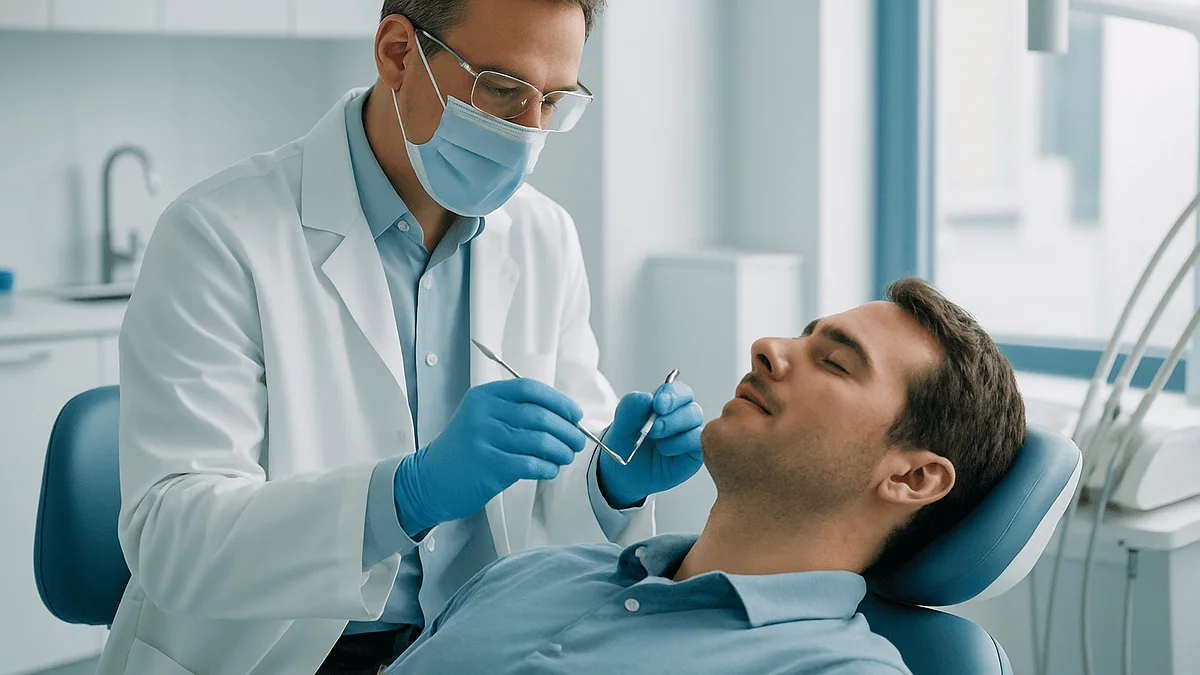
Numbness from a routine dental injection usually lasts two to five hours in the lips and cheek, while the tooth itself often regains feeling within one to two hours. The exact timeline depends on which anesthetic was used, whether it contained a vessel-narrowing additive, the injection site, and your metabolism. Lower-jaw injections linger longest. Numbness lasting beyond eight to twelve hours warrants a call to your dentist.
The receptionist waves goodbye, you try to smile back, and only half of your face cooperates. In the rearview mirror, one corner of your mouth sits a little lower than the other, your cheek feels borrowed from someone else, and the coffee in the cup holder suddenly looks less like a reward and more like a hazard.
Millions of dental patients walk out mid-numb every year and start the same silent countdown: when can I talk normally, eat lunch, take that work call? The internet offers plenty of tricks for hurrying things along. Most are folklore. A few are genuinely risky, chewing gum on a cheek you can’t feel, for one.
So here is the honest version: what that injection is actually doing inside your jaw, why your lip outlasts your tooth by hours, and the short, evidence-backed list of things that truly help.
Is it even novocaine? Probably not, and that matters
Start with a small correction that changes everything downstream: the numbing agent sold under that famous early-1900s brand name largely disappeared from dental offices decades ago. Newer local anesthetics took over because they start working faster, last more predictably, and cause allergic reactions far less often. The old name simply stuck, the way people say “Band-Aid” for any adhesive bandage.
Why does the vocabulary matter for your timeline? Because the original drug was notably short-acting, and durations quoted from old sources don’t match what’s actually in the syringe today. Modern dental anesthetics fall into rough families, short-acting formulas without additives, medium-acting formulas paired with a vasoconstrictor (a component that temporarily narrows nearby blood vessels to keep the medicine in place), and long-acting formulas reserved for surgery or post-operative comfort.
Your dentist chooses among them based on the job at hand. A quick filling on an upper tooth calls for something brief. A lower molar root canal often gets a medium-acting anesthetic with a vasoconstrictor, which is why that appointment leaves you numb well into the afternoon. Oral surgeons sometimes deliberately choose a long-acting option so the first, roughest hours after an extraction pass before full feeling returns.
Throughout this article, we’ll use “novocaine” the way most people do, as everyday shorthand for whatever local anesthetic your dentist selected, while being honest that the real answer to “how long does it last?” depends on which family of medicine you received.
How long does dental numbness actually last?
There are two clocks running after a dental injection, and they finish at very different times. The first is the working numbness: the window in which the tooth’s nerve is fully quiet so the dentist can drill, fill, or extract comfortably. The second is soft-tissue numbness: the heavy, rubbery feeling in your lip, cheek, and sometimes tongue. The tooth typically wakes up first; the soft tissue can lag by hours.
| Anesthetic family | Tooth (working) numbness | Lip and cheek numbness |
|---|---|---|
| Short-acting, no vasoconstrictor | About 20–40 minutes | Roughly 1–2 hours |
| Medium-acting with a vasoconstrictor (most common) | Around 60 minutes | Roughly 3–5 hours |
| Long-acting (surgical and post-operative use) | About 1.5–3 hours | Up to 8–12 hours |
Notice the gap in that middle row: the one most fillings and crowns fall into. Your tooth may be back online before you’ve left the parking lot, while your lip stays absent through lunch. That’s not a malfunction; it’s geometry and blood flow, which the next section unpacks.
One more honest caveat: these are population averages drawn from mainstream clinical references, not guarantees. Individual anatomy, the injection site, and how much anesthetic was needed can push your personal experience toward either edge of each range.
Why is my lip still numb when my tooth isn't?
Local anesthetics work by temporarily blocking sodium channels on nerve fibers: the tiny gates a nerve needs to fire a pain signal toward the brain. Close enough gates and the signal simply never leaves the neighborhood. The medicine doesn’t put you to sleep and doesn’t travel meaningfully through your whole body; it sits where it was placed and quiets whatever nerves it touches.
Here’s the catch. The dentist can’t inject directly into a tooth, so the anesthetic is deposited near the nerve that serves it, and that same nerve, or its branches, also serves your lip, cheek, gum, and sometimes half your tongue. The pool of medicine soaks the entire region indiscriminately.
The tooth’s nerve fibers regain function first because the concentration of anesthetic reaching them deep in the bone was lower to begin with, and it falls below the blocking threshold sooner. The soft tissue sits right next to the deposit, closest to the pool, last to drain.
Draining is the operative word. Your bloodstream clears the anesthetic away molecule by molecule, and the vasoconstrictor most dentists add slows that clearance on purpose, keeping the working area numb long enough to finish the procedure. The trade-off is a lip that stays heavy for a few extra hours. It’s a deliberate bargain, not a mistake, and knowing that makes the wait easier to accept.
How long does it take for four shots to wear off?
More anesthetic means a longer tail, but not a proportionally longer one. Four injections do not leave you numb four times as long as one, because your circulation is clearing the medicine continuously the entire time. Think of a sink with the drain open: pouring in more water raises the level and delays the moment it empties, but the drain never stops working.
In practice, multiple cartridges tend to push you toward the upper end of the normal range, and sometimes an hour or two past it. A patient who received one injection of a medium-acting anesthetic might feel normal in three hours; someone who needed four, common for lower molars, long procedures, or teeth that resisted numbing, might wait five or six.
Timing matters too. If your dentist re-injected partway through the appointment because feeling started creeping back, the clock effectively restarted at that moment, not when you first sat down. A two-hour appointment with a top-up at the ninety-minute mark can leave you numb well into the evening, and that’s entirely expected.
Two things worth remembering:
- Extra injections are usually a sign of thoroughness, dentists would rather use more anesthetic than work on a patient who can feel the drill.
- Inflamed or infected tissue resists numbing, so a painful tooth often requires more medicine than a routine cleaning-adjacent filling, extending the timeline accordingly.
Why lower-jaw numbness lingers so much longer
Ask around and you’ll hear a consistent story: upper teeth wear off fast, lower molars keep you mumbling until dinner. The anatomy explains it.
The upper jaw is made of relatively porous bone, so the dentist can inject a small amount of anesthetic right beside the target tooth, a technique called infiltration, and the medicine seeps through to the nerve within minutes. A small, local deposit means a small, local cleanup job, and feeling often returns within two to three hours.
The lower jaw is a different animal. Its outer bone is dense enough that infiltration near a molar often fails, so dentists usually perform a nerve block instead: the anesthetic is placed farther back, near the main nerve trunk before it enters the jawbone. Numbing the trunk numbs everything downstream, half the lower lip, the chin, the teeth on that side, and frequently half the tongue.
A block uses more anesthetic, deposits it in tissue that clears slowly, and silences a much larger nerve, so the numbness routinely runs three to five hours and occasionally longer. The tongue involvement is also why lower-jaw appointments make speaking and swallowing feel clumsier than upper-jaw ones.
None of this reflects on the dentist’s skill. It’s the price of working on teeth armored by the thickest bone in the face, and it’s the single biggest reason two people with identical fillings can have wildly different afternoons.
Can you make dental numbness wear off faster?
Honestly? A little. The anesthetic leaves your tissue only one way, carried off by your bloodstream, so anything that safely increases local blood flow can trim the timeline. The emphasis belongs on trim: think minutes shaved off, not hours erased.
- Move around. A brisk walk raises your heart rate and circulation everywhere, including your face. It’s the simplest lever you have, and it costs nothing.
- Apply gentle warmth. A warm, never hot, compress held against the outside of the cheek dilates nearby vessels. Test the temperature on your wrist first, because your numb cheek can’t warn you about a burn.
- Massage, with permission. Lightly massaging the outside of the cheek can encourage blood flow, but skip this entirely if you had an extraction or surgery, and ask your dentist before trying it.
There is one genuinely fast option, and it happens in the chair, not at home: a reversal injection your dentist can administer after the procedure, which works by re-opening the blood vessels the vasoconstrictor narrowed. In clinical studies, patients who received it regained normal lip sensation roughly twice as fast as those who didn’t. It’s not offered everywhere and isn’t suited to every patient or procedure, but if lingering numbness genuinely disrupts your life, you speak for a living, say, it’s a fair question to raise when booking.
Beyond that, the most reliable remedy remains unglamorous: time.
The wear-it-off tricks that don't work
For every legitimate strategy, the internet offers five that range from useless to actively harmful. A quick myth audit:
- Chewing gum to “work it off.” This is the worst of the bunch. Chewing on tissue you can’t feel is precisely how people bite through their own cheek or tongue without noticing. The blood-flow benefit is trivial; the injury risk is real.
- Hot rinses or hot drinks. Heat inside a numb mouth is a scald waiting to happen. You won’t feel the damage until hours later, when the anesthetic fades and a burned palate announces itself.
- Caffeine. There’s no credible evidence that coffee or energy drinks clear a local anesthetic faster. Caffeine actually narrows some blood vessels, which runs opposite to the goal.
- Pinching or slapping the numb area. You can’t stimulate a blocked nerve back to life, but you can bruise tissue that won’t report the damage until later.
- “Sleeping it off.” A nap is harmless, but lying still slows circulation slightly. If speed matters, gentle movement beats the couch.
The pattern behind all of these is worth internalizing: numbness itself is temporary and benign, while the injuries people cause trying to rush it, burns, bites, bruises, are the actual problem. If a trick involves putting a numb body part in harm’s way, the trick has failed before you’ve tried it.
What should you not do after dental numbing?
The short list, in order of how often each one sends people back to the dentist:
- Don’t chew on the numb side. Cheek and tongue bites are the most common post-anesthetic injury, and they hurt considerably once feeling returns. Some leave ulcers that take a week to heal.
- Don’t drink anything hot. Soup, tea, coffee, wait until you can reliably feel temperature on your lips. Lukewarm is the ceiling.
- Don’t bite down to “test” whether you’re still numb. People genuinely do this, and it works exactly as badly as it sounds. Tap a fingertip against your lip instead.
- Don’t schedule anything that depends on crisp speech. A lower-jaw block borrows half your tongue for a few hours; important calls and presentations will sound better after it returns.
- Don’t ignore your dentist’s procedure-specific instructions. After an extraction, rules about rinsing, straws, and smoking exist to protect the healing site and override any general advice here.
One reassurance worth stating plainly: local anesthesia by itself does not impair judgment, coordination, or reaction time, so driving yourself home after a routine numbed filling is generally considered safe. The calculation changes completely if you also received sedation of any kind, in that case you need a ride, full stop, and your dental team will have told you so beforehand.
Eating and drinking while numb, done safely
The ideal answer is to wait until full sensation returns before eating, usually a few hours. Real life, of course, includes morning appointments, skipped breakfasts, and blood sugar that won’t negotiate. If you must eat while numb, you can do it with low risk by respecting two facts: you cannot feel temperature, and you cannot feel where your cheek and tongue are relative to your teeth.
Choose foods that require no real chewing, yogurt, applesauce, a smoothie eaten with a spoon, scrambled eggs, oatmeal cooled to lukewarm. Take small bites, chew slowly and deliberately on the non-numb side, and keep your attention on the task rather than your phone. Drinks should be cool or room temperature; save the reunion with hot coffee for later.
A few situational notes:
- If you had a tooth extracted, follow your surgeon’s instructions above all, many advise against straws and vigorous rinsing in the first day to protect the clot forming in the socket.
- Numbness dulls taste and texture on one side, so food may seem oddly bland or feel strange. That’s the anesthetic, not the food, and it resolves with everything else.
- Drooling slightly or dribbling from the numb corner of your mouth is common and temporary. A napkin at hand spares the shirt.
When your lip responds normally to a light fingertip tap and you can feel warmth again, normal meals are back on the menu.
Kids and numb cheeks: the biting problem parents should know about
Children experience the same numbness adults do, with one crucial difference: a numb cheek is fascinating when you’re six. It feels puffy and strange, and the natural response is to poke, suck, and, most consequentially, chew on it. Pediatric dental teams see the result regularly: a child bites the inside of a numb lip or cheek repeatedly on the ride home, feels nothing, and wakes the next day with a swollen, whitish ulcer that looks alarming to parents but is actually a self-inflicted bite wound.
Prevention is mostly vigilance. For the first few hours after a child’s appointment:
- Remind them every ten to fifteen minutes not to bite, suck, or pull at the numb side, young children genuinely forget within minutes.
- Stick to cool, soft foods that need no chewing, and skip meals entirely until feeling returns if the timing allows.
- Watch the mirror moments: kids love making faces at their numb half. Faces are fine; fingers and teeth on the numb tissue are not.
Timelines in children run broadly similar to adults, sometimes slightly shorter, and pediatric dentists often deliberately select shorter-acting anesthetics for exactly this reason. The reversal injection mentioned earlier has also been studied in school-age children, so if your child has a history of post-appointment cheek biting, ask whether it’s an option at your next visit.
If a bite ulcer does appear, it typically heals on its own within a week or so; your dental office can confirm and advise.
Why did my heart race right after the injection?
Few dental sensations rattle people more than this one: seconds after the injection, your heart suddenly pounds, you feel a wave of jitteriness, and the thought am I having a reaction? arrives uninvited. Almost always, the explanation is mundane and brief.
Most dental anesthetics are paired with a vasoconstrictor: the additive that narrows nearby blood vessels to keep the numbing medicine in place. If a small amount of that additive enters a tiny blood vessel during the injection, it briefly circulates and does what such compounds do: nudges the heart rate upward for a minute or three. The sensation is intense but short-lived and fades on its own. It is not an allergic reaction, and true allergy to modern local anesthetics is rare.
That said, the experience carries a useful lesson: your dentist’s medical history form is not bureaucratic filler. Tell your dental team about any heart rhythm problems, high blood pressure, thyroid conditions, or medications you take, because that information genuinely changes which anesthetic formulation they reach for. Formulas with less vasoconstrictor, or none, exist precisely for patients who need them, with the trade-off of shorter numbness.
If the racing sensation ever comes with chest pain, trouble breathing, facial swelling, or hives, that’s a different situation entirely and warrants immediate attention. But the classic thirty-second flutter after the injection, followed by nothing? That’s chemistry, not danger, and your dentist has seen it a thousand times.
What changes your personal numbness timeline
Hand two patients the identical injection and their afternoons can still diverge by hours. Several factors move the needle:
- Infection and inflammation. Infected tissue is more acidic than healthy tissue, and local anesthetics work poorly in acidic environments. Dentists compensate by using more medicine or injecting farther from the inflamed site, both of which extend the total numb time. This is why the appointment for a genuinely aching tooth often ends with the longest-lasting numbness.
- Injection technique and site. As covered earlier, a lower-jaw nerve block outlasts an upper-jaw infiltration almost every time. Where the needle went matters more than almost anything else.
- Your metabolism and liver function. The anesthetic is broken down by your body after the bloodstream carries it away. People clear it at genuinely different speeds, and significant liver disease can slow the process, another item that belongs on your health history form.
- Anatomy. Nerve pathways vary from person to person more than most people realize. Some patients are reliably “hard to numb” or “quick to wake up,” and it’s neither imagination nor the dentist’s fault.
- Anxiety, sort of. Stress doesn’t measurably change how fast the drug clears, but it sharpens attention on every strange sensation, which makes numbness feel longer. Distraction is legitimate medicine here.
If your numbness consistently runs far outside the ranges in this article, mention it. Dentists can and do adjust their choices for known outliers.
When numbness lasts too long: when to see a doctor
Here is the boundary line worth memorizing. Ordinary post-dental numbness resolves within about five hours for most procedures, and within eight to twelve hours even after long-acting anesthetics used in surgery. Beyond that window, and certainly if you wake up the next morning still numb, call your dental office. Don’t wait it out silently for days.
Persistent numbness or tingling after the anesthetic should have cleared is called paresthesia. It occasionally follows lower-jaw nerve blocks or lower wisdom tooth removal, when the needle or the procedure irritates a nerve directly. The encouraging truth, well supported in the literature: the large majority of these cases resolve on their own over weeks to a few months as the nerve recovers. Early evaluation still matters, because your dentist can document the extent, monitor progress, and refer you to a specialist if sensation isn’t returning on schedule.
Separate from lingering numbness, a few signs call for urgent care rather than a routine call:
- Swelling of the face, lips, or throat, or difficulty breathing or swallowing, seek emergency care immediately.
- A spreading rash or hives after the appointment.
- Fever, worsening pain, and swelling at the site days later, which suggests infection rather than anesthesia.
And a gentler flag: numbness accompanied by drooping on one side of the face hours after everything should have worn off deserves prompt medical evaluation, since facial numbness has causes beyond dentistry. When in doubt, make the call, dental offices field these questions daily and would rather hear from you.
Frequently asked questions
How long does it take for 4 shots of novocaine to wear off?
Expect the upper end of the normal range, often five to six hours of soft-tissue numbness instead of the typical three to five. Multiple injections add more anesthetic for your bloodstream to clear, and if some were given partway through the procedure, the clock restarted then. Numbness won’t last four times longer than a single shot, though, because your circulation removes the medicine continuously the whole time.
How long does it take numbness to wear off after the dentist?
For most routine procedures, lip and cheek numbness fades within three to five hours, and the tooth itself often regains feeling within one to two. Upper-jaw injections tend to resolve fastest, sometimes within two to three hours, while lower-jaw nerve blocks linger longest. Long-acting anesthetics used for surgery can keep tissue numb for eight to twelve hours, which the surgical team will usually tell you to expect.
What should you not do after novocaine?
Avoid hot drinks, chewing on the numb side, and biting your lip or cheek to test sensation, unfelt burns and bite injuries are the most common post-anesthetic problems. Stick to cool, soft foods if you must eat, supervise children closely since they often chew numb cheeks, and follow any procedure-specific instructions from your dentist, especially after extractions. Driving after a plain local anesthetic is generally fine; after sedation, it is not.
How can I make numbness from novocaine go away faster?
Gentle activity is your best at-home tool: a brisk walk increases circulation, which is what carries the anesthetic away. A warm, not hot, compress on the outside of the cheek can help slightly, as can light massage if your dentist approves it. Expect minutes of improvement, not hours. The only genuinely fast option is a reversal injection given by the dentist, which studies show can roughly halve soft-tissue numb time.
Can I eat while my mouth is still numb?
It’s safest to wait until feeling returns, but if you must eat, choose foods that need no real chewing, yogurt, applesauce, lukewarm oatmeal, scrambled eggs. Take small bites, chew slowly on the non-numb side, and keep drinks cool or room temperature, since you can’t feel a scald. After an extraction, follow your surgeon’s specific instructions about rinsing and straws, which take priority over general advice.
Is it safe to drive home after dental numbing?
Yes, in most cases: a local anesthetic alone does not affect judgment, coordination, or reaction time, so driving after a routine numbed filling is generally considered safe. The answer changes completely if you also received any form of sedation, in which case you need someone else to drive and your dental team will have arranged this in advance. If you feel dizzy or unwell for any reason, wait or call the office.
Why is my mouth still numb 6 hours after the dentist?
Six hours is on the long side but often still normal, particularly after a lower-jaw nerve block, multiple injections, a long procedure with mid-appointment top-ups, or a long-acting anesthetic used for surgical work. Infected or inflamed tissue also requires more anesthetic, extending the tail. If numbness passes the eight-to-twelve-hour mark, or you wake up the next morning still numb, call your dental office for guidance.
Can dental numbness be permanent?
Permanent numbness is rare. Occasionally a lower-jaw injection or wisdom tooth removal irritates a nerve, causing lingering numbness or tingling called paresthesia, and the large majority of these cases resolve on their own over weeks to a few months as the nerve recovers. Contact your dentist promptly if numbness persists past a day, so the extent can be documented and monitored, with a specialist referral if sensation isn’t returning as expected.
How long does dental numbness last in kids?
Roughly the same as in adults, often two to four hours, though pediatric dentists frequently choose shorter-acting anesthetics on purpose. The bigger issue is behavior: children commonly chew or suck on a numb lip or cheek and injure it without feeling anything, discovering a painful ulcer the next day. Remind your child every ten to fifteen minutes not to bite the numb side, and offer only cool, soft foods until feeling returns.
Why does my lip feel swollen when it isn't?
Because your brain has lost the constant stream of position and touch signals from that area, it fills the gap with a sensation of puffiness: the same reason a numb foot feels oversized. Check a mirror and you’ll usually see a normal-looking lip that simply droops slightly from relaxed muscle tone. The swollen feeling fades in step with the numbness itself. Actual visible swelling that grows over hours is different and worth a call to your dentist.
References
- MedlinePlus: Anesthesia
- NHS: Local anaesthesia
- Cleveland Clinic: Anesthesia
- Cleveland Clinic: Paresthesia
This article is for general information only and is not a substitute for professional medical advice. Please consult a qualified doctor about your individual situation.

More from the Blog

Root Canal Recovery: What the First Days Feel Like and When to Check In
Most people recover from a root canal within a few days. Mild soreness or tenderness when biting typically peaks in the first 24 to…
Simple vs Surgical Wisdom Teeth Removal: How the Approach Depends on the Tooth’s Position
A simple wisdom tooth extraction is used when the tooth has fully erupted and can be loosened and lifted out with hand instruments. A…

Tooth Decay Treatment Visit: Numbing, Removing Damaged Tissue and Restoring the Tooth
A cavity treatment procedure usually has three steps: the dentist numbs the area with a local anesthetic, removes the softened, decayed part of the…

How a Smile Makeover Is Planned: Photographs, Digital Impressions and Smile Design
A smile makeover is planned in stages: a dental health examination first, then a set of standardized photographs, a digital scan of the teeth,…

Gum Recession Treatment Results: How Grafted Gum Matures and What It Can and Cannot Restore
Gum graft results develop in stages: the graft attaches over the first one to two weeks, swelling and a pale or reddish look settle…
How to Read a Smile Makeover Plan: Questions About Each Step and Temporary Teeth
A smile makeover treatment plan is a written, sequenced document that lists each proposed procedure, the order it will happen in, what temporary teeth…