

How Neuromodulation Works: What Electrical and Magnetic Stimulation Do to Nerve Signals

Key Takeaways
- Neuromodulation changes how nerves fire rather than destroying them, which is why implanted systems can be switched off, reprogrammed or removed.
- Spinal cord stimulation is explained largely by gate control theory from 1965: activating large touch fibers in the dorsal horn reduces how many pain signals travel upward.
- Transcranial magnetic stimulation induces current in the brain through the intact skull and is typically delivered five days a week for about four to six weeks, according to Mayo Clinic.
- Most pain neuromodulation systems are tested in a trial of roughly five to seven days with an external generator before anything permanent is implanted, per Cleveland Clinic.
- The most frequent reason for revision surgery with spinal cord stimulation is lead migration, not device failure or infection.
- The NHS states there is not enough good-quality evidence to say whether TENS reliably relieves pain, even though it is low-risk and some people find it helpful.
Neuromodulation works by delivering carefully controlled electrical currents or magnetic pulses to specific nerves, the spinal cord or brain regions, altering how those cells fire. The pulses can make overactive pain or motor circuits quieter, or nudge underactive circuits to fire more normally. It changes signaling rather than destroying tissue, and the effect is adjustable and usually reversible.
The pulse arrives as a faint hum under the skin, somewhere between a cat’s purr and a phone on vibrate. For the person on the table, it is replacing a burning ache that has lived in their left leg for three years. The programmer sitting beside them turns a dial, asks a quiet question, and waits.
That scene, repeated in pain clinics, neurology suites and psychiatric day units, is the practical face of a question many people now type into a search bar: how neuromodulation works. The short version is that nerves speak in electricity, and anything that reshapes that electricity can reshape what the brain receives.
The longer version matters more, because it explains why one person’s spinal cord stimulator eases pain while another’s does little, why magnetic pulses to the scalp are used for depression but not for a sore knee, and why the honest answer to “will it work for me?” is still “we test it first.”
What is neuromodulation therapy, in one plain picture?
Neuromodulation therapy is any treatment that changes nerve activity by delivering a stimulus, usually electrical or magnetic, directly to a chosen part of the nervous system. The word modulate is borrowed from radio: you are not switching the signal off, you are changing its volume or rhythm.
Picture a busy motorway at rush hour. Pain signals from a damaged nerve behave like a jam that never clears, with cars still pressing forward long after the original roadworks have gone. Neuromodulation does not demolish the road. It installs traffic lights at a strategic junction and times them so that fewer cars reach the city center, which in this analogy is the part of your brain that registers hurt.
Three features define the approach and separate it from older options such as cutting or burning a nerve:
- It is targeted. A lead or coil is aimed at a specific nerve, spinal segment or brain region, not at the body as a whole.
- It is adjustable. Strength, frequency and pulse width can be reprogrammed as symptoms shift.
- It is largely reversible. Implanted systems can be switched off or removed; non-invasive systems simply stop when the session ends.
The targets vary widely. The spinal cord is the usual site for chronic limb or back pain. Deep brain structures are the site for tremor and advanced Parkinson’s disease. The vagus nerve in the neck is used for certain epilepsies. The outer brain surface, reached through the intact skull with a magnet, is the site for treatment-resistant depression (Mayo Clinic). What unites them is the same core idea: electricity is already the nervous system’s native language, so a device that speaks it fluently can join the conversation.
How neuromodulation works: the language of nerve signals
To understand how neuromodulation works, start with the single nerve cell. A neuron keeps a small electrical charge across its outer membrane, like a tiny battery. When enough stimulus arrives, that charge flips for roughly a thousandth of a second and the flip travels down the fiber as an action potential, the nerve’s version of a bit of data. At the far end, chemical messengers called neurotransmitters pass the message to the next cell.

Everything a neuromodulation device does happens at one of two points in that chain.
The first is the membrane. An applied current can make the membrane more likely to flip, which is called depolarization, or less likely, which is called hyperpolarization. Rapid trains of pulses can also tie up a neuron so that it cannot respond to the slower, irregular barrage coming from a damaged nerve. In practical terms, the device’s pulses crowd out the pain traffic.
The second is the synapse, the junction between cells. Repeated stimulation changes how much neurotransmitter is released and how sensitive the receiving cell becomes. Neuroscientists call this plasticity, the nervous system’s capacity to rewire itself with use. This is why some effects outlast the stimulation itself: the circuit has been retrained, not just interrupted.
Magnetic stimulation reaches the same endpoint by a detour. A rapidly changing magnetic field passing through the scalp and skull induces a small electrical current in the brain tissue beneath, a principle called electromagnetic induction. The coil never touches neurons; the induced current does the work.
Which effect dominates depends on the frequency, intensity and location chosen by the care team, which is why programming sessions can be as decisive as the implant itself.
What is neurostimulation, and how does it differ from a nerve block or TENS?
Neurostimulation is the branch of neuromodulation that uses electrical pulses, as opposed to drugs delivered into the nervous system by pump or to magnetic fields. People often use the two words interchangeably, and in a pain clinic that is usually fine.
The comparison that matters more is with a nerve block. A nerve block is an injection of local anesthetic, sometimes with a steroid, that numbs a nerve for hours to weeks. It works chemically, blocking the sodium channels that let the membrane flip. It is also a one-way street: once the drug wears off, the effect is gone, and repeating it indefinitely is rarely the plan. Neurostimulation, by contrast, is continuous or on-demand and can be tuned over months.
Transcutaneous electrical nerve stimulation, or TENS, is the simplest form of neurostimulation. Sticky pads on the skin deliver mild pulses to nerves just beneath. The NHS describes it as a method some people find helpful for short-term pain relief, while noting that there is not enough good-quality evidence to say whether it is reliably effective for most conditions. That is the honest position: TENS is low-risk and may help some people some of the time, but it is not a proven treatment for chronic pain.
Implanted systems go further by placing the electrode directly on or near the target nerve, which allows far more precise and consistent stimulation than pads on skin can achieve. Peripheral nerve stimulation targets a single named nerve, for instance in the leg or scalp. Sacral nerve stimulation targets the nerves controlling bladder and bowel. Spinal cord stimulation, covered next, targets the cord itself.
The through-line is dose by electricity rather than by chemistry, delivered where the signal travels.
How does spinal cord stimulation work?
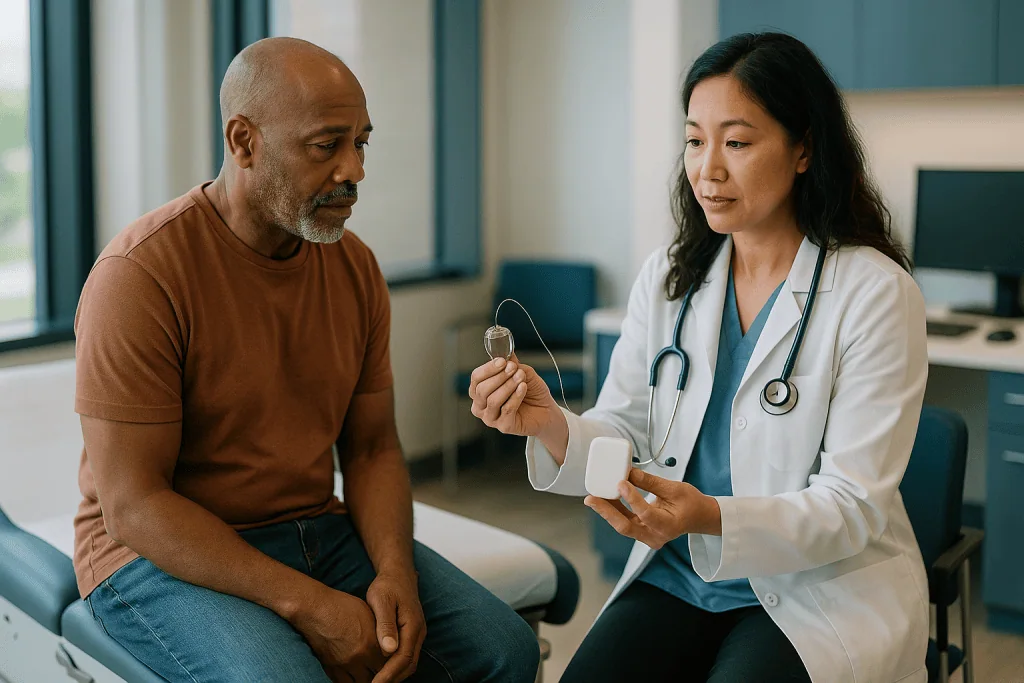
Spinal cord stimulation places one or two thin, insulated wires called leads in the epidural space, the narrow gap between the bony spinal canal and the protective membrane around the spinal cord. The leads carry small electrical contacts. A pulse generator, roughly the size of a pocket watch, sits under the skin of the buttock or abdomen and connects to the leads, sending programmed pulses up to the cord (Cleveland Clinic).
The classic explanation is gate control theory, proposed by Melzack and Wall in 1965. Large, fast-conducting touch fibers and small, slow pain fibers both enter the spinal cord at the same level. When the large fibers are busy, they close a metaphorical gate in the dorsal horn, the cord’s relay station, so fewer pain messages pass upward. Spinal cord stimulation activates those large fibers artificially. Traditional systems produce a tingling called paresthesia in the painful area, which is the gate being held partly shut.
Newer programs use higher frequencies or burst patterns that do not cause tingling. Their mechanism is thought to involve calming overactive dorsal horn cells and altering signaling in the brain regions that assign emotional weight to pain, though the precise pathways are still under study. Saying so plainly matters, because device marketing sometimes outruns the science.
Spinal cord stimulation is most often considered for neuropathic pain, meaning pain from damaged nerves rather than from ongoing tissue injury. Typical examples include persistent pain after spine surgery, complex regional pain syndrome and some painful diabetic neuropathies (Cleveland Clinic). It is not a treatment for a fresh injury, and it does nothing to the structural cause of pain. It changes what the brain is told about that cause.
What happens inside the brain during magnetic stimulation (TMS)?
Transcranial magnetic stimulation, or TMS, is the main non-invasive form of brain neuromodulation. The person sits awake in a reclining chair. A padded electromagnetic coil rests against the scalp, usually over the left prefrontal cortex, a region just behind the forehead involved in mood regulation. Each time the coil fires, the magnetic field passes through skin and bone without resistance and induces a current a few centimeters deep (Mayo Clinic).
In depression, imaging studies have found that this region tends to be underactive. Repetitive TMS, delivered at high frequency, is thought to increase its activity and strengthen its connections with deeper mood circuits. Over a course of sessions, plasticity does the rest. Mayo Clinic describes a typical course as daily sessions, five days a week, for about four to six weeks, and lists it as an option for depression that has not responded adequately to medication and talking therapy. TMS is also used for some cases of obsessive-compulsive disorder and migraine.
What the person feels is a tapping sensation and a loud clicking, which is why earplugs are standard. There is no anesthesia and no recovery period; most people drive themselves home.
Two honest caveats. First, response varies, and a course can be completed without benefit; the treating team should discuss realistic expectations before starting. Second, TMS is a treatment for specific brain conditions. It is not a general brain booster, and the evidence for off-label uses is thinner than online clinics sometimes imply.
A less common cousin is transcranial direct current stimulation, which applies a weak constant current through scalp electrodes. Its effects are subtler and the research base is still developing, so most guideline bodies treat it as investigational.
Deep brain stimulation and vagus nerve stimulation: the implanted cousins
Deep brain stimulation, or DBS, carries the same principle into the center of the brain. A neurosurgeon places a thin electrode into a precisely mapped nucleus, such as the subthalamic nucleus for Parkinson’s disease or the thalamus for essential tremor. A wire runs under the skin to a generator in the chest. Mayo Clinic lists its established uses as Parkinson’s disease, essential tremor, dystonia, epilepsy and severe obsessive-compulsive disorder, with other uses still being studied.
How does stimulating a brain region reduce tremor? The target nuclei in movement disorders fire in abnormal, synchronized rhythms, like an orchestra section stuck on one beat. High-frequency pulses appear to override that rhythm with a regular, less disruptive pattern, letting downstream circuits move more smoothly. The effect switches on and off with the device, which is both reassuring and instructive: DBS manages symptoms, it does not alter the underlying disease.
Vagus nerve stimulation, or VNS, takes a different route. The vagus is a long cranial nerve running from the brainstem through the neck to the chest and abdomen. A cuff electrode is wrapped around the left vagus nerve in the neck and connected to a chest generator. Pulses travel upward into the brainstem and spread to networks involved in seizures and mood. Mayo Clinic describes it as an option for certain drug-resistant epilepsies and for treatment-resistant depression when other approaches have failed.
Both are major procedures. Both involve a trade-off between symptom control and surgical risk, which is why candidacy is decided by a multidisciplinary team rather than a single clinician. For many people, though, the ability to turn a tremor down with a handheld controller is a genuinely different kind of relationship with a chronic illness.
Who is neuromodulation usually for, and who is usually asked to wait?
Neuromodulation sits late in most treatment pathways, not because it is a last resort in the dramatic sense, but because it is invasive, expensive to the health system and only useful when the problem is one of signaling.
People typically considered include those with:
- Chronic neuropathic pain that has persisted despite rehabilitation and appropriate medicines, where imaging shows no surgically correctable cause (Cleveland Clinic).
- Movement disorders whose symptoms are no longer controlled smoothly by medication, or where medication side effects have become limiting (Mayo Clinic).
- Epilepsy that continues despite adequate trials of antiseizure drugs and is not suitable for resective surgery.
- Depression that has not responded to several evidence-based treatments.
People commonly asked to wait, or steered toward other options, include those with an active infection anywhere in the body, uncontrolled bleeding risk, pain that is primarily from ongoing tissue damage such as an inflamed joint, or a diagnosis that has not yet been fully worked up. Many centers also ask for a psychological assessment before implanting a pain device. This is not a judgment on anyone’s character. Untreated depression, anxiety or unrealistic expectations are among the strongest predictors of disappointment with any chronic pain intervention, so addressing them first is part of giving the device a fair chance.
Pregnancy, certain implanted cardiac devices and the need for frequent MRI scans are also discussed case by case, because compatibility varies between systems.
For TMS, the key exclusions are metal implants in or near the head and a history of seizures, since the induced current can, rarely, provoke one (Mayo Clinic).
In every case the decision belongs to the treating team, who weigh these factors against the person’s goals and alternatives.
The main types of neuromodulation at a glance
The field can feel like an alphabet soup. The table below groups the main approaches by where they act and how they reach the target. It is a map, not a menu; which option is appropriate depends on diagnosis, prior treatment and individual risk.
| Approach | Target | How the stimulus reaches it | Typical indications discussed | Invasiveness |
|---|---|---|---|---|
| TENS | Skin and superficial nerves | Adhesive pads, external battery unit | Short-term pain relief; evidence mixed (NHS) | None |
| Transcranial magnetic stimulation | Outer brain cortex | Magnetic coil on scalp, induced current | Treatment-resistant depression, some OCD, migraine (Mayo Clinic) | Non-invasive |
| Peripheral nerve stimulation | A single named nerve | Implanted lead near the nerve | Focal neuropathic pain | Minor implant |
| Spinal cord stimulation | Dorsal columns of the spinal cord | Epidural leads, implanted generator | Persistent neuropathic limb or back pain, CRPS (Cleveland Clinic) | Implant, usually after a trial |
| Vagus nerve stimulation | Left vagus nerve in the neck | Cuff electrode, chest generator | Drug-resistant epilepsy, resistant depression (Mayo Clinic) | Implant |
| Deep brain stimulation | Specific deep brain nuclei | Intracranial electrode, chest generator | Parkinson’s, essential tremor, dystonia, epilepsy, severe OCD (Mayo Clinic) | Brain surgery |
Two patterns stand out. The deeper and more precise the target, the more invasive the route, and the stronger the requirement that other treatments have been tried first. And the external options, TENS in particular, trade precision for safety, which is why their evidence is softer even though their risks are small.
A further implication: the right question is rarely “is neuromodulation good?” but “is this type, for this diagnosis, at this stage, a reasonable next step?”
What the trial and the following weeks usually look like
For spinal cord and many peripheral nerve systems, a trial comes first. Under local anesthetic and light sedation, the leads are threaded into position using X-ray guidance and connected to an external generator worn on a belt. Cleveland Clinic describes the trial period as typically about five to seven days. During that week the person goes home, lives as normally as the dressings allow, and keeps a simple diary of pain, sleep and activity. If the team and the person judge the benefit worthwhile, a second procedure implants the permanent generator; if not, the leads are removed in minutes and nothing permanent remains.
After permanent implantation, the first weeks are about healing and settling. Incisions need to stay clean and dry. Bending, twisting and lifting are limited for several weeks so that the leads do not migrate before scar tissue anchors them (Cleveland Clinic). Programming visits follow, often more than one, because the sensation and the pain pattern both change as swelling subsides.
Deep brain stimulation follows a different rhythm. The electrodes and generator are placed, but programming usually begins a few weeks later once the brain has recovered from surgery, and medication is adjusted alongside stimulation over months by the neurology team (Mayo Clinic).
TMS has the simplest timeline. Sessions last a matter of minutes to under an hour, repeated on weekdays over several weeks, with no restrictions in between (Mayo Clinic). Mood changes, when they occur, tend to build gradually rather than arriving in a single session.
Across all types, the common experience is that benefit is assessed over weeks, not days, and that the treating team expects to fine-tune. Patience is part of the protocol.
What are the common side effects of neuromodulation?
Neuromodulation side effects divide neatly into those caused by the procedure and those caused by the stimulation itself.
Procedural risks for implanted systems are those of any surgery plus a few specific to hardware. Infection at the generator or lead site is the most consequential, because an infected device usually has to be removed. Bleeding, pain over the generator, and a leak of spinal fluid causing a positional headache are recognized with spinal cord stimulation (Cleveland Clinic). Lead migration, where the wire shifts and the tingling moves away from the painful area, is the most frequent reason for revision surgery. Deep brain stimulation carries the additional, uncommon but serious, risk of bleeding inside the brain or stroke during electrode placement (Mayo Clinic).
Stimulation-related effects are usually milder and often adjustable. For spinal cord systems, unwanted tingling, jolts with posture changes and a sense that the stimulation has lost its effect over time are the common complaints. For vagus nerve stimulation, hoarseness, cough, throat discomfort and shortness of breath during the pulse are typical and often ease with reprogramming (Mayo Clinic). For deep brain stimulation, speech changes, tingling, balance problems and mood or behavior shifts can occur and are frequently reduced by changing settings.
TMS is generally well tolerated. Mayo Clinic lists scalp discomfort, headache, lightheadedness and facial muscle twitching as the usual short-lived effects, with seizure a rare but documented risk that drives the screening questions asked beforehand.
TENS can cause skin irritation under the pads and should not be used over the front of the neck or by people with certain implanted cardiac devices (NHS).
None of these should be weighed alone. The treating team’s job is to set them against the burden of the untreated condition.
Where neuromodulating medications fit in
Searches for neuromodulating medications usually refer to drugs that change nerve signaling rather than drugs that treat the original injury. They are the pharmacological branch of the same idea.
Several classes are used this way. Medicines originally developed as anticonvulsants, including the gabapentinoid class, reduce the release of excitatory neurotransmitters from overactive nerve endings, which is why they are used in neuropathic pain and some seizure disorders. Certain antidepressant classes, notably serotonin-norepinephrine reuptake inhibitors and older tricyclics, strengthen the brain’s own descending pain-inhibition pathways, the top-down traffic lights that normally dampen incoming pain. Local anesthetics block sodium channels directly, as in nerve blocks. In movement disorders, drugs that replace or mimic dopamine restore signaling in the circuits that deep brain stimulation also targets.
Two features distinguish these medicines from the painkillers most people are familiar with. Their effect on nerve pain typically builds gradually, over weeks rather than hours, as receptors and circuits adapt. And their benefit is often partial: a reduction in pain intensity or seizure frequency rather than elimination.
Where do devices and drugs meet? In practice, a person being evaluated for a spinal cord stimulator has usually already tried at least one of these medicine classes, and many continue them afterward at a reduced burden. In Parkinson’s disease, stimulation and medication are deliberately balanced by the neurology team, each covering what the other cannot.
Any change to these medicines, whether starting, reducing or stopping, belongs with the prescribing clinician. Several classes carry withdrawal effects if stopped abruptly, and the right pace of adjustment depends on the individual’s full medical picture rather than on a general rule.
What people often get wrong about neuromodulation
The myths cluster around three themes: what it does, what it fixes and how it feels.
“It burns or kills the nerve.” It does not. That describes radiofrequency ablation, a different procedure. Neuromodulation leaves the nerve intact and simply changes its firing pattern, which is why the effect stops when the device is switched off.
“If it works, the pain is gone for good.” Guideline bodies and device trials measure success as a meaningful reduction in pain and improvement in function, not elimination. Many people still have background pain and still use other strategies. Anyone promising a pain-free life is overselling.
“It treats the cause.” A stimulator does nothing to a herniated disc, a damaged joint or the degenerating neurons of Parkinson’s disease. It changes signal processing. That is valuable, but it means the underlying condition still needs its own care.
“It must hurt.” The sensations are tingling, tapping or a hum. Pain from stimulation itself is a sign the settings need adjustment, not an expected part of treatment.
“A bigger battery means a stronger effect.” Battery capacity determines how long a generator lasts before replacement or recharging, not how well it works. Mayo Clinic notes that non-rechargeable deep brain stimulation batteries typically need replacing every few years, while rechargeable models last longer; neither is more effective.
“TMS is a general brain tune-up.” Its evidence is for specific psychiatric and neurological diagnoses under medical supervision. Claims of enhanced memory, creativity or focus in healthy people are not supported by mainstream evidence.
“You cannot ever have an MRI.” Compatibility varies by system and scanner settings. Many modern devices allow MRI under specific conditions; the device card and the implanting team have the details.
Questions to ask your care team about neuromodulation
A good consultation leaves you knowing not just what the device does but why it is being suggested for you. These questions tend to produce the most useful answers.
- What exactly is the diagnosis you are treating, and why do you think it is a signaling problem rather than ongoing tissue damage?
- Which other treatments should I have tried first, and have I tried them adequately?
- Will there be a trial period, what counts as a successful trial, and who decides?
- What realistic change in pain, tremor, seizures or mood would you consider a good result, and how will we measure it?
- What are the specific risks of the procedure in my case, given my other conditions and medicines?
- How will my current medicines be managed before, during and after, and who is responsible for those decisions?
- How many programming visits are usual, and what happens if the first settings do not help?
- Is the system MRI-compatible, and under what conditions?
- How long is the battery expected to last, and what does replacement involve?
- What activities will I need to limit, and for roughly how long?
- If it does not help, can the system be removed, and what does that involve?
- Who do I contact urgently if something goes wrong at home?
Bring someone with you if you can. Programming sessions and consent discussions contain a lot of detail, and a second set of ears catches what the first misses. Ask for written material you can read later, and do not be reluctant to request a second opinion within the same health system before committing to an implant. A team confident in its recommendation will welcome that.
The point of these questions is not to challenge the clinician. It is to make sure the decision, which remains theirs to recommend and yours to accept, rests on shared understanding.
When to call your doctor
Most people living with a neuromodulation device have an uneventful course, but a small number of problems need prompt attention. Contact your treating team the same day, or seek emergency care, if any of the following occur.
Signs of infection at any incision or over the generator: spreading redness, warmth, swelling, pus or a wound that opens, especially with fever or chills. Device infections can progress quickly and are far easier to manage early (Cleveland Clinic).
New neurological symptoms after a spinal procedure: weakness or numbness in the legs, difficulty walking, or loss of bladder or bowel control. These are rare but constitute an emergency, because they can signal bleeding or pressure in the spinal canal.
A severe headache that is worse when upright and eases lying down, in the days after a spinal lead placement, which may indicate a spinal fluid leak.
After brain surgery for deep brain stimulation: sudden severe headache, confusion, new weakness on one side, trouble speaking, or a seizure (Mayo Clinic).
Stimulation that feels wrong: sudden painful jolts, stimulation in a new area, or a complete loss of effect with no obvious reason. This usually indicates lead movement or a hardware fault and is not an emergency, but it needs a prompt appointment.
During or after TMS: any seizure, fainting, or hearing change that persists beyond the session (Mayo Clinic).
Mood changes: new or worsening depression, thoughts of self-harm, or marked personality change, which have been reported with both deep brain and vagus nerve stimulation and must be assessed urgently.
Keep your device identification card with you and tell any clinician treating you, including in emergency settings, that you have an implanted system. If you are unsure whether a symptom matters, call. The team would rather hear from you unnecessarily than late.
Frequently asked questions
What is neurostimulation and is it the same as neuromodulation?
Neurostimulation is the subset of neuromodulation that uses electrical pulses to change nerve activity. Neuromodulation is the broader term and also includes magnetic stimulation and drugs delivered directly to the nervous system by implanted pump. In a pain clinic the words are often used interchangeably, because electrical devices such as spinal cord and peripheral nerve stimulators are the most common forms encountered there.
How does spinal cord stimulation work to reduce pain?
Leads placed in the epidural space deliver pulses to the spinal cord’s dorsal columns, activating large sensory fibers that inhibit pain transmission in the dorsal horn, an effect described by gate control theory. Newer high-frequency and burst programs appear to calm overactive spinal cells without causing tingling. The structural cause of pain is unchanged; what changes is the signal the brain receives (Cleveland Clinic).
What are the common side effects of neuromodulation?
Procedural effects include infection, bleeding, pain over the generator and, for spinal systems, headache from a spinal fluid leak. Stimulation effects depend on the target: unwanted tingling or lead migration with spinal cord stimulation, hoarseness and cough with vagus nerve stimulation, speech or balance changes with deep brain stimulation, and scalp discomfort or headache with TMS. Many stimulation effects can be reduced by reprogramming.
What are neuromodulating medications used for?
They treat conditions driven by abnormal nerve signaling rather than ongoing tissue injury. Anticonvulsant-class drugs reduce excitatory neurotransmitter release in neuropathic pain and epilepsy; certain antidepressant classes strengthen the brain’s descending pain-inhibition pathways; dopamine-related drugs restore signaling in Parkinson’s disease. Their benefit usually builds over weeks and is partial rather than complete, and any change belongs with the prescribing clinician.
What is neuromodulation therapy used for most often?
The most established uses are chronic neuropathic pain, including persistent pain after spine surgery and complex regional pain syndrome; movement disorders such as Parkinson’s disease and essential tremor; drug-resistant epilepsy; and treatment-resistant depression. Each use pairs with a specific target and device type, and all sit late in treatment pathways after other options have been adequately tried (Mayo Clinic, Cleveland Clinic).
Does neuromodulation hurt?
The intended sensation is tingling, tapping or a faint hum, not pain. Pain from stimulation itself usually means the settings need adjustment or a lead has shifted, and should be reported to the care team. Implant procedures involve ordinary surgical soreness for a period afterward, and TMS can cause scalp discomfort or headache during early sessions that typically settles.
Is neuromodulation permanent or can it be reversed?
It is designed to be adjustable and largely reversible. Implanted systems can be switched off, reprogrammed or surgically removed, and non-invasive methods such as TMS or TENS stop having any effect when sessions end. This reversibility is the main difference from older procedures that cut or ablate nerves, and it is why a trial period is standard before most permanent pain implants.
How long does a neuromodulation trial last?
For spinal cord stimulation, Cleveland Clinic describes the trial as typically about five to seven days, during which temporary leads connect to an external generator and the person records pain and activity at home. The permanent implant proceeds only if the trial is judged worthwhile by both the person and the team. Deep brain stimulation and TMS do not use this kind of external trial.
Can I have an MRI with a neuromodulation device?
It depends on the specific system and scanner settings. Many modern spinal cord and deep brain stimulators are approved for MRI under defined conditions, while some older systems are not. Always carry your device identification card and inform radiology staff before any scan; the implanting team can confirm the exact conditions that apply to your device.
Why would someone be asked to wait before neuromodulation?
Common reasons include an active infection, uncontrolled bleeding risk, a diagnosis not yet fully worked up, pain driven mainly by ongoing tissue damage, or untreated depression and anxiety that reduce the chance of a meaningful result. Many centers also want rehabilitation and appropriate medicines tried adequately first. These are safeguards for the person, and the decision rests with the treating team.
This article is for general information only and is not a substitute for professional medical advice. Please consult a qualified doctor about your individual situation.

More from the Blog

Joint Injection Aftercare: Resting the Joint, Managing Soreness and When Relief Begins
Joint injection aftercare is usually simple: rest the joint from strenuous activity for a day or two, keep the small dressing clean and dry…

Who May Be a Candidate for Neuromodulation? Conditions, Prior Treatments and Testing
A candidate for neuromodulation is typically someone with a chronic, clearly diagnosed condition, such as persistent nerve-related pain, overactive bladder, or a movement disorder,…

Preparing for an Interventional Pain Procedure: Blood Thinners, Fasting and Imaging Review
Preparing for an interventional pain procedure usually means three things: telling the team about every blood thinner you take so they can decide, with…

Chronic Pain Treatment in Older Adults: Balancing Mobility, Other Conditions and Safety
Chronic pain treatment in older adults usually combines movement-based therapy, pacing, sleep and mood support, and carefully chosen medicines, with injections or procedures considered…

Exercise After Shock Wave Therapy: Why Loading the Tendon Matters Once Soreness Settles
Gentle movement is usually fine straight after shockwave therapy, but structured tendon loading typically waits until the post-session soreness has settled, often within a…

How Facet Denervation Works: Radiofrequency Heat on the Nerves That Carry Facet Joint Pain
A facet denervation procedure, also called radiofrequency neurotomy or ablation, uses a thin probe placed under X-ray guidance to heat the small medial branch…