

How Orthodontic Treatment Moves Teeth: Pressure, Bone Remodeling and Adjustment Visits
Key Takeaways
- Braces do not push teeth through bone; they compress the periodontal ligament so bone cells dissolve bone ahead of the root and rebuild it behind, moving the socket with the tooth.
- Teeth typically move on the order of a millimeter per month, a pace set by how fast bone can safely remodel rather than by how hard a wire pulls.
- Heavy force can crush the ligament's blood supply, stall movement and raise the risk of root shortening, which is why light, continuous pressure is the modern standard.
- Fixed braces typically take 18 months to 2 years according to the NHS, with adjustment visits roughly every 6 to 8 weeks to renew the force on the teeth.
- Soreness usually peaks in the first two to three days after fitting or adjustment and settles within about a week, according to the Mayo Clinic's description of typical discomfort.
- Newly moved teeth sit in immature bone and stretched gum fibers, so retainers are needed long term, often indefinitely at night, to prevent relapse.
Orthodontic treatment works by applying light, continuous pressure to teeth through braces, aligners or other appliances. That pressure compresses the ligament on one side of each root and stretches it on the other, prompting bone cells to remove bone ahead of the tooth and build new bone behind it. Regular adjustment visits renew the force so teeth keep moving in small, planned steps over months.
The first thing most people do after the brackets go on is run their tongue over them, then look in the mirror and wonder how something so small and still could possibly relocate a tooth. It is a fair question. Teeth sit in bone, and bone is the hardest tissue in the body after enamel. Nothing about a wire looks strong enough to move it.
Understanding how orthodontic treatment works is the best antidote to the two feelings that dominate the first month: impatience, because nothing seems to happen, and worry, because everything aches. Both make sense once you see what the wire is really doing, which is not pushing teeth through bone at all.
What follows is the biology, the appointments and the honest trade-offs, drawn from mainstream medical sources rather than from anyone selling a smile. Your orthodontist will tailor all of it to your mouth; this is the map they are reading from.
How orthodontic treatment works: the short version
Every orthodontic appliance, from a metal bracket to a clear plastic tray, does one job: it holds a tooth under gentle, persistent pressure in a chosen direction. The tooth itself does not respond to that pressure. The living tissue around its root does.
Each tooth hangs in its socket by the periodontal ligament, a thin cushion of fibers and cells between root and bone. When an appliance nudges the crown, the root tilts a fraction of a millimeter inside that cushion. On the side the tooth is moving toward, the ligament is squeezed. On the opposite side, it is stretched. Cells in the squeezed zone call in bone-dissolving cells; cells in the stretched zone call in bone-building cells. Bone quietly disappears in front of the root and reappears behind it, and the socket effectively walks through the jaw with the tooth inside it.
This is why orthodontics is slow by design. The Cleveland Clinic notes that teeth typically move on the order of a millimeter a month, and that pace reflects how fast bone can be safely broken down and rebuilt rather than how hard a wire can pull. Faster is not better here; faster tends to mean damage.
The appointments you attend every several weeks exist to refresh that pressure. Wires relax as teeth move toward them, elastics lose stretch and aligner trays finish their programmed shape. Each visit resets the system so the ligament keeps receiving its signal. Braces, aligners, elastics and retainers are simply different ways of delivering the same message to the same cells: keep remodeling, in this direction, a little at a time.
How do braces move teeth through solid bone?
The phrase is misleading. Braces do not move teeth through bone; they persuade bone to move around teeth. Three players make that happen.
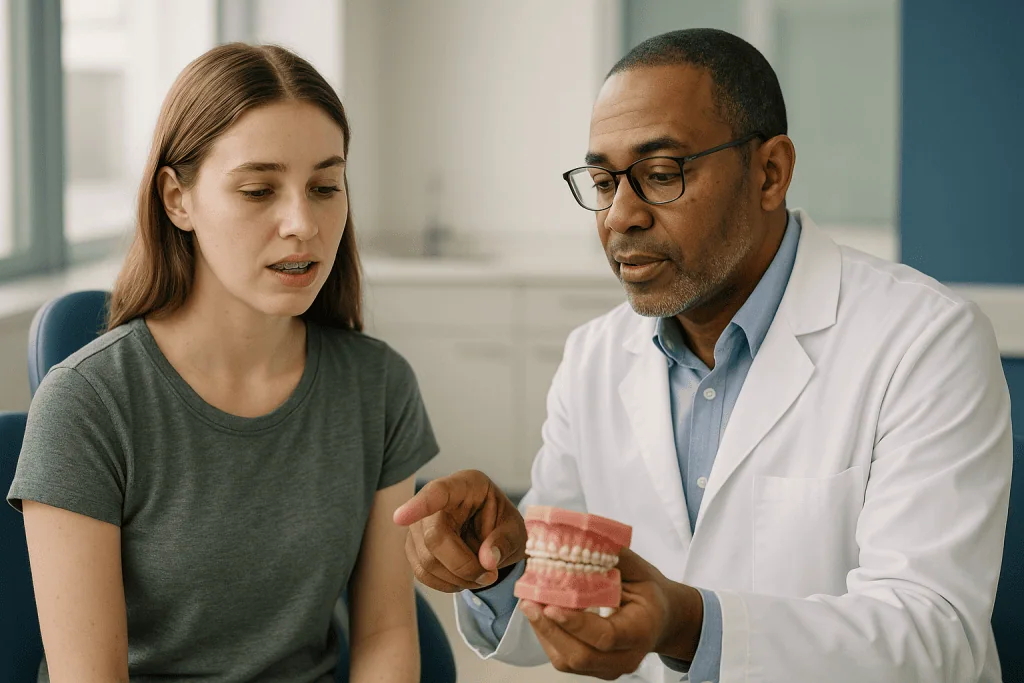
The periodontal ligament is the trigger. When compressed, its blood supply narrows and its cells release signaling molecules. Those signals recruit osteoclasts, large cells whose job is to dissolve bone mineral. Osteoclasts arrive at the compressed wall of the socket and begin clearing a path. Meanwhile, on the tension side, the stretched ligament fibers activate osteoblasts, the cells that lay down new bone. They fill the gap opening behind the root so the tooth is never loose in its socket for long.
MedlinePlus describes malocclusion, the medical term for teeth that do not meet properly, as a mechanical problem of alignment, and this cellular loop is how mechanics gets translated into anatomy. The process has a lag. In the first few days after force is applied, the compressed ligament is still reorganizing and little visible movement occurs. Then bone resorption begins in earnest and the tooth shifts in a burst, after which things settle again until the next adjustment.
Two details matter for patients. First, the same remodeling runs in reverse when pressure stops, which is why teeth drift back toward their old positions without a retainer; the ligament and the gum fibers around the neck of the tooth carry a kind of memory of where they used to be. Second, remodeling depends on healthy, well-perfused tissue. Smoking, uncontrolled gum disease and certain medicines that alter bone turnover can slow or complicate the process, which is one reason orthodontists ask about general health and not just teeth.
Why light, steady pressure works better than brute force
Intuition says a stronger push should mean a faster result. Biology disagrees, and the reason is blood flow.
The periodontal ligament is only a fraction of a millimeter thick. Under light pressure its vessels narrow but keep flowing, and the cells inside stay alive to organize an orderly removal of bone. Under heavy pressure those vessels can be crushed shut. The tissue in that zone dies and turns glassy, a change orthodontists call hyalinization, a term for ligament that has lost its blood supply and cellular structure. Dead tissue cannot recruit osteoclasts, so bone removal stalls until the body clears the damaged area from the edges. Paradoxically, the tooth moves more slowly under a heavy force than under a light one, and it does so with more discomfort.
Excess force also raises the risk of root resorption, the shortening of root tips as the same bone-dissolving cells nibble at the root itself. The Mayo Clinic lists root shortening among the recognized risks of braces. Most cases are minor and clinically insignificant, but the risk climbs when forces are high or treatment drags on.
Modern appliances are engineered around this. Thin, flexible nickel-titanium wires at the start of treatment deliver a low, even force over a wide range of bends; stiffer steel wires arrive later, when teeth are already roughly aligned and finer control matters more than gentleness. Aligner systems stage movement into small increments per tray for the same reason. When your orthodontist declines to tighten things harder to speed you up, that is not caution for its own sake. Steady beats strong, every time, in living bone.
What braces, aligners and elastics actually do
Appliances differ in materials and appearance, but each is a force-delivery system aimed at the ligament. Knowing which part does what makes the daily routine feel less arbitrary.
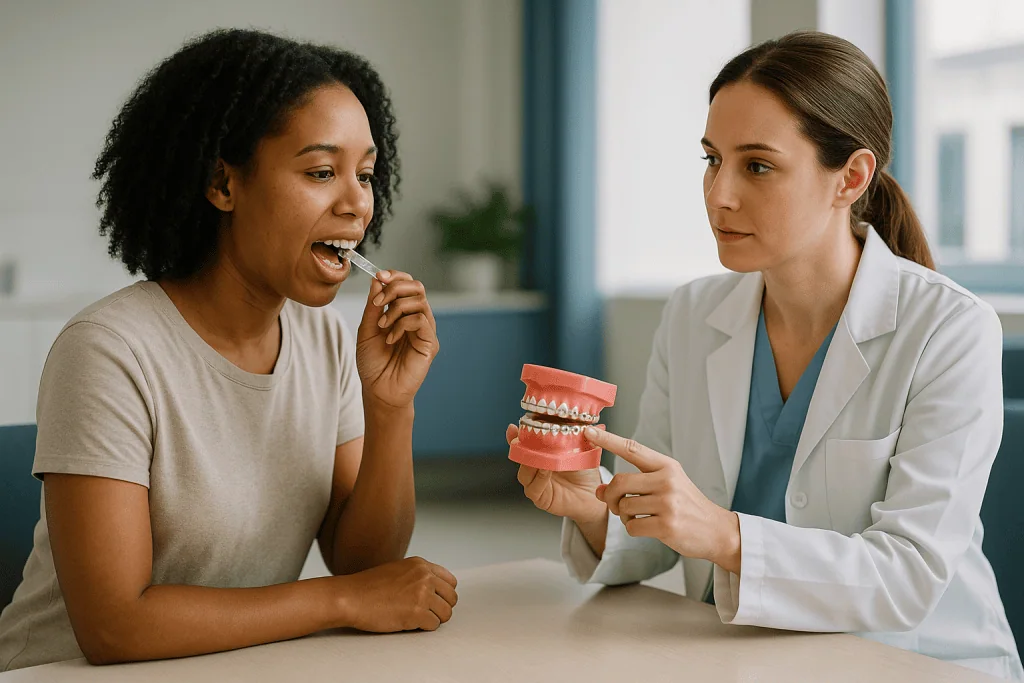
| Appliance | How it applies force | What it is typically used for |
|---|---|---|
| Fixed braces (brackets and archwire) | A shaped wire seated in bracket slots springs back toward its programmed arch form, dragging teeth with it | Wide range of crowding, spacing, rotations and bite problems |
| Clear aligners | Each tray is slightly different from the last; the plastic flexes against teeth that are out of position | Mild to moderate alignment; more complex moves need added attachments or may be unsuitable |
| Interarch elastics (rubber bands) | Stretched between upper and lower hooks to pull whole segments forward or back | Correcting how upper and lower teeth meet, such as overbite or underbite |
| Functional or expansion appliances | Reposition the jaw or widen the palate, working with growth in children | Jaw discrepancies during growth spurts |
| Retainers | Hold rather than move; resist the ligament’s tendency to pull teeth back | Every completed case |
The NHS describes fixed braces as the most commonly used appliance and notes that removable options are suited to more limited movements. Elastics deserve a special word because they are the part most often skipped. The archwire aligns teeth within one jaw; only elastics, pulling across the bite, can shift how the two jaws relate. Wearing them intermittently gives the ligament an on-off signal, and bone remodeling needs consistency. An orthodontist cannot compensate for missed hours at the next visit, which is why elastic wear is one of the biggest patient-controlled variables in total treatment time.
What happens at orthodontic adjustment appointments?
Adjustment visits look uneventful from the chair and are anything but. The NHS notes that patients with fixed braces are typically seen every 6 to 8 weeks, a rhythm set by how long a wire keeps delivering useful force before teeth catch up with it.
A typical visit opens with a check of progress against the plan: which teeth have leveled, which rotations are lagging, whether the bite is closing as expected. The orthodontist then decides what the next interval should accomplish. That may mean removing the current archwire and seating a stiffer or differently shaped one, adding a bend to a specific bracket, changing the size of elastics, or fitting a new set of aligner trays with attachments checked.
Ligatures, the tiny colored elastic rings or thin wires holding the archwire in each bracket, are usually replaced because they lose grip. Brackets that have come loose are rebonded. Hooks, springs or small power chains, which are connected elastic loops that close gaps, may be added or removed.
Aligner appointments follow a similar logic with less hardware: the clinician confirms trays are seating fully, checks that attachments are intact, and may trim or reshape a tray edge that is rubbing.
Expect the new wire to feel snug for a day or two. That sensation is the compressed ligament registering fresh force, not a sign anything is wrong. Visits are also where problems get caught early: a wire tip poking the cheek, a spot of early decalcification, gums that are puffier than they should be. Bring your questions, and bring your elastics and retainers if you have them, since the clinician cannot check what is not in the room.
How long do braces take, and what sets the pace?
The honest answer is a range, not a date. The NHS gives a typical span of 18 months to 2 years for fixed braces; the Mayo Clinic frames it as roughly 1 to 3 years, with duration depending on the complexity of the problem and how closely instructions are followed. Anyone who quotes a precise month at the first visit is estimating, and good clinicians say so.
Several factors stretch or compress that window. The type of movement matters most. Tipping a crown is quick; moving an entire root bodily through bone, closing a large extraction space or rotating a stubborn canine takes far longer because more bone must be remodeled. Bite corrections that rely on elastics depend heavily on how consistently they are worn. Age plays a role: growing jaws can be guided, while adult bone turns over more slowly, so comparable movements often take longer in adults.
Biology sets the ceiling, and behavior often sets the floor. Broken brackets, missed appointments, aligners worn fewer hours than prescribed and gum inflammation from poor cleaning all extend treatment, sometimes by months. Inflamed gums bleed and swell, and inflamed tissue remodels less predictably.
Timelines also include a final phase that patients tend to forget: detailing. Once teeth are aligned, the orthodontist spends weeks refining how they meet, because a bite that looks straight but does not function well is not finished. Then come retainers, which the NHS describes as long-term, often for years and frequently indefinitely at night. Treatment, in other words, has an active phase with an end and a passive phase that does not.
Do braces hurt? What the first days and weeks usually feel like
People ask for a pain score, and the fairest reply is that most describe soreness and pressure rather than sharp pain, and that the sensation follows a predictable curve. Fitting braces is not itself painful; there is no drilling and usually no injection. The ache arrives hours later as the ligament registers force.
The Mayo Clinic notes that discomfort typically lasts a few days after braces are placed or adjusted. In practice, the first day is mild, the second and third are the peak, and by the end of the first week most people are eating normally again. Chewing feels odd because teeth that are slightly loosened in their sockets are tender to bite on; softer foods for a few days help. Cheeks and lips often complain more than teeth do at first, because brackets rub tissue that has never met metal. Orthodontic wax pressed over the offending bracket buys time while the lining toughens, which it does within a couple of weeks.
Each adjustment restarts a smaller version of the same cycle, usually milder than the first because you know what to expect and the appliance is no longer novel. Aligner changes produce a similar pattern of tightness for a day or two per tray.
Your care team can advise on managing soreness, including whether an over-the-counter pain reliever is appropriate for you; that decision depends on your health history and belongs with them. What should not happen is escalating pain, pain that wakes you, swelling of the face or gums, or a tooth that suddenly feels very different from its neighbors. Those are reasons to call, covered below.
Who orthodontic treatment is usually for, and who is asked to wait
Orthodontics treats malocclusion, and MedlinePlus lists the familiar forms: crowding, gaps, protruding upper teeth, underbite, open bite, crossbite and jaw misalignment. Not every deviation needs treatment. The question clinicians ask is whether the problem affects function, oral health or the person’s own wellbeing enough to justify a year or more of appliances and lifelong retention.
Children are often assessed around the time most adult teeth have arrived, which the NHS places at roughly age 12, though the NHS also notes that some problems are best addressed earlier while the jaw is still growing. A first assessment does not commit anyone to braces; frequently the advice is to watch and return.
Adults are candidates too, as long as the supporting tissues are healthy. What tends to prompt a wait rather than a start:
- Active gum disease or untreated decay: moving teeth through inflamed bone is unpredictable and risky, so periodontal and restorative care comes first.
- Too many baby teeth still present: the plan cannot be finalized until it is clear which adult teeth will erupt and where.
- An imminent growth spurt that would change the jaw relationship the plan depends on.
- Poor daily cleaning that has not yet improved, because braces make brushing harder, not easier.
- Uncertainty about commitment, since interrupted treatment can leave teeth worse aligned than at the start.
Some people are offered alternatives instead: a removable appliance for a single tooth, restorative options for small gaps, or no treatment if the bite functions well. The decision rests with the treating team after examination, radiographs and a conversation about what the person actually wants changed and why.
How orthodontic treatment works differently in adults
The cellular mechanism is identical at 14 and 44: ligament compression, bone resorption, bone deposition. What changes is the environment those cells work in, and that changes the plan.
Adult bone is denser and turns over more slowly, so the same movement generally takes longer. There is no growth to harness. In a child, a jaw that sits too far back can be encouraged forward as it grows; in an adult, the jaws are fixed, so bite problems rooted in jaw size have only two routes: compromise, meaning teeth are positioned to camouflage the discrepancy, or combined orthodontic and surgical treatment. Your orthodontist should lay out both honestly if this applies.
Adult mouths also carry history. Missing teeth, large fillings, crowns, implants and past gum disease all shape what can move and where. An implant cannot be moved orthodontically because it fuses to bone rather than hanging in a ligament, so it becomes a fixed landmark the rest of the plan works around. Bone that has receded from earlier gum disease supports teeth less well, so forces must be lighter and gum health monitored closely throughout.
The upside is that adults are usually excellent at the parts of treatment that depend on discipline: wearing elastics, keeping aligners in, cleaning thoroughly and turning up. The Mayo Clinic makes the general point that braces can be effective at any age provided teeth and gums are healthy. Adults also tend to have clearer goals, which makes the planning conversation more productive. Retention matters even more, since adult teeth have spent decades settling into their old positions and will want to return there.
The downsides of orthodontic treatment, stated plainly
Any treatment worth having has costs that are not financial, and orthodontics has several worth weighing before you start.
Decay and white spots are the most common. Brackets create ledges where plaque hides, and the Mayo Clinic identifies tooth decay and gum disease as key risks of braces, driven by trapped food and plaque. Enamel around a bracket can lose mineral and leave a permanent chalky mark, called decalcification, that shows when the braces come off. The remedy is not exotic: thorough brushing after meals, floss threaders or interdental brushes, fluoride toothpaste and fewer sugary drinks.
Root resorption, described earlier, is a second recognized risk. Most is minor, but a small number of people lose enough root length to matter, and it cannot be reversed. Gum recession can occur when teeth are moved outside the bony envelope that supports them.
Relapse is the risk everyone underestimates. Without retainers, teeth migrate back, and the Mayo Clinic is explicit that failure to wear retainers as directed can undo results. Soft-tissue irritation, broken brackets, dietary restrictions on hard and sticky foods and the sheer duration of treatment are lesser but real burdens.
Alternatives exist and deserve a fair hearing: accepting a functional but imperfect bite, treating a single tooth with a limited appliance, or restorative approaches for small gaps. None of these is automatically better or worse. What matters is that the person choosing understands what they are trading and that the treating team explains those trade-offs in plain terms before any bracket is bonded.
Why retainers are part of the treatment, not an afterthought
The day the braces come off feels like the end. Biologically it is the most fragile point in the entire process.
Consider what has just happened. Bone around every moved tooth is newly formed and still immature; it takes months to mineralize fully. The periodontal ligament and the elastic fibers in the gum collar around each tooth have been stretched into new positions and are still under tension, pulling back toward where they started. Lips, cheeks and tongue continue to press on teeth as they always have. Nothing in that picture is stable on its own.
A retainer is a passive appliance. It does not push; it holds, giving bone time to mature and fibers time to reorganize while blocking the drift that would otherwise begin within days. Removable retainers are worn as instructed, usually full time at first and then at night; bonded retainers are thin wires fixed behind the front teeth for continuous support. Your orthodontist will decide which suits your case.
How long is the question everyone asks, and the NHS answer is sobering: retention is usually long term, and many people need to wear a retainer, at least at night, indefinitely if they want their teeth to stay put. Teeth continue to shift throughout adult life whether or not you had braces, so the retainer is guarding against normal aging as much as against relapse.
Practical points follow from this. Keep the retainer in its case, not a pocket or napkin. Clean it daily. Report cracks, a fit that suddenly feels tight, or a bonded wire that has come loose, because a tight retainer is an early warning that teeth have already begun to move.
What people often get wrong about orthodontic treatment
Myths about braces are durable because they sound plausible. A few deserve direct correction.
Tighter means faster. The opposite is closer to the truth. Heavy force starves the ligament of blood, stalls bone removal and raises the risk of root damage. Light, continuous force moves teeth more efficiently and more comfortably.
Braces are only for teenagers. The remodeling mechanism works at any age. Adults may take longer and cannot rely on jaw growth, but healthy teeth and gums, not birth year, determine candidacy.
Once the braces are off, the job is done. Newly moved teeth sit in immature bone and stretched fibers. The NHS and Mayo Clinic both describe retainers as long-term and essential; skipping them is the commonest way good results are lost.
Straight teeth mean a finished case. Alignment is visible; bite function is not. Orthodontists spend the final weeks detailing how teeth meet, and cutting that phase short trades a photograph for a functioning mouth.
Soreness means damage. Aching for a few days after adjustments is the ligament responding to force, and the Mayo Clinic describes it as expected. Persistent, severe or one-sided pain is a different matter and should be reported.
Elastics are optional extras. They are the only component that changes how the two jaws relate. Wearing them half the time gives the bone half a signal.
Aligners are a shortcut with no rules. They move teeth by the same biology and demand the same consistency, usually most of the day and night; a tray left in a bag is doing nothing.
Each of these errors costs time, and time in orthodontics means more months of brackets, more appointments and more opportunity for decay.
Questions to ask your care team
A first consultation is a conversation, not a sales pitch, and the quality of the answers tells you a great deal. These questions are drawn from what patients commonly wish they had asked earlier.
- What exactly is wrong with my bite, and which of those things would you treat, leave, or watch?
- Which appliance do you recommend for me, and what could a different appliance not achieve in my case?
- What is the typical range of treatment time for a problem like mine, and what would make it longer?
- Will any teeth need to be removed, and what are the alternatives to extraction here?
- How often will I be seen, and what happens at those visits?
- How many hours a day do elastics or aligners need to be worn for this plan to work?
- What are the specific risks for my teeth, given my gum health, past dental work and any medical conditions?
- What kind of retainer will I need afterward, and for how long?
- How should I clean around the appliance, and what foods should I avoid?
- What should I do if a bracket breaks or a wire comes loose between visits?
- If I have a medical condition or take medicines that affect bone or gums, how does that change the plan?
- What would you consider a finished result, and how will I know we are there?
Write the answers down. Treatment lasts long enough that the reasoning behind early decisions fades, and having it on paper helps when you are tired of wearing elastics in month fourteen. Ask, too, who to contact for urgent problems, and confirm that the plan, its timeline and its retention phase are all decisions the treating team is making with you rather than for you.
When to call your doctor
Most orthodontic problems are minor and can wait for the next scheduled visit: a ligature that has popped off, a wire end that wax can cover for a few days, a bracket that is loose but still on the wire. Call the practice so they can decide whether to see you sooner. A few situations should not wait.
- Severe or worsening pain that is not easing after the first few days, or pain that wakes you at night.
- Swelling of the face, jaw or gums, especially with fever or a bad taste, which can signal infection.
- A tooth that becomes noticeably loose, changes color, or feels very different from its neighbors when you bite.
- Bleeding gums that are heavy, persistent or accompanied by pus.
- A wire or bracket embedded in the cheek, lip or gum that you cannot free, or a swallowed or inhaled piece of appliance, particularly with coughing or breathing difficulty, which is an emergency.
- A sore or ulcer that has not healed within about two weeks.
- Trauma to the mouth: a fall or blow while wearing braces needs prompt assessment even if teeth look intact.
Numbness, tingling or a sudden change in how your teeth meet after an adjustment also warrant a call. For anyone with a heart condition, bleeding disorder, diabetes or a medicine that affects bone or immunity, mention it before treatment and again if anything in your mouth changes unexpectedly, because your medical team and orthodontist may need to coordinate.
When in doubt, phone. Orthodontic teams would far rather reassure you over a wire end than repair a problem that grew quietly for six weeks. Every decision about whether, when and how to intervene sits with the clinicians who can examine you, and calling early gives them the best chance to keep your treatment on track.
Frequently asked questions
How do braces move teeth?
Braces move teeth by holding them under light, constant pressure that compresses the ligament on one side of the root and stretches it on the other. Compressed ligament summons cells that dissolve bone; stretched ligament summons cells that build it. The socket gradually shifts through the jaw with the tooth inside, which is why movement is measured in months rather than days.
How painful are braces on a scale of 1 to 10?
Most people describe soreness and pressure rather than sharp pain, and scores vary widely between individuals. The Mayo Clinic notes discomfort typically lasts a few days after fitting or adjustment, peaking around the second and third day. Cheek and lip irritation from brackets is often more bothersome than the teeth themselves early on. Severe, worsening or one-sided pain is not typical and should be reported to your care team.
How long do braces take to straighten teeth?
The NHS gives a typical range of 18 months to 2 years for fixed braces, and the Mayo Clinic describes roughly 1 to 3 years depending on complexity and cooperation. Moving roots bodily, closing extraction spaces and correcting bites with elastics take longer than simple alignment. Missed appointments, broken brackets and inconsistent elastic or aligner wear commonly extend treatment by months.
What happens at orthodontic adjustment appointments?
At an adjustment visit the orthodontist checks progress against the plan, then renews the force on the teeth. That may mean fitting a stiffer or reshaped archwire, replacing worn ligatures, adding bends, springs or power chains, changing elastic sizes, or issuing new aligner trays. Loose brackets are rebonded and early problems such as gum inflammation or decalcification are flagged. The NHS notes visits are typically every 6 to 8 weeks.
What are the downsides of orthodontic treatment?
Recognized downsides include a higher risk of decay and permanent white spots from plaque trapped around brackets, gum inflammation, minor root shortening, soft-tissue irritation, dietary restrictions and the length of treatment. The Mayo Clinic lists decay, gum disease, root resorption and relapse among the risks of braces. Relapse is the most underestimated: without long-term retainer wear, teeth tend to drift back toward their original positions.
Do braces hurt more than clear aligners?
Both work by the same biology and both cause tightness when force is renewed, so neither is pain-free. Aligners avoid bracket rubbing on cheeks and lips, which many people find the most irritating part of fixed braces early on, but each new tray produces a day or two of pressure. Individual pain perception, the type of movement and how closely wear instructions are followed matter more than the appliance category.
Can adults get braces, and does the process work the same way?
Yes. The remodeling mechanism is the same at any age, and the Mayo Clinic notes braces can be effective for adults with healthy teeth and gums. Differences include denser bone that remodels more slowly, no jaw growth to guide, and dental history such as implants or past gum disease that shapes the plan. Comparable movements often take longer, and retention is especially important.
Why do I have to wear rubber bands with my braces?
Elastics are the only component that changes how the upper and lower jaws relate to each other. The archwire aligns teeth within one jaw; elastics stretched between hooks on opposite arches pull whole segments forward or back to correct overbite, underbite or crossbite. Bone remodeling needs a continuous signal, so wearing elastics intermittently delivers an on-off message and prolongs treatment.
Why do teeth move back after braces come off?
Bone around newly positioned teeth is immature for months, and the ligament and gum fibers have been stretched and pull back toward their old positions. Lips, cheeks and tongue keep pressing as before. Without a retainer to hold teeth while tissues mature, drift begins within days. The NHS describes retention as long term, often indefinitely at night, because teeth also shift naturally with age.
What do people wish they knew before getting braces?
Common reflections include how much cleaning effort brackets demand, how decisive elastic and aligner wear are for total time, that soreness fades within days, and that retainers are for years, not weeks. Many also wish they had asked what a finished bite would look like, not just straight front teeth, and had written down the plan so the reasoning stayed clear through a long treatment.
References
This article is for general information only and is not a substitute for professional medical advice. Please consult a qualified doctor about your individual situation.

More from the Blog
Who Is a Candidate for Clear Aligners? Bite Types, Gum Health and Wear Commitment
Most people with mild to moderate crowding, spacing or bite problems, healthy gums and a full set of adult teeth can be considered for…
Why Straws and Smoking Matter After Wisdom Teeth Removal: Dry Socket Explained
Dry socket is a painful complication after wisdom teeth removal in which the protective blood clot in the empty socket is lost or fails…
How Laser Assisted Dental Procedures Work: Cleaning First, Then Precise Light Treatment
A laser assisted dental procedure uses a focused beam of light, chosen for the tissue being treated, after the tooth or gum has first…

Living With TMJ Treatment: Soft Foods, Wide Yawns to Avoid and Daily Jaw Habits
A soft diet for TMJ means choosing foods that need little chewing, such as yogurt, eggs, cooked grains, flaky fish and well-cooked vegetables, for…

What Halitosis Treatment Can Change and How Quickly Breath Usually Improves
Halitosis treatment can usually change the source of the odor rather than mask it: bacterial coating on the tongue, gum disease, dry mouth, or…
What Bruxism Treatment Can and Cannot Do: Protecting Teeth vs Stopping the Grinding
Bruxism treatment results depend on which goal you mean. Custom night guards and dental repairs reliably protect teeth from further wear, but current evidence…