

How Prostate Brachytherapy Is Done: Anesthesia, Ultrasound Guidance and Seed Placement
Key Takeaways
- Prostate brachytherapy places radiation inside the gland through needles passed through the perineum under rectal ultrasound guidance, with no incision, under general or spinal anesthesia.
- Permanent low dose rate seeds decay over months and stay in place for life, while high dose rate treatment leaves nothing radioactive behind because the source is withdrawn after minutes.
- The implant itself typically takes about one to two hours and is often a day case, but urinary symptoms commonly worsen over the following weeks before easing.
- Brachytherapy alone is generally reserved for localized low-risk or favorable intermediate-risk cancer; higher-risk disease usually pairs it with external beam radiation and sometimes hormone therapy.
- A temporary PSA bounce is recognized after seed implantation, so a single rising result prompts a repeat test rather than a conclusion about recurrence.
- After seeds, precautions are limited to prolonged close contact with pregnant women and small children for a defined period and condom use for the first several sexual encounters.
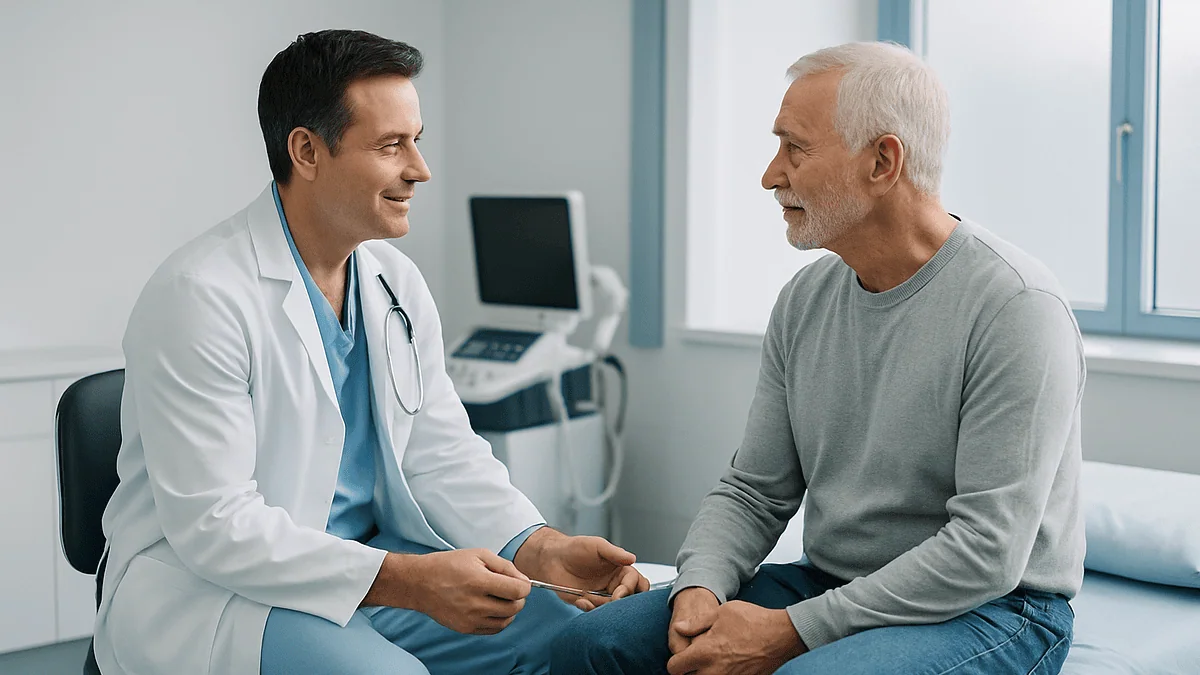
Prostate brachytherapy is done under general or spinal anesthesia, usually as a day or overnight procedure. A rectal ultrasound probe shows the prostate in real time while thin needles are passed through the skin between the scrotum and anus, guided by a grid template. Through those needles, tiny permanent radioactive seeds are placed, or a temporary high-dose source is delivered through catheters and then removed.
The folder from the urology appointment sits on the kitchen table for three days before he opens it again. Two words keep pulling his eye: seeds and radioactive. He knows, roughly, that the plan is to treat the prostate cancer from the inside. What he cannot picture is the room, the needles, whether he will be awake, and how anyone aims something that small into an organ the size of a walnut.
That gap between the leaflet and the imagination is where most of the worry lives. So this article walks through how prostate brachytherapy is done, step by step: the anesthesia, the ultrasound probe that acts as the surgeon’s eyes, the grid that turns a plan into needle positions, and what happens to the seeds afterward. It also covers the questions people actually type at midnight, from what not to do afterward to whether the cancer can come back.
Nothing here replaces the conversation with the treating team, who know the specifics of one particular prostate and one particular person. It should, though, make that conversation easier to follow.
What actually happens during prostate brachytherapy, in plain language
Brachytherapy is internal radiation: the radioactive source is placed inside or right next to the tumor rather than beamed in from a machine across the room. The word comes from the Greek brachys, meaning short, because the radiation only travels a short distance. That short reach is the whole point. Prostate tissue receives a high dose while the rectum and bladder, sitting only millimeters away, receive far less than they would from many external approaches.
For the permanent version, the team places dozens of tiny metal capsules, each roughly the size of a grain of rice, throughout the prostate. Each capsule contains a radioactive isotope that gives off low-energy radiation, slowly fading over a period of months, after which the inert seeds simply stay where they are for life. MedlinePlus and Mayo Clinic describe the procedure as typically taking one to two hours in an operating room.
For the temporary version, hollow plastic catheters are placed in the same way, a single high-activity source is driven through them for a matter of minutes under computer control, and then the catheters come out. Nothing radioactive stays behind.
Either way, the mechanism of benefit is the same as any radiation therapy. The energy damages the DNA of cancer cells so they cannot keep dividing. Healthy prostate cells are damaged too, but the cancer cells, which divide more and repair less efficiently, are more likely to die. The effect is not instant; the tumor shrinks and PSA falls over months, not days.
What makes the procedure elegant is the delivery system. A rectal ultrasound probe shows a live picture of the gland, a grid template fixed against the perineum (the skin between the scrotum and anus) turns the treatment plan into needle coordinates, and a physicist checks the radiation map as the needles go in. Everything else in this article is a closer look at those three pieces.
Who is prostate brachytherapy usually for, and who is usually asked to wait
Brachytherapy suits a cancer that is still confined to the prostate. The radiation has a short reach by design, so it cannot treat disease that has spread to lymph nodes or bone. In practice, guideline bodies such as NICE and the NHS describe low dose rate seed brachytherapy on its own as an option for localized cancer classed as low risk or favorable intermediate risk, with risk judged from the PSA level, the Gleason grade (a score describing how abnormal the cells look under the microscope) and the clinical stage.
For higher-risk but still localized disease, brachytherapy is more often combined with external beam radiation, with or without hormone therapy, so that the seeds or catheters deliver a concentrated boost while the external beam covers a wider margin. This combined approach is part of the standard menu described by the NHS and Mayo Clinic, not an experimental add-on.
Several practical factors push a team toward suggesting something else, or toward waiting:
- A very large prostate, because the pubic bone can block needle paths to the front of the gland; a course of hormone therapy sometimes shrinks it first.
- Significant urinary symptoms before treatment, since radiation temporarily worsens them and can raise the risk of urinary retention.
- A previous transurethral resection of the prostate (a procedure that hollows out the center of the gland), which leaves less tissue to hold seeds and raises incontinence risk.
- Inflammatory bowel disease affecting the rectum, or an inability to lie in the required position under anesthesia.
Then there is the group asked to wait for a different reason entirely. Many men with very low-risk cancer are offered active surveillance, meaning regular PSA tests, examinations and repeat biopsies or scans, with treatment reserved for signs of progression. That is not neglect; for slow-growing disease, guidelines treat surveillance as a legitimate first choice. Whether a given cancer sits in that category is a judgment for the urologist and radiation oncologist together.
HDR vs LDR brachytherapy for prostate: seeds and catheters compared
People often hear “brachytherapy” as a single treatment, but two quite different procedures share the name. Low dose rate (LDR) means permanent seeds emitting weak radiation over months. High dose rate (HDR) means a temporary high-activity source delivered through catheters in minutes. Both use the same anesthesia, the same rectal ultrasound guidance and the same perineal grid, so the experience on the table feels similar. What differs is what stays in the body and how the schedule runs.
| Feature | Low dose rate (LDR, seeds) | High dose rate (HDR, temporary) |
|---|---|---|
| What is placed | Dozens of permanent rice-sized radioactive seeds | Hollow catheters; a single source passes through, then everything is removed |
| Radiation timing | Slow release over months as the isotope decays | Delivered in minutes, often in one or more sessions |
| Radioactivity after leaving hospital | Low-level, fading; short-term precautions around pregnant women and small children | None; no source remains |
| Typical setting | Day case or overnight (MedlinePlus, Mayo Clinic) | Overnight stay is common when several sessions run from one catheter placement (NHS) |
| Often combined with | Sometimes external beam for higher-risk disease | Frequently used as a boost alongside external beam |
| Later imaging or airport scanners | Seeds visible on X-ray; rarely trigger security alarms, card sometimes issued | No implant remains |
Neither version is “better” in a blanket sense. Teams choose based on the risk category, prostate size, urinary function, whether external beam is also planned, and the department’s own experience and equipment. When a plan mentions a “boost,” it usually means HDR or LDR added to an external course rather than replacing it. It is entirely reasonable to ask the radiation oncologist to say out loud which type is proposed and why that one for this cancer.
How is prostate brachytherapy done? Step one is the planning visit
The procedure day is the visible part, but a good deal of the work happens weeks earlier. Many centers begin with a volume study: a transrectal ultrasound performed in clinic, with the patient awake and lying on his side or back, in which the probe records the prostate in slices from base to apex. From those images a physicist and radiation oncologist build a three-dimensional model and decide how many seeds or catheter positions are needed and where each should sit. MedlinePlus notes that permanent implants commonly involve somewhere between roughly 40 and 100 seeds, with the exact number depending on gland size and the prescribed dose distribution. Other centers do the planning in real time in the operating room; the principle is the same, only compressed.
Around the same time, a pre-assessment visit checks general fitness for anesthesia. Expect questions about heart and lung history, previous reactions to anesthetics, and every medicine and supplement being taken. Blood thinners matter most, because the perineum is punctured many times; the anesthetist or urologist gives specific instructions about whether and when to pause them. Never change those medicines on your own initiative, in either direction. The same goes for medicines that relax the prostate or bladder, which the team may adjust around the procedure.
Bowel preparation is usually modest, often an enema on the morning of the procedure so that the rectum is empty and the ultrasound picture is clear. Fasting instructions follow standard anesthesia rules, typically no food for several hours beforehand, with the exact cut-off given in writing.
Two questions worth settling at this stage: whether the plan includes hormone therapy first, which changes the timeline by months, and whether external beam radiation is part of the package. Knowing the whole map makes the individual steps far less unsettling.
Anesthesia during prostate brachytherapy: awake, asleep or numb from the waist down?
The short answer is that patients do not feel the needles. Prostate brachytherapy is performed under either a general anesthetic, meaning fully asleep, or a spinal anesthetic, meaning a single injection into the lower back that numbs everything below the waist for a few hours while the person stays awake or lightly sedated. Mayo Clinic and MedlinePlus list both as standard.
Why not local anesthetic alone? Two reasons. The procedure involves many needle passes through the perineum into a deep organ, and even with numbing skin the sensation of pressure would be hard to tolerate. More importantly, the patient must lie completely still in a specific position for an hour or more. Any shift moves the prostate relative to the grid and undoes the geometry the whole plan depends on.
That position deserves a mention because it surprises people. It is the dorsal lithotomy position: lying on the back with legs raised and supported in padded stirrups, the same posture used for many gynecological procedures. The perineum faces the surgeon, the ultrasound probe sits in the rectum, and a urinary catheter is usually placed so the urethra can be seen on ultrasound and so the bladder stays empty.
The choice between general and spinal is made by the anesthetist with the patient. Spinal anesthesia avoids a breathing tube and often means feeling clearer sooner afterward, but it is unsuitable for some people, for instance those on certain blood thinners or with particular spine problems. General anesthesia is straightforward for most and is sometimes preferred simply because the person would rather not be aware of anything. Neither choice affects how well the radiation works.
A dedicated anesthetist stays throughout, monitoring heart rate, blood pressure and oxygen. Antibiotics are commonly given before the first needle to reduce the risk of infection introduced through the perineal punctures.
Ultrasound guidance: how the team sees inside the prostate in real time
Once the anesthetic has taken effect, the team places the instrument that makes modern brachytherapy possible: a transrectal ultrasound probe. It is a slender device, inserted into the rectum and held in a mechanical stepper that can advance or retract it in precise increments, often fractions of a centimeter at a time. Because the prostate sits directly in front of the rectal wall, the probe produces a crisp picture of the gland, the urethra running through its middle, and the rectum behind it.
The probe gives two views. A transverse view shows the prostate in cross-section, like slicing a loaf of bread, and this is the picture on which the grid coordinates are chosen. A sagittal view shows the gland lengthwise, from base near the bladder to apex near the pelvic floor, which lets the surgeon watch a needle advance to exactly the right depth. Switching between the two is constant throughout the case.
Overlaid on the ultrasound screen is a pattern of dots corresponding to the holes in a physical template, a perforated block clamped against the perineum. Each hole has a letter-and-number address. When the plan says a needle belongs at, say, a particular coordinate at a particular depth, the surgeon can pass it through that hole and confirm on the screen that its tip is where the plan intended. The Johns Hopkins and Mayo Clinic descriptions both stress this image guidance as the reason the procedure can be so anatomically precise.
Ultrasound also protects the neighbors. The rectal wall is visible at every moment, so needles can be kept clear of it, and the urethra can be identified and spared from the densest seed clusters, which lowers the risk of later urinary problems. Some centers add fluoroscopy, a live X-ray, or a CT scan at the end to confirm seed positions; ultrasound remains the main set of eyes from start to finish.
Seed placement: how the prostate seed implant procedure unfolds needle by needle
With the probe in place and the template fixed, the implant itself begins. Each needle is long, hollow and thin, and it enters through a template hole, passes through the perineal skin and pelvic floor, and travels forward into the prostate. There is no incision. On the ultrasound screen the surgeon watches the bright tip advance and stops when it reaches the planned depth, usually just short of the bladder base.
For permanent seeds, two loading methods are common. In one, seeds are pre-loaded into each needle separated by tiny spacers, and as the needle is slowly withdrawn a stylet holds the seeds in place so they are left behind in a line. In the other, seeds are linked in a flexible strand that is deposited as a unit, which helps keep them from migrating. Some systems use an applicator that dispenses seeds one at a time to positions chosen live on the screen. The physicist updates the dose map after every needle, and the plan can be adjusted mid-procedure if the gland has shifted or swollen.
How many seeds? MedlinePlus gives a broad range, on the order of several dozen to around a hundred, and the true number is whatever the physics calls for in that gland; more is not better. Seeds are placed more densely toward the outer parts of the prostate and more sparsely around the urethra, so the tissue most likely to harbor cancer gets the highest dose while the passage for urine is spared as far as possible.
For HDR, the same needles are replaced by hollow catheters left in position, secured to the template, and connected to an afterloader, a shielded machine that pushes a single high-activity source along each catheter under computer control. The source dwells at pre-calculated points for seconds to minutes each, then retracts fully. Staff leave the room during delivery and return as soon as it ends. After the final session, the catheters are removed in the ward, which people describe as brief and uncomfortable rather than painful.
A final check, by fluoroscopy, cystoscopy (a small camera passed into the bladder to look for stray seeds) or a CT scan, closes the procedure. The catheter and probe come out, a dressing goes on the perineum, and the patient wakes in recovery.
How long does prostate brachytherapy take, and how long is the hospital stay?
The implant itself is quicker than most people expect. MedlinePlus and Mayo Clinic describe the seed procedure as typically taking about one to two hours in the operating room. Add the time to place the anesthetic and position the patient beforehand, and a recovery period afterward, and the whole day still usually fits into a single hospital visit. Many centers treat permanent seed brachytherapy as a day case, with discharge once the person has passed urine and is walking comfortably, while others keep patients overnight as a precaution. Which happens depends on the department’s routine and on how the individual recovers from anesthesia, not on how well the seeds went in.
HDR often runs longer in total because the catheters may stay in place for more than one radiation session. In that arrangement, the NHS describes an overnight stay as usual, with the person resting in bed between sessions so the catheters do not shift, and going home the day after removal. When HDR is delivered as a single session, or when each session has its own catheter placement, the stay can be shorter.
The urinary catheter placed during the procedure is generally removed before discharge, once swelling from the needles is judged unlikely to block the flow. A small number of men cannot pass urine in the first day or two and need the catheter reinserted for a while; this is uncomfortable but expected and does not mean anything has gone wrong with the implant.
Returning to normal activity is usually measured in days rather than weeks. MedlinePlus notes that most people are back to routine activities within a few days, with heavy lifting and vigorous exercise held back a little longer to let the perineum settle. The cancer-treating part continues silently for months as the seeds decay, so the short operating time should not be mistaken for a short treatment. Follow-up PSA tests, not the calendar, mark how the therapy is doing.
What are the potential downsides of prostate brachytherapy?
Every effective cancer treatment has a cost in side effects, and brachytherapy’s cluster is predictable because of where the radiation lands. The urethra passes through the middle of the prostate, the bladder base sits on top, the rectum lies directly behind and the nerves controlling erections run along the sides. Each can be irritated.
Urinary symptoms are the most common early effect, described consistently by Mayo Clinic, the NHS and MedlinePlus. Radiation inflames the prostate and urethra, so people notice a slower stream, urgency, going more often, getting up at night, and sometimes burning. Blood in the urine for a day or two after the needles is expected. Complete inability to pass urine, urinary retention, affects a minority and may need a temporary catheter. These symptoms usually peak in the first weeks to months and then gradually ease as the seeds’ output fades, though some men have a milder version that persists.
Bowel effects are generally less prominent than with older external beam techniques but still occur: looser stools, urgency, or occasional rectal bleeding from irritated blood vessels in the rectal wall. Persistent bleeding warrants a review rather than a shrug.
Erectile function is the effect people ask about most and hear about least. Radiation damages small blood vessels and nerves slowly, so erections may be unaffected at first and then decline over one to several years. The likelihood depends heavily on age, function before treatment, other health conditions such as diabetes, and whether hormone therapy is also given. Medicines that improve blood flow to the penis are often used; whether they are suitable is a decision for the prescribing clinician.
Rarer long-term problems include narrowing of the urethra, a fistula (an abnormal connection between rectum and urethra) and second cancers in the irradiated area many years later. These are uncommon, and the treating team should be able to describe their own experience honestly. Fatigue in the weeks after treatment, and the perineal bruising from the needles, round out the list.
What the first days and weeks usually look like
The first evening at home is mostly about soreness and plumbing. The perineum feels bruised, as though from a long bike ride, and sitting on a soft cushion helps. Urine may be pink or contain small clots for a day or two, which MedlinePlus lists as expected. Drinking steadily helps flush the bladder, though caffeine and alcohol tend to sharpen urgency and are worth pausing while things settle.
Over the first week, most people return to desk work, driving and light housework, as Mayo Clinic and MedlinePlus describe. Vigorous exercise, cycling and heavy lifting are usually held off for a period the team specifies, partly to protect the perineum and partly because straining while the prostate is swollen can provoke retention.
Between roughly the second week and the second month, urinary symptoms often become more noticeable rather than less. This surprises people who expect a straight line to recovery. The explanation is that radiation-induced inflammation builds as the seeds keep delivering dose, so frequency, urgency and nighttime trips can reach a peak some weeks after the procedure before slowly easing. Many teams prescribe a medicine that relaxes the muscle at the bladder outlet to soften this phase; any changes to it belong with the prescriber.
A post-implant scan, commonly a CT about a month later, is routine. It lets the physicist reconstruct exactly where the seeds ended up once early swelling has subsided and confirm the dose actually delivered matches the plan. It is a quality check, not a hunt for trouble.
Then the follow-up rhythm settles into PSA blood tests every few months at first, spacing out over time as the team judges appropriate. PSA falls slowly after brachytherapy, and the lowest point may not arrive for a couple of years, so a single number rarely tells the story. Fatigue tends to lift over the same weeks that the urinary symptoms improve.
What not to do after brachytherapy: radiation precautions around other people
The instructions after permanent seed implantation can sound alarming on paper, so it helps to understand the physics behind them. The isotopes used give off low-energy radiation that is largely absorbed within the prostate and surrounding tissue. Very little escapes the body, and what does falls off sharply with distance. That is why Mayo Clinic and the NHS describe the precautions as modest and time-limited rather than as isolation.
The usual guidance covers a few situations:
- Avoid prolonged close contact, such as sitting a small child on the lap or sharing a bed with a pregnant partner, for the period the team specifies, typically counted in weeks to a couple of months while the seeds are most active. Brief hugs and ordinary household life are fine.
- Use a condom during intercourse for the first several encounters, as Mayo Clinic advises, because a seed can occasionally be passed in semen. Semen may also look discolored or contain a little blood at first.
- Strain urine through a fine sieve for the first days if instructed, since a loose seed can rarely be passed in urine. If one appears, it should not be handled with bare fingers; the team will explain how to return it.
- Carry any card the department provides describing the implant. Seeds rarely set off security scanners but occasionally do, and the card explains why.
Beyond radiation, the other things not to do are the same as after any perineal procedure: no heavy straining, no cycling until cleared, and no ignoring an inability to pass urine. Constipation is worth preventing actively, because straining on the toilet aggravates a swollen prostate and irritated rectum.
HDR patients have none of the radiation precautions, since nothing radioactive stays in the body. Their post-procedure list is the physical one only. Whichever type was used, the written instructions from the department take precedence over anything general, including this article.
Can prostate cancer come back after brachytherapy?
Yes, it can, and honest teams say so plainly. No treatment for localized prostate cancer, whether surgery, external radiation or brachytherapy, controls the disease in every person. Recurrence after brachytherapy happens in two broad ways. Cancer cells within the prostate may survive the radiation, especially if some part of the gland received a lower dose than planned or if the tumor was more resistant than average. Or microscopic disease may already have spread beyond the gland before treatment, out of reach of radiation with a short range, and declare itself later.
The signal watched for is PSA. After brachytherapy the level drifts down over months to a couple of years, and doctors use a defined rise from that lowest point as the trigger to investigate. One well-known complication in reading these numbers is the PSA bounce: a temporary rise followed by a fall, occurring in a meaningful share of men in the first few years after seed implantation and thought to reflect inflammation rather than cancer. A bounce can be indistinguishable from an early recurrence at the time it happens, so the usual approach is to repeat the test rather than react to one result.
If recurrence is confirmed, options depend on where the disease is. For cancer confined to the prostate, salvage treatments may include surgery, further focused radiation, cryotherapy or high-intensity focused ultrasound, each with higher side-effect risks than a first treatment because the tissue has already been irradiated. For disease elsewhere, hormone therapy and systemic treatments come into play. The Johns Hopkins and NIH National Cancer Institute overviews both describe these pathways in general terms.
The likelihood of recurrence varies enormously with the starting risk group, which is exactly why guidelines restrict brachytherapy alone to lower-risk disease and add external beam or hormone therapy for higher-risk cancers. A team can put a personal estimate on it using the specific PSA, grade and stage; a generic percentage from the internet cannot.
What about life expectancy after brachytherapy for prostate cancer?
People searching for an average life expectancy after brachytherapy are usually asking a more personal question: will this treatment let me live a normal span? The honest answer is that a single average would mislead. Men treated with brachytherapy range from their fifties to their eighties, from low-risk to high-risk disease, from robust health to several other conditions, and life expectancy is driven by all of those factors at once, not by the implant alone.
What can be said neutrally is this. Guideline bodies including NICE and the NHS list low dose rate brachytherapy among the standard curative-intent options for localized prostate cancer, alongside surgery and external beam radiation, precisely because long-term outcome data support it in appropriately selected men. For low-risk and favorable intermediate-risk disease, prostate cancer is very often not the condition that ends a man’s life, whichever standard treatment he has. For higher-risk disease, brachytherapy is generally part of a combined plan because the combination improves control compared with any single component.
Figures for survival do exist in the medical literature, but they come from specific cohorts with specific risk profiles and follow-up periods, and quoting one here would apply the wrong number to most readers. The treating team has access to validated tools that combine age, health, PSA, grade and stage into a personal estimate, and can explain what those tools do and do not capture.
One perspective is worth holding onto. Because prostate cancer often moves slowly, the decision between treatments for lower-risk disease frequently comes down less to survival and more to which side-effect profile a person would rather live with for the next twenty or thirty years. Urinary symptoms, sexual function and bowel function each weigh differently for different men. That is a values conversation, and it belongs at the center of the consultation rather than at the edge.
What people often get wrong about prostate brachytherapy
“I will be radioactive and dangerous to my family.” After seed implantation the radiation that leaves the body is small and short-range, which is why precautions are limited to prolonged close contact with pregnant women and young children for a defined period. Nobody needs a separate bathroom, separate dishes or a separate house. After HDR there is no residual radiation at all.
“The seeds are removed later.” Permanent seeds are permanent. Once the isotope has decayed they are inert metal, visible on future X-rays, and they stay in place for life without causing harm. Temporary HDR catheters, by contrast, are removed at the end of treatment, which is the source of the confusion.
“It is a minor procedure, so recovery is trivial.” The operating time is short and there is no incision, but urinary symptoms commonly worsen over the following weeks before improving, and erectile changes can emerge years later. Treating it as trivial leads to frustration when the second month is harder than the first week.
“Brachytherapy is the gentle option that avoids side effects.” It concentrates dose within the prostate, which spares surrounding organs relative to some techniques, but the prostate itself, and the urethra within it, receive a very high dose. Urinary side effects are, if anything, more prominent than with external beam.
“A rising PSA afterward means the cancer is back.” Not necessarily. A temporary PSA bounce is a recognized phenomenon after brachytherapy. A single rise prompts a repeat test, not a diagnosis.
“Any prostate cancer can be treated with seeds.” Brachytherapy alone is for cancer confined to the gland in lower-risk categories. Higher-risk or more extensive disease needs a combined plan, and disease that has spread needs a different approach altogether.
“If I had a TURP, it makes no difference.” A previous operation that hollowed out the prostate changes the anatomy and raises incontinence risk with seeds, and teams weigh that seriously.
Questions to ask your care team before prostate brachytherapy
A consultation moves fast, and the questions that matter most often surface in the car afterward. Writing a list beforehand shifts the balance. These are the ones that tend to unlock the most useful answers.
- Which type is being proposed, permanent seeds or temporary HDR, and why that one for my prostate and my risk category?
- Is external beam radiation or hormone therapy part of the plan, and if so, in what order and over what total timeline?
- How does my prostate size and my current urinary function affect my suitability, and was a volume study done?
- Would active surveillance be a reasonable option for me instead of treating now, and what would trigger a change?
- What anesthesia do you recommend for me, and will I go home the same day?
- Which of my regular medicines, especially blood thinners, need to be adjusted around the procedure, and who gives me those instructions?
- What urinary, bowel and sexual side effects do you see most often in your patients, and how long do they typically last?
- What is my personal risk of needing a catheter afterward, and what is the plan if I cannot pass urine at home?
- What radiation precautions apply to me, for how long, and does anyone in my household change that advice?
- How will my PSA be monitored, how is a PSA bounce distinguished from recurrence, and what would happen if the cancer came back?
- Who do I call, at any hour, if something feels wrong in the first weeks?
Bring someone along if possible; a second pair of ears catches what anxiety filters out. Ask for the plan in writing, including the follow-up schedule, and do not hesitate to request a second appointment if the first left gaps. Teams that treat many of these procedures expect and welcome detailed questions. The final decision about whether and how to proceed rests with the treating team and the patient together, informed by the specifics of this cancer rather than by averages.
When to call your doctor after prostate brachytherapy
Most of the first weeks are uncomfortable rather than dangerous, and the department will have given a direct number to use. Some situations should prompt that call the same day, or a visit to emergency care if the team cannot be reached.
- Inability to pass urine, or passing only dribbles with a painfully full bladder. Urinary retention needs a catheter promptly; waiting overnight risks bladder injury and kidney strain.
- Fever, chills or shaking, especially with burning on urination or back pain. Infection can enter through the perineal punctures or the urinary tract and needs early treatment.
- Heavy or persistent bleeding from the urine or rectum, large clots, or blood that does not settle after the first couple of days.
- Severe or worsening pain in the perineum, lower abdomen or rectum that is not eased by the pain relief you were given.
- Redness, swelling, warmth or discharge at the perineal skin.
- A swollen, painful calf, sudden breathlessness or chest pain, which can signal a blood clot after any procedure involving anesthesia and reduced mobility.
- Passing a seed, so the team can advise on safe handling and check whether the dose coverage is affected.
Less urgent but still worth reporting at the next contact: urinary symptoms that keep worsening beyond the expected peak, new bowel urgency or bleeding weeks after treatment, or a change in erectile function that troubles you. None of these should be endured silently on the assumption that they are normal; the team can only help with what it knows about.
In the longer term, any PSA result the team flags, new bone pain, or unexplained weight loss deserves a prompt appointment rather than a wait for the scheduled review. This article describes typical patterns drawn from mainstream medical sources; the specific thresholds for concern, and every decision about treatment, rest with the doctors who know the individual case.
Frequently asked questions
How is prostate brachytherapy done, in one sentence?
Under general or spinal anesthesia, a rectal ultrasound probe images the prostate while thin needles pass through a grid template against the perineum, and through those needles either permanent radioactive seeds are deposited or temporary catheters deliver a high-dose source that is then removed. There is no incision, the procedure typically takes one to two hours according to MedlinePlus, and most people go home the same day or the next morning.
How long does prostate brachytherapy take from start to finish?
The seed implant itself usually takes about one to two hours in the operating room, per MedlinePlus and Mayo Clinic, with extra time for anesthesia and recovery on either side. High dose rate treatment can involve an overnight stay when several sessions run through one catheter placement, as the NHS describes. The radiation from permanent seeds continues working for months afterward, so the short operating time is not the whole treatment.
Will I be awake during the prostate seed implant procedure?
You will not feel the needles either way. Most centers use a general anesthetic, meaning fully asleep, or a spinal anesthetic, a single injection in the lower back that numbs everything below the waist while you stay awake or lightly sedated. The anesthetist chooses with you based on your health and preference. Staying completely still matters for accuracy, which is why local anesthetic alone is not used.
What is the average life expectancy after brachytherapy for prostate cancer?
There is no meaningful single average, because life expectancy depends on age, overall health, and the cancer’s risk category far more than on the implant itself. Guidelines from NICE and the NHS list brachytherapy among standard treatments for localized prostate cancer because long-term data support it in selected men. Your team can use validated tools to give a personal estimate; a generic figure would apply the wrong number to most people.
What are the potential downsides of prostate brachytherapy?
The most common effects are urinary: frequency, urgency, a slower stream, nighttime trips and occasionally retention needing a temporary catheter. Bowel irritation or rectal bleeding can occur, and erectile function may decline gradually over one to several years. Rare long-term problems include urethral narrowing and fistula. Mayo Clinic, the NHS and MedlinePlus describe this profile consistently; your own risk depends on prostate size, prior urinary function and whether other treatments are combined.
What not to do after brachytherapy with permanent seeds?
Avoid prolonged close contact with pregnant women and small children for the period your team specifies, use a condom for the first several sexual encounters as Mayo Clinic advises, and do not handle a passed seed with bare fingers. Physically, avoid heavy straining, cycling and vigorous exercise until cleared, and do not ignore an inability to pass urine. High dose rate patients have no radiation precautions because no source remains.
Can prostate cancer come back after brachytherapy?
Yes. Cells within the prostate may survive the radiation, or microscopic disease may already have spread beyond the gland before treatment. Recurrence is detected mainly through a defined PSA rise, though a temporary PSA bounce in the first few years can mimic it, so results are repeated before conclusions are drawn. If recurrence is confirmed, salvage options depend on where the disease is and are discussed individually with the team.
HDR vs LDR brachytherapy for prostate: which is better?
Neither is better in a blanket sense. Low dose rate uses permanent seeds releasing radiation over months; high dose rate delivers a temporary source through catheters in minutes and leaves nothing behind. Teams choose based on risk category, prostate size, urinary function, whether external beam is planned, and their own equipment and experience. The anesthesia, ultrasound guidance and perineal grid are the same for both.
Do the seeds ever need to be removed?
No. Permanent seeds stay in the prostate for life. Once the isotope has decayed over a period of months they are inert metal capsules, visible on future X-rays and harmless. The confusion usually comes from high dose rate brachytherapy, in which hollow catheters are placed temporarily and removed after the final radiation session. Ask your team which type you are having so the aftercare instructions make sense.
Who is usually not offered prostate brachytherapy?
Teams commonly steer away from seeds when the prostate is very large, when urinary symptoms are already significant, after a previous transurethral resection of the prostate, or when cancer has spread beyond the gland, since the radiation has a short range. Men with very low-risk disease may instead be offered active surveillance, which guidelines treat as a legitimate first option. Suitability is a judgment for the urologist and radiation oncologist together.
References
This article is for general information only and is not a substitute for professional medical advice. Please consult a qualified doctor about your individual situation.

More from the Blog
Liver Cancer Treatment When Cirrhosis Is Present: How the Plan Protects Liver Function
Liver cancer treatment with cirrhosis is planned around two questions at once: how far the cancer has spread and how much working liver tissue…
Does Every Thyroid Cancer Need Surgery Right Away? How Doctors Decide the Extent
Not every thyroid cancer needs surgery right away. Surgery is the main treatment for most confirmed thyroid cancers, but very small, low-risk papillary cancers…

Lymphoma Chemotherapy Cycle by Cycle: Infusion Days, Rest Days and Blood Count Checks
Lymphoma chemotherapy is given in repeating cycles, most commonly two to four weeks long, each with one or more infusion days followed by rest…
Acute Lymphocytic Leukemia in Children: How Families Are Guided Through the Care Pathway
Childhood acute lymphocytic leukemia is usually treated along a structured, risk-adapted pathway of chemotherapy phases: induction to reach remission, consolidation and intensification to deepen…

Is a Second Opinion Helpful in Multiple Myeloma? What a Specialist Review Can Add
A second opinion is generally considered reasonable and often helpful in multiple myeloma, because diagnosis, risk grouping and treatment sequencing rest on specialist interpretation…
Basal Cell Carcinoma Removal Step by Step: Local Anesthesia, Excision and Closure
Basal cell carcinoma removal is usually a same-day outpatient procedure done under local anesthetic. The clinician numbs the skin with an injection, cuts out…