

How Removable Orthodontic Appliances Work: Retainers, Expansion Plates and Functional Devices
Key Takeaways
- Removable orthodontic appliances fall into three families: passive retainers that hold teeth, active plates and expanders that move or widen, and functional appliances that reposition a growing child's jaw.
- The two main removable retainers are the wire-and-acrylic Hawley and the clear vacuum-formed shell; a Cochrane review found insufficient evidence to declare either design superior.
- Expansion appliances work by pushing across the mid-palatal seam, which is open in children and generally fused by late adolescence, so timing matters more than device design.
- A Cochrane review of Class II treatment found early functional-appliance treatment produced similar final results to later braces, with the main benefit being fewer injuries to prominent front teeth.
- The NHS advises that retainers are worn full-time then at night and often indefinitely, because teeth continue to drift throughout life whether or not a person had braces.
- Every removable appliance only works while it is in the mouth, so wear habits, not the device itself, are the biggest single factor in whether treatment succeeds.
Removable orthodontic appliances are custom-made devices patients can take in and out. The main types are retainers (Hawley and clear vacuum-formed) that hold teeth after treatment, expansion plates that gently widen the upper arch in growing children, and functional appliances that reposition the lower jaw while a child grows. Each works through light, sustained pressure or guided jaw posture, and an orthodontist decides which, if any, suits a person.
A father sits in a school parking lot turning a small plastic case over in his hands. Inside is the thing his ten-year-old has been asked to wear every night: a pink acrylic plate with a tiny screw in the middle. The orthodontist called it an expansion plate. His daughter calls it “the turtle shell.” He is wondering how a piece of plastic, worn twelve hours a day, is supposed to change the shape of a jaw.
It is a fair question, and the answer is more interesting than most leaflets let on. The removable orthodontic appliances types you will meet in a dental office fall into three families that do very different jobs: holding teeth still, making room, and steering jaw growth. They share one trait. None of them is glued to the teeth, which is both their great convenience and their great weakness.
This explainer walks through how each one actually works, who tends to be offered them, what the first weeks feel like, and what the evidence honestly does and does not show.
What actually happens when a removable appliance moves or holds a tooth
Teeth are not fused to the jaw. Each root sits in a socket lined by a thin cushion of living tissue called the periodontal ligament, and around that is bone that constantly rebuilds itself. When something presses on a tooth gently and for long enough, cells on the squeezed side dissolve a little bone while cells on the stretched side lay new bone down. The tooth drifts. Stop the pressure and the process stops too, but the new bone takes months to harden fully, which is why teeth tend to slide back toward where they came from.
Every orthodontic appliance, fixed or removable, exploits that biology. What differs is how the force is delivered. Braces use wires threaded through brackets bonded to the enamel. A removable appliance instead grips the teeth with wire clasps or hugs them with a thin plastic shell, and delivers its push through a spring, a screw, or simply by holding the jaw in a new position.
Three consequences follow. First, a removable device only works while it is in the mouth; hours on a bedside table are hours of no treatment. Second, it can deliver only relatively simple movements, usually tipping a tooth rather than dragging its root through bone. Third, because the patient controls wear, the outcome depends heavily on habit. Mainstream sources such as the NHS and Mayo Clinic describe removable devices as suitable for minor corrections, for holding position after braces, and for certain growth-related problems in children, rather than for complex realignment.
Understanding that mechanism makes the rest of this article easier. A retainer is pressure at zero: enough contact to stop drift. An expansion plate is pressure across a seam in the palate. A functional appliance is pressure applied indirectly, through muscles and jaw posture. Same biology, three strategies.
What are the different types of removable orthodontic appliances?
Ask three orthodontists to list the removable orthodontic appliances types and you will hear slightly different groupings, but the same three families keep appearing.
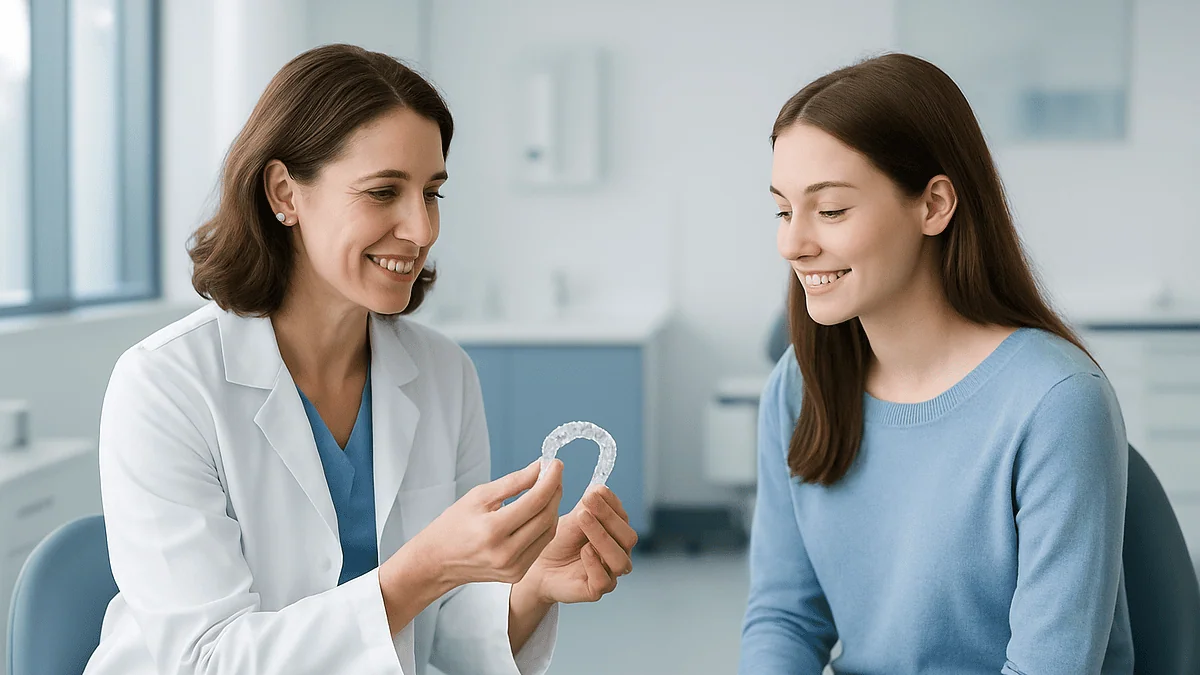
Retainers are passive. They do not move teeth; they prevent movement after active treatment has finished. The two main designs are the Hawley retainer, a wire-and-acrylic plate, and the clear vacuum-formed retainer, a thin transparent shell moulded over the teeth.
Active plates, sometimes called removable appliances in the narrow sense, carry a working part: a spring that tips a single tooth, a bite plane that discourages a deep bite, or a midline screw that widens the arch. The expansion plate belongs here. So does the removable version of the palatal expander, which targets the seam running down the middle of the roof of the mouth.
Functional appliances are bulkier devices, usually worn by children between roughly the ages when the last baby teeth are falling out and the growth spurt of adolescence. They hold the lower jaw forward or reposition it so that the muscles and growth patterns of the face help correct the way the upper and lower teeth meet.
Two things are worth clarifying because they cause confusion online. Clear aligners are technically removable, but they are a system of many sequential trays designed to move teeth through a whole course of treatment, and most professionals discuss them separately from traditional plates. Space maintainers, small devices that hold a gap open after a baby tooth is lost early, are usually cemented in place and are therefore fixed, though removable versions exist. Mouthguards and night guards are not orthodontic appliances at all, even though they look similar on a nightstand.
MedlinePlus, in its overview of malocclusion, the medical term for teeth that do not line up properly, notes that treatment may involve braces, removable devices, or, in a minority of cases, surgery. Which family a person is offered depends on the diagnosis, the age, and how much movement is needed.
What are the two main types of removable retainers?
Nearly everyone who finishes braces meets a retainer, and nearly every retainer is one of two designs.
The Hawley retainer is the older one. A thin acrylic plate rests against the roof of the mouth (or, for the lower arch, along the inside of the teeth), and a wire runs across the front of the teeth like a slender bow. Small clasps hook around the back molars to keep it stable. Because the wire can be adjusted with pliers, a Hawley can be tweaked in the chair to nudge a tooth that has begun to drift, and the acrylic can be trimmed to allow the back teeth to settle together. Its downsides are visibility, a slight effect on speech in the first days, and the fact that the wire crosses the front of the smile.
The clear vacuum-formed retainer, often called an Essix-style retainer after one early trade name, is made by heating a sheet of transparent plastic and sucking it down over a model of the teeth. It covers every tooth surface, is almost invisible, and is thin enough that speech adapts quickly. In exchange, it cannot be adjusted, it wears out faster, and because it covers the biting surfaces the back teeth cannot settle into one another while it is worn.
Which is better? The honest answer is that the evidence does not crown a winner. A Cochrane systematic review of retention procedures, indexed on PubMed, found only low to moderate quality evidence comparing retainer designs and could not recommend one type over another for keeping teeth straight. Choice therefore comes down to the individual case, the patient’s habits, and the orthodontist’s judgement.
There is a third option people sometimes forget: the bonded or fixed retainer, a thin wire glued behind the front teeth. It is not removable, but many people end up with a fixed wire on the lower teeth and a removable retainer on top. Ask your team which combination they are proposing and why.
Hawley retainer vs Essix: what is inside the appliance
Holding a Hawley retainer up to the light is a good way to understand every removable appliance, because the parts repeat across the whole family.
The baseplate is the acrylic body. It sits against the palate or the gums, spreads the load, and anchors everything else. In a plain retainer it is passive. In an active plate it may be split down the middle so a screw can push the two halves apart.
Retentive components are the clasps. The most common is the Adams clasp, a wire loop with two small arrowheads that grip the bulges on a molar. Clasps decide whether the appliance stays put when the tongue moves; a loose clasp is the single most common reason a plate feels wrong.
Active components do the moving. A labial bow is the wire across the front teeth; in a retainer it is passive, but it can be tightened. Finger springs are tiny wire fingers tucked into the acrylic that press on one tooth. An expansion screw is a threaded barrel turned with a key. A bite plane is a ramp of acrylic that stops the front teeth meeting so the back teeth can erupt further.
The Essix-style retainer strips this list to one item. The whole shell is baseplate and retention in a single piece of plastic, with no active part at all. That simplicity is its selling point and its limit.
Why does this matter to a patient? Because when something goes wrong, you can describe it precisely. “The clasp on the left is bent” or “the acrylic has cracked next to the screw” tells a clinician far more than “it doesn’t fit.” It also explains why a Hawley can often be repaired while a cracked clear retainer generally has to be remade from a new impression or scan.
How expansion plates and palatal expanders work
The roof of the mouth is not one bone. In children it is two halves joined along a seam called the mid-palatal suture, and that seam stays open, or at least flexible, until it knits together during the teenage years. An expansion appliance exploits that window.
A removable expansion plate is an acrylic baseplate cut in two, with a small screw bridging the gap. Turning the screw, usually with a key, pushes the halves apart by a fraction of a millimetre at a time. The clasps carry that push to the molars, the molars carry it to the bone, and over weeks the upper arch becomes wider. Because the device comes out, the force it can deliver is limited, and much of the widening comes from tipping the teeth outward rather than opening the seam itself. Orthodontists tend to use removable plates for modest widening in younger children.
The fixed palatal expander does the same job with more force. Metal bands cemented to the molars connect to a screw in the centre of the palate, and it is turned on a schedule set by the orthodontist. Mayo Clinic’s overview of braces describes expanders as devices used mainly in children to create room before the jaw finishes growing. Because the two halves of the palate genuinely separate, a small temporary gap can open between the front teeth, a startling but expected sign that closes as treatment continues.
Why widen at all? The usual reasons are a crossbite, where upper back teeth bite inside the lower ones, or crowding severe enough that teeth have nowhere to erupt. Widening the arch can create space and can improve how the upper and lower teeth meet. What it cannot reliably do in adults is open a fused suture; once the seam has knitted, expansion generally means either surgically assisted approaches or accepting tooth tipping only. That is why timing, not device design, is the biggest factor in this branch of care.
Functional appliance orthodontics: guiding jaw growth, not just teeth
Some children have upper front teeth that sit well ahead of the lower ones. Orthodontists call this a Class II malocclusion, and the measurable gap between the front teeth is the overjet. Often the cause is not that the upper teeth are too far forward but that the lower jaw sits too far back. Functional appliances are designed for that situation.
The idea is elegant. Instead of pushing directly on teeth, the appliance holds the lower jaw in a forward position whenever it is worn. The child’s own chewing and postural muscles then work against the device, and that altered force pattern is thought to encourage the lower jaw to grow forward, restrain the upper jaw, and tip the teeth into a better relationship. Familiar designs include the Twin Block, two separate plates with angled ramps that lock the jaw forward when the mouth closes, and one-piece devices that hold both arches in a single block of acrylic.
Does it really change the jaw? Here the evidence deserves a careful reading. A Cochrane review of orthodontic treatment for prominent upper front teeth in children, indexed on PubMed, compared early treatment with a functional appliance followed by braces against a single course of braces in adolescence. Final tooth positions and jaw relationships were similar between approaches. The one clear advantage of early treatment was fewer new injuries to the protruding front teeth during the years in between, though the authors graded the certainty of that finding as low to moderate. In other words, the appliance corrects the bite, but most of the long-term skeletal change appears to be modest, and the main argument for starting young is protecting vulnerable teeth.
That nuance matters for families weighing two phases of treatment against one. Ask what the appliance is expected to achieve in your child’s case specifically, and how that expectation squares with the evidence above.
Removable orthodontic appliances types compared at a glance
The three families overlap in appearance yet differ sharply in purpose, timing and what they demand of the person wearing them. The table brings the key points together; the text beneath fills in what a table cannot.
| Appliance | Main job | Usual candidate | Active or passive | Typical daily wear | Key limitation |
|---|---|---|---|---|---|
| Hawley retainer | Hold teeth after braces | Anyone finishing treatment | Passive (adjustable) | Full-time then nights, per clinician | Visible wire; speech adjustment |
| Clear vacuum-formed retainer | Hold teeth after braces | Anyone finishing treatment | Passive | Full-time then nights, per clinician | Wears out; cannot be adjusted |
| Removable expansion plate | Widen upper arch modestly | Younger children, open palatal seam | Active (screw) | As directed, often most of the day | Limited force; relies on wear |
| Active plate with springs | Tip one or a few teeth | Simple, isolated movements | Active (springs) | As directed | Cannot move roots through bone |
| Functional appliance | Reposition lower jaw, correct overjet | Growing children with Class II bite | Active (muscle-driven) | As directed, often including sleep | Bulky; results depend on growth and wear |
Notice the pattern down the fourth column. Retainers are passive; everything else is active. That single distinction explains why retainers are for life in many cases while active plates are used for months and then retired.
Notice too that the “typical daily wear” column avoids numbers. That is deliberate. Wear schedules are set by the treating orthodontist for the individual case and vary with the appliance, the age, and how the teeth respond. The NHS notes that retainers are commonly worn full-time at first and later at night, and that many people are advised to keep wearing them indefinitely, but the exact pattern for any one person is a clinical decision.
The final column is the one to read twice. Every removable device shares a limitation that fixed braces do not: it works only when it is in.
Who removable appliances are usually for, and who is usually asked to wait
Removable devices suit certain situations well and others poorly, and honest orthodontists are open about the difference.
Retainers are for almost everyone who has completed active treatment, regardless of age. Whether the alignment came from braces, aligners or a functional appliance, the newly moved teeth sit in immature bone and will drift without support. The Cochrane retention review is blunt about the absence of good evidence for skipping retention altogether.
Expansion plates and functional appliances are, in practice, children’s devices. Both rely on growth: the open palatal seam for expansion, and the adolescent growth spurt for jaw repositioning. Most candidates are in the mixed dentition stage, the years when baby teeth and adult teeth share the mouth, or in early adolescence. A child who is very young may be asked to wait because the adult teeth that need guiding have not yet arrived, or because the child is not ready to manage the device. An adult with the same bite pattern is unlikely to be offered a functional appliance at all, because the growth it relies on has finished; alternatives then include fixed braces, aligners with attachments, or, for large skeletal discrepancies, surgical planning.
Active plates with springs suit isolated, simple movements: one tooth tipped a little, a mild crossbite of a single tooth. They are rarely the right tool when several teeth need rotating or when roots must move.
Beyond diagnosis, teams look at behaviour and oral health. A child who cannot yet reliably keep track of a small object, a person with uncontrolled gum disease, or someone whose teeth need extensive restorative work first may be asked to postpone. Cleveland Clinic’s guidance on malocclusion stresses that treatment planning begins with a full examination and often X-rays, precisely because the visible crowding is only part of the picture.
None of this is a verdict on anyone’s worth as a patient. It is about matching a tool to a job, and about honesty when the tool will not do it.
What the first days and weeks with a removable appliance usually feel like
Day one is mostly about saliva and speech. A new baseplate against the palate tricks the mouth into thinking there is food present, so the glands run overtime for a day or two. Words with “s” and “th” come out soft. Most people find that reading aloud for ten minutes speeds the adjustment, and the NHS describes this early awkwardness as expected and short-lived rather than a sign of a problem.
Pressure follows. A retainer fitted immediately after braces should feel snug but not painful. An active plate, once its spring or screw is engaged, produces a dull ache on the teeth being moved, similar to the tenderness after braces are adjusted. Functional appliances add muscle fatigue, because the jaw is being held in an unfamiliar position; that eases as the muscles adapt.
By the second week the device usually feels like part of the mouth, and this is where the real work begins: habit. Removable appliances live or die by routine. Out for meals, cleaned, back in. Case in the pocket, never a napkin. Many orthodontists ask families to track wear informally, and some appliances include a small built-in sensor for the same reason.
Cleaning is straightforward. Brush the appliance with a soft toothbrush and cool water, away from the sink basin so a slip does not crack it. Skip hot water, which warps acrylic and clear plastic. Keep it away from dogs, who find the scent irresistible, and out of direct sun in a car.
Review appointments are typically spaced weeks apart. For a retainer the clinician checks fit and looks for early drift. For an expansion plate or functional appliance, the visit is when adjustments happen: a screw checked, a spring activated, acrylic trimmed. The NHS gives a general figure of about 18 to 24 months for a full course of orthodontic treatment with braces, but removable phases are planned individually, so ask your team what your own timeline looks like rather than relying on averages.
How long do you have to wear a retainer? What the evidence says
This is the question that outlasts every other. The uncomfortable answer is that nobody can promise a date after which the teeth will stay put on their own.
Relapse, the drift of teeth back toward their old positions, has two drivers. The first is the immature bone around recently moved roots, which stabilises over the months after treatment. The second is lifelong: gums, lips, tongue and the slow forward shift of the lower teeth that continues into middle age even in people who never had braces. Retention addresses the first completely and the second only for as long as the retainer is worn.
The NHS states that retainers are usually worn full-time at first and then at night, often for at least a year, and that many people are advised to keep wearing them indefinitely to prevent teeth moving back. The Cochrane review on retention procedures, indexed on PubMed, reached a sobering conclusion: the available trials were small and of low to moderate quality, and there was not enough evidence to say which retainer type, or which wear schedule, works best. What no trial has shown is that stopping retention altogether leaves teeth reliably where they are.
In practical terms that means a phased pattern set by the clinician, followed by a long tail of night-time wear that many orthodontists describe as “as long as you want your teeth to stay straight.” It also means replacing worn-out clear retainers rather than letting a cracked one gradually stop doing its job.
If a retainer that once slid on easily now feels tight, that is information, not a fault. Teeth have moved a little. Wear it as directed and mention it at review; a tight retainer that still seats fully is often enough to guide the teeth back, while one that no longer fits at all needs a professional look before it is forced.
Risks, side effects and the alternatives to removable appliances
Removable devices are low-risk compared with almost any medical intervention, but “low” is not “none,” and a neutral picture helps people make decisions.
The most common problems are mechanical. Sore spots where acrylic rubs the gum, a clasp that pinches, a sharp edge where plastic has chipped. These are adjustment issues and resolve with a trim in the chair. Speech changes and extra saliva fade within days for most people. Some patients notice a temporary change in how the back teeth meet, especially with clear retainers that cover the biting surfaces.
Hygiene risks are real but manageable. A plate worn without cleaning collects plaque and can contribute to gum inflammation or, in the long run, tooth decay along the gum line. Regular brushing of both teeth and appliance is the answer. Damaged appliances carry their own hazards: a cracked clear retainer can cut the tongue, and a broken wire can scratch the cheek or, rarely, be swallowed.
Over-expansion or over-activation can happen if a screw is turned more than instructed, which is one reason schedules must come from the clinician and not from online forums. Functional appliances occasionally cause temporary jaw-joint discomfort as the muscles adapt.
Alternatives depend on the goal. For holding teeth, the main alternative to a removable retainer is a fixed wire bonded behind the teeth; it removes the compliance problem but requires careful flossing and can debond. For moving teeth, fixed braces deliver more precise, three-dimensional control and are the standard for complex cases. Clear aligners cover minor to moderate alignment in patients who will wear them consistently. For expansion in adults or for large jaw discrepancies, surgical approaches exist and are planned jointly by orthodontists and surgeons.
Mayo Clinic and the NHS both frame the choice as a conversation about trade-offs: visibility, control, comfort, and how much responsibility the patient wants to carry. There is no universally correct answer, only the right fit for a specific mouth and a specific life.
What people often get wrong about retainers, expanders and functional appliances
Myths gather around anything that lives in a bathroom drawer. These are the ones clinicians hear most.
“A retainer will straighten my teeth.” It will not. Retainers are passive; they hold. A Hawley can be adjusted to coax a slightly drifted tooth back, but a retainer worn over crooked teeth simply becomes a badly fitting retainer. Alignment requires an active appliance.
“Once my teeth are stable, I can stop wearing it.” The NHS advises that many people need retainers indefinitely, and the Cochrane review found no evidence supporting a safe stopping point. Stability is not a finish line; it is a condition maintained by the retainer.
“An expander makes the whole face wider.” Expansion widens the upper dental arch and, in children, the palate. It does not broaden cheekbones or change facial width in any noticeable way. Photographs online showing dramatic facial transformation almost always reflect growth or angle.
“Functional appliances grow the jaw permanently.” The evidence, summarised in the Cochrane review of Class II treatment, suggests the bite correction is real but the long-term skeletal change is modest, and final outcomes after a full course are similar whether treatment starts early or in adolescence. The clearest benefit of starting early is fewer injuries to prominent front teeth.
“If it hurts, it is working harder.” Mild pressure is expected. Persistent sharp pain, ulcers or bleeding mean something is rubbing or broken and needs adjusting, not endured.
“Any dentist can make one from a kit.” Appliances are fabricated from a precise impression or scan and designed for a specific diagnosis. Generic or mail-order plates cannot account for root position, gum health or bite, and problems created by them can be harder to correct than the original issue. Orthodontic devices belong within a supervised plan.
“Boiling water sterilises it.” Heat warps acrylic and clear plastic. Cool water and a soft brush are all that is needed.
Questions to ask your care team before you say yes
A good consultation leaves you able to explain the plan to a friend. If you cannot, ask more. These questions tend to surface the information that matters.
- Which family does this appliance belong to: retainer, active plate, expander or functional device? What exactly is it meant to change, and what will it not change?
- Why a removable appliance rather than fixed braces or aligners in my case? What would you expect to be different if we chose the alternative?
- How many hours a day does it need to be worn, and what happens to the plan if wear falls short?
- For a child: what is the reasoning behind treating now rather than waiting, and how does that fit with the evidence on early versus later treatment?
- For an expander: is the palatal seam still open at this age, and how will you check progress?
- For a functional appliance: what proportion of the correction do you expect from tooth movement versus jaw growth?
- How will we know it is working, and when would you decide it is not?
- What is the retention plan after active treatment ends, and for how long?
- What should I do if it cracks, a clasp bends, or it stops fitting?
- Who do I contact between appointments, and how quickly should I expect a response?
- Are there habits, such as thumb-sucking or mouth-breathing, that could undermine the result, and is anyone assessing them?
Write the answers down. Treatment plans evolve, and having the original reasoning in your own words makes later conversations far easier. Remember too that the decision to start, to pause or to change course always rests with the treating orthodontist in partnership with you; no article, including this one, can substitute for that examination and judgement.
When to call your doctor or orthodontist
Most problems with removable appliances are small and can wait for the next scheduled visit. A few should not.
Contact your orthodontic team promptly if a wire or clasp has broken and is scratching the cheek, tongue or gum; if the appliance has cracked or a piece has come away; if it no longer seats on the teeth at all; if a screw has been turned incorrectly or has jammed; or if a sore spot has become an ulcer that is not healing after a few days of leaving the device out as advised. Do not try to bend wires or file acrylic at home, and do not force a retainer that will not fit; a tooth that has drifted needs assessment, not pressure.
Seek urgent medical care, not just a dental appointment, if a fragment of appliance has been swallowed and you have chest pain, difficulty swallowing, drooling, vomiting or breathlessness; if a piece has been inhaled and there is coughing, wheezing or noisy breathing; if there is bleeding from the mouth that does not stop with steady pressure; or if there is rapidly spreading swelling of the face or floor of the mouth, fever, or difficulty opening the mouth, which can signal a dental infection needing immediate treatment. Cleveland Clinic and MedlinePlus both list persistent pain, swelling and difficulty breathing or swallowing among signs that warrant same-day attention.
Children deserve a lower threshold. A child who suddenly refuses to wear an appliance that was previously tolerated may have a sore spot they cannot describe. A child with a persistently loose plate is at risk of the device shifting during sleep. Both warrant a call.
Finally, a gentle reminder that this article explains and does not diagnose. Any change to how or when you wear an appliance, and any decision to stop, is for the clinician who fitted it and who can see your teeth.
Frequently asked questions
What are the two main types of removable retainers?
The two main removable retainers are the Hawley retainer and the clear vacuum-formed retainer. A Hawley uses an acrylic plate with a wire across the front teeth and can be adjusted by the orthodontist. A clear retainer is a thin transparent shell moulded over the teeth, nearly invisible but not adjustable and quicker to wear out. A Cochrane review found no strong evidence that one design holds teeth better than the other.
What are the different types of orthodontic appliances used today?
Orthodontic appliances divide into fixed and removable. Fixed appliances include braces, bonded retainers and cemented palatal expanders. Removable appliances include Hawley and clear retainers, active plates with springs or screws, removable expansion plates and functional appliances such as the Twin Block. Clear aligners are removable too but are usually discussed as their own category. The orthodontist chooses based on diagnosis, age and the amount of movement needed.
What is an example of a removable orthodontic appliance?
The Hawley retainer is the classic example: an acrylic plate that rests against the roof of the mouth, held by wire clasps on the molars, with a wire bow across the front teeth. Other everyday examples are the clear vacuum-formed retainer, the removable expansion plate with a midline screw, and functional appliances that hold the lower jaw forward in growing children. All can be taken out for eating and cleaning.
Hawley retainer vs Essix: which one should I choose?
Neither is proven better at keeping teeth straight, so the choice rests on your situation and your orthodontist’s judgement. A Hawley is visible but durable and adjustable, and it lets back teeth settle together. An Essix-style clear retainer is discreet and comfortable but cannot be adjusted, wears out sooner, and covers the biting surfaces. Some people end up with a fixed wire behind the lower teeth plus a removable retainer on top.
Is a palatal expander for kids painful?
Most children describe pressure rather than pain, especially in the first day or two after the screw is turned, along with extra saliva and altered speech at the start. The sensation usually eases within days. With fixed expanders a small gap can appear between the front teeth, which is expected and closes as treatment proceeds. Persistent sharp pain, ulcers or bleeding are not normal and should prompt a call to the orthodontic team.
How does functional appliance orthodontics correct an overbite?
A functional appliance holds the lower jaw forward whenever it is worn, so the child’s own muscles push against the device and encourage the teeth and jaws into a better relationship over months of growth. Research summarised in a Cochrane review shows the bite correction is real but the lasting change to jaw size is modest, and long-term results are similar whether treatment starts early or waits for adolescent braces.
How long do you have to wear a retainer after braces?
There is no evidence-based date after which teeth are guaranteed to stay put. The NHS advises that retainers are usually worn full-time at first, then at night, often for at least a year, and that many people are told to continue indefinitely. A Cochrane review found the available trials too small to recommend a specific schedule. The pattern for any individual is set by the treating orthodontist.
Can adults use removable expansion plates or functional appliances?
Usually not for their original purpose. Expansion plates rely on an open seam in the palate that fuses during adolescence, and functional appliances rely on jaw growth that has finished by adulthood. Adults with crossbites or jaw discrepancies are generally offered fixed braces, aligners, or, for larger skeletal problems, surgically assisted approaches. Retainers, however, are appropriate at any age after active treatment.
What happens if I stop wearing my retainer for a few weeks?
Teeth may begin to drift, and the retainer may feel tight or fail to seat fully when you try it again. If it still fits completely, wearing it as directed often guides the teeth back; if it no longer fits, do not force it, because that can damage teeth or the appliance. Contact your orthodontist, who can assess how much movement has occurred and whether a new retainer or further treatment is needed.
How should I clean and store a removable orthodontic appliance?
Brush it gently with a soft toothbrush and cool water after meals and before bed, holding it over a towel so a slip does not crack it. Avoid hot water, which warps acrylic and clear plastic, and avoid abrasive toothpaste on clear retainers. When it is out of your mouth it belongs in its case, never wrapped in a napkin, and away from pets and hot cars. Ask your team about specific cleaning tablets before using any.
References
- NHS: Orthodontics
- MedlinePlus: Malocclusion of teeth
- Cleveland Clinic: Malocclusion
- PubMed (Cochrane): Retention procedures for stabilising tooth position after treatment with orthodontic braces
This article is for general information only and is not a substitute for professional medical advice. Please consult a qualified doctor about your individual situation.

More from the Blog
Why Teeth Discolor: How the Cause Decides Whether Teeth Whitening Will Work
Teeth discolor for three broad reasons: pigments from food, drink or tobacco settle on the outer enamel; enamel thins with age so the yellower…

How Orofacial Pain Is Diagnosed: Jaw Movement, Bite, Muscle and Nerve Examination
Orofacial pain is diagnosed mainly through a detailed history and a hands-on examination rather than a single test. Clinicians measure how the jaw opens…
When Dentists Reach for a Laser: Gum Reshaping, Sensitivity and Small Cavity Repair
Dentists use lasers most often for soft-tissue work such as reshaping gum lines, trimming overgrown tissue and cleaning infected gum pockets, and less often…
Why Enamel, Dentin and Pulp Matter: Dental Anatomy Explained Layer by Layer
A tooth has three main living and non-living layers. Enamel is the hard outer shell that resists chewing forces and acid but cannot regrow…

Caring for a Child’s Space Maintainer: Brushing Around the Band and Foods to Avoid
Space maintainer care comes down to three habits: brush twice a day with fluoride toothpaste, angling the bristles to sweep plaque from where the…

What Can You Eat With Metal Braces? Foods That Break Brackets and Easy Swaps
With metal braces you can eat most foods once they are cut small and cooked soft: pasta, rice, eggs, fish, yogurt, soft fruit, steamed…