

How to Compare Two Facial Aesthetic Surgery Plans: Technique, Scars and Recovery Weighed

Key Takeaways
- Mayo Clinic describes facelift approaches that range from limited-incision skin lifts to procedures repositioning the deeper SMAS layer and neck, so two different plans for one face can both be legitimate.
- Facelift incisions typically run from the temple hairline, along the ear and behind it; ask each surgeon to draw their exact map, because scar position matters more than scar length.
- Bleeding under the skin (hematoma) is the most common facelift complication and usually appears within the first day, which is why both plans should name an out-of-hours contact.
- Rhinoplasty tip swelling can take up to a year to settle fully according to Mayo Clinic, so plans that reshape more of the nose carry a longer wait before the result is final.
- Smoking impairs wound healing and raises the risk of skin loss along incisions, so any credible plan addresses nicotine use before surgery rather than after.
- The NHS advises a cooling-off period of at least two weeks between consultation and booking, and recommends checking a surgeon's registration and experience with the specific procedure.
To compare two facial aesthetic surgery plans, line them up on the same four points: what each technique changes beneath the skin, where every incision sits and how that scar typically matures, what the first weeks of recovery usually involve, and which risks each surgeon names. A second opinion is a normal part of informed consent, and the final choice is made together with the treating team.
Two envelopes, two consultation summaries, one face. Someone sits at the kitchen table on a Sunday evening and reads both again. One surgeon has sketched a deeper lift with incisions tucked behind the ear; the other proposes a shorter scar and a smaller change. Both sounded confident. Both used words that were only half familiar. And nowhere in either letter is there a sentence that says which plan is right for this particular person.
That gap is what a second opinion facial surgery consultation is meant to close, yet it often opens a new one: how do you weigh two reasonable plans against each other without a medical degree? The honest answer is that you do not judge them on charm or on who promised more. You judge them on technique, scars and recovery, the three things that will still matter long after the consultation is forgotten.
This explainer walks through how to do that, section by section, using the same questions surgical teams ask themselves.
What does a second opinion facial surgery consultation actually involve?
A second opinion is not a vote against the first surgeon. It is a second, independent assessment of the same question: what, if anything, should be done to this face, and how. The NHS encourages people considering any cosmetic procedure to take time, ask questions and speak to more than one qualified clinician before committing.
In practice, the appointment follows a predictable arc. The surgeon takes a history, including previous facial procedures, medical conditions, medicines and smoking status, because each of these shapes what is safe. They examine the face at rest and in movement, noting skin thickness, the position of soft tissue over the bone, how the brow, eyelids, cheeks, jawline and neck relate to one another, and any asymmetry that was there long before anyone thought about surgery. Standardized photographs are usually taken so that both plans can later be compared against the same images.
Then comes the part that makes a second opinion worth having: the surgeon explains what they would propose and why, in their own words, without being steered by the first plan. Some people prefer not to show the first summary until after this explanation, so that the second surgeon’s reasoning is genuinely independent. Others bring it along at the start. Either approach is legitimate; what matters is that the second surgeon eventually sees the first plan and comments on where the two overlap and where they differ.
You should leave with a written summary that names the procedure, the planned incisions, the anesthesia type, the expected recovery and the main risks. If the first consultation did not provide one, that absence is itself useful information.
Why can two surgeons propose different plans for the same face?
Faces age in layers, and surgeons disagree about which layer to address first. Skin loses elasticity; the fat pads beneath it shrink and descend; the fibrous sheet that wraps the facial muscles (the superficial musculoaponeurotic system, usually shortened to SMAS) loosens; and the bone itself remodels. Any plan is a judgement about which of these changes is driving what you see in the mirror.
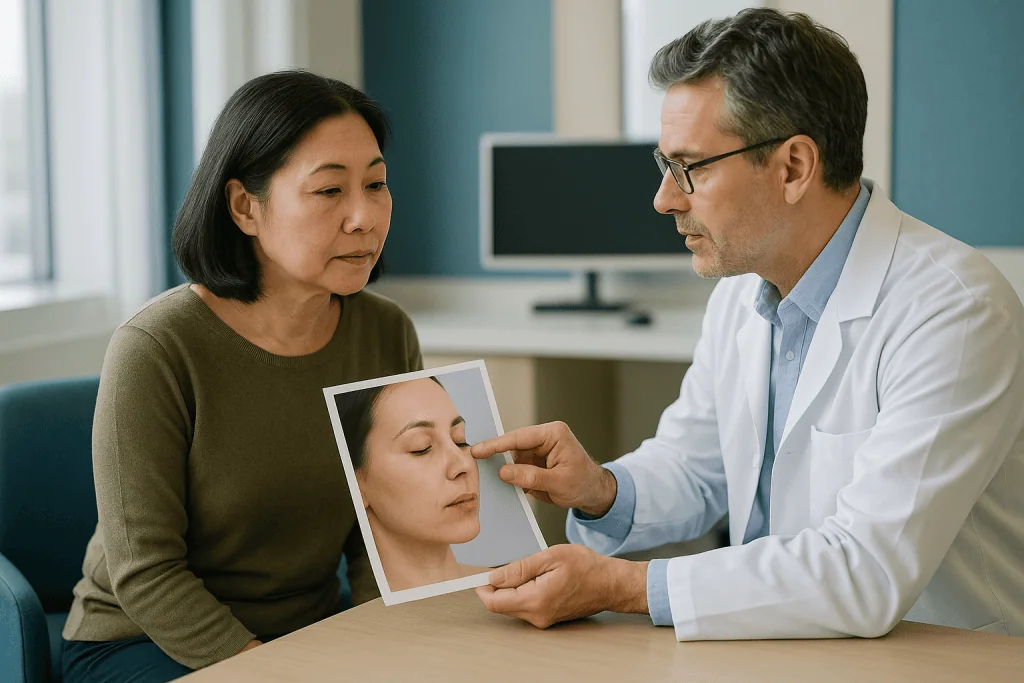
One surgeon may weight skin laxity most heavily and favor a procedure with a limited incision and a shorter recovery. Another may believe the deeper supporting tissue has dropped and propose repositioning it, accepting a longer operation. Mayo Clinic describes exactly this range in facelift surgery: approaches vary from limited-incision techniques to procedures that lift and reposition deeper tissue and the neck as well as the face.
Training and habit also play a part. A surgeon who has spent years refining one approach will, reasonably, propose the approach they know best. That is not a flaw; it is how surgical skill is built. But it does mean the plan reflects the surgeon as much as the patient, and a second opinion lets you see which parts of the recommendation are about your anatomy and which are about preference.
Finally, two surgeons may simply be answering different questions. If you told the first that you wanted a natural, modest change and the second that you wanted the most noticeable result, the plans will diverge because the brief did. Before comparing them, it helps to write down, in one plain sentence, what you want changed and what you want left alone, and to check that both surgeons heard the same sentence.
How do I compare the surgical technique in each plan?
Technique is the hardest element to judge, yet the most consequential. Start by asking each surgeon to describe the operation as a sequence: what is cut, what is lifted or removed, what is reshaped, what is fixed in place, and how the wound is closed. A plan you can retell in your own words is a plan you can compare.
Three distinctions come up repeatedly in facial aesthetic surgery:
- Skin-only versus deeper-tissue work. Procedures that tighten skin alone tend to be shorter, while those that reposition the SMAS or the fat compartments beneath aim to change the shape of the face rather than only its surface. Mayo Clinic notes that a facelift does not change the quality of the skin itself; fine lines and sun damage are not treated by lifting.
- Open versus closed approach. In rhinoplasty (surgery to reshape the nose), an open approach adds a small incision across the columella, the strip of tissue between the nostrils, to lift the skin and see the framework directly; a closed approach keeps all incisions inside the nose. Mayo Clinic describes both as standard options, chosen according to what needs to be done.
- Removal versus repositioning. In eyelid surgery (blepharoplasty), one plan may remove fat and skin while another conserves and redistributes tissue. The difference affects how hollow or full the result looks.
Ask each surgeon why their technique fits your anatomy specifically. A good answer references what they saw in your examination. A weak answer references only what they usually do. Then ask the reverse question: what would they lose, or risk, by doing it the other surgeon’s way? Surgeons who can articulate the trade-offs of an approach they did not choose are showing you their reasoning rather than their marketing.
Where will the scars sit, and how does facelift scar healing usually progress?
Every incision becomes a scar; the question is where it lives and how it behaves. Ask each surgeon to draw the planned incisions on a diagram or on your photographs, then compare the two drawings line by line.
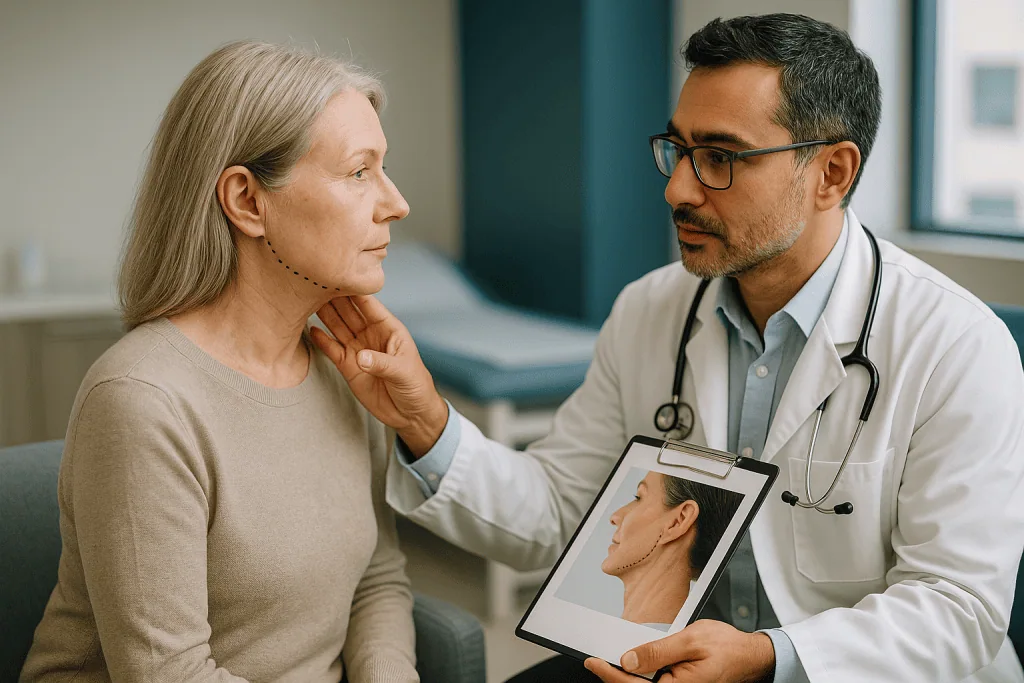
Facelift incisions commonly begin in the hairline at the temple, follow the natural crease in front of the ear or sit just inside its cartilage edge, curve behind the earlobe and finish in the hair behind the ear, according to both Mayo Clinic and Cleveland Clinic. A limited-incision technique shortens that path. A plan that also addresses the neck may add a small incision beneath the chin. Each choice trades length of scar against how much tissue the surgeon can reach.
Where the scar sits matters as much as how long it is. A scar hidden in a crease or inside the hairline is forgiving; one that crosses a visible, mobile area is less so. Ask whether hair will be shaved, whether the hairline will shift, and whether the shape of the earlobe or tragus (the small flap in front of the ear canal) could change.
Then ask about maturation. MedlinePlus explains that scars form as part of normal wound healing, usually fade over time, and never disappear completely. Early scars are typically pink and slightly raised; over months they flatten and lighten. Some people, particularly those with a personal or family history of thick or raised scars, heal less predictably, and a surgeon should ask about that history. Smoking impairs wound healing and raises the risk of skin loss along incisions, a point Mayo Clinic lists among the main risks of facelift surgery; both plans should address it the same way.
A plan that promises an invisible scar is not describing surgery. A plan that explains where the scar will be and how it is expected to mature is.
What do the first days and weeks of recovery usually look like?
Recovery is where the two plans will feel most different in daily life, so compare them on the same clock. Ask each surgeon to describe day one, the first week, the first month and the point at which the final shape is expected to settle.
For a facelift, Mayo Clinic describes a dressing around the face and sometimes a small drainage tube, with swelling and bruising that commonly peak around two days after surgery and then ease. Sutures are generally removed within the first week or so. Many people return to everyday activities in roughly two weeks, with strenuous exercise usually deferred for about four weeks, though these are typical ranges and your own team sets the schedule.
For rhinoplasty, Mayo Clinic notes that an external splint is usually worn for about a week, that bruising around the eyes is common early on, and that subtle swelling of the nasal tip can take up to a year to resolve fully. That long tail matters when you compare plans: a technique that reshapes more of the nasal framework often means a longer wait before the result is final.
Eyelid surgery tends to have a shorter visible recovery, with bruising and swelling settling over one to two weeks according to Mayo Clinic, though dryness or sensitivity to light can linger for a while.
Whatever the procedure, ask each surgeon the same practical questions: How many nights of supervision will I need at home? When can I shower and wash my hair? When can I drive, wear glasses, or bend forward? How many follow-up visits are planned, and who will see me? Two plans that look similar on paper can diverge sharply here, and the one with the more demanding recovery is not necessarily wrong; it just needs to be chosen with open eyes.
Side-by-side: a worksheet for weighing two facial surgery plans
Writing the two plans into one table turns an emotional comparison into a structured one. Fill the right-hand columns from each surgeon’s own written summary, not from memory, and leave a cell blank rather than guess. Blank cells tell you what to ask at the follow-up call.
| Point of comparison | Plan A | Plan B | What to look for |
|---|---|---|---|
| Problem the surgeon identified | Does it match what you see and what you asked about? | ||
| Layers addressed (skin, fat, SMAS, bone, cartilage) | Deeper work usually means longer surgery and recovery | ||
| Incision map | Length, hidden versus visible, effect on hairline or ear shape | ||
| Anesthesia and setting | Local with sedation versus general; day case versus overnight | ||
| Typical recovery milestones | Splint or dressings, suture removal, return to work, exercise | ||
| Time until swelling settles | Weeks for some procedures, up to a year for rhinoplasty tip swelling | ||
| Risks named by the surgeon | Specific to you, not just a generic list | ||
| Plan if a revision is needed | Who, when, and how it would be handled | ||
| Non-surgical steps included | Skin care, sun protection, smoking cessation support | ||
| Cooling-off period offered | NHS guidance suggests at least two weeks |
The table will not choose for you. What it does is expose asymmetry: a plan that is detailed on technique but vague on risks, or precise about recovery but silent on scar placement. Once the gaps are visible, a short message to each surgeon’s office can usually fill them. If an office cannot or will not fill a gap, weigh that too.
Who is usually a good candidate, and who is usually asked to wait?
Both plans should rest on the same foundation: that surgery is reasonable for you at all. If the two surgeons disagree on that point, it is the most important disagreement of the whole process.
Candidates for facial aesthetic surgery are generally adults in good overall health with realistic expectations and a clear, specific concern. Mayo Clinic adds that for facelift surgery, people whose skin retains some elasticity and whose bone structure is well defined tend to have more predictable outcomes, and that the face continues to age after any lift.
Surgeons commonly ask people to wait, or decline to operate, in several situations:
- Current smoking or nicotine use, because of impaired wound healing and the risk of skin loss along incisions.
- Medical conditions that affect bleeding, clotting or healing, such as uncontrolled high blood pressure or diabetes, until these are managed with the person’s own physician.
- Recent major life stress, bereavement or a relationship ending, when the motivation for surgery may be shifting.
- Signs of body dysmorphic disorder, a condition in which a person is preoccupied with a perceived flaw that others do not see; the NHS advises that cosmetic surgery is not an appropriate treatment and that a referral for psychological support should come first.
- Expectations that surgery cannot meet, such as wanting to look like a different person or expecting a procedure to resolve a job or relationship problem.
Medicines also matter. Some prescription drugs and supplements affect clotting, and any change to them is a decision for the prescribing clinician and the surgical team together; a good plan states what will be reviewed and who will review it rather than leaving it to you.
A surgeon who asks you to wait is not dismissing you. Often they are protecting the result you want from the circumstances that could spoil it.
Does anesthesia type and surgical setting change the comparison?
Two plans can describe the same operation and still differ in how awake you are and where you wake up. Both matter for safety and for recovery, and both belong in the comparison.
Facial procedures are performed under local anesthesia with sedation, in which the area is numbed and you are relaxed but breathing on your own, or under general anesthesia, in which you are fully unconscious and an anesthesiologist manages your breathing. Mayo Clinic notes that both are used for facelift and rhinoplasty depending on the extent of the surgery and the person’s health. Longer, deeper procedures lean toward general anesthesia; shorter ones may be done with sedation.
Ask who will deliver the anesthesia and what their qualification is. Ask whether the operation is planned as a day case, where you go home the same day, or with an overnight stay, and what would trigger a change of plan. Ask where the surgery will take place: a hospital operating theater, a licensed ambulatory surgical center or an office-based procedure room, and what emergency equipment and transfer arrangements exist in that setting. The NHS advises checking that any facility and clinician are properly registered with the relevant regulator.
These answers connect directly to recovery. A general anesthetic adds its own early effects, including grogginess and nausea for some people, to those of the surgery. A day-case plan requires a responsible adult to take you home and stay with you, and that person should be identified before you decide, not after.
Anesthesia is not the place to compare plans on convenience. It is the place to compare them on what happens if something unexpected occurs during the operation and who is standing in the room when it does.
How should I read each surgeon's list of risks and complications?
Every surgeon is obliged to discuss risks, but the quality of that discussion varies, and it is one of the clearest signals of how carefully a plan has been thought through.
Mayo Clinic groups facelift risks into bleeding beneath the skin (hematoma), which is the most common complication and usually appears within the first day; scarring that may be thicker or more visible than expected; injury to the nerves that move or give sensation to the face, which is usually temporary but can occasionally be lasting; hair loss at the incision sites; skin loss where blood supply is compromised; and asymmetry. Rhinoplasty carries its own set, including breathing difficulty, numbness, persistent swelling, septal perforation (a hole in the wall between the nostrils) and the possibility of needing a further operation, according to Mayo Clinic. Both share the general surgical risks of infection, reaction to anesthesia and blood clots.
When you compare the two lists, look for three things. First, specificity: does the surgeon connect risks to you, mentioning for instance that your thin skin raises the chance of visible irregularity, or that your history of raised scars changes the scar discussion? Second, honesty about revision: what proportion of their own patients return for a touch-up, and how is that handled? Third, proportion: a plan that lists only minor risks is not safer; it is less complete.
Risk also runs in the other direction. A less extensive operation may carry fewer surgical risks but a higher chance of under-correction, which can lead to disappointment or to a second procedure. Neither plan is risk-free; the aim is to understand which risks each one accepts, and to decide, with your team, which set you are prepared to carry.
Are there non-surgical or smaller-step alternatives in either plan?
A thorough plan does not begin with the knife. It begins with the question of whether surgery is needed at all, and it is fair to expect both surgeons to have asked it.
Non-surgical options address different layers than surgery does, which is why they are not interchangeable with it. Injectable neuromodulators, a class of medicine that temporarily relaxes muscles, soften lines caused by expression but do not lift sagging tissue. Dermal fillers, gel-like substances injected beneath the skin, restore volume where fat has been lost but do not remove excess skin. Skin-resurfacing treatments such as lasers or chemical peels improve texture and pigmentation, which Mayo Clinic notes is something a facelift does not do. A surgeon who proposes surgery for a concern that is mainly about skin quality, or who proposes filler for a concern that is mainly about laxity, is answering the wrong question.
Smaller surgical steps also exist. A neck-only procedure, an isolated eyelid operation or a limited-incision lift may address the one feature that bothers you most without committing to a full-face operation. Conversely, a surgeon may explain that treating one area in isolation would leave it looking out of step with its neighbors, and propose a broader plan for that reason.
What you want from each consultation is evidence that alternatives were considered and a reason, stated in plain language, for why they were or were not chosen. Compare the reasons, not just the conclusions. Two surgeons who both reject non-surgical options for the same anatomical reason are telling you something reliable. Two who reach the same conclusion by different routes deserve a follow-up question. And a plan that never mentions alternatives at all has skipped a step that informed consent requires.
What people often get wrong about a second opinion on facial surgery
Several beliefs make second opinions less useful than they should be. Correcting them is part of comparing plans well.
“Asking for a second opinion will offend the first surgeon.” Experienced surgeons expect it and often suggest it. The NHS explicitly advises people considering cosmetic procedures to take time and to seek more than one view. A clinician who reacts badly to the request has given you information about how they handle disagreement.
“The surgeon who proposes more is more thorough.” Extent is not rigor. A more extensive plan may be right for your anatomy, or it may reflect a surgeon’s habit. The test is whether the reasoning connects to what was found on examination.
“The surgeon who proposes less is being cautious.” Sometimes. Under-correction is also a known cause of dissatisfaction and of further surgery. Caution is a judgement, not a virtue in itself.
“A short scar is always better.” A shorter incision limits what the surgeon can reach. For some faces that limitation costs nothing; for others it means a result that does not last or does not address the main concern.
“Before-and-after photos settle it.” Photographs show selected patients, in chosen lighting, at a chosen time point. They illustrate a surgeon’s style; they do not predict your outcome, and no responsible team presents them as a promise.
“If both plans are similar, the decision does not matter.” Agreement between two independent surgeons is genuinely reassuring about the diagnosis. The remaining differences, in recovery support, follow-up and how complications would be handled, still deserve attention.
“I should pick the one I liked more.” Rapport matters; you will see this person during a vulnerable recovery. But rapport is the tiebreaker after technique, scars and recovery have been compared, not the first criterion.
Questions to ask your care team before choosing a plan
Carry the same list to both consultations, and to any follow-up call. Identical questions produce comparable answers; improvised ones do not.
- What exactly did you see when you examined my face, and which of those findings is driving your recommendation?
- Can you describe the operation step by step, from the first incision to the final suture?
- Please draw every planned incision on my photographs. Where will each scar sit, and how do you expect it to mature over the first year?
- What type of anesthesia do you propose, who will administer it, and where will the surgery take place?
- What will the first two days, the first two weeks and the first three months typically look like for this specific plan?
- Which risks apply to me in particular, given my skin, my health and my history?
- How often do your patients need a revision after this procedure, and how would that be arranged?
- What alternatives did you consider, including non-surgical ones, and why did you set them aside?
- Is there anything about my health, my medicines or my habits that you would want changed or reviewed before you would operate?
- Who will I see at follow-up, and how do I reach the team out of hours if something worries me?
- How long a cooling-off period do you offer between this consultation and any booking?
- Are you registered with the relevant medical regulator, and how often do you perform this exact procedure?
The NHS recommends asking about a surgeon’s registration, qualifications and experience with the specific operation, and treating reluctance to answer as a reason to pause. Write the answers down during the appointment or ask permission to record them. Comparing two sets of answers to the same twelve questions is far more revealing than comparing two impressions.
When to call your doctor
Whichever plan you eventually choose, you should leave the consultation knowing exactly who to contact after surgery and when. Compare the two plans on this too: a named contact and an out-of-hours route are part of safe care, not extras.
Contact your surgical team the same day, or seek emergency care, if you notice any of the following after facial surgery:
- Rapidly increasing swelling or tightness on one side of the face or neck, or a firm, expanding, painful area under the skin. Mayo Clinic identifies bleeding beneath the skin (hematoma) as the most common facelift complication, usually within the first day, and it needs prompt assessment.
- Pain that is severe, worsening or not controlled by what your team advised.
- Bleeding that soaks dressings or does not slow with gentle pressure.
- Fever, spreading redness, warmth, foul-smelling discharge or a wound edge that is opening or turning dark.
- New weakness in part of the face, such as difficulty closing an eye or an uneven smile, that was not present immediately after surgery.
- Sudden change in vision, severe eye pain or inability to close the eyelids after eyelid surgery.
- Difficulty breathing through the nose that worsens sharply, or heavy nosebleeds, after rhinoplasty.
- Shortness of breath, chest pain, or a painful, swollen calf, which can signal a blood clot and require emergency care.
Before surgery, call the team if you develop an infection, a cold, a new medical diagnosis or a change in medicines, or if your circumstances or feelings about the operation have shifted. Postponing is always an option, and a plan that makes postponing feel difficult is worth questioning.
None of these signs should be managed by searching online or waiting for the scheduled review. The treating team made the plan; they are the people to judge whether something has gone off it.
How to make the final decision with your treating team
At some point the table is filled in, the questions are answered and the two plans sit side by side. Choosing between them is still not a solo act.
Begin with the cooling-off period. The NHS advises a gap of at least two weeks between a consultation and any decision to proceed, and recommends against booking surgery under time pressure. Use that interval to let the first impression fade and the written details stand on their own. Reread both summaries a week apart; notice which questions you still cannot answer.
Then return to whichever surgeon’s plan you are leaning toward and tell them, plainly, what the other surgeon proposed and why you found it attractive. A good clinician will engage with the alternative rather than dismiss it. Some will revise their own plan slightly; some will explain why they would not; a few will say that the other approach is equally reasonable and that the choice comes down to your priorities on scar length versus extent of change. All three responses are honest. Reluctance to discuss the comparison at all is not.
Involve the people who will support your recovery. A plan with a demanding first fortnight is only realistic if someone can be with you for it. Involve your own physician if you have a medical condition, because managing blood pressure, blood sugar or clotting around surgery is their decision together with the surgical team, not yours alone.
Finally, accept that no comparison removes uncertainty. Surgery works on living tissue that heals in its own way, and no surgeon can promise a result. What a careful comparison does is ensure that the plan you choose was chosen for reasons you understand, with risks you have weighed, by a team you can reach. That is what informed consent means, and it is the whole point of the second envelope on the kitchen table.
Frequently asked questions
Is it rude to ask for a facelift second opinion?
No. Seeking a second opinion before cosmetic surgery is standard practice and is encouraged by the NHS as part of making an informed decision. Experienced surgeons expect it, and many suggest it themselves. A clinician who reacts defensively is giving you useful information about how they handle disagreement, which matters if a complication ever needs discussing.
Should I show the second surgeon the first plan?
Either approach works, but many people hold the first plan back until the second surgeon has examined them and explained their own recommendation. That keeps the second assessment independent. Afterwards, sharing the first summary lets the surgeon comment directly on where the two plans overlap and where they differ, which is the most useful part of the comparison.
What does a rhinoplasty revision consultation involve?
A revision consultation assesses a nose that has already been operated on, so the surgeon examines breathing as well as shape, reviews previous operative notes if available, and may use imaging to see remaining cartilage and bone. Mayo Clinic notes that revision rhinoplasty is more complex because scar tissue and reduced structural support change what is possible, so plans and recovery timelines may differ from a first operation.
How do I choose a facial plastic surgeon between two I like?
Start with verifiable facts rather than rapport: registration with the relevant medical regulator, formal training in facial surgery, and how often they perform your specific procedure, all of which the NHS recommends checking. Then compare the written plans on technique, incision placement, recovery and risks using the same questions for both. Rapport is a reasonable tiebreaker once those points are equal.
Why do the two surgeons recommend different incision lengths?
Incision length reflects how much tissue the surgeon intends to reach and reposition. A shorter incision limits access and suits faces where laxity is modest; a longer one allows deeper work on the SMAS layer and neck. Ask each surgeon what they would be unable to address with the other’s incision, which turns an abstract difference into a concrete trade-off.
How long does facelift scar healing usually take?
Scars go through a predictable sequence: early redness and slight firmness, then gradual flattening and fading over many months. MedlinePlus explains that scars fade over time but never disappear entirely. People with a personal or family history of thick or raised scars heal less predictably, and smoking slows healing, so both points should be discussed with each surgeon before comparing plans.
Does a longer recovery mean the surgery is better?
Not necessarily. Longer recovery usually reflects more extensive surgery, which is appropriate for some faces and excessive for others. The relevant question is whether the extent of the operation matches the anatomical problem the surgeon identified. A demanding recovery for a result you did not need is not a sign of thoroughness, and a quick recovery from an operation that under-corrects is not a bargain.
What if the two plans are almost identical?
Agreement between two independent surgeons is reassuring about the diagnosis and the general approach. The remaining differences then become the deciding factors: anesthesia type and setting, follow-up arrangements, how complications and revisions would be handled, and how clearly each surgeon explained risks. Those practical details shape the experience of surgery as much as the technique does.
Can I combine parts of both plans?
Sometimes, but only with the surgeon who will operate. Describe the element you found attractive in the other plan and ask whether it fits your anatomy and their technique. Some surgeons will adjust; others will explain why the combination would compromise safety or result. The treating surgeon must own the final plan, so it should be their reasoning, not a patchwork, that you consent to.
How long should I wait before deciding between two facial surgery plans?
The NHS advises a cooling-off period of at least two weeks between a consultation and any commitment, and warns against booking under time pressure. Use the interval to reread both written summaries, fill gaps with follow-up questions, and discuss the practicalities of recovery with whoever will support you. If anything still feels uncertain at the end of that period, extending it is reasonable.
References
This article is for general information only and is not a substitute for professional medical advice. Please consult a qualified doctor about your individual situation.

More from the Blog
Liquid Facelift or Surgical Facelift: Which One Addresses Jowls and Loose Skin?
A surgical facelift repositions the deeper tissue layer and removes excess skin, so it is the option designed to address true jowls and loose…

Sliding Genioplasty vs Chin Implant: Which Option Fits a Receding or Long Chin?
Sliding genioplasty moves the patient's own chin bone forward, back, up, or down and fixes it with small plates, so it can treat both…
What Happens at a Liquid Rhinoplasty Appointment? Numbing, Injection Points and First Swelling
A liquid rhinoplasty procedure is a nonsurgical treatment in which small amounts of dermal filler, usually hyaluronic acid, are injected along the bridge or…

What Does Lip Lift Recovery Look Like Day by Day? Swelling, Sutures and Smiling Again
Lip lift recovery usually unfolds in stages: swelling and tightness are most noticeable in the first few days, sutures beneath the nose are typically…

Buccal Fat Removal Myths: Instant Cheekbones, Gaunt Faces and What the Evidence Says
Buccal fat removal is a surgery that takes out part of a deep fat pad in the cheek to make the lower face look…

Buccal Fat Removal Risks: Asymmetry, Nerve Injury and Salivary Duct Problems Explained
Buccal fat removal risks include facial asymmetry, injury to the buccal branches of the facial nerve (causing temporary or occasionally lasting weakness of the…