

How to Fall Asleep Fast: Evidence-Based Techniques That Beat Counting Sheep
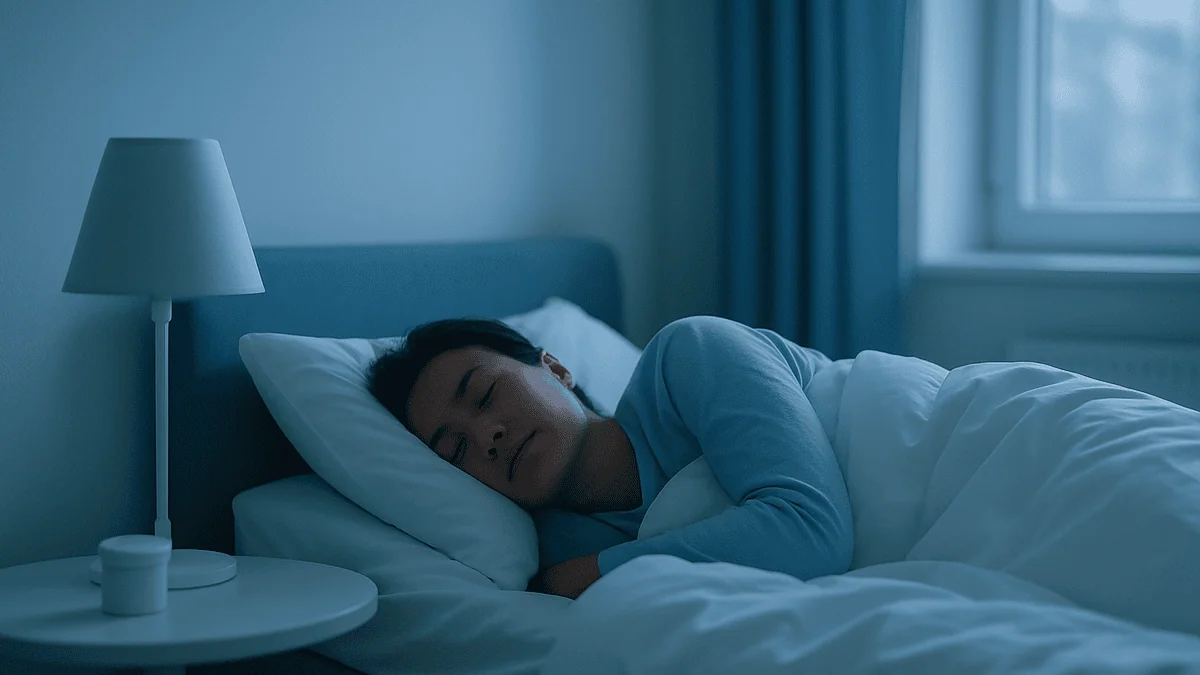
Key Takeaways
- A normal sleep latency is 10 to 20 minutes, falling asleep in under five may signal sleep deprivation, not talent.
- The military method's famous '96 percent in two minutes' claim comes from a 1981 book, not a clinical trial, though its relaxation components are individually evidence-based.
- A warm bath or shower one to two hours before bed shortened sleep onset by roughly ten minutes in a pooled analysis of 17 studies, by accelerating your core temperature drop.
- Caffeine's average half-life is about five hours, so half of a 3 p.m. coffee is still circulating at 8 p.m., timing matters more than quitting.
- Blue-wavelength evening light suppressed melatonin about twice as long as comparable green light in Harvard research, shifting circadian timing by up to three hours.
- If you've been awake in bed about 20 minutes, getting up and returning only when sleepy retrains the bed-sleep association: a core, clinically validated insomnia strategy.
Quick Answer
Most people fall asleep faster by lowering physical and mental arousal rather than forcing sleep. Evidence supports slow, extended-exhale breathing, progressive muscle relaxation, a warm shower one to two hours before bed, a cool dark room around 65 to 68 degrees Fahrenheit, and getting out of bed after roughly 20 wakeful minutes. Regularly taking more than 30 minutes to fall asleep merits a medical conversation.
It’s 1:47 a.m. and you’re doing the arithmetic nobody wants to do: if I fall asleep right now, I can still get five hours and thirteen minutes. Ten minutes later, you run the numbers again. The math gets worse. So does your mood.
Here’s the uncomfortable part: that mental countdown is precisely what’s keeping you awake. Sleep is one of the few biological processes that retreats the harder you chase it. Effort raises alertness, alertness delays sleep, and the cycle feeds itself like a squeaky wheel you keep oiling with anxiety.
The internet’s answer is a parade of hacks, two-minute military methods, one-minute breathing tricks, numeric rules that read like locker combinations. Some of these have real physiology behind them. Others are folklore in a lab coat. This guide sorts one from the other, with the honest caveats the listicles leave out.
Why trying harder to fall asleep keeps you awake
Sleep onset requires your nervous system to downshift from sympathetic (alert, vigilant) to parasympathetic (rest, digest) dominance. The moment you start monitoring your own wakefulnessam I drifting off yet?you introduce performance pressure, and performance pressure is a sympathetic activator. Heart rate ticks up. Muscles hold subtle tension. The brain interprets the effort as a reason to stay online.
Sleep researchers have a name for this trap: it’s the engine behind psychophysiological insomnia, where the bed itself becomes a cue for frustration rather than rest. Cognitive behavioral therapy for insomnia: the treatment mainstream medicine considers first-line, per Mayo Clinic and the NHS, spends much of its effort dismantling exactly this pattern.
One counterintuitive strategy that clinicians sometimes use is paradoxical intention: lying comfortably in the dark and gently trying to stay awake, without screens or activity. By removing the pressure to perform, the anxiety often deflates and sleep arrives through the side door. It sounds like a party trick, but small clinical studies have found it can shorten the time to fall asleep in people whose main problem is sleep effort itself.
The practical takeaway shapes everything that follows in this article: every legitimate fall-asleep technique works by reducing arousal, not by summoning sleep on command. Keep that lens handy: it’s the fastest way to tell an evidence-based method from a viral myth.
How long should it actually take to fall asleep?
Sleep scientists call the stretch between lights-out and sleep your sleep latency, and the healthy range is wider than most people assume: roughly 10 to 20 minutes. Falling asleep the instant your head touches the pillow isn’t a superpower, consistently dropping off in under five minutes can be a sign of sleep deprivation, meaning your body is running a debt and collecting the moment it gets a chance.
On the other end, occasionally needing 30 or 40 minutes after a stressful day is normal human variation, not a disorder. The pattern that deserves attention is chronic: taking more than 30 minutes to fall asleep at least three nights a week, for three months or longer, is part of how clinicians define chronic insomnia.
Why does this matter for technique-shopping? Because your baseline sets realistic expectations. If your natural latency is 15 minutes, no breathing exercise will reliably compress it to 60 seconds, and chasing that target rebuilds the performance anxiety from the previous section. A better goal: trim the excess. Someone lying awake for 50 minutes who gets down to 20 has won, even if no stopwatch-friendly headline would say so.
It’s also worth knowing that we’re poor judges of our own latency. People routinely overestimate how long they lay awake, sometimes by double, because light early-stage sleep doesn’t feel like sleep. If the clock says you got seven hours but you’d swear it was four, that mismatch is common, and it’s another reason to turn the clock face away from the bed.
Does the military sleep method really work in two minutes?
The technique traces back to Relax and Win, a 1981 book describing a routine reportedly used to help Navy pilots sleep in noisy, upright, decidedly unrestful conditions. The steps: relax your facial muscles, including jaw and tongue; drop your shoulders and let your arms go heavy, one at a time; exhale and release your chest, then your legs from thighs to feet; finally, clear your mind for ten seconds, by picturing a calm scene, or by silently repeating “don’t think.”
Now the honest part. The famous claim: that 96 percent of pilots could fall asleep within two minutes after six weeks of practice, comes from that book, not from a peer-reviewed study. No modern clinical trial has tested the method as a package. Anyone telling you it’s “proven” is citing an anecdote with a publication date.
And yet the ingredients are individually legitimate. The body scan is essentially a compressed form of progressive muscle relaxation, which has decades of evidence behind it. The mental-imagery step resembles cognitive distraction techniques that studies have found reduce pre-sleep rumination. The slow exhale nudges the parasympathetic system.
So the fair verdict: the military method is a well-designed relaxation sequence with an overhyped origin story. Practice it nightly for several weeks: the original account emphasized repetition, and that part rings true, since relaxation skills improve with rehearsal like any motor skill. Expect it to help you unwind reliably; don’t expect a two-minute guarantee.
The 4-7-8 breath: why long exhales make you drowsy
Breathe in quietly through your nose for a count of four. Hold for seven. Exhale slowly through your mouth for eight, with a soft whooshing sound. Repeat for four cycles. That’s the entire 4-7-8 technique, popularized from pranayama yoga breathing and described by Cleveland Clinic as a practical tool for easing anxiety and settling toward sleep.
The mechanism is the interesting part. Your exhale is neurologically linked to the vagus nerve, the main highway of the parasympathetic nervous system. When the out-breath is longer than the in-breath, heart rate slows measurably with each cycle: a phenomenon called respiratory sinus arrhythmia. Stack several long exhales together and you’re manually pulling the lever your body normally pulls on its own as it drifts toward sleep.
The specific 4-7-8 ratio isn’t magic. Research on slow breathing more broadly, around six breaths per minute, versus the typical twelve to eighteen, shows reduced blood pressure, slower heart rate, and lower self-reported arousal. If holding for seven feels like a chest-tightening ordeal (it does for some people, especially anyone with respiratory conditions), shrink the numbers: three-five-six works on the same principle. The rule that matters is exhale longer than you inhale.
Two practical notes. First, a few people feel lightheaded early on; doing the exercise lying down solves that. Second, this is a skill with a learning curve. The first night it may feel like counting homework. By week two, many people find the pattern itself has become a sleep cue: a Pavlovian shortcut worth building.
Progressive muscle relaxation: the oldest trick that still works
Before sleep apps, before white-noise machines, there was a physician named Edmund Jacobson teaching patients in the 1920s to tense and release their muscles one group at a time. A century later, progressive muscle relaxation (PMR) remains one of the best-supported relaxation techniques in sleep medicine, and it’s a standard component of cognitive behavioral therapy for insomnia.
The method exploits a simple contrast effect. Muscles relax more deeply after a brief, deliberate contraction than they do from a vague instruction to “just relax.” You also learn, often for the first time, what tension actually feels like in your own jaw, shoulders, and hands, which tend to hold stress you’ve stopped noticing.
A basic run-through, done lying in bed:
- Squeeze your toes and feet for about five seconds, then release for fifteen, noticing the warmth that follows.
- Move upward: calves, thighs, glutes, abdomen, same rhythm, one group at a time.
- Make fists, then let your hands fall open. Shrug your shoulders toward your ears, then drop them.
- Finish with the face: scrunch, hold, release. The jaw deserves special attention; let your teeth part slightly.
The full circuit takes ten to fifteen minutes, which is a feature rather than a bug: it fills the sleep-latency window with a task that is absorbing enough to crowd out worry but boring enough not to excite you. People with chronic pain or muscle injuries should tense gently or simply focus on the release phase; the relaxation half carries most of the benefit.
The cognitive shuffle: give your racing brain a boring job
For many people the barrier isn’t a tense body: it’s a mind replaying the day’s awkward conversation or drafting tomorrow’s email at full volume. Telling that mind to “stop thinking” fails for the same reason “don’t picture a pink elephant” fails. The workable strategy is replacement: occupy the mental stage with content too dull and disconnected to sustain arousal.
The cognitive shuffle, developed by a cognitive scientist, does this systematically. Pick a random word, say, piano. Think of words starting with P: pumpkin, pavement, parrotand briefly picture each one. When P runs dry, move to I, then A, and so on. The images are deliberately random and emotionally neutral, which mimics the loose, fragmented imagery that naturally occurs as the brain slides into stage-one sleep. You’re essentially forging your brain’s boarding pass.
Formal evidence is early-stage, small studies suggest imagery-based distraction shortens sleep latency compared with unstructured thinking, and research on pre-sleep cognitive arousal supports the general principle, so file this under “plausible and low-risk” rather than “proven.”
Lower-tech cousins work on the same logic. Counting backward from 300 by threes gives the verbal mind arithmetic instead of anxiety. A detailed mental walkthrough of a familiar, pleasant route, every turn of a childhood walk to school, does the same with spatial memory. Even counting sheep is a crude version, though a well-known Oxford study found that imagining a tranquil scene beat sheep-counting, likely because sheep are simply too boring to hold attention against a determined worry.
What is the 10-3-2-1-0 rule for sleep?
You’ve likely seen this mnemonic circulating: it packages a day’s worth of sleep hygiene into a countdown. It was popularized by a fitness coach rather than a medical body, so treat it as a memory aid built from evidence-based parts, some parts sturdier than others.
| Rule | What it says | What the evidence shows |
|---|---|---|
| 10 hours before bed | No more caffeine | Strong logic: caffeine’s half-life averages about five hours, so a 2 p.m. cup leaves a meaningful dose circulating at midnight. Ten hours is conservative but reasonable for sensitive sleepers. |
| 3 hours before | No heavy meals or alcohol | Well supported. Alcohol shortens latency but fragments the second half of the night; large late meals promote reflux when lying flat. |
| 2 hours before | Stop work | Sensible. Cognitively arousing tasks raise pre-sleep rumination, a known latency-stretcher. |
| 1 hour before | No screens | Partly supported. Evening light suppresses melatonin; the bigger culprit may be engaging content, not the glow alone. A full hour is a good buffer either way. |
| 0 | Zero snooze-button presses in the morning | Indirectly supported: a consistent wake time is one of the strongest anchors of the circadian clock. |
Is the exact arithmetic clinically validated as a package? No, nobody has trialed “10-3-2-1-0” against a control group. But each element points in the direction mainstream sleep guidance already points. Use it as scaffolding, then adjust the numbers to your own sensitivity; a slow caffeine metabolizer may need twelve hours, not ten.
The warm shower trick: heat up to cool down
It sounds backward: to fall asleep faster, take a warm bath or shower. But the physiology is elegant. Sleep onset is tightly coupled to a drop in core body temperature: your internal thermostat dips roughly one to two degrees Fahrenheit overnight, and the steepest part of that decline is when drowsiness hits hardest.
Warm water an hour or two before bed accelerates the process. The heat draws blood to the skin of your hands and feet, and when you step out, those dilated vessels radiate heat away efficiently. Your core temperature falls faster than it would have on its own, and the brain reads that falling curve as a green light for sleep.
This isn’t folklore. A 2019 systematic review pooling seventeen studies found that warm baths or showers, around 104 to 109 degrees Fahrenheit, taken one to two hours before bedtime, for as little as ten minutes, shortened average sleep latency by roughly ten minutes and improved self-rated sleep quality. Ten minutes may sound modest until you remember it’s a third of the way from “chronic problem” territory back to normal range.
Timing is the detail people get wrong. A hot shower immediately before bed can leave your core still elevated at lights-out, working against you. Give the cooldown its runway. The same principle explains two related observations: warm feet help (socks in bed genuinely have physiological logic, warm feet dilate vessels and speed core heat loss), while an overheated bedroom hurts, which brings us to light and environment.
Light is the master switch, and your phone knows it
Deep in the hypothalamus sits a cluster of about 20,000 neurons, the suprachiasmatic nucleus, that runs your circadian clock, and its single most powerful input is light hitting the retina. Evening light, particularly the blue wavelengths that screens and LED bulbs emit heavily, tells this clock the sun hasn’t set. Melatonin, the hormone your pineal gland releases to signal biological night, gets suppressed and delayed.
Harvard researchers quantified the effect: blue light suppressed melatonin about twice as long as green light of comparable brightness and shifted circadian timing by roughly twice as much, three hours versus one and a half. That’s not a rounding error; it’s the difference between feeling sleepy at 10:30 and at midnight.
The honest caveat: newer research suggests the content on the screen may matter as much as the wavelength. A gripping show or a heated group chat raises cognitive and emotional arousal in ways no amber filter can undo. Night-mode settings are reasonable, but they’re not an alibi for doomscrolling.
The morning half of this equation gets less airtime and deserves more. Bright light within an hour of waking, ideally outdoors, since even an overcast sky delivers far more lux than indoor lighting, anchors the clock so that melatonin rises on schedule that night. If you want to fall asleep faster at 11 p.m., one of the most effective interventions happens at 7 a.m. Think of it as setting the timer, not fighting the alarm.
Caffeine, alcohol, and the late-night snack: timing beats abstinence
Caffeine works by blocking adenosine, the neurochemical that accumulates across your waking hours and creates “sleep pressure.” It doesn’t erase that pressure: it hides the dashboard warning light. With an average half-life around five hours (and considerable person-to-person variation), half of a 3 p.m. coffee is still on duty at 8 p.m., and a quarter at 1 a.m. A frequently cited controlled study found that caffeine taken even six hours before bed measurably disrupted sleep, though participants underestimated the damage. If you fall asleep slowly, an early-afternoon cutoff is one of the cheapest experiments you can run.
Alcohol is the great impostor of sleep aids. It genuinely shortens sleep latency, which is why the nightcap tradition refuses to die, but as the liver clears it overnight, sleep architecture rebounds: more awakenings, suppressed REM in the first half and a REM surge later, lighter and more fragmented sleep overall. You trade ten minutes at the front for a worse second act. The NHS and CDC both flag evening alcohol as a common, underrecognized sleep disruptor.
Food is subtler. A heavy or spicy meal within about three hours of bed invites reflux once you’re horizontal, and active digestion nudges core temperature upward when it should be falling. Going to bed hungry backfires too: a light snack is fine. The theme across all three: the substance matters less than the clock. Most people don’t need to quit anything; they need to move it earlier.
Set the room: 65 degrees, dark as a cave, boring on purpose
Environmental fixes are unglamorous, which is why people skip past them to breathing hacks. That’s backwards. A room working against your physiology will quietly tax every technique you try.
Temperature comes first, because of the core-cooling mechanism we’ve already covered. Sleep experts, including Cleveland Clinic, generally recommend a bedroom around 60 to 67 degrees Fahrenheit, with roughly 65 a common sweet spot. A room in the mid-70s forces your body to fight for the temperature drop it needs. If a cool room means cold feet, wear socks: the combination of cool air and warm extremities is close to ideal.
Darkness matters more than most bedrooms deliver. Streetlight through curtains, a charging LED, a glowing clock, each provides low-level light that can nibble at melatonin. Blackout curtains or a simple eye mask are inexpensive; studies of hospitalized patients given masks and earplugs show measurable sleep improvements, a decent proxy for any light-polluted bedroom.
Sound is trickier than “silence is best.” Intermittent noise, a door, a truck, a snore, is more disruptive than steady noise, because the brain remains alert to change even during sleep. Consistent low sound (a fan, white or pink noise) can mask those spikes. Evidence for noise machines improving sleep is mixed but low-risk.
Finally, boredom is a feature. A bedroom that doubles as an office, cinema, and dining room trains your brain to treat the bed as an activity hub. The next section explains why that association matters more than any gadget.
The 20-minute rule: why staying in bed awake is a mistake
Of everything in this article, this may be the highest-yield habit for chronic slow sleepers, and it’s the one people resist most, because it feels like giving up. It’s called stimulus control, it dates to the 1970s, and it remains a core pillar of cognitive behavioral therapy for insomnia.
The logic: your brain is an association machine. If you routinely spend 45 minutes in bed frustrated and awake, the bed itself becomes a conditioned cue for frustration and wakefulness: the way the smell of a dentist’s office can spike your pulse before anyone touches a drill. Good sleepers have the opposite conditioning: bed means sleep, full stop.
The protocol rebuilds that link:
- If you’ve been awake roughly 15 to 20 minutes (estimate, don’t clock-watch, which is its own arousal source), get up.
- Go to another room, keep lights dim, and do something calm and genuinely dull: a paper book, quiet music, folding laundry. No screens, no snacks, no productivity.
- Return to bed only when sleepiness, heavy eyelids, nodding, actually arrives. Repeat as many times as needed.
- Keep your wake time fixed regardless of how the night went. Yes, even Saturday.
The first week can be rough; you may log less sleep while the conditioning resets. That short-term cost is why people abandon it, and why it works for those who don’t. Clinical guidelines from Mayo Clinic and the NHS consistently rank this behavioral approach ahead of any quick fix, because it addresses the cause, a mistrained association, rather than tonight’s symptom.
Can you really fall asleep in one minute? An honest answer
Search “how to get sleepy in 1 minute” and you’ll find confident tutorials. Here is what the evidence actually supports: no technique reliably puts a healthy, non-sleep-deprived adult to sleep in 60 seconds. The physiology doesn’t allow it. Sleep onset involves a coordinated handoff, falling heart rate, dropping core temperature, rising melatonin, slowing brain waves: that takes minutes even in excellent sleepers. People who genuinely conk out in under a minute are usually carrying significant sleep debt, which is a health flag, not a skill.
The “5-minute tricks” occupy more honest territory. Slow breathing measurably lowers heart rate within a few cycles. The military method’s body scan can produce real muscle relaxation inside five minutes. Acupressure claims (pressing specific points on the wrist or behind the ear) have thin, low-quality evidence, plausibly relaxing, far from proven. What these techniques honestly deliver is a faster descent toward sleep, shaving minutes off an inflated latency rather than teleporting you to unconsciousness.
Why does this framing matter? Because stopwatch expectations sabotage the tools. If you practice 4-7-8 breathing while mentally auditing whether it’s “working yet,” you’ve reintroduced the performance pressure that keeps you awake. The people who benefit most treat these techniques as a wind-down ritual with no deadline.
A reasonable, evidence-aligned goal: if your typical latency runs 40-plus minutes, aim for the normal 10-to-20-minute range over several weeks of consistent practice, combining one relaxation technique, the 20-minute rule, and the light and caffeine timing covered earlier. Unsexy, but it’s the version that survives contact with real physiology.
When to see a doctor about trouble falling asleep
Self-help techniques have a ceiling, and knowing where it sits is part of taking sleep seriously. Talk with a healthcare professional if any of the following describes you:
- You take more than 30 minutes to fall asleep at least three nights a week, and it’s persisted for three months or longer despite consistent sleep habits.
- Daytime consequences are real: nodding off in meetings or, urgently, while driving, memory slips, irritability that’s affecting work or relationships.
- A bed partner reports loud snoring, gasping, or pauses in your breathing, possible signs of sleep apnea, which is common, underdiagnosed, and treatable.
- An irresistible urge to move your legs in the evening, relieved by movement, delays your sleep: a hallmark of restless legs syndrome.
- Sleep trouble arrived alongside low mood, persistent anxiety, or loss of interest in things you enjoy. Insomnia and mental health conditions travel together in both directions, and treating one often helps the other.
- You suspect a medication or health condition is involved, many common prescriptions affect sleep, and only a clinician can safely sort that out.
Here’s the encouraging part that fear-based headlines skip: chronic insomnia is among the more treatable conditions in medicine. Cognitive behavioral therapy for insomnia, delivered in person, by telehealth, or through structured digital programs, helps the majority of people who complete it, with benefits that outlast the treatment itself. MedlinePlus and Mayo Clinic both describe it as the recommended first-line approach. Asking for help isn’t the failure of your wind-down routine; it’s the logical next step when the routine has done all it can.
Frequently asked questions
How can I fall asleep fast in 5 minutes?
No method guarantees sleep in five minutes, but you can meaningfully lower arousal in that window. Try slow breathing with extended exhales, inhale for four counts, exhale for six to eight, combined with a head-to-toe muscle release like the military method’s body scan. Both measurably slow heart rate within a few cycles. Practiced nightly for a few weeks, these become conditioned sleep cues that shorten your real-world latency.
How do you get sleepy in 1 minute?
You can’t reliably force sleepiness in 60 seconds, sleep onset requires a coordinated drop in heart rate, core temperature, and brain activity that takes minutes even in excellent sleepers. People who fall asleep almost instantly are usually sleep-deprived rather than skilled. One minute of slow, extended-exhale breathing is a genuine start toward relaxation, but treat one-minute promises as marketing, not physiology.
What is the 10-3-2-1-0 rule for sleep?
It’s a mnemonic: no caffeine within 10 hours of bed, no heavy food or alcohol within 3, no work within 2, no screens within 1, and zero snooze-button presses in the morning. It comes from a fitness coach, not a medical body, and hasn’t been trialed as a package, but each element aligns with mainstream sleep guidance on caffeine timing, alcohol, evening light, and consistent wake times.
How does the military sleep method work?
You systematically relax your face, jaw, shoulders, arms, chest, and legs, then spend ten seconds picturing a calm scene or repeating ‘don’t think.’ It’s essentially compressed progressive muscle relaxation plus cognitive distraction, both individually supported techniques. The widely quoted claim that 96 percent of pilots mastered it in six weeks comes from a 1981 book, not peer-reviewed research, so expect a useful wind-down tool rather than a two-minute guarantee.
Does the 4-7-8 breathing technique actually work?
The specific 4-7-8 ratio hasn’t been rigorously trialed, but the principle it uses, slow breathing with exhales longer than inhales, has solid evidence for lowering heart rate, blood pressure, and self-reported arousal by activating the parasympathetic nervous system. Cleveland Clinic describes it as a practical anxiety and pre-sleep tool. If the seven-count hold feels uncomfortable, shorten all the numbers; the long-exhale principle is what matters.
Why can’t I fall asleep even when I’m exhausted?
Tiredness and sleepiness are different states: you can be physically drained while mentally aroused, and arousal wins. Common culprits include afternoon caffeine still circulating, bright evening light delaying melatonin, pre-sleep rumination, and a conditioned association between your bed and frustration. Racing thoughts respond better to replacement techniques, like the cognitive shuffle, than to commands to stop thinking. If the pattern persists for months, discuss it with a clinician.
Is it bad to fall asleep as soon as I hit the pillow?
It can be a warning sign rather than a badge of honor. Consistently falling asleep in under five minutes often indicates significant sleep debt: your body seizing sleep the instant it can. Healthy latency runs about 10 to 20 minutes. If instant sleep comes with daytime drowsiness, nodding off unintentionally, or loud snoring reported by a partner, it’s worth raising with a doctor, since it can accompany conditions like sleep apnea.
What temperature helps you fall asleep fastest?
Most sleep guidance points to a bedroom around 60 to 67 degrees Fahrenheit, with roughly 65 a common target. Sleep onset is coupled to a drop in core body temperature, and a cool room helps that drop happen faster, while an overheated room fights it. Pairing cool air with warm feet, socks are legitimate physiology, since warm skin releases core heat, is close to the ideal combination.
Should I stay in bed if I can’t sleep?
No, after roughly 15 to 20 wakeful minutes, get up. Lying in bed frustrated teaches your brain to associate the bed with wakefulness, which perpetuates the problem. Move to another room, keep lights dim, do something calm and screen-free, and return only when genuinely sleepy. This stimulus-control approach is a core element of cognitive behavioral therapy for insomnia and one of the best-validated behavioral strategies in sleep medicine.
Does counting sheep actually help you fall asleep?
Probably not much. A well-known Oxford University study found that people instructed to imagine a tranquil scene fell asleep faster than those counting sheep or left to their own thoughts, likely because sheep are too monotonous to hold attention against active worries. The underlying idea is sound, though: occupying the mind with neutral imagery crowds out rumination. Structured versions like the cognitive shuffle simply do the same job better.
References
This article is for general information only and is not a substitute for professional medical advice. Please consult a qualified doctor about your individual situation.

More from the Blog
How to Improve Sleep Quality: The Ten Highest-Yield Changes
The highest-yield ways to improve sleep quality are keeping the same wake time seven days a week, getting bright outdoor light soon after waking,…
Nasal Breathing vs Mouth Breathing: What It Changes for Sleep, Jaw and Exercise
Nasal breathing filters, warms and humidifies air, adds nitric oxide and slows the breath, and observational studies link habitual mouth breathing to snoring, dry…
How to Track Sleep: What Wearables Get Right and Wrong
The most dependable everyday way to track sleep is to pair a consistent wake time with a simple two-week sleep diary, adding a wearable…
How to Improve REM Sleep: Protecting the Dreaming Third
To improve REM sleep, protect total sleep time: REM concentrates in the final hours before waking, so sleeping seven to nine hours matters most.…

How to Tell If You Have Insomnia, and Whether It Can Harm You
You likely have insomnia if you regularly struggle to fall asleep, stay asleep, or wake too early despite having enough time and a suitable…
Brown Noise: Why Half the Internet Sleeps to Static Now
Brown noise is a deep, steady sound whose energy is concentrated in low frequencies, so it rumbles like distant thunder or a waterfall rather…