

How to Floss Under a Dental Bridge: Threaders, Interdental Brushes and the Daily Routine
Key Takeaways
- A bridge's false tooth is fused to its neighbors, so the only route for floss is sideways underneath it, which is why a threader, pre-threaded floss or interdental brush is needed.
- The teeth at risk are the abutments holding the bridge: decay at their crown margins and gum disease around them are the usual reasons a bridge fails, not the bridge itself.
- NHS and MedlinePlus guidance for adults, brushing about two minutes twice a day and cleaning between teeth once a day, applies unchanged to people with bridges.
- Bleeding when you first start cleaning under a bridge is typically inflamed gum responding to plaque and usually settles within one to two weeks of daily cleaning; bleeding that persists should be reported.
- Electric toothbrushes are safe on porcelain and metal bridgework, but no toothbrush reaches the tunnel beneath the pontic, so a between-teeth tool is still required.
- Implant-supported bridges cannot decay, but the gum and bone around implants are more vulnerable to plaque than natural teeth, and bone lost there does not regrow on its own.
To floss under a dental bridge, pass a floss threader or pre-threaded floss with a stiff end beneath the false tooth, hug the floss against the gum side of each supporting tooth and gently wipe along the underside of the bridge once a day. Small interdental brushes or a water flosser can clean the same space; a dental team can show which fits your bridge.
The bridge had been in place for three weeks when the dinner-party spinach found it. A tug of ordinary floss went nowhere: the string sat on top of the porcelain, stopped dead by a false tooth that is fused to its neighbors on either side. The person at the table smiled, said nothing, and spent the rest of the evening working their tongue against a spot that no toothbrush seemed to reach.
That small, private frustration is the moment most people start searching for how to floss under a dental bridge. The question sounds mechanical, but the stakes are not. A bridge stays put only for as long as the natural teeth or implants holding it stay healthy, and the gap beneath the false tooth is exactly where plaque collects when nobody can get in.
The good news is that this is a solved problem with cheap, simple tools. The less good news is that it asks for a new habit, and habits are harder than technique.
Are you supposed to floss under a dental bridge?
Yes, and the reason is structural. A dental bridge is a row of connected crowns: the artificial tooth in the middle, called a pontic, is joined to crowns cemented onto the teeth on either side, which dentists call abutments. Because the pontic is fused to its neighbors, there is no gap between them for floss to drop through from above. The only way in is from the side, underneath the pontic, along the gum.
That underside is not sealed. A pontic rests on or just above the gum ridge, and a thin channel runs beneath it. Saliva, food particles and bacteria move through that channel every day. Left alone, the bacteria organize into plaque, a soft sticky film that hardens into tartar within days if it is not disturbed. According to the National Institute of Dental and Craniofacial Research, plaque that stays on teeth and gums leads to gingivitis, the early reversible stage of gum disease, and can progress to periodontitis, where the bone supporting teeth begins to break down.
The abutment teeth are the ones that matter most here. They already carry more load than they did before the bridge, and their crown margins, the fine line where porcelain or metal meets natural tooth, are a favored spot for decay to start. Decay under a crown margin is hard to see and hard to treat without removing the bridge. Cleveland Clinic notes that bridges commonly last somewhere in the range of five to fifteen years, and that daily cleaning around and beneath them is one of the main things within a patient’s control.
So the honest answer to the search query is not just that you should floss under a bridge. It is that the bridge was designed on the assumption that you would.
How a dental bridge works, and why food gets trapped under it
Picture a small suspension bridge. The two towers are your abutment teeth, shaved down slightly and capped with crowns. The road deck is the pontic, suspended between them. Everything is cast or milled as one piece and cemented in place, so the whole unit moves as one when you bite.
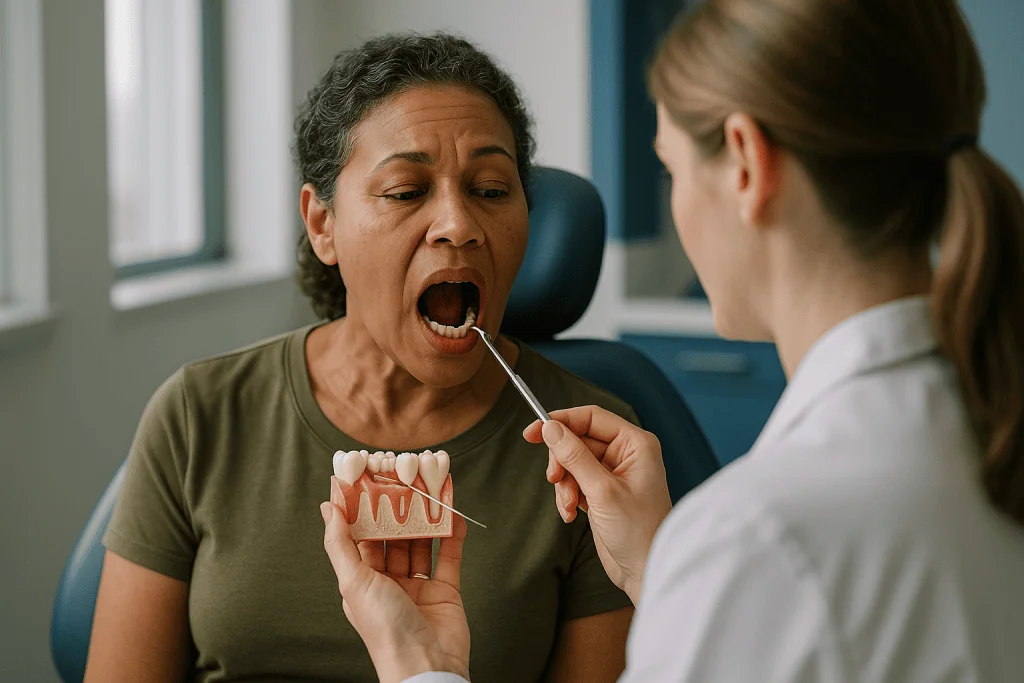
Cleveland Clinic describes four main designs. A traditional bridge uses crowns on both sides. A cantilever bridge anchors to a tooth on one side only. A Maryland bridge bonds thin metal or ceramic wings to the back of neighboring teeth rather than capping them. An implant-supported bridge rests on titanium posts placed in the jawbone instead of on natural teeth. Each design changes what the underside looks like and therefore which cleaning tool fits.
The pontic itself is shaped to be kind to the gum. Most are made either to touch the gum lightly across a small area, or to arch above it with a visible gap. A pontic that touches the gum feels more natural to the tongue but traps debris in the seam. A pontic that arches above the gum is easier to clean but can look less lifelike and may whistle or collect food from above.
Chewing pushes softened food forward and sideways into any space it can find. A gap of even a millimeter under a pontic acts like a gutter: material washes in and, without something physically sweeping it out, it stays. Saliva does not flush the space well because the pontic shields it. This is why the tongue finds trouble there so quickly after a meal, and why the smell people sometimes notice from a bridge is almost always a hygiene issue rather than a problem with the bridge itself.
How to floss under a dental bridge with a floss threader, step by step
A floss threader is a flexible plastic loop with a stiff pointed tail, a bit like an oversized sewing needle without the sharp point. It is the tool most dental teams demonstrate first, because it works with any floss you already own.
- Cut a length of floss roughly the span from your fingertips to your elbow. Thread one end through the loop of the threader and pull a few inches through so it does not slip out.
- Stand at a mirror with good light. Guide the stiff tail of the threader between the gum and the underside of the pontic, entering from the cheek side.
- Pull the threader through toward the tongue side until the floss follows it under the bridge. Set the threader down; the floss is now where the threader was.
- Holding both ends, slide the floss along the underside of the pontic in a gentle sawing motion. You are wiping a surface, not cutting into gum.
- Move the floss to one abutment tooth. Curve it into a C shape against the tooth, ease it just below the gum line, and draw it up and down a few times.
- Repeat the C shape on the other abutment tooth, then pull the floss out from one side.
Pre-threaded floss with a built-in stiff end and a spongy middle section removes the loop step entirely; the fuzzy portion is meant to sweep the wider space under a pontic. Either approach reaches the same places.
The NHS recommends cleaning between teeth with floss or interdental brushes once a day, and bleeding when you first start is common while gums are inflamed. That bleeding usually settles over a week or two of daily cleaning as the gum tissue heals. Bleeding that continues or worsens is worth reporting rather than ignoring.
What can I use to clean under a dental bridge? Tools compared
People often assume there is one right tool. In practice, most dental teams suggest trying two or three and settling on whatever you will actually use every night. The table below sets out the common options in neutral terms.

| Tool | How it reaches under the bridge | Suits best | Common frustration |
|---|---|---|---|
| Floss threader with regular floss | Stiff tail pulls floss beneath the pontic | Tight or low pontics; people who already floss well | Fiddly at the back of the mouth |
| Pre-threaded floss with spongy middle | Built-in stiff end; fuzzy section sweeps wider gaps | Single bridges with a visible gap under the pontic | Spongy section can be too thick for tight spaces |
| Interdental brush | Thin wire brush pushes straight through the gap | Wider gaps, implant bridges, limited dexterity | Wrong size either will not fit or feels loose |
| Water flosser | Pulsing jet flushes debris from the channel | Long-span or full-arch bridges; people who will not floss | Messy at first; does not scrub the tooth surface |
| Rubber tip or soft pick | Tapered point traces the gum edge | Massaging gums around abutments | Does not reach far under the pontic |
None of these has strong evidence of being superior to the others for bridges specifically; the comparative trials that exist mostly study natural teeth, and results vary with technique and adherence. What the broad guidance from the NHS and MedlinePlus consistently supports is the underlying principle: mechanical disruption of plaque between and around teeth once a day, alongside brushing twice a day.
A practical way to decide is to ask the hygienist to size an interdental brush against your bridge at your next visit, and to watch you use a threader once. Ten minutes of coaching resolves most of the awkwardness that stops people from continuing at home.
Using an interdental brush for bridge cleaning
An interdental brush is a tiny bottle brush: a wire core, often coated in plastic, with soft bristles, mounted on a short handle. Sizes are usually color-coded by diameter, from ones that pass through the narrowest gaps to ones that fill a space the width of a pencil lead. The NHS lists interdental brushes alongside floss as an acceptable way to clean between teeth, and for many people with bridges they are the more forgiving option.
The technique is straightforward. Choose the largest brush that slides under the pontic without forcing. Insert it from the cheek side at a slight angle so it follows the curve of the gum rather than jabbing into it. Push through until the bristles appear on the tongue side, then draw it back and forth two or three times. Rinse the brush and use the same motion at the gum edge of each abutment tooth, where the crown margin sits.
Size matters more than brand. A brush that is too small waves around without touching the walls of the gap and cleans little. A brush that is too large bends at the wire and can scratch the gum or the underside of the pontic. If the gap under your bridge changes over time, which happens as gum tissue settles after placement, the correct size may change too.
Interdental brushes carry one caution worth stating plainly: the wire core should never be bent sharply back and forth to reach a spot, because a fatigued wire can snap. Bend it once, gently, if you need a curve for a back tooth, and replace the brush when the bristles splay or the wire kinks. MedlinePlus gives similar replacement advice for toothbrushes, suggesting a new one every three to four months or sooner when bristles wear.
Does a water flosser for bridge cleaning actually work?
A water flosser is a small pump that sends a pulsing stream of water through a narrow nozzle. Aimed along the gum line, it flushes loose food and some plaque out of spaces that string floss struggles to enter. For people with long bridges, implant-supported bridges or arthritis in their hands, it can turn a chore that gets skipped into one that gets done.
What does the evidence say? Trials of water flossers have mostly been carried out on people with natural teeth, orthodontic braces or implants rather than conventional bridges, and results vary with how the device is used and what it is compared against. The fair summary is that water flossing reduces gum bleeding and plaque compared with brushing alone, and that direct comparisons with string floss give mixed results depending on the study. Mainstream guidance from the NHS and Mayo Clinic continues to treat floss and interdental brushes as the core recommendation, with water flossers as a reasonable addition or alternative for people who cannot or will not use them.
Technique changes the outcome. Lean over the sink, close your lips partway around the nozzle so water drains rather than sprays, and start on the lowest pressure setting until your gums are used to it. Trace the gum line slowly, pausing for a couple of seconds at each abutment tooth and directing the jet under the pontic from both the cheek side and the tongue side. Aim along the tooth, not straight at the gum.
One limit deserves emphasis. A jet of water rinses; it does not scrub. The sticky film of plaque that clings to a crown margin is best removed by something that physically rubs against it. Many hygienists therefore suggest pairing a water flosser with an interdental brush rather than relying on the water alone, and the choice can be settled at a hygiene visit.
The daily routine for a dental bridge, minute by minute
Routine beats heroics. A bridge cleaned adequately every night outlasts one cleaned perfectly on Sundays. The NHS advice for adults is a useful backbone: brush for about two minutes twice a day with a fluoride toothpaste, clean between the teeth once a day, and spit rather than rinse after brushing so the fluoride stays on the teeth. MedlinePlus gives the same twice-daily brushing and once-daily flossing pattern.
Here is how that looks with a bridge in the mix.
Morning, roughly two minutes. Brush all surfaces, angling the bristles toward the gum line where the crowns meet the gum. Spend deliberate extra seconds on the abutment teeth from the cheek side and the tongue side. Spit; do not rinse.
Evening, roughly four to five minutes. Start with the between-teeth cleaning, because plaque disrupted first is then washed away by brushing. Thread floss under the pontic or pass an interdental brush through, wipe the underside, then clean the gum edge of each abutment tooth. Run floss or a brush between your other teeth as usual. Then brush for two minutes and spit.
Once a week, a quick check. Look at the gum around the bridge in good light. Healthy gum is pale pink and firm. Gum that looks red, puffy or shiny, or that bleeds when you clean it after the first couple of weeks, is a signal to mention at your next visit, not a reason to scrub harder.
People who already floss find this adds perhaps a minute a day. People who have never flossed usually find the first two weeks clumsy and the third week automatic. Attaching the new step to something you already do without fail, such as setting a nightly alarm or leaving the threaders next to the toothpaste, makes the difference between a habit and a good intention.
Can you use an electric toothbrush on a dental bridge?
Yes. An electric toothbrush is not only safe on a bridge, it is often easier to use well around one. Porcelain, zirconia and dental metals are far harder than natural enamel, and the oscillating or vibrating head of a powered brush does not damage them under normal use. The NHS states that electric and manual brushes are both effective when used properly, and suggests that some people find an electric brush easier for reaching every surface.
The details that matter are the same as for natural teeth. Use a soft head. Let the brush do the moving and guide it slowly along the gum line rather than scrubbing back and forth. Tilt the head slightly so bristles reach the crown margin, that fine junction where the crown ends and the natural tooth root begins, because this is the place decay finds first on an abutment tooth. Many powered brushes have a two-minute timer, which lines up with the duration guidance from the NHS and MedlinePlus.
Two cautions apply. A very abrasive toothpaste, such as some whitening formulas with coarse particles, can dull the glaze on porcelain over years of use; a standard fluoride paste is the safer default, and a dental team can advise if whitening is a goal. And no toothbrush, electric or manual, reaches the channel under the pontic. The bristles simply are not shaped to enter a horizontal tunnel. The brush cleans the outside of the bridge; the threader, interdental brush or water jet cleans the inside.
People who switch to an electric brush after years of manual brushing sometimes notice their gums feel tender for a few days. That usually reflects gums that were previously under-cleaned rather than harm from the brush, and it settles. Tenderness that persists beyond a couple of weeks is worth mentioning to the hygienist.
Who this routine is for, and who is usually asked to wait
Almost everyone with a cemented bridge should be cleaning underneath it daily from the point their dental team says the cement has fully set, which is typically within the first day or two. That includes traditional bridges, cantilever bridges and Maryland bridges. Implant-supported bridges have their own considerations, covered later, but the principle is the same.
There are situations where the team may ask you to hold off or to modify the routine.
Immediately after the bridge is fitted, particularly if the gums were sore from impressions or a temporary bridge, the dentist may suggest gentle brushing only for a day or so before introducing threaders. This is about comfort and letting irritated tissue calm down, not about the bridge being fragile.
After gum surgery around the bridge, such as a procedure to reshape the gum or treat a pocket, the surgeon usually gives specific instructions about when to resume cleaning beneath the pontic. Sutures and healing tissue can be disturbed by floss, and the timing depends on what was done. Those instructions override any general advice in an article.
People with a temporary bridge, the acrylic placeholder worn while the permanent one is made, are often told to be careful with threaders because a temporary is held with weaker cement and can lift if floss is pulled up sharply. The usual guidance is to slide floss out sideways rather than pulling it up through the contact.
People with limited hand movement, tremor, or reduced vision are not asked to wait, but they are usually steered toward tools that need less fine control, such as interdental brushes on long handles or a water flosser. A carer can be shown the technique too. The decision about what to use, and when to start, sits with the treating dental team, who can see the bridge and the gums directly.
The first days and weeks with a new bridge: what usually happens
A new bridge feels enormous for about a week. The tongue explores it constantly, speech sounds slightly different to your own ears, and the bite can feel high on one side. Most of this is adaptation rather than a problem; the brain recalibrates to a new shape in the mouth remarkably quickly. A bite that stays uneven after the first several days, or a spot that hits first every time you close, is something the dentist can adjust in a short visit and should be reported.
Sensitivity to cold in the abutment teeth is common in the early weeks, because those teeth were reshaped to take crowns and the nerve inside can be irritable. This typically eases over a period of weeks as the tooth settles. Sensitivity that sharpens rather than fades, or pain that arrives without a trigger, is different and warrants a call.
Gums around a new bridge may be tender and bleed a little when you first start threading floss beneath it. Mayo Clinic describes bleeding gums as a hallmark of gingivitis, and the NIDCR notes that gingivitis is reversible with good daily cleaning. In practice, bleeding that appears when a new hygiene routine starts usually diminishes within one to two weeks of consistent cleaning, because the inflamed tissue firms up once plaque is no longer sitting against it.
The gap under the pontic can change during this period too. Gum tissue that was swollen from the fitting process shrinks as it heals, so a space that seemed too tight for an interdental brush at week one may accept one comfortably by week four. It is reasonable to recheck the fit of your chosen tool at the first review appointment.
Food trapping is the complaint people notice most in the early weeks, and it is also the one that settles least on its own. It settles because you clean, not because the bridge changes.
Implant-supported bridges: a different cleaning problem
An implant-supported bridge rests on titanium posts embedded in the jawbone rather than on natural teeth. Cleveland Clinic lists it as one of the main bridge types, and it changes the hygiene picture in two ways.
First, implants cannot decay. There is no enamel and no crown margin on a natural root to protect. That removes one worry entirely.
Second, the tissue around an implant is more vulnerable than the tissue around a natural tooth. A natural tooth is held by a ligament that acts as a barrier and a shock absorber; an implant sits in direct contact with bone and is surrounded by gum that seals less firmly. Plaque left at that seal can trigger inflammation of the surrounding soft tissue, and if it progresses, loss of the bone that holds the implant. The clinical terms are peri-implant mucositis for the soft tissue stage and peri-implantitis when bone is involved. Unlike gingivitis around a natural tooth, bone lost around an implant does not regrow on its own.
The spaces under implant bridges are often larger and more uniform than under tooth-supported bridges, because the pontics and connectors sit above the gum ridge with deliberate clearance. That makes interdental brushes and water flossers particularly practical, and it is why the search phrase about not being able to get under a full implant bridge comes up so often: people expect to floss and find the gap is really a tunnel.
Full-arch implant bridges, where a single connected row replaces every tooth in the jaw, add a further wrinkle. The underside runs the whole length of the arch, and some are made to be removed only by the dentist for periodic deep cleaning. The team that placed the bridge will usually specify a cleaning interval and demonstrate which tools reach each segment. Follow that specific plan over general advice.
What people often get wrong about flossing under a bridge
Myth: a bridge is artificial, so it cannot get cavities, and the gap underneath does not matter. The pontic cannot decay, but the abutment teeth can, and the gum beneath the pontic can become inflamed. The NIDCR is clear that untreated gum disease can lead to loss of the bone and tissue holding teeth, and a bridge is only as secure as its anchors.
Myth: if the floss will not go through, the bridge must be too tight to need cleaning. A bridge that floss cannot pass beneath still has a channel where bacteria live; it just needs a threader or a fine interdental brush rather than bare floss dropped from above.
Myth: bleeding means you are damaging the gum, so stop. Early bleeding usually means the gum is inflamed from plaque that has been sitting there. Mayo Clinic identifies bleeding as a sign of gingivitis, and daily gentle cleaning is what resolves it. Bleeding that persists past a couple of weeks, or that comes with pain or swelling, is the version to report.
Myth: mouthwash reaches where floss cannot. Rinsing does not remove plaque film that is attached to a surface. Some antibacterial rinses reduce bacterial counts and may be recommended by a dentist in specific circumstances, but mainstream guidance from the NHS treats them as an addition, never a replacement for mechanical cleaning.
Myth: a water flosser makes string floss unnecessary for everyone. For some people it is a reasonable substitute, and for people who otherwise would do nothing it is a clear improvement. The evidence comparing the two directly is mixed, and a jet does not scrub a crown margin the way a brush or floss does.
Myth: scrubbing harder cleans better. Firm pressure with a hard brush wears gum tissue and can expose the root of an abutment tooth, which is softer than enamel and more prone to decay. Soft bristles, light pressure and thoroughness beat force every time.
Questions to ask your care team about cleaning your bridge
A few minutes at the chair, with the bridge in front of both of you, resolves more than any article can. These are the questions worth bringing.
- Which type of bridge do I have, and does the pontic touch the gum or sit above it? The answer determines which tool fits the space.
- Can you size an interdental brush against my bridge now, and tell me which color or size to buy?
- Would you watch me use a floss threader once so you can correct my angle?
- Is there a spot on this bridge where you are already seeing plaque or inflammation at check-ups? Tell me exactly where so I can target it.
- Are my abutment teeth showing any early signs of decay at the crown margins, and what would you expect to see if they were?
- How often do you want to see me for hygiene visits given this bridge, rather than the standard interval?
- If I have a temporary bridge, how should I clean around it without lifting it?
- For an implant bridge: how do you monitor the bone level around the implants, and what cleaning interval do you recommend for the underside?
- Is a water flosser a sensible addition for my particular bridge, or would you rather I concentrated on floss and brushes?
- What should prompt me to call between appointments rather than wait?
Write the answers down. The specifics of your own bridge, its shape, the size of the gap beneath it and the condition of the teeth holding it, are what turn general advice into a routine that actually protects it. The NHS recommends dental check-up intervals be set by your dentist based on your individual risk, and a bridge is one of the factors that shapes that judgement.
When to call your doctor or dentist about a dental bridge
Most bridge trouble is quiet and slow, which is exactly why it is worth knowing which signs mean a phone call rather than another week of hoping. The following are red flags that a dental team would want to hear about promptly rather than at the next scheduled visit.
- The bridge feels loose, rocks when you press it, or you notice movement when chewing. A bridge that has partly debonded lets saliva and bacteria under a crown, where decay progresses unseen.
- A sharp or throbbing toothache in an abutment tooth, pain that wakes you at night, or pain that comes on without a trigger. These can indicate the nerve inside the tooth is inflamed or infected.
- Swelling of the gum or face near the bridge, a pimple-like bump on the gum, a persistent bad taste, or pus. Any of these can signal an abscess, and Mayo Clinic advises prompt dental care for them.
- Gum bleeding that continues beyond the first couple of weeks of a new cleaning routine, or bleeding that returns after it had stopped.
- A chip or crack in the porcelain, or a rough edge that catches your tongue or cheek.
- Persistent sensitivity to hot or cold in an abutment tooth that worsens rather than fades over the first weeks.
- For implant bridges, any sign of gum recession exposing metal, or a metallic screw or component that appears to have loosened.
Facial swelling that spreads toward the eye or neck, difficulty swallowing or breathing, or fever alongside dental pain are urgent and warrant same-day medical attention, because a dental infection can occasionally spread beyond the mouth. MedlinePlus lists swelling and fever with tooth pain among the reasons to seek care without delay.
None of these signs diagnoses a problem on their own. They are prompts for an examination, and the treating dentist or physician decides what, if anything, needs to be done. Waiting for a scheduled appointment is reasonable for a mild concern that is stable; it is not reasonable for anything on the list above that is new, worsening or painful.
Frequently asked questions
Are you supposed to floss under a dental bridge?
Yes, daily. The false tooth of a bridge is joined to the crowns on either side, so food and plaque collect in the channel beneath it where a toothbrush cannot reach. Cleaning that space protects the natural teeth anchoring the bridge from decay and gum disease. Because ordinary floss cannot drop between fused teeth, a floss threader, pre-threaded floss with a stiff end, or an interdental brush is used to enter from the side.
What can I use to floss under my bridge?
The common options are a floss threader with regular floss, pre-threaded floss that has a stiff end and a spongy middle, small interdental brushes, and a water flosser. Each reaches the space under the false tooth by a different route. Dental teams usually suggest trying two and keeping whichever you will use every night. A hygienist can size an interdental brush against your bridge in a few seconds.
What is the best way to clean under a dental bridge?
There is no single best tool proven superior for bridges; the strongest evidence supports the principle of physically disrupting plaque under and around the bridge once a day. For tight gaps a floss threader works well; for wider gaps or implant bridges an interdental brush is often easier; a water flosser helps flush long spans. Pairing a brush with the water jet covers both scrubbing and rinsing.
Can you use an electric toothbrush on a bridge?
Yes. Porcelain, zirconia and dental metals are harder than natural enamel and are not damaged by a soft-headed electric toothbrush used with light pressure. The NHS considers electric and manual brushes equally effective when used properly. Angle the bristles toward the gum line where the crowns meet the tooth. Remember that no brush reaches the channel under the false tooth, so a threader or interdental brush is still needed.
How do I use a floss threader for a bridge at the back of my mouth?
Use a mirror, good light and a longer piece of floss than feels necessary. Enter from the cheek side, since there is usually more room there, and guide the stiff tail under the pontic with your index finger rather than holding it at the far end. Once the floss is through, drop the threader and work with the floss alone. Many people find pre-threaded floss with a built-in stiff end simpler for molars.
What size interdental brush for a bridge should I choose?
Choose the largest brush that slides under the false tooth without forcing. Too small and the bristles do not touch the walls of the gap; too large and the wire bends and can scratch the gum. Because gum tissue settles after a bridge is fitted, the right size can change over the first weeks. Ask the hygienist to size it at a visit rather than guessing from packaging.
Is a water flosser for bridge cleaning as good as floss?
The evidence is mixed. Trials show water flossers reduce plaque and gum bleeding compared with brushing alone, but direct comparisons with string floss give varied results, and most studies were not done on conventional bridges. A jet rinses but does not scrub the crown margin. Mainstream guidance keeps floss or interdental brushes as the core recommendation, with a water flosser as a useful addition or an alternative for people who cannot use them.
Why does my bridge smell or taste bad?
The most common reason is food and plaque trapped in the channel under the false tooth, where bacteria break it down. Daily cleaning beneath the pontic usually resolves it. A persistent bad taste despite good cleaning, or one accompanied by swelling, a bump on the gum or pain, can indicate decay under a crown or an infection and should be assessed by a dentist rather than masked with mouthwash.
My gums bleed when I floss under my bridge. Should I stop?
Not usually. Bleeding when a new between-teeth routine starts typically reflects gum already inflamed by plaque, and gentle daily cleaning is what calms it. Mayo Clinic lists bleeding as a sign of gingivitis, which the NIDCR notes is reversible with good hygiene. Bleeding generally eases within one to two weeks. If it continues beyond that, worsens, or comes with pain or swelling, contact your dental team.
How long does a dental bridge last if I clean under it properly?
Cleveland Clinic describes a typical range of five to fifteen years, and notes that daily cleaning around and under the bridge is one of the main factors within the patient’s control. Lifespan also depends on the health of the anchoring teeth, bite forces, grinding habits and the materials used. No cleaning routine guarantees a particular lifespan, but decay at the crown margins and gum disease around the abutments are the most common preventable reasons bridges fail early.
References
- Cleveland Clinic: Dental Bridges
- NHS: How to keep your teeth clean
- MedlinePlus: Dental care – adult
- NIH National Institute of Dental and Craniofacial Research: Periodontal (Gum) Disease
This article is for general information only and is not a substitute for professional medical advice. Please consult a qualified doctor about your individual situation.

More from the Blog

How Long Do Inlays and Onlays Last? Wear, Bonding Strength and When Replacement Is Discussed
Inlays and onlays usually last many years, and patient-facing sources place comparable restorations in roughly the five-to-fifteen-year range that Cleveland Clinic gives for crowns,…
3-on-6 Dental Implants: How This Full-Arch Alternative Differs From All-on-4
3-on-6 dental implants replace a full arch of teeth using six upright implants that support three separate ceramic bridges, while All-on-4 uses four implants,…

Who Needs Maxillofacial Prosthetics? Obturators and Facial Prostheses After Surgery Explained
Maxillofacial prosthetics treat openings and missing structures in the mouth, jaws and face left by cancer surgery, injury, infection or birth differences. An obturator…
Dental Bone Graft Warning Signs: Exposed Membrane, Persistent Swelling and When to Call
Dental bone graft failure signs include swelling or pain that worsens after the third day instead of easing, a membrane or grayish graft material…
What Happens in Dental Implant Surgery: Flap or Flapless, Drilling and Seating the Post
In dental implant surgery, the area is numbed, the jawbone is reached by lifting a small gum flap or through a small opening (flapless),…

What to Ask Before All On 4: Bridge Material, Bite Design and the Long-Term Maintenance Plan
Before a full-arch fixed bridge on four implants, ask what the bridge will be made of (acrylic on a metal frame, zirconia or metal-ceramic),…