

Implant-Supported Dentures: Fixed vs Removable: the Honest Comparison
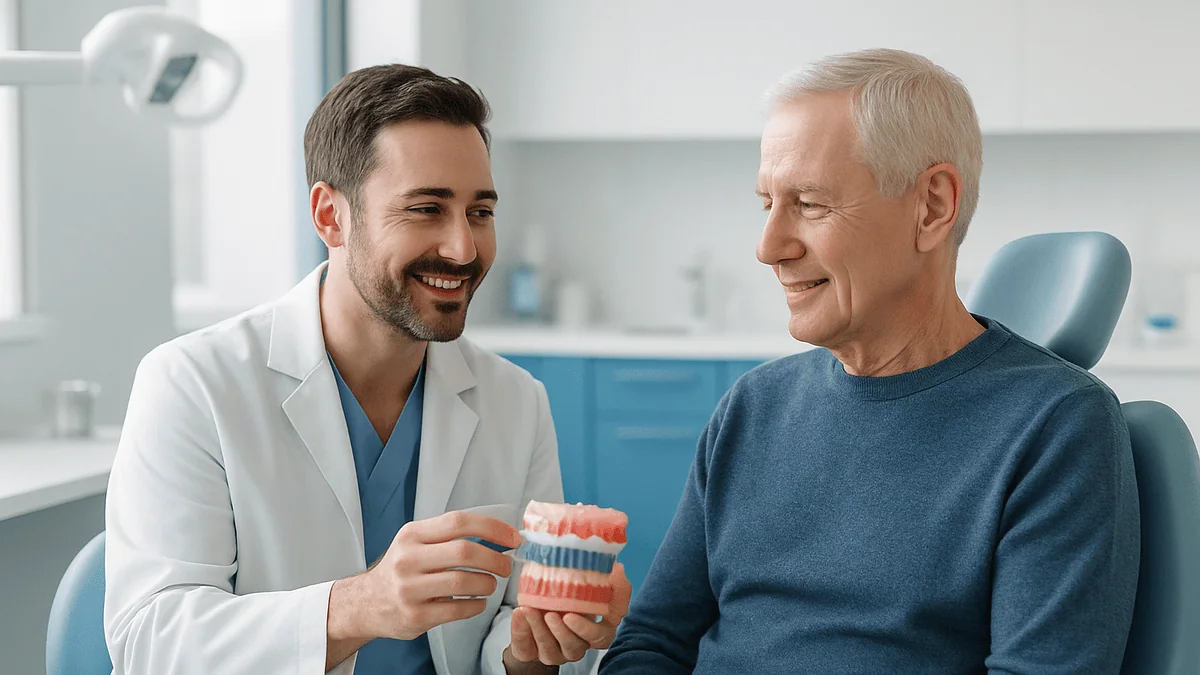
Key Takeaways
- Conventional full dentures deliver only around 20–25 percent of natural chewing efficiency, while implant anchorage restores a large share of normal bite force.
- A removable lower overdenture on just two implants is recognized in peer-reviewed consensus statements as the first-choice standard of care for the toothless lower jaw.
- Dental implants show roughly 90–95 percent survival at ten years, but the denture or bridge attached to them is a consumable that typically needs relining, refurbishment, or replacement within five to ten years.
- Snap-in overdentures come out daily for cleaning, whereas fixed full-arch prostheses can only be removed by a dentist at maintenance visits: a difference that reshapes both hygiene and lifestyle.
- Peri-implantitis, a gum-disease-like infection around implants, is frequently painless until advanced, which makes six-month recall exams non-negotiable even when everything feels fine.
- Smoking is associated with roughly doubled implant failure rates, making it one of the few risk factors entirely within a patient's control before surgery.
Implant-supported dentures replace a full arch of teeth using implants anchored in the jawbone. Removable (snap-in) overdentures usually rest on two to four implants, cost less, and come out nightly for cleaning; fixed versions use four to six implants, stay in place around the clock, and chew more like natural teeth, but cost more and demand meticulous hygiene. Both preserve jawbone better than conventional dentures.
At a family barbecue last summer, a retired teacher I interviewed for this story quietly passed on the corn on the cob, again. Her conventional denture, relined twice in five years, still shifted when she bit into anything firmer than a dinner roll. Her dentist had mentioned implants, but the brochures all seemed to promise the same glossy smile without answering her real question: snap-in or screwed-in, and what does each one actually cost her in money, maintenance, and surprises?
That question deserves a straight answer, because the two paths diverge more than most marketing admits. One gives you teeth you take out at night and clean at the sink. The other gives you teeth that never leave your mouth, and never stop needing professional attention.
Here is the comparison the brochures skip, built from what mainstream dental evidence actually shows.
What are implant-supported dentures, exactly?
Strip away the jargon and the idea is simple: instead of a full denture resting on your gums and held by suction or adhesive, small titanium posts are surgically placed into the jawbone, and the denture attaches to those posts. The bone fuses to the titanium over a few months, a process called osseointegration, so the posts behave like artificial tooth roots, as the Mayo Clinic describes in its overview of dental implant surgery.
Why does that matter so much? Two reasons. Stability is the obvious one: a denture locked onto implants cannot float, rock, or launch itself during a laugh. The quieter reason is bone. When teeth are lost, the jawbone that once held them begins to shrink because it no longer receives chewing pressure, studies commonly report that a substantial share of ridge width disappears within the first year after extraction. Conventional dentures do nothing to stop this; they may even accelerate it by pressing on the gum. Implants transmit bite force into the bone the way roots once did, which helps preserve it.
Every implant-supported denture belongs to one of two families. Removable overdentures snap onto attachments and come out daily. Fixed full-arch prostheses are screwed or cemented onto the implants and stay put until a dentist removes them. Same foundation, very different daily life, and that difference is the heart of this article.
Fixed vs removable: what's the actual difference?
Picture two houses on the same concrete footing. One is a mobile home you can unhitch; the other is bolted to the slab. Both are far sturdier than a tent pitched on the lawn, which is roughly where a conventional denture sits in this analogy.
A removable overdenture clicks onto two to four implants through snap attachments (small ball- or locator-style connectors). You feel a firm click when it seats, and you pull it off each night for cleaning. It still has an acrylic base covering part of your gum and, on the upper jaw, sometimes part of the palate.
A fixed prosthesis is a slimmer bridge of teeth screwed onto four to six implants. No adhesive, no nightly removal, no palate coverage. It is the closest current dentistry comes to a third set of teeth.
| Feature | Removable (snap-in) | Fixed (screw-retained) |
|---|---|---|
| Typical implants per arch | 2–4 | 4–6 |
| Comes out for cleaning | Yes, daily | Only by a dentist |
| Chewing ability | Much better than conventional | Closest to natural teeth |
| Palate coverage (upper) | Often partial | None |
| Relative cost per arch | Lower | Higher, often 1.5–2× |
| Routine maintenance | Attachment inserts replaced periodically | Professional removal and cleaning visits |
| Home hygiene difficulty | Easy, clean it at the sink | Harder, brush and floss under a fixed bridge |
Neither column wins outright. Which trade-offs bother you least is the real question, and the rest of this guide works through them one by one.
How many implants do you actually need?
Fewer than you might fear. A full arch of teeth does not require an implant per tooth; it requires enough well-placed posts to spread chewing force across the bone.
For a removable lower overdenture, two implants is a widely accepted minimum: a landmark consensus among prosthodontic researchers in 2002 (often called the McGill consensus, published in peer-reviewed literature indexed on PubMed) concluded that a two-implant overdenture should be considered the first-choice standard of care for the edentulous lower jaw, because it dramatically outperforms a conventional denture on stability and patient satisfaction.
The upper jaw is a different animal. Its bone is softer and more porous, so removable upper overdentures typically need four implants, and fixed upper arches often use five or six. Fixed lower arches commonly rest on four or five. You may hear trademarked marketing names for four-implant fixed arches; the concept is the same regardless of branding, angled rear implants that avoid the sinus and nerve while maximizing support.
Bone volume decides much of this. Years of wearing conventional dentures shrink the ridge, and a 3D cone-beam scan tells the surgeon whether there is enough bone or whether grafting must come first. That single scan can swing your timeline by six months and your budget by thousands, which is why no honest estimate exists before imaging. Treat any quote given without a scan as a guess.
What is the average cost of implant-supported dentures?
Here is the number everyone wants and no one publishes plainly: in the United States, a removable implant overdenture commonly runs in the range of $15,000 to $30,000 per arch, while a fixed full-arch prosthesis typically lands between $25,000 and $50,000 per arch, sometimes more where bone grafting, sinus lifts, or extractions are needed first. Fees vary enormously by region, by the materials chosen (acrylic versus zirconia teeth can differ by five figures), and by how much preparatory surgery your jaw requires, so treat these figures as orientation, not promise.
What the sticker price hides matters just as much:
- Extractions and bone grafting are usually billed separately and can add several thousand dollars.
- Removable overdentures need their nylon attachment inserts swapped roughly every six to eighteen months: a small recurring cost, like brake pads.
- The denture itself typically needs relining or remaking after years of wear; fixed arches need periodic professional removal for deep cleaning and occasional repair of chipped teeth.
- Dental insurance rarely covers the full cost; many plans cap annual benefits at a level below the price of a single implant, so most patients pay largely out of pocket or through financing.
A fair comparison also counts what conventional dentures cost over time: adhesives, relines every few years, replacements roughly every five to eight years, and, harder to price, the bone loss they fail to prevent. Cheap up front is not always cheap over twenty years.
Are implant-supported dentures worth it?
For most people who can have them, the evidence says yes, with the honest caveat that “worth it” is a value judgment about your money, health, and priorities, not a lab result.
Start with function. Researchers estimate that conventional full dentures deliver only a fraction of natural chewing efficiency, figures around 20 to 25 percent appear repeatedly in the prosthodontic literature, because the denture rides on movable gum tissue. Anchoring even two implants transforms that picture: bite force rises substantially, patients eat a wider range of foods, and satisfaction scores in comparative studies consistently favor implant overdentures over conventional dentures.
Longevity strengthens the case. Dental implants show survival rates around 90 to 95 percent at ten years in published follow-up studies, durability few other body-part replacements match. The National Institute of Dental and Craniofacial Research notes that implants can last for decades with good care.
Then there is the part you cannot see in a mirror: bone preservation. Because implants load the jaw the way roots once did, they slow the ridge shrinkage that gradually collapses a denture-wearer’s lower face and forces repeated relines.
Who might reasonably say no? Someone whose conventional denture fits well and eats comfortably; someone with uncontrolled diabetes, heavy smoking, or health conditions that raise surgical risk; someone for whom the cost would create genuine hardship. A well-made conventional denture remains a legitimate, respectable choice. The point is to choose with the full picture, not out of assumption that surgery is automatically off the table after a certain age: it is not.
Can implant-supported dentures be removed?
It depends entirely on which type you have, and this single fact confuses more patients than any other.
A snap-in overdenture is designed to be removed, by you, every day. It clicks off with a firm upward or downward pull, gets brushed at the sink, and soaks like a conventional denture. Dentists generally advise taking it out overnight so the gum tissue underneath can rest and to reduce the risk of fungal irritation under the acrylic. The implants themselves, of course, stay in your jaw permanently; only the denture detaches.
A fixed prosthesis cannot be removed at home, full stop. It is held by small screws that only a dentist can access, typically at maintenance visits every six to twelve months when the whole bridge is unscrewed, cleaned professionally, inspected, and reattached. Between those visits, it functions like a natural arch of teeth, which is precisely its appeal.
One vocabulary note that trips people up online: some clinicians distinguish “implant-retained” dentures (implants hold the denture in place, but the gums still bear most chewing force, typical of two-implant snap-ins) from “implant-supported” dentures (implants carry the bite load, typical of four-plus implants and all fixed arches). In everyday usage the terms blur together, and this article uses “implant-supported” broadly. When comparing quotes, ask specifically how many implants are planned and whether the final prosthesis snaps on or screws in. Those two answers tell you more than the label does.
What are the disadvantages of implant-supported dentures?
Every honest comparison needs this section, so here it is without softening.
Surgery is surgery. Implant placement involves incisions, drilling into bone, and weeks of healing. The Mayo Clinic lists infection, injury to nearby structures, nerve disturbance (which can cause numbness or tingling in the lip or chin), and sinus complications among the possible risks. Serious complications are uncommon, but “uncommon” is not “never.”
Implants can fail. A small percentage never integrate with bone, and integrated implants can later develop peri-implantitis: a gum-disease-like inflammation around the post that can destroy supporting bone. Reviews suggest peri-implantitis affects a meaningful minority of implant patients over time, and smoking and poor hygiene raise the odds considerably.
The timeline is long. From first scan to final teeth often takes four to nine months, longer if grafting is needed. Some fixed protocols attach provisional teeth the same day as surgery, but the definitive prosthesis still waits for healing.
Costs recur. Snap attachments wear out; acrylic teeth chip; overdentures need relines as the ridge slowly changes; fixed arches need professional maintenance visits. Budget for upkeep, not just the procedure.
Fixed arches are hard to clean. Food and plaque collect where the bridge meets the gum, and reaching under it demands water flossers, interdental brushes, and real diligence. People who struggled to floss natural teeth should weigh this honestly.
Speech and adaptation quirks. Some wearers lisp for a few weeks; upper overdenture wearers occasionally miss the palate coverage that helped them sense food temperature, while others celebrate its absence. Small things, but daily ones.
How does the process work, step by step?
Expect a marathon with well-marked mile posts rather than a sprint.
Evaluation and imaging. A clinical exam plus a 3D cone-beam scan maps your bone height, width, and the location of nerves and sinuses. Medical history matters here: conditions affecting healing, medications that influence bone, and smoking status all shape the plan.
Extractions and grafting, if needed. Failing teeth come out; deficient bone may be built up with graft material. Grafts typically heal for three to six months before implants can be placed: the step most likely to stretch your timeline.
Implant placement. Under local anesthesia (with sedation options), the posts are placed in a procedure that usually takes one to three hours for a full arch. Many people are surprised that the surgery itself is less uncomfortable than a difficult extraction.
Osseointegration. Bone fuses to titanium over roughly three to six months, per the Mayo Clinic’s guidance. During this stretch you wear a temporary denture, or, in same-day fixed protocols, a provisional bridge attached immediately, with a soft-food diet while the bone knits.
Attachment and delivery. Once integration is confirmed, connectors are fitted and the final prosthesis is made: a snap-in overdenture you learn to seat and remove, or a fixed bridge torqued into place with screws.
Follow-up. Adjustment visits fine-tune the bite, and a recall schedule begins. The delivery appointment is not the finish line; it is the start of maintenance.
What do recovery and healing really feel like?
Less dramatic than most people brace for, according to both clinical sources and the patients I have interviewed over the years, but not nothing.
The first 72 hours bring swelling, minor bruising, and soreness managed with cold compresses and whatever pain-relief plan your surgeon recommends. Most people return to desk work within two to four days. Bleeding should taper to light oozing within a day; steady bleeding beyond that warrants a call to the office.
Weeks one through six are about protecting the sites. That means a soft diet, think eggs, yogurt, soup, well-cooked pasta, gentle rinsing as directed, and absolutely no smoking, which impairs blood flow to healing bone and is one of the best-documented risk factors for implant failure. If provisional teeth were attached on surgery day, they are for smiling and soft chewing, not for steak; overloading implants before the bone has fused is a classic cause of early loss.
Months two through six feel oddly uneventful. Osseointegration is silent; you will not sense the bone bonding. The main tasks are keeping follow-up appointments so the team can confirm integration and adjusting any temporary denture that rubs.
Nerve symptoms deserve a special mention. Tingling, numbness, or altered sensation in the lip, chin, or tongue after lower-jaw surgery should be reported promptly rather than waited out, early evaluation matters. It is rare, but it is the complication worth knowing by name before you consent, not after.
Cleaning and daily care: where fixed and removable trade places
Here is my opinion, stated plainly because the evidence supports it: hygiene access is the most underrated factor in this entire decision, and it is where the removable option quietly shines.
Caring for a snap-in overdenture is refreshingly simple. Out it comes at night; you brush it with a soft brush (non-abrasive cleanser, not regular toothpaste, which scratches acrylic), soak it as directed, and, the step people skip, brush the implant attachments and your gums thoroughly. Cleveland Clinic’s guidance on dentures emphasizes this two-part routine: clean the appliance and clean the mouth. Total honest time commitment: five minutes a day.
A fixed arch demands more craft. Plaque collects in the tunnel where the bridge meets the gum, and if it stays there, peri-implant inflammation follows. The daily kit typically includes:
- A soft or electric toothbrush for the visible surfaces, twice daily
- A water flosser aimed along the gumline to flush under the bridge
- Interdental brushes or floss threaders for the gaps around implant posts
- Professional maintenance visits, during which the dentist may unscrew the entire arch for deep cleaning
None of this is difficult, but all of it is non-negotiable. Implants cannot get cavities, and that fact lulls people into complacency, yet the gum and bone around them remain fully capable of infection. The most common reason a beautiful fixed arch turns into an expensive problem is not the surgery or the materials. It is the water flosser gathering dust in a bathroom drawer.
Who is a good candidate, and who should think twice?
Age is not the gatekeeper people assume. Healthy patients in their eighties receive implants routinely and heal well; what matters is bone, health, and habits.
Favorable signs, drawing on Mayo Clinic and NIDCR criteria: adequate jawbone (or the willingness to graft), healthy gum tissue, generally good health, well-managed chronic conditions, non-smoking status, and a realistic commitment to daily hygiene and recall visits.
Reasons for cautionnot automatic disqualifiers, but flags that require conversation between your dentist and physician:
- Uncontrolled diabetes, which impairs healing and raises infection risk; well-controlled diabetes is far less of a barrier
- Heavy smoking, associated in multiple studies with roughly doubled implant failure rates
- A history of radiation therapy to the jaws
- Certain bone-modifying medications, which merit careful review before jaw surgery, bring your full medication list to the consultation
- Severe clenching or grinding, which can overload implants and fracture prosthetic teeth without a protective night strategy
- Conditions or circumstances that make meticulous daily hygiene unrealistic
Notice what is absent from that list: being “too old,” having worn dentures for decades, or having lost bone. Long-term denture wearers often have shrunken ridges, yet grafting and angled-implant techniques rescue many such cases. The only way to know your category is imaging and an honest medical history, ideally reviewed by both your dental team and your physician when chronic conditions are involved.
How long do implant-supported dentures last?
Separate the two components and the answer gets clearer, because they age on completely different schedules.
The implants themselves are the durable part. Long-term studies consistently report survival rates around 90 to 95 percent at ten years, and NIDCR notes that well-maintained implants can serve for decades. Failures cluster early (integration problems in the first year) or late (peri-implantitis after years of inadequate hygiene). Between those bookends, a healthy implant is remarkably boring, which is exactly what you want from hardware in your skull.
The prosthesis on top is the consumable. Snap-in overdentures typically need new attachment inserts every six to eighteen months, periodic relines as the ridge slowly remodels, and full replacement somewhere in the range of five to ten years, depending on materials and wear. Fixed arches vary by material: acrylic teeth on a titanium frame chip and wear faster and may need refurbishment within a decade, while monolithic zirconia arches resist wear better but cost substantially more and can be less forgiving if something does fracture.
Three habits stretch every one of those numbers: showing up for maintenance visits, keeping the gumline clean daily, and addressing grinding with a night appliance if your dentist recommends one. Think of it the way you would a good car: the engine can run for decades, but only for owners who change the oil. Skipping recalls to save a small fee is the most expensive economy in implant dentistry.
When should you see a dentist or doctor?
Whether you already wear an implant-supported denture or are still deciding, certain symptoms should move you from “watchful waiting” to “make the call.”
Contact your dental team promptly if you notice:
- Bleeding, swelling, or tenderness of the gum around an implant, early peri-implant inflammation is far easier to treat than established bone loss
- Any looseness, whether of the denture, an attachment, or (most urgently) the implant itself; a mobile implant is never normal
- Persistent bad taste or odor near an implant, which can signal trapped infection
- Pain when chewing that appears weeks or months after everything had felt fine
- A cracked tooth, broken clasp, or attachment that no longer clicks, small mechanical failures compound quickly under chewing forces
- Sores or raw spots under a removable overdenture that do not heal within about two weeks; any mouth sore lasting longer than that deserves professional evaluation regardless of cause, per standard oral-health guidance from MedlinePlus
Seek care urgently, same day, for: fever with facial swelling after surgery, bleeding that will not stop with pressure, difficulty swallowing or breathing, or new numbness or tingling in the lip, chin, or tongue.
Even with no symptoms at all, keep the recall schedule your dentist sets, typically every six months, sometimes more often in the first year. Peri-implantitis is frequently painless until it is advanced, which means the exam you feel you do not need is often the one that saves the implant.
The honest bottom line: which one should you choose?
After weighing the evidence, here is where I land, offered as a framework, not a prescription.
Choose removable if budget is a genuine constraint, if your bone supports two to four implants without extensive grafting, or if easy cleaning ranks high on your list. The two-implant lower overdenture remains one of the best value propositions in all of dentistry: a fraction of the fixed-arch price, a transformative upgrade over a conventional denture, and hygiene a child could manage. People with arthritis or dexterity limits often do better here, too, because sink-side cleaning beats maneuvering a water flosser under a fixed bridge.
Choose fixed if the psychological weight of removable teeth is what you are trying to escape, if you want the strongest bite and the slimmest, most natural feel, and if you can honestly commit to the cleaning regimen and maintenance visits for decades. For many patients, never again taking their teeth out is worth every extra dollar. That is a legitimate calculus, just make it with open eyes about the hygiene demands.
Choose neither, for now, if your current denture serves you well, your health raises surgical concerns your physician has not yet reviewed, or a quoted plan came without 3D imaging. Implants reward preparation and punish haste.
Get two independent opinions, ask each clinician how many implants, which attachment system, what the maintenance schedule costs, and what happens if an implant fails. The provider who answers those questions patiently, without steering you toward the most expensive column, is usually the one to trust with your jaw.
Frequently asked questions
What is the average cost of implant-supported dentures?
In the United States, removable snap-in overdentures commonly range from about $15,000 to $30,000 per arch, while fixed full-arch prostheses typically run $25,000 to $50,000 or more. Prices swing widely with geography, materials, and whether extractions or bone grafting are needed first. Attachment inserts, relines, and maintenance visits add recurring costs, and dental insurance rarely covers more than a small portion, so ask for an itemized, scan-based estimate before comparing providers.
Are implant-supported dentures worth it?
For most eligible patients, the evidence supports yes: chewing ability improves dramatically over conventional dentures, satisfaction scores in comparative studies are consistently higher, and implants help preserve jawbone that otherwise shrinks. Ten-year implant survival rates around 90–95 percent make it a durable investment. It may not be worth it if your current denture works well, your health raises surgical risks, or the cost would create real hardship: a well-made conventional denture remains a valid choice.
Can implant-supported dentures be removed?
Snap-in overdentures are removed by you every day for cleaning and usually overnight so gum tissue can rest. Fixed implant prostheses cannot be removed at home; they are held by screws that only a dentist accesses, typically at maintenance visits every six to twelve months for professional cleaning. In both cases the implants themselves remain permanently in the jawbone, only the teeth attached to them differ in removability.
What are the disadvantages of implant-supported dentures?
The main drawbacks are surgical risk (infection, nerve disturbance, sinus issues in the upper jaw), a treatment timeline of four to nine months or longer, high upfront cost, and ongoing maintenance expenses. Implants can fail to integrate or later develop peri-implantitis, especially in smokers or with poor hygiene. Fixed arches are also genuinely harder to clean at home than removable versions, requiring water flossers and interdental brushes used consistently for life.
How many implants do you need for implant-supported dentures?
Typically two to four implants for a removable overdenture and four to six for a fixed arch. The lower jaw’s denser bone allows a two-implant snap-in denture, a widely endorsed standard of care, while the softer upper jaw usually needs four implants for a removable version and five or six for a fixed one. Your bone volume, confirmed by a 3D scan, ultimately determines the count.
Does insurance cover implant-supported dentures?
Usually only partially, and often not at all. Many dental plans cap annual benefits below the cost of a single implant, and some classify implants as elective. Certain plans contribute the amount they would have paid toward a conventional denture. Medical insurance occasionally helps when tooth loss stems from injury or specific medical conditions. Request a pre-treatment estimate from your insurer and an itemized plan from your dentist before committing.
How long do implant-supported dentures last?
The implants can last decades, studies report roughly 90–95 percent survival at ten years, but the prosthesis wears out sooner. Snap-in overdentures need attachment inserts replaced every six to eighteen months and full replacement in about five to ten years. Fixed acrylic arches often need refurbishment within a decade, while zirconia versions resist wear longer. Daily hygiene, recall visits, and managing tooth grinding are the biggest factors in longevity.
Is the surgery for implant-supported dentures painful?
Most patients report less discomfort than they feared, often comparing it to a tooth extraction. The procedure is done under local anesthesia, frequently with sedation options, so you feel pressure but not pain. Afterward, expect swelling, bruising, and soreness for several days, managed with cold compresses and your surgeon’s pain-control plan. Most people return to normal light activity within two to four days; severe or worsening pain after that warrants a call to your surgeon.
Can you sleep with a snap-in implant denture?
Dentists generally recommend removing a snap-in overdenture at night. Taking it out lets the gum tissue underneath rest and recover, reduces the risk of fungal irritation beneath the acrylic base, and gives you the chance to clean both the denture and the implant attachments thoroughly. Fixed implant prostheses, by contrast, stay in around the clock by design. Follow your own dentist’s specific instructions, as protocols can vary during the healing phase.
What is the difference between implant-retained and implant-supported dentures?
Implant-retained dentures are held in place by implants but still transfer most chewing force to the gums, typical of two-implant snap-in designs. Implant-supported dentures carry the bite load on the implants themselves, which usually requires four or more posts and includes all fixed arches. In everyday conversation the terms overlap heavily, so when comparing treatment plans, ask how many implants are proposed and whether the final teeth snap on or screw in.
References
This article is for general information only and is not a substitute for professional medical advice. Please consult a qualified doctor about your individual situation.

More from the Blog

Is All On 4 Possible With Bone Loss? How Angled Implants Use the Bone You Still Have
Often, yes. All-on-4 with bone loss is frequently possible because the technique places four implants where bone usually remains, at the front of the…
Which Zirconium Crown Suits Front or Back Teeth? Layered vs Monolithic Zirconia Compared
For most back teeth, a monolithic zirconia crown, milled from a single block with no porcelain layer, is usually preferred because there is no…
How Removable Dentures Are Made: Impressions, Bite Records, Try-In and the Final Fitting
Removable dentures are made over several appointments, usually spread across a few weeks. The dentist takes preliminary and then detailed impressions of the gums,…
Porcelain Crowns for People Who Grind Their Teeth: Night Guards, Materials and Bite Checks
People who grind their teeth can have porcelain crowns, but material choice, design and follow-up matter more than usual. Dentists often favor tougher ceramics…
Which Dental Prosthetic Fits Your Situation? From a Single Missing Tooth to a Full Arch
The dental prosthetic you need depends mainly on how many teeth are missing, where they sit, the health of the neighboring teeth and jawbone,…
All On 6 Surgery Explained: Implant Positions, Same-Day Temporary Bridge and the Final Teeth
The all on 6 procedure replaces a full upper or lower row of teeth with a single fixed bridge anchored to six dental implants…