

Inside a Hyperbaric Oxygen Therapy Session: Pressurization, Ear Equalizing and Chamber Time

Key Takeaways
- Medical hyperbaric oxygen therapy raises chamber pressure to roughly two to three times normal while you breathe near-pure oxygen, and a full session takes about two hours.
- Oxygen enters only through your lungs; the raised pressure forces more of it to dissolve in blood plasma so it can reach tissue that red cells cannot.
- Middle ear barotrauma is the most common complication and is largely preventable by equalizing early and often during pressurization with swallowing, yawning or a gentle Valsalva.
- Scheduled breaks breathing ordinary air during the session exist to lower the small risk of oxygen toxicity seizure.
- Carbon monoxide poisoning may need only about three sessions, while non-healing wounds may require 40 or more, with progress reviewed by measurement rather than a fixed count.
- Blood oxygen returns to normal soon after each session; the benefit comes from cumulative tissue changes, which is why one visit changes little and courses run for weeks.
During hyperbaric oxygen therapy you lie or sit in a sealed chamber while the air pressure is raised to roughly two to three times normal and you breathe pure oxygen. A session usually lasts about two hours, including slow pressurization, time at pressure and a gradual return to normal. Your ears feel full during pressure changes, and you clear them by swallowing or yawning.
The first thing most people notice is the sound. Not a roar, more a steady hiss, like a tire slowly taking air, as the technician begins to pressurize the chamber. A woman who had been dreading her first visit for a slow-healing foot wound told her nurse afterward that the hiss was the only part that matched her imagination. The rest felt closer to a long, oddly quiet flight.
Hyperbaric oxygen therapy has an intimidating name and a surprisingly ordinary routine. If you have been told it might help a wound, a radiation injury or a bone infection, you probably want the practical version: what happens during hyperbaric oxygen therapy, minute by minute, and what your body will do in response.
This explainer walks through pressurization, ear equalizing, the long middle stretch of chamber time and the trip back to normal pressure, with the evidence kept honest about what the treatment can and cannot do.
What happens during hyperbaric oxygen therapy, in plain language
Hyperbaric oxygen therapy, often shortened to HBOT, means breathing pure oxygen inside a chamber where the air pressure is higher than normal. Two things change at once. The gas you breathe is close to 100 percent oxygen instead of the 21 percent in room air, and the surrounding pressure is raised to about two to three times what you feel at sea level, according to Mayo Clinic.
Why does pressure matter? Under ordinary conditions nearly all the oxygen in your blood rides on hemoglobin, the protein inside red blood cells. Hemoglobin is almost fully loaded already, so breathing extra oxygen at normal pressure adds little. Raise the pressure and a physical law takes over: more gas dissolves directly into the liquid part of blood, the plasma. Plasma can then carry oxygen into tissue where blood flow is poor and red cells struggle to reach, such as the edges of a diabetic foot ulcer or bone damaged by radiation.
That flood of dissolved oxygen is the whole point. Over repeated sessions it is thought to encourage new small blood vessels to grow, help infection-fighting white cells work, and support cells that build new tissue. In carbon monoxide poisoning the mechanism is more immediate: high-pressure oxygen helps clear the poison from hemoglobin faster than room air can.
One thing HBOT does not do is push oxygen through your skin. The oxygen you receive travels through your lungs. Some chambers are filled with oxygen; in others you breathe it through a hood or mask while the chamber itself holds ordinary air. Either way, the lungs do the work, and the pressure does the rest.
How is hyperbaric oxygen therapy given? Monoplace and multiplace chambers
There are two main designs, and knowing which one you will use removes a lot of first-day anxiety.
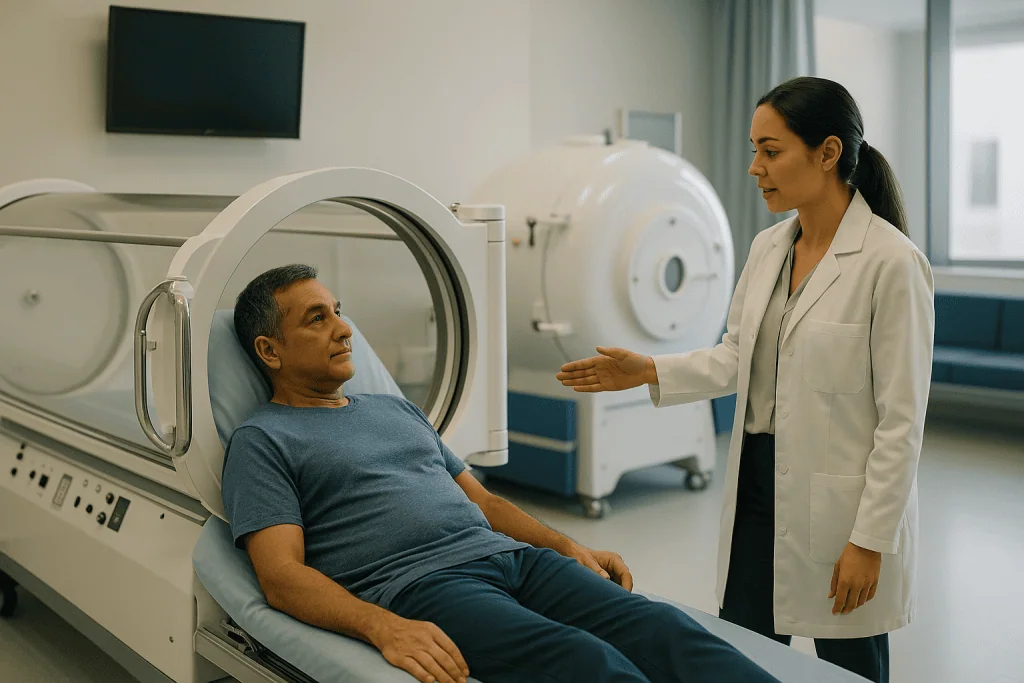
A monoplace chamber treats one person. It is a clear acrylic tube, roughly the size of a tanning bed, that you slide into on a padded stretcher. The whole chamber fills with oxygen, so you breathe normally without a mask. Staff sit outside, watch you through the acrylic and talk to you through an intercom. Johns Hopkins Medicine notes that you can usually see a television or window and are never out of sight.
A multiplace chamber is a room. It may hold several patients at once, seated in reclining chairs, with a nurse or technician inside for the entire session. Here the room is pressurized with ordinary air and you receive oxygen through a soft clear hood that seals at the neck, or through a tight-fitting mask. Multiplace chambers are also where critically ill patients are treated, because equipment and staff can accompany them.
Neither type is better in a general sense. The choice depends on your condition, your mobility, whether you need monitoring, and what the center has. People who dislike enclosed spaces sometimes prefer the open feel of a multiplace room; others prefer the privacy and mask-free breathing of a monoplace tube.
In both designs the sequence is the same: a slow rise in pressure, a long stretch breathing oxygen at the target pressure, then a slow return. Cleveland Clinic describes the full visit as taking about two hours from the moment you change clothes to the moment you walk out. Most of that is simply lying still and breathing.
Before you enter the chamber: the safety check everyone goes through
Oxygen does not burn on its own, but it makes everything else burn faster and hotter. That single fact shapes the pre-session routine, and it is why staff can seem fussy about pockets and hair products.
You will change into a cotton gown or scrubs provided by the center. Synthetic fabrics can build static charge, so they stay in your locker. Jewelry, watches, hearing aids, phones and anything battery powered come off. Lighters and matches are strictly forbidden. Staff will ask about lotions, hair spray, perfume, nail polish and deodorant, because many contain petroleum or alcohol that could fuel a spark. Most centers ask you to arrive with clean skin and no products at all.
Expect a short set of questions every single visit, not just the first. Have you had a cold, sinus congestion or ear pain since last time? Any fever? Any new medicines? Did you eat? A blocked nose makes equalizing your ears far harder, and a fever can raise the small risk of oxygen-related seizure, so an honest answer sometimes means a day’s postponement rather than a difficult session.
People with diabetes usually have blood sugar checked beforehand, because HBOT can lower it during treatment. A nurse will check your ears with an otoscope, a lighted instrument for looking at the eardrum, to confirm they are clear. If you wear glasses, you will be asked to remove them; contact lenses are often allowed in multiplace chambers but ask first.
The checklist takes ten minutes. It feels repetitive by week three. It is also the reason chamber fires are extraordinarily rare, and it is worth treating as part of the treatment rather than a formality to rush through.
Pressurization: what the first few minutes feel like
Once the door closes, the technician starts raising the pressure. This phase is sometimes called descent, borrowed from diving, because the body experiences exactly what a diver feels going down. The pressure inside rises over several minutes, and the air hiss you hear is the sound of it entering.
You will feel it first in your ears. Within the first thirty seconds or so, a sense of fullness builds, the same sensation as an airplane dropping toward a runway. The air in your middle ear, the small cavity behind the eardrum, is now at lower pressure than the chamber, so the eardrum is pushed gently inward. That is uncomfortable, not dangerous, as long as you equalize promptly. The next section covers how.
Two other sensations are common. The chamber warms slightly as air is compressed, so you may feel briefly flushed; many centers run cooling to offset this. Sounds also change. Your own voice may seem muffled or oddly deep, and the intercom can sound tinny. Both are normal effects of denser air on your eardrum and vocal cords.
The technician controls the speed. If your ears hurt and will not clear, you tell them, and they stop or back off pressure for a moment while you try again. Nobody is timing you against a clock. First sessions are often pressurized more slowly than later ones for exactly this reason.
By the time you reach the target pressure, the hissing stops, the ear fullness settles, and the chamber goes quiet. From here on, the hard part of the session is over. What remains is the long, uneventful middle.
Hyperbaric chamber ear pain: how to equalize and why it matters
Middle ear barotrauma, meaning injury to the eardrum or middle ear from pressure change, is the most common complication of hyperbaric oxygen therapy, according to Mayo Clinic and Cleveland Clinic. Almost all of it is preventable with a few simple techniques, and your care team will coach you through them before your first session.
Equalizing means opening the eustachian tube, the narrow passage that connects the middle ear to the back of the throat, so air can flow in and balance the pressure on both sides of the eardrum. Several methods work:
- Swallowing. Sipping water or sucking a hard candy keeps you swallowing regularly during descent.
- Yawning, even a forced one, stretches the tube open.
- Jaw movement: pushing your lower jaw forward and side to side.
- The Valsalva maneuver: pinch your nose closed, keep your mouth shut, and blow gently as if inflating a balloon. The word is gently. Forceful blowing can hurt the inner ear.
- The Toynbee maneuver: pinch your nose and swallow at the same time.
Start before you feel pressure, not after. Once the eardrum is stretched tight, the tube is harder to open. Equalize every few seconds during the whole pressurization phase, and tell the technician the moment one ear stays full.
Some people cannot clear reliably because of allergies, a cold or eustachian tubes that are naturally narrow. For them, an ear, nose and throat specialist may place small ventilation tubes in the eardrum, a short procedure that keeps the middle ear open for the duration of the course. That is a decision for your treating team, not a reason to abandon treatment.
Ears usually need no help during the slow return to normal pressure, because air escapes the middle ear more easily than it enters.
Chamber time: a typical session from start to finish
Mayo Clinic describes a standard session as about two hours. The table below shows how that time is typically divided. Exact minutes vary by center and condition, and your schedule will be set by the hyperbaric physician.
| Phase | What is happening | What you feel | Typical share of session |
|---|---|---|---|
| Preparation | Changing, safety check, ear and blood sugar check | Routine questions | 10–15 minutes |
| Pressurization | Pressure raised to roughly 2–3 times normal | Ear fullness, slight warmth | About 10–15 minutes |
| Treatment at pressure | Breathing oxygen, with short scheduled breaks on ordinary air | Quiet, resting, often watching TV | Around 90 minutes |
| Decompression | Pressure lowered gradually | Ears pop outward, slight coolness | About 10–15 minutes |
The air breaks deserve explanation. Breathing pure oxygen under pressure for too long raises the risk of oxygen toxicity, a reaction of the brain or lungs to excessive oxygen that can, rarely, cause a seizure. To reduce that risk, most protocols interrupt the oxygen periodically with a few minutes of ordinary air. In a multiplace chamber you simply lift the hood or mask when told; in a monoplace chamber a mask delivering air is handed to you or built into the protocol.
Between breaks you rest. Most chambers have a screen you can watch, music through speakers, or a window for staff to chat through. Reading is often not allowed in monoplace chambers because paper and static are a fire concern; ask your center. Many people sleep. Blood pressure and pulse are checked for some patients; people with diabetes may have glucose rechecked afterward.
The technician stays within sight the entire time. Pressing a call button or simply speaking brings an answer in seconds.
Coming back up: decompression and the first hour after
Decompression is pressurization in reverse and is usually the easier half. The technician lowers the pressure gradually over several minutes. Your ears pop, this time outward, and most people find they clear on their own without any maneuvers. The air cools slightly as it expands, so you may feel a brief chill.
One rule matters here: breathe normally and never hold your breath. As pressure falls, gas in the lungs expands. Normal breathing lets it escape. Holding a deep breath during decompression is the one way a healthy lung could be overstretched. Staff will remind you, and it is a point worth remembering on your own.
When the door opens, you sit up slowly. A small number of people feel lightheaded for a minute after lying flat for two hours; it passes. Your ears may feel slightly muffled for a short while. A mild headache or a sense of fatigue is reported by some patients and usually clears within hours, according to Cleveland Clinic.
Blood sugar is often checked again for people with diabetes, because levels can drop during a session; eating a normal meal beforehand is usually advised. You can drive yourself home unless you were given a sedative for anxiety, which is uncommon but does happen for people who find the chamber distressing.
There are no special restrictions for the rest of the day. You can eat, shower, work and exercise within whatever limits your underlying condition already sets. Wound dressings are changed on the schedule your wound team gave you, which is sometimes coordinated with the chamber visit so you make one trip.
How does hyperbaric oxygen therapy feel? Honest answers from patients
Ask a dozen people and you get a dozen variations on the same theme: strange for the first ten minutes, then boring. Boring is good. It means the session is going as planned.
The ear pressure during descent is the sensation people mention most. It is real, it is brief, and once you learn to equalize early it fades into the background the way airplane landings do for frequent travelers. A few describe a mild pressure in the sinuses or across the front teeth, which can happen if a tooth has a tiny air pocket beneath a filling; it is harmless and dentists can address it.
At pressure, the chamber is quiet and the air feels slightly thick. Some people notice their breathing feels a little different, as if the air has weight. Hoods in multiplace chambers can feel warm and humid; staff can adjust flow. Monoplace chambers are cool and clear-sided, and most people stop noticing the walls once a program starts on the screen.
Claustrophobia is the honest exception. Mayo Clinic lists anxiety in enclosed spaces among the reasons a person might struggle with treatment. Centers handle it in several ways: a tour before the first session, a trial lie-down in the chamber at normal pressure, starting with shorter or shallower sessions, music, a staff member talking throughout, or a short-acting anti-anxiety medicine prescribed by the treating physician. Most people who are nervous at the first session are relaxed by the third.
Fatigue afterward is common enough that many people schedule sessions for the afternoon or plan a quiet evening. Others report feeling unusually alert. Neither pattern predicts how well the treatment is working.
Who is hyperbaric oxygen therapy usually for, and who is usually asked to wait
HBOT is a tool with a defined list of uses, not a general wellness treatment. Mayo Clinic and Johns Hopkins describe its established applications, which include decompression sickness and arterial gas embolism in divers; carbon monoxide poisoning; certain severe infections such as gas gangrene and necrotizing soft tissue infection; crush injuries and compromised skin grafts or flaps; diabetic foot ulcers that are not healing despite standard care; tissue damage from radiation treatment; chronic bone infection that has resisted other treatment; severe anemia when transfusion is not possible; and sudden hearing loss. In some of these the evidence is strong; in others it is supportive but limited. The Cochrane review of HBOT for chronic wounds, for example, found that it improved short-term healing of diabetic foot ulcers but that the trials were small and longer-term benefit was uncertain.
Some people are asked to wait, or not to have it at all. An untreated collapsed lung, called a pneumothorax, is an absolute reason not to enter a chamber, because trapped air expands as pressure falls. A cold, sinus infection or ear infection usually means postponing until the airways clear. Recent ear or chest surgery, uncontrolled seizures, a high fever, and certain lung diseases with trapped air need careful review. Some chemotherapy medicines and a medicine used in alcohol dependence treatment can interact badly with high oxygen; your hyperbaric physician will check your list.
Pregnancy is generally a reason to avoid elective HBOT, with carbon monoxide poisoning as the notable exception where benefit to the fetus outweighs theoretical risk. Pacemakers and implanted pumps must be confirmed pressure-safe by the manufacturer.
The decision in every case rests with the referring and hyperbaric teams together.
How many sessions, and how long does each one take?
The number of sessions depends entirely on the condition. Mayo Clinic gives the two ends of the range plainly: carbon monoxide poisoning may be treated in as few as three visits, while a non-healing wound may need 40 or more. Radiation injury and chronic bone infection usually sit toward the higher end. Divers with decompression sickness often have a single, longer, deeper session followed by a few shorter ones.
For wound-related indications, the pattern is typically one session a day, five days a week, for several weeks. That rhythm is not arbitrary. The tissue changes HBOT aims to produce, particularly the growth of new small blood vessels, happen slowly and depend on repeated oxygen exposure. Missing scattered sessions is usually tolerated; missing a week in a row may prompt your team to reassess.
Each session is about two hours door to door, per Mayo Clinic and Cleveland Clinic. The time breathing oxygen at pressure is usually around 90 minutes within that. Emergency protocols for divers or carbon monoxide poisoning run longer and at higher pressure, and those patients are often admitted to hospital between sessions.
How long does hyperbaric oxygen stay in your system? Not long, and that surprises people. The extra oxygen dissolved in plasma begins returning toward normal within minutes of breathing room air again, and blood oxygen is back at baseline soon after you leave. What persists is not the oxygen but the effect: the cellular signals, vessel growth and infection control that accumulate across a course. That is why one session rarely changes anything and why your team talks in terms of weeks.
Progress is reviewed regularly, often with wound measurements or imaging, and the course is adjusted or stopped based on what is seen, not on a preset count.
Disadvantages of hyperbaric oxygen treatment: risks and side effects, graded honestly
HBOT is considered generally safe when given by trained staff, and serious complications are uncommon. Still, every treatment has a cost in time, inconvenience and risk, and a fair explainer lays them out.
The common and mild problems, drawn from Mayo Clinic, Cleveland Clinic and Johns Hopkins:
- Middle ear barotrauma: pressure injury to the eardrum, ranging from fullness and mild pain to, rarely, a small perforation. This is the most frequent complication and the one most under your control through equalizing.
- Sinus pressure or pain, especially with congestion.
- Temporary nearsightedness: after many sessions, the lens of the eye can stiffen slightly, blurring distance vision. This reverses over weeks after the course ends; new glasses are usually not needed until vision settles.
- Fatigue, mild headache or lightheadedness after sessions.
- Lower blood sugar in people with diabetes.
The rare but serious problems:
- Oxygen toxicity seizure: a convulsion triggered by high oxygen in the brain. It is rare, is more likely with fever or certain medicines, and does not cause lasting harm in itself; the air breaks built into protocols exist to prevent it.
- Lung injury: a collapsed lung from gas expansion during decompression, rare and linked to breath-holding or pre-existing lung disease.
- Fire: extremely rare because of the strict safety rules described earlier, but the reason those rules are not negotiable.
The non-medical disadvantages matter too. A course of 30 to 40 daily sessions is a serious commitment of time, transport and energy, often for people already managing a chronic illness. Some people find the chamber distressing. Insurance coverage varies by indication. These are legitimate factors to weigh with your team, and no one should feel pressured into a course they cannot sustain.
What the following days and weeks usually look like
Day one usually ends with relief that it was undramatic. The rest of the first week is about building a routine: a time of day that suits your energy, a meal beforehand, a plan for getting there, and the habit of starting to equalize before the hiss begins.
By the second week most people describe sessions as almost automatic. Ear discomfort fades as technique improves. Fatigue after sessions, if it occurs, tends to lessen or at least become predictable. People with diabetes often settle into a pattern with their care team about when to check glucose and what to eat beforehand.
Wound changes, if they are coming, are slow. A chronic wound that has not improved in months will not transform in a week. What wound nurses look for first is a change in the base of the wound, from pale and sluggish to pink and granular, and a gradual reduction in measured size. These checks typically happen weekly. The Cochrane review notes that the measurable benefit of HBOT for diabetic foot ulcers was seen in healing at around six weeks, with less certainty about outcomes at one year. Your team will use its own measurements, not a calendar, to judge whether to continue.
Around the third or fourth week some people notice distance vision blurring. Tell your team; it is the expected, reversible lens change and not a reason to stop unless it is severe. Avoid buying new glasses during the course, since the prescription will likely shift back afterward.
When the course ends, there is no tapering and no withdrawal. Follow-up with the referring specialist continues on the schedule that condition requires. Radiation injury and bone infection are often reassessed with imaging some weeks later, because tissue effects continue to evolve after the final session.
What people often get wrong about hyperbaric oxygen therapy
Myths cluster around this treatment, partly because of the diving mystique and partly because soft-sided inflatable chambers are marketed for things the evidence does not support.
“It works through the skin.” No. Oxygen enters through the lungs. A chamber you sit in without breathing oxygen under meaningful pressure is not delivering hyperbaric oxygen therapy in the medical sense.
“More sessions are always better.” The course length is set by condition and response. Extra sessions add risk of ear injury and lens changes without a proven extra benefit.
“It is proven for autism, stroke recovery, long COVID and anti-aging.” Johns Hopkins and Mayo Clinic both note that HBOT is sometimes promoted for conditions without good supporting evidence. Trials exist for some of these, results are mixed or preliminary, and no major guideline endorses HBOT for them. Saying “the evidence is not there yet” is accurate; saying “it works” is not.
“Mild, low-pressure chambers are the same thing.” Medical HBOT uses rigid chambers reaching two to three times normal pressure with near-pure oxygen. Soft chambers typically reach far lower pressures with room air or oxygen concentrators and have not been shown to produce the same physiological effects.
“The oxygen stays in your body for days.” Blood oxygen returns to normal soon after the session. The benefit comes from cumulative tissue changes, not stored oxygen.
“It will heal any wound.” HBOT is an adjunct. It supports, and depends on, good wound care, pressure offloading, infection control and blood sugar management. Without those, the oxygen has little to work with.
“Ear pain means something is wrong with me.” It means you need to equalize earlier or more often, or that congestion is in the way. Both are fixable.
Questions to ask your care team before your first session
A good hyperbaric team expects questions and would rather answer them than have you lie in the chamber wondering. These are the ones that tend to make the biggest difference to how the course goes.
- What specific problem is HBOT meant to help in my case, and how will you measure whether it is working?
- Which type of chamber will I be in, and can I see it before the first session?
- How many sessions are you planning, and at what points will you review whether to continue or stop?
- What pressure and how long at pressure is my protocol, and why that choice for my condition?
- Which of my current medicines, including over-the-counter products and supplements, need to be reviewed before starting?
- I have a pacemaker, insulin pump, or other implanted device. Has it been confirmed safe for pressure?
- What should I eat before a session, and if I have diabetes, how will blood sugar be managed around treatment?
- What should I do if I wake up with a cold or blocked ears on a treatment day?
- I am nervous about enclosed spaces. What options do you offer, and can I try a short trial first?
- Can I bring anything into the chamber, and what is absolutely not allowed?
- Who do I contact after hours if something feels wrong, and what signs should prompt that call?
- How will HBOT fit with my wound care, physical therapy or other appointments so I am not making extra trips?
Write the answers down. By the twentieth session the details blur, and a clear record of your protocol and your team’s reasoning is useful if your care is ever transferred or if a new symptom appears and you need to explain your history quickly.
When to call your doctor: red-flag signs during and after a course
Most problems during HBOT are mild and handled in the chamber by the staff watching you. A few signs deserve prompt attention, and knowing them in advance makes you a safer patient.
Call the hyperbaric center or your doctor the same day if you notice:
- Ear pain that persists after a session, fluid or blood from the ear canal, sudden hearing loss, or ringing that does not fade within a few hours. These can signal eardrum injury.
- Severe or worsening sinus pain or facial pain.
- Blurred vision that is more than mild, or any sudden change in one eye only. Gradual mild nearsightedness is expected; anything sudden or one-sided is not.
- Shakiness, sweating or confusion after a session if you have diabetes, which may indicate low blood sugar.
- A new fever, cough or cold before your next session, since your team may want to delay.
Seek emergency care immediately, and tell responders you have been receiving hyperbaric oxygen therapy, if you experience:
- Sudden sharp chest pain or shortness of breath, especially during or soon after decompression. This can indicate a collapsed lung.
- A seizure, or twitching of the face or limbs, ringing in the ears, nausea and tunnel vision that come on together during a session. These can precede an oxygen toxicity seizure; staff will stop oxygen at once, and you should report them the moment they start.
- Severe dizziness, vomiting or loss of balance after a session.
- Coughing up blood.
Tell your wound or radiation team about any change in the treated area as well: spreading redness, new discharge, foul odor, increasing pain or a wound that grows rather than shrinks. HBOT is one part of a plan, and the plan may need adjusting. Every decision about pausing, continuing or ending treatment belongs to the treating team, informed by what you report.
Frequently asked questions
How is hyperbaric oxygen therapy given?
You lie in a clear single-person chamber filled with oxygen, or sit in a multi-person room pressurized with air while breathing oxygen through a hood or mask. The pressure is raised slowly to about two to three times normal, held for roughly 90 minutes with short air breaks, then lowered. A technician watches you the whole time and talks to you through an intercom.
How long does hyperbaric oxygen stay in your system?
Only briefly. The extra oxygen dissolved in your blood plasma begins returning to normal within minutes of breathing room air again, and blood oxygen is back to baseline soon after the session. The lasting effect is not stored oxygen but the gradual tissue changes, such as new small blood vessel growth, that build up over a course of repeated sessions.
What are the disadvantages of hyperbaric oxygen treatment?
The most common problems are ear pressure injury, sinus discomfort, temporary nearsightedness that reverses after the course, fatigue and lower blood sugar in people with diabetes. Rare serious risks include oxygen toxicity seizure and lung collapse. Practically, a course can mean 30 to 40 daily visits of about two hours, which is a real commitment, and some people find the chamber distressing.
How does hyperbaric oxygen therapy feel?
Most people describe ear fullness during the first few minutes, like an airplane landing, then a long quiet period of lying still and breathing. The air may feel slightly thick and sounds change. After the session some feel tired or lightheaded for a short time. Nervousness about the enclosed space usually eases after the first two or three visits.
Does hyperbaric chamber ear pain mean I should stop treatment?
Usually not. Ear pain during pressurization means the middle ear has not equalized, and the fix is to start swallowing, yawning or a gentle Valsalva before the pressure builds and to tell the technician so they can slow down. Persistent pain, fluid from the ear or hearing change after a session should be reported. People who cannot equalize may be offered ear ventilation tubes by a specialist.
Can I eat before hyperbaric oxygen therapy?
Yes, and most centers encourage a normal meal beforehand, because blood sugar can drop during a session, particularly in people with diabetes. Avoid carbonated drinks right before, which can cause gas discomfort as pressure changes. Your team will give specific instructions, and people with diabetes are usually asked to check glucose before and sometimes after each visit.
What can I bring into the hyperbaric chamber?
Very little. Electronics, jewelry, hearing aids, lighters and anything battery powered stay outside because oxygen makes fire spread rapidly. You wear a cotton gown provided by the center, and lotions, hair products, perfume and makeup are usually not allowed. Most chambers have a screen or window for entertainment, and multiplace rooms sometimes allow more items. Always check with your center first.
Is hyperbaric oxygen therapy proven for stroke, autism or anti-aging?
No major guideline currently endorses it for those uses. Studies exist, but results are mixed or preliminary, and both Mayo Clinic and Johns Hopkins caution that HBOT is sometimes promoted for conditions without good supporting evidence. Established uses include decompression sickness, carbon monoxide poisoning, certain severe infections, radiation tissue injury and selected non-healing wounds.
Why does my vision get blurry after several weeks of hyperbaric treatment?
Repeated high oxygen exposure can temporarily stiffen the lens of the eye, causing mild nearsightedness after many sessions. It is a recognized side effect and usually reverses over weeks after the course ends. Tell your team so they can document it, and avoid buying new glasses during treatment because the prescription is likely to shift back. Sudden or one-sided vision change should be reported promptly.
Can I drive home after a hyperbaric oxygen session?
Usually yes. Most people leave the chamber alert and need no special restrictions for the rest of the day. The exception is if your treating physician prescribed a sedative for anxiety in the chamber, in which case you will need someone to drive you. If you feel lightheaded, dizzy or unusually fatigued after a session, sit for a few minutes and tell staff before leaving.
References
- Cleveland Clinic: Hyperbaric Oxygen Therapy
- MedlinePlus Medical Encyclopedia: Hyperbaric oxygen therapy
This article is for general information only and is not a substitute for professional medical advice. Please consult a qualified doctor about your individual situation.

More from the Blog

How to Use Crutches Properly: Stairs, Sitting and Not Falling
To use crutches safely, set the tops two finger-widths below your armpits and carry your weight through your hands, never your armpits. Move both…

Scar Tissue Massage: When It Helps, How It Is Done, and When to Leave Scars Alone
Scar tissue massage can help soften, flatten, and desensitize a healing scar once the wound has fully closed and a clinician has cleared you,…

Who Is Referred for Clinical Nutrition Therapy? Diabetes, Kidney Disease and Surgery Recovery
Medical nutrition therapy is usually recommended for people whose eating pattern directly affects a diagnosed condition: most often type 1 or type 2 diabetes,…

What a Chronic Wound Care Visit Involves: Assessment, Debridement, Dressings and Compression
A wound care appointment usually begins with a review of your health history and medicines, followed by measuring and photographing the wound, checking circulation…

Monoplace vs Multiplace Hyperbaric Chambers: What Changes for You During Oxygen Therapy
A monoplace hyperbaric chamber treats one person lying in a clear acrylic tube, usually pressurized with pure oxygen. A multiplace chamber is a walk-in…

What a Chronic Wound Care Visit Involves: Assessment, Debridement, Dressings and Compression
At a wound care appointment, a clinician reviews your health history, examines and measures the wound, and checks circulation and sensation in the surrounding…