Contact Lenses
Contact lenses correct vision without surgery through personalized lens selection, fitting and eye health assessment. They may help with nearsightedness, farsightedness, astigmatism or cosmetic needs.
Quick answer
Contact lenses are medical devices worn on the eye to correct vision or change appearance, selected according to each person’s prescription, eye shape and ocular surface health. At Acibadem in Turkey, contact lens care includes a detailed eye examination, personalized lens fitting and guidance on safe use, follow-up and alternatives when lenses are not suitable.
Choosing Contact Lenses With Confidence
Contact lenses are thin, transparent medical lenses worn directly on the surface of the eye to correct vision. They address refractive errors such as nearsightedness, farsightedness, astigmatism and age-related near vision changes without surgery, and because they move with the eye they give a wide, natural field of view that spectacle frames cannot match. They suit adults of most ages and, in selected cases, teenagers and children who are mature enough to handle lens care responsibly.
Buying them has never looked easier. Large online retailers list page after page of lens brands, and optical chains and high-street opticians dispense them daily. Most wearers simply call them contacts, and that everyday familiarity makes it easy to forget what they actually are: regulated medical devices resting on living tissue. The convenience of ordering online is real, but it sits on top of a medical process that has to happen first. An accurate prescription, a fitting that respects the shape and health of your eyes, and honest training in hygiene are what separate comfortable, safe lens wear from irritation, corneal injury or infection.
If you are considering contact lenses, it is normal to have both practical and medical questions. Will they be comfortable? Are they safe for your eyes? Can they correct astigmatism or the near vision changes that arrive with age? What if you have dry eyes, allergies or an irregular cornea? Can coloured cosmetic lenses be used safely? How much will lenses cost over a year, and do they expire? The answers depend on a careful eye examination, an accurate prescription and a lens fitting matched to the anatomy and sensitivity of your eyes, not on the strength of your glasses prescription alone.
It is worth stating the limits plainly. Contact lenses do not treat eye disease, they do not stop a prescription from changing, and even a perfectly fitted lens can cause problems if it is overworn, slept in without approval or handled with poor hygiene. Cosmetic lenses that change eye colour carry the same risks as corrective lenses and need the same professional fitting. The goal of good contact lens care is not simply to place a lens on the eye; it is to select the right material, design and wearing schedule so that vision correction works and the ocular surface stays healthy for years.
At Acibadem, contact lens care is approached as part of comprehensive eye health rather than as a retail transaction. Ophthalmologists and experienced eye care professionals evaluate vision, corneal shape, tear film quality, eyelid health and lifestyle needs before recommending a lens type. The process is organised with clear communication, interpreter support when needed and coordinated appointments, so you understand both the clinical plan and the practical steps of safe lens use before you leave the clinic.
What Contact Lenses Are
Contact lenses are thin medical lenses worn on the surface of the eye to correct refractive errors or, in some cases, to protect the eye surface or improve appearance. Unlike glasses, which sit in front of the eyes, contact lenses float on the tear film and move with the eye, which is why many wearers describe vision through them as more natural. They may be used every day, occasionally for sport or events, or as part of a specialised treatment plan for certain corneal conditions. Understanding the main lens families helps you follow the fitting conversation with your clinician.
Soft contact lenses
Soft contact lenses are the most commonly prescribed type. They are made from flexible hydrogel or silicone hydrogel materials that allow oxygen to reach the cornea, and many people find them comfortable after a short adaptation period. Soft lenses come in different replacement schedules: daily disposables, worn once and discarded; lenses replaced every one to two weeks; and monthly replacement lenses. Daily disposables can be a sensible choice for people who prefer convenience, have allergies, travel frequently or want to reduce cleaning requirements, because a fresh, sterile lens goes in every morning and no case or solution is needed. Reusable lenses require disciplined cleaning and storage, but some wearers prefer them for reasons of design availability or personal preference.
Rigid gas permeable lenses
Rigid gas permeable lenses, sometimes called hard lenses or RGP lenses, are smaller, firmer lenses that transmit oxygen well and can deliver crisp optical quality in selected patients. They are often considered when soft lenses cannot provide sufficient visual clarity, such as in some cases of irregular corneal shape. They usually require a longer adaptation period than soft lenses, and the sensation of the lens edge takes time to fade, but for the right patient the sharpness of vision can be excellent and worth the patience.
Toric, multifocal and scleral lenses
Toric contact lenses are designed to correct astigmatism, a condition in which the eye’s focusing surface is shaped more like a rugby ball than a perfect sphere. Their optics vary across the lens, so they must sit in a stable rotational position on the eye, one reason toric fitting takes more care than a standard spherical fitting. Multifocal contact lenses help patients with presbyopia, the age-related difficulty focusing at near distances, by building distance, intermediate and near zones into the same lens. Scleral lenses are larger lenses that vault over the cornea entirely and rest on the white of the eye; they may be used for complex corneal disorders, severe dry eye or post-surgical corneal irregularity, because the fluid reservoir beneath the lens creates a smooth optical surface and bathes the cornea continuously.
Orthokeratology and cosmetic lenses
Orthokeratology lenses are specially designed rigid lenses worn overnight to temporarily reshape the cornea, usually considered for selected cases of myopia management or for daytime freedom from lenses. They demand careful, ongoing monitoring and are not suitable for everyone. Cosmetic contact lenses change or enhance eye colour, and prosthetic versions can improve appearance after certain eye conditions. They can be made with or without prescription power, but both kinds touch the cornea and both require professional fitting. A lens bought for a costume or an event without any assessment carries the same medical risks as any other poorly fitted lens.
Who May Need Contact Lenses
Contact lenses may be appropriate for adults and, in selected cases, teenagers or children who can handle lens care safely. The decision depends on the prescription, eye health, manual dexterity, hygiene habits, lifestyle and expectations. People choose lenses for visual performance, comfort during activity, appearance, convenience, occupational needs or as a non-surgical alternative to laser vision correction.
Typical symptoms that lead people to seek lenses include blurred distance vision, difficulty reading, eye strain, headaches linked to uncorrected vision, trouble seeing at night, distorted vision from astigmatism, or simple inconvenience with glasses during sport or professional work. Some patients see well with glasses but want a wider field of vision or better comfort while wearing masks, helmets, cameras or optical equipment. Others want lenses for special occasions, travel or cosmetic reasons.
Before lenses are prescribed, the eye care team confirms the refractive error and checks whether the eyes are suitable for lens wear at all. This typically includes a vision test, refraction, measurement of corneal curvature, assessment of eye surface health, eyelid evaluation and tear film assessment. In patients with astigmatism, irregular corneas, previous eye surgery, keratoconus or unexplained visual distortion, detailed corneal mapping may be recommended, because it reveals the shape of the cornea precisely and supports safer, more accurate lens selection.
A contact lens prescription is not the same as a glasses prescription. It includes additional parameters, lens diameter, base curve, material, design and replacement schedule, that a spectacle prescription does not carry. A lens that matches your glasses power can still be uncomfortable or unsafe if it does not fit the curvature of your eye. This is why a professional fitting is essential, particularly for first-time users and for anyone with dry eye, allergies, a high prescription, astigmatism or a complex ocular history. It is also why reputable retailers ask for the full contact lens prescription, not the spectacle one, before dispensing.
Some patients are not good candidates at a particular moment. Active eye infection, significant untreated dry eye, a severe allergy flare, poor eyelid hygiene or an inability to follow care instructions can make lens wear unsafe until the underlying issue is addressed. In those situations the priority is to protect the eye surface first and return to the lens question when it can be answered safely. Skin problems around the eyes matter too: eyelid irritation from solutions, cosmetics or other triggers can behave like contact dermatitis and deserves assessment before lens wear begins or resumes.
Conditions and Indications Contact Lenses Can Address
Contact lenses serve a range of vision correction and eye-related needs. In many cases they are chosen for convenience and quality of life; in others they are part of a specialised medical plan, particularly when glasses cannot deliver adequate visual quality.
- Nearsightedness, or myopia: Lenses focus distant objects clearly for daily visual correction. Certain specialised lens strategies may be considered for myopia management in younger patients when clinically appropriate.
- Farsightedness, or hyperopia: Lenses can reduce blur and eye strain, especially during reading, screen use or tasks that demand sustained focus.
- Astigmatism: Toric or rigid lens designs improve clarity when corneal or lens curvature distorts vision.
- Presbyopia: Multifocal designs, or a monovision approach in which one eye is corrected for distance and the other for near, can support adults who need near vision help after about age 40.
- Keratoconus and irregular corneas: Rigid gas permeable, hybrid or scleral lenses can improve vision by creating a smoother optical surface over an irregular cornea.
- Post-surgical or post-injury corneal irregularity: Specialised lenses may help when vision is not fully corrected with glasses after corneal surgery, trauma or scarring.
- Dry eye or ocular surface disease in selected cases: Certain scleral designs protect the corneal surface and improve comfort for carefully chosen patients, though the dry eye itself must be assessed and managed properly first.
- Cosmetic and prosthetic needs: Medically fitted coloured or prosthetic lenses can enhance eye colour or improve appearance after certain eye conditions.
- Sport and active lifestyles: Lenses offer freedom from frames, better peripheral vision and compatibility with protective eyewear.
The best lens type is highly individual. A patient with mild myopia may do well with off-the-shelf daily disposables, while a patient with keratoconus may need a custom-designed rigid or scleral lens built to measurements of that specific cornea. A presbyopic patient may need careful trialling of multifocal designs to balance distance, intermediate and near vision, because no multifocal lens delivers all three ranges perfectly and the right compromise varies from person to person. The fitting process exists to match the lens to the medical condition, the eye’s anatomy and your daily routine, not the other way round.
How Contact Lens Fitting and Treatment Are Performed
Initial evaluation and preparation
The process begins with a detailed discussion of your vision goals and medical history. Your clinician asks about current glasses or previous lens use, work habits, screen time, sport, travel frequency, allergies, dry eye symptoms, medications, previous eye surgery and any history of eye infection. This matters because a lens that is ideal for one person can be unsuitable for another with a different lifestyle or a different tear film.
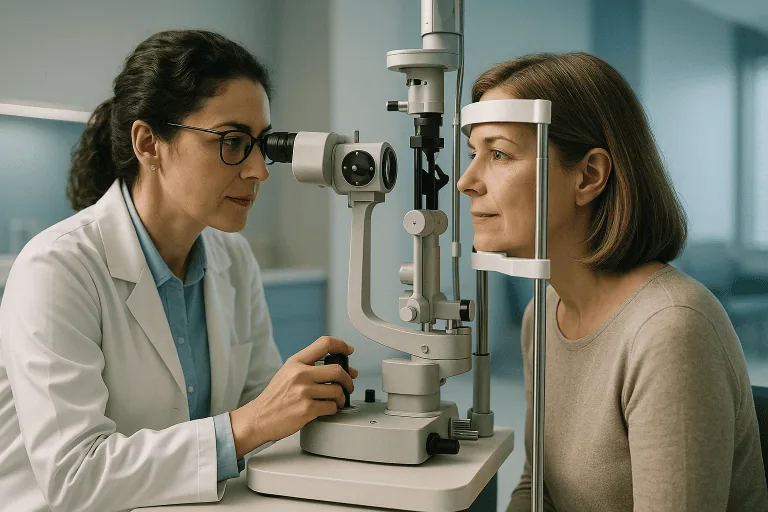
A comprehensive eye examination follows. Visual acuity is measured and refraction determines the power needed to focus light properly. The doctor examines the front of the eye, cornea, conjunctiva, eyelids and tear film, under the slit lamp. The retina and optic nerve may also be checked as part of routine eye health assessment, particularly if there are symptoms, underlying medical conditions or a need for a full ophthalmic review.
Corneal curvature measurement guides lens selection. For many patients, basic keratometry readings are enough. For those with higher astigmatism, irregular corneas, keratoconus, prior refractive surgery or unexplained visual quality problems, corneal topography or tomography may be used. These imaging methods create detailed maps of the cornea’s shape, thickness pattern and optical behaviour. Tear film analysis and ocular surface evaluation may be added when dryness, discomfort or fluctuating vision is suspected, because a poor tear film undermines even a well-chosen lens.
Lens selection and trial fitting
After the examination, the clinician selects a trial lens based on the prescription, corneal measurements, eye health and intended use. For soft lenses this may mean choosing between daily disposable, planned replacement, toric or multifocal designs. For complex cases, custom lens parameters and additional diagnostic fitting sessions may be needed.
During the trial fitting, the lens is placed on the eye and allowed to settle. The clinician then evaluates how it centres, how it moves with blinking, whether it covers the cornea appropriately, and whether it causes irritation or redness. Vision is checked with the lenses in place and small power adjustments may follow. With toric lenses, rotational stability is critical, because a lens that rotates on the eye shifts the astigmatism correction off axis. With multifocals, the doctor assesses how well you actually function at distance, intermediate and near ranges in realistic tasks, not just on a letter chart.
Rigid gas permeable and scleral fittings involve more detailed assessment. The specialist evaluates lens alignment, clearance over the cornea, edge interaction with the eye surface and tear exchange beneath the lens. Imaging tools may be used to confirm how the lens sits and whether the cornea is adequately protected. Scleral lenses require additional instruction because they are filled with preservative-free fluid before insertion and demand specific handling techniques that take practice.
How do you put on your contact lenses?
You put on contact lenses with clean, dry hands, placing the lens on the eye while holding the lids open: a skill your clinician teaches and watches you practise before you take lenses home. The standard sequence for soft lenses is:
- Wash your hands with soap, rinse thoroughly and dry them with a lint-free towel.
- Take the lens out of its blister pack or case and check it is not inside out: sitting on your fingertip it should form a smooth bowl, not a shallow shape with flared edges.
- Inspect the lens for tears, nicks or debris. If it is a reusable lens, rinse it with the recommended solution, never with water.
- Balance the lens on the tip of your index finger.
- With your other hand, hold your upper eyelid open; with the middle finger of the lens hand, pull the lower lid down.
- Look straight ahead or slightly upward and place the lens gently on the eye.
- Release the lids slowly, close the eye briefly and blink a few times so the lens settles, then check that vision is clear and the lens feels stable.
First attempts often take several tries, and that is normal. The blink reflex calms with repetition, and most new wearers become quick within days. Rigid and scleral lenses use modified techniques, scleral lenses, for instance, are inserted filled with fluid while you look downward, and your fitter will train you in the exact method for your lens type.
How do I take out my contact lenses?
You take out soft contact lenses by sliding the lens off the cornea and pinching it gently between clean fingertips. The steps your clinician will teach you are:
- Wash and dry your hands thoroughly.
- Look upward and pull the lower eyelid down with your middle finger.
- With your index finger, slide the lens down onto the white of the eye.
- Pinch the lens softly between thumb and index finger and lift it away.
- Discard a daily disposable immediately; clean and store a reusable lens in fresh solution in a clean case.
Rigid lenses are usually removed with a blink-and-pull technique or a small suction device, and scleral lenses with a plunger placed at the lens edge; both are demonstrated during training. If a lens ever feels stuck, lubricating drops recommended by your clinician and patience are the right approach, forcing a dry lens off the eye can scratch the surface. A lens that repeatedly binds or is hard to remove usually reflects the fit rather than your technique, and the design or parameters can be adjusted at a routine review.
Patient training and hygiene education
A successful contact lens plan depends on education as much as optics. Before leaving with lenses, patients are taught how to wash and dry hands properly, insert and remove lenses, inspect lenses for damage, clean and store reusable lenses, follow replacement schedules and avoid unsafe habits. This training matters most for first-time users and younger patients, and good clinics do not skip it.
The rules are simple and worth repeating. Do not rinse lenses or cases with tap water. Do not swim or shower in lenses unless specifically advised with protective measures. Do not sleep in lenses unless the lens type and the clinical plan explicitly allow it. Clean the lens case daily and replace it regularly. Apply lenses before makeup and remove them before taking makeup off; keep creams and sprays away from the lens. Written instructions from your fitter cover these points and are worth keeping alongside your lens supplies.
How long does a fitting appointment take?
A contact lens evaluation and fitting takes longer than a routine glasses visit because it includes lens selection, trial fitting and hands-on training. Straightforward fittings may finish in a single visit; specialised lenses often need several appointments as parameters are refined. It helps to plan enough time for the initial assessment, lens ordering if custom lenses are needed, fitting verification and a follow-up check. The care team may request previous prescriptions, eye examination reports, corneal maps or surgical history before the visit, which helps predict whether standard or customised lenses are likely and how many visits to plan for. Standard lenses may be available quickly; complex custom designs need manufacturing time and sometimes a second refinement.
Recovery and adaptation
Contact lenses involve no surgical recovery, but the eyes and brain need time to adapt. Soft lenses often feel comfortable within hours or days; rigid lenses need a gradual build-up of wearing time. Multifocal lenses require a period of neuroadaptation as the visual system learns to use different focal zones, and judging them on the first afternoon is usually premature. Scleral lens wear tends to be comfortable once the handling routine is mastered, but insertion, removal and care genuinely take practice.
Follow-up is part of the treatment, not an optional extra. The clinician checks vision, comfort, lens fit and eye surface health after you have worn the lenses in real life, and adjusts power, material, wearing schedule or design as needed. Long-term follow-up matters even when everything feels fine, because early signs of corneal stress or inflammation do not always cause symptoms the wearer would notice.
Buying Contact Lenses: Opticians and Online Retailers
Once you hold a valid, current contact lens prescription, you can buy contact lenses from an optician, an in-store optical department or an online retailer: the fitting determines what you buy, and the retailer simply supplies it. Reputable sellers in most countries are required to verify the prescription before dispensing, and they will ask for the full lens specification, including base curve and diameter, not just the spectacle power. Orders placed with any large online seller go through the same verification step. Warehouse and supermarket optical departments dispense lenses in person and can be convenient for wearers on stable, uncomplicated prescriptions.
What no retailer can do is replace the clinical side. An online listing cannot tell whether your tear film tolerates the material, whether a toric lens sits stably on your cornea, or whether your fluctuating vision is a prescription problem or an eye surface problem. The safe pattern is fitting and follow-up with an eye care professional, then purchase wherever suits you, then periodic re-examination before the prescription is renewed.
Can I buy contact lenses online?
Yes, many online optical retailers sell contact lenses through their websites and deliver to home addresses. In most jurisdictions the seller must confirm a valid, unexpired prescription before shipping, which is a legal safeguard rather than an inconvenience: it ensures the lenses reaching your door match parameters an eye care professional has actually verified on your eyes. Buy only lenses matching your exact prescription, from sellers who ask for it. A listing that offers powered or coloured lenses with no prescription check is a warning sign wherever it appears.
How much do contact lenses cost?
Contact lens costs vary so widely that no single figure is honest, which is why this page does not print one. What you pay depends on the lens category, daily disposables cost differently from monthly lenses over a year, and custom rigid or scleral lenses sit in another bracket entirely, as well as the material, the complexity of the prescription (toric and multifocal designs cost more to manufacture than simple spherical lenses), the replacement schedule, and where you buy. Reusable lenses add the recurring cost of solutions and cases; daily disposables avoid that but use more lenses. Professional fees for examination, fitting and follow-up are separate from the lenses themselves and differ between countries and clinics. When people ask how much are contact lenses per year, the useful answer is to compare complete annual pictures, lenses plus solutions plus professional care, rather than a single box price, and to ask any clinic or retailer for its current, itemised figures directly.
Do contact lenses expire?
Yes, contact lenses expire. Every sealed blister pack or vial carries an expiry date, because the sterile packaging solution and the lens material cannot be assumed stable indefinitely; a lens past that date should be discarded unopened. Expiry is separate from the replacement schedule: a monthly lens is replaced a month after opening regardless of the box date, and a daily disposable is discarded after a single wear. Cleaning and storage solutions expire too, both by printed date and within a set period after opening. In many countries the prescription itself also has an expiry, typically requiring re-examination before renewal: a sensible safeguard, since eyes and tear films change over time even when vision feels stable.
Why Acting Early Matters
Many people wait to seek professional contact lens care until glasses become inconvenient, vision changes noticeably or discomfort develops with poorly fitted or over-the-counter lenses. Early assessment prevents avoidable problems. If your prescription has changed, if eye strain is increasing, or if your current lenses feel dry or unstable, an examination can identify whether the issue is the prescription, the fit or an underlying eye surface condition, three different problems with three different solutions.
Delay is particularly risky when people wear cosmetic lenses without a prescription, share lenses, extend wearing time beyond recommendations, or keep wearing lenses despite redness or pain. The cornea receives much of its oxygen directly from the air; an unsuitable lens or excessive wear reduces that oxygen supply and can contribute to swelling, new blood vessel growth or inflammation. Microbial keratitis, a serious corneal infection, is uncommon but can threaten vision if not treated promptly, and unsafe lens habits are among its known risk factors.
Patients with keratoconus, irregular astigmatism or progressive myopia also gain from timely evaluation. In keratoconus, earlier diagnosis lets the ophthalmologist judge whether the condition is stable or progressing and whether treatments beyond contact lenses should be considered. In children and teenagers with increasing myopia, an early, evidence-based discussion of management options is valuable; lenses can be part of that plan for selected patients, but only within a broader medical evaluation.
Acting early does not mean rushing into lenses. It means obtaining a precise diagnosis, understanding the options and choosing a safe approach before discomfort, poor vision or complications become harder to manage.
Benefits of Contact Lenses
When prescribed and used correctly, contact lenses offer practical and visual advantages for many wearers.
| Benefit | What It Means for You |
|---|---|
| Clear vision without frames | Contact lenses move with the eye and provide a wide field of view, which many wearers find more natural than looking through spectacle lenses. |
| Compatibility with active lifestyles | Useful for sport, exercise, travel and professional activities where glasses slip, fog or interfere with equipment. |
| Correction for a range of prescriptions | Modern designs address nearsightedness, farsightedness, astigmatism and presbyopia in many patients. |
| Specialised options for complex eyes | Custom rigid or scleral lenses may improve vision in selected patients with keratoconus, irregular corneas or post-surgical optical changes. |
| Non-surgical vision correction | Lenses improve daily visual function without permanently changing the eye, and the plan can be adjusted as your needs change. |
| Cosmetic flexibility | Medically fitted coloured or prosthetic lenses can enhance or change appearance while keeping eye safety in view. |
Recovery and Adaptation Timeline
Most patients begin using contact lenses soon after fitting, but adaptation varies by lens type, prescription and eye surface health.
| Time Period | What Patients Can Expect |
|---|---|
| Day 1 | You learn insertion, removal and hygiene steps. Mild awareness of the lens is common, especially for first-time users. Vision and comfort are checked before you leave. |
| First Week | Wearing time increases gradually. Soft lenses often feel comfortable early; rigid lenses follow a slower build-up as the eyes adapt. |
| First Month | A follow-up visit confirms that the lens fits well, vision is stable and the eye surface remains healthy. Power or design adjustments may be made. |
| Longer Term | Routine check-ups monitor corneal health, tear film quality and prescription changes. Safe hygiene and replacement habits remain essential for continued wear. |
Factors That Influence Outcomes
A good contact lens result depends on more than the strength of the prescription. The fit of the lens, the health of the ocular surface, oxygen transmission, tear quality, wearing schedule and personal habits all shape comfort and safety. When these factors align, wearers get dependable vision and comfortable days. When one is overlooked, the experience disappoints even if the prescription is technically correct.
Eye surface health is one of the most important considerations. Dry eye, blepharitis, meibomian gland dysfunction and allergies cause fluctuating vision, lens awareness, redness or shortened wearing time. Treating these conditions before or during lens use can markedly improve tolerance. For some people the answer is a different lens material; for others, a daily disposable schedule, preservative-free lubricating drops or a temporary pause in lens wear while inflammation settles. Persistent eyelid skin irritation is worth investigating separately, since reactions to solutions or cosmetics can mimic lens intolerance.
Corneal shape plays a central role. Regular corneas with straightforward prescriptions usually mean a simple fitting. High astigmatism, keratoconus or previous eye surgery mean custom designs and more follow-up, where success depends on precise measurement and patience rather than a one-size approach.
Lifestyle matters. Long hours on digital devices reduce blink rate and encourage dryness, so the plan may include screen-use strategies and materials suited to the tear film. A frequent traveller may prefer daily disposables to avoid carrying solutions and to reduce case contamination. A healthcare worker, athlete, pilot, photographer or performer may have occupational visual requirements that steer the lens choice in specific directions.
Compliance is essential and worth saying bluntly. Contact lenses are safe for many people when used correctly, but risk rises when wearers sleep in lenses without approval, reuse old solution, top off solution in the case, expose lenses to water, stretch replacement schedules or ignore symptoms. The best lens design cannot compensate for unsafe handling, which is why serious contact lens care always includes practical training and clear written instructions rather than a box handed over a counter.
Age and maturity influence outcomes too. Children and teenagers can be excellent candidates when they are responsible, motivated and supported by parents or caregivers. Older adults may need extra instruction if fine motor control, dry eye or medication-related tear changes affect handling or comfort, any medication questions belong with the treating doctor. The plan should fit the person, not only the prescription.
Finally, regular follow-up protects long-term results. Even when vision seems clear, the specialist can detect early corneal changes, inflammation, deposit build-up or fit problems before they cause symptoms. Follow-up intervals are individualised according to lens type, eye health and clinical risk, and keeping those appointments is part of what makes years of lens wear uneventful.
Contact Lens Care at Acibadem
Some patients seek contact lens care in a hospital setting when they need a comprehensive opinion, a specialised fitting, evaluation for a complex corneal condition or coordinated care during a broader ophthalmology visit. At Acibadem, contact lens assessment is integrated into ophthalmic care rather than treated as a retail prescription exercise. That distinction matters most for patients with astigmatism, keratoconus, dry eye, previous eye surgery or unexplained changes in visual quality, where the real question is not “which lens?” but “what is happening in this eye?”
The process begins with medical assessment of the eye, not with lens selection. Ophthalmologists evaluate whether symptoms come from refractive error, corneal disease, ocular surface inflammation, cataract, retinal disease or another condition that may need a different treatment altogether. Multidisciplinary input is available when a case calls for it: a keratoconus patient may need cornea specialists and contact lens experts working together; a patient with diabetes may need retinal evaluation before vision correction is finalised; a dry eye patient may need ocular surface treatment before any lens is prescribed.
Modern diagnostic pathways support precise decisions. Depending on the case, evaluation may include refraction, slit-lamp examination, corneal curvature measurement, corneal topography or tomography, tear film assessment and ocular surface imaging. These tools show not only what power is needed but how a lens will interact with this particular cornea and tear film: the detail that makes specialised fitting more likely to end in comfort, stable vision and safe wear.
Experienced physicians and eye care teams offer the full range of options, from standard soft lenses to toric, multifocal, rigid gas permeable and scleral designs. Some patients need the simplest lens that works reliably; others need a customised approach for irregular optics or surface disease. The aim is always to match the medical indication with a lens the patient can realistically use and maintain in daily life. Some patients also seek a second opinion before committing, for example, a person told they are not a candidate for laser vision correction may want to understand whether standard lenses, scleral lenses or another ophthalmic treatment could meet their needs, or a keratoconus patient may want to know whether the disease is stable and which lens option offers the best functional vision.
Practical coordination supports the clinical work: appointment planning, medical record transfer, interpretation when needed and scheduling across departments when additional tests or consultations are required. This matters when time is limited and examination, fitting, training and follow-up must fit a fixed schedule. The guide to your first contact with Acibadem, from online inquiry to care plan describes how that coordination works in practice. The emphasis throughout is personalised planning: visual needs, eye health, handling ability, budget considerations, replacement preferences and long-term safety all feed into a plan that is medically sound and practical for daily life.
Preparing for a Contact Lens Assessment
Contact lenses can be a comfortable, effective way to correct vision without surgery, but the dependable results come from careful evaluation, precise fitting and consistent follow-up, whether you are trying lenses for the first time, struggling with discomfort in your current pair, exploring multifocal options, choosing cosmetic lenses safely or managing a complex corneal condition.
Useful preparation is simple. Gather your recent glasses prescription, previous contact lens details including brand and parameters, corneal imaging reports if you have them, and any history of eye surgery or eye disease. If you currently wear lenses, note your typical daily wearing time, your cleaning routine and any recurring discomfort, because those details often point directly at the cause of a problem. Existing wearers attending hospital for any procedure should also know the standard rules about lens wear on the day itself, which are set out in the guide to contact lenses, glasses, hearing aids and dentures on procedure day.
With that information in hand, the ophthalmology team can prepare properly, judge in advance whether standard or customised lenses are likely, and use the appointment to do what matters most: understand your eyes in detail, discuss realistic options honestly and build a contact lens plan that supports clear vision, comfort and long-term eye health.
Preparation
- An ophthalmologist evaluates your vision, cornea and tear film to determine suitable lens type and prescription. Bring any current glasses or contact lens prescription, and tell your doctor about dry eye, allergies or previous eye infections. If you already wear lenses, you may be asked to stop using them briefly before the exam.
Aftercare
- You will receive instructions on wearing time, cleaning, storage and replacement schedule. Avoid sleeping, swimming or showering with lenses unless specifically approved by your doctor. Follow-up visits help confirm comfort, vision quality and corneal health.
Frequently Asked Questions
What affects the cost of contact lenses?
The main factors are the lens type, prescription complexity, corneal shape, eye surface health, diagnostic tests, fitting time, trial lenses, follow-up visits and the chosen replacement plan.
How can I get a personalised quote?
A personalised quote is prepared after an eye health assessment and contact lens fitting plan. You can request a free consultation and share your current prescription, eye history and any previous lens experience.
Are contact lenses usually included as part of a package?
A package may include the eye examination, measurements, fitting session, trial lens assessment, handling training and follow-up planning. The actual inclusions depend on the lens type and your clinical needs.
Why can specialty lenses cost more than standard soft lenses?
Specialty lenses such as rigid gas permeable, scleral, toric or multifocal designs may require more detailed measurements, custom ordering, longer fitting time and additional follow-up to confirm comfort and eye health.
Can international patients combine contact lens fitting with other eye services?
Yes, this may be possible when clinically appropriate. International patient teams can help coordinate appointments, translation support and travel timing, but the final plan should be confirmed by the eye specialist.
Is this information medical or financial advice?
No. This is general educational information. A specialist consultation is needed to confirm suitability, and a personalised quote is required to understand the final cost.
Medically reviewed by the Acıbadem International Medical Board September 13, 2026
See our medical review board →
Update history
- PublishedJune 8, 2026
- Medical review approvedSeptember 13, 2026
- Last content updateSeptember 12, 2026
References1
Trusted care for international patients
From the Acibadem Blog
Who Can Wear Contact Lenses? Dry Eye, Astigmatism and Allergies at the Fitting Exam
Most people who need vision correction can wear contact lenses, including many with dry eye, astigmatism and seasonal allergies, provided a fitting exam confirms…

What Happens at a Contact Lens Fitting: Tear Film Checks, Trial Lenses and Wear Rules
A contact lens fitting appointment is a separate visit, or an add-on to an eye exam, in which an eye care professional measures the…

Why a Glasses Prescription Is Not a Contact Lens Prescription: What the Fitting Measures
A glasses prescription and a contact lens prescription are not interchangeable. Glasses sit about a centimeter from the eye, so the lens power is…