

Daily Disposable vs Monthly Contact Lenses: How Your Eye Doctor Helps You Choose
Key Takeaways
- A monthly lens ages from the day the blister is opened, so a lens worn only on weekends still needs replacing on the same calendar schedule as one worn every day.
- Dailies remove the case, the solution and the accumulated deposit layer, which are three of the most common points where contact lens hygiene fails.
- The CDC's national survey found more than four in five adult wearers reported at least one infection-risk behavior, and about a third slept or napped in lenses, regardless of lens type.
- Sleeping in lenses not approved for overnight use cuts oxygen and tear exchange to the cornea and raises the risk of keratitis several-fold, according to the CDC.
- Tap, shower and pool water can carry Acanthamoeba, an organism that causes a rare but severe corneal infection seen almost exclusively in contact lens wearers, so lenses should never touch water.
- A contact lens prescription includes curvature, diameter and material determined at a fitting, which is why swapping to a different product using your glasses prescription is not safe.
Daily disposable and monthly contact lenses correct vision the same way; they differ in how long each lens is worn before it is discarded. Dailies are thrown away after one wear, which removes cleaning and lowers deposit build-up. Monthlies are cleaned and stored nightly and replaced on a fixed schedule. Neither type is safer in every situation; fit, eye surface health, habits and prescription guide the choice, made with your eye care professional.
The optometrist slides two small foil packets across the table. One holds a lens you would peel open every morning and drop in the bin every night. The other holds a lens you would rinse, store and reuse for about a month. You have just been told your prescription, and now comes the question nobody warned you about: which one?
It is a real fork in the road for a lot of people. The daily vs monthly contact lenses decision touches how your eyes feel at 9 p.m., how forgiving your routine is on a camping trip, and how much cleaning you will honestly do when you are tired. Most people ask friends, then the internet, and come away more confused than when they started.
This explainer walks through what the evidence actually supports, where the differences are meaningful and where they are marketing, and what your eye doctor is weighing when they nudge you one way or the other.
How a contact lens actually works on your eye
A contact lens does not sit directly on your eye. It floats on the tear film, the thin, constantly refreshed layer of watery fluid, oils and mucus that coats the cornea. The cornea is the clear front window of the eye, and it has no blood vessels of its own; it draws most of its oxygen straight from the air through the tears. Anything placed on top of it, including a lens, becomes a barrier that oxygen has to pass through.
That single fact explains most of contact lens design. Early soft lenses were made of hydrogel, a water-holding plastic, and oxygen traveled through the water content. Modern lenses are often silicone hydrogel, a material in which silicone channels let far more oxygen reach the cornea than the water alone could carry. Your eye doctor may mention “oxygen transmissibility” when comparing options; it simply describes how easily oxygen crosses a given lens of a given thickness.
Every blink slides the lens a fraction of a millimeter, pumping fresh tears underneath and flushing debris out. Proteins, lipids and cells from the tear film settle onto the surface over hours. On a daily disposable, that layer is discarded with the lens. On a monthly, it has to be lifted off by rubbing, rinsing and soaking in disinfecting solution, and whatever is not removed accumulates.
Wear time, lens material, the health of the tear film and the cleanliness of the surface are the four levers that decide whether a lens feels invisible or feels like a grain of sand. The replacement schedule, daily or monthly, is really a decision about which of those levers you want to manage yourself and which you want the packaging to manage for you.
Daily vs monthly contact lenses: what the labels really mean
“Daily disposable” means the lens is designed for one period of wear, worn during the day and discarded. It is never cleaned, never stored, never reused. Each morning starts with a sterile lens from a sealed blister.

“Monthly” describes a replacement schedule, not a wearing schedule. The lens is inserted in the morning, removed at night, disinfected in solution and stored in a case, then reused the next day. The clock starts when the blister is opened, and manufacturers’ labeling and the NHS both frame the schedule as fixed from that point; the lens is retired on schedule even if you only wore it on weekends. Fortnightly (two-week) lenses sit between the two categories and are handled the same way as monthlies.
A separate label sometimes confuses people: “extended wear” or “continuous wear” lenses are specifically approved for overnight use, up to a limit the manufacturer and your prescriber set. Most dailies and most monthlies are daily-wear lenses, meaning they must come out before sleep. The CDC’s guidance is blunt on this point: sleeping in lenses not approved for it raises the risk of corneal infection several-fold.
One more distinction matters. Both categories exist in hydrogel and silicone hydrogel materials, in spherical designs for simple nearsightedness or farsightedness, toric designs for astigmatism/">astigmatism (an unevenly curved cornea that blurs vision at all distances) and multifocal designs for presbyopia (the age-related loss of near focus). The range is wider in monthlies, especially for unusual prescriptions, though daily options have expanded considerably. When people ask which is better, the honest answer begins with which category can be made in their prescription at all.
Are daily contacts healthier than monthly contacts?
This is the question underneath almost every daily vs monthly contact lenses search, and the answer has two parts. The first is about the lens. The second is about the person.
On the lens side, dailies remove several links in the chain that leads to trouble. There is no case, so there is no case to harbor biofilm, the slimy community of bacteria that grows on plastic left damp. There is no solution, so there is no risk of topping off old solution or reacting to a preservative. There is no accumulating deposit layer, which is relevant to giant papillary conjunctivitis, an allergic inflammation of the inner eyelid triggered by protein-coated lenses. On mechanism alone, dailies simplify hygiene.
On the person side, the CDC’s national survey published in Morbidity and Mortality Weekly Report found that roughly 45 million Americans wear contact lenses and that more than four in five adult wearers reported at least one behavior known to raise infection risk, most commonly napping in lenses, sleeping in lenses, swimming in them or stretching replacement schedules. Those habits cut across both categories. A daily lens slept in for a week is not healthier than a monthly lens cared for properly.
What the evidence does not show is that dailies eliminate risk. Microbial keratitis, an infection of the cornea, occurs in daily disposable wearers too, usually linked to overnight wear, water exposure or reusing a lens meant to be discarded. Studies comparing infection rates across lens types have been complicated by differences in who chooses each lens and how they behave.
A fair summary: dailies reduce the number of ways hygiene can go wrong; they do not make hygiene irrelevant. For a wearer with meticulous habits, a well-fitted monthly lens is a reasonable, mainstream choice.
What is a disadvantage of using daily contacts?
Dailies get described so glowingly online that their drawbacks are worth stating plainly.

The first is availability of the prescription you need. High degrees of astigmatism, high plus or minus powers, and some multifocal combinations are made in fewer daily designs. If your eye doctor can achieve a sharper, more stable result with a monthly toric or multifocal lens, that is a clinical reason, not a preference.
The second is material trade-offs. Many daily lenses are made thin and soft for comfort, and thin, high-water-content hydrogels can dehydrate faster over a long day, particularly in dry, air-conditioned offices. Some people who feel scratchy by late afternoon in one daily do better in a silicone hydrogel daily or, occasionally, in a monthly. This is a fitting problem, solved by trying alternatives, not a verdict on the category.
The third is handling. Daily lenses are often thinner and floppier than monthlies, and new wearers sometimes struggle to tell whether a lens is inside out or to keep it from folding on a fingertip. Monthlies tend to hold their shape a little better. Practice narrows this gap within a couple of weeks for most people.
The fourth is the temptation to reuse. Because a daily lens looks fine after one wear, some people are tempted to store it overnight in a case “just this once.” A lens not designed for disinfection may not tolerate the solution well, and the habit defeats the entire safety rationale. The NHS contact lens safety guidance is explicit: dailies are for one use only.
The fifth is waste. A year of dailies produces far more blister packs and lenses than a year of monthlies, though both categories generate solution bottles or packaging. If that matters to you, say so at the fitting; it is a legitimate factor in a shared decision.
Who is usually steered toward monthlies, and who is asked to wait
Eye care professionals rarely decide by category first. They decide by cornea, tear film, prescription and habits, and the category falls out of that.
Monthly lenses are commonly considered for people whose prescription is available in fewer daily designs, for those who want a wider selection of silicone hydrogel materials, and for wearers who have demonstrated consistent hygiene. Someone who already keeps a clean case, replaces solution nightly and keeps appointments is, in practice, a good candidate for the added responsibility.
Daily disposables are often suggested for part-time wearers, who might otherwise let a monthly sit in a case for weeks between uses; for people with seasonal or perennial allergies, because a fresh surface each morning carries less allergen and protein; for those who travel or exercise heavily; and for anyone with a history of solution sensitivity. Dailies are also frequently the starting point for teenagers, where a simple “wear it, throw it away” routine has fewer failure points.
Some people are asked to wait before starting any soft lens. Active eye infection or inflammation, a corneal abrasion, uncontrolled dry eye disease, or recent eye surgery are typical reasons to postpone a fitting until the surface has healed. The Mayo Clinic’s overview of keratitis notes that contact lens wear during an active corneal infection can worsen the outcome, which is why a clinician will usually want lenses out entirely until the eye is quiet.
Children can wear contact lenses, and there is no fixed minimum age in guidelines; readiness depends on maturity and the ability to handle lenses hygienically, judged by the prescriber and parents together. For any age, the decision about which lens, and whether lenses at all, rests with the fitting clinician after examining the eye.
Daily vs monthly contact lenses at a glance
The table below sets the two categories side by side on the factors that come up most in fittings. It is a summary of general guidance, not a ranking; a particular lens in either column may behave differently from the generalization.
| Factor | Daily disposable | Monthly replacement |
|---|---|---|
| Cleaning and storage | None; discard after each wear | Rub, rinse, disinfect and store every night |
| Lens case | Not needed | Required; replace at least every three months (CDC) |
| Deposit build-up | Reset daily | Accumulates between cleanings |
| Solution sensitivity | Not a factor | Possible; preservative-free options exist |
| Range of prescriptions | Expanding, but narrower for high powers and complex astigmatism | Broadest range of powers, torics and multifocals |
| Handling for new wearers | Often thinner, can be fiddly | Slightly firmer, often easier to place |
| Part-time or occasional wear | Well suited | Lens ages on the calendar regardless of use |
| Overnight sleep | Not permitted unless specifically approved | Not permitted unless specifically approved |
| Water exposure (pools, showers) | Avoid; if exposed, discard | Avoid; if exposed, disinfect or discard as advised |
| Packaging waste | Higher | Lower, plus solution bottles |
Two rows deserve emphasis. Overnight wear and water exposure look identical across the columns, and that is the point: the habits that most raise infection risk in the CDC’s data do not depend on the replacement schedule. The rows where dailies clearly win are hygiene-related; the rows where monthlies win are about optical options and handling. Which set of rows matters more is a conversation to have with your eye doctor, who knows your prescription, your tear film and, ideally, your honest account of your habits.
How your eye doctor decides: what happens at a fitting
A contact lens fitting is a separate step from a routine eye exam, and it is where the daily-or-monthly question is actually answered.
The clinician begins by measuring the curvature of your cornea with a keratometer or corneal topographer, instruments that map the front surface of the eye. A lens that is too flat will slide and blur; one that is too steep will grip and starve the cornea of tear exchange. Both categories come in a limited set of base curves and diameters, so the shape of your eye can rule some products in or out before comfort is even discussed.
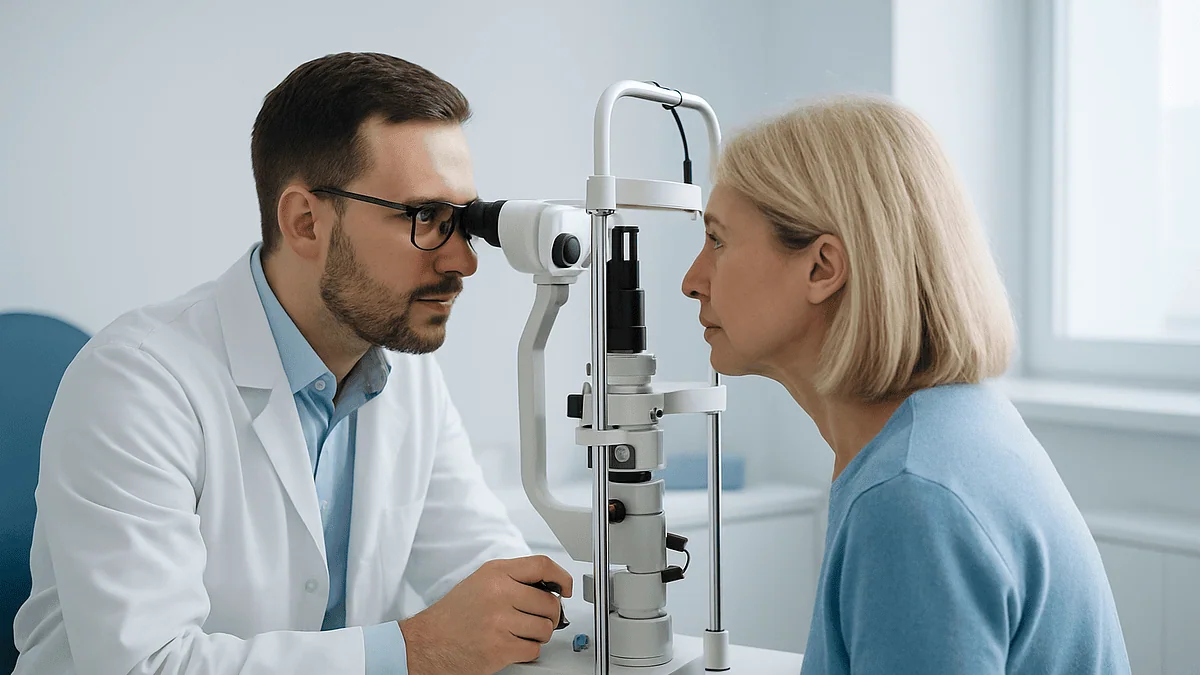
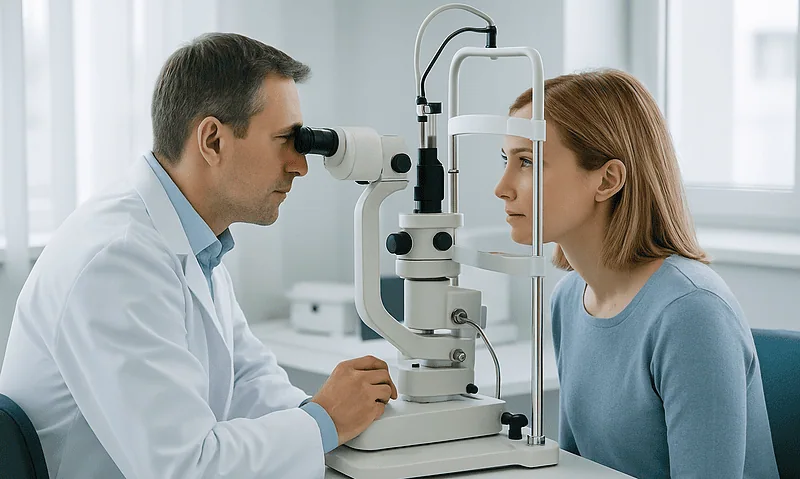
Next comes the tear film. Using a slit lamp, a microscope with a bright, adjustable beam, the doctor watches how quickly the tear layer breaks up between blinks and looks for signs of dryness, allergy or lid gland dysfunction. A fragile tear film often points toward a material that resists dehydration, and sometimes toward a daily so that a fresh, wettable surface goes in each morning.
Then trial lenses go on. The doctor checks how the lens centers, how it moves with each blink, and how your vision holds up at distance and near. You will usually wear the trial for a period, sometimes leaving the office and returning, so that comfort can be judged after the initial tearing settles.
The final piece is the conversation. How many days a week will you wear them? Do you nap after work? Do you swim? Have you reacted to eye drops or solutions before? These answers shape the recommendation as much as the measurements do. The prescription that results specifies the exact lens, and swapping to a different product without a re-fit is not advised, because a different curve or material behaves differently on the same eye.
Dry eyes, allergies and screen time: how comfort tips the choice
End-of-day discomfort is the most common reason people drift away from contact lenses, and it is where the daily-versus-monthly choice becomes personal rather than theoretical.
Dry eye disease, according to the Mayo Clinic, occurs when tears are insufficient in quantity or unstable in quality, and it is aggravated by prolonged screen use because blink rate falls when we concentrate. A lens sitting in a thinner, faster-evaporating tear film dries out along with it. For some wearers a daily lens helps because each morning’s lens is fully hydrated and free of the lipid deposits that reduce wettability; for others a particular monthly silicone hydrogel feels better at hour twelve. There is no universal winner, which is why fittings often involve trying more than one product.
Allergy is more clear-cut. Pollen, dust and pet allergens stick to lens surfaces, and protein deposits themselves can provoke an immune response along the upper eyelid. A fresh lens each day carries less of both, and clinicians commonly move seasonal allergy sufferers to dailies during high-pollen months, sometimes with a preservative-free lubricating drop approved for use with lenses. Any prescription eye medication is a separate matter: whether it can be used while wearing lenses, and in what order, is a question for the prescriber, not for a magazine.
Solution sensitivity, a low-grade redness or stinging that appears after switching solutions, is a monthly-only problem by definition. It can be addressed by changing to a different disinfecting system or by moving to dailies; the clinician decides which after examining the eye.
A practical point about screens: the twenty-second break to look across the room that many eye doctors suggest is not a treatment for dry eye, but it does restore blinking, and blinking is what re-wets the lens. That habit helps regardless of which foil packet you chose.
What the first days and weeks with new lenses usually look like
New soft lens wearers are often surprised by how normal the first hour feels, and equally surprised by how odd the first week can be.
Days one to three are about awareness. You may notice the edge of the lens when you blink, feel mild dryness by evening, and spend longer than you expected getting a lens on your fingertip. Many clinicians suggest a gradual build-up of wearing time over the first week, a schedule set by your prescriber rather than a fixed rule, so that the cornea adapts and so that any problem shows up while wear is still brief.
Days four to fourteen are about handling. Insertion and removal that took ten minutes on day one typically becomes a two-minute routine. Monthly wearers are also learning the cleaning ritual in this window: rub the lens in fresh solution, rinse, fill the case with new solution, cap it, and let the case air-dry face down each morning. Daily wearers have nothing to learn here, which is the category’s main appeal for busy or younger patients.
A follow-up visit is standard, usually within the first few weeks. The clinician looks again at how the lens sits, checks the cornea for any staining that suggests dryness or mechanical rubbing, and asks about comfort at the end of the day. This is the moment to say honestly if the lens feels fine at noon and awful at six; the doctor may change material, curvature or replacement schedule based on exactly that report.
Beyond the first month, annual review is the norm. The cornea can change over years of wear, and a lens that fitted well at first may need revisiting. Persistent redness, discomfort that does not settle within the adaptation period, or any change in vision at any stage should shorten that timeline; the section on red flags below explains when to stop waiting.
Caring for monthly lenses: solution, case and the "3:1:1 rule"
If you choose monthlies, the cleaning routine is where the health of your eyes is actually decided.
The CDC’s contact lens guidance and the NHS agree on the essentials. Wash and dry your hands before touching lenses. Rub each lens gently in fresh disinfecting solution, even if the bottle says “no rub,” then rinse and store in a case filled with new solution. Never top off yesterday’s solution with a splash of fresh; the disinfectant is spent and the bacteria are not. Empty the case each morning, rinse with solution, and leave it open to air-dry. Replace the case at least every three months, the interval the CDC specifies, because biofilm forms on plastic that stays damp.
Water is the enemy throughout. Tap water, bottled water, shower water and pool water can carry Acanthamoeba, a free-living amoeba that causes a rare but severe and painful corneal infection almost exclusively seen in contact lens wearers. Lenses should never be rinsed or stored in water, and the CDC advises removing them before swimming or showering.
As for the “3:1:1 rule” that people search for: it does not appear in CDC, NHS or professional-body guidance, and the versions circulating online differ from one another. The most common one we found packages the case-replacement interval of about three months alongside reminders to follow a single replacement schedule and have one annual eye examination. Treat it as a memory aid at best. The guidance that actually carries weight is the list above, plus the instructions on your specific solution and lens packaging.
One caution on solutions: not every solution is compatible with every lens material, and switching brands or types without asking can cause stinging or cloudiness. If your eyes react to a solution, stop wearing the lenses and speak to your prescriber rather than experimenting.
Sleeping, swimming, showering: habits that matter more than the schedule
The CDC’s 2016 national survey, published in MMWR, remains the clearest snapshot of how contact lens wearers actually behave, and it reframes the daily-versus-monthly debate. Among adult wearers, more than four in five reported at least one behavior linked to eye infection. About a third reported sleeping or napping in their lenses. Swimming in lenses, rinsing or storing lenses in tap water, and stretching replacement schedules were also common. Adolescents fared slightly better than adults on some measures, mostly because they were more likely to be in dailies and less likely to swim in lenses.
Why does sleep matter so much? A closed eyelid over a lens cuts oxygen to the cornea, slows tear exchange, and lets bacteria trapped under the lens multiply undisturbed. The cornea responds with swelling and tiny surface breaks that give microbes a way in. The CDC states plainly that sleeping in contact lenses increases the risk of keratitis several-fold, and a separate CDC analysis of reported corneal infections estimated that keratitis in general accounts for roughly one million clinic and emergency department visits in the United States each year, with contact lens wear the leading preventable risk factor.
Water carries its own hazards, described in the previous section. Showering in lenses is easy to overlook; the exposure is brief, but the microbes in household plumbing are the same ones implicated in Acanthamoeba infection.
The takeaway for the daily-or-monthly decision is uncomfortable but useful. If you know you fall asleep on the sofa with lenses in, the lens category is not your biggest problem; the habit is. If you swim several times a week, either category needs to come out first, or you need to talk to your doctor about prescription goggles. The safest lens is the one you will use exactly as directed, and honesty about your routine at the fitting is worth more than any product feature.
What people often get wrong about daily and monthly contacts
Several beliefs circulate widely enough that they deserve a direct correction.
“A monthly lens lasts thirty wears.” It lasts about a month from opening, however many days you wore it. A lens worn twice a week for two months has spent eight weeks in a case, accumulating deposits and exposed to whatever grew in the solution. The NHS guidance is to follow the replacement schedule as a calendar, not a tally.
“Dailies can be reused if they look clean.” They are not designed to withstand disinfection, and the CDC and NHS both classify reuse of daily disposables as a risk behavior. Appearance tells you nothing about microbial load.
“If it hurts, it’s just adaptation.” Mild awareness in the first days is normal. Pain, sharp light sensitivity, or a red eye is not adaptation and should prompt removal and a call to your eye doctor, whether you are on day one or year ten.
“Any solution works with any lens.” Materials differ, and some combinations cause stinging or surface changes. Use what your prescriber specified and ask before switching.
“Dailies are always better for dry eyes.” Often helpful, not always. Some monthly silicone hydrogels hold up better on certain tear films. The right answer is whichever lens the trial shows to be comfortable at the end of the day.
“Contact lens prescriptions are the same as glasses prescriptions.” They are not. A lens prescription includes curvature, diameter and a specific material, all of which come from a fitting. Buying a different product with your glasses numbers is buying a lens that has never been checked on your eye.
“Rinsing in water is fine in a pinch.” It is the single habit most strongly tied to Acanthamoeba keratitis. Carry a small bottle of solution or a spare pair of dailies instead.
Questions to ask your care team
A fitting appointment moves quickly, and it helps to arrive with questions written down. These are the ones that tend to change the recommendation or prevent problems later.
- Is my prescription available in both daily and monthly lenses, or does one category give you a sharper or more stable result for my eyes?
- What did you see in my tear film, and does it point toward a particular material or replacement schedule?
- How many hours a day is this lens designed to be worn, and what build-up schedule do you want me to follow in the first week?
- May I ever sleep in this lens, even briefly? If not, what should I do if I fall asleep in it by accident?
- Which disinfecting solution do you want me to use with this lens, and are there any I should avoid?
- How often should I replace the case, and how should I dry it?
- If I have hay fever, should I change anything during allergy season?
- Can I use my current eye drops with these lenses, and if so, in what order?
- Could I keep a small supply of dailies for travel or sports alongside monthlies, and would that need a separate fitting?
- What symptoms mean I should take the lenses out and call you the same day?
- When is my follow-up, and how often do you want to review the fit after that?
Two habits make these conversations more productive. First, describe your real routine, including the nap on the train and the twice-weekly swim; the doctor cannot fit around habits you have not mentioned. Second, ask for the answers to be written on your prescription or an information sheet. Wear-time limits, solution compatibility and the follow-up date are exactly the details that blur after you leave the office. Every decision about lens type, material and schedule sits with the clinician who examined your eyes, and these questions simply make sure the decision is built on complete information.
When to call your doctor
Most contact lens problems are minor and settle once the lens is out. A few are emergencies for the cornea, and the difference between a good and a poor outcome in a corneal infection is often measured in hours, not days. The Mayo Clinic’s guidance on keratitis is to seek care promptly for any of the following, and to remove the lens first.
Call your eye doctor the same day, or go to an emergency department if you cannot reach them, if you notice:
- Eye pain, rather than mild awareness, especially if it keeps building after the lens is out
- A red eye that does not clear within a short time of removing the lens
- Sudden sensitivity to light, or a feeling that you cannot keep the eye open
- Blurred or reduced vision in the affected eye that does not improve with blinking
- Excessive tearing or a sticky, thick discharge
- A visible white or gray spot on the cornea, or a feeling that something is stuck in the eye when nothing is there
- Any of the above after swimming, showering or sleeping in lenses, or after rinsing a lens in water
Do not put the lens back in, do not use anesthetic or redness-relief drops to mask symptoms, and keep the lens and case if you can; a clinician may want to culture them. If you wear monthlies, bring the solution bottle too.
Arrange a routine, non-urgent appointment for persistent end-of-day dryness that does not settle after the adaptation period, recurring mild redness, lenses that seem to fog or coat quickly, or any sense that your vision has drifted. These are fitting problems, and the fix is usually a change of material, curve or schedule rather than giving up lenses.
Whatever the category of lens, the rule that eye care professionals repeat most is the simplest one: if in doubt, take it out, and call.
Frequently asked questions
Are daily contacts healthier than monthly contacts?
Dailies simplify hygiene because there is no case, no solution and no deposit build-up, so fewer things can go wrong. They do not remove risk on their own; sleeping in lenses, water exposure and reusing dailies cause infections in this category too. A carefully maintained monthly lens is a mainstream, reasonable option. Your eye doctor weighs your habits and eye surface before recommending either.
Which is better for me, daily or monthly contact lenses?
Neither is better for everyone. Dailies often suit part-time wearers, allergy sufferers, travelers and new wearers; monthlies offer a broader range of prescriptions and materials for people with consistent hygiene. The fitting exam, which measures your cornea and tear film and includes trial lenses, is where the answer for your eyes is found, and the decision rests with the prescribing clinician.
What is a disadvantage of using daily contacts?
Fewer daily designs exist for high prescriptions, strong astigmatism and some multifocal needs, so a monthly may give sharper vision. Dailies are often thinner and can be harder to handle at first, some dehydrate faster in dry environments, they generate more packaging waste, and they tempt some wearers into unsafe reuse. Each of these is manageable, but they are real trade-offs.
What is the 3:1:1 rule for contacts?
It is an informal memory aid found online, not part of CDC, NHS or professional guidance, and versions differ. The commonest one bundles replacing your case about every three months with following one replacement schedule and having one annual eye exam. The evidence-based rules are simpler: fresh solution nightly, no water, no sleeping in lenses, and replacement exactly on schedule.
Monthly contacts: how long can you actually wear them?
About one month from the day the blister is opened, then discard, whether you wore the lens every day or only a few times. The lens is removed each night for cleaning unless your prescriber has specifically fitted a lens approved for overnight wear. Stretching the schedule increases deposit build-up and is listed by the CDC as an infection-risk behavior.
Can I mix daily and monthly lenses, for example dailies when traveling?
Many people do, but it requires a fitting for both lenses, because each has its own curvature, diameter and material that must be checked on your eye. Ask your eye doctor whether a daily lens in your prescription sits well alongside your monthlies. Never substitute a product you have not been fitted with simply because the power numbers match.
How do I choose contact lenses if I have dry eyes?
Start with the tear film assessment at your fitting. A fresh daily lens each morning helps some people because it is fully hydrated and free of lipid deposits, while others do better in a particular monthly silicone hydrogel. Trial wear through a full day is the deciding test. Whether lubricating drops are appropriate, and which ones, is a question for the prescriber.
Can I swim or shower in either type of lens?
No. Both the CDC and NHS advise removing lenses before any water contact, because tap, shower and pool water can carry Acanthamoeba and bacteria that cause severe corneal infection. If a lens is accidentally exposed, discard a daily and ask your eye doctor how to handle a monthly. Prescription goggles are the usual alternative for regular swimmers.
Is it okay to nap in daily contacts since they are thrown away anyway?
No. Daily disposables are daily-wear lenses, and a closed eyelid over any lens not approved for sleep reduces oxygen and tear exchange and lets bacteria multiply. The CDC found napping in lenses among the most common risk behaviors and links overnight wear to a several-fold increase in keratitis risk. If you fall asleep by accident, remove the lens and watch for symptoms.
How often should I see my eye doctor once I am settled in lenses?
A follow-up within the first few weeks is standard, then annual review is the norm for most wearers, because the cornea and tear film can change over years of wear. Bring any lens forward if you notice persistent redness, end-of-day discomfort that does not settle, or blurred vision. Your clinician sets the exact interval based on your eyes and lens type.
References
- CDC: About Contact Lenses
- CDC MMWR: Risk Behaviors for Contact Lens–Related Eye Infections Among Adults and Adolescents, United States
This article is for general information only and is not a substitute for professional medical advice. Please consult a qualified doctor about your individual situation.

More from the Blog
Keratoconus Treatment Ladder: Lenses, Cross-Linking, Rings and When Transplant Is Discussed
Keratoconus treatment options form a ladder rather than a single choice. Glasses and soft lenses help early; rigid gas-permeable, hybrid or scleral lenses restore…
Can a Contact Lens Get Lost Behind Your Eye? Contact Lens Myths, Corrected
No. A contact lens cannot travel behind your eye. The conjunctiva, the thin membrane lining the inside of the eyelids, folds back onto the…
Recovering From Myopia Laser Surgery: Screens, Makeup, Swimming and the Follow-Up Calendar
Myopia laser surgery recovery is usually quick for daily life and slow for fine detail. Patient guides describe most people returning to work and…
How IntraLase Creates the LASIK Flap and What That Means for Your Eye
An IntraLase femtosecond flap is the thin, hinged layer of cornea that a femtosecond laser, rather than a mechanical blade, creates during LASIK. The…

When Pink Eye Needs an Eye Doctor Rather Than Time: How Conjunctivitis Care Is Decided
Most pink eye is viral or allergic and settles on its own within one to two weeks, so time and hygiene are usually enough.…

When Is Glaucoma Surgery Needed? What Pushes Care Beyond Drops and Laser
Glaucoma surgery is usually needed when eye pressure stays above the target the treating team has set despite well-used drops and laser treatment, when…