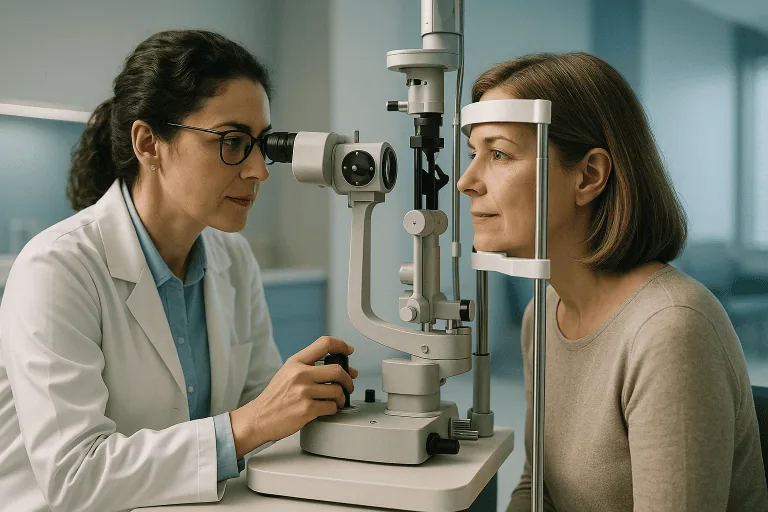
Multifocal Lens
Multifocal lens implantation replaces the eye’s natural lens with an advanced intraocular lens to improve near, intermediate, and distance vision, often during cataract or refractive lens surgery.
Quick answer
Multifocal lens implantation is a procedure that replaces the eye’s natural lens with an intraocular lens designed to improve near, intermediate, and distance vision, commonly during cataract surgery or refractive lens exchange. At Acibadem in Turkey, treatment involves detailed eye assessment, lens selection based on visual needs, and surgical implantation through modern ophthalmic techniques.
Multifocal Lenses: Seeing Clearly at More Than One Distance
A multifocal lens is a single lens built with more than one focusing power, so you can see at near, intermediate and far distances without switching between pairs of glasses. The term covers two quite different treatments. Multifocal contacts sit on the surface of the eye and come out on a daily or planned schedule. Multifocal intraocular lenses are implanted inside the eye during cataract surgery or refractive lens exchange, and they stay there for the long term. Both rely on the same optical principle, but they suit different eyes, different ages and different stages of life, and this page covers both.
Most people who research multifocal lenses have reached the point where one prescription no longer serves them. Reading a message on your phone, working at a computer, driving, recognising a face across a room: each of these happens at a different distance, and an eye affected by presbyopia or a cataract struggles to cover them all. Presbyopia is the age-related stiffening of the natural lens that makes near focus harder from the mid-forties onwards. A cataract is a clouding of that same lens, causing blur, glare, faded colours and difficulty seeing in low light. Both problems push people towards the same question: is there one lens that can handle everything?
What follows explains how multifocal contact lens designs behave day to day, what multifocal lens implantation involves, who suits each option, where each falls short, and how recovery and adaptation actually unfold. The two treatments are easy to confuse in search results, yet the choice between them is one of the more consequential decisions in adult eye care, so it is worth understanding them side by side before you sit down with an ophthalmologist.
What is a multifocal lens?
A multifocal lens is any lens, spectacle, contact or implanted, that carries several focal powers within one optic. Instead of producing a single sharp plane of focus, the lens presents your eye with two or more focal points at the same time. Your brain then learns to attend to the image that matters for the task in hand and to filter out the rest. That learning process, called neuroadaptation, is the reason multifocal vision tends to improve over the first weeks of use rather than feeling settled on day one. It is also the reason patient selection matters so much: the optics can only perform well when the rest of the visual system, cornea, tear film, retina and optic nerve, is healthy enough to make use of them.
What Is a Multifocal Contact Lens?
A multifocal contact lens is a contact lens with several prescription powers built into a single lens, worn to give useful vision at more than one distance, most commonly for presbyopia. Rather than balancing reading glasses on top of your distance correction, you wear one lens per eye that handles near, intermediate and far focus together. Multifocal contact lenses come as soft daily disposables, soft monthly lenses, rigid gas permeable lenses and hybrid designs, and toric versions exist for people who also have astigmatism.
The designs fall into two broad families. Simultaneous-vision lenses place different powers in front of the pupil at the same time, either as concentric rings that alternate between near and distance power, or as aspheric surfaces where the power changes gradually from the centre of the lens towards its edge. Some aspheric designs put the near power at the centre and the distance power at the edge; others do the reverse, and many successful fittings mix the two approaches between your eyes. Alternating-vision designs, usually rigid lenses, behave more like bifocal spectacles: the lens carries distinct zones and shifts slightly on the eye as you look down to read, moving the near zone in front of the pupil when you need it.
Replacement schedule and material deserve as much thought as the optics. Daily disposables suit part-time wearers and reduce the hygiene burden, because a fresh, sterile lens goes in each morning and nothing needs cleaning overnight. Monthly soft lenses broaden the range of available designs and powers but demand disciplined cleaning and storage. Silicone hydrogel materials transmit more oxygen to the cornea, which matters for long wearing days, while rigid gas permeable multifocals often deliver crisper optics at the price of a longer initial adaptation. The right combination depends on how many hours a day you wear lenses, how dry your eyes run and how much routine you can honestly commit to.
Fitting a multifocal is more involved than fitting a single-vision lens. The practitioner measures your refraction, your reading addition, your pupil size and your dominant eye, then selects a starting design and refines it across one or more follow-up visits. Trial and adjustment are a normal part of the process, not a sign that something has gone wrong. For the broader picture of lens types, materials, wearing schedules and hygiene, all of which apply to multifocals as much as to any other lens, see the overview of contact lenses.
How do multifocal contact lenses work?
Multifocal contact lenses work by delivering light from near, intermediate and distant objects to your retina at the same time, so a usable image exists for whichever distance you are attending to. The brain does the sorting: it selects the sharp image and suppresses the blurred ones, and that skill strengthens with consistent wear. Pupil size matters, because the pupil decides which zones of the lens are actually in play. This is why performance shifts between bright daylight, office lighting and a dim restaurant, why the same lens can behave differently in two people with identical prescriptions, and why a careful, measured fitting beats ordering a lens from prescription numbers alone.
Are progressive contact lenses the same thing?
Progressive contact lenses are, in everyday usage, the same thing as multifocal contact lenses; the word “progressive” is borrowed from spectacle lenses, where power changes gradually down the lens surface. In contact lenses, the closest equivalent is the aspheric simultaneous-vision design, in which power transitions smoothly across the optic rather than stepping between fixed zones. People searching for progressive contacts are almost always looking at this category. Bifocal contact lenses, by contrast, carry two distinct powers with a defined boundary between them, most often in alternating-vision rigid designs. Brand naming is loose across the industry, so it is more useful to ask a fitter how a specific lens distributes its power than to rely on the label on the box.
What are the downsides of multifocal contact lenses?
The main downsides of multifocal contact lenses are optical compromise and the demands of adaptation. Because the lens splits light between distances, no single distance receives all of it, so vision can feel slightly softer than a well-corrected single-vision lens, most noticeably with fine print and in dim conditions. Halos and glare around lights at night are possible. Contrast can feel reduced. Dryness tends to be more of an issue, partly because presbyopia and tear-film changes arrive in the same decades of life. Fitting takes longer and may need several revisions before the balance feels right. And some wearers, despite a technically sound fit, never feel comfortable with simultaneous images and do better with another strategy: reading glasses over distance contacts, or monovision, where one eye is corrected for distance and the other for near.
Is there a trick to wearing multifocal contacts?
The real trick to wearing multifocal contacts is a precise fitting followed by consistent, patient wear while your brain adapts. A few habits make that adjustment smoother:
- Wear the lenses regularly during the adaptation period rather than alternating with old glasses, so your visual system receives a stable signal to learn from.
- Use good, direct light for reading; a smaller pupil in bright light favours the zones of the lens that handle near work.
- Point your nose at what you want to see. Simultaneous-vision designs perform best when you look through the centre of the lens rather than glancing through its edge.
- Keep your follow-up fitting appointments, because small changes to power or design often resolve stubborn complaints.
- Mention dryness to your fitter early. A stable tear film is part of the optics, not an afterthought.
Wearers who succeed usually describe a turning point after some weeks, when they stop noticing the lenses and simply see. Wearers who struggle beyond that point deserve a redesign, not more perseverance.
Who cannot wear multifocal contact lenses?
People with significant untreated dry eye, active ocular surface disease or corneal irregularity such as keratoconus are generally poor candidates for standard multifocal contact lenses, although speciality lenses may remain an option in some of those situations. High or complex astigmatism narrows the field to toric multifocal designs, and not every prescription falls within their range. People whose work depends on critical contrast and fine detail, some professional drivers, pilots and precision trades, may find the inherent optical compromise unacceptable. Poor hygiene, or an unwillingness to follow wearing and replacement schedules, rules out contact lens wear of any kind. And if your blur comes from a cataract rather than presbyopia, no contact lens will fix it, because the cloudiness sits inside the eye, behind wherever the lens is placed.
Why can’t I read with multifocal contacts?
If you cannot read with multifocal contacts, the usual culprits are an under-powered near addition, a lens design whose near zone does not match your pupil, poor lighting, dryness blurring the lens surface, or simply not enough adaptation time. Reading strain in dim light is especially common, because a larger pupil brings more of the distance zones into play precisely when you need near focus most. A decentred lens, a prescription that has moved on, or an early cataract can each masquerade as a fitting problem. This complaint is solvable more often than not: a re-measured addition, a switch between centre-near and centre-distance designs, or treatment of the tear film frequently restores comfortable reading. When nothing does, that result is informative in itself: it tells you and your eye doctor something important about how your visual system tolerates multifocal optics, which matters if you are considering an implant later.
What Is Multifocal Lens Implantation?
Multifocal lens implantation is a surgical procedure in which the eye’s natural crystalline lens is removed and replaced with a specially designed intraocular lens, often called an IOL. Unlike a standard monofocal lens, which focuses mainly at one distance, a multifocal intraocular lens divides or extends focus so you can see at multiple distances, commonly near, intermediate and far. In everyday language, this category of implant is often described as a smart lens.
The procedure is most often performed as part of cataract surgery. A cataract develops when the natural lens becomes cloudy, causing blurred vision, glare, faded colours and difficulty seeing in low light. During cataract surgery the cloudy lens is removed and an artificial lens is implanted in its place. When a multifocal lens is selected, the aim is not only to clear the cataract but also to reduce your dependence on glasses for many everyday tasks afterwards.
Multifocal lens implantation can also be performed as refractive lens exchange, sometimes called clear lens exchange. Here the natural lens has not yet developed a visually significant cataract, but it is removed to correct refractive problems such as presbyopia, farsightedness, nearsightedness or a combination of focusing needs. This route may be considered for selected adults who are not good candidates for corneal laser vision correction, or who want a lens-based answer to age-related loss of near vision that will not be undone by a cataract later.
Modern multifocal lenses use sophisticated optical designs to distribute light between focal points. Many current implants are diffractive: microscopic concentric steps on the optic split incoming light into two or three focal points, which is why the terms bifocal and trifocal intraocular lens appear on clinic paperwork. Refractive multifocal designs use zones of different curvature instead. Some lenses are optimised for near and distance; others support a broader range that includes intermediate vision, such as computer work. A related category, extended-depth-of-focus lenses and enhanced monofocal lenses, stretches a single focal point rather than splitting it, and suits some eyes better. The correct choice emerges from diagnostic testing and a detailed conversation with the surgeon, not from a brochure.
Be clear about what these implants are not. A multifocal lens is not a young natural lens. It can reduce your need for glasses, but it does not restore childhood vision, and you may still want glasses for very small print, prolonged reading, night driving or specific professional tasks. Multifocal optics can also produce halos, glare or reduced contrast sensitivity, particularly in low light. For many carefully selected patients these effects are mild or fade with adaptation, but they are real, and they belong in the pre-operative conversation, not in the small print.
Does health insurance cover a multifocal lens for cataract surgery?
Most insurers and national health systems cover medically necessary cataract surgery with a standard monofocal implant, while the multifocal upgrade is usually classed as elective and billed to the patient separately. Coverage rules change, differ between plans, and vary again between insurers and countries, so the only reliable answer comes from your insurer and the treating clinic’s administrative team before you commit to a lens. Keep the two questions separate: whether multifocal optics suit your eye is a clinical decision, and it should be settled first, independently of what any policy pays for.
Who May Need Multifocal Lens Treatment?
Multifocal lens implantation may be considered if you have cataracts and want a wider range of vision after lens replacement, or if you have presbyopia, want to reduce your dependence on reading glasses, and are an appropriate candidate for refractive lens exchange. The procedure suits people best when they hold realistic expectations, have healthy eyes apart from the lens problem being treated, and are willing to adapt to a new way of seeing.
The symptoms that typically bring people to an evaluation are familiar ones: blurred or cloudy vision, increasing glare from headlights, difficulty reading without glasses, frequent changes of spectacle prescription, trouble seeing a computer screen comfortably, or dependence on several pairs of glasses at once. Some people notice their vision has become unreliable in dim light; others are simply worn down by the constant switching between distance glasses and readers.
A full eye examination comes before any decision. It begins with a careful medical and visual history, previous eye surgery, contact lens use, medications, systemic conditions such as diabetes, and family history of eye disease, followed by vision testing, refraction, slit-lamp examination, cataract grading, eye pressure measurement and a retinal examination.
Advanced measurements carry particular weight in multifocal planning. The team measures the length and curvature of the eye, corneal shape, astigmatism, pupil size, tear film quality and the health of the macula and optic nerve. Corneal imaging can reveal irregular astigmatism, dry eye patterns or subtle corneal disease. Retinal imaging can detect macular degeneration, diabetic retinal changes or an epiretinal membrane, any of which would affect quality of vision after surgery and might change the recommendation entirely.
Not everyone is a good fit. If you spend long hours driving at night, if your profession demands very high contrast sensitivity, or if you have certain eye diseases, a multifocal implant may not serve you well. In those cases the ophthalmologist may recommend a different strategy: monofocal lenses, toric lenses for astigmatism, monovision, or an extended-depth-of-focus option. A good result depends as much on choosing the right patient and the right lens as it does on the surgery itself.
Conditions a Multifocal Lens Can Address
The most common indication is cataract combined with a wish for a wider range of spectacle-independent vision. The procedure removes the cloudy natural lens and implants an optic designed to support vision at several distances, dealing with clarity and focus in a single operation.
The second major indication is presbyopia itself. Presbyopia usually becomes noticeable in the forties and progresses over time, forcing you to hold reading material further away or reach for reading glasses. In selected patients, replacing the natural lens with a multifocal implant reduces that dependence, and, because the natural lens is gone, a cataract cannot form in that eye later.
Multifocal implants may also address refractive errors: farsightedness, mild to moderate nearsightedness, and astigmatism, depending on the lens design and the surgical plan. Where astigmatism is present, the surgeon may choose a toric multifocal lens or combine implantation with astigmatism management techniques. This matters because uncorrected astigmatism degrades the quality of a multifocal result; the goal is a balanced optical system, not merely a replaced lens.
The treatment is not intended for every eye. Significant macular disease, advanced glaucoma, severe dry eye, irregular corneas, uncontrolled diabetic eye disease or complications from previous eye surgery can all reduce the quality of vision through multifocal optics. These conditions do not always rule out lens surgery, but they often change which lens is recommended. A careful diagnosis protects you from choosing a technology your eye cannot support.
Multifocal Contacts or a Lens Implant: Which Route Fits?
The deepest difference is reversibility. Multifocal contacts are a removable trial of simultaneous-vision optics: if the compromise does not suit you, you take the lenses out and try something else. An implanted multifocal lens is intended to stay in the eye long term, and although exchange is technically possible, it is a further operation that surgeons prefer to avoid. That asymmetry should shape how much certainty you demand before each step.
The nature of the underlying problem also decides the route. Presbyopia with an otherwise clear lens can be managed with multifocal contact lenses, spectacles, monovision or, in selected adults, refractive lens exchange. A visually significant cataract can only be treated surgically, because the cloudiness is inside the eye; the choice there is not whether to replace the lens but which lens to replace it with. Some surgeons find a patient’s history with multifocal contact lens wear a useful, if imperfect, preview of how that person tolerates split-focus optics before committing to an implant.
Age and the state of the natural lens shape the sequence too. In the mid-forties and fifties, when the lens is usually still clear, contact lenses or spectacles are the natural first step because they leave every later option open. From the sixties onwards, when early lens changes are often already visible on examination, an operation that would eventually be needed for cataract anyway can reasonably enter the discussion sooner. Safety profiles differ as well: contact lens wear carries a small ongoing risk of surface infection tied to handling and hygiene, spread across years of use, while surgery concentrates its risks into a single operative and healing episode.
Practicalities complete the picture. Contact lenses involve daily handling, hygiene, replacement schedules and ongoing supplies, and they interact with dry eye that tends to worsen with age. An implant involves a surgical episode, a healing period and an adaptation phase, after which there is nothing to insert, clean or reorder. Neither route frees every patient from glasses in every situation, and an honest fitter or surgeon will say so plainly.
How Multifocal Lens Implantation Is Performed
The process begins well before the day of surgery. In consultation, the ophthalmologist reviews your symptoms, lifestyle, medical history and expectations. Expect questions about reading habits, computer work, driving patterns, hobbies and how much you mind wearing glasses. This conversation matters because no single lens design is ideal for everyone; the surgeon correlates your goals with the diagnostic findings and recommends a lens strategy accordingly.
Preparation centres on precise measurement. Biometry establishes the dimensions of the eye needed to calculate lens power. Corneal topography or tomography evaluates the shape and regularity of the cornea. Optical coherence tomography examines the macula and retinal layers. Tear film testing is added where dry eye is suspected, because an unstable tear film distorts both the measurements and the post-operative visual quality; if dry eye or eyelid inflammation is found, treating it before final measurements is often recommended.
If you wear contact lenses, you may need to leave them out for a period before measurement, because lenses temporarily mould the corneal shape and can skew the calculations. The team gives you instructions on drops, medications, fasting where the anaesthesia plan requires it, and arrival time; the practical guide to contact lenses, glasses, hearing aids and dentures on procedure day covers what to bring and what to leave out.
Surgery is usually done as an outpatient procedure. Most patients receive local anaesthesia with numbing drops, sometimes with mild sedation, depending on individual needs and the medical assessment. The eye is cleaned, protected with sterile drapes and held comfortably open with a small instrument. You may notice light, movement and mild pressure during the operation, and the team stays in communication with you throughout. The main steps run as follows:
- The surgeon makes a very small incision at the edge of the cornea.
- The front of the lens capsule, the thin membrane holding the natural lens, is opened.
- The natural lens is softened and removed, typically with ultrasound-assisted fragmentation and aspiration.
- The capsule itself is preserved as a natural pocket to hold the new lens.
- The folded multifocal lens is inserted through the same small incision, unfolds inside the capsule and is aligned precisely.
- In many cases the incision seals itself and needs no stitches.
For selected patients, laser-assisted steps support precision at particular points, creating the corneal incisions, opening the capsule or fragmenting the lens, and imaging-based planning systems help the surgeon map the eye’s anatomy and plan lens positioning. These technologies do not replace surgical judgement; they support careful planning and execution.
One eye is treated per session, and the operation itself is short, although the total hospital time is longer because of preparation and recovery monitoring. When both eyes need treatment, they are commonly operated on separate days, letting the first eye begin healing and giving the surgeon an early look at the result before the second eye is treated. The interval varies with your condition, your daily commitments and the surgeon’s recommendation.
Afterwards you rest briefly in a recovery area. Vision may be blurry at first, and the eye can feel scratchy, watery or light-sensitive. Protective eyewear may be provided, and you receive a regimen of antibiotic, anti-inflammatory and lubricating drops with instructions on how to use them. Do not rub the eye. Light activities usually resume soon, but swimming, heavy lifting, dusty environments and eye make-up stay off the list during early healing.
Follow-up visits are not optional. The first check comes shortly after surgery to examine the eye, confirm the pressure is acceptable and verify the lens is well positioned; later visits track healing, visual adaptation and any need for refinement. Multifocal vision often improves progressively as the eye settles and the brain adapts, some people see well quickly, others need more time, particularly for night-vision effects and fine near work. Serious complications after lens surgery are uncommon, but they are time-sensitive, and your surgical team will explain exactly what deserves prompt attention before you leave.
One late development is worth knowing about in advance. Months or years after any lens replacement, some patients notice a gradual return of blur or glare caused by posterior capsule opacification: a clouding of the thin capsule that holds the implant, not of the lens itself. It is a well-understood, common occurrence rather than a failure of the surgery, and it is typically treated in minutes with a laser capsulotomy during an outpatient visit, after which the multifocal optics work as before.
Why Acting Early Matters
A common question: should you wait until vision becomes much worse before considering cataract or lens surgery? In the past, cataracts were often left until they were very advanced. Today timing is individualised. When cataracts or lens changes interfere with reading, driving, work, safety or quality of life, most ophthalmologists consider that sufficient grounds to assess the lens rather than wait. Waiting too long makes daily life harder and, in some advanced cataracts, can increase the technical complexity of the surgery itself.
Delay carries quieter costs too. Poor contrast sensitivity and glare make night driving hazardous. Blurred vision raises the risk of falls, medication errors and everyday mistakes. For working adults, unstable vision interferes with screens, professional responsibilities and travel. And a progressively clouding lens makes it harder for the ophthalmologist to examine the retina behind it, which matters, because the retina is where other eye diseases are diagnosed.
Early consultation does not mean immediate surgery. It means understanding the cause of your symptoms, comparing lens options while there is time to think, treating any ocular surface disease before measurements are taken, and planning the timing of care deliberately. It also leaves room to trial the reversible option first: a period in multifocal contact lenses can show how well your visual system tolerates simultaneous focus before any irreversible step is considered.
Potential Benefits of Multifocal Lens Treatment
For suitable candidates, multifocal lens implantation offers several practical benefits. How much you gain depends on your eye health, the lens chosen and how healing and adaptation go.
| Benefit | What It Means for You |
|---|---|
| Improved range of vision | Many patients see more comfortably at distance, intermediate and near ranges, reducing the need to switch between different glasses for common daily tasks. |
| Cataract removal and vision correction in one procedure | When performed for cataracts, the cloudy lens is removed and replaced with an artificial lens selected to address both clarity and focusing needs. |
| Reduced dependence on glasses | You may need glasses less often for reading, computer work or distance activities, although glasses can still be useful for certain tasks or low-light conditions. |
| Long-term lens stability | The implanted lens does not develop a cataract. Once healing is complete, the lens is intended to remain in place for the long term. |
| Personalised correction strategy | Lens selection can be adapted to your visual priorities, eye measurements, astigmatism and lifestyle when you are a good candidate. |
Recovery Timeline After Multifocal Lens Implantation
Healing differs from person to person, but the following timeline describes what many patients can generally expect after uncomplicated multifocal lens surgery.
| Time Period | What Patients Can Expect |
|---|---|
| Day 1 | Vision is often brighter but may be blurry or fluctuating. Mild scratchiness, watering and light sensitivity are common. A post-operative examination checks early healing. |
| First week | Many patients resume light daily activities. Eye drops are used as directed. Rubbing the eye, swimming, heavy lifting and dusty environments are usually avoided. |
| First month | Vision typically becomes more stable as inflammation settles. The brain continues adapting to the multifocal optical pattern. Night halos or glare may gradually become less noticeable. |
| Longer term | Most patients reach a more settled visual result after healing and adaptation. Some still choose glasses for very fine print, prolonged reading or specific professional tasks. |
What Determines a Good Result
The first factor is patient selection. A multifocal lens performs best in an eye with a regular cornea, a healthy tear film, and a well-functioning retina and optic nerve, held by a patient who understands the lens’s strengths and limits. Subtle conditions that barely affect standard cataract surgery become more significant with multifocal optics, because split-focus designs demand a high-quality visual system to deliver on their promise.
Accurate measurement comes next. Lens power calculations depend on precise biometry and corneal assessment, and dry eye, contact lens warpage, irregular astigmatism or unstable fixation can all distort them. That is why ophthalmologists treat surface problems before final testing and repeat measurements to confirm consistency. A carefully calculated power reduces the chance of residual nearsightedness, farsightedness or astigmatism after surgery.
Astigmatism management is decisive in its own right. Even a modest amount left uncorrected can blunt the sharpness of a multifocal result. Depending on the amount and pattern of astigmatism, the surgeon may recommend a toric multifocal lens or another correction method. The aim is to optimise the whole optical pathway, not simply to swap one lens for another.
Surgical precision and lens positioning matter as well. The implant should sit centred and stable within the capsule; the size and position of the capsular opening, the handling of the natural lens material and the control of inflammation all feed into the final quality. Experienced lens surgeons pay close attention to these details, because with premium optics small differences are meaningful.
Healing and neuroadaptation carry the result home. Multifocal lenses split or extend focus in a pattern the brain must learn to interpret. Some patients adapt quickly; others need weeks or months before vision feels natural, and during that period glare, halos, fluctuations or a mismatch between the two eyes can come and go. Treating dryness, using the drops consistently and attending follow-up visits all support the process.
Expectations shape satisfaction as much as optics do. Someone who expects complete freedom from glasses in every lighting condition can be disappointed even after technically successful surgery. Someone who understands that the lens is designed to reduce dependence on glasses, while allowing occasional use where it helps, is positioned to judge the result fairly. The pre-operative conversation should be honest, detailed and specific to you.
Finally, general health influences healing. Diabetes, autoimmune disease, certain medications, previous eye trauma or prior refractive surgery can all affect planning and outcomes. None of these automatically prevents treatment, but each requires evaluation, and in some cases additional testing or a different lens approach protects visual quality better than the multifocal you first asked about.
How Acibadem Approaches Multifocal Lens Treatment
At Acibadem, multifocal lens treatment is handled as a personalised medical decision rather than a product choice. Ophthalmologists evaluate cataract severity, refractive error, corneal shape, astigmatism, retinal health, ocular surface condition and lifestyle goals before recommending anything. Where the findings suggest a multifocal lens is not the best option, patients are told so and steered towards alternatives that better protect visual quality. That willingness to advise against the premium option is one of the more useful signals of a careful clinic.
The diagnostic pathway uses advanced ophthalmic imaging and measurement, optical biometry, corneal mapping, macular imaging and further specialised assessments depending on the eye in question. The purpose is practical: to reduce uncertainty, surface risk factors before surgery and match the lens strategy to the individual eye rather than to a catalogue.
Cataract and refractive lens procedures are managed by physicians who perform them regularly, and complex cases are coordinated with retina, glaucoma, cornea or ocular surface specialists where the plan needs refining. That multidisciplinary reach matters most for patients with prior eye surgery, diabetes, corneal irregularity, glaucoma risk or unexplained visual symptoms: the situations in which the choice between multifocal optics and another lens design is least obvious.
Because this procedure depends on careful pre-operative measurement and early post-operative review, consultation, testing, surgery and follow-up are planned together as one sequence rather than improvised visit by visit. After treatment, patients receive post-operative documentation and recommendations to support ongoing follow-up, along with guidance on activity restrictions and medication use from the treating team.
A second opinion has particular value in this field. It is most useful when several lens choices have been offered, when there is a history of LASIK or other eye surgery, when astigmatism complicates the calculation, or when it is unclear whether symptoms stem from cataract, presbyopia, dry eye or retinal disease. Reviewing the diagnostic data with an experienced ophthalmologist clarifies which path is safest before an irreversible choice is made.
Making the Decision
If cataracts, presbyopia or a growing pile of glasses is shaping your daily life, both routes described here, multifocal contact lenses and multifocal lens implantation, deserve a place in the conversation with an ophthalmologist. The starting point is always a complete eye examination, because it determines whether your eyes can support multifocal optics at all, whether another lens strategy would serve you better, and what level of improvement is realistic for your particular eye.
Whichever clinic you attend, recent eye examination reports, current spectacle prescriptions, your contact lens history, retinal imaging and records of any previous eye surgery make the assessment more accurate. Vision at multiple distances is measured against your life, not against an average: how you read, work, drive and spend your evenings should all inform which compromise, because every option is a compromise, fits you best.
A multifocal lens, worn or implanted, is a long-term vision decision. With careful diagnostic testing, thoughtful lens selection and experienced care, many patients gain a broader range of functional vision and rely less on glasses for everyday activities. The patients who end up most satisfied are usually the ones who understood the trade-offs before treatment, not after it.
Preparation
- A detailed eye examination, vision tests, corneal measurements, and retinal evaluation are performed to confirm suitability. Your ophthalmologist reviews medications, eye conditions, and expectations, and may prescribe antibiotic or anti-inflammatory eye drops before surgery.
Aftercare
- You will use prescribed eye drops and avoid rubbing the eye, swimming, and heavy activity for the first days. Follow-up visits monitor healing, lens position, and visual adaptation, which may continue gradually over several weeks.
Frequently Asked Questions
What affects the cost of multifocal lens implantation?
The final cost depends on the lens type, whether astigmatism correction is needed, the surgeon and hospital setting, diagnostic testing, surgical complexity, medications, follow-up care, and any international patient services such as interpretation or transfers.
How can I get a personalised quote from Acibadem?
You can request a free consultation and share your eye examination results, medical history, and any previous surgery details. If needed, the team may recommend additional tests before preparing a personalised treatment plan and quote.
Is a multifocal lens package always all-inclusive?
Package contents vary. Patients should confirm whether the quote includes preoperative diagnostics, the selected lens, surgery, medications, follow-up visits, interpreter support, transfers, and any extra care that may be needed.
Can everyone have a multifocal lens?
No. Suitability depends on factors such as corneal shape, retinal health, glaucoma status, dry eye, pupil characteristics, lifestyle needs, and expectations. An ophthalmologist decides whether a multifocal lens or another option is more appropriate.
Will I still need glasses after multifocal lens implantation?
Many patients reduce their dependence on glasses, but glasses may still be needed for certain tasks, lighting conditions, or very fine near work. Outcomes vary and should be discussed with a specialist before surgery.
Is travelling to Turkey for multifocal lens implantation practical?
For international patients, practicality depends on medical suitability, travel plans, follow-up requirements, and recovery guidance. This information is general and is not medical or financial advice; a free consultation can help clarify the expected pathway and quote.
Medically reviewed by the Acıbadem International Medical Board September 13, 2026
See our medical review board →
Update history
- PublishedJune 8, 2026
- Medical review approvedSeptember 13, 2026
- Last content updateSeptember 12, 2026
Trusted care for international patients
From the Acibadem Blog

Who Is a Poor Match for Multifocal Lenses? Retina, Cornea and Personality Factors
People are usually a poor match for multifocal lenses when the eye has a condition that limits contrast or sharp focus, such as macular…

What Multifocal Lens Implants Really Deliver: Halos, Reading Light and Adaptation
Multifocal lens implants split incoming light into two or more focal points so many people read and see distance with less need for glasses…

Multifocal Contact Lenses vs Multifocal Lens Implants: How to Weigh the Two Paths
Multifocal contact lenses and multifocal lens implants both aim to reduce dependence on reading glasses, but they differ sharply in permanence and risk. Contacts…