Quick answer
Presbyopia is an age-related loss of the eye’s ability to focus on nearby objects, causing blurred near vision during reading or other close work. At Acibadem in Turkey, presbyopia is assessed with a comprehensive eye examination and managed with individualized options such as glasses, contact lenses, or suitable surgical and lens-based treatments depending on the patient’s vision needs.
What is presbyopia?
Presbyopia (pronounced prez-bee-OH-pee-ah) is the gradual, age-related loss of the eye’s ability to focus on nearby objects. The word comes from Greek roots meaning “old eye,” which reflects what it is: a normal part of the aging process rather than a disease. If you have noticed that reading a menu, a text message, or the label on a medicine bottle has become harder unless you hold it farther away, you may be experiencing presbyopia. In medical coding systems it is listed under ICD-10 code H52.4.
To answer the common question “what is presbyopia” in the simplest terms: inside your eye sits a natural lens that changes shape to bring near objects into sharp focus, a process called accommodation. With age, this lens gradually becomes stiffer and less flexible, so it can no longer change shape as easily. As a result, close-up vision becomes blurred while distance vision may remain unchanged.
Presbyopia affects essentially everyone who lives long enough. Most people begin to notice it in their early to mid-40s, and the change usually continues gradually until around the mid-60s, after which it tends to stabilize. It occurs regardless of whether you previously had perfect vision, nearsightedness (difficulty seeing far away), or farsightedness (difficulty seeing up close). People who are already farsighted often notice presbyopia earlier, while some nearsighted people can delay its effects by simply removing their distance glasses to read.
It is important to understand that presbyopia is different from farsightedness (hyperopia), even though the symptoms can feel similar. Farsightedness is usually related to the shape of the eye and can occur at any age, while presbyopia is caused by age-related changes in the lens itself.
Symptoms of presbyopia
Presbyopia symptoms develop slowly, often over several years, which is why many people do not realize what is happening at first. They may simply feel that their arms are “too short” for reading. Common presbyopia symptoms include:
- Blurred vision at a normal reading distancetext on books, phones, or labels looks fuzzy unless moved farther away.
- The need to hold reading material at arm’s length to see it clearly.
- Eye strain or tired eyes after reading, sewing, or other close-up work.
- Headaches, especially after prolonged near tasks such as computer work or reading.
- Difficulty seeing small print in dim lightsymptoms are often worse in restaurants or in the evening.
- Needing brighter light for reading and detailed tasks.
- Squinting when trying to focus on close objects.
- Slower focusing when shifting your gaze between near and far objects, such as looking from a book up to the television.
Symptoms typically vary by stage. In early presbyopia, usually in the 40s, people often manage by holding things farther away, increasing font sizes on screens, or using more light. As the lens continues to stiffen through the 50s, these workarounds stop being enough, and reading correction becomes necessary for most near tasks. By the 60s, the eye’s remaining focusing ability is usually minimal, and symptoms tend to plateau rather than keep worsening.
How you experience presbyopia also depends on your baseline vision. People with no prior refractive error notice near blur while distance vision stays clear. Farsighted people may find that both near and, eventually, distance vision become more difficult. Nearsighted people may notice they see better up close without their glasses than with them. When symptoms interfere with daily activities such as reading, working, or checking medication labels, it is reasonable to have an eye examination.
Causes and risk factors
The main cause of presbyopia is aging of the eye’s natural lens and the small muscle that controls it. To focus on nearby objects, a ring-shaped muscle inside the eye called the ciliary muscle contracts, allowing the flexible lens to become more rounded and increase its focusing power. Over the years, the proteins within the lens gradually harden, and the lens loses its elasticity. The lens also continues to grow slowly throughout life, becoming thicker and less able to change shape. Together, these changes mean the eye can no longer adjust its focus for near objects, no matter how hard the ciliary muscle works.
Because these changes happen to everyone, age is by far the most important factor. However, certain circumstances are associated with earlier or more noticeable symptoms, sometimes called premature presbyopia:
- Age over 40the single strongest predictor; almost everyone develops presbyopia to some degree.
- Farsightedness (hyperopia)people who are farsighted often experience near-vision problems earlier.
- Certain medical conditionsdiabetes, multiple sclerosis, and cardiovascular disease have been linked with earlier onset of near-focusing difficulty in some people.
- Certain medicationssome drugs, including certain antidepressants, antihistamines, and diuretics (water pills), can reduce the eye’s focusing ability or contribute to blurred near vision.
- Eye trauma or eye surgeryprevious injury or operations on the eye can affect focusing in some cases.
Among presbyopia causes, lifestyle plays a smaller role than many people assume. Reading a lot, using screens, or wearing glasses does not cause presbyopia or make it progress faster; the underlying change in the lens happens with age regardless of how the eyes are used. That said, prolonged near work can make existing presbyopia symptoms, such as eye strain and headaches, more noticeable.
Diagnosis
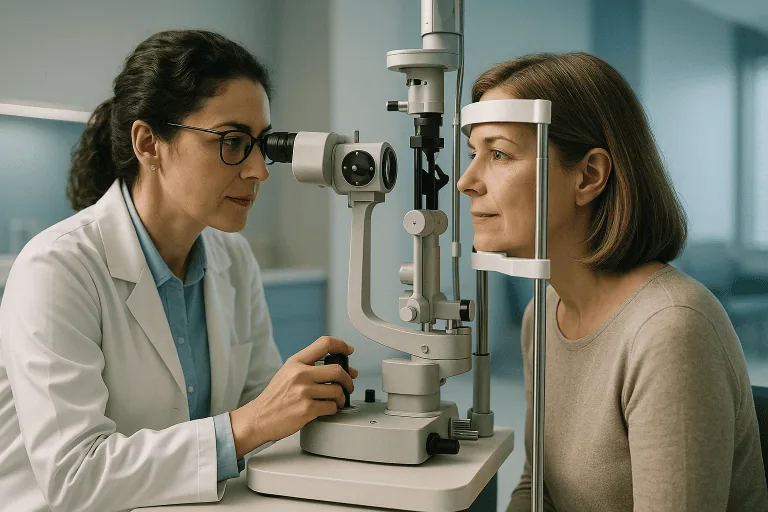
Presbyopia diagnosis is straightforward and painless. It is confirmed during a comprehensive eye examination performed by an eye-care professional, typically an ophthalmologist (a medical doctor specializing in eye conditions) or an optometrist. Within hospital settings such as Acibadem, presbyopia and related refractive conditions are evaluated within the ophthalmology specialty. No imaging scans or blood tests are needed to diagnose presbyopia itself; the diagnosis rests on your age, your symptoms, and the results of vision testing.
A typical examination may include:
- Visual acuity testingyou read letters on a standard eye chart at distance, and read small print on a near card held at reading distance, to measure how clearly you see at each range.
- Refraction assessmentthe examiner uses a device with interchangeable lenses (a phoropter) or an automated instrument to determine the exact lens power that gives you the sharpest vision, both for distance and for near. This identifies presbyopia and any coexisting refractive errors such as nearsightedness, farsightedness, or astigmatism (an irregular curvature of the eye’s surface that blurs vision at all distances).
- Measurement of accommodationthe doctor may assess how close an object can come to your eyes before it blurs, which reflects your remaining focusing ability.
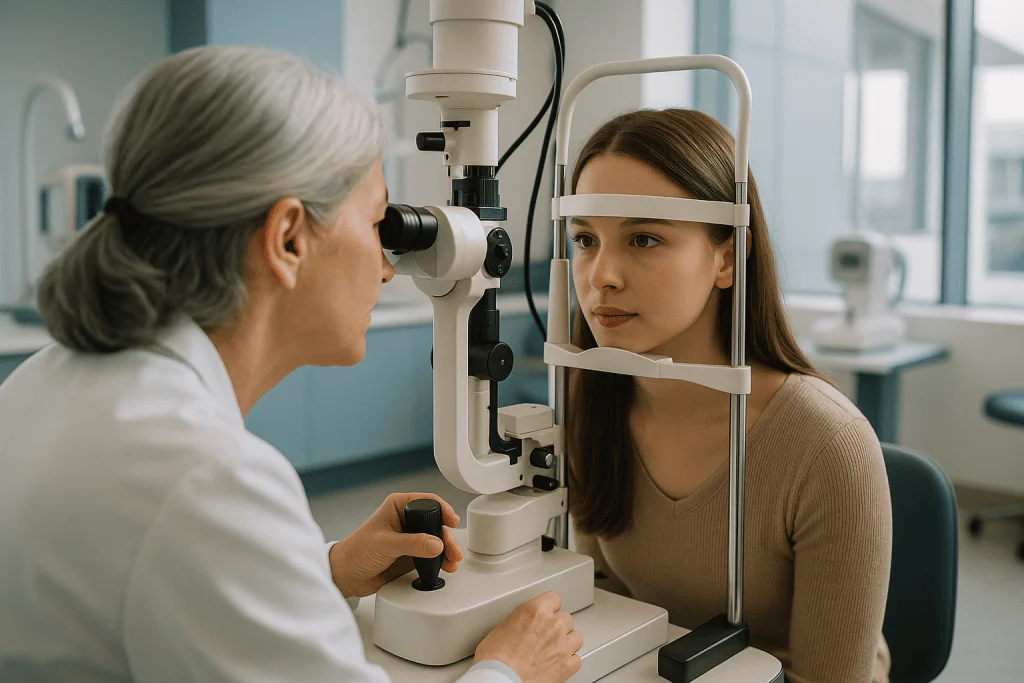
- Eye health examinationusing a microscope called a slit lamp and, often, eye drops that temporarily widen the pupil (dilation), the doctor examines the lens, retina (the light-sensing layer at the back of the eye), and optic nerve. This step is important because it helps rule out other conditions that can cause blurred vision, such as cataracts (clouding of the lens), glaucoma (damage to the optic nerve often related to eye pressure), or retinal disease.
Ruling out other causes matters because near blur is not always presbyopia. Early cataracts, uncontrolled blood sugar, and some medications can all change vision. A full examination allows the doctor to confirm that presbyopia is the explanation and that the rest of the eye is healthy. If drops are used to dilate your pupils, your vision may be blurry and light-sensitive for several hours afterward, so it is wise to arrange transportation and bring sunglasses.
Treatment options for presbyopia
There is currently no way to reverse the aging of the lens, but presbyopia treatment is well established and effective at restoring comfortable near vision for most people. The right option depends on your lifestyle, your other vision needs, your eye health, and your preferences. Care for presbyopia is typically coordinated through an ophthalmology department, where doctors can review the full range of options with you.
Glasses
Eyeglasses are the simplest and most common treatment. Options include:
- Reading glassessingle-power lenses used only for near tasks. Non-prescription versions are widely available and may be adequate for people with no other vision problems, though a prescription pair matched to each eye is often more comfortable.
- Bifocalslenses with a visible segment for near vision at the bottom and distance correction above.
- Progressive lenseslenses that change power gradually from distance at the top to near at the bottom, without a visible line. Many people prefer their appearance, though they can take some time to adapt to.
- Office or computer lensesdesigned for intermediate and near distances, useful for people who spend long hours at a desk.
Contact lenses
Contact lens options include multifocal lenses, which provide both distance and near focus in each lens, and monovision, in which one eye is corrected for distance and the other for near. Monovision works well for some people but reduces depth perception slightly, and not everyone adapts to it. A trial period with your eye doctor usually helps determine whether these approaches suit you.
Eye drops
In some countries, prescription eye drops have been approved that temporarily improve near vision, generally by making the pupil smaller, which increases the eye’s depth of focus. Their effect is temporary, they are not suitable for everyone, and they can cause side effects such as headache, eye redness, or dimmer vision in low light. Your doctor can advise whether this option is available and appropriate for you.
Surgical options
Several surgical approaches exist for people who prefer not to depend on glasses or contact lenses. All surgery carries risks, and none of these procedures restores the eye’s youthful focusing mechanism; instead, they compensate for its loss in different ways.
- Laser vision correctionprocedures such as LASIK can be used to create monovision, correcting one eye for distance and one for near, similar to monovision contact lenses. A contact lens trial is often recommended first to see whether you tolerate this arrangement.
- Corneal inlayssmall devices implanted in the cornea (the clear front surface of the eye) of one eye to improve near focus. Availability varies, and long-term results differ from person to person.
- Refractive lens exchangethe eye’s natural lens is removed and replaced with an artificial lens, similar to cataract surgery. Multifocal or extended-depth-of-focus artificial lenses can reduce dependence on glasses, though some people notice glare or halos, especially at night. When a person with presbyopia also develops cataracts, lens replacement addresses both conditions at once.
Watchful waiting and simple adjustments
Because presbyopia is not harmful to the eye itself, some people in the earliest stages manage with practical adjustments alone: brighter task lighting, larger fonts on phones and computers, and holding material at a comfortable distance. This is a reasonable approach as long as regular eye examinations continue and symptoms do not interfere with safety or daily life. In many cases, however, correction eventually becomes necessary as the condition progresses.
Living with presbyopia and outlook
The outlook for presbyopia is generally good. It does not cause blindness, does not damage the eye, and does not lead to other eye diseases. It is, however, progressive through midlife: your near-vision prescription will typically need to be strengthened every few years until the change levels off, usually sometime in your 60s. Regular eye examinations allow your prescription to be kept up to date and give your doctor the chance to detect unrelated age-related conditions, such as cataracts, glaucoma, or macular degeneration, which become more common in the same decades of life.
Day to day, most people adapt well. Helpful habits include using good lighting for reading and close work, taking regular breaks during long periods of screen use, keeping a spare pair of reading glasses where you use them most, and increasing text size on digital devices. If your work involves fine detail, mention this to your eye doctor, since lens designs can be tailored to specific working distances.
It is worth setting realistic expectations: no treatment currently restores the flexible, self-adjusting focus of a young lens, and every option involves some compromise. Even so, with appropriate correction, most people with presbyopia continue reading, working, and driving without significant limitation. Wearing corrective lenses does not weaken your eyes or accelerate the condition: this is a common misconception. Presbyopia progresses at its own pace regardless of whether you correct it.
Frequently asked questions
What is presbyopia in simple terms?
Presbyopia is the normal, age-related loss of the eye’s ability to focus on close objects. The natural lens inside the eye stiffens over time and can no longer change shape easily, so near vision becomes blurry while distance vision often remains unchanged. It typically becomes noticeable in the early to mid-40s and affects almost everyone eventually.
Can presbyopia heal or go away on its own?
No. Presbyopia does not heal or reverse, because it results from permanent age-related changes in the lens. It usually progresses gradually through midlife before stabilizing. Although it cannot be cured, it can be managed effectively in most cases with glasses, contact lenses, or, for some people, drops or surgical procedures.
How serious is presbyopia?
Presbyopia is not a disease and does not threaten your sight or the health of your eyes. It is an inconvenience rather than a danger. That said, uncorrected presbyopia can affect safety in situations that require clear near vision, such as reading medication labels, so appropriate correction and regular eye exams are sensible.
What is the difference between presbyopia and farsightedness?
Both make near objects blurry, but the causes differ. Farsightedness (hyperopia) is usually related to the shape of the eye and can be present from childhood. Presbyopia is caused by age-related stiffening of the lens and develops in adulthood. A person can have both at the same time, and an eye examination can distinguish between them.
Do eye exercises or diet improve presbyopia?
There is no reliable evidence that eye exercises, supplements, or specific diets can prevent or reverse presbyopia, since it stems from physical changes in the lens rather than muscle weakness that training could fix. A generally healthy lifestyle supports overall eye health, but it will not restore lost focusing ability. Be cautious of products that promise to cure presbyopia.
What is recovery like after presbyopia surgery?
Recovery depends on the procedure. After laser-based procedures, many people resume normal activities within days, while lens replacement surgery may involve a somewhat longer adjustment period, and the brain often needs weeks to adapt to new lens designs or monovision. Temporary effects such as glare, halos, or fluctuating vision can occur. Your surgeon can explain the expected recovery for your specific situation, since experiences vary from person to person.
At what age should I get checked for presbyopia?
Many eye-care organizations suggest a comprehensive eye examination around age 40, even without symptoms, because this is when presbyopia and several other eye conditions often begin. If you notice near blur, eye strain, or headaches with reading at any age, an examination is reasonable sooner. After 40, your doctor will recommend how often to return based on your eyes and overall health.
When to see a doctor
Gradual difficulty with near vision after age 40 is usually presbyopia and can be addressed at a routine eye examination. It is reasonable to schedule an exam if reading has become uncomfortable, if you rely on holding things at arm’s length, or if you experience frequent eye strain or headaches during close work.
However, some symptoms are not typical of presbyopia and need prompt medical attention, because they can signal more serious eye conditions such as retinal detachment, glaucoma, or problems with the blood supply to the eye. Seek urgent care if you experience any of the following:
- Sudden loss of vision in one or both eyes, even if it is partial or temporary.
- A sudden change in vision rather than the slow, gradual blur typical of presbyopia.
- Flashes of light or a sudden shower of new floaters (small dark spots or strands drifting across your vision).
- A shadow or curtain spreading across part of your visual field.
- Sudden double vision.
- Eye pain, significant redness, or halos around lights accompanied by blurred vision, nausea, or headache.
- Blurred vision after an eye injury of any kind.
These warning signs are unrelated to ordinary presbyopia and should never be attributed to aging without a proper examination. When in doubt, it is always safer to have your eyes checked promptly by a qualified eye-care professional.
Medically reviewed by the Acıbadem International Medical Board September 2, 2026
See our medical review board →
Update history
- PublishedJune 14, 2026
- Medical review approvedSeptember 2, 2026
- Last content updateSeptember 2, 2026