Presbyopia Treatment
Presbyopia treatment corrects age-related loss of near vision using options such as prescription lenses, laser procedures, or intraocular lens implants after a detailed eye examination.
Quick answer
Presbyopia treatment corrects age-related loss of near vision by improving the eye’s focusing ability with options such as glasses or contact lenses, laser vision correction, or lens-based procedures. At Acibadem in Turkey, care begins with a detailed eye examination to confirm the cause of blurred near vision and guide the most suitable treatment approach.
Presbyopia Treatment: Seeing Near Objects Clearly Again
Presbyopia treatment corrects the age-related loss of near focusing ability that makes reading, phone screens and other close work blurred from the early to mid-40s onwards. It ranges from reading glasses and contact lenses to eye drops, laser procedures and intraocular lens implants. No option reverses the ageing of the natural lens. Each one compensates for it in a different way, and the right choice depends on your eyes, your general health and your daily visual demands.
Presbyopia is one of the most common vision changes adults experience, yet it can feel surprisingly disruptive. You may notice that restaurant menus look blurred, phone text seems smaller than it used to, or reading is easier only when you hold material farther away. Tasks that were once automatic, checking a message, reviewing a document, threading a needle, reading medication labels, begin to require more effort, better lighting or frequent breaks.
For many people, presbyopia is also frustrating on a personal level. It tends to appear during an active stage of life, when professional responsibilities, travel, driving, digital work and family obligations all depend on comfortable vision. Some people worry that their eyesight is failing. Others are unsure whether they need simple reading glasses, a laser procedure or an implant-based solution.
Presbyopia is not a disease. It is an age-related focusing change that affects near vision. It still deserves careful evaluation, because it can occur alongside other eye conditions, cataract, dry eye, astigmatism, glaucoma, diabetic eye disease or changes from previous refractive surgery. The right treatment is not the same for every patient. It depends on your age, eye health, occupation, tolerance for reading glasses, driving habits and whether you already have cataracts or are likely to develop them.
At Acibadem, presbyopia treatment starts with a detailed eye examination and a realistic discussion of the options. The aim is not only to make reading more comfortable, but to protect the quality of your vision across distance, intermediate and near ranges in a way that fits how you actually live.
What Is Presbyopia?
What is presbyopia? It is the gradual, age-related decline in the eye’s ability to focus on near objects. In a younger eye, the natural lens changes shape easily, pulling close objects into sharp focus on the retina within a fraction of a second. Over the decades the lens stiffens, and the small muscles that flex it become less effective. The result is that near images no longer land in clear focus, while distance vision, in an otherwise healthy eye, may remain exactly as it was. This is why so many people in their 40s find they can still read road signs comfortably but struggle with a menu in dim light.
Presbyopia definition, causes and meaning
A working presbyopia definition: the progressive loss of the eye’s accommodative ability, its capacity to shift focus from far to near, caused by age-related stiffening of the crystalline lens and weakening of the focusing mechanism. It is a physiological change, not a disease, and it happens to essentially everyone who lives long enough, regardless of how good their eyesight was in youth. As for the presbyopia meaning, the word itself tells the story: it comes from Greekpresbys, meaning old or elder, and ops, meaning eye. Literally, the ageing eye. The name is apt, because unlike short-sightedness or long-sightedness, which reflect the shape of the eye, presbyopia reflects the passage of time inside a normally shaped eye.
What is the main cause of presbyopia?
The main cause of presbyopia is the gradual hardening of the eye’s natural lens. From childhood onwards, the lens slowly loses elasticity. In a young eye, the ciliary muscle contracts, the lens thickens and rounds, and near objects come into focus: a process called accommodation. As the lens stiffens, the same muscular effort produces less and less change in lens shape, so the eye can no longer bring close objects into sharp focus. Reduced effectiveness of the ciliary muscle itself contributes as well, but lens stiffening is the dominant factor. Because this process is driven by biology rather than behaviour, presbyopia cannot be prevented by eye exercises, diet or screen habits, although good lighting and an accurate prescription can make its symptoms far more manageable.
Is presbyopia nearsighted or farsighted?
Presbyopia is neither nearsightedness nor farsightedness, although its symptoms resemble farsightedness. Nearsightedness (myopia) and farsightedness (hyperopia) are refractive errors caused by the length or optical power of the eye: they are usually present from youth. Presbyopia is a focusing problem caused by ageing of the lens, and it arrives later in life. Confusingly, presbyopia can sit on top of any refractive state: a nearsighted person, a farsighted person and a person with previously perfect vision will all develop presbyopia. Nearsighted people sometimes notice it later or cope by removing their distance glasses to read, because their eyes are naturally focused at near. Farsighted people often notice presbyopia earlier and more intensely, because their eyes were already working harder to focus.
What is presbyopia vs myopia?
Presbyopia and myopia are different problems that can coexist in the same eye. Myopia means the eye focuses light in front of the retina, so distant objects are blurred while near objects are clear: it typically appears in childhood or adolescence and relates to the eye’s shape. Presbyopia means the lens can no longer flex to focus on near objects, so close work becomes blurred: it appears with age and relates to the lens’s flexibility. A person with myopia who reaches their mid-40s develops both at once: blurred distance vision from myopia and blurred near vision from presbyopia. That combination is exactly what progressive lenses, multifocal contact lenses and certain surgical strategies are designed to manage, correcting more than one focusing problem in a single plan.
Is There Any Treatment for Presbyopia?
Yes: there are several effective ways to treat presbyopia, though none of them makes the natural lens young again. Presbyopia treatment refers to the medical and optical methods used to compensate for the loss of near focusing ability: prescription lenses, contact lenses, eye drops in some countries, laser-based vision correction and intraocular lens implants. Which option is best depends on whether the eye is otherwise healthy, whether cataract is present, and how much independence from glasses you actually want.
Common presbyopia treatment options include:
- Reading glasses: simple lenses used for near tasks. Over-the-counter readers work for some people; prescription lenses give more accurate correction, particularly if the two eyes differ.
- Progressive or multifocal spectacles: lenses that provide different focusing zones for distance, intermediate and near vision without visible lines.
- Bifocal or trifocal spectacles: lenses with distinct optical segments for different distances.
- Contact lenses: multifocal contact lenses, or monovision, one eye optimised more for distance and the other more for near.
- Miotic eye drops: prescription drops available in some countries that temporarily sharpen near vision through a pupil effect.
- Laser vision correction strategies: procedures that reshape the cornea, often using a monovision or blended-vision approach in carefully selected patients.
- Intraocular lens implants: lens-based procedures, cataract surgery or refractive lens exchange, in which the natural lens is replaced with an artificial lens designed to widen the range of clear vision.
Each method has advantages and trade-offs. Glasses are non-invasive and flexible, but some people do not want to depend on them. Contact lenses reduce dependence on glasses but require comfort, hygiene and tolerance of lens wear. Drops are temporary and not suitable for everyone. Laser procedures suit selected patients, but not every cornea or prescription is appropriate. Lens implant procedures can address presbyopia and cataract together, but they involve surgery inside the eye and demand careful selection of the lens type. A high-quality presbyopia consultation therefore focuses on matching the treatment to the person, not simply correcting a number on an eye chart.
What are the best treatment options for presbyopia?
There is no single best treatment for presbyopia: the best option is the one that matches your eyes, your health and your daily visual priorities. For many people, well-fitted progressive glasses or a good pair of readers remain the simplest and safest answer. For someone who dislikes glasses and tolerates lens wear, multifocal or monovision contact lenses may be better. For a patient with developing cataract, cataract surgery with a carefully chosen intraocular lens can address both problems in one plan. For a healthy eye with a stable prescription and a strong preference for spectacle independence, laser blended vision or refractive lens exchange may be discussed. Anyone who claims one method is best for everyone is oversimplifying; honest planning starts from the individual eye.
How can you fix presbyopia?
You cannot reverse presbyopia, but you can correct its effects. The lens does not regain flexibility once it has stiffened, so every treatment works by compensating: adding focusing power optically (glasses, contact lenses), creating a pinhole effect (miotic drops), reshaping the cornea (laser correction) or replacing the stiff natural lens with an artificial one designed for a wider focusing range (lens implants). Because presbyopia continues to progress gradually until roughly the point where accommodation is fully lost, corrections chosen in the mid-40s often need adjusting over the following years, one reason a long-term plan matters more than a quick fix.
Presbyopia Glasses: Readers, Progressives and Occupational Lenses
Presbyopia glasses are the most common starting point and, for many people, the most appropriate long-term answer. The simplest form is a pair of reading glasses: single-vision lenses with added focusing power for near work. Off-the-shelf readers can work when both eyes have a similar, straightforward need; prescription readers are more accurate when the eyes differ, when astigmatism is present, or when you need a specific working distance: a musician reading a stand, for instance, needs a different focal distance from someone reading in bed.
Progressive lenses go further, blending distance, intermediate and near zones into one lens without a visible line. They suit people who need distance correction as well as near help and who do not want to swap glasses all day. They do require adaptation: the near zone sits low in the lens, peripheral areas carry some distortion, and it can take days to move your head and eyes in the way the lens expects. Bifocals and trifocals use distinct visible segments instead of a blend, less elegant, but some wearers find the defined zones easier to use. Occupational or office lenses are a further variation, optimised for the intermediate and near range of a desk and screen rather than for driving.
Anti-fatigue and enhanced single-vision designs sit between plain readers and full progressives, adding a small boost of near power towards the bottom of the lens. They can suit early presbyopia, when the eyes still accommodate partially but tire during long screen sessions. Lens design, coatings and frame fitting all affect how well presbyopia glasses actually perform, which is why two apparently similar pairs of spectacles can behave very differently in daily use, accurate measurement of the eyes and of the frame position on your face matters as much as the prescription itself.
Contact Lenses for Presbyopia
Contact lenses can correct presbyopia in two main ways. Multifocal contact lenses build several focusing zones into each lens, so both eyes receive distance and near information simultaneously and the brain learns to select the image it needs. Monovision uses standard lenses fitted differently in each eye: the dominant eye is corrected primarily for distance, the other for near. Both approaches work well for many wearers, and both involve compromise, multifocal designs can soften contrast slightly, while monovision reduces the sense of depth for some people and takes getting used to.
A trial period is usually recommended, because comfort, vision quality and adaptation vary widely from person to person. Fitting also has to account for dry eye, corneal shape and lens hygiene: an eye that is dry or irritated will not tolerate any lens design well, and treating the ocular surface first often makes the difference between success and abandonment. Contact lens trials serve one more purpose worth knowing about: they are frequently used to simulate monovision before laser surgery, letting you experience the visual arrangement before committing to it.
Eye Drops for Presbyopia
Eye drops for presbyopia are a newer, non-surgical option available in some countries. The main class is miotic drops, which temporarily constrict the pupil. A smaller pupil creates a pinhole effect that extends the eye’s depth of focus, sharpening near vision for a period of hours without changing the lens itself. The effect is temporary, wears off during the day, and is more useful in early presbyopia than in advanced near-focus loss. Drops can also cause side effects, dimmer vision in low light is a common one, and they are not suitable for everyone; certain retinal and other eye conditions rule them out.
Several branded miotic preparations exist, and their availability, formulation and regulatory approval vary considerably from country to country. Whether any drop is appropriate for your eyes is a decision for the ophthalmologist examining you, made after assessing your retina, your pupil behaviour and the stage of your presbyopia. In practice, drops tend to be used situationally, for a meeting, a restaurant, an evening of reading, rather than as an all-day correction, and they are typically combined with glasses or another method rather than replacing one. Drops do not replace an eye examination, and they do not slow the underlying stiffening of the lens: they manage the symptom for a few hours at a time.
Laser-Based Presbyopia Correction
Laser vision correction can reduce dependence on reading glasses in selected patients, most commonly through monovision or blended vision: the dominant eye is optimised for distance and the non-dominant eye is adjusted towards near or intermediate tasks. The brain merges the two images, and many adapted patients move through the day without reaching for readers. Before surgery, a contact lens simulation is often arranged so you can live with the arrangement first, some people adapt within days, others find the imbalance between the eyes intolerable, and it is far better to discover this before an irreversible corneal procedure.
The laser itself reshapes the cornea according to carefully planned measurements. The treatment is usually brief, and numbing drops are used for comfort during the procedure. Depending on the technique, a thin corneal flap or a surface-based approach may be used, and the treatment pattern is customised to your prescription, corneal characteristics and visual goals. Afterwards, medicated eye drops are prescribed and follow-up visits monitor healing, dryness and the balance between the two eyes.
Laser presbyopia correction is not appropriate for everyone. Thin or irregular corneas, unstable prescriptions, significant dry eye, certain autoimmune conditions, and some retinal and optic nerve conditions can all argue against it. It is also worth understanding a structural limitation: because the laser works on the cornea while presbyopia progresses in the lens, near vision needs can continue to change after treatment, and a patient who later develops cataract will still need lens surgery. The pre-operative evaluation exists precisely to surface these issues before a decision is made, not after.
Lens-Based Presbyopia Correction
Lens-based presbyopia correction replaces the stiff natural lens with an artificial intraocular lens, and it is the one approach that addresses presbyopia at its anatomical source. For patients with cataract, cataract surgery is often the natural opportunity: the cloudy natural lens is removed and replaced with a clear implant. Depending on eye health and goals, that implant may be monofocal, toric for astigmatism, multifocal, trifocal or extended-depth-of-focus. Some patients choose monovision with lens implants; others choose lenses designed to provide a broader range of vision from a matched pair.
For patients without cataract but with a strong wish to reduce dependence on glasses, refractive lens exchange may be discussed. The procedure is essentially the same as cataract surgery, performed before the lens has clouded into a visually significant cataract. Because it is intraocular surgery on an otherwise healthy eye, the decision demands careful weighing of age, prescription, retinal status, lens choice and risk profile: it is a considered choice, not a default.
Lens procedures are typically performed under local anaesthesia with eye drops or regional techniques, often with light sedation when appropriate. The surgeon creates very small incisions, removes the natural lens using ultrasound-based technology, and places the selected intraocular lens inside the eye. The operation itself commonly takes a short time per eye, though you should allow additional hours for preparation and recovery on the day. Many patients have one eye treated first and the second eye later, depending on the plan. Lens choice is the single most consequential decision in this pathway: multifocal and extended-range designs can reduce dependence on glasses, but they can also produce halos, glare or contrast changes in some eyes, and they demand a healthy retina and cornea to perform well. That is why the lens discussion deserves unhurried time and plain language, and why the measurements behind it, biometry, corneal assessment, retinal imaging, matter as much as the lens brochure.
Who May Need Presbyopia Treatment
Most adults begin to notice presbyopia in their early to mid-40s, although the timing varies. People who already wear distance glasses or contact lenses experience the change differently. Nearsighted patients may find that removing their distance glasses helps them read. Farsighted patients often notice symptoms earlier or more intensely. People who spend long hours on computers, tablets, smartphones or detailed near work tend to become aware of presbyopia sooner, simply because their days place greater demand on near and intermediate vision.
Typical symptoms include:
- Blurred vision when reading books, menus, phone screens, documents or labels
- Holding reading material farther away to make it clearer
- Eye strain, tired eyes or headaches after near work
- Difficulty seeing in dim lighting
- Needing brighter light for reading
- Trouble switching focus between near and far objects
- Reduced comfort during computer work or prolonged screen use
- Frequent changes in reading glasses strength
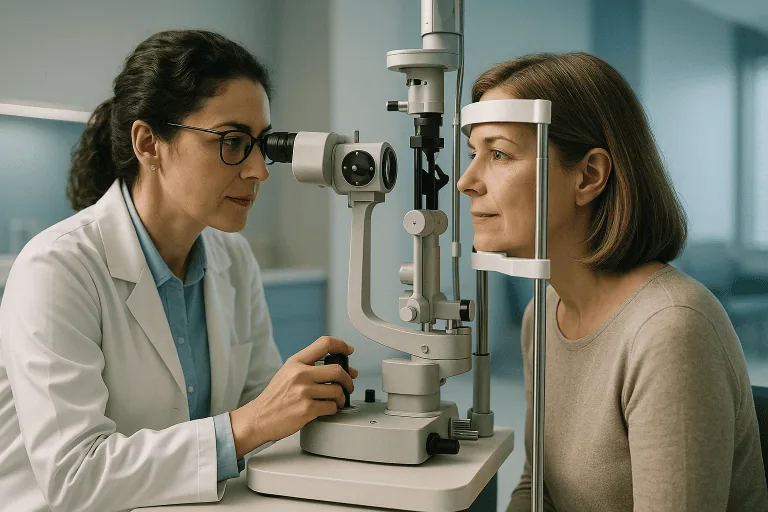
Presbyopia is diagnosed through a comprehensive eye examination. This usually includes visual acuity testing, refraction to measure the prescription, near vision assessment and evaluation of eye health. The ophthalmologist may also assess the cornea, lens, retina, eye pressure, tear film and pupil behaviour. For patients considering laser or lens implant procedures, additional diagnostic imaging is usually necessary: corneal mapping, corneal thickness measurement, tear film evaluation, optical biometry for lens implant planning, retinal imaging and optical coherence tomography when indicated. These tests determine whether the eye is suitable for surgery, whether other conditions could affect the result, and which plan is most likely to deliver a balanced outcome.
People seek presbyopia treatment in several recognisable situations. Some want a reliable prescription for reading or progressive glasses. Others are tired of carrying multiple pairs. Some cannot get on with contact lenses and want another route. Patients with cataracts may want to correct cloudy vision and near vision in the same surgical plan. Others had laser vision correction years ago and are now noticing age-related near blur, which requires specialised assessment because the cornea has already been reshaped. In every case, the evaluation has to consider both today’s symptoms and the eye’s likely trajectory over the next decade.
Conditions and Indications Presbyopia Treatment Addresses
Presbyopia treatment is primarily used to correct age-related near vision loss. Because near vision sits within the broader optical system of the eye, however, treatment planning often addresses related focusing and lens conditions at the same time.
Presbyopia treatment may be considered for:
- Age-related near vision difficulty: the classic indication, usually beginning after 40.
- Presbyopia with nearsightedness, farsightedness or astigmatism: many patients need correction for multiple refractive errors, not near vision alone.
- Presbyopia with early or established cataract: cataract surgery can be planned with intraocular lenses that also reduce dependence on reading glasses in appropriate patients.
- Presbyopia after previous laser vision correction: patients who had LASIK or similar procedures may later develop presbyopia and need specialised assessment of the altered cornea.
- Computer vision and occupational near-vision needs: people who work at intermediate distances may benefit from customised optical correction or tailored surgical planning.
- Contact lens intolerance: patients who cannot comfortably wear multifocal or monovision contact lenses may explore alternatives.
- A wish to reduce dependence on reading glasses: some patients are good candidates for laser or lens-based solutions; others are genuinely better served by modern glasses or contact lenses.
Not every patient who wants freedom from reading glasses is a surgical candidate. Significant dry eye, irregular corneas, unstable prescriptions, uncontrolled glaucoma, retinal disease, advanced diabetic eye disease or unrealistic expectations can all make certain procedures less suitable. A careful evaluation protects you from treatments that would not serve you well, declining to operate is sometimes the most valuable recommendation an ophthalmologist makes.
How Presbyopia Treatment Is Planned, Step by Step
Presbyopia treatment begins with understanding your eyes and your daily life, because two patients with the same age and prescription may need entirely different solutions. A surgeon, architect, pilot, teacher, executive, athlete or frequent traveller each has different visual priorities. Some value the sharpest possible night-driving vision. Others prioritise reading and screen comfort. Some accept a small amount of glasses use; others strongly prefer a surgical option. The pathway below reflects how a thorough clinic works through those questions.
Step 1: Comprehensive Eye Examination
The first step is a detailed ophthalmic assessment. Your doctor evaluates distance, intermediate and near vision; measures your prescription; examines the front and back of the eye; and looks for cataract, dry eye, corneal irregularity, retinal disease, glaucoma risk and anything else that could steer the treatment choice. For surgical candidates, advanced testing follows: corneal topography or tomography maps the shape of the cornea, pachymetry measures its thickness, tear film testing identifies dry eye that could distort measurements, optical biometry measures the eye for intraocular lens calculations, and retinal imaging or optical coherence tomography assesses the macula and optic nerve when clinically indicated. This is where avoidable surprises are caught.
Step 2: Discussion of Lifestyle and Visual Goals
Presbyopia correction involves choices, and the trade-offs need to be on the table before anything else happens. Some options provide excellent reading vision but require adaptation. Others preserve strong distance vision but still leave you reaching for glasses over fine print. Your physician will ask how much near vision you actually need, whether you drive often at night, how much time you spend on screens, whether you play sports, and whether you can tolerate a difference between the eyes. This conversation matters most for monovision and multifocal strategies: monovision works well for many, but some dislike the imbalance or notice reduced depth perception; multifocal and extended-range implants reduce dependence on glasses, but can cause halos, glare or contrast changes in some eyes. Understanding this before treatment is the whole point of the consultation.
Step 3: Trialling Non-Surgical Options First
For many patients, the first and most appropriate treatment is optical. Prescription reading glasses can be customised for the exact working distance you need. Progressive lenses cover distance, intermediate and near in a single pair. Occupational lenses can be designed specifically for computer and office use. Contact lens options, multifocal or monovision, are usually trialled over a period, both to test comfort and, in the case of monovision, to preview a visual arrangement that a laser procedure might later make permanent. Where available and appropriate, miotic drops may also be considered at this stage. Nothing here is irreversible, which is precisely its value.
Step 4: Laser Correction, If Suitable
If the assessment and trials point towards laser correction, the plan is finalised from your corneal maps, prescription and visual goals, most often as monovision or blended vision. The treatment itself is brief and performed with numbing drops; a flap-based or surface-based technique is chosen according to your cornea. Medicated drops follow, and healing is monitored across scheduled visits. Candidacy limits from Step 1 apply strictly: a marginal cornea is a reason to choose a different pathway, not to proceed hopefully.
Step 5: Lens Surgery, If Chosen
If cataract is present, or refractive lens exchange has been chosen after careful discussion, the intraocular lens is selected from your biometry, retinal status and goals, monofocal, toric, multifocal, trifocal, extended-depth-of-focus, or a monovision arrangement. Surgery is typically done one eye at a time under local anaesthesia, through very small incisions, with light sedation when appropriate. On the day itself there are practical rules about what to bring and what to leave out: the guide on contact lenses, glasses, hearing aids and dentures on procedure day covers what patients are usually asked to do, since contact lens wear in particular has to be paused before measurements and surgery to keep the corneal readings honest.
Step 6: Recovery and Follow-Up
Recovery depends on the treatment. With glasses, adaptation may take a few days, particularly with progressives. Contact lenses need a fitting period and sometimes adjustments. After laser treatment, many patients notice functional improvement within days, while vision continues to stabilise over the following weeks. After lens implant surgery, vision often improves quickly, but the eye continues to heal and adapt over several weeks. Follow-up visits check visual acuity, eye pressure, corneal healing, inflammation, lens position where applicable, and symptoms such as dryness, glare, halos or imbalance between the eyes. Some patients need fine-tuning of the prescription, treatment for dry eye, or simply more time for neuroadaptation: the brain’s process of learning to use a new visual system.
Why Acting Early Matters
Presbyopia itself is not an emergency, and it does not usually threaten eye health. Delaying evaluation still carries costs. Many people compensate by turning up screen brightness, holding text at arm’s length, squinting, or using non-prescription readers poorly matched to their eyes. Over time this feeds headaches, eye strain, reduced productivity and difficulty with detailed tasks, all of it avoidable with an accurate correction.
More importantly, near-vision symptoms overlap with other eye conditions. Cataract causes glare, blur and reading difficulty. Dry eye makes vision fluctuate. Glaucoma and retinal diseases can be silent in their early stages yet detectable during a comprehensive examination. Diabetes and high blood pressure can affect the retina. A presbyopia assessment is often the appointment at which one of these conditions is picked up early, which is a far better outcome than discovering it late.
Early evaluation also protects your options. If you are developing cataracts, a lens-based plan will usually make more sense than a corneal laser procedure that would need revisiting. If dry eye is significant, treating the ocular surface first improves both comfort and measurement accuracy. If you turn out to be a strong candidate for contact lenses or progressive glasses, you may reasonably avoid surgery altogether. Acting early does not commit you to anything; it gives you more choices and better information.
Benefits of Presbyopia Treatment
The benefits depend on the method chosen, but the goal is always the same: better visual function in daily life, without trading away something you value more.
| Benefit | What It Means for You |
|---|---|
| Clearer near vision | Reading, phone use, labels, menus and close-up tasks become easier and less tiring. |
| Reduced eye strain | Accurate correction can lessen headaches, squinting, fatigue and the need to hold text at an uncomfortable distance. |
| Better visual comfort across distances | Progressive lenses, contact lens strategies, laser planning or lens implants can improve the balance between distance, intermediate and near vision. |
| Less dependence on reading glasses in selected patients | Some laser and lens-based approaches reduce the need for readers, although occasional glasses may still be needed for fine print or low light. |
| Opportunity to address related eye problems | A comprehensive examination can identify cataract, dry eye, astigmatism, retinal changes or glaucoma risk that influences treatment. |
| Personalised long-term planning | Treatment can be chosen with future eye changes in mind, especially if cataract is present or likely to become relevant. |
Recovery Timeline After Presbyopia Treatment
Recovery varies according to whether treatment involves glasses, contact lenses, drops, laser correction or intraocular lens implantation. The table below sets out broad expectations rather than promises: your own timeline is set by your eye and your surgeon’s guidance.
| Time Period | What Patients Can Expect |
|---|---|
| Day 1 | With glasses or contact lenses, vision may improve immediately, though adaptation may be needed. After laser or lens surgery, mild irritation, watering, light sensitivity or blurred vision can occur. |
| First week | Many patients return to routine activities, depending on the procedure and their physician’s guidance. Prescribed eye drops are used after surgery. Vision may fluctuate, especially if dryness is present. |
| First month | Vision usually becomes more stable. Follow-up visits assess healing, eye pressure, visual balance and whether any prescription adjustment is needed. |
| Longer term | The brain continues adapting to monovision, multifocal optics or lens implants. Some patients still use glasses for fine print, prolonged reading or night driving, depending on the chosen method. |
Factors That Influence Outcomes
A good result in presbyopia treatment depends on accurate diagnosis, appropriate patient selection, precise measurement and realistic expectations. Correcting presbyopia is not simply a matter of making near vision sharper: it requires balancing the whole visual system, and several factors shape what any given method can achieve.
- Age and stage of presbyopia: early presbyopia is managed differently from advanced near-focusing loss, and corrections chosen early often need updating.
- Distance prescription: nearsightedness, farsightedness and astigmatism each narrow or widen the menu of suitable options.
- Corneal health: thickness, shape, scarring and irregularity are critical for laser planning.
- Tear film quality: dry eye reduces measurement accuracy and causes fluctuating vision after treatment.
- Lens clarity: cataract changes usually make lens-based treatment more sensible than corneal laser correction.
- Retinal and optic nerve health: macular disease, glaucoma or diabetic eye changes can rule out multifocal or extended-range implants.
- Pupil size and night-vision needs: these influence the risk of glare, halos or reduced contrast sensitivity.
- Visual priorities: a frequent night driver needs a different plan from someone who mainly wants reading and computer comfort.
- Adaptation to monovision or multifocality: some patients adapt quickly; others prefer both eyes corrected the same way, and a trial usually reveals which camp you are in.
- Previous eye surgery: prior LASIK, PRK, cataract surgery or retinal procedures require specialised planning and adjusted calculations.
Outcome discussions should be honest and individual. Many patients achieve meaningful improvement in near vision and daily comfort. Some reduce dependence on reading glasses substantially. Others are best served by a combined approach, distance correction plus glasses for fine near work, or cataract surgery with occasional readers. A successful plan is one that supports your daily activities safely and predictably, not one that promises a single ideal solution for every person. Any clinic that presents one procedure as the answer for all comers, before examining your eyes, is telling you more about its sales process than its medicine.
How Presbyopia Care Is Organised at Acibadem
Choosing where to have presbyopia treatment involves more than choosing a procedure. It requires confidence in the diagnostic process, the medical team, communication and follow-up planning. At Acibadem, ophthalmology sits within a broader hospital structure, which matters when presbyopia overlaps with cataract, corneal disease, retinal conditions, glaucoma risk, diabetes or previous eye surgery: patients in these situations can benefit from input across subspecialties, so that recommendations rest on the health of the whole eye rather than only the wish for near-vision correction.
Diagnostic pathways are central to how the planning works. Depending on the patient, evaluation may include corneal mapping, ocular surface assessment, retinal imaging, optical coherence tomography, eye pressure measurement and precise biometry for intraocular lens selection. These measurements are what separate a patient better suited to glasses or contact lenses from one who is a reasonable candidate for laser correction, cataract surgery or refractive lens exchange, and they are also what identify the patients for whom surgery is not advisable.
For patients considering intraocular lenses, the selection discussion is deliberately unhurried, because different lens designs create different visual experiences. A monofocal lens provides excellent clarity at one main distance and can be combined with glasses or a monovision arrangement. Toric lenses correct astigmatism. Multifocal, trifocal and extended-range lenses can reduce dependence on glasses in selected patients, but must be chosen against retinal health, corneal quality, pupil behaviour and tolerance for optical phenomena such as glare or halos. The consultation is meant to make these differences plain in ordinary language, including the trade-offs.
For surgical patients, the care plan sets out a clear follow-up schedule before anything is booked: which checks happen in the first days after a laser or lens procedure, when eye pressure and healing are reviewed, and at what point the prescription is considered stable enough for final glasses, if any are needed. Healing after intraocular surgery continues for weeks, and neuroadaptation to multifocal optics or monovision can take longer still, so the follow-up calendar is treated as part of the treatment itself rather than an afterthought.
Living Well After Presbyopia Treatment
Presbyopia is a normal part of ageing, but living with unnecessary blur, strain or improvised workarounds is not. Today’s presbyopia treatment options run from highly customised glasses and contact lenses through drops to laser procedures and advanced intraocular lens implants, and each has a legitimate place. The right choice starts with a careful diagnosis and a frank conversation about your eyes, your lifestyle and your expectations, including the possibility that the best recommendation is the simplest one. Whatever path fits, an accurate, current correction tends to repay itself daily: in easier reading, calmer screen work, safer driving and the quiet absence of the strain you had stopped noticing you carried.
Preparation
- A comprehensive eye examination is performed to assess vision, corneal health, eye pressure, and lens status. Patients should bring current glasses or contact lens prescriptions and inform the doctor about eye diseases, medications, and previous eye surgery. Contact lenses may need to be stopped before measurements if laser or lens-based correction is planned.
Aftercare
- After treatment, follow-up visits check vision quality, healing, and eye pressure when needed. If drops are prescribed, they should be used exactly as directed, and patients should avoid rubbing the eyes. Temporary glare, dryness, or adaptation to near and distance vision may occur depending on the chosen method.
Frequently Asked Questions
What affects the cost of presbyopia treatment?
The main factors are the treatment option, diagnostic tests, eye health, surgeon and hospital setting, laser or lens technology, medications, and follow-up needs. International patients should also consider travel, accommodation, and language support.
How can I get a personalised quote?
A personalised quote requires a detailed eye assessment and review by an ophthalmology specialist. You can request a free consultation so the team can evaluate your vision goals, medical history, and likely treatment options.
Is lens implant surgery more expensive than glasses or contact lenses?
Lens implant surgery usually involves more resources because it requires operating room conditions, advanced diagnostics, specialist planning, and intraocular lens selection. Glasses and contact lenses are non-surgical and usually have a different cost structure.
Does the type of intraocular lens affect the quote?
Yes. Lens design, astigmatism correction, distance range, and the technology used for planning can influence the final quote. The most appropriate lens is chosen after specialist examination and discussion of your lifestyle needs.
Are travel and follow-up included in presbyopia treatment packages?
Package inclusions vary by provider. Some international patient programs may help coordinate appointments, interpreter support, accommodation guidance, and follow-up planning, while travel and hotel expenses may be separate.
Medically reviewed by the Acıbadem International Medical Board August 31, 2026
See our medical review board →
Update history
- PublishedJune 8, 2026
- Medical review approvedAugust 31, 2026
- Last content updateAugust 31, 2026
References1
- Presbyopia my.clevelandclinic.org
Trusted care for international patients
From the Acibadem Blog

Presbyopia Treatment Options Ranked by Invasiveness: Readers, Contacts, Drops, Laser, Lenses
Presbyopia treatment options, from least to most invasive, are over-the-counter or prescription reading glasses, progressive or bifocal lenses, multifocal or monovision contact lenses, prescription…