Cataracts
Learn what cataracts are, common cataracts symptoms and causes, how doctors confirm the diagnosis, and treatment options from glasses to lens replacement surgery.

Quick answer
Cataracts are a clouding of the eye's natural lens that causes blurred, dim, or glare-sensitive vision. They most often develop slowly with age, but injury, diabetes, certain medicines, and inherited factors can also cause them. Diagnosis is made by an eye examination, and surgery to replace the cloudy lens is the only effective treatment when vision is significantly affected.
What is cataracts?
A cataract is a clouding of the natural lens of the eye. The lens is a clear, flexible structure that sits behind the colored part of the eye (the iris) and focuses light onto the retina, the light-sensitive tissue at the back of the eye. When the lens becomes cloudy, less light reaches the retina and the light that does pass through is scattered, so vision becomes blurred, dim, or hazy. People often describe it as looking through a frosted or fogged-up window.
When people ask “what is cataracts,” they are usually thinking of the age-related type, which is by far the most common. The lens is made mostly of water and protein. Over many years, some of that protein can clump together and the lens gradually loses its clarity. This process is a normal part of aging for many people, and cataracts are one of the leading causes of reduced vision in older adults worldwide.
Cataracts can affect one eye or both, although they often develop at different rates in each eye. Less commonly, cataracts occur in younger adults, in children, or even at birth (congenital cataracts). They can also develop after an eye injury, as a result of another eye disease, or as a side effect of certain medicines. Cataracts are not a growth or a film on the surface of the eye and they do not spread from one eye to the other.
Cataracts symptoms
Cataracts symptoms usually develop slowly. In the early stages, many people notice little or no change in their sight, and the cataract may only be found during a routine eye examination. As the clouding progresses, the following symptoms often appear:
- Blurred, cloudy, or misty vision that does not fully clear with glasses
- Increased sensitivity to glare, especially from headlights, sunlight, or bright lamps
- Difficulty seeing at night or in low light
- Halos or starbursts around lights
- Colors that look faded, dull, or yellowish
- Frequent changes in glasses or contact lens prescription
- Double vision in one eye (this often disappears as the cataract advances)
- Needing brighter light for reading and close work
Symptoms can vary depending on where the clouding sits within the lens. A cataract in the center of the lens (a nuclear cataract) often causes a gradual worsening of distance vision, and some people briefly notice that their near vision improves before it declines; this is sometimes called “second sight.” A cataract at the edge of the lens (a cortical cataract) tends to cause problems with glare and contrast because light is scattered as it enters the eye. A cataract at the back of the lens (a posterior subcapsular cataract) can progress faster and often interferes with reading and with vision in bright light, even while the overall cataract appears small.
Cataracts are not painful and do not usually cause redness, discharge, or itching. If those symptoms occur, another condition is more likely to be the cause and should be assessed separately.
Cataracts causes and risk factors
The main cause of cataracts is aging. Over time, the proteins and fibers in the lens break down and clump together, and the lens may also take on a yellow or brown tint. This is why most cataracts are seen in people over the age of 60, although the process often begins earlier and simply takes years to affect vision.
Other recognized cataracts causes include:
- Eye injury, including blunt trauma or a penetrating wound (traumatic cataract), which may appear soon after the injury or years later
- Eye surgery, such as surgery for retinal problems, which can speed up lens clouding
- Other eye conditions, such as long-standing inflammation inside the eye (uveitis) or advanced glaucoma
- Long-term use of corticosteroid medicines, whether taken by mouth, inhaled in high doses, or used as eye drops
- Radiation exposure, including radiation treatment to the head or eye
- Congenital and childhood cataracts, which may be inherited, linked to an infection during pregnancy, or associated with certain genetic conditions
Several factors are known to increase the risk of developing cataracts or to make them appear at a younger age. These include diabetes, particularly when blood sugar is poorly controlled over a long period; smoking; heavy alcohol use; prolonged exposure to ultraviolet (UV) light from the sun without eye protection; high blood pressure; obesity; and a family history of cataracts. Some research suggests that diet and general health play a role, but no single food or supplement has been proven to prevent cataracts. Having one or more risk factors does not mean a person will definitely develop cataracts, and many people with none of them do.
Cataracts diagnosis
Cataracts diagnosis is made by an eye care professional, usually an ophthalmologist (a medical doctor who specializes in eye diseases and eye surgery) or an optometrist (an eye care practitioner who examines eyes and prescribes glasses). The assessment is painless and is typically done in a clinic in a single visit.
The examination usually includes:
- Medical and vision history. Your doctor will ask how your vision has changed, whether glare or night driving is a problem, what medicines you take, and whether you have conditions such as diabetes.
- Visual acuity test. You read letters of decreasing size on a chart, one eye at a time, to measure how sharply you see at a distance and up close.
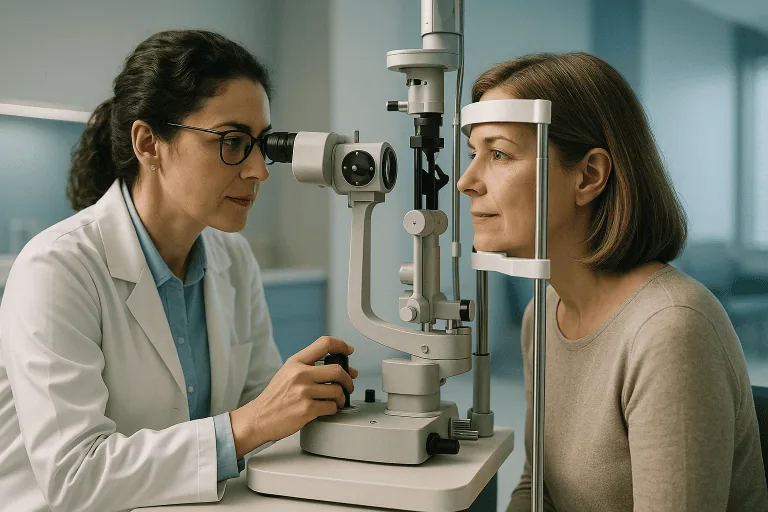
- Slit-lamp examination. A slit lamp is a microscope with a bright, narrow beam of light. It lets the doctor examine the front structures of the eye, including the cornea, iris, and lens, in fine detail and see exactly where the lens is cloudy and how dense the clouding is.
- Dilated eye examination. Eye drops are used to widen (dilate) the pupil so that the whole lens and the retina behind it can be examined. This helps confirm the cataract and check for other conditions, such as age-related macular degeneration or diabetic changes, that could also be affecting vision. Your vision will be blurry and light-sensitive for a few hours afterward.
- Tonometry. A quick measurement of the pressure inside the eye, used mainly to screen for glaucoma at the same visit.
Additional tests may be used in some cases. A contrast sensitivity test measures how well you distinguish objects from their background, which can show the effect of a cataract even when the letter chart looks fairly good. A glare test measures how much a bright light reduces your vision. If surgery is being planned, measurements of the length and curvature of the eye (biometry) and scans of the retina are taken to choose the right artificial lens and to make sure the back of the eye is healthy.
There is no single number that defines when a cataract is “significant.” Doctors combine the findings of the examination with how much the cataract interferes with daily life. Cataracts are usually managed in an ophthalmology department; at Acibadem, for example, this is the specialty responsible for both diagnosis and surgical care of cataracts.
Cataracts treatment options
Cataracts treatment options depend mainly on how much the cataract affects your vision and your daily activities. There is currently no medicine, eye drop, diet, or exercise that has been proven to reverse or dissolve a cataract. Treatment falls into two broad approaches: managing symptoms while the cataract is mild, and surgery when it becomes troublesome.
Observation and non-surgical measures. In the early stages, many people manage well with simple adjustments. Your doctor may suggest:
- Updating your glasses or contact lens prescription
- Using brighter, well-directed lighting for reading and close tasks
- Wearing anti-glare sunglasses and a brimmed hat outdoors
- Using magnifying lenses for small print
- Limiting night driving if glare is a problem
These measures do not stop the cataract from progressing, but they can make everyday life easier for months or years. Regular check-ups allow the doctor to monitor the cataract and other aspects of eye health.
Cataract surgery. Surgery is the only effective treatment for a cataract that is significantly affecting vision. It is one of the most commonly performed operations in the world and is generally considered safe and effective, although, like all surgery, it carries some risks. During the procedure the cloudy natural lens is removed and, in most cases, replaced with a clear artificial lens called an intraocular lens (IOL). The operation is usually done under local anesthetic (numbing drops or an injection around the eye) with the patient awake but relaxed, and it typically takes well under an hour. Most people go home the same day.
The most widely used technique is phacoemulsification, in which a small incision is made at the edge of the cornea and a fine ultrasound probe breaks the cloudy lens into tiny pieces, which are then suctioned out. The folded artificial lens is inserted through the same small incision and unfolds into position. In some centers a laser is used to perform certain steps of the operation; this is an alternative approach rather than a different treatment, and your surgeon can explain whether it is relevant to your case. When a cataract is very dense or other eye problems are present, a larger incision technique may be needed.
Artificial lenses come in several types. A monofocal lens gives clear focus at one distance, usually far, so glasses are still needed for reading. Multifocal or extended-depth-of-focus lenses aim to reduce the need for glasses at several distances, and toric lenses correct astigmatism (an irregular curvature of the cornea). Each type has advantages and trade-offs, and not every option suits every eye; your surgeon will discuss which is appropriate for you.
If both eyes have cataracts, surgery is usually performed on one eye first and the second eye some weeks later, once the first has recovered, although in some cases both may be treated closer together.
Recovery and rehabilitation. After surgery, most people notice clearer vision within a few days, although it can take several weeks for the eye to settle fully. You will typically be given antibiotic and anti-inflammatory eye drops for a period, and asked to avoid rubbing the eye, swimming, heavy lifting, and dusty environments for a short time. A follow-up visit checks healing, and a new glasses prescription is usually given once vision has stabilized. Possible complications include infection, inflammation, swelling of the retina, retinal detachment, and a later clouding of the thin membrane behind the artificial lens (posterior capsule opacification), which can often be treated with a brief laser procedure. Serious complications are uncommon, but your surgeon will explain the specific risks before you decide.
Living with cataracts and outlook
Cataracts are generally a slowly progressive condition, and a diagnosis does not mean that surgery is needed right away. Many people live with mild cataracts for years, adjusting their lighting, glasses, and activities. Because a cataract does not usually harm the eye simply by being there, the timing of surgery is often a personal decision based on how much your vision affects your reading, work, driving, hobbies, and safety. Delaying surgery does not typically make the operation less successful, although very advanced cataracts can be slightly harder to remove, and a dense cataract makes it difficult for your doctor to examine the retina for other problems.
For most people who have surgery, vision improves considerably, and the artificial lens is intended to last for the rest of their life. However, the outcome depends on the overall health of the eye. If there is also disease of the retina or optic nerve, such as macular degeneration, glaucoma, or diabetic retinopathy, vision may remain limited even after the cataract has been removed. Your doctor should be able to give you a realistic idea of what to expect based on your examination.
Practical steps that may help while living with cataracts include keeping your glasses prescription current, keeping surfaces and stairs well lit, reducing glare from screens and windows, using large-print materials, and being cautious about driving at night if you notice halos or glare. Managing conditions such as diabetes and high blood pressure, not smoking, and protecting the eyes from UV light are sensible for general eye health and may slow progression, although they cannot reverse an existing cataract.
Frequently asked questions
What are the first signs of cataracts?
The earliest cataracts symptoms are often subtle: slightly blurred or hazy vision, more trouble with glare from headlights or the sun, and needing more light to read. Some people notice that colors seem less vivid or that their glasses prescription changes more often than before. Because these changes are gradual, many early cataracts are first detected during a routine eye examination rather than because of symptoms.
Can cataracts be treated without surgery?
At present there is no proven medical treatment that removes or reverses a cataract. Non-surgical cataracts treatment options, such as new glasses, better lighting, and anti-glare lenses, can ease symptoms in the early stages but do not change the lens itself. When a cataract begins to interfere with daily life, surgery to replace the cloudy lens is the only effective option. Your doctor can help you weigh when that point has been reached.
How is a cataracts diagnosis confirmed?
A cataract is confirmed by an eye examination. The doctor measures your vision with a letter chart, then uses a slit lamp, a special microscope with a bright beam of light, to look directly at the lens. Dilating drops are usually given to widen the pupil so the whole lens and the retina can be checked. These tests together show whether a cataract is present, how dense it is, and whether anything else is contributing to your vision problems.
What causes cataracts at a young age?
Although aging is the most common of all cataracts causes, cataracts in younger people may be related to diabetes, eye injury, previous eye surgery, inflammation inside the eye, long-term corticosteroid use, radiation exposure, or an inherited tendency. Babies can be born with cataracts, sometimes linked to genetic conditions or infections during pregnancy. When a cataract appears unusually early, a doctor may look for an underlying cause.
Do cataracts come back after surgery?
A cataract cannot return once the natural lens has been removed, because the artificial lens does not become cloudy in the same way. However, some people later develop clouding of the thin capsule that holds the new lens in place, a condition called posterior capsule opacification. This can cause vision to become blurry again, sometimes months or years after surgery, and it can usually be treated with a short outpatient laser procedure.
Can cataracts cause blindness?
If left untreated for a very long time, a cataract can eventually become so dense that only light and dark can be seen. This is uncommon where eye care is accessible, because surgery is usually performed well before that stage. Importantly, vision lost to a cataract alone can generally be restored by surgery, which differs from vision loss caused by damage to the retina or optic nerve. Regular eye examinations help ensure cataracts are monitored and treated in good time.
Is cataract surgery painful?
Cataract surgery is usually performed under local anesthetic, so the eye is numb and most people feel pressure or mild discomfort rather than pain. Sedation may be offered to help you relax. After the operation the eye may feel gritty, itchy, or mildly sore for a few days, and it may be sensitive to light. Significant or increasing pain after surgery is not expected and should be reported to your surgeon promptly.
When to see a doctor
Cataracts themselves develop slowly and are not an emergency, but any change in vision deserves a professional eye examination, particularly if it interferes with reading, driving, or work, or if you are over 60 and have not had your eyes checked recently. Seek medical attention promptly, on the same day if possible, if you experience any of the following, as they may indicate a different and more urgent eye problem:
- Sudden loss of vision or a sudden, marked increase in blurriness in one or both eyes
- Sudden onset of flashes of light, a shower of new floaters, or a dark curtain or shadow moving across your field of vision, which can be signs of a retinal tear or detachment
- Severe eye pain, especially with headache, nausea, vomiting, or a red eye, which can indicate a sudden rise in eye pressure
- Sudden double vision affecting both eyes together
- Redness, discharge, increasing pain, or worsening vision after cataract surgery, which could suggest infection or inflammation
- Any vision change after an injury to the eye
If you have diabetes, a history of eye disease, or take long-term corticosteroids, your doctor may recommend more frequent eye examinations so that cataracts and other conditions can be detected early. If you are unsure whether a symptom is urgent, it is safer to have it assessed.
Patient Guides for This Condition
Medically reviewed by the Acıbadem International Medical Board September 9, 2026
See our medical review board →
Update history
- PublishedSeptember 8, 2026
- Medical review approvedSeptember 9, 2026
- Last content updateSeptember 8, 2026