Quick answer
Myopia is a common refractive error in which distant objects look blurry because light focuses in front of the retina instead of directly on it. At Acibadem in Turkey, myopia is evaluated with detailed eye examinations and managed according to its cause and severity, typically with glasses, contact lenses, or suitable laser vision correction procedures.
What is myopia?
Myopia, commonly called nearsightedness, is a very common eye condition in which nearby objects look clear but distant objects appear blurry. If you have ever wondered what is myopia in simple terms, it is a refractive error: a problem with the way the eye bends (refracts) light. In a normally shaped eye, light rays entering through the front of the eye come to a sharp focus directly on the retina, the light-sensitive layer at the back of the eye. In an eye with myopia, the light focuses in front of the retina instead of on it. This usually happens because the eyeball has grown slightly too long from front to back, or because the cornea (the clear front window of the eye) is more curved than average.
Myopia affects people of all ages, but it most often begins in childhood or the early teenage years, when the eyes are still growing. It frequently becomes noticeable at school age, when children start needing to read a whiteboard or see details at a distance. The condition often progresses gradually through the growing years and then tends to stabilize in early adulthood, although this varies from person to person. Myopia has become more common worldwide in recent decades, and it appears in every population and ethnic group.
Most myopia is mild to moderate and can be corrected effectively with glasses, contact lenses, or, in suitable adults, refractive surgery. A smaller group of people develop high myopia, a more severe form in which the eye is considerably longer than normal. High myopia carries a higher lifetime risk of certain eye problems, such as retinal detachment, which is why regular eye examinations remain important even when vision is well corrected.
Symptoms of myopia
The central feature of myopia is blurred distance vision while near vision remains relatively clear. Myopia symptoms often develop slowly, and many people, especially children, do not realize their vision is abnormal because they have nothing to compare it with. Common signs and symptoms include:
- Blurry vision when looking at distant objects, such as road signs, a television across the room, or a classroom whiteboard.
- Squinting or partially closing the eyelids to see distant things more sharply.
- Eye strain or tired eyes, particularly after activities that require distance vision.
- Headaches, often related to prolonged squinting or straining to focus.
- Difficulty seeing while driving, especially at night (sometimes called night myopia, because blur can feel worse in low light).
- Sitting very close to screens or holding books and devices unusually close to the face, which is often the first clue in children.
- Frequent blinking or eye rubbing in children.
How symptoms appear can differ by stage and severity. Mild myopia may cause only slight blur at long distances and might go unnoticed for years. Moderate myopia usually makes everyday distance tasks clearly difficult without correction. In high myopia, uncorrected distance vision is significantly blurred, and near objects may only be clear when held very close to the eyes. People with high myopia should also be aware of warning symptoms of retinal problems, such as a sudden shower of floaters (small drifting spots), flashes of light, or a shadow or curtain across part of the vision, because these can signal a retinal tear or detachment and need urgent attention.
In children, myopia symptoms often show up indirectly: falling grades, losing interest in sports that require distance vision, or teachers noticing that a child squints at the board. Because children rarely complain about blurry vision, routine vision screening is valuable.
Causes and risk factors
Myopia causes are not fully understood, but the condition results from a mismatch between the focusing power of the eye and the length of the eyeball. In most cases the eyeball is slightly too long, so light comes to a focus before it reaches the retina. Less commonly, the cornea or the lens inside the eye is more powerful (more curved) than usual. Research suggests that both genetics and environment play a role in why this mismatch develops:
- Family history. Myopia often runs in families. Children with one nearsighted parent have a higher risk, and the risk is higher still when both parents are nearsighted.
- Age of onset. Myopia that begins early in childhood tends to progress more over time, because there are more growing years ahead during which the eye can lengthen.
- Prolonged near work. Many studies have linked long hours of close-up activity, reading, studying, and screen use, with a higher likelihood of developing or worsening myopia, although the exact mechanism is still being researched.
- Limited time outdoors. Spending more time outdoors in daylight during childhood appears to be associated with a lower risk of developing myopia. Outdoor time is now commonly recommended as a sensible, low-risk measure for children.
- Certain medical conditions. Some conditions, such as poorly controlled diabetes, certain connective tissue disorders, and some medications, can temporarily or permanently affect the eye’s focusing power.
It is worth emphasizing what does not cause myopia: wearing glasses does not weaken the eyes, and using correctly prescribed lenses does not make myopia worse. Sitting close to a television is more often a sign of existing myopia than a cause of it.
Diagnosis
Myopia diagnosis is straightforward and painless, and it is usually confirmed during a comprehensive eye examination performed by an ophthalmologist (a physician specializing in eye care) or an optometrist (a licensed eye-care professional who examines eyes and prescribes corrective lenses). Common steps include:
- Visual acuity testing. You read letters of decreasing size on a standardized chart, one eye at a time, to measure how sharply you see at distance and near.
- Refraction. The examiner places different lenses in front of your eyes, often using a device called a phoropter, and asks which choices look clearer. This determines the exact lens prescription needed to focus light correctly on the retina.
- Retinoscopy or autorefraction. These are objective ways of measuring the eye’s focusing error. In retinoscopy, the examiner shines a light into the eye and observes the reflection; an autorefractor is an automated instrument that estimates the prescription. These methods are especially useful in young children who cannot describe what they see.
- Cycloplegic refraction in children. Your doctor may use eye drops that temporarily relax the eye’s focusing muscle. This gives a more accurate measurement in children, whose strong focusing ability can otherwise mask or exaggerate a refractive error. Vision is blurry and light-sensitive for a few hours afterward.
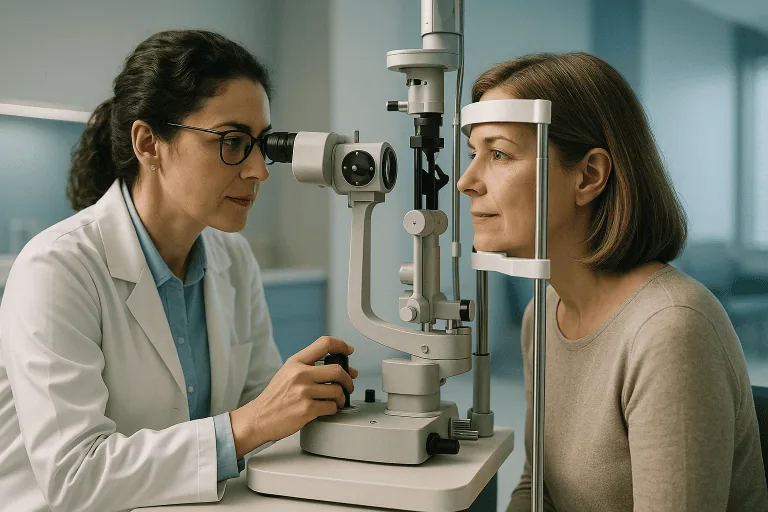
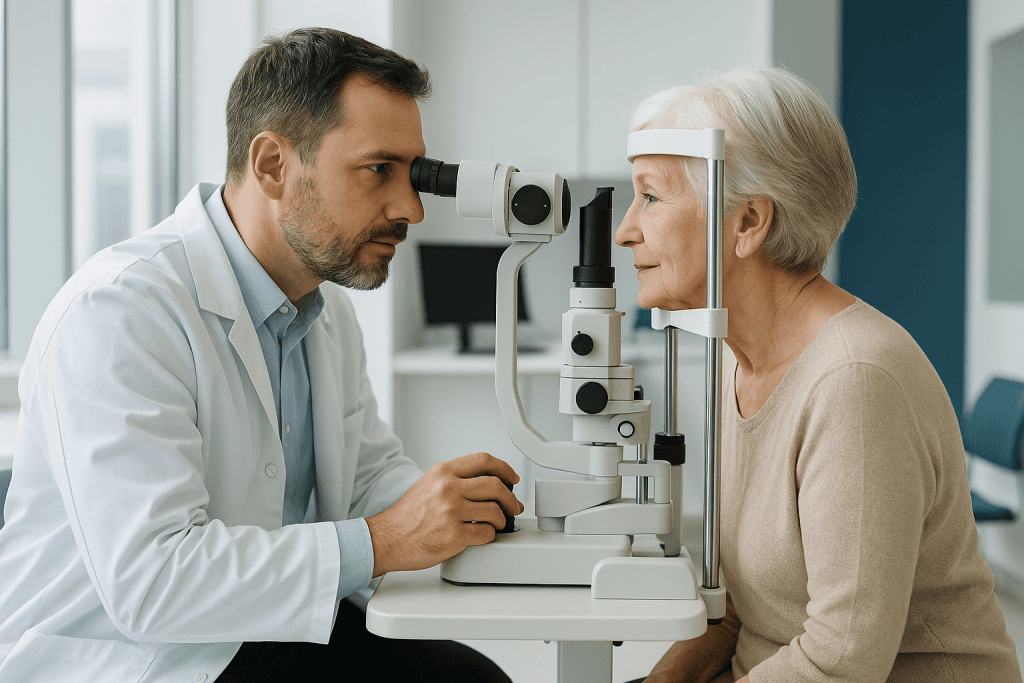
- Examination of the eye’s structures. A slit lamp (a special microscope with a bright light) is used to inspect the front of the eye, and the pupil is often dilated with drops so the doctor can examine the retina and optic nerve. This is particularly important in high myopia, where the retina needs careful checking.
- Additional measurements when needed. In some cases, for example, when monitoring myopia progression in children or planning refractive surgery, doctors may measure the length of the eyeball (axial length) with an ultrasound or optical biometry device, or map the shape of the cornea with corneal topography.
Myopia is described in diopters, the unit used for lens power, written as a negative number (for example, −2.00). Broadly speaking, smaller negative numbers indicate milder myopia and larger negative numbers indicate more severe myopia, though your doctor will interpret the measurement in the context of your overall eye health.
Treatment options for myopia
Myopia treatment aims to do two things: correct blurred distance vision so you can function comfortably, and, in children, slow the progression of the condition where appropriate. The right approach depends on age, the degree of myopia, lifestyle, and overall eye health. Conditions such as myopia are typically managed within an ophthalmology department; at hospital groups such as Acibadem, this is the specialty responsible for both routine correction and surgical options.
Glasses
Eyeglasses are the simplest, safest, and most common way to correct myopia. Lenses with negative (concave) power move the focal point back onto the retina so distant objects appear sharp. Glasses can be worn full time or only for specific tasks, depending on the degree of myopia and your doctor’s advice. Prescriptions are rechecked periodically, since myopia can change, particularly in children and teenagers.
Contact lenses
Contact lenses sit directly on the surface of the eye and correct vision in the same way as glasses. Many people prefer them for sports or cosmetic reasons. They are safe for most people when fitted properly and cared for hygienically, but they do carry a small risk of eye infection, so correct cleaning, storage, and replacement schedules matter.
Myopia control in children
Because myopia that progresses in childhood can end up more severe in adulthood, doctors increasingly offer treatments intended to slow its progression. Options that may be discussed include:
- Low-dose atropine eye drops. Atropine is a medication that, in very dilute concentrations, has been shown in studies to slow myopia progression in many children. It is used under medical supervision, usually as a nightly drop.
- Orthokeratology (ortho-k). Specially designed rigid contact lenses are worn overnight to temporarily reshape the cornea, allowing clear vision during the day without lenses. Ortho-k may also slow myopia progression in some children. It requires careful fitting and strict hygiene.
- Specially designed glasses or soft contact lenses. Certain multifocal or peripheral-defocus lens designs are intended to slow eye growth while correcting vision.
- Lifestyle measures. Encouraging regular time outdoors and sensible breaks from prolonged near work is commonly recommended alongside any of the above.
None of these methods stops myopia completely, and results vary from child to child. Your eye doctor can explain which option, if any, suits your child.
Refractive surgery for adults
Adults whose prescription has been stable, often for at least a year, may be candidates for laser refractive surgery. Procedures such as LASIK, PRK, and SMILE reshape the cornea so that light focuses correctly on the retina, reducing or eliminating the need for glasses or contact lenses. These procedures are generally safe and effective for suitable candidates, but they are elective, they have eligibility criteria (adequate corneal thickness, healthy eyes, realistic expectations), and, like all surgery, they carry risks, including dry eye, glare or halos, and, rarely, under- or over-correction. Importantly, laser surgery corrects the focusing error but does not shorten an elongated eyeball, so it does not remove the retinal risks associated with high myopia.
Lens-based surgery
For people with very high myopia or corneas unsuitable for laser treatment, doctors may discuss implantable contact lenses (a thin lens placed inside the eye in front of the natural lens) or, in selected cases, refractive lens exchange (replacing the eye’s natural lens with an artificial one). These are more invasive options with their own benefits and risks, and they require a detailed evaluation.
Watchful monitoring
Very mild myopia that causes no meaningful difficulty may simply be monitored, particularly in adults whose prescription is stable. Regular eye examinations remain important either way, so that any change in vision or eye health is detected early.
Living with myopia and outlook
For most people, the outlook with myopia is very good. Corrected vision with glasses or contact lenses is usually excellent, and the condition typically stabilizes once eye growth finishes in early adulthood. Living well with myopia mostly means keeping prescriptions up to date, attending routine eye examinations, and caring properly for contact lenses if you wear them.
People with high myopia need somewhat closer follow-up. A longer eyeball stretches the retina, which raises the lifetime risk of retinal tears, retinal detachment, myopic macular degeneration (damage to the central part of the retina), and possibly glaucoma and earlier cataract. These complications are not inevitable, many people with high myopia never develop them, but regular dilated eye examinations allow problems to be found and treated early, when outcomes are generally better. Learning the warning signs of retinal detachment, described in the final section below, is one of the most useful things a highly myopic person can do.
Parents of nearsighted children can support healthy visual habits: plenty of daily outdoor time, regular breaks during reading and screen use (for example, briefly looking into the distance every 20 to 30 minutes), good lighting, and holding books and devices at a comfortable distance. These habits will not cure myopia, but they may help slow its progression and are good for eye comfort in any case.
Frequently asked questions
What is myopia in simple terms?
Myopia, or nearsightedness, means you can see close objects clearly but distant objects look blurry. It happens because light entering the eye focuses in front of the retina instead of on it, usually because the eyeball is slightly longer than average or the cornea is more curved than usual. It is a focusing problem, not an eye disease in the usual sense, and it is very common.
Can myopia heal or go away on its own?
In most cases, no. Once the eyeball has grown longer, it does not shorten again, so established myopia generally does not reverse. Vision can be fully corrected with glasses, contact lenses, or surgery in suitable adults, and progression can often be slowed in children, but there is currently no proven way to cure the underlying condition. Be cautious of any product or exercise program that claims to eliminate myopia.
How serious is myopia?
Mild and moderate myopia are generally not serious; they are inconvenient but easily corrected. High myopia deserves more attention because it increases the lifetime risk of retinal detachment, myopic macular degeneration, and other eye problems. That is why people with high myopia are usually advised to have regular dilated eye examinations even when their corrected vision is good.
Does wearing glasses make myopia worse?
No. This is a common myth. Correctly prescribed glasses simply focus light properly on the retina; they do not weaken the eyes or accelerate myopia. Not wearing needed glasses does not slow progression either. Myopia progresses mainly because of natural eye growth influenced by genetics and environment, not because of lens wear.
Can myopia be prevented in children?
It cannot be prevented with certainty, especially when there is a strong family history, but risk may be reduced. Encouraging children to spend more time outdoors in daylight and to take regular breaks from prolonged close-up work is associated with a lower risk of developing myopia. For children who are already nearsighted, treatments such as low-dose atropine drops, orthokeratology, or special lens designs may slow progression under a doctor’s supervision.
What is the recovery like after myopia surgery?
Recovery varies by procedure. After LASIK, many people notice improved vision within a day or two, with mild dryness or light sensitivity for a period afterward. Surface procedures such as PRK typically involve a few days of discomfort and a slower visual recovery over days to weeks. Your surgeon will explain what to expect, prescribe protective drops, and schedule follow-up visits. Full stabilization of vision can take several weeks to months, and outcomes vary from person to person.
What is the difference between myopia and astigmatism?
Both are refractive errors, but they blur vision differently. Myopia blurs distant objects because light focuses in front of the retina. Astigmatism, caused by an unevenly curved cornea or lens, blurs or distorts vision at all distances because light focuses at more than one point. Many people have both at the same time, and both can usually be corrected with the same pair of glasses or contact lenses.
When to see a doctor
Arrange a routine eye examination if you or your child has blurry distance vision, frequent squinting, unexplained headaches or eye strain, difficulty seeing the board at school, or trouble seeing clearly while driving, especially at night. Children benefit from vision screening even without complaints, since they often do not report blurry vision themselves.
Seek urgent medical carethe same day, if you experience any of the following, particularly if you have high myopia:
- A sudden increase in floaters (new drifting spots, specks, or cobweb-like shapes in your vision).
- Flashes of light, especially repeated flashes at the edge of your vision.
- A dark shadow or curtain moving across part of your field of vision.
- Sudden loss or dimming of vision in one or both eyes.
- Sudden distortion of central vision, such as straight lines appearing wavy or bent.
- Severe eye pain, marked redness, or light sensitivity, particularly in contact lens wearers, which can indicate an eye infection.
These symptoms can indicate a retinal tear, retinal detachment, or another condition that may threaten sight if not treated promptly. Early evaluation by an eye specialist gives the best chance of protecting your vision.
Medically reviewed by the Acıbadem International Medical Board September 2, 2026
See our medical review board →
Update history
- PublishedJune 14, 2026
- Medical review approvedSeptember 2, 2026
- Last content updateSeptember 2, 2026