Myopia Treatment
Myopia, or nearsightedness, is corrected with glasses, contact lenses, or laser eye surgery after detailed eye measurements. Treatment aims to improve distance vision and reduce dependence on lenses.
Quick answer
Myopia, or nearsightedness, is a common vision problem in which distant objects appear blurry and is typically managed with glasses, contact lenses, or laser vision correction. At Acibadem in Turkey, evaluation includes detailed eye measurements and corneal assessment to determine the most suitable option for improving distance vision and reducing dependence on corrective lenses.
Choosing the Right Treatment for Myopia
Myopia, commonly called nearsightedness, is a refractive error in which the eye focuses light in front of the retina rather than on it. Distant objects look blurred; near objects usually stay clear. Treatment works by refocusing that light, with glasses, with contact lenses or, in suitable adults, with laser surgery that reshapes the cornea. Which option fits you depends on your age, how stable your prescription is, the thickness and shape of your corneas, the health of the rest of your eye, and the way you live and work.
Myopia affects far more than the ability to read a street sign or see a classroom board. For many people it shapes daily confidence: driving at night, recognising faces across a room, following a presentation, playing sport, or travelling without worrying about spare glasses or contact lens solutions. For parents, a child’s steadily increasing prescription raises an understandable question, will it keep getting worse? For adults weighing up laser eye surgery, the questions are practical and personal. Am I a safe candidate? Will the result be stable? How long does recovery take? What tests come before any decision is made?
Myopia treatment is not one single procedure. It is a structured approach to improving distance vision and, where possible, reducing dependence on glasses or contact lenses. Some patients do best with updated spectacles or contact lenses. Others are candidates for laser vision correction after a detailed ophthalmic evaluation. In selected cases, higher prescriptions, or corneas unsuitable for laser reshaping, the ophthalmologist may discuss other refractive options instead.
At Acibadem, planning begins with measurements rather than assumptions. The aim is to understand the optical system of your eye as precisely as possible, identify anything that could affect safety, and recommend the option that fits your medical profile and your daily life. That diagnostic step matters most for people travelling for a second opinion or for vision correction surgery, who want clear guidance before committing to anything.
What Is Myopia? Nearsightedness Explained
Nearsighted people see close objects clearly while distant objects blur, because light entering the eye comes to a focus before it reaches the retina. The retina is the light-sensitive layer at the back of the eye that converts light into the signals your brain reads as vision. When the focal point falls short of the retina, the image that lands on it is out of focus, and the further away something is, the blurrier it appears.
Myopia definition: what does myopia mean?
The simplest myopia definition is a mismatch between the focusing power of the eye and its length, so that light from distant objects focuses in front of the retina instead of on it. This happens for one of three reasons, sometimes in combination. The eye may be slightly longer than average from front to back. The cornea, the clear front window of the eye, may be more curved than average, bending light too strongly. Or the internal focusing structures of the eye may be more powerful than the length of the eye requires.
The words vary, but the condition is the same. If a clinical report describes your eye as myopic, the myopic definition is identical: an eye that focuses light short of the retina. In Britain the everyday term is short-sighted; in North America it is nearsighted. A nearsighted myopic prescription is written in minus dioptres, and the higher the minus number, the shorter the distance at which the world begins to blur.
What is the main cause of myopia?
The main cause of myopia is an eye that grows slightly too long from front to back during childhood and adolescence: a process called axial elongation. A cornea that is steeper than average contributes in some people. Why the eye elongates is only partly understood. Genetics play a clear role: children with one or two myopic parents are more likely to develop myopia themselves. Environment matters too: research links prolonged close work and limited time outdoors during childhood with the onset and progression of myopia, although the exact mechanisms are still being studied.
Myopia typically appears during the school years, tends to progress through the teens while the eye is still growing, and usually stabilises in early adulthood. That pattern explains two things you will hear repeatedly from eye specialists: why children’s prescriptions are monitored at regular intervals rather than judged on a single visit, and why refractive surgeons insist on a stable prescription before considering laser correction.
What is high myopia?
High myopia usually means a prescription of around minus six dioptres or more, although exact cut-offs vary between clinics and studies. Eye specialists commonly describe mild myopia as up to about minus three dioptres, moderate myopia as roughly minus three to minus six, and high myopia as anything beyond that.
The distinction matters because high myopia is usually a sign that the eye is considerably longer than average, which stretches the retina and the tissues behind it. Over a lifetime, highly myopic eyes carry a greater risk of retinal tears, retinal detachment, myopic changes at the macula, cataract and glaucoma. Correcting the prescription sharpens the focus, but it does not change the shape of the eye, which is why people with high myopia need regular dilated eye examinations even when their corrected vision is excellent, and even after successful surgery.
Is minus 2.5 eyesight bad?
A prescription of minus 2.5 dioptres is not bad in any medical sense. It sits in the mild-to-moderate range and corrects fully with glasses, contact lenses or, in suitable candidates, laser surgery. Without correction, the world starts to blur beyond roughly forty centimetres, which makes driving, classroom work and presentations genuinely difficult, but the eye itself is usually structurally healthy at this level. Routine eye examinations remain sensible, as they do for everyone, because a comprehensive check assesses eye health as well as the prescription.
Is myopia very serious?
For most people, myopia is an optical problem rather than a disease, inconvenient, but well managed with correction. It becomes a health concern in two situations. The first is when it goes uncorrected: a child who cannot see the board falls behind without knowing why, and an adult who drives with blurred distance vision takes real risks, particularly at night. The second is when it is high: the structural changes of a long eye carry lifetime risks that deserve regular specialist monitoring, whatever correction method is used. Grading myopia as mild, moderate or high is not an academic exercise: it determines how the condition is followed over time and which treatments are appropriate.
Can Myopia Be Cured or Reversed?
Can myopia be cured?
No current treatment cures myopia in the sense of returning the eye to its pre-myopic shape. Glasses and contact lenses correct vision only while they are worn. Laser surgery reshapes the cornea so the eye focuses accurately without lenses, but this is compensation rather than cure: the eye remains anatomically myopic, and in high myopia the retinal considerations remain even after a successful procedure. In children, myopia management aims to slow progression, not eliminate the condition. Any provider promising to cure myopia outright is claiming more than medicine can honestly deliver.
Can myopia be reversed?
Established myopia in adults does not reverse on its own, and no eye exercises, supplements or vision-training programmes have been shown to shorten an elongated eye. Orthokeratology, rigid lenses worn overnight to flatten the cornea temporarily, can give clear daytime vision without lenses, but the effect fades once the lenses are stopped, so it is a reversible form of correction rather than a reversal of the myopia itself. What can genuinely change is your dependence on correction: accurate glasses or contact lenses restore sharp distance vision immediately, and suitable adults can have the correction built into the cornea surgically. The honest framing is management and correction, not reversal.
Who May Need Myopia Treatment
People usually seek an evaluation when distance vision becomes noticeably blurred. A child may move closer to the television, struggle to see the classroom board, squint habitually, or complain of headaches after visually demanding tasks. An adult may notice difficulty reading road signs, following presentation screens, recognising people across a room, or driving at dusk. Some patients already know they are myopic and simply need updated correction because their current glasses or contact lenses no longer provide sharp vision.
Myopia is diagnosed through a comprehensive eye examination. The ophthalmologist or optometrist measures visual acuity, determines the refractive prescription, and examines both the front and the back of the eye. In children, cycloplegic refraction, drops that temporarily relax the focusing muscles, may be used to obtain a more accurate measurement, because young eyes can partly compensate for refractive error during standard testing. In adults considering refractive surgery, the diagnostic process is more detailed and includes advanced measurements of the cornea and the ocular surface.
Patients who may need treatment include those with mild, moderate or high myopia; people whose vision interferes with school, work, sport or driving; and adults who want to reduce their dependence on lenses. Patients with high myopia require particularly careful monitoring, because the elongated shape of the eye can be associated with a higher risk of retinal problems, glaucoma and other eye conditions over time. Correcting the prescription improves focusing, but it does not remove the need for regular eye health examinations in people with higher levels of myopia.
Many international patients arrange a myopia evaluation because they want a complete assessment before choosing laser vision correction. Some have been told elsewhere that they are not candidates; others want independent confirmation that surgery would be safe for them. A second opinion is most valuable when the prescription is high, the cornea is thin, dry eye symptoms are present, or previous scans have shown irregularities. In those situations the decision is not simply whether surgery can be performed, but whether it should be.
Conditions and Indications Addressed by Myopia Treatment
Myopia treatment addresses blurred distance vision caused by nearsightedness. It also manages the practical consequences of refractive error in daily life: visual fatigue, difficulty with driving, and dependence on optical correction. Which treatment is selected depends on the type and severity of the myopia and on whether other refractive errors are present, most commonly astigmatism.
Common indications include stable myopia in adults who want clearer distance vision, children with newly diagnosed or progressing myopia, patients who need reliable correction for professional or lifestyle reasons, and people who are uncomfortable with glasses or contact lenses. Some seek treatment because contact lenses cause dryness, irritation or inconvenience. Others are motivated by sport, travel, active work environments, or simply the wish to simplify their daily routine.
Laser correction may be considered for adults whose prescription has remained stable and whose eye measurements fall within safe parameters. A stable prescription generally means no meaningful change over a period the ophthalmologist judges sufficient. Surgery is usually postponed during pregnancy and breastfeeding, and it may not be suitable for people with certain corneal diseases, uncontrolled dry eye, active eye inflammation, unstable prescriptions, or specific systemic conditions that affect healing.
In many patients, myopia is accompanied by astigmatism, in which the cornea or lens has an irregular curvature that blurs vision at all distances. Laser treatment plans can often address both myopia and astigmatism in the same procedure when the measurements are appropriate. Patients with very high myopia, thin corneas, or corneal mapping findings that raise concern may be advised to continue with glasses or contact lenses, or to consider alternative refractive options after specialist assessment.
How Myopia Treatment Is Performed
Initial Consultation and Eye Measurements
The pathway begins with a detailed consultation. The ophthalmology team asks about your current glasses or contact lens use, prescription history, visual needs, occupation, screen time, driving habits, sport, medical conditions, medications, allergies, and any previous eye disease or surgery. Contact lens wearers may need to stop wearing their lenses for a period before measurements, because contact lenses temporarily alter the shape of the cornea; the recommended interval depends on the lens type and the ophthalmologist’s instructions.
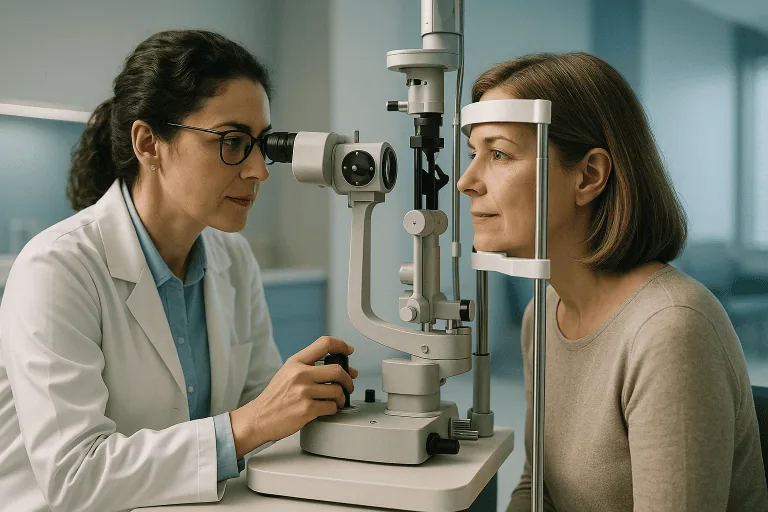
Diagnostic testing usually includes refraction, visual acuity assessment, intraocular pressure measurement, slit-lamp examination, retinal examination, and evaluation of the tear film. For patients considering laser vision correction, additional technologies measure the cornea in detail. Corneal topography and tomography map its shape, curvature and thickness. Pachymetry measures corneal thickness directly. Wavefront or optical quality measurements assess higher-order visual distortions that a standard prescription cannot capture. Pupil size may be measured under different lighting conditions. Together, these tests establish whether the cornea can be safely reshaped and whether you are likely to be satisfied with the visual result.
The retina is also examined carefully, particularly in patients with moderate or high myopia. Because a myopic eye may be longer than average, the peripheral retina can be more vulnerable to thinning or tears. If retinal findings are identified, the ophthalmologist may recommend treatment or a period of monitoring before any elective refractive procedure goes ahead.
Myopia Glasses and Contact Lens Correction
Myopia glasses are the first and most dependable form of correction for most people: lenses ground to your prescription bend incoming light so that it focuses on the retina. Glasses are non-invasive, easily updated, and suitable for nearly all ages. They are often the most appropriate choice for children, for patients whose prescriptions are still changing, and for anyone who prefers a fully reversible method. Modern lens materials also make higher prescriptions far more wearable than they once were: high-index lenses reduce edge thickness and weight, and anti-reflective coatings improve clarity for night driving and screen work.
Contact lenses rest on the surface of the eye and correct focusing in the same optical way. They can provide a more natural field of vision for some activities and suit sport or work settings where glasses get in the way. A proper fitting includes measuring the eye surface, selecting the right lens type, teaching insertion and removal, and reviewing hygiene. That last point is not a formality: poor hygiene, sleeping in lenses without medical approval, and overwearing lenses all increase the risk of eye infection, some of which can threaten vision.
For children with progressive myopia, the ophthalmologist may discuss monitoring intervals and, where appropriate, myopia control strategies. These can include specific lens designs, lifestyle guidance such as increased time outdoors, or other medical approaches depending on the child’s age and examination findings. Research suggests that time spent outdoors in daylight during childhood is associated with later onset of myopia, which is why many specialists recommend building regular outdoor activity into a child’s routine alongside scheduled eye examinations. The aim is straightforward: keep vision clear now, and watch the rate of progression carefully.
Laser Eye Surgery for Myopia
Laser vision correction changes the shape of the cornea so that light focuses accurately on the retina. Different laser techniques are used depending on your corneal measurements, prescription, ocular surface health and the surgeon’s assessment. The technical details differ, but the purpose is the same in each case: to remove a precisely calculated amount of corneal tissue, or reshape the corneal surface, according to a personalised treatment plan built from your own measurements.
Before surgery, you receive instructions covering contact lens discontinuation, eye drops, cosmetics and arrival time. The practical details matter more than people expect: our guide to contact lenses, glasses and other devices on procedure day covers what to bring and what to leave at home. The procedure itself is usually performed with topical anaesthetic eye drops. You remain awake, but the eye is numbed and the team talks you through each step. The laser portion is typically brief, although the full visit takes longer because of preparation, safety checks and postoperative instructions.
During treatment, imaging and tracking systems align the laser precisely with your eye. Corneal mapping data and refractive measurements design the correction; eye-tracking technology compensates for the small eye movements that everyone makes; the surgeon monitors positioning and tissue response throughout. You may feel pressure or mild discomfort at certain moments, but significant pain is not expected during the procedure because of the anaesthetic drops.
Afterwards, vision is often blurry or fluctuating at first. Some patients notice improvement quickly; others need more time for the surface of the eye to settle. Dryness, light sensitivity, tearing, glare, halos and a foreign-body sensation are all common in early healing. Prescribed eye drops reduce inflammation, help prevent infection and support comfort. Follow-up visits are essential: they confirm the eye is healing as expected and catch anything that needs attention early.
How Long Does Treatment and Recovery Take?
Duration depends entirely on the method. Glasses can usually be prescribed after a single examination and prepared by an optical provider. Contact lens fitting may require trial lenses and one or more follow-up adjustments. Laser eye surgery is a short outpatient procedure, but the full pathway includes preoperative testing, surgical planning, the procedure day itself, and a schedule of postoperative visits.
Many patients return to desk-based activities within a short period after laser correction, depending on the technique used and the surgeon’s instructions. Driving, exercise, swimming, eye make-up and contact sports each need individualised guidance rather than a fixed date. The surface of the eye continues to heal over time, and visual stability tends to improve gradually. Two rules apply to everyone: do not rub your eyes, and use the prescribed drops exactly as your surgeon directs.
Patients travelling for treatment have an extra planning layer. The care team advises how long to remain near the hospital for examination, treatment and early follow-up. The length of stay varies with the procedure performed, your eye findings and whether additional monitoring is needed. A sensible plan builds in the postoperative checks before the flight home, not after it, flying out the day after surgery without medical clearance is a plan built around the airline, not the eye.
Why Acting Early Matters
Myopia should not be ignored, especially when vision changes are affecting daily life or a child’s prescription appears to be increasing. Clear vision underpins learning, mobility, safety and independence. In children, uncorrected distance blur interferes with school performance and participation in activities, and a child rarely explains the problem clearly. Squinting, sitting close to screens, or avoiding distance tasks are often the first clues a parent notices.
In adults, delaying an evaluation can mean living with avoidable visual strain or taking unnecessary risks behind the wheel, particularly at night or in unfamiliar places. People who make do with old glasses or unprescribed contact lenses also miss out on proper eye health screening. A complete examination identifies not only the refractive error but any associated eye conditions that deserve attention in their own right.
For anyone considering laser surgery, early assessment establishes candidacy before travel plans are made. It can reveal dry eye, corneal irregularity, an unstable prescription, retinal findings, or other factors that need treatment or observation first. Acting early does not mean choosing surgery quickly. More often it means obtaining the right measurements, understanding all the options, and making the decision at the safest possible time.
High myopia deserves particular attention, because it can be associated with a greater lifetime risk of retinal tears, retinal detachment, myopic macular changes, cataract and glaucoma. Corrective lenses and laser surgery improve focusing, but neither changes the underlying structure of a highly myopic eye. Regular ophthalmic follow-up remains important even when corrected vision is excellent.
Benefits of Myopia Treatment
What treatment delivers depends on the method chosen, the health of your eyes, and the accuracy of the diagnosis and follow-up behind it.
| Benefit | What It Means for You |
|---|---|
| Clearer distance vision | Improved ability to see road signs, classroom boards, presentations, faces and other distant objects with the appropriate correction. |
| Reduced visual strain | Proper correction can decrease squinting, headaches related to blurred distance vision, and fatigue during visually demanding tasks. |
| More convenient daily life | Glasses, contact lenses or laser correction may make driving, work, sport and travel easier, depending on your needs and suitability. |
| Less dependence on glasses or contact lenses | For suitable laser surgery candidates, treatment may significantly reduce the need for corrective lenses, although some patients still need glasses for certain tasks later in life. |
| Better monitoring of eye health | A detailed myopia evaluation can identify associated issues such as dry eye, corneal changes or retinal findings that need follow-up. |
Recovery Timeline After Laser Myopia Treatment
Recovery varies with the laser technique, the prescription level, ocular surface health and individual healing, but most patients follow a broadly similar pattern.
| Time Period | What Patients Can Expect |
|---|---|
| Day 1 | Vision may be blurry or hazy, with tearing, light sensitivity or a gritty sensation. Patients use prescribed drops and avoid rubbing the eyes. |
| First Week | Vision often improves, though fluctuation is common. A follow-up examination checks healing, eye pressure where relevant, and the ocular surface. |
| First Month | Many daily activities are resumed with medical guidance. Dryness, glare or halos may continue in some patients and are managed with drops and follow-up care. |
| Longer Term | Vision typically becomes more stable as healing progresses. Regular eye examinations remain important, especially for patients with higher myopia. |
Factors That Influence a Good Result
A good outcome in myopia treatment begins with an accurate diagnosis. The prescription must be measured carefully, and in surgical candidates it must be stable enough to support a predictable plan. If the prescription is still changing, laser correction is postponed. This matters most for younger adults and for anyone whose recent glasses prescriptions show ongoing progression, operating on a moving target produces a correction that goes out of date.
Corneal health is one of the most important factors in laser vision correction. The cornea must have adequate thickness and a regular shape. Corneal topography and tomography detect patterns that may indicate weakness or early corneal disease. If the cornea is too thin or too irregular, laser surgery may not be the safest choice, and the ophthalmologist may recommend non-surgical correction or discuss other refractive options where appropriate. Declining to operate on an unsuitable cornea is not caution for its own sake; it is the decision that protects your vision.
Dry eye and tear film quality also matter. Laser procedures can temporarily worsen dryness, and patients who already have dry eye may need treatment before surgery. Burning, fluctuating vision, redness or contact lens intolerance are all relevant findings at the consultation stage, because managing the ocular surface beforehand improves comfort and produces more reliable measurements, and unreliable measurements produce unreliable surgery.
The level of myopia shapes the plan. Lower and moderate prescriptions suit a wider range of corrective options, while high myopia demands more careful evaluation of corneal tissue, optical quality and retinal health. Patients with high myopia should understand a specific limit clearly: even when laser correction improves unaided vision substantially, long-term retinal monitoring remains necessary, because the surgery changes the cornea, not the length of the eye.
Expectations count as much as measurements. Laser eye surgery can reduce dependence on glasses or contact lenses, but it does not stop the eye ageing normally. Presbyopia, the age-related loss of near focusing ability, commonly develops in midlife and may require reading glasses even in people whose distance vision was corrected successfully years earlier. Some patients also need glasses for night driving, fine visual tasks or specific professional requirements after treatment. A surgeon who explains these limits before the procedure is doing the job properly.
Finally, following postoperative instructions has a direct effect on recovery. Use the prescribed drops correctly, attend every follow-up visit, avoid rubbing the eyes, and follow the individual guidance on swimming, make-up, sport and screen use. Patients travelling for treatment should plan the journey home around the recommended postoperative schedule rather than leaving immediately after surgery without medical clearance.
How Acibadem Approaches Myopia Care
Patients considering myopia treatment abroad usually want more than a procedure. They want careful assessment, clear communication, and a recommendation grounded in their own eye health rather than a one-size-fits-all package. Acibadem’s ophthalmology services are structured around that kind of decision-making, from diagnostic testing through treatment planning and follow-up.
For refractive surgery candidates, detailed eye measurements evaluate suitability and guide the plan. The diagnostic pathway can include corneal mapping, ocular surface assessment, retinal evaluation and optical quality measurements, information that helps the ophthalmologist judge both what correction is possible and whether surgery is safe for that particular eye. Experienced ophthalmologists assess each patient individually and discuss the options in practical terms. For some, the honest recommendation is updated glasses or contact lenses. For others, laser vision correction is appropriate. In more complex cases, high myopia, suspected corneal irregularity, previous eye surgery, retinal findings, additional specialist input and a multidisciplinary review within the wider hospital network may be part of the process.
Technology supports the decision but never replaces it. Diagnostic imaging evaluates corneal shape and thickness; laser planning systems deliver a correction based on measured refractive needs; surgical microscopes, eye-tracking functions, sterilisation protocols and postoperative monitoring all contribute to safety and consistency. The point of these tools is to give the physician better information, not to automate a judgement that should remain clinical.
Personalised planning is particularly valuable in myopia care because the same prescription can mean different things in different eyes. Two patients with identical glasses numbers may differ in corneal thickness, tear film quality, pupil size, retinal status and daily visual demands, and a careful plan weighs all of these before recommending surgery or a non-surgical alternative. Prior prescriptions, scans and medical history can be reviewed as part of an evaluation, but final candidacy is confirmed only after in-person examination and repeat measurements. That is a deliberate limit: responsible refractive care does not promise surgery before the eye has been fully assessed.
For patients travelling from abroad, coordination services cover the practical side of a hospital visit, appointment scheduling, medical record transfer, interpretation and travel-related guidance, so that the medical decision stays at the centre of the process rather than getting lost in logistics.
Making a Considered Decision
Myopia is one of the most common eye conditions in the world, but the right treatment choice is personal. Glasses, contact lenses and laser eye surgery each have real advantages, real limitations and specific medical considerations. The best starting point is a thorough eye examination that explains not just your prescription, but the health and structure of the eyes behind it.
Whatever route you take, the same principles hold. Candidacy for surgery depends on measurements, not motivation. Results should be described realistically, including the tasks that may still need glasses afterwards. Recovery unfolds gradually rather than overnight. And for anyone with higher levels of myopia, regular eye examinations remain part of life, with or without correction, and with or without surgery. Understanding those points before you decide is what turns a hopeful choice into an informed one.
Preparation
- A comprehensive eye examination is needed to measure vision, corneal thickness, eye pressure, and retinal health. Contact lenses may need to be stopped for several days or weeks before laser assessment. Your ophthalmologist reviews age, prescription stability, dry eye status, and suitability for laser correction.
Aftercare
- Use prescribed eye drops as directed and avoid rubbing the eyes after treatment. Swimming, dusty environments, and eye makeup are usually avoided for a short period. Follow-up visits help confirm healing, visual improvement, and eye pressure status.
Frequently Asked Questions
What affects the cost of myopia treatment?
Cost depends on the correction method, prescription strength, corneal measurements, diagnostic testing, technology used, surgeon experience, clinic setting and aftercare requirements. Travel, accommodation and interpreter support may also influence the total budget for international patients.
How can I get a personalised quote?
A personalised quote usually requires recent eye records and a specialist consultation. Acibadem International can arrange a free consultation process to review your needs and explain which tests are required before a final treatment plan is confirmed.
Is laser eye surgery always the best option for myopia?
No. Glasses, contact lenses, myopia control strategies, laser vision correction and implantable lenses may all be considered depending on age, prescription stability, corneal thickness, eye health and lifestyle. Suitability must be decided by an ophthalmologist.
What is usually included in a myopia treatment package?
Packages may include eye examinations, corneal mapping, surgeon consultation, procedure planning, medication guidance and early follow-up. Patients should always request a written list of inclusions and exclusions before booking.
Can international patients have assessment and treatment during the same trip?
This may be possible for some patients, but it depends on medical suitability, eye test results and the chosen procedure. A pre-travel review helps determine whether additional waiting, preparation or follow-up planning is needed.
Medically reviewed by the Acıbadem International Medical Board August 31, 2026
See our medical review board →
Update history
- PublishedJune 6, 2026
- Medical review approvedAugust 31, 2026
- Last content updateSeptember 8, 2026
References2
- Short-sightedness (myopia) nhs.uk
- Myopia (Nearsightedness) my.clevelandclinic.org
Trusted care for international patients
From the Acibadem Blog

Why You Must Pause Contact Lenses Before a Myopia Laser Assessment (and for How Long)
Contact lenses press on the cornea and temporarily change its shape, so measurements taken too soon after removing them can be inaccurate and could…