

Why You Must Pause Contact Lenses Before a Myopia Laser Assessment (and for How Long)

Key Takeaways
- Contact lenses physically mold the cornea, and Mayo Clinic advises wearing only glasses for at least a few weeks before both the laser evaluation and the surgery, with the interval set by lens type and years of wear.
- Cleveland Clinic gives about two weeks as the usual break for soft lenses and roughly four weeks or more for rigid gas permeable lenses, and long-term rigid-lens wearers often need longer.
- The break should be continuous from the first scan through to surgery; a single day back in lenses can restart the cornea's adaptation and the team may reset the count.
- Lens-induced corneal warpage can mimic keratoconus on topography maps, so teams judge stability by comparing scans over time rather than by counting days.
- The so-called 3:1:1 rule is informal patient shorthand that does not appear in mainstream clinical guidance, and versions found online contradict one another.
- Cleveland Clinic and Mayo Clinic describe a prescription stable for at least a year as a usual expectation, while the NHS cites about two years and an age of 18 or over.
Contact lenses press on the cornea and temporarily change its shape, so measurements taken too soon after removing them can be inaccurate and could mislead surgical planning. Most eye teams ask people to switch to glasses for at least a few weeks before a laser assessment: typically about two weeks for soft lenses and longer, often around four weeks or more, for rigid gas permeable lenses. Your own team sets the exact interval.
The email from the eye clinic arrives with a line that stops most people mid-scroll: please do not wear your contact lenses for two to four weeks before your appointment. For someone who has slipped lenses in every morning since high school, that sentence lands like a small dare. The old glasses are somewhere in a drawer, the prescription is a year out of date, and a work presentation is coming up.
It is tempting to treat the request as clinic caution, the eye-care equivalent of arriving fifteen minutes early. It is not. The instruction to stop contact lenses before laser assessment exists because a lens leaves a physical imprint on the front of the eye, and the laser plan is built entirely on measurements of that surface. Measure a cornea while it is still molded to a lens and you measure the lens as much as the eye.
This explainer covers what happens under a lens, how long different lens types take to settle, why rigid lenses need the longest break, and what those weeks in glasses usually feel like.
Why you must stop contact lenses before laser assessment: the cornea remembers
The cornea is the clear, dome-shaped window at the front of the eye. It is roughly half a millimeter thick at the center, about five sheets of printer paper stacked together, and it does most of the eye’s focusing work. Because it is soft living tissue rather than glass, it yields slightly to whatever sits on it.
A contact lens sits on that dome for twelve or more hours a day. Even a thin soft lens gently flattens the tissue beneath it and can reduce the oxygen reaching the surface. The cornea adapts, and that adaptation does not vanish the moment the lens comes out. Mayo Clinic notes that lenses can change corneal shape and advises wearing only glasses for at least a few weeks before the evaluation and the surgery, with the exact guideline depending on lens type and years of wear.
Laser vision correction for myopia (nearsightedness, where the eye focuses distant images in front of the retina) works by reshaping the cornea by a few tens of microns. A micron is a thousandth of a millimeter. The surgeon’s plan is calculated from a detailed map of the corneal surface and a refraction, which is the measured prescription. If the map still carries the ghost of a lens, the plan is built on a shape the eye will not keep.
That is the whole argument in one line: you cannot correct a surface you have not seen at rest. Everything that follows, from the two-week soft-lens break to the longer pause for rigid lenses, is about giving the cornea time to return to its own shape before anyone measures it.
What actually happens to the cornea under a contact lens
Three things change while a lens is worn, and each settles at a different pace.
Shape comes first. A lens applies a small, steady pressure across the central cornea. Over months and years, the tissue can take on a subtly flattened or irregular profile. Eye specialists call this corneal warpage: a temporary, lens-induced distortion of the corneal surface. Warpage is usually invisible to the wearer because the lens itself corrects the vision, and glasses often feel slightly off for the same reason.
Oxygen comes second. The cornea has no blood vessels and draws oxygen mostly from the air through the tear film, the thin liquid layer coating the eye. A lens reduces that supply. The surface cells, called the epithelium, can swell a little and the tissue can thicken by a few microns. Thickness matters because the assessment includes pachymetry, a measurement of how thick the cornea is, and the surgeon needs enough tissue to reshape safely.
The tear film comes third. Long-term lens wear is associated with dryness and a less stable tear layer. Mayo Clinic lists contact lens wear among contributors to dry eye symptoms. An unstable tear film scatters light and can make prescription readings fluctuate from one minute to the next.
Here is the useful mental image: think of a lens as a shoe worn all day. Take it off and the foot still carries the shape for a while. The cornea does the same. Soft lenses leave a lighter, faster-fading impression; rigid lenses leave a firmer one that can take weeks to release. The pause before assessment is simply the time it takes for the tissue to forget.
How long no contacts before LASIK? Typical ranges by lens type
There is no single universal number, and any article that gives you one is simplifying. What the major consumer health sources agree on is a range that lengthens as lenses get firmer and are worn longer.
| Lens type | Typical minimum break before measurements | Why the difference |
|---|---|---|
| Soft daily or two-week lenses | About 2 weeks (Cleveland Clinic) | Thin, flexible, lightest imprint on the cornea |
| Soft toric lenses for astigmatism | Often 2–3 weeks, set by the team | Thicker zones that stabilize the lens can press unevenly |
| Extended-wear or overnight soft lenses | Often longer than daily-wear soft lenses | Less oxygen overnight, more corneal swelling to resolve |
| Rigid gas permeable (RGP, hard) lenses | Roughly 4 weeks or more, sometimes longer for decades of wear (Cleveland Clinic, Mayo Clinic) | Firm material molds the cornea most; warpage releases slowly |
Mayo Clinic frames the soft-lens interval as at least a few weeks and states that the team tailors it to lens type and how long you have worn lenses. MedlinePlus describes the same principle: lenses must come out for a period before surgery so the cornea can return to its natural shape. Cleveland Clinic puts the soft-lens break at about two weeks and asks hard-lens wearers to allow considerably longer.
Treat these as floors, not ceilings. If your first set of scans still shows a distorted surface, the team may ask you to stay in glasses and return for repeat measurements. That is not a setback; it is the process working as designed, and it happens more often with rigid lenses.
Contacts before a LASIK consultation vs before surgery: two pauses, not one
People often assume the no-lens rule applies only to the day of surgery. In practice there are two separate measurement points, and the pause matters for both.
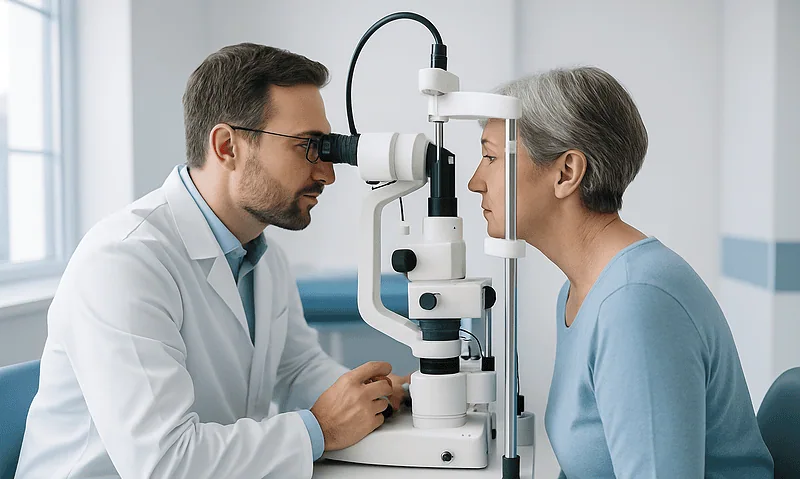
The consultation, sometimes called the suitability assessment, is where the team decides whether laser surgery is a reasonable option at all. It includes the refraction, corneal mapping and thickness measurement, an examination of the tear film, a dilated look at the retina, and a discussion of your goals. If you arrive having worn lenses that morning, the scans may be unreliable and the team will usually ask you to come back after a proper break. A wasted visit is the mild consequence; a decision made on distorted data is the serious one.
Pre-operative measurements follow, often on the same visit as surgery or a few days before. These are the numbers that program the laser. Some teams accept the consultation scans if the gap to surgery is short and lenses have stayed out; others repeat everything. Either way, the expectation is that lenses stay out continuously from the start of the first break right through to the procedure.
That continuity is the part most people miss. Going back into lenses for a wedding between the consultation and the surgery date restarts the clock, because the cornea begins adapting again within days. Mayo Clinic’s wording is deliberate: no lenses for at least a few weeks before the evaluation and the surgery. Read it as one unbroken stretch in glasses, with the end date set by your team rather than your calendar.
What the assessment measures, and how lenses distort each reading
Knowing what the machines are looking for makes the waiting feel less arbitrary.
Refraction is the prescription measurement, the familiar which-is-clearer test. Lens-induced warpage and a dry tear film can shift the reading by a fraction of a diopter (the unit of lens power) or change the astigmatism axis. In glasses that fraction is barely noticeable. In a laser plan it is permanent.
Corneal topography maps the curvature of the surface, producing a color-coded contour map much like a hillside on a hiking chart. Warpage shows up as asymmetric patterns that can mimic keratoconus, a condition in which the cornea thins and bulges into a cone shape. Cleveland Clinic notes that keratoconus is a reason laser correction is generally not offered, so a false-positive pattern from a lens can wrongly close a door, and a masked pattern could wrongly open one.
Tomography goes a step further and images the back surface of the cornea as well as the front. It helps the team judge structural stability, which is central to ruling out early ectasia, a progressive weakening of the cornea.
Pachymetry measures thickness. Mild swelling from reduced oxygen can add a few microns, which may overstate the tissue available for treatment.
Tear film assessment looks at how quickly the tear layer breaks up and how much the eye produces. Chronic lens wear can temporarily worsen both, and the team wants a baseline that reflects your eyes rather than your lenses.
Pupil size in dim light is also recorded, and this one is unaffected by lenses. Everything else on the list is cleaner after a break, which is why the break is not negotiable.
What is the 3:1:1 rule for contacts? Separating shorthand from guidance
Search for pre-laser advice and you will find references to a so-called 3:1:1 rule. Versions circulating online do not agree with each other. Some describe three weeks out of soft lenses, one week extra per decade of wear, and one repeat scan; others attach the numbers to different lens types entirely. The pattern is a clue: this is informal shorthand passed between patients, not a rule found in mainstream clinical guidance.
None of the major consumer sources, including Mayo Clinic, MedlinePlus, Cleveland Clinic or the NHS, describe a 3:1:1 rule. What they describe is a principle with a range attached: soft lenses out for at least a couple of weeks, rigid lenses out for considerably longer, with the treating team adjusting for years of wear and repeating scans until the surface is stable.
Why do neat rules spread so easily? Because they feel actionable, and because the honest answer, it depends and your team will tell you, is less satisfying. Yet the honest answer protects you better. A person who has worn rigid lenses for twenty-five years may need well beyond a month before two topography maps taken a week apart look identical. A person who has worn daily soft lenses for two years may be stable in a fortnight.
If a formula helps you plan, use it only to decide how early to start glasses, never to decide when the break is over. The end point is a measurement, not a date. When two consecutive scans match and the refraction stops drifting, the cornea is telling the team it has returned to its own shape. That is the rule that actually matters.
RGP lenses before laser eye surgery: why rigid lenses need the longest break
Rigid gas permeable lenses, usually called RGPs or hard lenses, are small, firm lenses that hold their own shape rather than draping over the eye. That firmness is exactly why they correct irregular astigmatism so well, and exactly why they leave the deepest impression.
A soft lens flexes to the cornea. An RGP makes the cornea flex to it. Over years, the tissue under the lens can flatten centrally while the surrounding area stays steeper, or the reverse depending on how the lens rides. Cleveland Clinic advises RGP wearers to stop for roughly four weeks or more before measurements, and many teams extend that for long-term wearers, sometimes asking for a week of glasses for every decade of wear on top of the base interval. That figure varies between teams and is not a fixed guideline; treat it as an illustration of how individual the decision is.
Two practical realities follow. First, glasses will feel worse than expected during the break. Warpage can make even a fresh spectacle prescription seem slightly wrong for the first week or two, because the cornea is still changing. Second, the team will almost certainly want repeat scans. Stability is judged by comparing maps over time, not by counting days.
Orthokeratology lenses, rigid lenses worn overnight to deliberately flatten the cornea and provide lens-free daytime vision, sit in a category of their own. Their entire purpose is to reshape the cornea, so the reversal period is typically the longest of any lens type and is set case by case.
The message for rigid-lens wearers is not alarming, just realistic: plan for a month or more in glasses, expect at least one repeat visit, and let the maps decide when you are ready.
Corneal warpage from contact lenses: how it is detected and how it settles
Corneal warpage is the term for lens-induced distortion of the corneal surface that reverses once lenses are stopped. It is not a disease and it is not damage in the permanent sense. It is more like a crease in fabric that has been folded too long.
Detection relies on comparing topography maps. A warped cornea often shows an irregular, non-symmetric pattern, sometimes with a steep zone displaced away from the center. The picture can resemble early keratoconus, which is why an experienced team never diagnoses keratoconus from a single scan taken in a lens wearer. The differentiator is time: warpage improves over weeks of lens-free wear, while true keratoconus does not.
Settling follows a rough pattern. Soft-lens warpage tends to resolve within the two-week window most teams use. Rigid-lens warpage can take four weeks or considerably longer, with the final stages of change being small and slow. Mayo Clinic’s advice to allow at least a few weeks, tailored to lens type and wearing history, reflects this uneven curve.
The team’s working definition of settled is usually two maps, taken about a week apart, that look the same, alongside a refraction that has stopped shifting between visits. Some people reach that point at their first assessment; others need one or two more visits.
What you notice from the inside is mostly vision in glasses gradually becoming sharper and more consistent over the break. If it goes the other way, with vision in glasses getting steadily worse rather than better, that is worth mentioning to the team, because it prompts a closer look at whether something other than warpage is going on.
Who is usually asked to wait, and what disqualifies you from laser eye surgery
Being asked to wait and being told laser surgery is not suitable are different outcomes, and it helps to know which category a reason falls into.
Common reasons to wait rather than proceed include a corneal map that still shows lens warpage, a prescription that has changed within roughly the past year (Cleveland Clinic and Mayo Clinic both describe stable vision for at least a year as a usual expectation), active dry eye that needs settling first, pregnancy or recent breastfeeding because hormonal shifts can alter the prescription, and age under 18, since the eye is still growing. The NHS notes that laser eye surgery is generally not offered under 18 and that prescriptions usually need to have been stable for about two years.
Reasons a team may advise against laser surgery altogether are more structural. Keratoconus or signs of corneal weakness are the clearest, because removing tissue from an already unstable cornea risks progressive bulging. A cornea that is too thin for the planned correction, a prescription beyond the range the laser can safely treat, uncontrolled glaucoma, cataract already affecting vision, certain autoimmune conditions that impair healing, and a history of severe dry eye also feature on mainstream lists from Mayo Clinic and Cleveland Clinic.
Neither list is a verdict you can apply to yourself. Several items, particularly corneal thickness and topography, can only be judged after the lens break, and some people who are not suitable for LASIK are suitable for a surface-based laser technique or for a lens-based procedure inside the eye instead. The NHS describes lens surgery as an alternative pathway for people who are not candidates for laser treatment. The decision sits with the team, and it is made on clean measurements.
Can you have laser eye surgery with dry eyes, and does lens wear make it worse?
Dry eye is one of the most common reasons people are asked to pause before laser assessment, and it is tangled up with lens wear in a way that surprises many.
Long-term contact lens use is a recognized contributor to dry eye symptoms; Mayo Clinic lists it alongside screen use, aging and certain medications. Lenses can disrupt the tear film and, over time, may be associated with reduced sensitivity of the corneal surface, which dulls the reflex that keeps tears flowing. Some people discover during their lens break that their eyes feel gritty or tired in a way they had attributed to the lenses themselves, when in fact the dryness had been building underneath.
Laser surgery, particularly LASIK, temporarily worsens dryness for most people because the procedure cuts through some of the corneal nerves that trigger tear production. Mayo Clinic and MedlinePlus both list dry eye as a common temporary side effect, typically improving over weeks to months as nerves recover. Starting with an already dry surface can make that period longer and less comfortable, which is why teams want a true baseline measured after lenses are out.
Mild to moderate dry eye does not automatically rule anyone out. It usually means the team treats the surface first, perhaps with lubricating drops, lid hygiene or other measures they select, then re-measures. Severe dry eye is listed by Mayo Clinic as a reason laser surgery may not be advisable, and a surface-based or lens-based alternative may be discussed instead.
The practical point for the waiting weeks: notice how your eyes feel without lenses and tell the team honestly. That information is part of the assessment, and it changes decisions.
After you stop contact lenses before laser assessment: what the weeks in glasses usually look like
The first three days are the adjustment. Glasses sit on a face that has forgotten them: frames slide, lenses fog, and peripheral vision feels narrower because a spectacle lens does not move with the eye the way a contact does. If the glasses prescription is old, edges may look slightly soft. Most people notice these things acutely and then stop noticing them by the end of the first week.
Days four to ten are when warpage begins to release. Soft-lens wearers often find glasses becoming a touch sharper during this window as the cornea returns to its own curve. Rigid-lens wearers may find the opposite at first, with vision in glasses fluctuating from morning to evening as the surface changes; that fluctuation is expected and usually calms down.
Around the two-week mark, soft-lens wearers typically reach the point where the team is willing to scan, consistent with the Cleveland Clinic interval. Rigid-lens wearers are often only halfway through and may be asked for an interim visit to check progress.
Weeks three to five apply mainly to rigid-lens and long-term wearers. Changes slow to a crawl. The team compares maps a week apart and calls the surface stable when they match.
Throughout, a few habits help the readings without changing the science: keep an old but wearable pair of glasses on hand from day one, avoid rubbing the eyes, mention any eye drops you already use, and resist the single day of lenses for a special event. That one day can restart the clock for the cornea beneath it.
What people often get wrong about pausing contacts before laser assessment
Some mistakes recur so often that they deserve naming plainly.
The first is treating the break as a day-of rule. Removing lenses in the waiting room does nothing for warpage that has built over years. Mayo Clinic’s language is weeks, not hours.
The second is assuming daily disposables are exempt. A fresh lens each morning reduces deposits and infection risk, which is why the CDC and others encourage good replacement habits, but a fresh lens presses on the cornea exactly as an older one does. The two-week soft-lens interval applies.
The third is the one-day exception. A single day back in lenses partway through the break is often described as harmless. It is not harmless to the measurements; the cornea begins adapting again quickly, and many teams will restart the count. Ask before you do it.
The fourth is reading a rough online formula, such as the so-called 3:1:1 rule, as a clinical standard. It is patient shorthand, and it varies from one forum to the next.
The fifth is assuming that being asked to wait means being turned down. Waiting is the most common outcome of a first assessment in long-term lens wearers, and it usually ends with a clean scan rather than a closed door.
The sixth is believing glasses will be a clear stand-in during the break. For someone with significant warpage, glasses may feel slightly wrong for a week or two precisely because the cornea is changing. That is a sign of progress, not a sign the prescription is bad.
Last is the belief that stopping lenses cures dryness. Lens-related dryness often improves during the break, but underlying dry eye may remain and needs its own management plan from the team.
Questions to ask your care team before and after the lens break
A good assessment is a conversation, and the most useful questions are specific to your eyes and your lenses. Bring your current lens box or the parameters from your last fitting; the material, design and years of wear all shape the answer.
- Given my lens type and how many years I have worn them, how long do you want me in glasses before the first scan, and will that change after you see the maps?
- Will you repeat the topography before surgery, and what tells you the cornea is stable?
- If my prescription has shifted in the past year, does that change the timing or the decision?
- Did my maps show any warpage or any pattern that needs to be watched, and how would you tell that apart from keratoconus?
- How thick is my cornea, and how much tissue would the planned correction use?
- How did my tear film look, and is there anything you want me to do about dryness before we go further?
- Which procedure are you considering for me, and why that one rather than the alternatives?
- What are the realistic outcomes and the known risks for someone with my measurements, and how are those discussed in the consent process?
- If I need to go back into lenses for any reason during the break, should I call first?
- What is the plan if the scans still are not stable at the next visit?
Write the answers down or ask for them in writing. The point of the questions is not to test the team; it is to make sure the decision, when it comes, is one you understand and one built on measurements taken when your cornea was truly your own.
When to call your doctor during the lens break or after the assessment
Most of the lens-free weeks are uneventful, and the main discomfort is the nuisance of glasses. A few situations warrant a prompt call rather than waiting for the next scheduled visit.
Contact the eye team, or seek urgent care if they are unavailable, for any of the following red-flag signs: sudden or rapidly worsening vision in one or both eyes; a painful red eye, especially with light sensitivity or a white spot visible on the cornea, which can indicate infection and is a recognized risk in lens wearers described by MedlinePlus and the CDC; a sudden shower of new floaters or flashes of light, or a curtain or shadow moving across part of the vision, which can signal a retinal problem and is more common in people with higher myopia; severe eye pain with headache, nausea or halos around lights; or discharge and swelling that develop quickly.
Less urgent but still worth reporting before your appointment: vision in glasses that is getting steadily worse rather than better during the break, marked fluctuation in vision from day to day beyond the second week for soft lenses, new or worsening dryness that interferes with daily life, or any accidental return to lens wear, so the team can decide whether to adjust the timing.
After the assessment itself, dilating drops may blur near vision and make eyes light-sensitive for several hours; that is expected and passes. Persistent blur, pain or redness after the visit is not expected and should be reported.
None of this is meant to alarm. It is a short, concrete list so that the rare serious sign is not mistaken for ordinary glasses fatigue, and so that every decision about timing stays with the team who has seen your eyes.
Frequently asked questions
How long to stop wearing contacts before a LASIK consultation?
For soft lenses, most teams ask for about two weeks in glasses before the consultation scans, according to Cleveland Clinic, and Mayo Clinic describes at least a few weeks tailored to your lens type. Rigid gas permeable lenses usually need around four weeks or more. Your own team sets the interval and may extend it if the first scans still show a distorted corneal surface.
What is the 3:1:1 rule for contacts?
It is an informal shorthand that circulates among patients online, and the versions do not agree with each other. None of the mainstream sources, including Mayo Clinic, MedlinePlus, Cleveland Clinic or the NHS, describe such a rule. The reliable principle is a range: soft lenses out for at least two weeks, rigid lenses out for four weeks or more, with the end point decided by stable repeat scans rather than a formula.
Can I wear contact lenses before laser eye surgery if I only wear dailies?
No, daily disposables still need to come out for the standard soft-lens break. A fresh lens each day is better for hygiene, but it presses on the cornea exactly as any soft lens does and can leave the same temporary warpage. Cleveland Clinic’s roughly two-week soft-lens interval applies, and the break should continue without interruption until the procedure.
How long no contacts before LASIK if I have worn hard lenses for decades?
Longer than the standard month is common. Cleveland Clinic advises roughly four weeks or more for rigid lenses, and many teams extend that for long-term wearers because warpage releases slowly. Some use an informal extra week per decade of wear, though this is not a fixed guideline. The team will compare topography maps over time and call you ready when consecutive scans match.
What disqualifies you from laser eye surgery?
Mayo Clinic and Cleveland Clinic list keratoconus or signs of corneal weakness, a cornea too thin for the planned correction, a prescription outside the treatable range, uncontrolled glaucoma, cataract affecting vision, certain autoimmune conditions, severe dry eye, pregnancy, and age under 18. Several of these can only be judged after the lens break, and some people who are unsuitable for LASIK may be candidates for another procedure.
Does corneal warpage from contact lenses go away on its own?
Yes, in almost all cases warpage reverses once lenses are stopped, which is what distinguishes it from keratoconus. Soft-lens warpage usually settles within the two-week window; rigid-lens warpage can take four weeks or considerably longer. Teams confirm recovery by comparing topography maps about a week apart and by checking that the refraction has stopped drifting between visits.
What happens if I wear my contacts for one day during the break?
The cornea begins adapting to the lens again within hours, so a single day can undo part of the recovery and many teams will restart the count. Call the clinic before doing it rather than after. If it has already happened, tell the team at your visit so they can decide whether to rescan later rather than plan surgery on measurements that may not reflect your resting cornea.
Can you have laser eye surgery with dry eyes?
Often yes if the dryness is mild to moderate and is treated first, but Mayo Clinic lists severe dry eye as a reason laser surgery may not be advisable. Lens wear itself contributes to dryness, so the team wants to measure your tear film after the break. LASIK temporarily worsens dryness in most people for weeks to months, which is why a healthy starting surface matters.
Why do my glasses feel wrong after I stop wearing contacts?
Two reasons usually combine. The glasses prescription may be out of date, and the cornea is still changing shape as lens warpage releases, so no prescription fits perfectly during the first week or two. Vision in glasses typically becomes sharper and more consistent as the break continues. If it steadily worsens instead, mention it to the team, who may want to look more closely.
Is my prescription stable enough for laser assessment?
Cleveland Clinic and Mayo Clinic describe a prescription that has not changed for at least a year as a usual expectation, and the NHS cites about two years. Bring previous prescriptions to the assessment if you have them. Stability is judged on measurements taken after the lens break, because warpage can create apparent changes that disappear once the cornea returns to its own shape.
References
- MedlinePlus: LASIK eye surgery
- NHS: Laser eye surgery and lens surgery
- Cleveland Clinic: LASIK eye surgery
This article is for general information only and is not a substitute for professional medical advice. Please consult a qualified doctor about your individual situation.

More from the Blog

Ophthalmic Lasers Explained: Retina, Glaucoma and Corneal Lasers and What Each One Does
Eye lasers fall into three broad groups. Retinal lasers seal leaking or abnormal blood vessels and barricade retinal tears. Glaucoma lasers improve fluid drainage…
Ocular Surface Disease Explained: How Tear Film, Eyelids and Cornea Fail Together
Ocular surface disease is an umbrella term for conditions in which the tear film, eyelids and cornea stop working as a unit, most often…

Eye Surgery in Older Adults With Heart Disease or Diabetes: How the Plan Is Adjusted
Eye surgery in older adults with heart disease or diabetes is usually still possible, but the plan changes. Most procedures, especially cataract surgery, are…

Injections, Laser or Surgery for Macular Diseases: How the Retina Team Picks a Path
Macular disease treatment depends on what is happening in the macula. Leaking new blood vessels and swelling are usually treated with repeated anti-VEGF eye…

How Tear Duct Irrigation and Imaging Confirm Where the Blockage Sits
A blocked tear duct test locates where tears stop draining rather than simply confirming that they overflow. An eye specialist usually starts with a…

What Happens in the Operating Room During Cataract Surgery, Minute by Minute
During cataract surgery, a surgeon numbs the eye with drops or a small injection, makes an incision of a few millimeters at the edge…