

Inside a Proton Therapy Session: Positioning, Image Checks and the Minutes the Beam Is On
Key Takeaways
- The proton beam is on for only about one to three minutes per session; positioning and image checks account for most of the 15 to 45 minutes you spend in the room.
- Protons deposit most of their energy at a chosen depth, the Bragg peak, and stop, which is why the team repeats millimeter-level positioning and daily imaging.
- Courses typically run once a day, Monday to Friday, from a handful of sessions up to about seven weeks, and a single missed day is made up rather than lost.
- You are not radioactive after external-beam treatment and can be around children, pregnant people and pets straight away.
- Side effects usually build through the course and peak in the final week and the first one to two weeks after it ends, not at the start.
- For many adult cancers, trials have not yet shown protons outperform modern photon radiotherapy; the case for protons is strongest when critical organs sit close to the target.
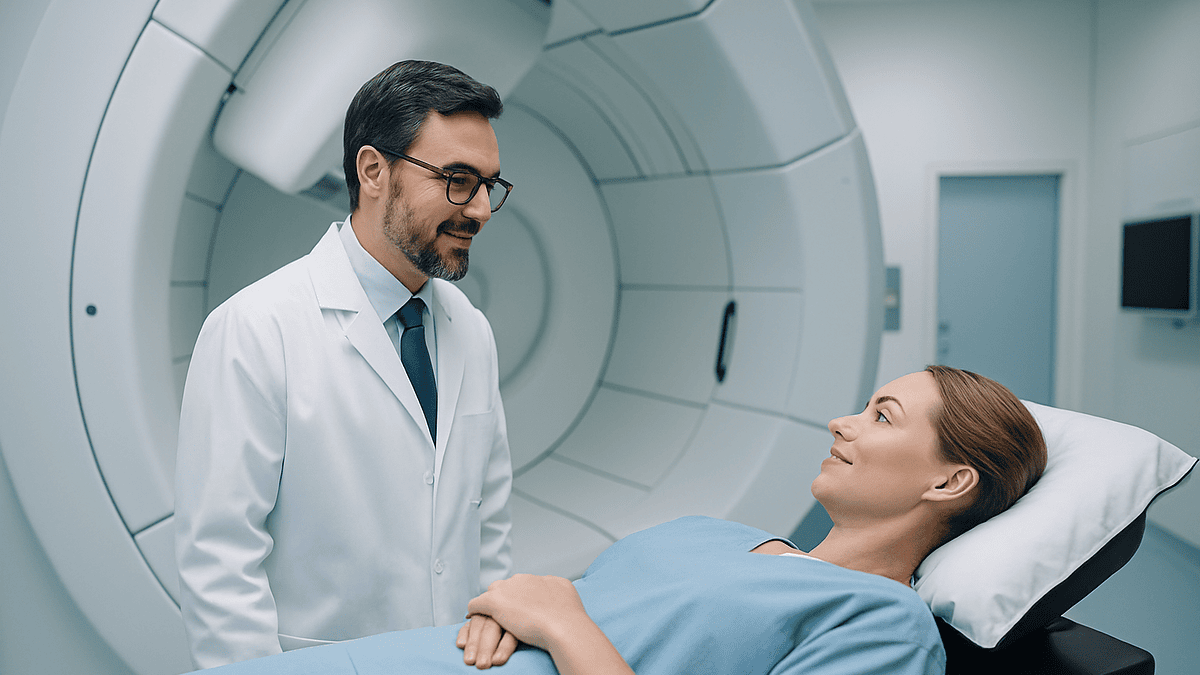
A proton therapy session is usually an outpatient visit of about 15 to 45 minutes, and most of that time goes to positioning you in a custom mold or mask and taking X-ray or CT images to line up the beam. The beam itself is on for roughly one to three minutes per angle, and you feel nothing while it runs. Courses typically run five days a week for several weeks, with the exact schedule set by your radiation oncology team.
The first thing many people notice on their first morning is not the machine. It is the mold. A blue foam cradle or a white mesh mask, shaped to their body a week earlier, sitting on a shelf with their name written on a strip of tape. Yours is one of dozens. Somebody has already thought about exactly how you will lie down.
If you are searching for a proton therapy session, what to expect is the real question underneath. How long will I be on the table? Will it hurt? Why do they keep taking pictures of me before anything happens? People who have finished a course tend to remember the same three things: the quiet, the stillness, and how short the actual treatment turned out to be compared with everything wrapped around it.
This article walks through that visit minute by minute, from the check-in desk to the parking lot, and then through the weeks that follow, using what mainstream medical sources actually say rather than what the brochures imply.
What actually happens when a proton beam meets tissue
Radiation treats cancer by damaging the DNA inside tumor cells so they can no longer divide. Standard radiotherapy does this with X-rays, which are packets of energy with no mass. Proton therapy uses protons, the positively charged particles found in the nucleus of every atom, and that single difference changes where the energy lands in the body.
An X-ray beam gives up energy steadily as it travels, so tissue in front of the tumor, the tumor itself and tissue behind it all receive a share. A proton beam behaves differently. It releases little energy as it enters, deposits most of its energy in a sharp burst at a depth the physics team chooses, and then stops. That burst is called the Bragg peak. Beyond it there is almost no exit dose. The National Cancer Institute describes this as the main physical reason protons are considered for tumors sitting close to sensitive structures such as the spinal cord, the brainstem or the optic nerves.
To make a beam that stops at the right depth, protons are accelerated in a cyclotron or synchrotron, a room-sized ring of magnets and electric fields. The beam travels through a pipe, is steered by more magnets and enters the treatment room through the gantry, the large rotating arm above the couch. Many centers use pencil-beam scanning, which sweeps a beam a few millimeters wide across the tumor layer by layer, a little like a printer laying down ink.
None of this alters how the experience feels from the couch. You lie still, the gantry moves, and the physics happens invisibly. Understanding the Bragg peak matters mostly because it explains why the team is so exacting about position: a beam designed to stop at a certain depth needs you at that depth every single day.
The planning visit: why the simulation appointment comes first
Before any treatment, there is a longer appointment usually called simulation or mapping. Nothing is treated that day. Its purpose is to build the exact geometry that every later session will copy.
You lie on a flat CT scanner table in the position you will hold for treatment. Therapists shape an immobilization device around you. For head and neck or brain tumors this is often a thermoplastic mask, a sheet of plastic mesh that softens in warm water, is stretched over the face and hardens in a few minutes. For chest, abdomen or pelvis it may be a vacuum-formed bag or foam cradle. Some people find the mask claustrophobic; telling the team in advance lets them adjust the fit or leave openings around the eyes and mouth.
A planning CT is then taken, sometimes with contrast dye and sometimes fused later with MRI or PET images. The NHS explains that tiny permanent tattoo dots, often three, or semi-permanent marker lines are placed on the skin so the same alignment can be found each day. The dots are the size of a freckle.
Between simulation and the first treatment, physicians outline the tumor and nearby organs on every CT slice, and medical physicists and dosimetrists design the beam angles and energies. The National Cancer Institute notes that this planning work commonly takes several days to a couple of weeks. That gap is not a delay caused by a full schedule; it is the calculation that makes the short daily visit possible.
Practical points people report wishing they had known: wear clothing that is easy to remove around the treated area, expect the room to be cool, and ask whether you should arrive with a full or empty bladder, since for pelvic tumors that instruction will be repeated at every visit.
Proton therapy session what to expect: from check-in to walking out
A typical treatment day unfolds in a predictable order, and the predictability is part of the design. You check in, often with a card or code so the team knows you have arrived. You change if needed, usually into a gown that opens toward the treated area. A radiation therapist, the trained professional who operates the equipment, collects you from the waiting area and confirms your identity and the treatment site.
Inside the treatment room the couch is already set to your saved coordinates. You lie down in your mold or mask. Therapists use the skin marks, small alignment lasers on the walls and the couch controls to bring you close to position. This step is unhurried and hands-on; you will be nudged a centimeter here and there.
The therapists leave the room. From a control area next door they take verification images, watching you on cameras and speaking through an intercom. The couch may shift slightly by remote control after the images are compared with the plan. Then the beam is delivered. You hear the gantry rotate between angles and may hear a hum or click, but nothing touches you.
Therapists return, release the mask or straps, help you sit up slowly, and you are free to leave. The Mayo Clinic describes the whole visit as commonly taking 15 to 30 minutes in the treatment room, with the beam itself on for only a minute or so. Cleveland Clinic gives a similar range of 15 to 45 minutes including setup.
Most people drive themselves, return to work or errands, and repeat the routine the next weekday. Once a week you will usually also meet your radiation oncologist, the doctor supervising the course, to review side effects and check your skin and weight.
Why positioning takes longer than the treatment itself
Newcomers are often surprised that the part with the most human attention is the part where nothing seems to happen. Positioning is the longest single step of the visit, and there is a good reason.
Because a proton beam is designed to stop at a chosen depth, a small change in what sits in front of the tumor changes where the energy ends up. Radiation oncologists call this range uncertainty. Weight loss, a fuller stomach, a different amount of gas in the bowel or a slightly rotated shoulder can all alter the path. Johns Hopkins Medicine notes that proton plans are especially sensitive to anatomy changes, which is why teams repeat the setup so carefully and may rescan you partway through the course.
The mold or mask handles gross position. Fine tuning comes from the therapists, who align your skin marks with laser lines projected onto your body and then adjust the couch in millimeter increments. You may be asked to relax your shoulders, straighten your hips, or hold a bar above your head. For tumors in the chest or upper abdomen, some centers use breath-hold or breathing-gated techniques, where the beam only fires during a particular phase of your breathing, tracked by a sensor on your chest or a spirometer you breathe through.
What helps from your side is consistency rather than effort. Eat similar meals at similar times before treatment if your team asks, follow bladder or bowel instructions exactly, and report any new pain that stops you lying flat. Tensing to hold perfectly still usually backfires; a relaxed, repeatable posture is easier for the therapists to reproduce.
If you are fitted with a mask and it feels tighter one day, say so. Facial swelling, dental work or a change in weight can all alter the fit, and the team can remold or adjust it rather than have you endure it.
What happens during proton therapy image checks before the beam
Every day, before treatment, images are taken with you already in position. This step is called image-guided radiation therapy, or IGRT, which simply means using pictures taken on the treatment couch to confirm the target is where the plan expects it.
Depending on the equipment, the images may be two low-dose X-rays taken from different angles, a cone-beam CT that rotates once around you, or a CT scanner mounted on rails in the same room. The imaging itself takes a few minutes. You do not need to do anything except stay as you are.
In the control room, software overlays the day’s images on the planning scan. Bone landmarks, implanted markers or soft-tissue outlines are matched. If the match is off by more than the team’s tolerance, often a few millimeters, the couch is moved remotely and, if the shift was large, the image is repeated. The National Cancer Institute describes daily imaging as a standard part of modern external-beam radiotherapy, protons included.
People sometimes worry that the imaging adds meaningful radiation. The verification X-rays are low dose and are accounted for in the overall plan; your team can tell you how your center handles this. Others worry when the therapists take longer than usual. In practice, a longer imaging step usually means the team is being careful about a bowel or bladder difference, not that something is wrong with you.
Occasionally the images show a change that cannot be fixed by moving the couch, such as a shrinking tumor, weight loss or fluid buildup. In that case the team may pause, take a new planning CT and adjust the plan, a process called adaptive replanning. It can feel like a setback. It is actually the quality check doing exactly what it is meant to do.
The minutes the beam is on: what you hear, feel and see
Here is the part people imagine most and remember least. When the beam is on, there is nothing to feel. Protons do not create heat, pressure or tingling as they pass through tissue. The Mayo Clinic states plainly that the treatment is painless and that patients feel nothing during delivery.
What you will notice is sound and movement. The gantry rotates to each planned angle with a low mechanical whir. Some systems produce a faint clicking or buzzing while the beam is scanning. With pencil-beam scanning, the beam is painted across the tumor spot by spot and layer by layer, and each layer can take seconds. A plan with two or three angles, called fields, usually means the beam is on for about one to three minutes in total, with short pauses while the gantry moves and the energy is reset.
You will not see the beam. Some people treated near the eyes or optic pathways report brief flashes of light, which are thought to come from the beam directly stimulating the retina or visual nerves; they are described in the medical literature as harmless and transient, but tell your team if they happen so it can be documented.
Breathing normally is fine unless you have been coached in breath-hold, in which case the therapists will guide you through the intercom: breathe in, hold, relax. The couch may be tilted or rotated to a new position between fields, particularly with fixed-beam rooms where the beam comes from one direction and the couch does the moving.
The beam stops instantly when the planned dose is delivered or if anyone presses an interrupt. If you need to cough or feel panicked, raise a hand or speak; the therapists are watching on camera and will stop, come in, and start again from where you left off.
How long is a proton therapy session, and how many will I have?
Two different clocks are running. One measures the visit; the other measures the course. Mainstream sources give consistent ranges, but every plan is individual and your team’s schedule is the one that counts.
| Stage of a typical visit | What is happening | Typical time |
|---|---|---|
| Check-in and changing | Identity check, gown if needed | 5–10 minutes |
| Positioning | Mold or mask, skin marks, laser alignment | 5–15 minutes |
| Image checks | X-rays or cone-beam CT, couch corrections | 3–10 minutes |
| Beam on | Delivery across each planned angle | 1–3 minutes total |
| Whole visit in the room | Everything above | 15–45 minutes |
Those room times come from the Mayo Clinic and Cleveland Clinic patient pages, which describe 15 to 30 and 15 to 45 minutes respectively, with the beam itself lasting only a minute or so. Your first session is usually longer because the team double-checks every step, and days when a new planning scan is needed will also run long.
The course is measured in fractions, the term for one day’s dose. Splitting the total dose into daily fractions lets healthy tissue repair between sessions while tumor cells, which repair less efficiently, accumulate damage. The NHS explains that external radiotherapy is usually given once a day, Monday to Friday, with weekends off, over a period that can range from a single visit to around seven weeks depending on the cancer and the aim of treatment. Proton courses follow the same logic. Some tumors are treated in five to fifteen larger fractions; others take six or seven weeks of smaller ones.
A frequent question on patient forums is whether missing a day ruins the plan. It does not. Teams routinely make up missed fractions at the end, and one missed day for illness or weather is built into the tolerance of the plan. Several missed days in a row is worth discussing, and your team will tell you how they handle it.
Who is proton therapy usually for, and who is asked to wait?
Proton therapy is not a different medicine; it is a different way of delivering radiation. The question your team asks is whether the sharper stopping point gives a meaningful advantage for your particular tumor, in your particular body, over conventional photon radiotherapy.
The National Cancer Institute and Johns Hopkins Medicine describe the situations where that advantage is most often considered:
- Tumors in children and young adults, because the growing tissues around a tumor are especially sensitive to radiation and reducing dose to them may lower long-term effects.
- Tumors close to critical structures, such as the base of the skull, the spine, the eye, the brainstem or the salivary glands, where even a small exit dose matters.
- Situations where someone has already had radiation to the same region and the surrounding tissue cannot safely take much more.
- Some tumors of the head and neck, liver, esophagus, lung or prostate, where trials are ongoing and selection depends on individual anatomy.
Being a good candidate on paper is not the whole picture. People are sometimes asked to wait or to consider another approach when a tumor is moving significantly with breathing and cannot be reliably tracked, when there is metal hardware in the beam path that makes the stopping depth unpredictable, when anatomy is changing rapidly, or when the same result is expected from conventional radiotherapy that can start sooner. Access also depends on how many centers exist in a region, and waiting lists are a real factor that your team will be honest about.
The decision belongs to the treating team, usually made in a multidisciplinary meeting where radiation oncologists, surgeons, medical oncologists and physicists review the images together. If you are curious about whether protons were considered for you, asking that question directly is entirely reasonable, and the answer should come with a reason either way.
Proton therapy vs traditional radiation: an honest comparison
Marketing on this topic tends to run ahead of the evidence, so it helps to separate what is established from what is still being tested.
What is physically certain: protons deposit less dose beyond the target than X-rays. Planning studies consistently show lower dose to surrounding organs. The National Cancer Institute states that proton therapy may reduce damage to nearby healthy tissue, and that is the mechanism behind every proposed benefit.
What the clinical evidence shows: for many adult cancers, randomized trials directly comparing protons with modern photon techniques such as intensity-modulated radiotherapy are still being completed. Where results exist, they tend to show similar tumor control with differences in specific side effects that vary by site. Cleveland Clinic and Johns Hopkins Medicine both describe protons as an option in selected cases rather than a universal upgrade. Saying that protons are better in general is not supported; saying that they are better for particular tumors in particular locations is a conversation worth having with your oncologist.
What is the same from the patient’s chair: daily visits, immobilization, image checks, a painless beam, five days a week, weekends off, side effects concentrated in the treated region. Someone having photon therapy for the same tumor would have an almost identical daily routine.
What differs practically: proton centers are fewer, so travel time to daily visits can be longer; sessions can be somewhat longer because of the extra care over range; and the equipment is more sensitive to anatomy changes, so replanning during the course is more common. The bare-skin side effects of photons on the far side of the body, for example on the back when the chest is treated from the front, are largely avoided with protons.
The best comparison is not protons versus photons in the abstract. It is your plan versus the alternative plan for your tumor, side by side, with the doses to each organ listed. Your team can show you that comparison.
What are the downsides of proton therapy?
Any treatment explainer that only lists advantages is not doing its job. Proton therapy has drawbacks, and they are worth understanding before you begin.
Side effects still happen. Protons spare tissue behind the tumor, but tissue in front of and around the target still receives dose, and the tumor itself sits inside an organ. Skin redness, fatigue, hair loss in the treated area and site-specific effects such as mouth soreness, swallowing difficulty, bowel irritation or urinary urgency are described by the National Cancer Institute for radiation of all types. People sometimes arrive expecting no side effects at all and feel let down when the ordinary ones appear.
Range uncertainty is a real physical limitation. Because a proton beam stops abruptly, a few millimeters of error in the estimated depth can under-dose the tumor edge or over-dose the tissue just beyond it. Teams manage this with margins, daily imaging and replanning, but it is the reason protons are avoided for some moving tumors and for beam paths through metal implants.
Logistics weigh on people. Centers are scarce, so a course can mean weeks of long daily drives or staying away from home. The evidence base, as discussed above, is stronger for some tumors than others, and for many adult cancers the expected outcome is similar to conventional radiotherapy. Choosing protons for a site where the evidence is unsettled means accepting that the theoretical benefit has not yet been proven in trials.
Late effects can still occur. Radiation of any kind can cause changes months or years later in the tissue that was treated, including fibrosis, hormonal changes if glands are in the field, and a small long-term risk of a second cancer. Protons may lower some of these risks by reducing the volume of tissue exposed, but they do not remove them.
None of these points argues against proton therapy. They argue for going in with clear eyes and a team willing to discuss trade-offs.
Proton therapy side effects timeline: the days and weeks that follow
Radiation effects do not arrive on day one and do not leave on the last day. They build, peak and fade on a schedule that surprises people who expected to feel worst at the start.
During the first week or two, most people feel little beyond the disruption of daily appointments. Fatigue creeps in gradually rather than hitting suddenly. The National Cancer Institute describes radiation fatigue as different from ordinary tiredness: rest does not fully relieve it, and it tends to accumulate as the course continues.
By the middle of the course, the treated area starts to speak up. Skin may redden, itch or darken, especially in folds. If the mouth, throat or gut is in the field, soreness, taste changes or bowel symptoms typically begin in this window. Weekly visits with your oncologist and nurses exist precisely to catch these early, and supportive measures are adjusted week by week.
The hardest days, asked about so often online, are usually the final week of treatment and the first one to two weeks after it ends. Radiation continues acting on tissue after the last fraction, so symptoms often peak after the machine has stopped. Knowing this in advance spares people the fear that something has gone wrong when they feel worse at home than they did in the clinic.
Recovery from acute effects follows over the following weeks. The NHS notes that most side effects settle within a few weeks of finishing, while skin usually heals over two to four weeks and fatigue can linger for weeks to a few months. Site-specific effects such as swallowing difficulty may take longer. A follow-up visit is typically scheduled a few weeks after completion, with imaging later, because tumors keep responding for weeks and an early scan can be misleading.
Long-term effects, when they occur, appear months to years later and are monitored through ongoing follow-up rather than daily attention.
What people often get wrong about what to expect from a proton therapy session
Some myths are harmless. Others cause needless worry or, worse, lead people to skip care. These are the ones that come up most.
You will be radioactive afterwards. External-beam radiation, protons included, does not leave any radiation in your body. The NHS and MedlinePlus are clear that it is safe to be around children, pregnant people and pets immediately after a session. Only some internal treatments, such as implanted radioactive seeds, carry precautions, and that is a different procedure.
It will hurt, or you will feel the beam. The beam is painless and produces no sensation. Discomfort during a visit, when it occurs, comes from lying still in a mask or from an existing sore area, not from the protons.
Protons mean no side effects. They reduce dose beyond the target; they do not eliminate dose to the target region. Skin, fatigue and organ-specific effects still occur in proportion to what is being treated.
A shorter beam time means a weaker treatment. The dose is set by physics, not by the clock. A minute of protons delivers what the plan calls for. Longer time on the couch reflects setup and imaging, not extra medicine.
If I feel worse after the course ends, it must have failed. Symptoms commonly peak after the last fraction. That is the expected timeline, not a sign of failure.
The machine can fire without checks. Modern systems interlock: the beam cannot start until the plan, patient identity and position match, and it stops automatically the instant the planned dose is reached or a door opens.
Protons are always the better choice. For many tumors, trials have not shown a difference from modern photon techniques. The right choice depends on anatomy, tumor site, prior treatment and what the comparison plans show, and your team is the right place to weigh that.
Questions to ask your care team
The weekly review with your radiation oncologist is short, and it is easy to leave without asking what matters to you. Writing questions down beforehand helps. These are the ones patients and nurses most often wish had been raised earlier.
About the plan itself:
- Why were protons recommended for my tumor rather than conventional radiotherapy, and can I see the two plans side by side?
- How many fractions are planned, over how many weeks, and what happens if I miss a day?
- Which organs near my tumor receive the most dose, and what does that mean for me later?
- Will I need a new planning scan during the course, and how would you decide?
About the daily visit:
- Do I need a full or empty bladder, an empty stomach or any special preparation before each session?
- Can I bring music, and can the mask be adjusted if I find it hard to tolerate?
- Who do I call if I am running late or unwell?
- Can I keep driving, working and exercising during treatment?
About side effects and recovery:
- Which side effects should I expect for my treatment site, when do they usually start, and when should they fade?
- How should I care for the skin in the treated area, and which products should I avoid?
- Which symptoms mean I should call the same day rather than wait for the weekly visit?
- When will I have follow-up imaging, and why not sooner?
About the bigger picture:
- Is this treatment intended to control the tumor completely, to shrink it before surgery, or to relieve symptoms?
- Are there clinical trials relevant to my situation?
- Who coordinates my care between the radiation team and my other doctors?
There are no wrong questions here, and a team that welcomes them is a team you can trust with the details.
When to call your doctor
Most side effects of proton therapy are expected, monitored and managed through the weekly visits. A smaller set of symptoms should not wait. Your team will give you a number to call, often staffed around the clock, and using it is never an overreaction.
Call the same day, or seek urgent care, if you notice any of the following:
- A fever, chills or shaking, especially if you are also receiving chemotherapy, since infection can progress quickly when blood counts are low.
- Difficulty breathing, new chest pain, or coughing up blood.
- Inability to swallow liquids, or being unable to keep fluids down for more than a day, which risks dehydration.
- Skin in the treated area that is blistering, weeping, bleeding or showing spreading redness, warmth or pus.
- Severe or worsening headache, confusion, new weakness or numbness in a limb, seizures, or sudden changes in vision, particularly if the brain or spine is being treated.
- Bleeding from the bowel or bladder, or being unable to pass urine.
- A swollen, painful or red calf, or sudden shortness of breath, which can signal a blood clot.
- Feeling faint, a racing heartbeat, or a rapid decline in how you feel overall.
Call within a day or two, without waiting for your scheduled review, if pain is not controlled by the measures your team suggested, if you cannot lie flat for treatment, if you are losing weight quickly, or if low mood or anxiety is making it hard to keep attending. The National Cancer Institute and MedlinePlus both emphasize that reporting side effects early gives the team more options to keep you comfortable and on schedule.
Every decision about pausing, adjusting or continuing treatment rests with your treating team. Your job is simply to describe what you notice, as soon as you notice it.
Frequently asked questions
How long is a proton therapy session from start to finish?
Most visits take about 15 to 45 minutes in the treatment room, according to Mayo Clinic and Cleveland Clinic patient information. Positioning in your mold or mask and daily image checks take up most of that time. The beam itself runs for roughly one to three minutes across all angles. The first session and any day requiring a new planning scan usually run longer.
What happens during proton therapy when I am on the table?
You lie in a custom mold or mask while therapists align skin marks with lasers, then leave the room and take X-ray or CT images to confirm your position. The couch is adjusted remotely if needed. The gantry rotates to each planned angle and the beam is delivered painlessly. Therapists watch on camera, speak through an intercom, and return to help you up.
What are the downsides of proton therapy?
Side effects in the treated region still occur, including skin changes, fatigue and organ-specific symptoms. The beam’s sharp stopping point makes plans sensitive to weight loss, breathing motion and metal implants, so replanning is more common. Centers are scarce, which can mean long daily journeys. For many adult cancers, trials have not yet shown an advantage over modern photon radiotherapy.
What are the hardest days after radiation treatment?
For most people, the toughest stretch is the final week of the course and the first one to two weeks after it ends. Radiation keeps acting on tissue after the last fraction, so skin, mouth, throat or bowel symptoms and fatigue often peak at home rather than in the clinic. The NHS notes most acute effects then settle over the following weeks.
How long does it take to recover from proton therapy?
Acute effects such as skin reactions typically heal over two to four weeks after treatment ends, while fatigue can persist for weeks to a few months, according to the NHS and the National Cancer Institute. Site-specific effects like swallowing difficulty may take longer. Tumor response continues for weeks, which is why follow-up imaging is usually scheduled later rather than immediately.
What do people wish they knew before starting radiation?
Common reflections include that the daily visit is short and painless, that side effects build slowly and peak after the course ends, that following bladder or bowel instructions exactly makes setup faster, and that reporting symptoms early gives the team more options. Many also wish they had arranged transport and work flexibility before week one rather than during it.
Does the proton beam hurt or feel like anything?
No. The beam produces no heat, pressure or tingling, and the Mayo Clinic describes treatment as painless. You may hear the gantry rotate and a faint hum or click. A few people treated near the eyes report brief light flashes, considered harmless. Any discomfort during a session usually comes from lying still in a mask or from an existing sore area.
How does proton therapy vs traditional radiation feel different day to day?
From the patient’s chair, the routines are nearly identical: daily weekday visits, a mold or mask, image checks and a painless beam. Differences are mostly logistical. Proton centers are fewer, sessions can run slightly longer because of extra care over beam depth, and replanning during the course is more common. Side effects on the far side of the body are largely avoided with protons.
Can I drive myself and keep working during proton therapy?
Many people do, since sessions are short and cause no immediate impairment. The exceptions are when sedation is used, when brain treatment or medication affects alertness, or when fatigue builds later in the course. Your team will advise based on your treatment site. Planning reduced hours or flexible work for the final weeks and the fortnight after is often sensible.
Am I radioactive after a proton therapy session?
No. External-beam radiation, including protons, passes through and does not remain in your body. The NHS and MedlinePlus confirm it is safe to hug children, be near pregnant people and handle pets immediately afterward. Precautions apply only to certain internal treatments such as radioactive implants, which are a different procedure from what happens in a proton treatment room.
References
This article is for general information only and is not a substitute for professional medical advice. Please consult a qualified doctor about your individual situation.

More from the Blog
When Is Radioiodine Treatment Chosen for an Overactive Thyroid Over Tablets or Surgery?
Radioiodine is usually chosen for an overactive thyroid when antithyroid tablets have not kept the condition controlled, when hyperthyroidism returns after a course of…
Why Surgeons Remove a Margin of Healthy Skin in Wide Local Excision for Melanoma
Surgeons remove a rim of healthy-looking skin around a melanoma, usually between 0.5 and 2 centimeters wide depending on how thick the tumor is,…

What Happens During a Lutetium-177 PSMA Therapy Session: Infusion, Fluids and Monitoring
A lutetium-177 PSMA treatment session is an outpatient visit of several hours in which a radioactive medicine is given through an intravenous line, usually…

Exercise, Weight and Bone Strength During Hormone Therapy: A Practical Routine
Exercise during hormone therapy for cancer is generally encouraged because these treatments lower estrogen or testosterone, which speeds bone loss, muscle loss and fat…
When Is Mohs Surgery Chosen Over Standard Excision for Skin Cancer? How Surgeons Decide
Surgeons usually choose Mohs surgery over standard excision when a basal cell or squamous cell skin cancer sits in a cosmetically or functionally sensitive…

When Do Scans Show a Response After CyberKnife? Why Follow-Up Imaging Takes Patience
Scans after CyberKnife, a form of stereotactic radiosurgery, usually change slowly. Cancerous tumors often begin to shrink over a few months, while benign tumors…