

Inside a Robotic Rehabilitation Session: Set-Up, Practice Blocks and How Progress Is Measured
Key Takeaways
- A rehabilitation robot senses your effort and adjusts its help in real time, which is what separates it from a passive motion machine.
- The Cochrane review of 45 trials found robot-assisted arm training improved daily activities and arm function after stroke, with modest effect sizes.
- For walking, the clearest benefit is in people early after stroke who cannot yet walk independently; those already walking gain little extra.
- A large randomized trial of 770 stroke survivors found robotic arm training no better than an equal amount of skilled conventional therapy.
- Progress is tracked by the falling percentage of each movement the motor performs, alongside standardized clinical scales and your own goals.
- Robotic training is safest and most useful when a therapist supervises every session and follows it with practice on real everyday tasks.
A robotic rehabilitation session is a supervised physiotherapy appointment in which a motorized device supports, guides or resists a limb while you practice hundreds of task-like movements. A therapist fits and calibrates the machine, sets the level of assistance, runs timed practice blocks with rests, and tracks built-in measures such as repetitions, range of motion and force alongside standard clinical tests. Sessions typically last 30 to 60 minutes and complement, rather than replace, conventional therapy.
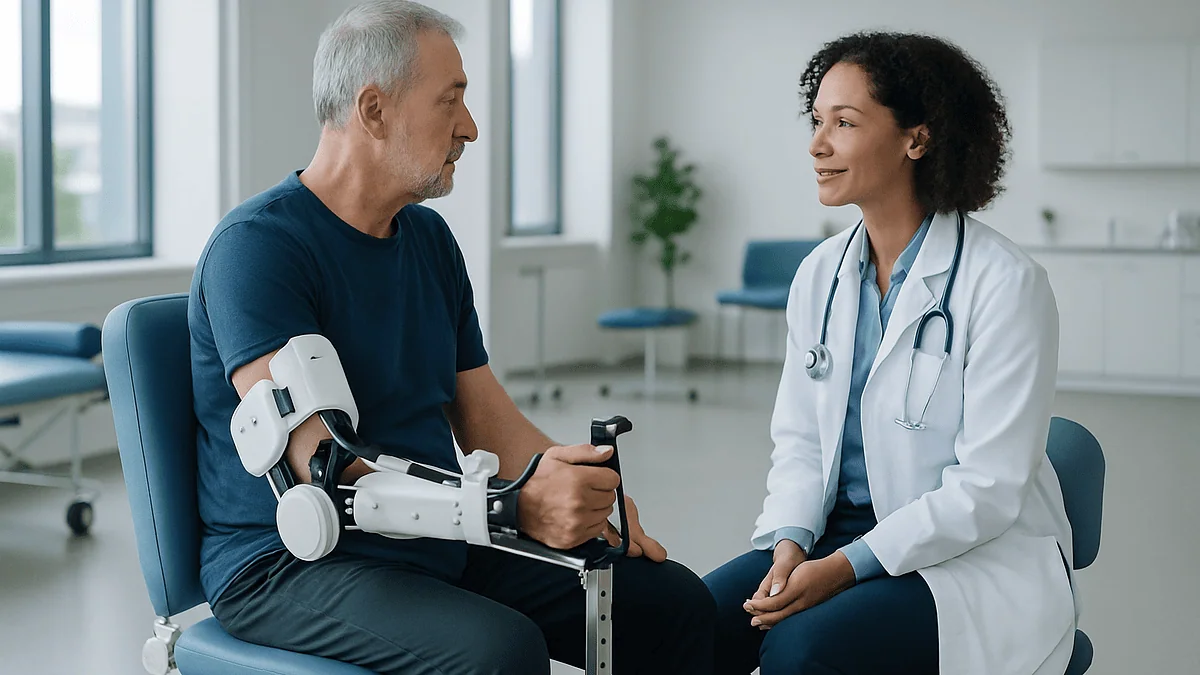
The first thing many people notice is not the robot. It is the quiet. A physiotherapist kneels beside the chair, tightening a padded cuff around a forearm that has barely moved since a stroke three weeks earlier, and the room hums like a dentist’s office before the drill starts. Then a screen lights up with a small blue circle, and the forearm, with the machine’s help, begins to travel toward it.
If a therapist has suggested a robotic rehabilitation session, you probably have a picture in your head from films: an exoskeleton, a treadmill, a person striding across a lab. The reality is slower, more repetitive and, for most people, oddly reassuring. It is still physiotherapy. The robot is a very patient assistant that never tires of holding an arm or a leg through the same arc for the thousandth time.
This explainer walks through what actually happens: how the equipment is set up, what the practice blocks feel like, how progress is measured, and what the research genuinely shows about who benefits.
What is robotic rehabilitation, and what is it not?
Robotic rehabilitation is the use of a motorized, computer-controlled device to help a person practice movement during physical or occupational therapy. The device can move a limb for you, move it with you, or push back against you, depending on how much you can already do. It is almost always paired with a screen-based task, so a reach becomes a game of touching targets and a step becomes a walk along a virtual path.
It is worth separating this from two things people often confuse it with. Robotic surgery is a completely different technology: a surgeon controls instruments inside the body through a console. Nothing in a rehabilitation robot enters the body, and no anesthesia is involved. The second confusion is with passive machines such as continuous passive motion devices, which simply bend and straighten a joint on a timer. Rehabilitation robots differ because they sense what you are doing and adjust in real time.
Why would anyone build such a thing? The answer lies in a principle that runs through modern stroke and spinal cord rehabilitation: recovery depends on repetition, and the more meaningful repetitions a person completes, the better the nervous system tends to relearn. The American Heart Association’s rehabilitation guideline describes intensive, task-specific practice as a foundation of motor recovery after stroke. A therapist working by hand can help a weak arm through perhaps 30 to 50 reaching movements before both of them tire. A robot can support several hundred in the same time, and it can record every one of them.
The World Health Organization defines rehabilitation as interventions designed to optimize functioning in everyday life, and that framing matters here. The robot is a tool serving that goal. It does not diagnose, does not replace assessment by a clinician, and does not by itself decide whether you are ready to go home.
What happens in a robotic rehabilitation session, step by step
Most robotic rehabilitation sessions follow a rhythm that becomes familiar after two or three visits. Knowing the shape of it in advance takes away much of the apprehension.
It begins with a brief check-in. The therapist asks about pain, sleep, fatigue and any new symptoms since the last visit, and looks at skin under the straps from the previous session. Blood pressure and heart rate are often recorded, particularly for people early after a stroke or cardiac event, because upright walking devices raise the heart’s workload.
Next comes transfer and set-up, which can take 10 to 15 minutes the first time and considerably less once the therapist knows your measurements. For an arm device you usually sit in a fixed chair with the trunk strapped loosely so that the arm, not the body, does the work. For a walking device you may be fitted with a harness and lifted partially by an overhead support.
The middle of the session is the practice itself, divided into blocks of a few minutes each with short rests between them. A typical arm session in research trials involved roughly 45 minutes of practice, and gait programs in the studies pooled by the Cochrane Collaboration commonly ran 20 to 40 minutes on the device, although the amount is adjusted to what you can tolerate.
The session ends with removal of the equipment, a skin check, and often a few minutes of conventional practice, such as reaching for a cup or walking a few meters without support, so that what was rehearsed on the machine is immediately tried in real life. The therapist notes what changed and sets the plan for next time. The whole appointment, door to door, usually fits inside an hour.
Set-up: how the robot is fitted and calibrated to you
Set-up is where a good session is won or lost, and therapists spend more time on it than newcomers expect. A poorly aligned robot fights the joint instead of helping it, so the first visit is partly a fitting appointment.
For arm and hand devices the therapist adjusts segment lengths so that the machine’s pivot points sit over your elbow, wrist or shoulder. Straps are snugged enough to transmit movement but loose enough to avoid pressure on bony points, a particular concern for skin that has lost sensation. Someone with a subluxed shoulder, a common problem after stroke in which the arm partly slips from its socket, will have the shoulder supported before any reaching begins.
Calibration follows. Many devices ask you to relax fully while the machine moves the limb through its available range, which teaches the software your joint limits so it never pushes beyond them. Then you are asked to push or pull as hard as you comfortably can, which sets a baseline for force. Some systems also measure resting muscle tone, the stiffness clinicians call spasticity, and slow their movements if a muscle catches.
Walking devices add a harness fitting. The therapist sets how much of your body weight the overhead support carries, often starting with a substantial fraction and reducing it over the weeks. Treadmill speed begins low. Exoskeleton legs are matched to your thigh and shin lengths, and the hip and knee trajectories are set to a normal walking pattern.
Finally the therapist chooses the assistance mode: fully assisted, assist-as-needed, or resisted. This single setting shapes the whole session, and it is one of the numbers you will see change over time as you improve.
Practice blocks: what the repetitions actually look like
Once set-up is done, the session settles into blocks. A block is a timed stretch of practice, usually two to five minutes for arm work and longer for walking, followed by a rest. The structure is deliberate. Motor learning research summarized in the American Heart Association guideline favors practice that is repetitive, task-specific and progressively challenging, and blocks make all three easier to deliver.
On an arm robot a block might be 40 reaches to targets that appear in a circle on the screen. In assist-as-needed mode you start the movement, and if the arm stalls the motor gently completes it. The software watches how much help it gave and, if you needed little, it nudges the targets farther out or slows its assistance next block. If you needed a lot, it does the opposite. This is the part people describe as a game, and for good reason: the constant small wins hold attention through repetitions that would otherwise be tedious.
Hand devices work similarly but on a smaller scale, opening and closing the fingers around a virtual or real object. Some link finger movement to a grasp-and-release task, since releasing is often harder than gripping after a stroke.
On a gait device a block is a period of continuous stepping, perhaps five to ten minutes, with the therapist standing beside you correcting trunk lean or prompting you to look ahead rather than at your feet. Between blocks you sit, and the therapist checks heart rate and asks you to rate your effort.
Fatigue is expected and is not a failure. Therapists watch for the point where movement quality drops, because sloppy repetitions teach sloppy patterns. Many sessions end a little earlier than planned for exactly that reason.
Robotic arm therapy after stroke: what the arm and hand devices do
Upper-limb robots come in two broad families, and which one you meet depends on what your therapist is trying to retrain.
End-effector devices hold only the hand or forearm, typically in a handle or cuff that slides across a table surface. Your shoulder and elbow are free to move however they like as you push the handle toward targets. These devices are quick to set up and suit people who already have some shoulder control but struggle with coordination or reach.
Exoskeleton devices wrap around the whole arm, with motors at each joint, so they can move the shoulder, elbow and wrist separately. They allow the therapist to isolate one joint, for example practicing elbow extension while the shoulder is held still, which is useful when the arm moves only in a stiff, all-or-nothing pattern.
Both families aim at the same underlying problem. After a stroke, the brain’s map for the affected arm is disrupted, and the arm tends to be neglected in daily life, which makes the loss worse. Repeated, attended, goal-directed movement is the strongest known driver of the brain’s capacity to reorganize. The Cochrane review of electromechanical and robot-assisted arm training, which pooled 45 trials involving 1,619 participants, found that people who received it showed improvements in activities of daily living, arm function and arm strength compared with other interventions, with the evidence graded as high quality for daily activities but lower for the other outcomes.
What the robots do not do is teach the hand to feel again, or make the arm useful without carry-over practice. Every arm block is usually followed by something ordinary: buttoning, pouring, folding a towel. The machine builds the movement; the real task gives it a reason to exist.
Robot assisted gait training: what the walking devices do
Walking robots address a different challenge. Relearning to walk requires not just leg strength but balance, weight shifting and the timing of hundreds of steps, and doing that safely with a person who cannot yet stand unaided usually takes two or three therapists. Robot assisted gait training, which means using a motorized device to move the legs through a walking pattern while supporting body weight, lets one therapist deliver many more steps with less physical strain and lower fall risk.
Treadmill-based exoskeletons strap the legs into motorized braces above a moving belt, with a harness carrying part of the body weight. The braces guide hip and knee through a normal stride, and as you improve the therapist reduces both the support and the guidance so your own muscles take over. End-effector gait trainers work differently: your feet rest on plates that move in a stepping arc, and the trunk is supported, but the knees are free.
More recent overground exoskeletons are worn like a heavy suit and allow walking across a room rather than on a belt. They are used in some spinal cord injury and stroke programs, always with a therapist walking alongside.
The evidence is clearer for some groups than others. The Cochrane review of electromechanical-assisted gait training after stroke, covering 62 trials and 2,440 participants, concluded that people who received it in combination with physiotherapy were more likely to achieve independent walking than those who had physiotherapy alone, and that the benefit appeared greatest in people within the first three months after stroke who could not yet walk. For people who were already walking, the added benefit was small or uncertain. Walking speed and endurance did not clearly improve. That pattern shapes who is usually offered gait robots and who is steered toward other approaches.
How progress is measured in a robotic rehabilitation session
One of the quieter advantages of a robotic rehabilitation session is that the device measures everything. Every reach, every step and every newton of force is logged, which gives you and your therapist numbers that conventional therapy can only estimate. Those numbers are read alongside standard clinical tests, never instead of them.
| Measure | Where it comes from | What a change tends to mean |
|---|---|---|
| Repetitions per session | Device log | Rising counts at the same fatigue level suggest better endurance |
| Assistance percentage | Device log | The share of each movement the motor performed; falling numbers mean you are doing more of the work |
| Active range of motion | Device sensors and goniometer | How far you can move the joint yourself; widening arcs point to recovering control |
| Movement smoothness | Device software | Fewer stops and starts in the path toward a target, a sign of improving coordination |
| Body-weight support | Gait harness setting | Percentage of your weight carried by the overhead system; lower means more load on your legs |
| Standardized clinical scales | Therapist assessment | Validated tests of arm function, balance and walking, repeated every few weeks |
| Self-reported goals | You | Tasks you set at the start, such as holding a phone or walking to the mailbox |
Two points deserve emphasis. First, device numbers can improve while everyday function does not, because a person can get better at a screen game without that skill transferring to real objects. That is why therapists insist on the clinical scales and on your own goals. Second, plateaus on the device are normal and often precede a gain elsewhere. A week of unchanged assistance percentage is information, not a verdict.
Ask to see your data. Most systems can print or display a session-by-session trend, and watching the assistance line drift downward over a month is, for many people, the most motivating part of the whole process.
Who a robotic rehabilitation session is usually for, and who is asked to wait
Selection is individual, and the treating team makes the call, but the patterns in guidelines and trials are consistent enough to describe.
The people most often offered robotic therapy are adults recovering from stroke with moderate to severe arm weakness or an inability to walk independently, particularly in the first weeks to months when the nervous system is most responsive. The American Heart Association guideline states that robot-assisted movement training to improve motor function and mobility after stroke in conjunction with conventional therapy may be considered, a moderate-strength recommendation for the arm. People with incomplete spinal cord injury, multiple sclerosis, traumatic brain injury and, in some centers, Parkinson’s disease or cerebral palsy may also be candidates, though the evidence base for these groups is thinner.
Certain features make therapists cautious or lead them to postpone. Unstable blood pressure or a recent heart event can make upright gait training unsafe until cleared by a physician. Severe spasticity that resists the machine, a fixed joint contracture, or an unhealed fracture in the limb usually rule out that device for now. Open wounds or fragile skin under strap sites need to heal first. Marked confusion or an inability to follow two-step instructions makes screen-based tasks impractical, though passive modes may still be used. Body size and weight outside a device’s engineered limits is a straightforward exclusion.
Being asked to wait is not the same as being turned down. Many people return to robotic sessions once blood pressure is controlled, a wound closes or spasticity is managed. Equally, some people never need a robot at all: if you can already reach and walk, conventional task practice is often just as effective and far simpler. The device earns its place when it lets you do something you otherwise could not do enough of.
What the evidence actually shows about robotic physiotherapy for stroke
This is the section that tends to be skipped on marketing pages, so it deserves plain language. Robotic physiotherapy for stroke has been studied for more than two decades, and the honest summary is: it works about as well as an equal amount of skilled conventional therapy, sometimes a little better, and its main advantage is practical rather than magical.
The Cochrane arm review found that robot-assisted training improved daily activities, arm function and strength. The effects were modest in size and, critically, the trials compared robots against a range of controls, some of which delivered far fewer repetitions. When the comparison is fair, the picture flattens. A large multicenter randomized trial of 770 stroke survivors published in The Lancet compared robot-assisted arm training against an enhanced program of conventional therapy matched for time, 36 sessions over 12 weeks, and against usual care. Robot-assisted training was not superior to either comparison on the primary measure of arm function at three months.
The gait review tells a parallel story: a clear benefit for independence in walking among people who could not yet walk early after stroke, no clear benefit for speed or endurance, and little added value for those already walking.
How should you read this? Not as a reason to avoid the robot, but as a reason to hold it in proportion. The device is a delivery system for repetition. Where it lets you get more high-quality practice than a therapist could provide by hand, it is likely to help. Where it substitutes for a therapist’s attention rather than extending it, the evidence gives no reason to expect a better result. The AHA guideline places robotic training among several reasonable ways to intensify practice, alongside constraint-induced therapy, mental practice and task-oriented training, rather than above them.
What the following days and weeks usually look like
Robotic rehabilitation is rarely a one-off. It is delivered as a course, and the shape of that course is fairly predictable even though the pace is personal.
In the research pooled by the Cochrane reviews, most programs ran three to five sessions a week for four to ten weeks, with individual sessions of 30 to 60 minutes. Inpatient programs cluster at the denser end because the person is already on site; outpatient programs are often two or three visits a week. Your team will set a frequency based on how you tolerate the sessions and on what else is in your schedule, since robotic blocks sit alongside conventional physiotherapy, occupational therapy and, where needed, speech therapy.
The first week is mostly about tolerance. Expect muscle soreness in places you had forgotten you had muscles, mild skin redness under straps that fades within an hour, and fatigue that can last into the evening. These are common and settle as the body adapts. The second and third weeks are when the assistance percentage typically begins to fall and the therapist starts trimming body-weight support or expanding target distances.
From about the fourth week the emphasis shifts toward carry-over. Sessions may shorten on the device and lengthen on real tasks. Home practice is prescribed, usually simple repetitive movements that mimic what the machine trained. Standardized scales are repeated, and the team reviews whether to continue, taper or stop the robotic component.
Recovery after stroke follows its own timeline. The NHS notes that the most rapid improvement usually happens in the first few months, with slower gains continuing for a year or longer in many people. Robotic sessions are one input into that curve, not a switch that changes its shape. Progress that stalls is a prompt for the team to reassess goals, not a sign that effort has stopped mattering.
Risks, discomfort and the alternatives your team may weigh
Robotic rehabilitation is considered a low-risk therapy, but low risk is not no risk, and a neutral account should name what can go wrong.
The most common problems are minor. Skin irritation, redness or small pressure marks under cuffs and harnesses are frequent, and occasionally a blister or abrasion forms, particularly on skin with reduced sensation. Muscle soreness for a day or two after early sessions is expected. Some people feel light-headed on standing into a gait harness, which is why blood pressure is checked. Joint pain can occur if a device is misaligned, and shoulder pain is a specific concern in people with a weak, subluxed shoulder if the arm is pulled rather than supported.
Rarer events include falls during transfer to or from a device, strains from a mistimed step in an exoskeleton, and, in people with fragile bones from prolonged immobility, the theoretical risk of a fracture under repeated loading. Autonomic dysreflexia, a dangerous blood pressure spike in people with higher spinal cord injuries, can be triggered by tight straps or a full bladder and is something spinal teams monitor closely. Motion sickness from screen tasks is uncommon but real.
The alternatives are not lesser options. Task-oriented practice with a therapist, constraint-induced movement therapy for the arm, body-weight-supported treadmill training without a robot, functional electrical stimulation, mirror therapy, mental practice and circuit-class group therapy all appear in the AHA rehabilitation guideline with their own evidence grades. Several match robotic therapy for effectiveness in trials. For many people the best program combines two or three of these, and the choice depends on what the person can do, what equipment and staff are available, and what the person actually wants to be able to do. That decision belongs to you and your treating team together.
What people often get wrong about robotic rehabilitation
Because the equipment looks futuristic, expectations tend to run ahead of the evidence. A few corrections save disappointment.
The first myth is that the robot does the work for you. In passive mode it can, and early on that may be all your arm allows, but the goal is the opposite. The device is set to do as little as possible, and success is measured by how quickly its share of the effort falls. Sessions in which you relax and let the motor move you are the least useful kind.
The second is that newer means better. Some of the strongest evidence comes from relatively simple end-effector devices that have existed for years. Sophisticated exoskeletons offer more joint control, not proven superiority, and no rehabilitation robot has a head-to-head evidence base showing it outperforms another. Claims about artificial intelligence choosing your program are, at present, descriptions of adaptive software rather than evidence of better outcomes.
Third, people assume robotic therapy is reserved for the severely affected. In fact the arm evidence includes people across the range, while the gait evidence favors those who cannot yet walk. Severity guides which device, not whether therapy is worthwhile.
Fourth, the idea that recovery stops at six months, so the robot is pointless after that. Trials have included people years after stroke and found measurable gains in arm function, though smaller. Later improvement is slower, not impossible.
Finally, a robotic rehabilitation session is sometimes imagined as a replacement for the therapist. Every trial that showed benefit had a clinician setting up, supervising and adjusting the device, and the transfer of gains to daily life depended on what that clinician did after the straps came off. The person in the room matters more than the machine in it.
Questions to ask your care team before and during the course
Good therapists welcome questions, and a short list carried into the first session helps you understand the plan rather than simply follow it.
Start with the why. Ask which specific problem the robot is being used to address, whether it is reach, grasp, standing balance or stepping, and what the team expects you to be able to do differently if it works. Ask why this device rather than a conventional approach, and what the plan would be if the robot were not available. The answer tells you whether the machine is extending your practice or standing in for it.
Then ask about the shape of the course. How many sessions a week, for how many weeks, and how will you both know when to stop? Which measures will be tracked, and can you see your own data each week? What will you be asked to practice at home, and how does that connect to what the device trains?
Practical questions matter too. What should you wear, and should you eat beforehand? Are there activities to avoid on session days? Who should you tell if a strap site becomes sore or if you feel dizzy?
Ask about the team. Who will be present during sessions, and what training do they have on this device? Will the same therapist see you each time?
Finally, ask about what else is in the program. Robotic blocks are one component. It is reasonable to ask how the sessions fit with occupational therapy goals, whether spasticity is being addressed medically and by whom, and how the team will review the whole plan if progress plateaus. A team that can answer these clearly is a team that is using the robot thoughtfully.
When to call your doctor
Most discomfort from a robotic rehabilitation session is mild and short-lived, but certain signs mean you should stop and contact your therapist, physician or, where indicated, emergency services rather than wait for the next appointment.
Call urgently, or ask someone to call emergency services, if during or after a session you notice sudden new weakness, numbness, facial drooping, slurred speech, confusion or a severe headache unlike any you have had. These can indicate a new stroke or bleed and are time-critical. Chest pain, pressure or tightness, sudden breathlessness, palpitations or fainting also warrant emergency assessment, particularly in the weeks after a cardiac or vascular event.
People with spinal cord injuries above the mid-back should treat a pounding headache with flushing, sweating above the injury level and a rising blood pressure as a possible episode of autonomic dysreflexia, which needs immediate action according to a plan your spinal team should already have given you.
Contact your care team the same day, without an emergency call, for a new swollen, warm or painful calf, which can signal a blood clot in people who are less mobile; for joint pain that persists more than a day or two after a session or that limits movement you previously had; for any skin break, blister or darkened pressure area under strap or harness sites, especially where sensation is reduced; for a fall, even one without obvious injury; and for dizziness or light-headedness that recurs on standing.
Tell your therapist at the start of the next session about anything smaller: soreness that lasts longer than expected, increased spasticity, poor sleep, or a mood that is sliding. Low mood after stroke is common, treatable and affects how much you get from every kind of therapy. None of these decisions should be made alone; the treating team is there to adjust the plan.
Frequently asked questions
What is robotic rehabilitation in simple terms?
Robotic rehabilitation is physiotherapy in which a motorized device helps you practice movements, moving a limb for you, with you, or against you as your ability allows. It is used mainly after stroke, spinal cord injury and similar neurological conditions to deliver many more repetitions than a therapist can provide by hand, while recording each movement so progress can be measured.
Is a robotic rehabilitation session the same as robotic surgery?
No. Robotic surgery uses instruments controlled by a surgeon inside the body under anesthesia. A rehabilitation robot stays entirely outside the body, and you are awake and actively participating throughout. Questions about downsides of robotic surgery or healing after it belong to a surgical team; they do not apply to rehabilitation devices, which carry only minor risks such as skin irritation and muscle soreness.
How long does a robotic rehabilitation session last?
Most sessions run 30 to 60 minutes, including set-up and rests, based on the programs studied in the Cochrane reviews of arm and gait training. Time actually on the device is often shorter, especially early on, because therapists stop blocks when movement quality drops. Frequency in trials was typically three to five sessions a week over four to ten weeks, adjusted to each person’s tolerance.
Does robotic physiotherapy for stroke work better than normal physiotherapy?
The evidence says roughly as well, not clearly better. Pooled trials show modest gains in arm function and daily activities, but a large randomized trial found robotic arm training no more effective than an equal dose of skilled conventional therapy. Its real advantage is practical: it lets one therapist deliver more supervised repetitions safely, particularly for people who cannot yet move or walk on their own.
Who is robot assisted gait training usually recommended for?
It is most often offered to people within the first three months after a stroke who cannot yet walk independently, because that is the group in whom Cochrane evidence shows a clearer increase in the chance of walking on their own. People who already walk gain little added benefit. Unstable blood pressure, recent cardiac events, unhealed fractures and fragile skin are common reasons a team asks someone to wait.
How is progress measured during robotic arm therapy after stroke?
The device logs repetitions, the percentage of each movement the motor performed, active range of motion and movement smoothness. Your therapist reads these alongside standardized clinical scales of arm function and, most importantly, the everyday tasks you set as goals. Device scores can improve without daily function changing, so the clinical tests and your own goals are the measures that count.
Does the robot do the work for me?
Only if it has to. Early on, a passive mode may move a limb you cannot yet move yourself, but the aim is to reduce the machine’s share as quickly as possible. In assist-as-needed mode the motor waits for your effort and only completes what you cannot. Sessions where you relax and let the device move you are the least useful, so therapists set assistance as low as you can manage.
Can robotic rehabilitation help years after a stroke?
Trials have included people several years after stroke and recorded measurable, though smaller, improvements in arm function. Recovery is fastest in the first months, but the nervous system remains capable of change, and intensive repetitive practice can still produce gains later. Whether a robotic course makes sense for you long after a stroke depends on your goals and assessment by your treating team.
Is robotic rehabilitation safe, and what are the risks?
It is considered low risk under supervision. The most common problems are skin redness or pressure marks under straps, muscle soreness after early sessions and light-headedness when standing into a gait harness. Less common issues include joint or shoulder pain from misalignment, falls during transfers and, in people with higher spinal cord injuries, blood pressure spikes from tight straps. Report any of these to your therapist.
How much does robotic physiotherapy cost?
This article does not give prices, because they vary widely by country, setting, insurer and whether the robot is part of an inpatient program or an outpatient course. The right people to ask are your rehabilitation team and your insurer or health service, who can explain what is covered and whether conventional alternatives with similar evidence would serve your goals equally well.
References
This article is for general information only and is not a substitute for professional medical advice. Please consult a qualified doctor about your individual situation.

More from the Blog

Who Qualifies for Pulmonary Rehabilitation? COPD, Interstitial Lung Disease and Lung Surgery
Pulmonary rehabilitation is usually offered to adults with a chronic lung condition that limits daily activity despite standard treatment. COPD is the most common…
Family Support During Spinal Cord Injury Rehabilitation: Transfers, Home Set-Up and Rest
Family support during spinal cord injury rehabilitation means learning safe transfer techniques from the therapy team, preparing the home for wheelchair access and pressure-relief…

Before Your First Vestibular Rehabilitation Visit: Symptom Diary, Hearing Tests and Medicines
Before a vestibular rehabilitation first appointment, most teams ask for three things: a short symptom diary recording when dizziness happens, how long it lasts…

Skin Checks and Pressure Relief After Spinal Cord Injury Rehabilitation: A Daily Routine
Pressure sore prevention after spinal cord injury rests on a daily routine: inspect skin over bony areas at least once or twice a day,…

What a Pulmonary Rehabilitation Session Involves: Exercise, Breathing Training and Education
Pulmonary rehabilitation is a supervised program for people with chronic lung disease that combines exercise training, breathing techniques and education. A typical session includes…
Daily Life After Vision Rehabilitation: Practicing Contrast Strategies and Orientation Skills
Living with low vision after rehabilitation works best when contrast and orientation skills become daily habits: use dark-on-light or light-on-dark pairings for food, stairs,…