

Robotic Surgery in Turkey: Treatment Guide

Robotic surgery is a minimally invasive technique in which the surgeon controls precision instruments from a console: the robot never operates on its own. In Turkey it is used for selected urological, gynaecological, general, colorectal, thoracic and cardiac procedures. Suitability depends on your diagnosis, anatomy and general health, and is confirmed only after in-person assessment and pre-operative testing.
Perhaps a surgeon at home has told you that your operation could be done robotically, and you are now weighing up whether to travel for it. How long will you be in hospital? When can you fly back? Is the robotic approach actually better for your case, or simply newer? These are the questions worth answering before you book anything.
This guide explains what robotic surgery is, how robotic surgery in Turkey is used across different specialties, what the journey looks like from first records review to travel clearance, and where the limits of the technique sit. It is written to help you prepare informed questions for your surgeon, not to replace that conversation.
At a glance
- Procedure type: Minimally invasive robot-assisted surgery: a technique, not a single operation
- Purpose: To perform selected operations through small incisions with magnified 3D vision and precise instrument control
- Anaesthesia: Usually general anaesthesia
- Hospital stay: Varies by procedure, from short observation to several nights for major operations
- Estimated recovery: Depends on the organ and operation; often smoother than comparable open surgery in suitable cases
- Return to daily life: From several days to a few weeks, based on your surgery and your surgeon’s advice
- Final result timeline: Functional recovery may continue for weeks to months; cancer-related care requires follow-up
- Suitable departments: Urology, gynaecology, general and colorectal surgery, thoracic surgery, cardiac surgery and others where appropriate
- International patient support: Interpreter assistance, appointment coordination, airport transfers, accommodation guidance and remote follow-up communication
What is robotic surgery?
Robotic surgery is a minimally invasive surgical approach in which the surgeon sits at a console and directs robotic instruments inside the body in real time. The system does not make decisions and does not operate independently. Every movement of every instrument is made by the surgeon; the platform translates hand movements into finer, steadier movements at the instrument tips, filters out tremor and provides a magnified three-dimensional view of the operating field.
Think of it as an extension of the surgeon’s hands, not a replacement for them. The value of robotic surgery in Turkey, as anywhere, depends far more on the experience of the surgical team and the suitability of the case than on the machine itself. A dedicated robotic surgery unit brings together the platform, the trained bedside team and the specialists who decide when the technique genuinely helps.
The goal is always the same: perform the required operation safely while reducing tissue trauma where possible. For suitable patients this can mean smaller incisions, less post-operative discomfort, earlier mobilisation and a shorter hospital stay than comparable open surgery. It is not automatically the best option for every patient or every condition, and an honest surgeon will say so.
Which operations use it in Turkey?
Robotic surgery in Turkey is established across several specialties rather than confined to one. The most common areas are:
- Urologyselected prostate, kidney, bladder and reconstructive procedures. Robotic prostate surgery is one of the most frequently performed robot-assisted operations worldwide, because the pelvis is a confined space where fine dissection and suturing matter.
- Gynaecologyselected hysterectomy, fibroid, endometriosis and pelvic organ prolapse operations.
- General and colorectal surgeryselected colon, rectal, hernia, gallbladder and reflux procedures, alongside the broader work of a general surgery department.
- Bariatric surgeryrobot-assisted approaches may be considered for selected weight-loss operations within bariatric and metabolic surgery.
- Thoracic and cardiac surgeryselected lung and mediastinal procedures in robotic thoracic surgery, and selected valve and coronary work in robotic cardiac surgery.
Which technique is offered for your case depends on the hospital, the surgical team and, above all, your individual diagnosis and anatomy.
When is it recommended?
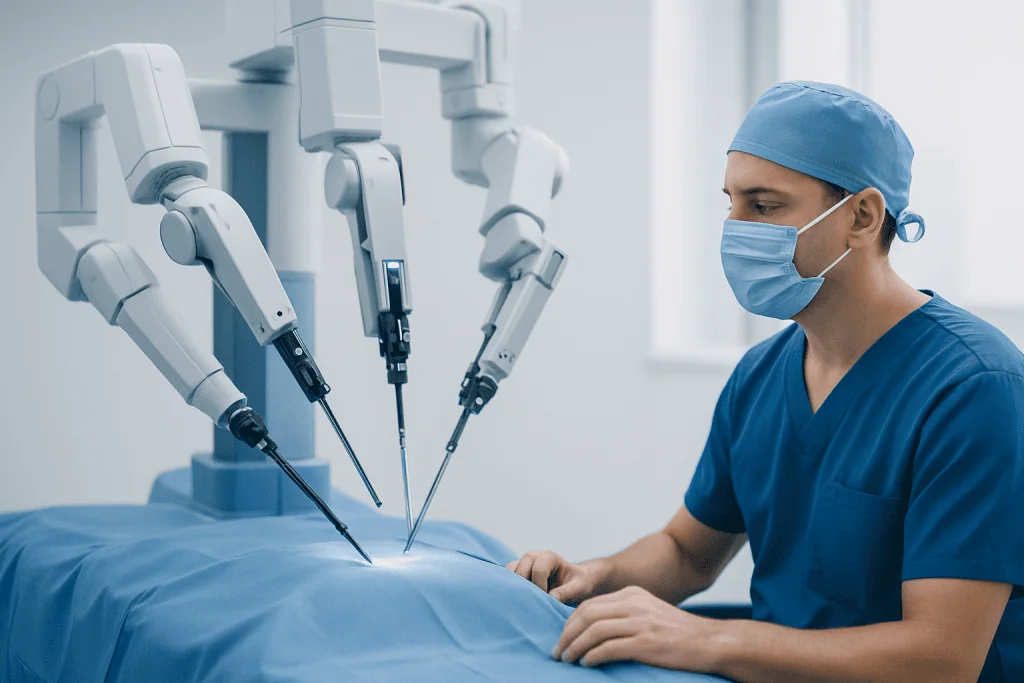
Robotic surgery may be recommended when a minimally invasive approach is appropriate and the platform helps the surgeon reach a complex area with precision. It is often considered for operations in confined spaces such as the pelvis or chest, and for procedures where delicate dissection and internal suturing are central to the result. The recommendation always follows from your diagnosis, imaging, anatomy and treatment goals, never from the availability of the technology alone.
For cancer-related surgery, robotic techniques form part of a broader plan that can include pathology review, imaging, oncology consultation and long-term surveillance. For benign conditions, the technique may be suggested when it helps remove diseased tissue, repair anatomy or relieve symptoms while supporting recovery.
It may not be recommended if open surgery is safer for your situation, if the disease is too advanced for a minimally invasive approach, if previous operations have left extensive scar tissue, or if your medical condition makes the required anaesthesia or patient positioning unsuitable. Occasionally an operation begins robotically and is converted to laparoscopic or open surgery during the procedure. This is a safety decision, not a failure, and it is discussed with you during consent.
Who is a good candidate?

Broadly, a good candidate has a condition that can be treated surgically, imaging and examination findings that support a minimally invasive approach, and the fitness to tolerate general anaesthesia. Good candidates also understand that robotic surgery is a tool in the surgeon’s hands rather than a shortcut to a particular result.
Assessment covers age, general health, body weight, previous operations, current medications, allergies, bleeding risk, heart and lung status, and chronic conditions such as diabetes or hypertension. For patients travelling internationally, the team also considers whether flying after the planned operation is realistic and whether early follow-up can be completed before the journey home.
Some patients need further evaluation before a final decision, updated imaging, blood tests, cardiology or pulmonary assessment, oncology input, or anaesthesia review. A preliminary opinion based on records is always refined after in-person consultation and pre-operative testing in Turkey. That refinement is normal, and it is why the initial plan is described as preliminary.
Treatment options and alternatives
Robotic surgery is one of three main surgical approaches, and the honest comparison matters:
- Robotic-assisted surgery uses small incisions and console-controlled instruments with 3D magnified vision.
- Conventional laparoscopy also uses small incisions, but with standard hand-held instruments. For many operations it remains an excellent and well-proven choice.
- Open surgery uses a larger incision and is still the safest option for certain complex, emergency or advanced cases.
Beyond surgery, your options may include monitoring, medication, radiotherapy, chemotherapy, interventional procedures or lifestyle-based management, depending on the diagnosis. Not every prostate condition requires an operation; not every fibroid needs removal; not every abdominal problem is best treated robotically.
During planning, your surgeon should explain why one approach is preferred, what the alternatives are, what benefits are expected and what limitations apply. If robotic surgery is chosen, the plan will cover the target organ, expected incision sites, the possible need for drains or catheters, the anticipated hospital stay, activity restrictions and the follow-up schedule.
How the evaluation works before travel
For international patients, the process usually begins with a remote review of medical records: history, current diagnosis, symptoms, previous operations, test results and imaging reports. This review establishes whether robotic surgery may be appropriate before travel is arranged, which specialist should assess the case, what documents are missing and roughly how long the stay in Turkey may need to be.
A preliminary review is not a diagnosis and not surgical approval. The final decision is made only after in-person consultation, physical examination and pre-operative evaluation. Interpreter support is available throughout, so the proposed plan, its alternatives and its limits can be understood clearly before travel arrangements are made.
Before the operation
The in-person consultation covers your diagnosis, imaging, previous treatment, surgical goals, expected benefits, limitations and risks. Use it to ask practical questions: what exactly will be done, what anaesthesia is planned, how long the hospital stay is likely to be, what the recovery restrictions are, and when flying home becomes realistic.
Pre-operative tests typically include blood and urine tests, ECG, chest imaging, anaesthesia assessment and any specialty-specific imaging or consultations. If you take blood thinners, diabetes medication, supplements or long-term prescriptions, decisions about continuing, pausing or adjusting them belong entirely to your treating doctors, no change should be made on your own initiative.
You will usually be asked not to eat or drink for a set period before anaesthesia. Depending on the operation, bowel preparation, skin preparation or infection-prevention measures may be needed. Consent forms, allergy information, blood group details and admission documents are all checked before the day of surgery.
What happens during the operation
On the day of surgery, anaesthesia is administered and you are monitored throughout, most robotic operations take place under general anaesthesia, so you are asleep for the whole procedure. The team positions you carefully, prepares the skin and creates small incisions for the camera and instruments.
The surgeon sits at a console near the operating table and controls the robotic arms continuously. A trained surgical team remains at your side to change instruments, monitor the field and manage safety. The system translates the surgeon’s hand movements into precise instrument movements inside the body, with motion scaled down and tremor filtered out.
The steps depend on the operation: tissue may be removed, repaired, reconstructed or sampled for pathology. At the end, instruments are withdrawn, the small incisions are closed, and drains or catheters are placed if needed. You then move to the recovery area for close monitoring as the anaesthesia wears off.
Hospital stay and discharge
Length of stay depends on the complexity of the surgery, your general health and how quickly you meet recovery milestones. Less complex procedures may need a short stay; major cancer, pelvic, colorectal, thoracic or reconstructive operations may need several nights. The team monitors pain control, wound condition, breathing, circulation, urination, bowel function and mobility.
Before discharge you receive a medication plan, incision-care instructions, dietary guidance, activity restrictions and follow-up appointments. If you have a catheter, drain or special dressing, its management and removal timeline are explained. Interpreter support helps make sure you and your companion understand the discharge plan fully.
Discharge does not automatically mean you can fly. Surgeons commonly recommend remaining in Turkey for a first control visit and a period of early recovery observation. Travel clearance depends on the procedure, healing progress, mobility and any post-operative findings, plan flexible return travel rather than a fixed early flight.
Recovery timeline
Recovery varies widely because the technique covers so many different operations: a straightforward hernia repair and a major cancer operation do not share a recovery path. The table below describes broad patterns; your surgeon’s advice for your specific operation always takes precedence.
| Timeframe | What to expect |
|---|---|
| First 24 hours | Close monitoring after anaesthesia. Mild to moderate pain, tiredness, nausea, shoulder discomfort from surgical gas or catheter discomfort may occur, depending on the operation. |
| First week | Gradual increase in walking, wound care by instruction, and an early control visit if planned. Swelling, bruising and fatigue are common but should steadily improve. |
| Weeks 2–4 | Many patients return to light daily activities with the surgeon’s approval. Heavy lifting, strenuous exercise and long journeys may still be restricted after some procedures. |
| Months 1–3 | Energy, strength and organ-specific function continue to improve. Cancer-related or reconstructive procedures may need further follow-up, pathology review or complementary treatment planning. |
| Final result | Functional results can take weeks to months to settle. Scars mature gradually, and long-term outcomes depend on the condition treated, surgical findings and follow-up care. |
A recovery plan may include walking, breathing exercises, wound care, a staged diet, prescribed medication, catheter or drain management and follow-up tests. Comparing your progress with another patient’s is rarely useful, different operations and different bodies recover at different speeds.
What to avoid after treatment
Even though the incisions are small, deeper tissue layers still need time to heal. Until your surgeon confirms otherwise, avoid heavy lifting, intense exercise, swimming, sauna use and anything that strains the abdomen or chest wall. Returning to strenuous activity too quickly can increase discomfort, swelling or wound problems.
Avoid driving while taking strong pain medication or before you can move comfortably and react quickly. Smoking, alcohol and poor hydration can interfere with healing and are worth discussing with your physician. If you have dietary instructions after bowel, bariatric, gallbladder or pelvic surgery, they exist for good reasons, follow them.
Dressings, drains, catheters and stitches should be managed only as instructed. Decisions about resuming blood thinners or other paused medications rest with your treating doctor. And before flying, wait for explicit travel clearance; long flights after surgery call for guidance on movement, hydration and, where recommended, compression stockings.
Risks and possible complications
All surgery carries risk, including surgery performed with advanced technology. Possible complications include bleeding, infection, pain, wound problems, anaesthesia-related reactions, blood clots, urinary or bowel issues, injury to nearby organs, nerve irritation, scarring and the need for further treatment. The specific risk profile depends on the operation, your anatomy and your health.
Robotic surgery may reduce some of the burdens of open surgery in suitable cases, but it does not remove risk. Technical challenges, unexpected findings or scar tissue from previous operations can complicate any procedure, and conversion to laparoscopic or open surgery remains a possibility the team keeps in reserve for your safety.
For cancer operations, the eventual result also depends on pathology findings, disease stage and whether additional treatment is needed. For functional or reconstructive surgery, symptoms often improve gradually rather than instantly, and complete correction cannot be assured for every patient. Your surgeon will set out the benefits, risks and alternatives before you give informed consent: that conversation is your best protection against unrealistic expectations.
Results and expectations
What counts as a good result depends on why the operation is being done: removing diseased tissue, restoring function, repairing anatomy, relieving symptoms or supporting a wider cancer treatment plan. Your surgeon will explain what success means for your condition and how it will be measured over time.
Small incisions do not mean a minor operation. Internal healing takes time, and fatigue can last longer than patients expect after major procedures. Some outcomes, urinary, bowel, sexual, hormonal or digestive function, improve gradually and may need rehabilitation, medication or lifestyle adjustment along the way. Some tiredness, mild swelling and manageable discomfort are a normal part of early recovery; your discharge documents describe what is expected for your specific operation and what falls outside that range.
Results differ from person to person. Revision surgery, additional procedures or complementary treatment are sometimes needed, particularly when pathology results or healing responses change the picture. A frank pre-operative discussion is the most reliable way to understand your likely outcome.
Planning the trip: how long, who with, what to expect
Medical travel for robotic surgery in Turkey needs to be built around the clinical schedule, not the other way round. Allow time for in-person consultation, pre-operative tests, the operation itself, the hospital stay, early recovery and a first control visit. The total stay varies by procedure and is estimated after your records are reviewed.
Travelling with a companion is strongly worth considering, especially for the first days after discharge, when help with mobility, meals, medication reminders and communication makes a real difference. Interpreter coordination, airport transfers and accommodation guidance can be arranged so the trip is organised around the care plan.
Book flexible or refundable return travel, and request any medical documents you need, for your home physician, insurer or employer, before discharge where possible. Take home your discharge summary, imaging and pathology reports; your local doctors will need them for ongoing care.
How costs and quotations work
This guide gives no figures, because no honest figure exists before medical review. The cost of robotic surgery depends on the specialty, the type and complexity of the operation, operating room requirements, length of hospital stay, anaesthesia, implants or special materials if needed, pathology, imaging, laboratory work and additional consultations. A personalised quotation is prepared only after your records have been assessed, and it may still be updated after in-person examination and pre-operative tests.
A typical international patient package covers hospital admission for the planned procedure, operating room services, anaesthesia, standard nursing care, routine in-hospital medications, package-related pre-operative tests, interpreter support for hospital processes and selected transfers. Items commonly outside a package include extra tests requested after evaluation, treatment of unrelated conditions, extended stays, intensive care if unexpectedly required, additional procedures, special medications, post-discharge accommodation, companion costs and flights.
The practical advice is simple: get the inclusions and exclusions confirmed in writing, and ask what could change the final figure, for example, pathology results that alter the treatment plan. A quotation you understand fully is worth more than a headline number.
Is Turkey a safe place for surgery?
Safety in surgery is a property of institutions and teams, not of countries. Turkey has a large, regulated hospital sector overseen by its Ministry of Health, and its major hospital groups treat substantial numbers of international patients across complex specialties every year. Robotic platforms are concentrated in large tertiary hospitals with trained specialty teams: the same pattern seen in the United States, across Europe, in East Asia and elsewhere, as robot-assisted surgery has become an established technique worldwide.
Turkey is internationally known for high-volume fields such as hair restoration, dental treatment and aesthetic surgery, but its major centres also deliver complex oncological, cardiac, thoracic and transplant care. Whatever the destination, the sensible questions are the same: who is the surgeon, how experienced is the team with this specific operation, what does the hospital’s multidisciplinary support look like, and how is follow-up handled after you go home. Those answers matter far more than the country on the map.
Why choose Acibadem
Acibadem International supports patients travelling to Turkey for complex care across the hospitals of the Acibadem network. Robotic surgery is delivered by specialty teams who first evaluate whether the robotic approach is appropriate for your diagnosis: the technology is a tool applied selectively, not a one-size-fits-all answer.
Depending on your condition, your care may involve surgeons, anaesthesiologists, radiologists, pathologists, oncology specialists, nurses, physiotherapists and international patient coordinators. This multidisciplinary structure matters most for cancer surgery, complex pelvic and digestive procedures, and patients with coexisting medical conditions.
Practical support carries equal weight for international patients: interpreter services, appointment coordination, transfer arrangements, accommodation guidance and remote follow-up communication are organised so each step of the journey is clear and coordinated.
Medical review and disclaimer
This guide has been reviewed by the Acibadem International medical team and provides general information about robotic surgery for international patients considering treatment in Turkey. It is not a diagnosis, a treatment prescription or an assurance of suitability, outcome or recovery timeline.
Robotic surgery may or may not be appropriate for your condition. Suitability requires evaluation by a qualified physician, review of your medical records and, where necessary, examination, imaging, laboratory tests and anaesthesia assessment. Your final treatment plan may change after in-person evaluation.
This information does not replace consultation with your doctor. In a medical emergency, seek immediate care in your current location, and always follow the instructions of your treating physician and surgical team.
Step by step
- Initial contact. You contact Acibadem International and share your main diagnosis, symptoms, treatment goals and travel expectations.
- Medical record submission. You send relevant reports, imaging, laboratory results, operation notes and your medication list, plus photos or videos where useful for your specialty.
- Preliminary medical review. The appropriate surgical team reviews your documents to assess whether robotic surgery may be considered and what further information is needed.
- Treatment plan and quotation. You receive a preliminary plan with expected tests, the proposed approach, an estimated length of stay and a personalised quotation based on available information.
- Travel planning. International patient services coordinate appointments, interpreter needs, transfers and accommodation guidance around your medical schedule.
- Arrival. You arrive in Turkey and proceed to your hospital or accommodation according to the arrangements made before travel.
- In-person consultation. Your surgeon examines you, reviews original records and confirms whether the robotic approach remains suitable after face-to-face assessment.
- Pre-operative tests. You complete blood tests, imaging, anaesthesia evaluation and any specialty consultations needed for surgical clearance.
- Treatment. Your operation is performed by the surgical and anaesthesia team, with the robotic system used if confirmed as the best approach.
- Hospital stay. You recover under nursing and medical supervision until pain, mobility, wound condition and key body functions are stable for discharge.
- First control. Your surgeon checks early recovery, reviews wound healing and explains pathology findings or next steps where relevant.
- Discharge and travel clearance. You receive discharge instructions, prescriptions, medical reports and advice on when it is safe to travel home.
- Remote follow-up. After returning home, you may share updates and reports with the international patient team and will be guided on follow-up with local physicians where needed.
Your checklist
- Valid passport and travel documents
- Medical history summary, including current diagnosis and symptoms
- List of current medications, supplements and blood thinners
- Known allergies, especially medication, latex, food or anaesthesia-related reactions
- Reports from previous surgeries, hospitalisations or complications
- Recent laboratory results, pathology reports and specialist notes
- Imaging files and reports: MRI, CT, ultrasound, X-ray or PET/CT where relevant
- Cardiology, pulmonary or anaesthesia clearance documents if you have chronic conditions
- Photos or videos when requested for wound, functional or specialty-specific assessment
- Insurance information or payment documents if applicable
- Contact details for your home physician and an emergency contact person
- Questions you want to ask about alternatives, recovery, travel timing and follow-up
Key takeaways
- Robotic surgery is a surgical technique, not a treatment in itself: it is used for selected operations when it offers a genuine clinical advantage.
- The surgeon controls every movement; the robot never operates independently, and the team’s experience matters more than the machine.
- Suitability depends on diagnosis, imaging, previous surgeries, general health and anaesthesia fitness, confirmed only after in-person assessment.
- A realistic trip includes consultation, pre-operative tests, surgery, hospital recovery and a first control visit before travel clearance.
- Small incisions do not mean a minor operation, internal healing takes time, and recovery advice for your specific procedure always takes precedence over general timelines.
Frequently asked questions
Does the robot perform the operation by itself?
No. The robotic system is controlled by the surgeon throughout the operation. It provides magnified 3D vision and refined instrument movement, but every clinical decision and every surgical action is made by the trained surgical team at the console and at the bedside.
Is Turkey a safe place for surgery?
Surgical safety depends on the individual hospital and team rather than the country. Turkey has a regulated hospital sector overseen by its Ministry of Health, and its major centres treat large numbers of international patients across complex specialties. The useful questions are about the surgeon’s experience with your specific operation, the hospital’s multidisciplinary support and how follow-up is arranged after you return home.
Which hospitals in Turkey do robotic surgery?
Robotic platforms are concentrated in large tertiary hospitals with trained specialty teams, because the technique requires both the equipment and an experienced bedside team. Within the Acibadem network, robot-assisted surgery is delivered through dedicated specialty units that assess whether the approach suits each individual case.
How long should I stay in Turkey for robotic surgery?
It depends on the procedure and your recovery. A realistic stay covers in-person consultation, pre-operative tests, the operation, the hospital stay and usually a first control visit before travel clearance. An estimate is given after your records are reviewed, and flexible return travel is sensible because healing does not follow a fixed schedule.
Is recovery faster than open surgery?
In suitable cases, robotic surgery can mean smaller incisions, less tissue trauma and earlier mobilisation than comparable open surgery. Recovery still depends on the operation and your overall health, and internal healing after major procedures can take weeks to months even when the skin incisions are small.
What happens if the operation cannot be completed robotically?
The surgeon may convert to laparoscopic or open surgery during the procedure, for example, because of unexpected bleeding, dense scar tissue or difficult anatomy. Conversion is a safety judgement made to protect you, and the possibility is discussed during the consent process.
Can robotic surgery be used for cancer treatment?
Yes, robot-assisted techniques are used for selected cancer operations in urology, gynaecology, colorectal surgery and thoracic surgery, among others. Suitability depends on the cancer type, stage, imaging and multidisciplinary evaluation, and further treatment or follow-up may be needed after the operation.
What affects the cost of robotic surgery in Turkey?
The specialty, the complexity of the operation, the length of hospital stay, anaesthesia, materials or implants, pathology, imaging, laboratory work and additional consultations. A personalised quotation is prepared after medical review, and it is worth confirming in writing exactly what is included, what is excluded and what could change the final plan.
Add us as a Preferred Source to see more of our trusted health content across Google Search, AI Overviews and Discover.

Update history
- PublishedJune 9, 2026
- Medical review approvedAugust 30, 2026
- Last content updateAugust 30, 2026
References2
- Robotic surgery: MedlinePlus Medical Encyclopedia medlineplus.gov
- Robotic Surgery: Cleveland Clinic my.clevelandclinic.org
More Patient Guides

HoLEP in Turkey: How It Compares With TURP and What Recovery Involves
HoLEP in Turkey treats enlarged prostate tissue with laser enucleation; learn how it compares with TURP, recovery, travel and follow-up.

Porcelain Veneers in Turkey: Who Is Suitable and How Many Visits Are Needed?
Porcelain veneers in Turkey can enhance tooth shape and colour in two visits for suitable patients after a personalised dental assessment.

How to Prepare for a Sedation Procedure in Turkey
Prepare safely for a sedation procedure in Turkey with guidance on fasting, medicines, travel, recovery and follow-up.

Treatment Delays in Turkey: What Happens If Tests or Recovery Change Your Schedule
Treatment delays in Turkey can happen if tests or recovery change your plan. Learn how to manage appointments, travel, accommodation and follow-up.