

Inside a Sleeve Gastrectomy: Stapling the Stomach, Checking for Leaks and Closing Up

Key Takeaways
- A sleeve gastrectomy removes about 80% of the stomach, including the fundus that produces most of the hunger hormone ghrelin, while leaving the pylorus and intestine untouched.
- The staple line is built around a bougie, a sizing tube typically 32 to 40 French wide (roughly one-third millimeter per French unit), which determines how narrow the finished sleeve is.
- Intraoperative leak tests using dye, air under saline or an endoscope catch problems at the time of surgery but cannot rule out delayed leaks, which usually arise days later from tissue breakdown near the top of the sleeve.
- The removed stomach is drawn out inside a retrieval bag through the largest port, and only that widened port is closed at the fascial layer to prevent a later hernia.
- Typical operating time is about 60 to 90 minutes, with a hospital stay of roughly one to three nights, though a hiatal hernia repair or prior abdominal surgery can lengthen both.
- Unlike gastric bypass, a sleeve can worsen acid reflux in some people, which is why existing heartburn is a key topic to raise before choosing an operation.
A sleeve gastrectomy removes roughly 80% of the stomach through several small keyhole incisions. Under general anesthesia, the surgeon frees the stomach's outer curve, passes a sizing tube through the mouth, staples along it to create a narrow tube, checks the staple line for bleeding and leaks, removes the detached portion in a bag, and closes the incisions. The whole procedure usually takes about an hour to ninety minutes.
The consent form is two pages long, and one phrase keeps snagging the eye: division of the stomach with a surgical stapler. Most people signing it have never seen a surgical stapler. They picture something from an office drawer, then try to imagine it inside their own abdomen, and the imagination stalls. Reasonably so. Surgeons describe the sleeve gastrectomy procedure steps to each other in shorthand that assumes years of anatomy.
This article slows that shorthand down. It follows the operation from the first incision to the last stitch: how the stomach is freed from its attachments, how a sizing tube guides the staple line, how the team looks for bleeding and leaks before anyone wakes up, and what the closed-up abdomen looks like afterward.
None of this is meant to talk anyone into or out of an operation. It is meant to make the conversation with a surgical team feel less like eavesdropping on a foreign language.
What are the sleeve gastrectomy procedure steps, in plain language?
Strip away the jargon and the operation has five movements. First, the anesthesia team puts the patient fully to sleep and the surgeon places a handful of small ports, hollow tubes about the width of a pen, through the abdominal wall. Second, the stomach’s long outer curve is separated from the fatty apron and blood vessels that hold it in place. Third, a sizing tube called a bougie is passed down through the mouth to lie along the inner curve of the stomach, and the surgeon fires a stapler alongside it, again and again, until a narrow tube of stomach remains and the larger outer portion is detached. Fourth, the new staple line is inspected for bleeding and often tested for leaks. Fifth, the removed stomach is bagged and drawn out through one port, and the small wounds are closed.
The procedure is almost always laparoscopic, meaning keyhole surgery performed through those ports with a camera rather than through one long cut. Carbon dioxide gas gently inflates the abdomen so the surgeon has room to see and work; it is released at the end.
What remains is a stomach shaped like a banana or shirt sleeve, hence the name. It holds far less food, and because the removed portion includes the fundus, the dome at the top that produces much of the hunger hormone ghrelin, appetite signaling changes too. Mayo Clinic puts the amount removed at about 80%, and the outlet at the bottom of the stomach, the pylorus, is left intact so food still passes normally into the small intestine. Nothing is rerouted. Nothing is removed and later put back. Each of those steps deserves a closer look, and the sections that follow take them in order.
Who is a sleeve gastrectomy usually for, and who is usually asked to wait?
Eligibility is not a single number, though a number usually opens the conversation. The NHS describes weight loss surgery as generally considered for people with a body mass index (BMI) of 40 or more, or a BMI between 35 and 40 alongside a weight-related condition such as type 2 diabetes or high blood pressure that might improve with weight loss. BMI is a ratio of weight to height squared; it is a screening tool, not a verdict. Most programs also want evidence that structured non-surgical approaches have been tried, and that the person is fit enough for general anesthesia and willing to attend long-term follow-up, because the operation changes nutrition for life.

The word candidate can sound like a job application. In practice a bariatric team, which often includes a surgeon, a dietitian, a psychologist and an anesthesiologist, is asking a more human question: is this the right operation, at the right time, for this person?
Some people are asked to wait rather than refused. Common reasons include a health problem that is not yet stable, an untreated eating disorder, current tobacco use, plans to become pregnant in the near future, or a need for more preparation time to build eating habits that the sleeve will depend on. Severe acid reflux or a known large hiatal hernia may prompt a discussion about whether a different operation would serve better, because a sleeve can worsen reflux in some people, a point the StatPearls review from NIH raises directly.
Waiting is not a judgment on character. It is the team trying to line up the safest version of a serious operation. The decision about timing, and about whether to proceed at all, sits with that team and the person in front of them.
What happens in the operating room before the first staple is fired?
A surprising amount of the operation is finished before the stapler is even opened. After the anesthesiologist induces general anesthesia and secures the breathing tube, the team turns to prevention. Compression stockings or inflatable leg wraps go on to reduce the risk of clots in the leg veins. Many programs also give an anticoagulant, a blood-thinning medicine, around the time of surgery; the choice and timing belong to the anesthesia and surgical team. A preventive antibiotic is typically given before the incision.
Positioning matters more than most patients realize. The table is tilted head-up, a position surgeons call reverse Trendelenburg, so gravity pulls the intestines away from the stomach and gives a clearer view. The patient is strapped securely, arms and legs padded, because the tilt is steep.
The surgeon then makes the first small cut and introduces a port, followed by carbon dioxide to lift the abdominal wall like a tent. A camera goes in, and under direct vision four or five more ports are placed across the upper abdomen. Through one of them a retractor lifts the left lobe of the liver, which otherwise drapes over the stomach like a curtain.
Only now does the surgeon look around. The liver, the stomach, the spleen and the diaphragm are inspected. One specific check comes before any cutting: the hiatus, the opening in the diaphragm where the esophagus passes into the abdomen. If part of the stomach has slipped up through it, a hiatal hernia, many surgeons repair it during the same operation because leaving it can contribute to reflux later. The StatPearls review notes that this inspection and repair is a routine part of the technique for many surgeons. Then, and only then, the stomach itself is addressed.
Stapling the stomach: how the surgeon builds the sleeve around a bougie
The stomach is not floating free. Along its outer curve, the greater curvature, it is tethered to the omentum, a fatty apron rich in blood vessels. The surgeon divides those vessels with an energy device that seals as it cuts, working from a point a few centimeters above the pylorus all the way up to the angle of His, the sharp corner where the esophagus meets the stomach. The StatPearls review describes the dissection starting roughly 2 to 6 centimeters from the pylorus, a distance that preserves the stomach’s pumping outlet. Behind the stomach, filmy attachments to the pancreas are freed so the organ can be stretched flat.
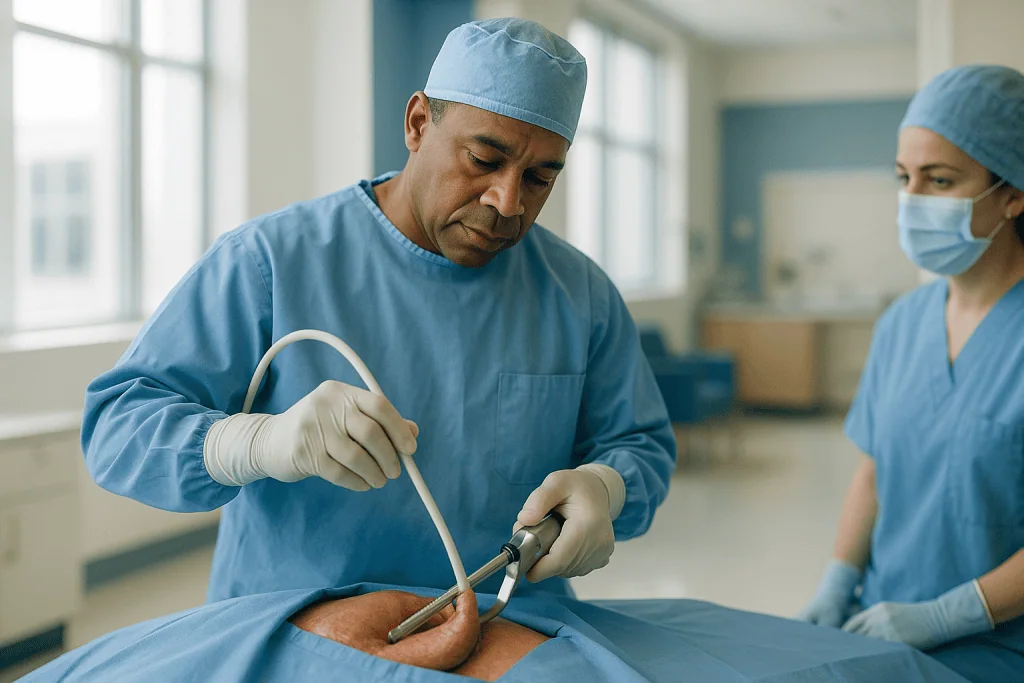
Now the bougie. This is a smooth, flexible tube passed by the anesthesiologist through the mouth and down along the inner curve of the stomach. Its diameter is measured in French units, where one French equals one-third of a millimeter; StatPearls cites sizes in the 32 to 40 French range as common, roughly the width of an adult finger. The bougie acts as a mold. Staple too close to it and the sleeve is dangerously narrow; too far and the sleeve is baggy.
The stapler itself is a long instrument that fires two or three rows of tiny titanium staples on each side while a blade cuts between them. The surgeon aligns it beside the bougie and fires, repositions, fires again, typically five to seven times, climbing from the antrum near the pylorus to the top of the stomach. Two spots demand particular care: the incisura angularis, a natural bend on the inner curve where over-tightening creates a kink, and the final firing near the angle of His, where the tissue is thinnest and leaks most often occur. Some surgeons add reinforcing material or stitches along the staple line; the evidence on whether this reduces complications is mixed, and practice varies.
How does a gastric sleeve leak test work while the patient is still asleep?
Once the last staple fires, the detached stomach lies to one side and the new sleeve stands as a long, pale seam of metal. The surgeon’s first job is to look. Bleeding from the staple line is common in small amounts and is controlled with clips, stitches or gentle pressure. Then comes the question every patient has heard about: is it sealed?
Three approaches are widely used, sometimes in combination. In the dye test, the bougie is swapped for a tube through which a dilute blue dye, methylene blue, is injected into the sleeve while the surgeon watches the staple line for any blue seepage. In the air test, the sleeve is filled with air while the outside is bathed in saline, so a leak announces itself as a stream of bubbles, much like checking a bicycle tire. In the endoscopic test, a flexible camera is passed down the sleeve to view the staple line from inside, check that the tube is uniformly wide with no twist or kink, and look for bleeding into the lumen.
Honesty about what these tests can and cannot do matters. A negative test at the end of the operation catches mechanical failures then and there, which is valuable. It does not guarantee against leaks that develop days later, because most delayed leaks come not from a staple that missed but from tissue at the upper end losing its blood supply and breaking down over time. The StatPearls review acknowledges that intraoperative testing has not been shown to reliably predict those later events, and some surgeons omit routine testing for that reason. Patients sometimes hear “the leak test was fine” and assume the risk is over. It is lower, not zero, and that is why the discharge instructions read the way they do.
Sleeve gastrectomy procedure steps at the finish: removing the stomach and closing up
The excised stomach is larger than most people expect, a floppy pouch that can be the size of an adult’s hand and forearm. It cannot simply be pulled through a port. The surgeon slides it into a sturdy retrieval bag inside the abdomen, gathers the bag’s neck, and draws it out through the largest port site, usually after widening that opening slightly. Removing it inside a bag keeps stomach contents away from the wound and lowers infection risk. The tissue goes to the pathology laboratory for routine examination.
Some surgeons place a thin drain beside the staple line, a soft tube that exits through a small skin opening and collects fluid for a day or two. Others do not, and studies have not settled which approach is better. Where a drain is used, the team will explain what color and volume of fluid is expected.
Closing follows a set order. The wider port opening is closed at the level of the fascia, the tough fibrous sheet under the skin that holds the abdominal wall together, because a gap there can later become a hernia. Smaller port sites are usually left to seal on their own at the fascial level. The carbon dioxide is released, and the skin at each site is closed with dissolvable stitches, skin glue or small adhesive strips.
The anesthesiologist then reverses the anesthesia and removes the breathing tube once breathing is steady. Many people’s first memory is the recovery room: a dry mouth, a sore throat from the tube, an ache in the shoulder from residual gas irritating the diaphragm, and a nurse asking them to take slow, deep breaths. Within a few hours, in most programs, they are being asked to sit up and then to walk.
Sleeve gastrectomy vs gastric bypass: what actually differs on the operating table?
Patients researching a sleeve almost always end up reading about gastric bypass, and the two are often lumped together as “stomach surgery.” They are quite different operations. A sleeve removes stomach and changes nothing else. A Roux-en-Y gastric bypass creates a small pouch from the top of the stomach and connects it directly to a loop of small intestine, so food bypasses the rest of the stomach and the first stretch of intestine. Nothing is removed in a bypass; the redundant stomach stays in place, disconnected.
| Feature | Sleeve gastrectomy | Roux-en-Y gastric bypass |
|---|---|---|
| What is done to the stomach | About 80% removed; tube-shaped remnant | Small pouch created; remainder left in place |
| Intestine rerouted | No | Yes, two new connections (anastomoses) |
| Pylorus preserved | Yes | Bypassed |
| Main mechanisms | Restriction plus hormonal changes | Restriction, hormonal changes, some malabsorption |
| Reversible | No | Technically possible, rarely done |
| Effect on acid reflux | May worsen in some people | Often improves |
| Typical nutrient concerns | Iron, B12, vitamin D | Same, generally greater risk of malabsorption |
The NHS lists both as standard options and notes that the choice depends on individual circumstances rather than one being universally better. For someone with troublesome reflux, a bypass may be favored; for someone with a complex surgical history or who takes medicines that need predictable absorption, a sleeve may be. The table is a map of differences, not a scoreboard, and the route a person takes is a decision for their surgical team.
How long does sleeve gastrectomy take, and how long is the hospital stay?
The operation itself is shorter than most people brace for. MedlinePlus, the National Library of Medicine’s patient resource, gives a typical operating time of about 60 to 90 minutes. That clock starts at the first incision, not when a person leaves the ward, so from a family member’s perspective in the waiting area the absence feels longer: anesthesia preparation beforehand, recovery-room monitoring afterward, and the normal variability of an operating list.
Complexity stretches the time. A previous abdominal operation leaves scar tissue that must be carefully freed. A large liver limits the view. A hiatal hernia repair adds a stage. None of these mean something has gone wrong; the surgeon will usually have flagged them beforehand.
The hospital stay is also shorter than it once was. The NHS and MedlinePlus both describe a stay of roughly one to three nights as typical, and many programs now follow enhanced recovery protocols, sometimes abbreviated ERAS, that aim to shorten it further. The principles are consistent: get people breathing deeply and walking within hours, start small sips of clear fluid early, rely on non-opioid pain relief where possible to limit nausea and drowsiness, and set clear criteria for going home rather than a fixed number of days.
Those criteria usually look like this: pain controlled with oral medicine, able to drink enough fluid to stay hydrated, walking independently, no fever, and stable vital signs. Some programs still perform a contrast swallow X-ray on the first day to look at the shape of the sleeve and check for leakage; others reserve it for people with symptoms, because a normal study cannot rule out a leak that develops later. Whichever approach a program takes, a longer stay than expected is a sign of caution, not failure.
Sleeve gastrectomy recovery time: what the first days and weeks usually look like
Recovery has two tracks running in parallel: the wounds healing on the outside, and the new stomach learning its job on the inside. The outside track is quick. Five small incisions, closed with glue or dissolvable stitches, generally look settled within a couple of weeks. The inside track is slower and is where most of the instructions concentrate.
Mayo Clinic outlines the standard staged diet. Liquids only for about the first week, letting the staple line rest. Then puréed foods for roughly three weeks, textures that need no chewing. Then soft foods, and by about four weeks, gradual reintroduction of regular foods in very small portions. Sips rather than gulps, protein first, and no drinking with meals, because the sleeve holds so little that liquid crowds out food.
Fatigue is normal in the first two weeks; the body is healing while taking in very few calories. Walking several times a day is encouraged from the first evening, both for clot prevention and for the trapped gas that causes shoulder pain. Heavy lifting is usually restricted for a period the surgeon will specify, to protect the fascial closure. MedlinePlus and the NHS describe most people returning to ordinary activities within a few weeks, with physically demanding work taking longer; the exact timing depends on the job and the person.
Follow-up is lifelong, not a courtesy. Vitamin and mineral supplements, chosen by the team, are needed indefinitely because a smaller stomach absorbs some nutrients less well, and blood tests track iron, vitamin B12, vitamin D and others. A dietitian usually reviews eating at set intervals. Weight comes off most rapidly in the early months and then slows; this is expected, and the team will interpret the trend rather than any single reading.
What are the risks of a sleeve gastrectomy?
Every operation under general anesthesia carries baseline risks: bleeding, infection at the incisions, reactions to anesthesia, and blood clots in the legs or lungs. The NHS lists these alongside the risks specific to weight loss surgery. A sleeve adds a short list of its own, and each is worth understanding rather than fearing.
The most discussed is a staple line leak, where stomach contents escape through a gap in the seam into the abdomen. The StatPearls review from NIH places leak rates in the low single-digit percentages, most often at the upper end of the sleeve, and typically appearing in the first days to a few weeks. A leak is serious and needs prompt treatment, which may include drainage, an endoscopic procedure or a return to the operating room. Bleeding along the staple line is another early risk, usually recognized in hospital.
A stricture is a narrowing, most often at the incisura, that causes persistent difficulty swallowing or vomiting; it is frequently treatable with endoscopic dilation. Acid reflux, either new or worsened, is a longer-term concern that the review emphasizes, since the sleeve is a high-pressure tube with a weaker valve at the top.
Rapid weight loss itself brings consequences: gallstones form more readily, and nutrient deficiencies can develop if supplements lapse. A small proportion of people regain weight over the years, sometimes because the sleeve stretches and sometimes because eating patterns drift. The operation is not reversible, though it can be converted to a bypass if needed.
How these risks weigh against the risks of untreated severe obesity is a personal calculation made with a surgical team, using that individual’s health picture. A neutral list of possibilities is where the conversation starts, not where it ends.
Why a sleeve is more than a restrictive operation: the hormone story
For years the sleeve was described as purely mechanical: a smaller container fills faster, so a person eats less. That explanation is true but incomplete, and the incomplete version leaves patients puzzled when their hunger changes far more than a smaller stomach alone would explain.
The missing piece lives in the fundus, the dome at the top of the stomach that is removed almost entirely during the operation. The fundus is the main source of ghrelin, a hormone released into the blood when the stomach is empty that travels to the brain and drives appetite. Remove most of the ghrelin-producing tissue and circulating levels fall, which is consistent with the sharp drop in hunger many people describe in the early months. The StatPearls review describes this hormonal effect as central to how the operation works, and Mayo Clinic makes the same point in patient language.
Emptying changes too. A narrow, high-pressure tube with an intact pylorus tends to move food into the small intestine faster than a relaxed, wide stomach did. Nutrients reaching the intestine earlier prompt release of gut hormones such as GLP-1 and PYY, which signal fullness and influence how the body handles blood sugar. This helps explain why blood-glucose control often improves in people with type 2 diabetes before much weight has been lost.
Two cautions keep this honest. Hormone levels are not destiny; the effect varies between people and can fade over years, and the physiology is still being worked out. Also, the drop in hunger does not switch off the emotional and habitual reasons people eat, which is why dietitians and psychologists remain part of most programs long after the wounds have healed.
What people often get wrong about sleeve gastrectomy
“They just put a band around it.” No. A gastric band is a separate, older operation that places an adjustable ring around the top of the stomach and removes nothing. A sleeve removes stomach permanently. The two are often confused because both are described as restrictive.
“The stomach grows back.” The removed portion does not regenerate. The remaining tube can stretch somewhat over time, particularly if it is repeatedly overfilled, which is one reason portion habits matter. Stretching and regrowth are different things.
“If the leak test was clear, I’m safe.” The test in the operating room catches problems at that moment. Most leaks that occur happen days later, from tissue breakdown at the top of the sleeve rather than from a missed staple. Clear at surgery lowers the risk; it does not remove the need to watch for symptoms.
“It’s a shortcut.” The operation changes the size of the stomach and some hormone signals. It does not change grocery lists, work schedules, sleep or stress. People who do well usually describe the surgery as a tool that made effort effective, not a substitute for it.
“Reflux is a bypass problem, not a sleeve problem.” The reverse is closer to the truth. A sleeve can worsen reflux in some people, while a bypass often improves it. Anyone with significant heartburn should raise it before choosing an operation.
“Vitamins are optional once weight stabilizes.” The smaller stomach produces less acid and less of the factor needed to absorb vitamin B12, and iron absorption falls. The NHS and MedlinePlus both describe lifelong supplements and monitoring as part of the operation, not an afterthought.
“Once it’s done, the decisions are over.” Follow-up appointments continue for years. That is where trends are caught early, from a stalled weight curve to a falling ferritin.
Questions to ask your care team before a sleeve gastrectomy
A consultation goes further when the questions are specific. These are the ones that experienced patients say they wished they had asked, grouped roughly by the phase of the operation they concern.
- Which bougie size do you use, and why? What does that mean for how the sleeve will feel when I eat?
- Do you routinely check for and repair a hiatal hernia during the operation?
- Do you reinforce the staple line, and what does the evidence say about that in your practice?
- Do you perform a leak test during surgery, and do you order a swallow study afterward? What would prompt one?
- Will I have a drain? If so, when does it come out and what should I expect from it?
- How many nights do you expect me to stay, and what are the criteria for going home?
- What pain-relief approach do you use, and how do you manage nausea in the first days?
- Which symptoms in the first two weeks should make me call the on-call number rather than wait for clinic?
- What is my personal risk profile for leak, bleeding and clots, given my health history?
- I have heartburn now. How does that change your advice about which operation is right for me?
- What does follow-up look like at one month, six months and yearly after that?
- Which supplements will I need, and how will you monitor my nutrient levels?
- If the sleeve does not work as hoped, what options exist and how are they decided?
Write the answers down or ask permission to record the conversation. A second appointment purely for questions is a reasonable request, and most teams welcome it. The point is not to interrogate the surgeon; it is to understand the operation well enough that the days after it hold no surprises.
When to call your doctor after a sleeve gastrectomy
Most recovery days are uneventful: mild wound soreness, tiredness, the odd bout of nausea while learning new portions. A few symptoms are different in kind and should not be waited out. The team will give a direct number for exactly this purpose, and using it is never an overreaction.
Call the surgical team or seek emergency care right away for any of the following. A heart rate that stays fast at rest, particularly above about 120 beats per minute, is one of the earliest signs of a leak and is often noticed before pain becomes severe. Fever, shaking chills, or feeling suddenly and unaccountably unwell fit the same pattern. New or worsening abdominal pain, especially pain that spreads to the left shoulder or chest, warrants urgent assessment. So does shortness of breath or chest pain, which can signal a clot in the lungs, and a swollen, painful calf, which can signal a clot in the leg.
Vomiting blood or passing black, tarry stools points to bleeding along the staple line. Being unable to keep down any fluids for more than a day risks dehydration and may indicate a narrowing. Redness spreading from an incision, pus, or a wound that opens should be seen the same day. If a drain is present, a sudden change to cloudy, foul or dark fluid needs a call.
The NHS and MedlinePlus both stress that leaks and clots are most likely in the first days to a few weeks, which is why the instructions feel repetitive about these signs. None of this list is for self-diagnosis. It is a prompt to pick up the phone and let a clinician who knows the operation decide what happens next.
Frequently asked questions
How long does sleeve gastrectomy take from start to finish?
The operation itself commonly takes about 60 to 90 minutes, according to MedlinePlus. That figure covers first incision to final stitch. Time in the anesthesia room beforehand and the recovery room afterward adds to what family members experience in the waiting area. Scar tissue from earlier surgery, a large liver or a hiatal hernia repair can extend the operating time without anything having gone wrong.
What is the gastric sleeve leak test and does everyone have one?
It is a check performed before the abdomen is closed to see whether the new staple line is sealed. Surgeons may inject blue dye into the sleeve, fill it with air under saline to look for bubbles, or inspect it with an endoscope. Not every surgeon performs one routinely, because the test detects problems at that moment but has not been shown to predict leaks that develop days later.
Is sleeve gastrectomy vs gastric bypass a question of which is better?
Not in a general sense. The NHS presents both as standard options chosen according to individual circumstances. A sleeve removes stomach and reroutes nothing; a bypass creates a small pouch and connects it to the intestine. Bypass tends to improve reflux while a sleeve can worsen it, and bypass carries a greater risk of nutrient malabsorption. Which suits a particular person is a decision for their surgical team.
What is the typical sleeve gastrectomy recovery time before normal activities?
MedlinePlus and the NHS describe most people returning to ordinary daily activities within a few weeks, with physically demanding jobs taking longer and heavy lifting restricted for a period the surgeon specifies. The staged diet runs alongside: roughly a week of liquids, about three weeks of puréed food, then soft and gradually regular foods by around four weeks, per Mayo Clinic. Fatigue in the first two weeks is common.
Why is the bougie size important in a sleeve gastrectomy?
The bougie is the tube passed through the mouth that the surgeon staples alongside, so its diameter sets the width of the finished sleeve. Sizes in the 32 to 40 French range are commonly cited by the StatPearls review, one French being one-third of a millimeter. A very narrow sleeve raises the risk of a stricture or leak from high pressure; a wide one may allow larger portions. Surgeons choose based on training and evidence.
Does the surgeon really remove most of the stomach, and where does it go?
Yes. Mayo Clinic describes about 80% of the stomach being removed. The detached portion is placed in a sturdy retrieval bag inside the abdomen and drawn out through the largest port site, which is widened slightly for the purpose. Bagging it keeps stomach contents away from the wound. The tissue is sent to a pathology laboratory for routine examination, as with most surgical specimens.
Why does the hospital check my heart rate so closely after a sleeve?
A persistently fast resting heart rate is one of the earliest signs of a staple line leak, often appearing before pain or fever become obvious. It can also point to bleeding or a blood clot. That is why nurses record vital signs frequently and why discharge instructions ask patients to report a racing pulse, a fever or new abdominal pain promptly rather than waiting for the next clinic appointment.
Will I need a drain or a swallow X-ray after surgery?
Practice varies. Some surgeons place a thin drain beside the staple line for a day or two; others do not, and studies have not shown a clear advantage either way. Some programs order a contrast swallow study on the first day to view the sleeve’s shape and look for leakage, while others reserve it for people with symptoms, since a normal study cannot exclude a leak that develops later.
Can a sleeve gastrectomy be reversed if I change my mind?
No. The removed stomach does not regrow and cannot be reattached, which is one reason the preparation process is deliberately thorough. If problems such as severe reflux or inadequate weight loss arise, the sleeve can in some cases be converted to a gastric bypass in a second operation. Whether that is appropriate is a decision for the surgical team based on the individual situation.
What are the red-flag signs after a sleeve gastrectomy that mean I should call the doctor?
Call the surgical team or seek emergency care for a resting heart rate that stays fast, fever or chills, new or worsening abdominal pain especially spreading to the left shoulder, chest pain or breathlessness, a swollen painful calf, vomiting blood or black stools, inability to keep fluids down for more than a day, or a spreading red or leaking wound. The NHS notes these complications are most likely in the first weeks.
References
- NHS – Weight loss surgery: Types
- NHS – Weight loss surgery: Risks
- NIH StatPearls – Sleeve Gastrectomy
- MedlinePlus – Vertical sleeve gastrectomy
This article is for general information only and is not a substitute for professional medical advice. Please consult a qualified doctor about your individual situation.

More from the Blog

Robotic vs Laparoscopic Bariatric Surgery: How Surgeons Decide Which Approach Fits You
Robotic and laparoscopic bariatric surgery are both minimally invasive; the difference is how the surgeon controls the instruments, not what is done to the…
Gastric Band vs Gastric Sleeve: Reversible Device or Lasting Reshaping, Compared Honestly
An adjustable gastric band is a removable silicone ring fitted around the upper stomach and tightened through a port under the skin; a gastric…
Robotic Bariatric Surgery: What the Robotic Arms Change Inside the Operating Room
Robotic bariatric surgery uses a surgeon-controlled console and wristed instruments to perform standard weight-loss operations, such as sleeve gastrectomy or gastric bypass, through small…

Gastric Balloon vs Gastric Sleeve: Temporary Device or Surgery, and How Doctors Compare Them
A gastric balloon is a temporary, saline-filled device placed in the stomach through the mouth and usually removed after about six months, while a…

Preparing for an Obesity Clinic Appointment: Weight History, Medicines and Questions to Bring
To prepare for an obesity clinic appointment, bring a written weight history (your weight at key life stages, past attempts, what helped and what…

Gastric Sleeve Results Over the Years: What Realistic Long-Term Expectations Look Like
Gastric sleeve results long term typically show the largest weight loss in the first one to two years, with a partial regain for many…