

Is Blood in the Urine After TURP Normal? What Healing Looks Like and When It Needs Attention

Key Takeaways
- Blood-tinged urine after TURP is expected because the operation leaves a raw internal surface that urine passes over every time the bladder empties.
- The NHS describes blood in the urine as normal for a few weeks after TURP, with the heaviest phase in the first one to two days while the catheter is in place.
- A return of redder urine around ten to fourteen days after surgery usually reflects the internal scab separating, a stage the NHS lists as a normal part of healing.
- A single teaspoon of blood can turn a full toilet bowl visibly red, so color alone is a poor measure of how much blood is being lost.
- Retrograde ejaculation, not bleeding, is the most common lasting effect of TURP, affecting up to 90 percent of men according to the NHS.
- Inability to pass urine with a painful, full bladder after TURP may mean a clot is blocking the outflow and needs emergency care rather than overnight waiting.
Some blood in the urine after TURP is expected. The procedure shaves away prostate tissue through the urethra, leaving a raw surface that heals from the inside, so pink or light red urine in the first days, and a brief return of bleeding around one to two weeks later, is common. Bleeding that turns thick, bright red, produces large clots, or stops you passing urine needs same-day medical attention.
Three mornings after coming home, a retired schoolteacher stands in his bathroom looking at a toilet bowl the color of watered-down cranberry juice. The catheter is out. The hospital told him this would happen. Yet the pamphlet on the kitchen counter suddenly feels thinner than the worry in his chest.
That moment is where most questions about blood in urine after TURP begin. Not in the operating room, where the surgeon can see exactly what is bleeding and why, but at home, where the only information is a bowl of colored water and a memory of being told it is fine.
The honest answer sits between two extremes. A tinge of blood is part of how the prostate bed heals, and it follows a fairly predictable rhythm. A small set of changes, though, mean the body needs help rather than patience. Knowing which is which turns a frightening bathroom into an ordinary one.
What actually happens during a TURP, and why the urine bleeds afterward
TURP stands for transurethral resection of the prostate, an operation that removes the inner part of an enlarged prostate using an instrument passed up the urethra, the tube that carries urine out of the body. There is no cut on the skin. The prostate is a gland roughly the size of a walnut that sits beneath the bladder and wraps around the urethra like a ring around a finger. When it grows with age, a condition called benign prostatic hyperplasia (a non-cancerous enlargement), that ring tightens and urine has to squeeze through.
The surgeon threads a telescope called a resectoscope through the penis to the prostate. At its tip is a fine wire loop carrying an electrical current. Pass by pass, the loop shaves away chips of tissue, which are flushed out with irrigation fluid, and the heat of the current seals the small blood vessels it cuts. By the end, the tight ring has become an open channel, sometimes described as coring an apple from the inside.
Here is the part that explains everything that follows. The operation leaves behind a raw internal surface, a graze the size of the tissue removed, lined with hundreds of tiny sealed vessels. Unlike a graze on the knee, it can never be kept dry or covered. Urine passes over it every time the bladder empties. A catheter, a soft tube left in the bladder, drains urine and often runs a gentle rinse for the first day or two so small clots cannot block the outflow. According to the NHS, the catheter typically stays in for about 24 to 48 hours, and the hospital stay is usually one to three days. The wound keeps healing long after that, and it announces its progress in the toilet bowl.
Is blood in urine after TURP normal? What the care team expects to see
Yes. Almost everyone who has a TURP passes blood-stained urine in the days that follow, and surgical teams plan for it rather than fear it. The Mayo Clinic lists blood in the urine among the expected effects of the operation, and the NHS advises people that some blood is normal for a few weeks afterward.
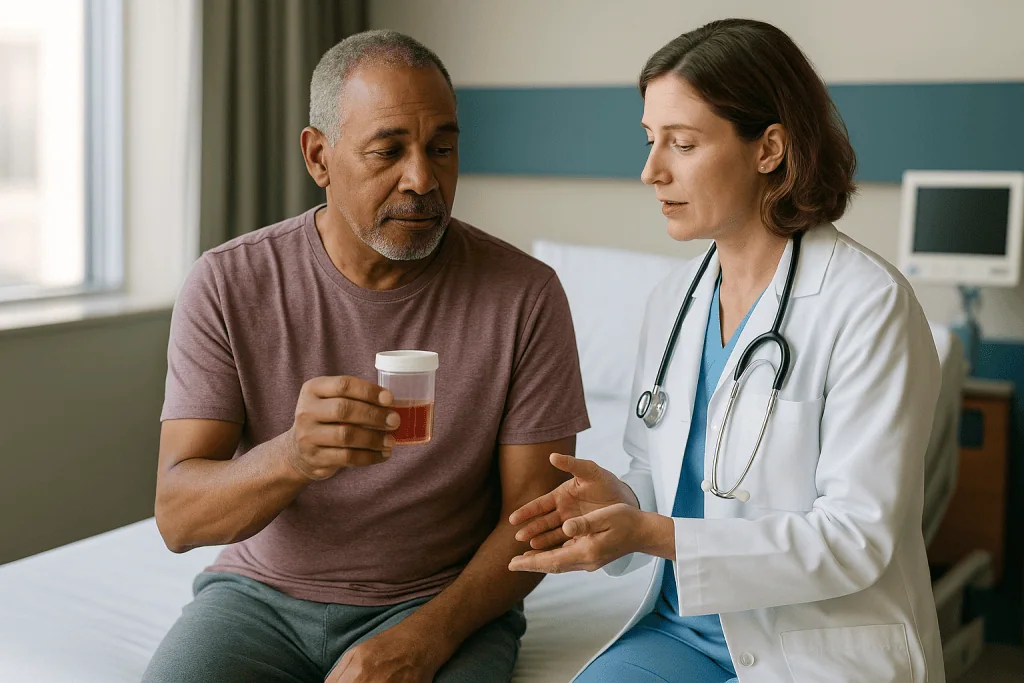
The phrase doctors use is that the bleeding should be settling, not necessarily gone. Settling means the color trends lighter over days, even if it wobbles from one bathroom visit to the next. Urine may look pinker first thing in the morning because it has been concentrated overnight, then pale through the afternoon once fluids catch up. It may darken a little after a walk or a bowel movement. None of that is a step backward.
One fact does more to calm nerves than any other: a very small amount of blood colors a very large amount of water. A single teaspoon of blood in a full toilet bowl produces an alarming red. Rosé wine and light cranberry juice are the colors most people describe in a normal recovery, not the deep red of a bloody nose collected in a cup.
What surgeons do not expect is the reverse trend. Urine that becomes steadily darker over several hours, bleeding that thickens toward the consistency of ketchup (the comparison the Mayo Clinic uses in its patient guidance), or new difficulty passing urine at all mean the healing surface needs to be looked at. Normal is a direction, not a single color, and that distinction is the whole art of watching a TURP recovery from home.
How long does bleeding last after TURP? Typical ranges, not promises
Most people ask this question with a specific date in mind: a grandchild’s visit, a return to work, a long car journey. The evidence offers ranges rather than dates.
The NHS describes blood in the urine as normal for a few weeks after a TURP, and the Mayo Clinic notes that urine may stay blood-tinged for several weeks. Within that window there is a common shape. The first one to two days, usually while the catheter is in, are the heaviest, which is why the bladder is often rinsed continuously. Once home, the color typically fades to pink over the first week. Many people then see a brief return of redder urine somewhere between the end of week one and the end of week two, a phase explained in the next section. After that, the tinge thins again, and by three to six weeks most urine looks clear, though occasional pink flecks can still appear toward the end of that period.
Several factors stretch or shorten the timeline:
- The size of the prostate removed. A larger cavity is a larger wound, with more surface to heal.
- Medicines that affect clotting, including anticoagulants and antiplatelet drugs, and when the treating team restarts them.
- Physical strain in the early weeks, from heavy lifting to constipation.
- Urinary infection, which inflames the healing surface.
Because those factors vary so widely, no article can tell an individual when their urine will run clear. The person who can is the surgeon who saw the size of the wound and knows the medical history. If bleeding continues beyond the range the team described, that is a reason for a phone call, not a reason to assume something has gone wrong.
Bleeding two weeks after TURP: why the scab lets go
Few things unsettle a recovering patient more than urine that had turned pale suddenly running red again around day ten to fourteen. It feels like the operation is undoing itself. In most cases it is doing the opposite.

When the surgeon seals blood vessels with heat, the treated surface forms a crust of coagulated tissue, the internal equivalent of a scab. Underneath it, new lining cells grow across the raw prostate bed. Once that new lining is established, the crust has done its job and begins to separate, often in fragments, over several days. As it lifts, it can expose the mouth of a small vessel that had been sealed, and a fresh trickle of blood follows. The NHS specifically warns people that bleeding can return about two weeks after the operation when this scab comes away, and describes it as a normal part of healing.
This phase, sometimes called secondary bleeding, often has a trigger: a long walk that pushed harder than usual, a heavy bag lifted from a car, a strained bowel movement, or a first attempt at sex before the team’s suggested waiting period. Each raises pressure in the pelvis or pulls on the healing surface at exactly the moment it is thinnest.
The pattern that reassures clinicians is short and self-limiting. Urine turns pink or red for a day or two, perhaps with a few small dark flecks of shed crust, then fades again with rest and steady fluids. The pattern that concerns them is heavy, thick bleeding that does not lighten within several hours, or bleeding accompanied by difficulty passing urine. The first is a scab doing what scabs do. The second is a call to the urology team, described in the red-flag section later.
A color guide to healing: what you see, what it usually means, what to do
Patients often want a chart, and for once a chart genuinely helps. Colors are approximate, and the treating team’s own instructions always override a general guide, but the patterns below reflect what mainstream patient guidance from the NHS, Mayo Clinic, and MedlinePlus describes.
| What the urine looks like | What it usually reflects | Reasonable response |
|---|---|---|
| Faint pink, like rosé, clearing through the day | Ordinary healing of the prostate bed | Keep drinking fluids as advised, carry on |
| Pink to light red with a few thread-like or grain-sized dark flecks | Small clots or fragments of shed scab | Extra fluids, rest, watch the trend |
| Red returning around days 10 to 14 after being pale | Scab separating (secondary bleeding) | Rest and fluids; call if it does not lighten in several hours |
| Dark red or thick, like ketchup, not lightening | Active bleeding from the healing surface | Contact the urology team the same day |
| Large clots, weak stream, or no urine with a painful full bladder | Possible clot blocking the outflow | Emergency care now |
| Cloudy or foul-smelling urine with fever or chills | Possible urinary infection | Same-day medical review |
Two cautions keep the chart honest. First, color alone is a poor measure of blood loss, because dilution changes everything; a well-hydrated bladder can hold the same few drops as a concentrated one and look far paler. Second, the right-hand column is about urgency, not diagnosis. Only the care team can decide whether a symptom needs a catheter, a bladder washout, an examination, or simply reassurance. The chart’s job is to help a worried person decide whether to wait until morning or pick up the phone.
TURP recovery time: what the following days and weeks usually look like
Recovery from a TURP is quieter than recovery from open surgery, but it is not nothing, and knowing the ordinary sequence makes the bloody bowl one detail among many rather than the only one.
The hospital phase lasts one to three days according to the NHS, most of it spent with a catheter draining and rinsing the bladder. Once the fluid runs pale enough and the catheter is removed, the first few times passing urine can sting sharply, because urine is flowing over a fresh surface for the first time without a tube. A weak or hesitant stream in the first day or two is common; the tissue is swollen.
At home, the first week is about frequency and urgency. The bladder, which spent months or years pushing against a blockage, has to relearn how to fill and empty at a normal pace. Some people leak briefly when they laugh or cough. The NHS notes these symptoms usually improve over weeks, though a small number of people have longer-lasting incontinence, a point discussed in the complications section.
Activity returns in stages. Walking is encouraged from the first day home. The NHS advises avoiding strenuous exercise, heavy lifting, and driving for the early period, with most people returning to work and normal activity within about three to four weeks, and waiting a similar period before resuming sex. Those weeks are exactly when the internal scab is lifting, which is why the timing is not arbitrary.
By the second month, most people describe a stream they had forgotten was possible. The bleeding, by then, is usually a memory, and the tissue removed during the operation has been examined under a microscope with results discussed at follow-up. Everyone’s version of this calendar differs, and the treating team’s instructions are the ones to follow.
Who is usually offered a TURP, and who is usually asked to wait
A TURP is not the first step for an enlarged prostate. It is usually offered when symptoms of benign prostatic hyperplasia remain troublesome despite medicine, or when the enlargement has started to harm the urinary system.
Medicines come first for most people. Alpha-blockers relax the muscle within the prostate and bladder neck so urine passes more easily, usually within days. Another class, 5-alpha-reductase inhibitors, slowly shrinks the gland over months by blocking a hormone that drives its growth. When those measures fail or are poorly tolerated, the Mayo Clinic and NHS describe the situations in which surgery is typically considered: a bladder that repeatedly cannot empty (urinary retention), recurrent urinary infections, bladder stones, blood in the urine caused by the prostate itself, or back pressure affecting the kidneys. Whether any medicine is started, changed, or stopped is entirely a decision for the prescribing clinician.
Some people are asked to wait or offered a different route. Common reasons include an active urinary infection, which must be treated first; a very large prostate, for which surgeons may suggest a laser enucleation or, less often, open surgery; heart or lung conditions that make an anesthetic risky at that moment; and clotting problems or blood-thinning treatment that need careful planning around the operation. A person whose symptoms are mild may simply be offered watchful waiting, with review rather than intervention.
Alternatives exist along a spectrum. Laser procedures vaporize or carve out tissue with less bleeding for some patients. Minimally invasive options that lift or shrink tissue suit selected anatomies. Each has its own trade-offs in durability, bleeding risk, and effect on ejaculation. The right choice depends on prostate size, overall health, and personal priorities, and it belongs to the person and their treating team together.
Blood clots in urine after TURP: part of healing or a warning sign?
Clots frighten people more than color does, and for understandable reasons. A clot looks like something solid has gone wrong. Most of the time it is the body doing exactly what it should.
When a small vessel on the prostate bed oozes, platelets and clotting proteins gather to plug it, the same process that stops a shaving nick. Some of that plug breaks free and washes out with the urine as a dark thread, a grain, or a soft fleck the size of a lentil. MedlinePlus patient guidance describes passing small clots as an expected part of recovery, particularly in the first weeks and again when the internal scab separates. Drinking fluids keeps the urine dilute so these fragments stay small and pass easily.
The concern is size and consequence. The urethra is narrow, and a clot large enough to lodge in it stops urine leaving the bladder. The bladder keeps filling, pressure builds, and the result is a painful, distended lower abdomen with a strong urge to pass urine and little or nothing coming out. Clinicians call this clot retention. It is uncomfortable, it can worsen bleeding because a stretched bladder wall bleeds more easily, and it needs prompt treatment, usually a catheter and a washout to clear the blockage. Nobody should try to wait it out overnight.
The middle ground, clots the size of a fingernail passing with a normal stream and lightening urine, generally warrants a phone call for advice rather than an emergency visit. The signal that separates the categories is simple: can urine still leave the body comfortably? If yes, the clot is a byproduct. If no, the clot is the problem, and the emergency department is the right place to be.
Blood thinners and bleeding after prostate surgery: what to know before the operation
A large share of people having a TURP are also taking a medicine that reduces clotting, because both prostate enlargement and cardiovascular disease become more common with age. Managing these medicines around the operation is one of the most important conversations to have before the day arrives.
Two broad classes matter. Anticoagulants slow the chemical cascade that builds a clot, and are commonly prescribed for atrial fibrillation or after blood clots in the legs or lungs. Antiplatelet medicines make platelets less sticky, and are often used after a heart attack, stroke, or stent. Both do their job everywhere in the body, including on the raw surface a TURP leaves behind. That is why the surgical and prescribing teams usually agree a plan to pause and later restart them, weighing bleeding from the prostate bed against the risk the medicine was protecting against in the first place.
Three points deserve emphasis. First, nobody should stop or delay one of these medicines on their own initiative, before or after surgery; the risk of a stroke or a coronary event from an unplanned gap can outweigh the risk of bleeding, and the balance is individual. Second, restarting the medicine after the operation can bring a temporary return of pinker urine, which the team will usually mention in advance. Third, supplements matter too. Some over-the-counter products and herbal remedies affect platelet function, so a complete list of everything taken, including vitamins and fish oil, belongs in the pre-operative assessment.
When bleeding does occur in someone taking a blood thinner, the treating team is the only party able to judge whether to hold a dose, adjust timing, or intervene on the bleeding directly. The safest thing a patient can do is report promptly and change nothing unilaterally.
What is the most common complication after TURP?
People searching this question usually expect the answer to be bleeding. It is not. The most common lasting effect of a TURP, according to the NHS, is retrograde ejaculation, in which semen flows backward into the bladder during orgasm instead of leaving the body. The NHS estimates it affects up to 90 percent of men after the operation. It is not harmful, the sensation of orgasm is generally preserved, and the semen simply leaves later in the urine, but it does affect fertility and can surprise people who were not warned.
Other recognized effects, drawn from NHS and Mayo Clinic guidance, include:
- Temporary urgency, frequency, and stinging while the bladder and prostate bed recover, usually easing over weeks.
- Urinary infection, which the healing surface makes more likely in the early period.
- Difficulty with erections, which the NHS reports in roughly 1 in 10 men, though the relationship with the operation itself is debated because erectile problems are common at the same age.
- Urethral stricture, a narrowing of the urethra by scar tissue, which can develop months later and cause a slowing stream.
- Persistent incontinence, uncommon but life-altering when it occurs.
- Regrowth of tissue years later, sometimes needing a repeat procedure.
Two complications are rare but taught to every trainee. TUR syndrome occurs when irrigation fluid used during the operation is absorbed into the bloodstream and dilutes the body’s salt balance; it was more common with older irrigation fluids and is now rare with modern techniques. Bleeding heavy enough to need a blood transfusion is also uncommon. So the honest ranking runs: retrograde ejaculation is near-universal, bladder symptoms are common and mostly temporary, and serious hemorrhage is the exception that the catheter, the rinsing, and the follow-up phone number exist to catch.
Can blood in urine go away on its own? What actually helps the prostate bed heal
For blood that comes from a healing TURP wound, the answer is usually yes. The body seals vessels, grows new lining, sheds its internal scab, and the tinge fades without anyone doing anything clever. That is fundamentally different from blood in the urine appearing in someone who has not had surgery, which the Cleveland Clinic and other sources say should always be evaluated because it can signal infection, stones, or, less often, a tumor. Surgery explains the bleeding; the absence of surgery does not.
Healing can be helped, though, and the helpful measures are ordinary. Fluids top the list. Dilute urine is gentler on the raw surface and keeps small clots too small to block anything, which is why most discharge instructions from MedlinePlus and the NHS ask people to drink steadily through the day unless a heart or kidney condition requires a limit set by their own doctor.
Constipation is the underappreciated enemy. The rectum sits directly behind the prostate, and straining to pass a hard stool presses on the healing bed like a thumb on a bruise. Fiber-rich food, fluids, and gentle daily walking keep stools soft; many teams discuss a stool softener before discharge, and that choice belongs with them.
Movement helps in the right dose. Short, frequent walks improve circulation and reduce the risk of blood clots in the legs after any operation, while heavy lifting, vigorous exercise, and long periods of cycling on a hard saddle load the pelvic floor and are usually deferred for the first few weeks per NHS advice.
What does not help is anxiety-driven inspection. Checking the bowl fifty times a day changes nothing except mood. Noting the trend once or twice daily, and reporting the specific changes covered in the red-flag section, is enough.
What people often get wrong about bleeding after TURP
Recovery myths spread fast among people comparing notes, and several of them cause needless fear or, worse, risky decisions.
The first is that red urine means heavy bleeding. It does not. Dilution dominates color, and the same few drops that pass unnoticed in a full bladder will paint a concentrated morning sample deep red. Clinicians judge bleeding by trend, thickness, and clots, not by shade alone.
The second is that bleeding at the two-week mark means the operation has failed or a vessel has burst. As explained earlier, this is most often the internal scab lifting as the new lining matures. The NHS describes it as expected. It is the wound graduating, not regressing.
The third, and the most dangerous, is that drinking less will reduce the bleeding by giving the body less to bleed into. The logic is backwards. Concentrated urine irritates the healing surface, and clots that form in a sluggish bladder grow large enough to block the outflow.
The fourth is that a blood thinner should be stopped at the first sign of pink. That decision has to be made by the prescribing team, because the medicine is preventing something, and an unplanned gap carries its own risk.
The fifth is that blood in the urine means cancer was found. The tissue removed at TURP is routinely examined under a microscope, and results are discussed at follow-up, but the bleeding itself comes from the surgical surface and says nothing about what the pathologist will see.
The last is subtler: that a good recovery means no blood at all before discharge. Most people go home with pink urine. The goal at discharge is urine pale enough to flow freely without a catheter, and a plan for what to do if that changes.
Questions to ask your care team before and after TURP
The best time to understand bleeding after a TURP is before the operation, when the surgeon has time and the patient has a notebook. A second round of questions belongs at discharge, when the specifics of what to watch are fresh. The following are worth asking in the patient’s own words.
- How large is my prostate, and does that change how much bleeding or how long a recovery you expect?
- Which of my medicines and supplements affect clotting, and exactly when should each be paused and restarted? Who will tell me?
- What color of urine should prompt a phone call, and what should send me straight to the emergency department?
- Whom do I call, at which number, if bleeding worsens at night or on a weekend?
- How much should I drink each day, given my heart and kidney health?
- When can I lift, drive, return to work, exercise, and have sex, and why those particular timings?
- Should I expect bleeding to return around two weeks, and what would make that episode a concern rather than normal?
- Will I need a stool softener or other measures to avoid straining?
- When and how will I learn the results of the tissue examination?
- What symptoms months from now, such as a slowing stream, should bring me back for review?
Answers to these questions are individual. The same operation on two people of the same age can produce very different recoveries because prostate size, medicines, and general health differ. Writing the answers down, and bringing a family member to hear them, turns a general article like this one into a personal plan, which is the only kind that reliably holds up in a bathroom at three in the morning.
When to call your doctor: red-flag signs after TURP
Most bleeding after a TURP resolves with time and fluids. A small number of situations should not wait, and recognizing them quickly protects both the bladder and the kidneys.
Seek emergency care now if you cannot pass urine and the lower abdomen feels full, tight, or painful; if urine is thick, dark red, or contains large clots and is not lightening; if you feel faint, dizzy, or notice a racing heart alongside heavy bleeding, which can indicate significant blood loss; or if you develop a high fever with shaking chills, which can signal infection spreading beyond the bladder.
Call the urology team or your doctor the same day if bleeding that had faded returns heavier than before and does not improve within several hours of rest and fluids; if you are passing clots larger than a fingernail even with a normal stream; if urine becomes cloudy or foul-smelling, or burning worsens rather than eases after the first few days; if pain in the lower abdomen, flank, or back appears; if bleeding continues past the timeframe your team described; or if you have any question about a blood-thinning medicine, before making any change yourself.
Mention at your next routine contact any ongoing leakage of urine beyond the first weeks, a stream that seems to be slowing months later, persistent pain with ejaculation, or worry about sexual changes, all of which have recognized explanations and, often, management options.
None of these signs is a diagnosis. Each is a reason for a trained person to assess you. The NHS and Mayo Clinic both stress that a healing prostate bed is an internal wound that cannot be inspected at home, so the threshold for asking should be low and the shame attached to asking should be zero. Every decision about treatment rests with the team that knows your operation and your history.
Frequently asked questions
How long does bleeding continue after a TURP?
Blood in the urine is typically heaviest in the first one to two days and then fades to pink over the first week, though the NHS says some blood is normal for a few weeks. Many people notice a short return of redder urine around ten to fourteen days when the internal scab separates. Larger prostates, blood-thinning medicines, and physical strain can lengthen the timeline, so your surgical team’s expected range matters more than any general figure.
Can blood in urine go away on its own after prostate surgery?
Yes, when it comes from the healing prostate bed after a TURP, bleeding usually settles by itself as vessels seal and new lining grows. Steady fluids, avoiding constipation, and deferring heavy lifting help the process along. This differs from blood in the urine in someone who has not had surgery, which should always be evaluated by a clinician. If bleeding thickens, produces large clots, or blocks urine flow, it needs medical attention rather than waiting.
What is the most common complication after TURP?
Retrograde ejaculation is the most common lasting effect, with the NHS estimating it affects up to 90 percent of men; semen enters the bladder during orgasm and passes out later in the urine. Temporary urgency, frequency, and stinging are common but usually ease over weeks. Erectile difficulties are reported in about 1 in 10 men, and urethral narrowing or lasting incontinence are less common. Bleeding heavy enough to need a transfusion is uncommon.
How long should blood be in urine after prostate surgery before I worry?
Worry less about the calendar and more about the trend. Pink urine that fluctuates but generally lightens over the first few weeks fits the pattern the NHS and Mayo Clinic describe as normal. Contact your team if urine becomes steadily darker, thick like ketchup, or full of large clots, if you cannot pass urine, or if bleeding continues beyond the timeframe your surgeon gave you. Fever or a painful full bladder alongside bleeding needs same-day care.
Why is there bleeding two weeks after TURP when it had almost stopped?
The heat used during surgery seals vessels under a crust of coagulated tissue, an internal scab. Around ten to fourteen days later, once new lining has formed beneath it, that crust lifts and can briefly reopen small vessels, turning urine red for a day or two. The NHS lists this as a normal part of healing. Rest and fluids usually settle it; bleeding that stays heavy for several hours or blocks urine flow should be reported.
Are blood clots in urine after TURP normal?
Small clots that look like dark threads, grains, or soft flecks are a normal byproduct of vessels sealing and the internal scab shedding, and MedlinePlus patient guidance describes them as expected. The concern is a clot large enough to block the urethra, which causes a painful, full bladder and little or no urine. That situation, called clot retention, needs emergency treatment, usually a catheter and a bladder washout, and should never be waited out overnight.
Should I drink more or less water if my urine is bloody after TURP?
More, in most cases. Dilute urine is gentler on the healing surface and keeps small clots too small to block the outflow, which is why NHS and MedlinePlus discharge advice asks people to drink steadily through the day. Cutting back to reduce bleeding is a common misconception that increases the risk of clot retention. If you have a heart or kidney condition that limits fluids, follow the specific target your own doctor sets.
What is the typical TURP recovery time?
The NHS describes a hospital stay of one to three days, with the catheter usually removed after about 24 to 48 hours. Most people avoid strenuous activity, heavy lifting, and driving for the early period and return to work and normal activity within about three to four weeks, waiting a similar time before sex. Urinary urgency and stinging generally ease over weeks, while occasional pink urine can persist within that window. Individual timelines vary with prostate size and health.
Can I restart my blood thinner if my urine is still pink after TURP?
Only on the timeline your surgical and prescribing teams agreed, never on your own judgment. Anticoagulants and antiplatelet medicines protect against strokes and heart events, so an unplanned gap has its own risks, while restarting too early can worsen bleeding from the prostate bed. A return of pinker urine after restarting is common and usually mentioned in advance. If bleeding increases after you resume the medicine, report it promptly and change nothing unilaterally.
Does blood in urine after TURP mean cancer was found?
No. The bleeding comes from the surgical surface where prostate tissue was removed and says nothing about the microscope findings. Tissue taken during a TURP is routinely examined by a pathologist because prostate cancer can occasionally be discovered incidentally, and the results are discussed at a follow-up appointment. The amount or duration of bleeding does not predict those results. If you are anxious while waiting, ask your team when and how the report will be shared.
References
- NHS: Transurethral resection of the prostate (TURP): Recovery
- NHS: Transurethral resection of the prostate (TURP): Risks
- MedlinePlus: Transurethral resection of the prostate
- MedlinePlus: Transurethral resection of the prostate – discharge
This article is for general information only and is not a substitute for professional medical advice. Please consult a qualified doctor about your individual situation.

More from the Blog

How Do You Read a Urodynamic Report? Capacity, Pressure-Flow Curves and Leak Points Explained
A urodynamic report is read in order: the header and patient details, then the flow curve and the volume left after voiding, then the…

When Can You Lift, Drive and Exercise Again After Robotic Prostate Surgery?
Most people walk the day of robotic prostate surgery, drive again once the catheter is out and they are no longer taking opioid painkillers,…
How Peritoneal Dialysis Exchanges Work: Fill, Dwell and Drain Explained in Plain Words
A peritoneal dialysis exchange uses the lining of your own abdomen as a filter. Cleansing fluid flows through a soft catheter into the belly…

Reading a Bladder Disease Treatment Plan: Questions to Ask Your Urologist Before You Decide
Before agreeing to a bladder disease treatment plan, ask your urologist which specific condition is being treated, what test results support that diagnosis, why…

Is Tiredness After Hemodialysis Normal? Cramps, Low Blood Pressure and What to Report
Yes, feeling tired after hemodialysis is common and expected for many people, because a session removes fluid and waste quickly and shifts salts and…

Shockwave Therapy or Endoscopic Removal: Which Kidney Stone Treatment Fits Your Stone?
Shock wave lithotripsy breaks a kidney stone from outside the body using focused sound waves, while ureteroscopy passes a thin scope up the urinary…