

Is Genioplasty Painful? General Anesthesia, Chin Tightness and What Helps in the First Days

Key Takeaways
- Genioplasty is performed under general anesthesia, so the bone cut itself is never felt; the sensations that follow are mainly tightness, pressure and numbness rather than sharp pain.
- Swelling after chin surgery typically builds for two to three days before it peaks, so feeling worse on the second morning is expected rather than alarming.
- Numbness of the lower lip and chin comes from stretching of the mental nerve, which usually recovers over weeks to months, though a small number of people have lasting altered sensation.
- Head elevation, cold applied through a cloth in the first 48 hours, soft lukewarm food and careful mouth rinsing do more for early comfort than any single medicine.
- A chin implant avoids cutting bone but introduces foreign-body risks such as infection and displacement, and it cannot shorten, lengthen or rotate the chin the way a sliding genioplasty can.
- Pain that escalates after day three, spreading swelling into the neck, fever, pus, or new facial weakness are red flags that need a same-day call to the surgical team, not a higher painkiller dose.
Genioplasty is usually described as uncomfortable rather than severely painful. Because it is performed under general anesthesia, nothing is felt during the operation itself. Afterward, most people report a tight, swollen, pressured feeling in the chin and lower lip, often with temporary numbness, rather than sharp pain. Soreness typically eases over the first week, while swelling and numbness settle more slowly under the care team's guidance.
The question usually arrives the night before, somewhere between brushing teeth and setting an alarm. The consent form has been signed, the soft foods are in the fridge, and then a hand drifts to the chin and presses, as if testing how much it will hurt to have that small square of bone cut and moved. Is genioplasty painful? Patients ask it quietly, often after they have already decided to go ahead.
It is a fair question, and it deserves a straighter answer than “everyone is different.” Genioplasty (surgery that reshapes the chin, most often by cutting the chin bone and sliding it into a new position) involves bone, nerves and a swollen lower lip, so it does produce real sensations. The honest news is that those sensations are more about tightness, pressure and strange numbness than about sharp pain.
What follows is the version of that answer a seasoned anesthetist or maxillofacial nurse would give you if you had an hour with them and a cup of tea.
Is genioplasty painful? What patients actually describe
Ask a room of people a week after chin surgery to describe the feeling and the word “pain” rarely leads. They talk about a chin that feels like it belongs to someone else, a lower lip that is fat and fizzy, a jaw that is stiff when they yawn. The dominant sensation after a sliding genioplasty is a heavy, stretched tightness across the front of the chin, not the stabbing or throbbing people imagine when they picture a bone being cut.
Why the mismatch between expectation and experience? Partly because the operation happens under general anesthesia, so the moment the bone is divided is never consciously felt. Partly because the chin bone has relatively few pain receptors inside it; the sensitive structures are the gum lining, the muscle that was lifted off the bone and the nerve that supplies feeling to the lower lip. Those tissues react with swelling and numbness, which read to the brain as pressure and strangeness more than hurt.
None of this means there is no discomfort. The first two or three days are usually the sorest. Opening wide, smiling, speaking for long stretches and chewing anything firm pull on the healing incision inside the mouth. Many people also describe a dull ache that is worse when the head is low, such as bending to tie shoes, because blood pools in the swollen tissue.
The evidence here is mostly surgeon experience and patient reports rather than large trials, so it is right to be cautious. Mainstream guidance on jaw surgery, which includes chin procedures, frames the early period as one of swelling, numbness and manageable soreness that is controlled with prescribed medicines and simple measures, and the rest of this article follows that framing.
What actually happens during a sliding genioplasty
The whole procedure takes place through the mouth. There is no skin cut on the face, which is one reason the chin can feel so tight afterward: the only scar is hidden inside the lower lip, where tissue is mobile and swells generously.
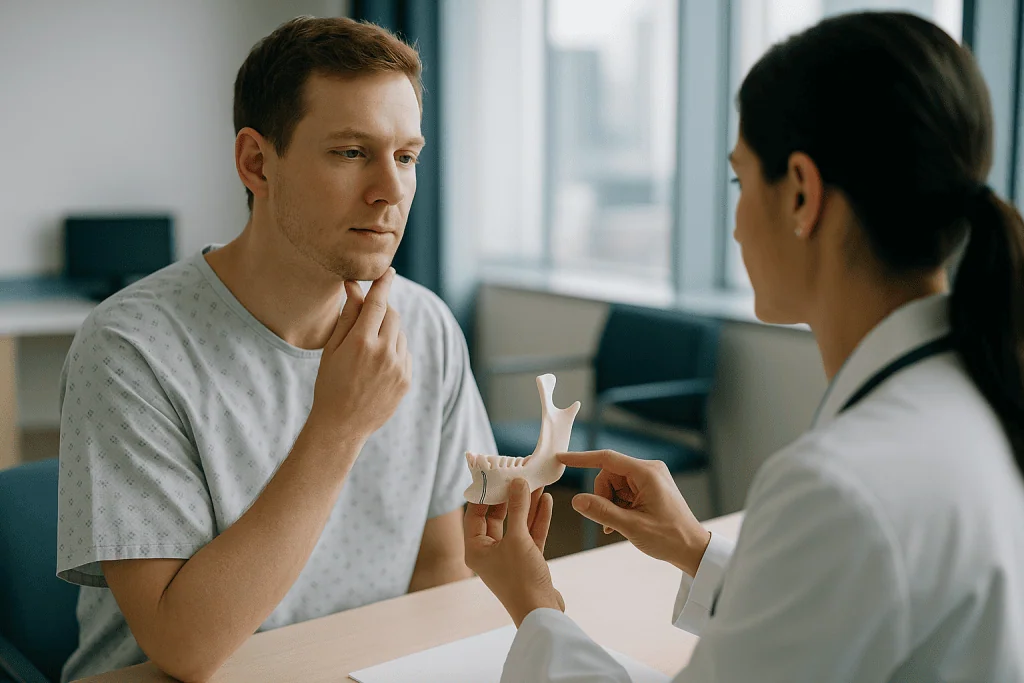
Once the general anesthetic has taken effect, the surgeon makes an incision through the lining of the lower lip, just above where the lip meets the gum. The muscle that attaches to the front of the chin is lifted gently off the bone. The surgeon then identifies and protects the mental nerve, the small sensory nerve that exits the lower jaw on each side of the chin and supplies feeling to the lower lip and chin skin. Protecting it is the most delicate part of the operation.
A horizontal cut is made through the chin bone below those nerves. The freed segment can now be slid forward to add projection, backward to reduce it, downward to lengthen the face, or upward to shorten it; it can also be tilted to correct asymmetry. Small titanium plates and screws hold the segment in its new position while bone heals around it. Most people never feel these plates once swelling settles, and they are usually left in place permanently.
The lining is then closed with dissolving stitches. A supportive dressing or tape is often applied across the chin from outside to limit swelling and to discourage the soft tissue from drooping while it re-attaches. The operation itself typically lasts about an hour, though combined jaw procedures take longer, and your team will give you their own estimate.
Understanding this sequence explains the sensations that follow: lifted muscle equals tightness, a cut through gum lining equals soreness when you move your lip, and a nerve that has been stretched or moved explains the numbness.
General anesthesia for genioplasty: before, during and the first hours after
General anesthesia is a medicine-induced state of controlled unconsciousness in which you feel nothing and remember nothing of the operation. For genioplasty it is the standard choice because the airway is shared with the surgical field and the surgeon needs the jaw completely still.
Before surgery, an anesthetist reviews your medical history, medicines, allergies and previous reactions to anesthesia. You will be asked to fast for a set period, usually several hours for food and a shorter time for clear fluids, following your hospital’s instructions. In the anesthetic room, a small cannula is placed in a vein, monitoring stickers go on, and the anesthetic is given through the cannula. Most people describe a brief cold feeling in the arm and then nothing until they wake.
During the procedure a breathing tube is placed, often through the nose so the mouth is free for the surgeon. You will not be aware of this, but it does explain two common complaints on waking: a sore throat and a stuffy or slightly tender nose. According to the NHS, feeling sick, shivering, a sore throat, bruising at the cannula site and general drowsiness are common after-effects that usually pass within hours, and you should not drive, drink alcohol or sign legal documents for 24 hours.
Serious complications of general anesthesia are rare in otherwise healthy people, and risk rises with smoking, obesity, sleep apnea and heart or lung disease, which is why honest pre-assessment matters. Mayo Clinic notes that the overall risk relates more to the type of surgery and your health than to the anesthetic itself.
In recovery you will wake with the chin dressing already on, a swollen lower lip and often a feeling that you cannot quite tell where your chin ends. That is expected. Pain relief has usually been given before you wake, and recovery nurses adjust it based on what you tell them.
Why the chin feels tight rather than sharply painful
Tightness is the sensation people are least prepared for, so it helps to know exactly where it comes from.

Three things happen at once. The mentalis muscle, the small muscle that lifts the lower lip and wrinkles the chin, has been detached from bone and must re-attach to a surface that is now in a different place. Until it does, every movement of the lower lip tugs on a healing edge. The gum lining has been cut and stitched, and mucous membrane swells quickly and generously. And the bony segment has moved, which means the overlying skin and soft tissue envelope is being stretched over a new contour, in the same way a shirt feels tight across the shoulders after a day of lifting.
Swelling adds pressure to all three. Fluid collects in loose tissue under the chin and in the lower lip because there is nowhere firmer for it to go, and gravity keeps it there while you are upright. The result is a chin that feels hard, hot and overfull, with a lip that does not quite close over the teeth for the first several days.
Nerve change contributes too. When the mental nerve is stretched or bruised, signals from the skin are scrambled rather than blocked. Some people feel a woolly numbness; others feel tingling, pins and needles, or an odd sensation that the chin is being pulled even when nothing is touching it. These altered sensations tend to be more unsettling than painful.
Knowing this changes behavior in useful ways. Tightness is not a sign that something has torn or a plate has shifted. It is the expected cost of moving bone and lifting muscle, and it eases as swelling drains and the muscle re-anchors. If, instead, the chin becomes suddenly more painful, more swollen on one side, or hot and red on the skin, that is a different pattern and belongs in the red-flag section below.
Numb chin after genioplasty: what the mental nerve is doing
Numbness in the chin and lower lip is so common after sliding genioplasty that surgeons usually mention it before pain. The reason sits a few millimeters from the bone cut.
The mental nerve carries sensation, not movement. It emerges from a small opening on each side of the lower jaw roughly below the premolar teeth and fans out into the skin of the lower lip and chin. During surgery it is lifted and held aside while the bone is divided beneath it. Even gentle retraction stretches the nerve fibers and bruises the tiny blood vessels that feed them. The nerve is intact, but it is temporarily stunned, a state neurologists call neuropraxia.
What this feels like varies. Some people have a completely dead-feeling lower lip and dribble a little when drinking because they cannot sense the cup. Others have patchy numbness on one side only, or a sense that the chin skin is covered in a thin film. As the nerve recovers, sensations often change to tingling, electric flickers or oversensitivity to light touch, which can be mistaken for a problem when it is in fact a sign of recovery.
Timelines are the honest difficulty here. Most sensation returns over weeks to months, but mainstream patient resources on jaw surgery acknowledge that recovery can take many months and that a small number of people are left with some permanent altered sensation, particularly after larger movements or combined procedures. MedlinePlus explains that numbness and tingling after an injury or operation reflect nerve irritation and should be assessed if they spread, worsen, or are accompanied by weakness.
Practical consequences matter more than theory. Numb skin burns and bites easily, so hot drinks need testing against the inner wrist, and a numb lip is easy to catch between the teeth when chewing. Your team will tell you when it is sensible to shave the area or apply heat.
Sliding genioplasty swelling and bruising: why day two or three feels the worst
People expect to feel worst on the day of surgery and better each morning after. The chin does not cooperate. Swelling after facial bone surgery builds for the first couple of days before it peaks, which is why many patients phone the ward on the second or third morning convinced something has gone wrong.
The mechanism is inflammation doing its job. Cutting bone and lifting muscle triggers the release of signaling chemicals that make small blood vessels leaky, flooding the tissue with fluid and immune cells. That process takes time to ramp up, so the lip and chin keep enlarging after you are already home. Bruising follows a similar lag as blood tracks down from the operated area under the skin, often appearing as a yellow-green tide along the jawline and even into the neck several days later.
What changes the curve is simple physics and patience. Keeping the head higher than the heart lets fluid drain by gravity, which is why sleeping propped on two or three pillows, or in a recliner, is advised for the first several nights. Cold applied through a cloth to the outside of the chin narrows surface blood vessels and blunts the fluid leak in the first 48 hours, after which its benefit tapers. Gentle walking around the house keeps circulation moving; lying flat all day does the opposite.
The chin tape or compression dressing many surgeons apply is not decorative. It gives the swollen tissue a firm surface to press against, limiting how far the lip can balloon and helping the soft tissue settle onto the new bone contour. Removing it early because it itches is a common regret.
Jaw surgery guidance from Mayo Clinic describes initial healing over about six weeks with complete healing taking up to twelve weeks, and residual subtle swelling in the chin can linger within that window. The dramatic swelling, though, usually eases noticeably after the first week.
Genioplasty recovery time: what the first two weeks usually look like
Recovery timelines are only ever typical ranges, and your own surgeon’s plan takes priority. With that said, people find it reassuring to know the general shape of the road.
The day of surgery is mostly sleep, sips and a thick, numb lip. Speech is slurred because the lower lip does not move well, and swallowing feels clumsy. Nurses check the dressing, offer pain relief and anti-nausea medicine as needed, and most people either go home the same day or after one night, depending on whether other jaw procedures were done.
Days one to three are the swelling peak. The chin is tight and hard, the lip protrudes, and bruising begins to show. Eating is liquid or very soft, mouth rinses start as instructed, and the biggest challenge is often boredom paired with mild misery. Many people describe this as the stretch where they wonder whether they made the right decision; that doubt tends to lift with the swelling.
By the end of the first week, soreness is usually mild and swelling visibly reduced. Chin tape may be removed or changed at a review appointment. Soft but more substantial foods return, and short outings feel possible, though the chin still looks larger than it will.
Week two is when most people feel like themselves in conversation, even if the mirror still shows puffiness. Office-type work is often resumed, with the caveat that fatigue surprises people after any general anesthetic. Strenuous exercise and contact sports remain off the table until the surgeon clears them, because a knock to the healing bone is the one thing that can undo the work.
Beyond that, Mayo Clinic’s jaw surgery resource frames the broader arc as roughly six weeks for initial bone healing and up to twelve weeks for completion. Numbness, as discussed, follows its own slower clock. The final chin shape is usually judged only once all swelling has gone, which can be several months.
What helps in the first days after chin surgery
The measures that make the biggest difference in the first days are not glamorous, but they work with the body’s own healing rather than against it.
Elevation comes first. Sleeping and resting with the head above heart level for the first several nights reduces the fluid gradient into the chin and lip. A wedge pillow or recliner does this more comfortably than a stack of pillows that slides apart at 3 a.m.
Cold, applied through a clean cloth to the outside of the chin in short intervals during the first two days, narrows surface vessels and dulls nerve endings. Direct ice on numb skin is a genuine hazard because you cannot feel a cold burn developing, which is why the cloth barrier and time limits matter.
Food is the next lever. A liquid and soft diet spares the healing lining inside the lip and avoids pulling on stitches. Lukewarm rather than hot temperatures protect numb tissue. Protein and fluids speed tissue repair; sugary drinks sipped all day feed bacteria around the incision. Smoothies, soups, yogurt and well-mashed meals are the practical staples.
Mouth care feels counterintuitive when the mouth is sore, but it is the single most important infection-prevention step. Gentle rinsing after eating, as instructed by your team, and careful brushing of the teeth away from the incision keep the bacterial load low. MedlinePlus notes that surgical wound infections are more likely when wounds are contaminated, and the mouth is never sterile, so hygiene stands in for sterility.
Movement in moderation closes the list. Gentle walking lowers the risk of blood clots after any anesthetic and helps swelling drain, while heavy lifting, bending with the head down and any activity that raises blood pressure sharply can increase bleeding and throbbing. Avoiding smoking and alcohol protects both the anesthetic recovery and the blood supply to the healing bone.
Pain relief after genioplasty: how the medicines work, without the numbers
Pain control after chin surgery is usually straightforward, and it helps to understand the logic your prescribing team is using, even though the specific choices, doses and timing are entirely theirs.
Most plans are built on a foundation of simple, non-opioid analgesics taken regularly for the first few days rather than waiting for pain to arrive. The principle is that steady blood levels of a mild painkiller prevent the peaks and troughs that make the second day feel unmanageable. Acetaminophen (paracetamol) works centrally on pain signaling; non-steroidal anti-inflammatory drugs reduce the inflammatory chemicals that drive both pain and swelling, though they are not suitable for everyone, particularly those with kidney problems, stomach ulcers or certain heart conditions, and some surgeons limit them because of bleeding concerns. Your team weighs these factors for you.
Stronger opioid medicines are sometimes provided for breakthrough pain in the first day or two. They work on receptors in the brain and spinal cord and are effective, but they cause constipation, drowsiness and nausea, and dependence risk rises with longer use, so mainstream guidance favors the smallest supply for the shortest time and a clear plan to stop. Many people never need them after chin surgery alone.
Some teams also give a short course of corticosteroid during or just after surgery to blunt swelling, and antibiotics may be prescribed because the incision sits in the mouth. Anti-nausea medicines are common in the first 24 hours after general anesthesia.
Two rules of thumb hold regardless of the plan. Never combine over-the-counter products with prescribed ones without checking, because the same ingredient can appear in both. And if pain is escalating rather than easing after day three, do not simply take more; that pattern needs a clinical assessment, not a higher dose. Every medicine decision, including when to stop, sits with the prescribing clinician who knows your history.
Genioplasty vs chin implant: does one hurt more?
People weighing chin surgery often ask whether an implant, a shaped piece of medical-grade material placed over the chin bone, would be an easier recovery than cutting and moving bone. The honest answer is that they trade one set of sensations for another, and the choice is driven by anatomy more than comfort.
A chin implant is placed through a small incision either inside the lower lip or under the chin, into a pocket created directly on the bone. No bone is cut, so there is less deep ache and typically less bruising. The soft tissue is still lifted, though, and the pocket must fit the implant snugly, so tightness and lip swelling are familiar features. The implant is a foreign body, which introduces risks that a sliding genioplasty does not carry: infection that may require removal, shifting, and slow erosion of the underlying bone over years. Implants can add forward projection but cannot shorten a long chin, lengthen a short one or correct asymmetry in the same way moving bone can.
| Feature | Sliding genioplasty | Chin implant |
|---|---|---|
| What is changed | Chin bone cut and repositioned, fixed with plates | Shaped implant placed over existing bone |
| Typical early sensation | Deep tightness, lip swelling, numbness | Surface tightness, lip or under-chin swelling, usually less bruising |
| Directions of correction | Forward, back, up, down, rotation | Mainly forward projection |
| Foreign material | Small plates and screws, usually permanent | Implant, permanent unless removed |
| Specific risks | Nerve stretch, bone healing issues | Infection, displacement, bone erosion |
| Reversibility | Difficult | Removable |
Neither option is painless and neither is dramatically more painful. What matters is which one addresses your actual anatomy, something only an examination and imaging can settle, and your surgeon will explain why one suits you.
Who genioplasty is usually for, who is asked to wait, and what the alternatives are
Genioplasty is usually offered to adults whose chin is retruded, over-projected, too long, too short or asymmetric relative to the rest of the face, and who are bothered by it. It is frequently combined with orthodontic treatment or jaw surgery when the bite is also out of alignment, because a chin that is set back often reflects a lower jaw that is set back. It is also part of reconstruction after injury and in some congenital conditions.
Several groups are typically asked to wait or to consider other routes. Adolescents are generally advised to wait until facial growth is complete, because moving the chin before the jaw has finished growing can produce an unpredictable result. People who smoke are often asked to stop well before surgery, since nicotine narrows the small blood vessels that bone and gum lining depend on for healing, and smoking also raises anesthetic and wound risks. Uncontrolled diabetes, bleeding disorders, active gum disease and recent dental infection are reasons to pause until they are managed. Surgeons also take time with anyone whose expectations focus on how the surgery will change their life rather than their chin, and with people who meet criteria for body dysmorphic disorder, for whom surgery rarely helps and often harms.
Alternatives exist at every level of invasiveness. Orthodontics alone can change the chin’s apparent position by moving teeth and lips. Injectable fillers can add temporary projection without surgery, at the cost of repeat treatments and their own risks, including rare vascular injury. A chin implant, as discussed, suits forward projection. Doing nothing is also a legitimate choice, and a good consultation makes that option feel available rather than foolish.
The decision to proceed, to wait or to choose a different path belongs to you and your treating team together, informed by an examination, photographs and often three-dimensional imaging rather than by what a screen or a search result suggests.
What people often get wrong about genioplasty pain
Myth: cutting bone means agony. Bone itself has few pain receptors; the periosteum covering it and the soft tissues around it do the complaining. Combined with general anesthesia and planned pain relief, this is why most people describe pressure and tightness rather than sharp pain. The misunderstanding tends to produce needless dread the night before.
Myth: feeling worse on day two means something has gone wrong. Swelling after facial surgery builds for a couple of days before it peaks, so the second and third mornings are predictably the hardest. The pattern to worry about is swelling or pain that keeps escalating after that point, or that is sharply one-sided.
Myth: numbness means the nerve was cut. A stunned, stretched nerve produces identical numbness to a damaged one in the early weeks. Most sensation returns over months. Persistent numbness beyond the timeframe your surgeon expects is worth reviewing, but early numbness on its own is not evidence of injury.
Myth: the plates will set off airport scanners and need removing. The small titanium plates used in genioplasty are usually left in permanently, are not magnetic, and do not trigger standard security scanners. Removal is uncommon and done only if a plate becomes palpable, infected or bothersome.
Myth: more painkiller is the answer to more pain. Escalating pain after the first few days needs assessment for infection, bleeding or a problem with the bone, not a bigger dose. Pain that is well controlled at rest but flares with movement is normal; pain that wakes you from sleep and climbs each day is not.
Myth: once the tape comes off, recovery is finished. External swelling settles in weeks, but bone takes a couple of months to consolidate, and the final soft-tissue contour is judged only after all swelling has gone. Treating week two as the finish line leads to premature judgments about the result and premature returns to contact sport.
Questions to ask your care team before chin surgery
A good consultation is a conversation, and the most useful questions are the ones that produce specific answers rather than reassurance. Take this list, cross out what has already been covered, and add your own.
- Which type of chin surgery are you recommending for me, and why does my anatomy suit that approach rather than the alternatives?
- In which directions will the bone move, and how was that decided? Will I be shown the plan on imaging?
- Will this be done alone or combined with other jaw or orthodontic work, and how does that change the recovery?
- What is your plan for pain relief, and what should I do if the first-line medicines are not enough or do not suit me?
- How long do you expect my swelling, tightness and numbness to last, and at what point would you want to see me if they have not improved?
- How will I know the difference between expected swelling and a problem that needs urgent review?
- What is your specific advice on diet, mouth rinsing, chin tape, sleeping position and exercise, and when does each restriction lift?
- Who do I contact out of hours, and what are the warning signs that mean I should not wait until morning?
- What are the realistic risks in your hands, including nerve injury, infection, asymmetry and the need for revision?
- Will the plates stay in permanently, and are there situations in which they would need to come out?
- When will I be able to judge the final result, and what happens if I am unhappy with it?
Write the answers down or ask whether someone can accompany you. People consistently remember less of a consultation than they expect, especially when the conversation turns to risks. Having the surgeon’s specific expectations on paper also makes the recovery easier to measure against something real instead of against what the internet says it should look like.
When to call your doctor after genioplasty: red-flag signs
Most chin surgery recoveries are uneventful, and the expected course has been described above: tightness, swelling that peaks around day two or three, bruising that tracks down toward the neck, numbness of the lip and chin, and soreness that eases over the first week. The signs below fall outside that pattern and deserve a same-day call to your surgical team, or emergency care if they are severe.
- Difficulty breathing, noisy breathing, or swelling that is spreading into the floor of the mouth, tongue or neck. Treat this as an emergency.
- Bleeding from the mouth that does not slow with gentle pressure, or repeated large clots.
- Pain that increases steadily after the third day rather than easing, or pain that is sharply worse on one side.
- Fever, chills, or a feeling of being generally unwell, especially combined with a bad taste, pus or a foul smell from inside the lip.
- Skin over the chin that becomes increasingly red, hot and hard, or a wound edge inside the mouth that opens up. MedlinePlus lists increasing redness, warmth, pain and drainage as features of surgical wound infection.
- A new clicking or movement sensation in the chin, or a visible change in chin position, particularly after a knock.
- Numbness that spreads beyond the lower lip and chin, or any weakness of facial movement such as inability to move the lip corner, which is different from numbness.
- Persistent vomiting, inability to keep fluids down, or signs of dehydration.
- Calf pain, swelling of one leg, chest pain or sudden breathlessness, which can indicate a blood clot after any operation under general anesthesia.
- Severe sore throat with difficulty swallowing saliva, or voice loss lasting more than a few days after the breathing tube.
When in doubt, call. Surgical teams would rather assess a swelling that turns out to be ordinary than hear about a problem a day late. Keep the out-of-hours number your team gave you somewhere you can find it without your glasses, and do not let a numb lip or slurred speech stop you from phoning; a text or a message from a family member works just as well.
Frequently asked questions
Is genioplasty painful during the operation?
No. Genioplasty is performed under general anesthesia, which means you are unconscious and feel nothing while the bone is cut and repositioned. Local anesthetic is also often injected into the surgical area so that you wake with the chin already numbed. Discomfort begins as the anesthetic wears off and is usually described as tightness and swelling rather than sharp pain.
How long does genioplasty recovery time usually take?
Most people are through the sorest period within the first week and back to desk-type activities around two weeks, though timelines vary with the extent of surgery. Mayo Clinic’s jaw surgery guidance describes initial bone healing over about six weeks and complete healing up to twelve weeks. Numbness and the last traces of swelling can take longer, and your surgeon’s plan takes priority.
Why is my chin numb after genioplasty?
The mental nerve, which supplies feeling to the lower lip and chin, is lifted aside and stretched while the bone is cut beneath it. Stretching temporarily stuns the nerve even when it is intact, producing numbness, tingling or oversensitivity. Sensation usually returns gradually over weeks to months. Numbness that spreads, worsens or comes with facial weakness should be reviewed by your team.
How bad is sliding genioplasty swelling, and when does it peak?
Swelling of the lower lip and chin is usually significant and tends to peak around the second or third day before easing. Bruising often appears later and can track along the jawline toward the neck. Head elevation, cold compresses through a cloth in the first two days and wearing the chin tape as instructed help limit it. Most dramatic swelling settles over the first one to two weeks.
Genioplasty vs chin implant: which has the easier recovery?
Neither is dramatically easier. An implant avoids cutting bone, so deep ache and bruising are often less, but it still involves lifting soft tissue and carries foreign-body risks including infection and shifting. A sliding genioplasty produces more tightness and numbness but can correct the chin in more directions. The choice depends on your anatomy, which your surgeon assesses with examination and imaging.
What does general anesthesia feel like afterward?
According to the NHS, common after-effects include drowsiness, feeling sick, shivering, a sore throat from the breathing tube and bruising where the cannula was placed; these usually pass within hours. After chin surgery the breathing tube is often placed through the nose, so a stuffy or tender nose is also common. You should not drive, drink alcohol or make important decisions for 24 hours.
Can I eat normally after chin surgery?
Not at first. A liquid and soft diet protects the stitched incision inside the lower lip and avoids pulling on the healing muscle. Lukewarm food is safer than hot because numb tissue cannot sense burns. Firmer foods are reintroduced gradually as your team advises, often over one to several weeks depending on whether other jaw procedures were performed at the same time.
Will the plates and screws in my chin need to be removed?
Usually not. The small titanium plates that hold the repositioned bone are designed to stay permanently, are not magnetic and do not set off standard security scanners. Removal is uncommon and generally considered only if a plate becomes palpable, infected or causes irritation. Once swelling settles, most people cannot feel them at all.
When can I exercise or play sport again after genioplasty?
Gentle walking is encouraged from the first days to aid circulation and swelling. Strenuous exercise, heavy lifting and anything that sharply raises blood pressure are usually paused for the first weeks because they can increase bleeding and throbbing. Contact sports wait until your surgeon confirms the bone has consolidated, since a blow to the chin is the main threat to the result.
Which signs after genioplasty mean I should call my doctor?
Call the same day for pain that keeps increasing after day three, fever, pus or a foul taste, spreading redness of the chin skin, bleeding that will not slow, or a wound that opens. Seek emergency care for breathing difficulty, swelling spreading into the tongue or neck, chest pain, sudden breathlessness or one-leg calf swelling, which can signal a clot after anesthesia.
References
- NHS: General anaesthesia
- MedlinePlus: Numbness and tingling
- MedlinePlus: Surgical wound infection – treatment
This article is for general information only and is not a substitute for professional medical advice. Please consult a qualified doctor about your individual situation.

More from the Blog

Forehead Lift for Men: Hairline, Brow Shape and Why the Plan Differs for Male Faces
A forehead lift for men lifts sagging brows and softens deep forehead lines by repositioning the tissue beneath the skin, but the plan usually…

Lip Lift vs Corner Lip Lift vs Italian Lip Lift: How the Incision Patterns Differ
The main types of lip lift differ by where the surgeon places the cut. A standard subnasal lip lift removes a strip of skin…

How Sliding Genioplasty Is Performed: The Osteotomy, Repositioning and Plate Fixation
A sliding genioplasty procedure reshapes the chin by cutting the lower front part of the jawbone through an incision inside the mouth, sliding the…

When Can You Wear Contacts and Makeup After Blepharoplasty? Eye Care in the First Weeks
Most surgeons ask patients to keep makeup off the eyelids until incisions have sealed and any stitches are out, which Mayo Clinic places at…

What to Ask a Rhinoplasty Surgeon at Your First Consultation: Twelve Questions That Matter
The most useful questions to ask a rhinoplasty surgeon cover four areas: their training and how often they perform nose surgery, what change is…
Does Thicker Skin Slow Ethnic Rhinoplasty Recovery? Swelling Timelines Explained
Thicker nasal skin does tend to hold swelling longer after rhinoplasty, especially at the tip, because the deeper soft tissue layer retains fluid and…