

Itchy Skin at Night or After a Shower: Why It Flares Then and What Soothes It

Key Takeaways
- Cortisol, the body's natural anti-inflammatory hormone, reaches its daily low around midnight, which is one reason itch of any cause feels louder at night.
- Dry skin and eczema are the most common explanations for itch at night and after a shower, and hot water makes both worse by stripping the skin's lipid barrier.
- The CDC reports that a first scabies infestation may not itch for 4–8 weeks, during which mites can still be passed on, and that mites survive only about 2–3 days off human skin.
- Iron deficiency is the only nutrient deficiency that appears in mainstream lists of itch causes; evidence for vitamin D or B12 as itch triggers is weak.
- Diabetes-related itch usually feels like ordinary dry-skin itch on the lower legs and feet, and is suspected because of its companions: thirst, frequent urination and recurrent fungal rashes.
- Whole-body itch with no rash that lasts more than two weeks, or comes with jaundice, fever, night sweats or weight loss, is the pattern that needs blood tests rather than another moisturizer.
Itching usually feels worse at night because the body's natural anti-inflammatory hormone, cortisol, dips after dark, skin warms and loses more moisture, and there are fewer distractions. Dry skin, eczema, hot showers and harsh soaps are the most common causes; scabies, allergies and conditions of the kidney, liver, thyroid or blood are less common. Itching that spreads to others, lasts more than two weeks or comes with jaundice, fever or weight loss needs medical review.
It is 2 a.m. and the sheets have become the enemy. One shin, then the other, then that patch between the shoulder blades you cannot quite reach. During the day you barely noticed your skin; now it is the only thing in the room. Or the itch arrives earlier, in the bathroom, a few minutes after a long hot shower, just as the towel comes off and the skin tightens.
If you have typed why am I so itchy at night into a search bar, you are in a large and sleepless crowd. Night-time itch is one of the most common reasons people mention skin to a family doctor, and in most cases it turns out to be dry skin or a mild skin condition reacting to heat, water and the body’s own daily rhythm. A smaller number of people are itching because of something happening deeper inside, which is why the pattern of the itch matters more than its intensity.
This article walks through the likely causes in order of how common they are, explains how a clinician separates them, and sets out what mainstream guidance says genuinely soothes an itch at night and after washing.
Why am I so itchy at night? The short answer first
Most night-time itch has two ingredients: a skin surface that is slightly too dry or inflamed, and a body clock that turns the volume up after dark. The NHS lists dry skin and eczema as the leading causes of itch overall, with allergies, insect bites, scabies and internal conditions behind them. Night does not usually create a new problem; it exposes one that was already there.
The pattern tells you a great deal. An itch confined to the lower legs and flanks in winter points toward dryness. An itch with a red, rough rash in the elbow and knee creases points toward eczema. An itch that is savage at night, sits between the fingers and around the wrists, and has started in more than one person in the household points toward scabies. An itch with no rash at all, spread over the whole body and lasting weeks, is the one that earns blood tests.
| Likely cause | Typical features | Usual next step |
|---|---|---|
| Dry skin | Flaky, tight skin on shins, forearms and sides; worse in winter and after hot showers; little or no rash | Moisturizing routine, lukewarm washing; review if no better in a few weeks |
| Eczema (atopic dermatitis) | Red, rough, itchy patches in skin folds; often from childhood; flares at night | Clinical diagnosis; prescribed anti-inflammatory creams when needed |
| Heat or water-triggered itch | Prickling within minutes of a hot shower or sweating; may fade within the hour | Cooler, shorter showers; review if persistent or with no rash at all |
| Scabies | Intense night itch, fine burrows between fingers and on wrists; others at home itching | Same-week appointment; skin scraping; whole household treated together |
| Bed-related allergy or bed bugs | Itch starts soon after a new mattress, detergent or travel; bites in lines or clusters | Inspect bedding; hot wash; pest control if bugs found |
| Internal cause (kidney, liver, thyroid, iron deficiency, diabetes, medicines) | Whole-body itch without a primary rash; other symptoms such as fatigue, jaundice or thirst | Blood tests ordered by a clinician |
Why do I itch at night more than during the day?
Several of the body’s rhythms move in the wrong direction for skin as the evening wears on. Cortisol, the hormone that quietly dampens inflammation, follows a daily cycle and reaches its lowest point around midnight, so the natural brake on itch signals is weakest exactly when you are trying to sleep. Core temperature drops at night, but skin temperature rises as the body sheds heat through the surface, and warm skin itches more readily than cool skin. Water loss through the skin also increases in the evening, which leaves an already dry surface drier still.
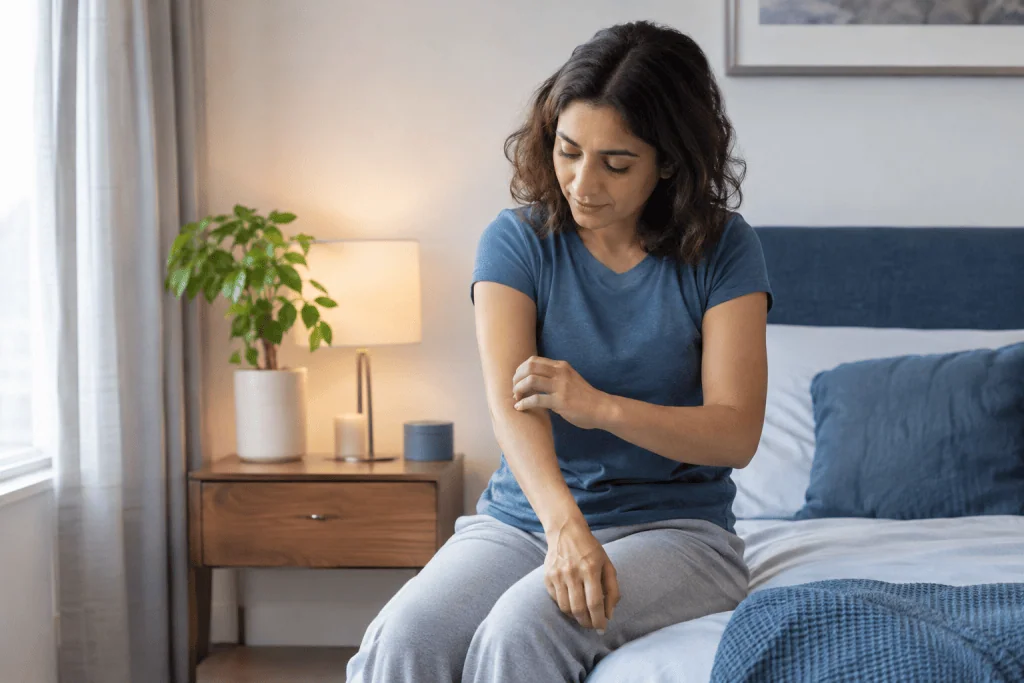
Then there is attention. In daylight, a mild itch competes with work, conversation and movement. In a dark, quiet bedroom it has no competition, and the brain’s itch pathways, which share wiring with pain pathways in the spinal cord, are more easily noticed. Clinicians who study the condition call this nocturnal pruritus; pruritus is simply the medical word for itch.
Scratching feeds the cycle. The nails damage the outer skin layer, the damage releases chemical messengers such as histamine, and those messengers trigger more itch. Many people scratch in their sleep without knowing, which explains waking up with raw patches and no memory of causing them. None of this is imagined, and none of it means something sinister. It means the night is an amplifier, and the signal it amplifies is what a clinician wants to identify.
Why am I itchy after a shower? Hot water, soap and the first few minutes
A shower should leave skin comfortable. When it leaves skin prickling, the usual explanation is that hot water and detergent have stripped away the thin film of natural oils, called the lipid barrier, that holds moisture in. As the water on the surface evaporates, the skin dries beyond its starting point and the nerve endings fire. This is why the itch often appears a few minutes after you step out, rather than under the water.
Temperature itself plays a part. Heat widens blood vessels and prompts the release of histamine, a chemical messenger involved in allergy and itch. Some people develop small, intensely itchy bumps whenever they get hot, whether from a shower, exercise or a heavy duvet; this is called cholinergic urticaria, a form of hives triggered by a rise in body temperature.
Products matter too. Fragranced shower gels, bubble bath and even laundry detergent left on towels can cause irritant or allergic contact dermatitis, an inflamed, itchy reaction where the product touched the skin.
Rarely, itch after any contact with water, with no rash and no obvious dryness, is a separate condition called aquagenic pruritus. It is uncommon, but because it is sometimes linked to disorders in which the bone marrow makes too many blood cells, a clinician will usually arrange a blood count if it persists. Those four possibilities, dryness, heat hives, contact reaction and true water-triggered itch, look alike for the first few minutes and are told apart by the history and by whether a rash appears.
Eczema, hives and other skin conditions that flare after dark
Atopic eczema, also called atopic dermatitis, is an inherited tendency for the skin barrier to leak moisture and overreact to irritants. The NHS notes that it affects about 1 in 5 children and often starts before the first birthday, although it can appear at any age and many adults carry it quietly into their twenties and beyond. Night is its worst hour: the evening dip in cortisol, warm bedding and unconscious scratching all combine, and disturbed sleep is one of the main ways eczema erodes quality of life. The Global Burden of Disease Study 2019 ranks skin conditions, with eczema prominent among them, among the leading non-fatal causes of disability worldwide.

Chronic hives, raised itchy wheals that come and go within hours, also tend to surface in the evening and may be triggered by heat, pressure from waistbands or, in many cases, nothing identifiable. Psoriasis produces thicker, scaly plaques that itch less fiercely than eczema but can still wake people. Fungal infections such as athlete’s foot or a yeast rash in skin folds itch more under warm covers.
What separates these from simple dryness is the presence of a primary rash: eczema’s rough red patches in the creases, the fleeting wheals of hives, the sharp-edged scaly plaques of psoriasis. A clinician looks at where the rash sits, what it feels like and how long each lesion lasts, and usually needs no tests to tell them apart. Treatment is condition-specific and decided with the prescribing clinician, which is why a correct label matters more than the strength of any cream.
Why is my bed making me itch all of a sudden?
When itch starts abruptly and only in bed, think of what changed. A new detergent, fabric softener or dryer sheet is the most common culprit; the residue sits against skin for eight hours a night and can cause irritant dermatitis on the back, buttocks and thighs. A new mattress, pillow or duvet can release chemical smells or shed fibers that irritate. Electric blankets and heavier winter bedding raise skin temperature, which, as the earlier sections explain, lowers the itch threshold.
House dust mites do not bite. They live in mattresses and pillows and their droppings are a potent allergen, but the usual reaction is sneezing, a blocked nose or worsening eczema rather than a bite mark. Bed bugs do bite, typically at night, and the bites are small red bumps often arranged in lines or clusters on skin left uncovered during sleep. Tiny dark spots on the sheets or mattress seams, and a faint sweet smell in heavy infestations, are the physical clues. Bed bugs are a nuisance rather than a health hazard; the CDC notes they are not known to spread disease.
Scabies is the third possibility and the one most often missed, because the mites are invisible to the naked eye and the itch is blamed on the bed rather than the person. The distinguishing feature is that the itch continues away from the bed, and that others in the household begin scratching too. Hot washing bedding, vacuuming the mattress and switching back to an unperfumed detergent settle most bed-related itch; if bites or burrows are visible, a clinician or pest professional needs to see them.
Scabies: why am I so itchy at night, and why is everyone at home scratching?
Scabies is an infestation by a microscopic mite that burrows into the outer layer of skin to lay eggs. The itch comes from an allergic reaction to the mites and their waste, not from the burrowing itself, and that reaction is famously worse at night. The World Health Organization estimates that about 200 million people are affected at any one time, so it is a common condition in every country, not a marker of poor hygiene or any particular lifestyle.
Timing is the clue that catches people out. According to the CDC, someone infested for the first time may not itch for 4–8 weeks, although they can pass mites on during that silent period; someone who has had scabies before reacts within 1–4 days. Spread needs prolonged skin-to-skin contact, the sort that happens between partners, parents and children, or carers and the people they look after. Brief handshakes rarely transmit it.
The rash is a mix of tiny red bumps and fine, wavy, thread-like burrows, classically between the fingers, on the wrists, around the waist, nipples and genitals, and along the sides of the feet. In infants and older adults the face and scalp may be involved. A clinician confirms it by examining the pattern and, where possible, scraping a burrow to find a mite or eggs under the microscope.
Two practical facts shape management. Mites survive only about 2–3 days away from human skin (CDC), so clothing and bedding used in the previous days are washed hot and dried hot, or sealed in a bag for at least 72 hours. And everyone in close contact is treated at the same time, whether or not they itch, otherwise the household simply reinfects itself. The NHS adds that itch can persist for several weeks after successful treatment while the allergic reaction fades, which does not mean treatment failed.
Itch with no rash: when the cause is inside the body
Skin that itches everywhere but shows nothing except scratch marks shifts a clinician’s attention inward. Both the NHS and MedlinePlus list a cluster of internal conditions that can present this way, and each tends to bring companions.
Chronic kidney disease causes itch because waste products build up in the blood and irritate nerve endings; it usually appears in advanced disease, often alongside tiredness, swollen ankles and changes in urine output. Liver and bile-duct problems cause itch when bile salts accumulate under the skin; the itch is classically worst at night and on the palms and soles, and may be joined by yellowing of the eyes or skin, pale stools and dark urine. In pregnancy, that same palm-and-sole night itch can signal a condition called intrahepatic cholestasis of pregnancy, which needs same-day assessment because it affects the baby.
An overactive thyroid warms the skin and speeds everything up; the itch comes with weight loss, a racing heart, tremor and heat intolerance. An underactive thyroid dries the skin and slows everything down. Iron deficiency anemia is a recognized cause, discussed in the next section. Some blood disorders, including lymphoma and polycythemia vera, can cause persistent itch, sometimes before any other sign; this is uncommon, but it is why whole-body itch lasting weeks is never dismissed.
Medicines deserve a specific mention. Opioid painkillers, some blood-pressure drugs, statins and certain antibiotics can cause itch, sometimes months after they were started. Nerve-related itch, such as the burning itch of shingles before the rash or the localized itch of a trapped spinal nerve, usually sits in one strip of skin. None of this calls for changing any prescription on your own; it calls for a conversation with the clinician who prescribed it.
What deficiency causes itchy skin at night?
This is one of the most searched questions on the topic, and the honest answer is narrower than the internet suggests. The one deficiency that appears in mainstream lists of itch causes, including the NHS and MedlinePlus pages on itchy skin, is iron deficiency. Low iron can produce a generalized itch without a rash, usually alongside the more familiar signs of anemia: tiredness, breathlessness on stairs, pale skin, brittle nails and sometimes a sore tongue or cravings for ice. The mechanism is not fully understood, but published series report that itch improves when iron stores are restored, which supports the link.
Beyond iron, the evidence thins out quickly. Vitamin D is often blamed because it is involved in skin cell turnover and immune signaling, and low levels are common in people with eczema, but a low level in the blood does not reliably cause itch and supplementing it has not been shown to settle itch in people who are not otherwise deficient. Vitamin B12 deficiency can cause tingling and numbness through nerve damage and is occasionally reported with itch, but that association rests on case reports rather than large studies. Zinc and essential fatty acid deficiencies cause dry, scaly skin when severe, which is rare outside malnutrition or malabsorption.
Two cautions follow. First, dry skin, not a missing nutrient, explains most night itch, so a tub of moisturizer is a more rational first step than a supplement. Second, blood tests for iron, thyroid, kidney and liver function are simple and routinely ordered for persistent itch, so the question is answered properly by a clinician rather than by guessing. Supplements taken without a confirmed deficiency can cause problems of their own, and the NIH Office of Dietary Supplements notes that iron in particular is harmful in excess.
What does diabetic itching feel like?
Diabetes earns a place on every list of itch causes, but the itch rarely arrives alone or feels special. It most often comes from dry skin: high blood glucose pulls water out of tissues and into the urine, leaving the skin dehydrated, flaky and tight, particularly on the lower legs and feet. People describe it as a persistent, crawling itch that is worse in the evening when socks come off and the skin warms.
Three other patterns are typical. Poor circulation to the lower legs, which develops over years, reduces oil production and makes shin skin shiny, hairless and itchy. Yeast and fungal infections thrive on sugar-rich skin and sweat, so an itchy red rash in skin folds, under the breasts, around the groin or between the toes is common and sometimes the first clue that glucose is running high. And diabetic nerve damage, called peripheral neuropathy, can produce itch mixed with burning, tingling or numbness in a stocking distribution on the feet, a sensation that does not respond to scratching because the fault is in the nerve rather than the skin.
What makes a clinician suspect diabetes rather than ordinary dryness is the company the itch keeps: unusual thirst, passing urine often including at night, blurred vision, slow-healing cuts, recurrent thrush or unexplained weight loss. The test is a straightforward blood sample measuring fasting glucose or HbA1c, which reflects average glucose over roughly the previous three months. Good glucose control, decided with the treating team, is the most effective thing for diabetes-related itch; the moisturizing measures in the next section help the skin while that happens.
How do I stop my skin from itching at night? What soothes it at home
Mainstream guidance from the NHS and MedlinePlus agrees on a short list of measures that work for the common causes and do no harm while a less common one is being investigated. Think of them as removing the amplifiers one by one.
- Wash cooler and shorter. Lukewarm rather than hot water, and a few minutes rather than twenty, protects the lipid barrier. Fragrance-free, soap-substitute cleansers remove sweat without stripping oils.
- Pat, do not rub, and moisturize while still damp. An unperfumed emollient applied within a few minutes of washing traps water in the skin; thicker ointments and creams hold more than thin lotions. Reapplying before bed targets the hours when skin loses the most moisture.
- Cool the bedroom and the bedding. Lighter covers, breathable cotton and a slightly cooler room lower skin temperature. A cool, damp cloth laid on an itchy area for a few minutes gives short-term relief that scratching cannot.
- Keep nails short and consider cotton gloves at night if you wake with scratch marks. Scratching damage is the single biggest driver of the itch-scratch cycle.
- Swap to a non-biological, fragrance-free laundry detergent and skip fabric softener for a few weeks to see whether the itch changes.
- Limit alcohol and spicy food in the evening; both widen skin blood vessels and warm the surface.
Over-the-counter antihistamines are often reached for, and the NHS notes they help some people with hives but do little for dry skin or eczema itch, where histamine is not the main messenger; older sedating types mainly help by aiding sleep. Anti-inflammatory creams, antifungals, scabies treatments and medicines for internal causes exist and work, but which one fits depends on the diagnosis, and that decision belongs to the clinician who examines you.
What people often get wrong about itching at night
The first mistake is a hotter, longer shower to scrub away the itch. It feels wonderful for ninety seconds, and then the skin is drier than before. Relief from heat is real but short-lived, because the same heat releases histamine and strips oils, and the rebound an hour later is worse.
The second is assuming scabies means dirt. It does not. The mite moves between people through ordinary skin contact and survives on scrupulously clean skin as happily as on any other. The shame attached to the word delays diagnosis, and delay is exactly what keeps it spreading through a family. The same neutrality applies to itch around the genitals, which is far more often a yeast infection, contact dermatitis or dry skin than anything sexually transmitted, and which deserves the same matter-of-fact examination as itch on the elbow.
The third is treating a supplement as a diagnosis. Night itch is rarely a deficiency, and taking iron, zinc or vitamin D on a hunch adds risk without answering the question a simple blood test would.
The fourth is the opposite error: assuming whole-body itch with no rash must be cancer because a search result mentioned lymphoma. Itch is a recognized but uncommon presentation of blood cancers, and in large clinical series the great majority of people with unexplained itch turn out to have dry skin, a medicine effect or a benign internal cause. The right response is a timely appointment, not a sleepless week.
Finally, people stop moisturizing the moment the itch eases. Dry skin and eczema are long-term tendencies; the routine that settled the itch is the routine that keeps it settled.
When to see a doctor, and what the appointment involves
Most night and shower itch can be managed at home for a couple of weeks while you cool the showers and moisturize. MedlinePlus advises seeing a clinician if itching is severe, lasts more than two weeks or keeps returning, or affects the whole body without an obvious cause. Seek care within days, rather than weeks, if the itch is spreading to other people in the household, if you can see burrows or bites, or if a new medicine was started shortly before it began.
Some signs need same-day assessment:
- Itch with yellowing of the skin or eyes, pale stools or dark urine
- Itch on the palms and soles during pregnancy, especially at night
- Itch with fever, drenching night sweats, unexplained weight loss or enlarged lymph nodes
- Itch with swelling of the lips, tongue or throat, wheeze or difficulty breathing, which is a medical emergency
- Scratched skin that has become hot, swollen, weeping or crusted, suggesting infection
- Itch that is destroying sleep or mood to the point of distress
The appointment itself is usually straightforward. The clinician asks when the itch started, where it is worst, what makes it better or worse, who else is affected and which medicines and supplements you take. They examine the whole skin in good light, looking for a primary rash, burrows, bites, scratch marks and signs of dryness, and check for enlarged glands and an enlarged liver or spleen. If there is no rash to explain things, blood tests typically cover a full blood count, iron stores, kidney and liver function, thyroid hormones and glucose; a skin scraping is taken when scabies or a fungal infection is suspected, and a small skin biopsy is reserved for rashes that do not fit any pattern. Referral to a dermatologist follows if the first round of tests and treatment leaves the question open.
Frequently asked questions
Why do I itch at night but feel fine during the day?
Because the night amplifies an itch that is present but masked by day. Cortisol falls to its lowest level around midnight, skin temperature and water loss rise under warm bedding, and a quiet room removes distraction. The underlying cause is usually dry skin or mild eczema, and the same measures that help those, cooler washing and regular moisturizing, usually reduce the night-time peak.
Why am I itchy after a shower but have no rash?
Most often because hot water and cleansers have stripped the skin’s natural oils, and the surface dries out as it evaporates. Cooler, shorter showers and moisturizing while the skin is still damp usually settle it. If itch follows every contact with water, with no dryness or rash, a clinician will consider a rarer condition called aquagenic pruritus and may check a blood count.
What deficiency causes itchy skin at night?
Iron deficiency is the recognized one; the NHS and MedlinePlus both list iron deficiency anemia as a cause of itch, typically with tiredness, breathlessness and pale skin. Evidence linking vitamin D, B12 or zinc to itch in otherwise healthy people is weak. A blood test confirms or excludes low iron; supplementing without a confirmed deficiency is not advised because excess iron is harmful.
What does diabetic itching feel like?
Usually like persistent dry-skin itch on the shins and feet, worse in the evening, sometimes with shiny, hairless skin from poor circulation. Fungal rashes in skin folds and a burning, tingling itch from nerve damage are the other patterns. What points to diabetes is the company: thirst, frequent urination, blurred vision and slow healing. A fasting glucose or HbA1c blood test settles it.
Why is my bed making me itch all of a sudden?
Look for what changed: a new detergent, fabric softener, mattress or heavier bedding are the usual culprits. Bed bugs leave bites in lines or clusters and dark spots on the sheets. If the itch continues away from bed and other household members start scratching, scabies is more likely than the bed itself, and a clinician should examine the skin that week.
How do I stop my skin from itching at night?
Remove the amplifiers: lukewarm, short showers; fragrance-free cleanser; unperfumed moisturizer applied within minutes of washing and again at bedtime; a cooler room and lighter covers; short nails; and a non-biological detergent. A cool damp cloth relieves a flare without the damage scratching causes. If this has not helped within two weeks, the cause needs identifying rather than more home measures.
Can itching at night be a sign of cancer?
Rarely. Persistent whole-body itch without a rash is a recognized but uncommon presentation of some blood cancers such as lymphoma, usually with night sweats, weight loss or enlarged glands. In most people with unexplained itch, the cause turns out to be dry skin, a medicine or a benign internal condition. The sensible response is a timely appointment with blood tests, not alarm.
Why is my itch worse at night during pregnancy?
Mild itch from stretching skin on the abdomen is common and harmless. Itch concentrated on the palms and soles, worst at night and without a rash, can signal intrahepatic cholestasis of pregnancy, in which bile salts build up in the blood. It needs same-day assessment with liver blood tests because it affects the baby, and the maternity team decides on monitoring and treatment.
Does scratching really make itching worse?
Yes. Nails damage the outer skin layer, which releases histamine and other messengers that trigger fresh itch, and repeated scratching thickens skin into leathery patches that itch on their own. Many people scratch during sleep without knowing. Short nails, cotton gloves at night and a cool compress during flares break the cycle more effectively than willpower alone.
How long does it take for itchy skin to settle once scabies is treated?
The itch can persist for several weeks after effective treatment, according to the NHS, because it is an allergic reaction to the mites and that reaction fades slowly even after the mites are dead. Persisting itch at two weeks does not mean failure; new burrows or spread to untreated contacts does, and both are reasons to return to the clinician.
References
- NHS: Itchy skin
- MedlinePlus Medical Encyclopedia: Itching
- CDC: About Scabies
- World Health Organization: Scabies fact sheet
This article is for general information only and is not a substitute for professional medical advice. Please consult a qualified doctor about your individual situation.
Add us as a Preferred Source to see more of our trusted health content across Google Search, AI Overviews and Discover.

More from the Blog
How Patch Testing Finds the Cause of Contact Dermatitis: What the Days of Testing Involve
Patch testing for contact dermatitis places small amounts of suspected allergens on the skin of the back under adhesive patches, usually for about 48…

How Long Does a Pimple Take to Go Away? The Usual Healing Timeline and What Slows It Down
Most ordinary pimples go away on their own within about a week, and even a sore red spot usually settles in one to two…

White Spots on Nails: What Causes Leukonychia, Common Myths and When to Have Nails Checked
White spots on nails, known as leukonychia, are most often the result of a minor knock to the nail base several weeks earlier, and…

Shingles and the Risk of Serious Complications: Can It Be Fatal and Who Is Most Vulnerable
Shingles is rarely fatal, but it can be in a small number of cases, almost always when the virus spreads to the brain, lungs…
How Rosacea Treatment Is Matched to Your Pattern: Flushing, Redness, Bumps and Thickened Skin
Rosacea treatment is matched to the features a person actually has rather than to the diagnosis alone. Flushing and persistent redness are managed with…

Itchy Armpits Without a Rash: Sweat, Shaving, Skin Products and Other Triggers
Itchy armpits without a rash are most often caused by sweat trapped in a warm fold, friction, shaving regrowth, dry skin, or irritation from…