Quick answer
Scabies is a contagious skin infestation caused by tiny mites that burrow into the skin, leading to intense itching and a rash. Treatment focuses on confirming the diagnosis, relieving symptoms, and eliminating the mites with prescription medications, while also addressing close contacts and hygiene measures to help prevent reinfestation.
What is scabies?
Scabies is a skin condition caused by a tiny mite called Sarcoptes scabiei. A mite is a very small creature, related to spiders and ticks, that is too small to see clearly with the naked eye. The female mite burrows into the top layer of the skin, where it lives, feeds, and lays eggs. The body reacts to the mites, their eggs, and their waste products with an allergic-type response, and this reaction is what causes the intense itching and rash that most people notice.
Understanding what is scabies helps take away much of the fear around it. Scabies is not caused by poor hygiene, and it is not a sign of an unclean home. It is an infestation, meaning a living organism has settled on the body, rather than an infection caused by bacteria or a virus. Anyone can get scabies: children, adults, and older people of every background. It spreads easily wherever people are in close, prolonged skin-to-skin contact, so it is often seen among family members living in the same household, between partners, in child-care settings, in nursing homes, and in other crowded living environments.
Scabies is common worldwide. It is classified in medical coding systems under ICD-10 code B86. Although it is uncomfortable and can be distressing, scabies is treatable, and most people recover fully once the mites are eliminated and the skin has had time to settle.
Symptoms of scabies
Scabies symptoms are mainly caused by the body’s allergic reaction to the mites rather than by the mites themselves. This is important, because it explains why symptoms may take time to appear and why itching can continue for a while even after successful treatment.
The most common scabies symptoms include:
- Intense itching, which is often worse at night or after a warm bath or shower.
- A rash of small red bumps, which may look like pimples, tiny blisters, or scaly patches.
- Burrow tracksthin, wavy, grayish or skin-colored lines on the skin surface, usually a few millimeters long, where a mite has tunneled. These can be hard to see, especially if the skin has been scratched.
- Sores and crusting from scratching, which can sometimes become infected with bacteria.
In adults and older children, the rash and burrows most often appear in certain typical areas: the webbing between the fingers, the wrists, the elbows, the armpits, around the waist, the buttocks, and the genital area. In women, the skin around the nipples may be affected. In men, the penis and scrotum are common sites. In infants and very young children, the pattern is often different, scabies may involve the scalp, face, palms of the hands, and soles of the feet, areas that are usually spared in adults.
The timing of symptoms depends on whether the person has had scabies before. In someone infested for the first time, itching and rash may not appear until several weeks after the mites arrive, because the immune system needs time to become sensitized. In someone who has had scabies previously, symptoms often appear much sooner, sometimes within a few days, because the body already recognizes the mites.
There is also a severe form called crusted scabies, sometimes known as Norwegian scabies. In this form, the skin develops thick crusts that contain very large numbers of mites. Crusted scabies mainly affects people with weakened immune systems, older adults, and people who cannot scratch or care for their skin normally, such as some people with disabilities or nerve conditions. Itching may be milder or even absent in crusted scabies, but the condition is far more contagious than ordinary scabies and needs prompt medical attention.
Causes and risk factors
Scabies causes come down to one thing: the transfer of the Sarcoptes scabiei mite from one person to another. In ordinary scabies, an affected person usually carries only a small number of mites, often around ten to fifteen adult female mites, yet even this small number is enough to cause intense symptoms and to pass the infestation on.
The main ways scabies spreads are:
- Prolonged skin-to-skin contact with a person who has scabies. Brief contact, such as a quick handshake, is much less likely to spread ordinary scabies. Sexual contact is a common route of transmission among adults.
- Close household contact, such as sharing a bed, holding a child for long periods, or caring for someone physically.
- Shared bedding, clothing, or towels, although this is a less common route for ordinary scabies because the mites do not survive long away from human skin, usually only a few days at normal room conditions. With crusted scabies, however, spread through bedding and the environment is a much greater concern because of the enormous number of mites involved.
Certain situations and groups carry a higher risk of catching or spreading scabies:
- Crowded living conditions, including dormitories, shelters, refugee camps, and prisons.
- Institutional settings such as nursing homes, long-term care facilities, and hospitals, where close physical care is routine.
- Households with an affected member, since close contact within families makes spread very likely.
- Young children and their caregivers, because of frequent close contact.
- People with weakened immune systems, including those with certain chronic illnesses or those taking medicines that suppress immunity, who are at higher risk of the crusted form.
It is worth repeating that scabies is not a hygiene problem. Washing frequently does not prevent infestation, because the mites live within the skin, not simply on its surface. Animals can carry their own types of mange mites, but these animal mites cannot complete their life cycle on humans; they may cause temporary itching but do not cause true, ongoing human scabies.
Diagnosis
Scabies diagnosis usually begins with a careful conversation and skin examination. A doctor will ask about the pattern and timing of the itching, especially whether it is worse at night, where the rash appears on the body, and whether anyone else in the household or close contacts have similar symptoms. Itching in several members of a household at the same time is a strong clue pointing toward scabies.
During the physical examination, the doctor looks for the typical rash distribution and, most importantly, for burrows. Because burrows are small and often disrupted by scratching, they can be difficult to find, and their absence does not rule out scabies.
To confirm the diagnosis, doctors may use one or more of the following approaches:
- Skin scraping and microscopy. The doctor gently scrapes the surface of a suspicious burrow or bump with a small blade and examines the material under a microscope. Finding a mite, mite eggs, or mite feces confirms scabies. Because there are usually very few mites on the body, a negative scraping does not exclude the condition.
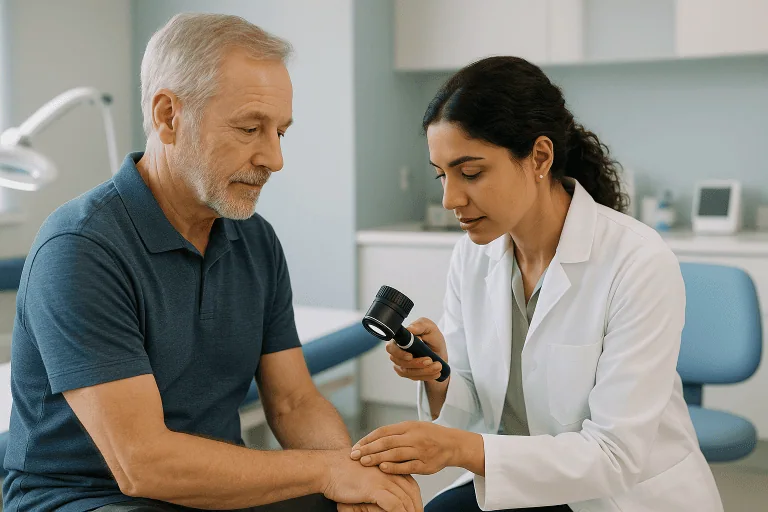
- Dermoscopy. A handheld magnifying device with a light, called a dermatoscope, is placed on the skin. It can sometimes reveal the mite at the end of a burrow, often described as a small dark triangular shape.
- The ink or burrow test. In some cases, ink is rubbed over a suspected area and then wiped away; ink that has seeped into a burrow leaves a visible dark line, making the burrow easier to see.
- Clinical judgment. When the history and examination strongly suggest scabies but a mite cannot be found, doctors may still make the diagnosis based on the overall picture, including whether close contacts are also itching. In many cases, improvement after appropriate treatment further supports the diagnosis.
No blood tests or imaging scans are needed to diagnose ordinary scabies. Because the rash can resemble other itchy skin conditions, such as eczema (an inflammatory skin condition), insect bites, allergic reactions, or certain infections: a specialist opinion is sometimes helpful when the diagnosis is uncertain. Skin conditions such as scabies are typically evaluated and managed by dermatology, the medical specialty focused on skin, hair, and nails.
Treatment options
Scabies treatment aims to kill the mites and their eggs, relieve symptoms, and prevent the infestation from spreading or coming back. Unlike some skin problems, scabies does not go away on its own, watchful waiting is not appropriate, because the mites continue to reproduce and the person remains contagious until treated. Medicines that kill mites are called scabicides, and they are available only by prescription.
Commonly used treatments include:
- Permethrin cream. A topical (applied to the skin) scabicide, widely considered a first-choice treatment for most adults and children. It is usually applied to the entire body from the neck down, and including the scalp and face in infants, as directed, left on for a set number of hours (often overnight), and then washed off. A second application is often recommended about a week later to kill mites that hatch from surviving eggs.
- Oral ivermectin. A tablet taken by mouth that kills mites. It is often used when creams are impractical, when topical treatment has not worked, in outbreaks affecting many people, and, usually combined with topical treatment, in crusted scabies. It is generally not recommended for very young children or during pregnancy unless a doctor decides otherwise; your doctor will advise on suitability.
- Other topical medicines. Depending on the country, the patient’s age, and individual circumstances, doctors may use alternatives such as benzyl benzoate lotion, sulfur-based ointments (often used in infants and pregnant women), or other prescription scabicides.
Killing the mites is only part of the plan. Doctors also usually recommend:
- Treating close contacts at the same time. All household members and recent intimate contacts are generally treated together, even if they have no symptoms, because symptoms can take weeks to appear and untreated contacts can re-infest the household.
- Managing the itch. Itching often continues for two to four weeks after successful treatment, because the allergic reaction in the skin takes time to calm down. This lingering itch does not necessarily mean the treatment failed. Doctors may suggest antihistamines (medicines that reduce allergic itching), soothing moisturizers, or short courses of mild steroid creams to ease symptoms.
- Treating complications. If scratching has led to a bacterial skin infection, signs include increasing pain, warmth, swelling, or pus, antibiotics may be needed.
- Environmental measures. On the day treatment starts, bedding, towels, and clothing used in the previous few days should be washed in hot water and dried on high heat, or sealed in a plastic bag for several days, since mites do not survive long away from human skin. Extensive fumigation of the home is not necessary for ordinary scabies.
Crusted scabies requires more intensive treatment, often combining repeated doses of oral ivermectin with topical scabicides and careful removal of crusts, usually under close medical supervision and sometimes in a hospital setting because of how contagious it is.
There is no role for surgery in treating scabies. If symptoms persist or return after a full course of treatment, it is important to see a doctor rather than repeat treatments on your own, since ongoing itching may reflect the normal post-treatment reaction, re-infestation from an untreated contact, incorrect application of the cream, or a different skin condition altogether. At hospital groups such as Acibadem, scabies and similar skin infestations are managed within the dermatology department.
Living with scabies and outlook
The outlook for scabies is generally very good. With correct treatment applied properly, most people are cured, and the skin heals over the following weeks. However, a few realities of living through a scabies episode are worth knowing.
First, itching commonly persists for several weeks after the mites are dead. This is expected and, in most cases, gradually fades. Second, scabies carries no lasting immunity, having had it once does not protect you from catching it again, so re-exposure to an untreated contact can start the cycle over. This is why simultaneous treatment of the whole household and close contacts is so strongly emphasized.
Some practical points for daily life during and after treatment:
- Avoid prolonged skin-to-skin contact with others until treatment is complete, following your doctor’s advice about when it is safe to return to work, school, or child care. In many settings, people can return the day after the first effective treatment.
- Try not to scratch, as broken skin can become infected. Keeping fingernails short and clean reduces this risk.
- Follow the medication instructions exactly, including reapplying the cream after washing hands if hand application is part of the regimen, and completing any recommended second treatment.
- Be open with close contacts. Scabies carries unnecessary stigma, but informing household members and recent partners allows them to be treated and prevents the infestation from bouncing back and forth.
Emotionally, scabies can be distressing: the itching disrupts sleep, and some people feel embarrassed. It may help to remember that scabies affects people of all ages and social circumstances and says nothing about a person’s cleanliness. Complications are uncommon when treatment is timely, though repeated scratching can occasionally lead to bacterial infections, and in some parts of the world untreated bacterial complications can have wider health consequences, which is one more reason to treat scabies promptly.
Frequently asked questions
What is scabies and how do you get it?
Scabies is an infestation of the skin by a microscopic mite that burrows into the top layer of skin and lays eggs, triggering an allergic reaction that causes intense itching and a bumpy rash. It spreads mainly through prolonged skin-to-skin contact with an affected person, which is why it often passes between family members, partners, and people living in close quarters. It is not caused by poor hygiene.
Can scabies go away on its own without treatment?
Ordinary scabies does not clear on its own. Without treatment, the mites continue to reproduce, symptoms usually persist or worsen, and the person remains contagious to others. Prescription scabicide medicines are needed to kill the mites and their eggs, and doctors generally recommend treating close contacts at the same time so the infestation does not return.
How serious is scabies?
For most people, scabies is uncomfortable rather than dangerous, and it responds well to treatment. However, intense scratching can break the skin and allow bacterial infections to develop, and the rare crusted form of scabies can be a serious problem, particularly for people with weakened immune systems. Prompt treatment keeps complications uncommon in most cases.
What do scabies symptoms look like in the early stage?
In a first infestation, symptoms may not appear for several weeks, because the immune system needs time to react to the mites. Early scabies symptoms often include itching that is worse at night and a rash of small red bumps, typically between the fingers, at the wrists, around the waist, or in the genital area. Fine, wavy burrow lines may be visible but are often hard to spot. In someone who has had scabies before, symptoms can appear within days of re-exposure.
How is scabies diagnosed by a doctor?
Doctors usually diagnose scabies based on the pattern of the rash, the character of the itching, and whether close contacts are also affected. To confirm it, they may take a gentle skin scraping and look for mites or eggs under a microscope, or examine the skin with a magnifying device called a dermatoscope. Because mites are few in number, tests can sometimes miss them, so doctors may still diagnose and treat scabies based on the overall clinical picture.
How long after scabies treatment does the itching stop?
Itching often continues for two to four weeks after successful treatment, because the skin’s allergic reaction takes time to settle even after the mites are dead. This lingering itch is expected and does not automatically mean the treatment failed. If itching is still severe more than about four weeks after treatment, or if new burrows or bumps appear, a doctor should re-examine the skin to check for re-infestation or another cause.
Do I need to treat my whole family if one person has scabies?
In most cases, yes. Doctors generally recommend that all household members and recent intimate contacts be treated at the same time as the affected person, even if they have no symptoms, because scabies can take weeks to cause itching and untreated contacts commonly re-infest the household. Bedding, towels, and recently worn clothing should also be washed in hot water and dried on high heat, or set aside in a sealed bag for several days.
When to see a doctor
You should see a doctor whenever you suspect scabies, for example, if you have new, intense itching that is worse at night, a bumpy rash in typical areas such as between the fingers or around the waist, or if a household member or close contact has been diagnosed with scabies. Only a doctor can confirm the diagnosis and prescribe the medicines needed to treat it.
Seek medical attention promptly if you notice any of the following warning signs:
- Signs of skin infectionincreasing redness, warmth, swelling, pain, pus, or yellow crusting around scratched areas.
- Fever or feeling generally unwell alongside an infected-looking rash.
- Red streaks spreading from a sore, which can indicate infection moving through the skin or lymph channels.
- Thick crusted or scaly patches on the skin, especially in an older person or someone with a weakened immune system, which may suggest crusted scabies.
- Symptoms in an infant or very young child, since scabies in babies can involve the face, scalp, palms, and soles and needs age-appropriate treatment chosen by a doctor.
- Symptoms that persist or return more than about four weeks after completing treatment, or new burrows appearing at any time after treatment.
- Severe itching that prevents sleep or significantly affects daily life despite treatment.
A doctor can distinguish scabies from other itchy skin conditions, confirm the diagnosis, and ensure that you, your household, and your close contacts receive the right treatment at the right time.
Medically reviewed by the Acıbadem International Medical Board September 2, 2026
See our medical review board →
Update history
- PublishedJune 14, 2026
- Medical review approvedSeptember 2, 2026
- Last content updateSeptember 2, 2026