

Kussmaul Breathing: What These Deep, Labored Breaths Tell Doctors

Key Takeaways
- Kussmaul breathing is the lungs' compensation for metabolic acidosis: exhaled carbon dioxide acts as an acid, so deep rapid breaths raise blood pH within minutes.
- Diabetic ketoacidosis is the most common cause, and acetone often gives the breath a fruity, nail-polish-remover smell that clinicians recognize instantly.
- Unlike Cheyne-Stokes breathing, Kussmaul respirations are continuous and regular with no pauses: a distinction observable at the bedside in seconds.
- The pattern is involuntary and cannot be calmed or coached away, because it is driven by pH sensors in the brainstem and carotid arteries, not by anxiety.
- Kussmaul breathing that slows while the person remains gravely ill often signals failing compensation, not improvement, and can precede respiratory arrest.
- In children, undiagnosed type 1 diabetes frequently masquerades as a stomach bug until deep labored breathing appears: a 'flu' with heavy breathing warrants a glucose check.
Quick Answer
Kussmaul breathing is a deep, rapid, labored breathing pattern that develops when the blood becomes dangerously acidic, most often from diabetic ketoacidosis or advanced kidney failure. The lungs work overtime to exhale carbon dioxide, which helps reduce that acidity. It is not a disease itself but an emergency signal, and anyone breathing this way needs urgent medical evaluation, usually in an emergency department.
Emergency nurses sometimes say they can hear it from the hallway before they see the patient: breathing so deep and deliberate it looks like someone sprinting up a hill, except the person is lying still in bed. Each breath is huge, hungry, almost mechanical. Nothing about it looks restful.
The pattern has a name, and a long history. In 1874, the German physician Adolf Kussmaul described this “air hunger” in patients slipping into diabetic coma, decades before anyone could measure blood acidity at the bedside. He noticed that the breathing itself told the story: the body was fighting a chemical battle, and the lungs had been drafted in.
That insight still holds. To a trained eye, this one breathing pattern narrows the diagnosis fast, which is why medical students memorize it and why it deserves a clear, honest explanation for the rest of us.
What is Kussmaul breathing?
Kussmaul breathing, clinicians often say Kussmaul respirations, is a distinctive pattern of very deep, fairly fast, effortful breaths that continue without pauses. It is not a disease. It is a compensation: the body’s attempt to correct severe metabolic acidosis, a state in which acid builds up in the blood faster than the kidneys can clear it.
Here is the core chemistry in one line: carbon dioxide dissolved in blood behaves like an acid, so exhaling more of it makes the blood less acidic. When acid accumulates, from ketones in uncontrolled diabetes, from waste products in kidney failure, from certain poisonings, sensors in the brainstem and in the carotid arteries detect the falling pH and order the lungs to ventilate harder. The result is breathing that looks like exercise without the exercise.
Two details matter. First, the pattern is involuntary. A person cannot simply calm down and stop it, because the drive comes from deep respiratory control centers, not from anxiety or habit. Second, the breathing usually evolves. Early, mild acidosis tends to produce breathing that is rapid but relatively shallow. As the acidosis deepens, breaths become slower, longer, and dramatically deeper: the classic Kussmaul breathing pattern. When a clinician sees that transition, it signals that the underlying problem is getting worse, not better, even though the respiratory rate may have technically come down.
What does Kussmaul breathing look and sound like?
Picture the breathing of someone who has just finished a hard 400-meter run: mouth open, chest and abdomen heaving, air moving in long, audible drafts. Now transplant that effort onto a person sitting quietly or lying in bed. That mismatch, marathon breathing at rest, is the visual signature.
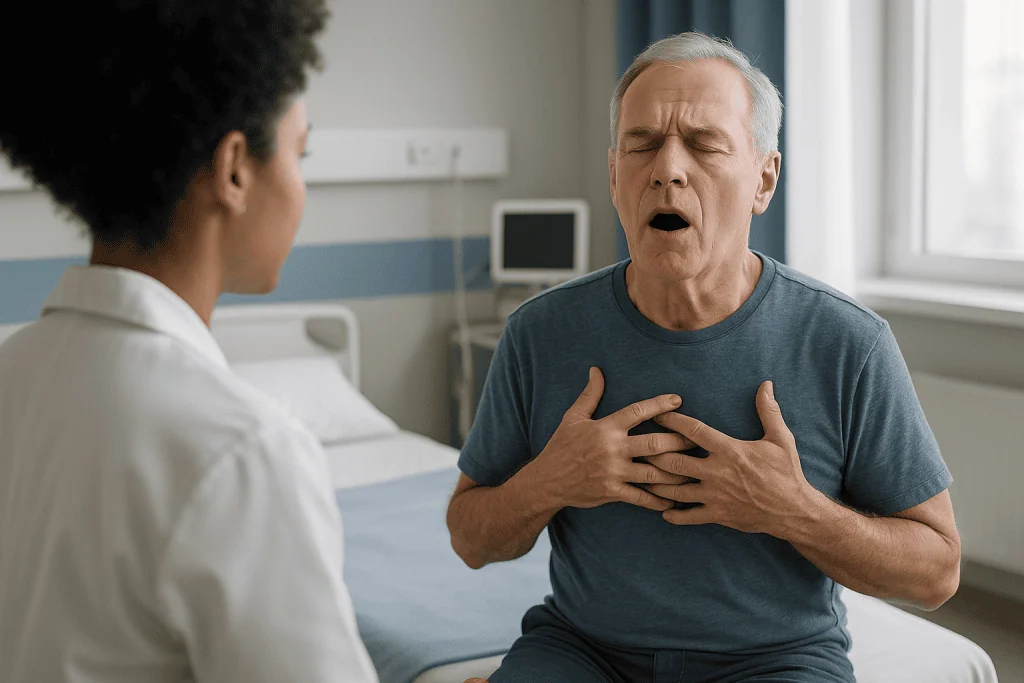
The sound is less rattling than heavy. There is typically no wheeze, no gurgle, no crackle; the airways themselves are usually clear. What you hear is sheer volume: forceful sighing inhalations followed by prolonged, almost groaning exhalations, repeated with unsettling regularity. Family members sometimes describe it as “panting in slow motion” or say the person seems unable to catch their breath no matter how hard they try.
In diabetic ketoacidosis, one more clue often rides along: a fruity or sweet chemical odor on the breath, similar to nail-polish remover. That smell comes from acetone, one of the ketones the body produces when it burns fat for fuel instead of glucose, and the lungs exhale it directly.
Other signs frequently keep company with the breathing itself, intense thirst, frequent urination, nausea or vomiting, belly pain, confusion, or profound fatigue. None of these is required for the diagnosis, but together they sharpen the picture. The breathing pattern alone, in a person who is ill, is enough reason to seek emergency care without waiting to see how the day goes.
Why does acid in the blood change how you breathe?
Blood pH is one of the most tightly guarded numbers in human physiology, normally held between 7.35 and 7.45. Drift much outside that band and proteins misfold, enzymes stall, and heart rhythm becomes unstable. The body defends this range with two main tools working on different clocks.
The kidneys are the slow, thorough tool. They excrete acid and regenerate bicarbonate: the blood’s principal chemical buffer, but they need hours to days to make a meaningful dent. The lungs are the fast tool. Because carbon dioxide acts as an acid in solution, changing how much you exhale changes blood pH within minutes.
So when metabolic acid floods in, chemoreceptors in the brainstem’s medulla and in the carotid bodies sense the falling pH and fire continuously. Their message to the respiratory muscles is blunt: ventilate more. The diaphragm and rib muscles respond by pulling in far larger breaths, far more often, dumping carbon dioxide with every cycle.
This is called respiratory compensation, and it genuinely works, up to a point. A person in early ketoacidosis can blow off enough carbon dioxide to hold their pH closer to normal than their acid load would predict. But compensation has a ceiling. The respiratory muscles fatigue, the acid keeps coming, and no amount of breathing can fix the underlying problem. That is why Kussmaul breathing is best understood as a countdown, not a cure: the body is buying time for treatment to arrive.
Why does DKA cause Kussmaul respirations?
Diabetic ketoacidosis, or DKA, is the textbook cause: the very condition Kussmaul described in 1874. It develops when the body lacks enough of the hormone that lets cells take in glucose. Starved of usable sugar despite plenty circulating in the blood, cells switch to burning fat, and the liver converts that fat into ketones for fuel.

Ketones keep the lights on, but they are acids. Produced in quantity, they overwhelm the blood’s bicarbonate buffer, and pH begins to fall. The brainstem’s chemoreceptors register the change and drive ventilation harder and harder. Kussmaul respirations are the visible endpoint of that chemical cascade.
DKA occurs most often in type 1 diabetes, though people with type 2 can develop it under stress. Common triggers include infection or other illness, missed diabetes medication, a malfunctioning insulin-delivery device, injury, surgery, or, sobering but common, undiagnosed diabetes announcing itself for the first time. In children and young adults, DKA is frequently the first clue that diabetes exists at all.
Blood glucose in DKA typically runs above 250 mg/dL, often much higher, and urine or blood testing shows abundant ketones. The full picture usually includes extreme thirst, frequent urination, nausea, abdominal pain, and that acetone-sweet breath. Kussmaul breathing arriving on top of those symptoms means the acidosis is significant, and it converts a bad day into an emergency-department visit, no glucose meter reading, however reassuring, should override that.
What else causes Kussmaul breathing?
Anything that pushes the blood toward severe metabolic acidosis can produce the same pattern, because the lungs respond to pH, not to the diagnosis. Clinicians keep a short mental list.
- Advanced kidney failure. Healthy kidneys excrete the acid a body generates daily. When they fail, acids and waste products accumulate, and breathing deepens to compensate.
- Lactic acidosis. Severe infection (sepsis), shock, or any state that starves tissues of oxygen forces cells into anaerobic metabolism, which produces lactic acid in bulk.
- Certain poisonings. Swallowing antifreeze ingredients or wood alcohol generates toxic acids as the body metabolizes them. Some medication overdoses can also acidify the blood. All are emergencies in their own right.
- Alcohol-related ketoacidosis. Heavy drinking combined with poor food intake can trigger ketone production similar to DKA, even in people without diabetes.
- Severe prolonged diarrhea. Less familiar, but sustained losses of bicarbonate-rich fluid can tip the balance, particularly in young children and frail older adults.
Notice what is not on the list: asthma, pneumonia, heart failure, panic attacks. Those cause breathlessness through entirely different mechanisms, and the breathing looks different, wheezy, wet, shallow, or irregular rather than deep, dry, and metronomic. That distinction is precisely what makes the Kussmaul breathing pattern so informative. When doctors recognize it, they stop hunting primarily in the lungs and start hunting in the blood chemistry.
Kussmaul vs. Cheyne-Stokes: what’s the difference?
These two patterns get confused constantly, partly because both carry nineteenth-century physicians’ names and both signal serious illness. Mechanically, they could hardly be more different. Kussmaul breathing is relentless and regular, deep breath after deep breath with no pauses, driven by acid in the blood. Cheyne-Stokes breathing is cyclical, breaths that swell from shallow to deep and back again, then stop entirely for seconds at a time before the cycle restarts, driven by an unstable feedback loop in the brain’s respiratory control.
| Feature | Kussmaul breathing | Cheyne-Stokes breathing |
|---|---|---|
| Rhythm | Steady, deep, continuous | Waxing and waning in cycles |
| Pauses in breathing | None | Apnea between cycles, sometimes 10–30+ seconds |
| Typical driver | Metabolic acidosis (DKA, kidney failure) | Heart failure, stroke, end of life, high altitude |
| Person’s awareness | Often awake, at least early on | Frequently asleep or with reduced consciousness |
| What it signals | Lungs compensating for blood acid | Brain’s breathing control oscillating |
The distinction matters at the bedside because it points investigations in opposite directions. Kussmaul vs Cheyne-Stokes is really a question of blood chemistry versus control-system failure. One sends the team for blood gases, glucose, and kidney tests; the other prompts a look at the heart and the brain. A pattern that pauses is not Kussmaul: that single observation, made in seconds, does real diagnostic work.
What is Cheyne-Stokes breathing?
Since so many readers land here comparing the two, Cheyne-Stokes deserves its own explanation. It is a crescendo-decrescendo pattern: breaths begin shallow, build steadily to a peak of depth and speed, fade back down, and then stop altogether. The pause, apnea, can last from a few seconds to half a minute or more. Then the cycle begins again, often repeating every 30 seconds to two minutes.
The mechanism is a delay problem. The brain adjusts breathing based on carbon dioxide levels it senses in arriving blood. When circulation is slow, most classically in heart failure, that feedback arrives late, and the system overshoots in both directions, like a shower whose temperature you keep overcorrecting. Damage to the brain’s control centers from stroke or other neurological injury can produce the same oscillation. Healthy people sometimes show a mild version during sleep at high altitude.
Cheyne-Stokes is also common in the final days of life, which is where many families first encounter it. In that setting it usually does not cause the dying person distress, though it can be hard to watch; hospice teams routinely coach families through it.
The practical takeaway: new Cheyne-Stokes breathing in someone not known to be dying warrants medical evaluation, because it may point to heart or neurological disease that can be addressed. But it is a different signal from Kussmaul breathing, and lumping them together muddies both.
Is Kussmaul breathing the same as hyperventilation from anxiety?
No, and the difference is worth understanding, because the two can superficially resemble each other and lead to dangerous misreadings in both directions.
Anxiety-driven hyperventilation starts in the mind’s alarm system. Breathing becomes rapid and typically shallow, blowing off carbon dioxide the body did not need to lose. Blood pH actually rises, which is why panic hyperventilation produces tingling lips and fingers, lightheadedness, and a feeling of unreality. Slowing the breath, through reassurance, paced breathing, grounding techniques, genuinely helps, because the breathing itself is the problem.
Kussmaul breathing starts in the blood. The deep, driven breaths are the correct physiological response to real acid, and they cannot be coached away. Ask a person in ketoacidosis to slow their breathing and they either cannot comply or feel dramatically worse when they try, because their body needs every exhaled molecule of carbon dioxide.
A few bedside distinctions help sort them out. Kussmaul breaths are strikingly deep, not just fast. The person usually has other signs of illness, thirst, vomiting, confusion, fruity breath, a known history of diabetes or kidney disease. Panic tends to arrive in waves with an emotional trigger and eases within minutes to an hour; Kussmaul breathing grinds on steadily and worsens over hours.
The stakes of confusing them are asymmetric. Treating acidosis as a panic attack delays emergency care. When in doubt, especially in anyone with diabetes, a glucose and ketone check, or an emergency visit, settles the question far more safely than guessing.
How do doctors diagnose the cause of Kussmaul breathing?
Recognition happens in seconds; confirmation happens in the lab. The workup is fast, standardized, and aimed at one question, what acid, from where?
The cornerstone is a blood gas measurement, drawn from an artery or vein, which reports pH directly along with carbon dioxide and bicarbonate levels. The classic Kussmaul signature is low pH, low bicarbonate (the buffer has been consumed), and low carbon dioxide (the lungs are compensating hard). That trio confirms metabolic acidosis with respiratory compensation in a single test.
Next comes the hunt for the specific acid:
- Glucose and ketones in blood and urine point toward diabetic ketoacidosis: the most common answer.
- Kidney function tests (creatinine, urea) reveal whether failing kidneys are letting acid accumulate.
- Lactate levels flag sepsis, shock, or oxygen-starved tissue.
- The anion gap, calculated from routine electrolytes, tells clinicians whether an unmeasured acid, ketones, lactate, or a toxin, is hiding in the blood.
- Toxicology screens follow when the history suggests a possible ingestion.
Alongside the labs, clinicians check electrolytes such as potassium, which acidosis shifts in ways that can disturb heart rhythm, and often run an electrocardiogram for the same reason. A chest X-ray or infection workup may follow if a trigger like pneumonia is suspected.
Most of this resolves within an hour in a functioning emergency department. Speed matters, because every cause on the list is treatable, and every one worsens with delay.
Is Kussmaul breathing itself dangerous?
Here is a distinction that surprises people: the breathing is the helpful part. Those enormous breaths are the body’s most effective short-term defense against acidosis, holding blood pH in survivable territory while the underlying problem rages. In that narrow sense, Kussmaul breathing is protective: a well-designed emergency system doing its job.
The danger lives in what the breathing represents and in what happens when it fails. Severe metabolic acidosis strains nearly every organ system: it weakens the heart’s contractions, predisposes to dangerous rhythm disturbances, shifts potassium in and out of cells unpredictably, and clouds consciousness. The respiratory effort itself is exhausting, sustaining that workload is like being forced to exercise for hours without rest, and respiratory muscles eventually tire.
Clinicians watch for one particularly ominous transition: Kussmaul breathing that slows and becomes shallow while the patient remains gravely ill. Untrained observers sometimes read this as improvement. It usually is not. It often means the compensation is collapsing, the muscles can no longer keep pace, and blood pH is about to fall steeply. Fading Kussmaul respirations in a still-sick patient can precede respiratory arrest.
This is also why no one should ever try to suppress the pattern, no breathing into bags, no coaching someone to slow down, no sedating remedies. The treatment target is the acid, never the breathing. Fix the chemistry, and the deep breaths quiet on their own, which is exactly how clinicians know their treatment is working.
When should you see a doctor or call 911?
Kussmaul breathing is not a wait-and-see symptom. Every condition that causes it can deteriorate within hours, and the pattern itself means compensation is already running near its limits.
Call 911 or go to the nearest emergency department immediately if someone has deep, labored, continuous breathing at rest, especially together with any of the following:
- Known diabetes, or symptoms suggesting it, extreme thirst, frequent urination, unexplained weight loss
- Fruity or chemical-smelling breath
- Vomiting, abdominal pain, or inability to keep fluids down
- Confusion, unusual drowsiness, or difficulty staying awake
- Known kidney disease, especially with missed dialysis sessions
- Any possibility of swallowing antifreeze, wood alcohol, or an overdose of medication
For people with diabetes, act earlier than the breathing stage. Check blood glucose and ketones during any illness, persistent vomiting, or unexplained malaise. Moderate or high ketones with elevated glucose warrant urgent medical contact even if breathing still feels normal: DKA caught before Kussmaul respirations appear is far easier to treat.
Two more scenarios deserve a same-day call to a doctor rather than watchful waiting: breathing that seems progressively deeper and more effortful over hours without an obvious explanation, and any dramatic breathing change in a child, who can slide into ketoacidosis faster than adults. Children with undiagnosed type 1 diabetes are frequently mistaken as having a stomach bug or the flu until the breathing changes; if a “stomach bug” comes with heavy breathing and deep fatigue, insist on a glucose check.
How is Kussmaul breathing treated?
By treating everything except the breathing. That sounds paradoxical until you remember the mechanism: the deep respirations are compensation, and they resolve on their own once the blood’s acid burden falls. Care therefore targets the cause, almost always in a hospital.
For diabetic ketoacidosis, treatment rests on three coordinated pillars. Intravenous fluids restore the liters of volume lost through excessive urination. Careful electrolyte replacement, potassium above all, protects the heart while the chemistry shifts. And hormone therapy allows cells to resume using glucose, which switches off ketone production at the source. Teams recheck glucose, electrolytes, and blood gases every one to two hours, adjusting continuously; done well, most DKA episodes turn the corner within 24 to 48 hours.
Other causes call for other tools. Advanced kidney failure may require dialysis to remove accumulated acid and waste directly. Sepsis and shock demand fluids, infection treatment, and support for blood pressure so tissues stop producing lactic acid. Toxic ingestions have specific antidotes and sometimes dialysis. Whatever the cause, clinicians treat the fire, not the smoke alarm.
Recovery has a satisfying visible marker: as pH climbs back toward normal, the breathing softens breath by breath. Families often notice it before the monitors announce it. What follows matters just as much, understanding why the episode happened, whether that means a new diabetes diagnosis, an adjusted sick-day plan, or closer kidney follow-up, because the best treatment for the next episode is preventing it.
Does Kussmaul breathing happen at the end of life?
Sometimes, yes, and families sitting vigil deserve a straight answer about what they may see and hear.
In the final days of life, breathing patterns commonly change as organ systems wind down. When failing kidneys, failing circulation, or overwhelming illness allow acid to accumulate, a dying person may develop deep, labored, Kussmaul-type respirations. More often, though, families witness Cheyne-Stokes breathing, the cyclical swelling and fading of breaths with long pauses, or irregular gasping patterns. It is common for several patterns to alternate over hours.
Two points offer genuine comfort, and both are supported by hospice and palliative care experience. First, these breathing changes are typically far more distressing to watch than to experience. As consciousness fades near death, the sensation of breathlessness usually fades with it; the body is running an automatic program, not struggling in the way it appears. Second, comfort can be actively supported, repositioning, mouth care, a calm presence, and medications a hospice team can provide if any distress does appear.
Context changes everything here. In a person receiving hospice care whose death is expected, changed breathing is part of a natural process and generally calls for comfort measures rather than an ambulance. In anyone else, the same pattern is an emergency demanding immediate care. If you are unsure which situation you are in, and many families genuinely are, call the hospice team if one is involved, or emergency services if not. Neither call is ever the wrong one to make.
Can Kussmaul breathing be prevented?
Not directly, but the conditions that produce it often can be, and this is where the practical power lies for readers rather than clinicians.
For people with diabetes, prevention has a name: the sick-day plan. Illness, infection, and stress push glucose and ketones upward even when eating stops, so the cardinal rule is never to skip diabetes medication during sickness without medical advice. Check glucose more frequently when unwell, every three to four hours is a common recommendation, and test for ketones whenever glucose runs high or vomiting begins. Keep drinking fluids. Know in advance which ketone level triggers a call to your care team, and have that number handy before you need it. Users of insulin-delivery devices should also know the backup plan for a device failure, since interrupted delivery can start ketone production within hours.
For people with chronic kidney disease, prevention means consistency: keeping dialysis and nephrology appointments, following dietary guidance, and reporting new fatigue, confusion, or breathing changes promptly rather than attributing them to a bad week.
For everyone else, the list is short but real. Store antifreeze and solvent products locked away from children, who are drawn to their sweet taste. Seek help for heavy alcohol use, particularly when combined with poor eating. And take unexplained deep, driven breathing seriously in yourself or anyone else: the entire value of recognizing this pattern is that it buys time, and time is the one resource every cause of Kussmaul breathing steadily consumes.
Frequently asked questions
What is the difference between Kussmaul and Cheyne-Stokes breathing?
Kussmaul breathing is continuous, deep, and regular with no pauses, driven by acid buildup in the blood from conditions like diabetic ketoacidosis or kidney failure. Cheyne-Stokes breathing is cyclical: breaths grow deeper, then shallower, then stop entirely for seconds before restarting, and it stems from unstable breathing control in the brain, typically with heart failure, stroke, or near the end of life. A pattern that pauses is not Kussmaul.
What does Kussmaul breathing sound like?
It sounds like heavy exercise breathing in a person at rest, long, forceful, audible inhalations followed by prolonged sighing exhalations, repeated steadily without pauses. There is usually no wheezing, gurgling, or rattling because the airways themselves are clear; the striking feature is sheer air volume. In diabetic ketoacidosis, the breath may also carry a fruity or nail-polish-remover odor from exhaled acetone.
Why does DKA cause Kussmaul respirations?
In diabetic ketoacidosis, cells cannot use glucose for fuel, so the liver burns fat and produces ketones, which are acids. As ketones accumulate, blood pH falls. Sensors in the brainstem and carotid arteries detect the acidity and drive the lungs to exhale more carbon dioxide, which behaves as an acid in blood. The resulting deep, rapid, labored breathing is the body’s fastest available tool for raising pH back toward normal.
What is Cheyne-Stokes breathing?
Cheyne-Stokes breathing is a cyclical pattern in which breaths build from shallow to deep, fade back down, and then stop completely for several seconds to half a minute before the cycle repeats. It results from delayed feedback in the brain’s breathing control, most often due to heart failure or stroke, and is also common in the final days of life. New Cheyne-Stokes breathing in someone not near death warrants medical evaluation.
Can anxiety cause Kussmaul breathing?
No. Anxiety causes hyperventilation, which is typically rapid and shallow, blows off carbon dioxide the body did not need to lose, and improves with paced breathing and reassurance. Kussmaul breathing is dramatically deep, driven by real acid in the blood, and cannot be coached away, slowing it makes the person feel worse. Mistaking acidosis for a panic attack delays emergency care, so when in doubt, especially in someone with diabetes, seek urgent evaluation.
Is Kussmaul breathing painful?
The breathing itself is usually not painful, but it is exhausting, sustaining it is like being forced to exercise for hours without rest. People often describe air hunger, profound fatigue, and sore chest and abdominal muscles from the effort. Discomfort more commonly comes from the underlying illness: nausea, abdominal pain, and headache are frequent in ketoacidosis. As treatment corrects the blood’s acidity, the breathing quiets and the effort eases.
Can children have Kussmaul breathing?
Yes, and it deserves special vigilance. Children with undiagnosed type 1 diabetes can develop ketoacidosis quickly, and their illness is often mistaken for a stomach virus or flu, vomiting, belly pain, tiredness, until deep, labored breathing appears. A child breathing heavily at rest, especially with excessive thirst, frequent urination, or fruity-smelling breath, needs emergency evaluation and a blood glucose check immediately rather than watchful waiting at home.
Does Kussmaul breathing go away on its own?
No, and apparent improvement without treatment can be a danger sign. The breathing resolves only when the underlying acidosis is corrected, which requires hospital care. If deep breathing becomes slower and shallower while the person remains gravely ill, it often means the respiratory muscles are failing and compensation is collapsing, which can precede respiratory arrest. Genuine recovery comes with treatment: as blood pH normalizes, the breathing softens noticeably, breath by breath.
What blood tests confirm the cause of Kussmaul breathing?
A blood gas measurement is the cornerstone, showing low pH, low bicarbonate, and low carbon dioxide: the signature of metabolic acidosis with respiratory compensation. Clinicians then test glucose and ketones for diabetic ketoacidosis, creatinine and urea for kidney failure, and lactate for sepsis or shock, and calculate the anion gap from routine electrolytes to detect hidden acids, including toxins. Most of these results return within an hour in an emergency department.
Is Kussmaul breathing a sign of dying?
Context determines the answer. In someone receiving hospice care whose death is expected, deep or irregular breathing patterns, including Kussmaul-type and Cheyne-Stokes breathing, are common in the final days and are usually more distressing to witness than to experience. In anyone else, Kussmaul breathing signals a treatable emergency such as diabetic ketoacidosis or kidney failure, and prompt hospital care very often reverses it. If you are unsure which situation applies, call the hospice team or emergency services.
References
This article is for general information only and is not a substitute for professional medical advice. Please consult a qualified doctor about your individual situation.

More from the Blog

Collapsed Lung (Pneumothorax): How Urgent It Is and What Happens Next
A collapsed lung is not one condition with one clock. A small spontaneous pneumothorax in an otherwise healthy person often heals on its own…

Always-Cold Hands: Circulation, Thermoregulation and When to Check
Hands that are always cold usually reflect normal thermoregulation: when your core cools or you feel stress, small arteries in the fingers narrow to…

Chills Without Fever: What Your Body Might Be Signaling
Chills without a fever usually mean the body is losing heat or reacting to signals that mimic cold. Common causes include cold exposure, anxiety,…

How to Tell If You Have Appendicitis, and Whether It Can Go Away on Its Own
Appendicitis usually begins as a dull ache around the belly button that, over several hours, sharpens and settles in the lower right abdomen, often…

Food Poisoning Symptoms: The Timeline by Culprit and When It Is Serious
Food poisoning symptoms, nausea, vomiting, stomach cramps, diarrhea, and sometimes fever, usually begin between 30 minutes and 3 days after eating contaminated food, depending…

Heat Exhaustion vs Heat Stroke: The Difference That Saves Lives
Heat exhaustion causes heavy sweating, clammy skin, dizziness, nausea, and weakness, but the person still thinks clearly. Heat stroke is a medical emergency: body…