

Leg Stiffness That Keeps Progressing: When a Neurologist Considers an HSP Evaluation

Key Takeaways
- Hereditary spastic paraplegia affects the longest nerve fibers in the corticospinal tract first, which is why the legs stiffen while the hands are usually spared.
- Steady progression over months to years, rather than fluctuating stiffness, is the main trigger for a neurology referral.
- More than 80 genetic types of HSP have been identified, and the SPG4 type accounts for roughly 40 percent of autosomal dominant cases.
- A normal MRI does not exclude HSP; its main role is to rule out treatable mimics such as spinal cord compression or vitamin B12 deficiency.
- Genetic testing can return a disease-causing variant, a variant of uncertain significance, or no finding, and a negative result does not rule HSP out.
- Sudden weakness, new loss of bladder control or saddle numbness are emergencies that point away from HSP's slow course and require same-day care.
Hereditary spastic paraplegia (HSP) is a group of inherited conditions in which leg stiffness and weakness slowly worsen over years. A neurologist referral is usually considered when leg stiffness progresses rather than fluctuates, when a relative has had similar walking problems, or when stiffness appears alongside bladder changes, falls or balance loss. Diagnosis combines a neurological examination, MRI to exclude other causes, and genetic testing; the treating team makes every decision.
The first clue is often the shoes. A heel worn down unevenly, the toe of a trainer scuffed from catching the ground, a sense that the feet are landing before the brain has finished telling them where to go. Many people notice the shoes long before they notice their legs.
Then come the small adjustments. Holding the rail on stairs. Standing up in two stages instead of one. A partner mentions that the walk looks different, a little stiff-legged, as though the knees have forgotten how to swing. Months pass, and the stiffness does not pass with them.
If that pattern sounds familiar, the question that eventually surfaces is the one in this article: with HSP, when to see a neurologist, and what will happen when you do. The honest answer is that progression itself, more than any single symptom, is what prompts a specialist evaluation. This explainer walks through why, what the appointment involves, and which signs should never be left to wait.
First, which HSP are we talking about?
Two very different conditions share the same three letters, and search results mix them freely. Hereditary spastic paraplegia (HSP) is a group of inherited disorders that gradually stiffen and weaken the legs. Henoch-Schönlein purpura, now called IgA vasculitis, is an inflammation of small blood vessels that most often affects children between the ages of 2 and 6 and shows up as a purplish rash, joint pain and tummy pain, according to Mayo Clinic.
This article is about the first one, the neurological HSP. The second is covered briefly in the FAQs, because people searching for “HSP purpura” land here too, and the two should never be confused at a clinic desk.
Why does the distinction matter so much? Because the pathways are different. A child with a purple rash and swollen ankles needs a pediatrician or urgent care, sometimes the same day. An adult whose legs have been slowly tightening over two or three years needs a neurologist, usually through a routine referral. Mixing the two leads to either unnecessary alarm or unnecessary delay.
A plain-language definition helps anchor the rest. Spastic means the muscles are abnormally tight because the nerve signals that normally relax them are weakened. Paraplegia, in this context, means the problem affects mainly the legs. Hereditary means a change in a gene is responsible, even when no one else in the family has an obvious diagnosis, since a new change can appear for the first time in one person.
The National Institute of Neurological Disorders and Stroke (NINDS), part of the NIH, describes HSP as a group rather than a single disease because more than 80 genetic types have been identified so far, each with its own gene and sometimes its own pattern of extra features. That variety is one reason diagnosis can take time, and it is also why a careful specialist assessment matters more than any online quiz.
What actually happens in the nervous system with hereditary spastic paraplegia
Picture the nerve fibers that carry movement commands from the brain to the legs as very long cables. They start in the motor cortex at the top of the brain, run down through the brainstem, and travel the full length of the spinal cord before handing off to nerves that reach the thigh and calf muscles. This bundle is called the corticospinal tract, which is simply the medical name for that command cable.
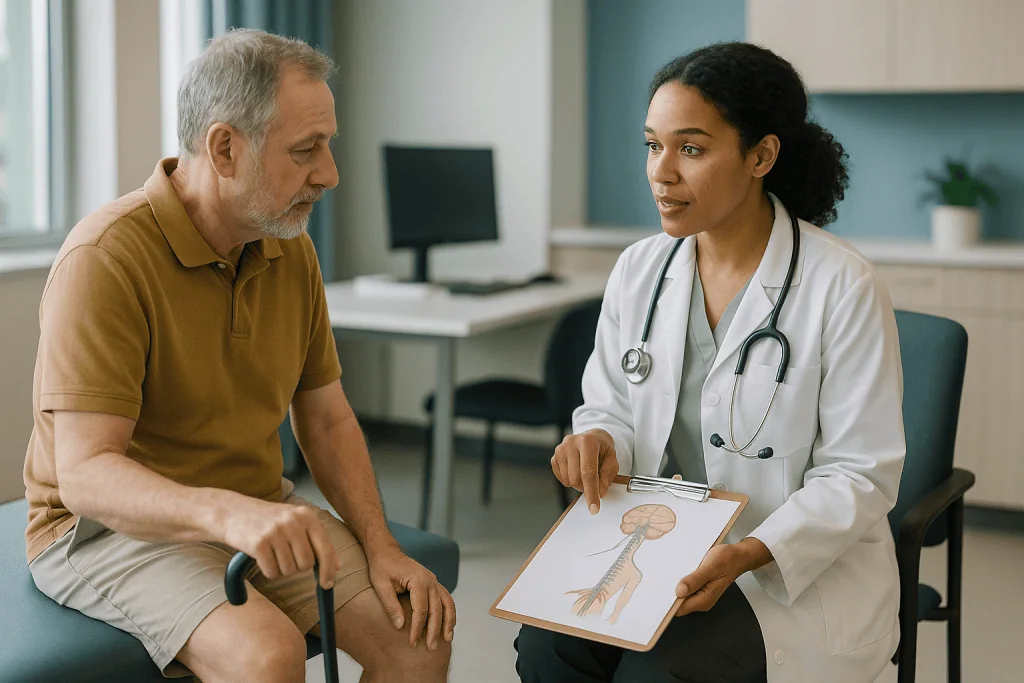
In HSP, the longest of these cables degenerate from their far ends backward. The NIH-hosted GeneReviews overview describes this as a length-dependent axonopathy: the tips of the longest nerve fibers, which reach the lower spinal cord and serve the legs, are affected first and most. The fibers to the arms are shorter and are usually spared or affected only mildly, which is why HSP so characteristically troubles the legs while leaving the hands able to type and button a shirt.
The result is a double problem. Weakness appears because fewer movement commands arrive. Spasticity appears because the same tract normally also sends calming signals that keep reflexes in check; when those signals fade, muscles become tight, reflexes become brisk, and the legs can feel like they are resisting the person who owns them.
Different HSP genes disrupt different housekeeping jobs inside these long cells. Some affect how the cell shapes its internal membranes, others how it transports cargo along its length, others how it manages energy. The most common type, known as SPG4 and caused by changes in the SPAST gene, accounts for roughly 40 percent of autosomal dominant HSP according to GeneReviews. Autosomal dominant means a single altered copy of the gene, inherited from one parent, is enough to cause the condition.
None of this damage happens overnight. The slow retreat of nerve endings is why the story is one of gradual change, and why that gradual quality is itself a diagnostic clue.
Early signs of HSP in adults: how the stiffness usually declares itself
Textbooks list symptoms. Real life offers hints. The NHS describes the typical early picture as stiffness and weakness in the legs that develops slowly, often with a tendency to trip, difficulty walking, and in some people an urgent or frequent need to pass urine.
In practice, adults often describe these things first:
- Toes catching on carpet edges or uneven paving, because the foot does not lift cleanly.
- Legs that feel heavy or tight after sitting, easing a little once walking starts.
- A stiff, slightly scissoring gait, where the knees seem to brush past each other.
- Calf or thigh cramps at night that were never a problem before.
- Needing to plan toilet stops more carefully than other people the same age.
Age at onset varies enormously. GeneReviews notes that symptoms can begin anywhere from early childhood to late adulthood, and that even within one family the age of onset and the severity can differ. A parent who needed a cane at 60 may have a child whose stiffness begins at 25, or the reverse.
Two features deserve emphasis because they shape the referral decision. The first is symmetry: HSP usually affects both legs fairly evenly, although one side may lead slightly. A markedly one-sided problem points the clinician toward other diagnoses. The second is the course. HSP progresses, but it does so steadily rather than in attacks and recoveries. Someone who had a bad month, improved, then relapsed is describing a different pattern that a neurologist will want to investigate on its own terms.
Sensation is often normal or only mildly altered in the feet. Pain is not usually the headline, although tight muscles can ache. If numbness, burning or electric-shock sensations dominate, the examination will look carefully for other explanations alongside HSP.
HSP: when to see a neurologist, and why progression is the deciding factor
Here is the opinion this article holds, grounded in how specialists actually triage: the single most useful question is not “how stiff are my legs?” but “are they stiffer than they were a year ago?” Progression is the hinge on which the whole referral decision turns.

Plenty of things make legs stiff for a while. A back strain, a long illness, deconditioning after surgery, even a change of job that means standing all day. These settle. Stiffness that has quietly advanced over 12 months or more, without a clear injury to explain it, is a different category and deserves a neurological opinion.
Family doctors and general practitioners usually consider a referral when one or more of the following apply:
- Leg stiffness or weakness that has worsened steadily over months to years.
- Repeated trips or falls with no orthopedic cause found.
- A relative, at any age, who developed a stiff-legged walk, used a cane or wheelchair for unexplained reasons, or was told they had a “spinal” or “nerve” condition.
- New urinary urgency or frequency alongside the stiffness.
- Brisk reflexes or other upper motor neuron signs noticed during a routine examination.
The term upper motor neuron sign simply means a physical finding, such as an exaggerated knee jerk or a toe that curls upward when the sole is stroked, that points to the command cable rather than the muscles or peripheral nerves.
Timing matters in a practical way too. The NHS points out that HSP can be mistaken for other conditions, and that getting an accurate diagnosis helps ensure the right support. Earlier evaluation does not change the underlying genetics, but it does mean physiotherapy, bladder care and family counseling start sooner, and it avoids years of treatment for a wrong label.
If you are unsure whether your stiffness counts as progressive, write down what you could do a year ago that you cannot do as easily now. That one sentence often tells the referring clinician more than any scan.
Who is usually referred quickly, and who is usually asked to watch and wait
Not everyone with stiff legs is sent to a neurologist that week, and that is appropriate. Referral pathways sort people by the likelihood of a neurological cause and by how fast the picture is changing.
Usually referred promptly:
- Adults with progressive bilateral leg stiffness and a family history of similar problems.
- Anyone whose examination shows clear upper motor neuron signs.
- People with stiffness plus bladder or bowel changes, since the spinal cord is a shared route for both.
- Children whose walking milestones were reached but then deteriorated, or who develop toe-walking that worsens rather than resolves.
- Anyone whose stiffness is accompanied by features such as vision changes, speech changes, cognitive difficulty or seizures, which could indicate a complicated form of HSP or an entirely different condition.
Usually asked to watch, with a review date:
- People with recent-onset stiffness after an identifiable trigger such as a fall, prolonged bed rest or a new intensive exercise program.
- Those whose symptoms fluctuate day to day and have not worsened over a defined interval.
- People with one-sided calf tightness and a musculoskeletal explanation on examination.
Watching is not the same as dismissing. A sensible plan includes a time frame, often a few months, and a clear statement of what would bring the appointment forward. If the agreed review passes and the stiffness has advanced, the threshold for referral has been met.
There is a middle group as well: adults in their 50s and 60s whose walking has slowed and who assume it is simply age. Ordinary aging slows gait but does not produce the brisk reflexes, scissoring or toe-catching typical of spasticity. A primary care examination can usually tell the difference in ten minutes, and that examination is worth asking for.
The decision to refer, and its urgency, always rests with the clinician who has examined you. This article can only describe the usual thresholds.
What a neurologist actually checks at the first visit
The first appointment is mostly conversation and observation. Expect to be watched walking down a corridor, turning, standing on your heels and toes, and possibly climbing a step. Gait tells a trained observer a great deal before any instrument is picked up.
The history will go deep. When did you first notice anything? Has it changed? Were there periods of improvement? Any bladder changes, back pain, visual symptoms, numbness? Then comes the family tree, drawn out in detail across at least three generations. The neurologist may ask about relatives who were described as “clumsy” or who walked with a limp, because older generations often went undiagnosed.
The physical examination focuses on:
- Tone: how much resistance the legs offer when moved passively. Spasticity feels like a catch that gives way, sometimes called a clasp-knife quality.
- Reflexes: knee and ankle jerks that are exaggerated, and sometimes clonus, which is a rhythmic beating of the foot when the ankle is pushed upward quickly.
- The plantar response: stroking the sole and watching whether the big toe curls up, an upper motor neuron sign.
- Strength: often reduced in hip flexion and ankle dorsiflexion, the movements that lift the leg and foot.
- Sensation: vibration sense at the ankles may be mildly reduced; large sensory loss points elsewhere.
- Arms, eyes, speech and coordination, to look for features beyond the legs.
MedlinePlus describes spasticity as muscle stiffness caused by damage to the nerve pathways controlling movement, and notes that the examination itself is central to confirming it.
A frank conversation usually follows about what the findings suggest and what tests come next. Many people leave this first visit without a name for their condition, and that is normal. The neurologist is building a case, step by step, and the next steps are investigations designed as much to rule other things out as to rule HSP in.
HSP diagnosis: genetic testing, MRI and what each test can and cannot tell you
There is no single blood test that says “HSP, confirmed.” Diagnosis is a structured process of exclusion and confirmation, and understanding each piece reduces the anxiety of waiting for results.
MRI of the brain and spinal cord comes first for most adults. Its main job is to look for conditions that can mimic HSP and that may need different treatment: compression of the spinal cord by a disc or bony overgrowth, inflammatory lesions, tumors, or structural abnormalities. GeneReviews notes that in pure HSP the MRI is often normal or shows only mild thinning of the spinal cord, so a “normal” scan does not rule HSP out; it rules other things out.
Blood tests check for treatable or acquired causes of a stiff-legged gait, including vitamin B12 deficiency, copper deficiency, certain infections and metabolic disorders. Nerve conduction studies, which measure how fast electrical signals travel in peripheral nerves, help determine whether the peripheral nerves are involved too.
Genetic testing is the confirmatory step. Because more than 80 genes are implicated, testing usually uses a multigene panel or broader sequencing rather than one gene at a time. A positive result identifies the specific type and clarifies the inheritance pattern for relatives. A negative result does not exclude HSP, since not every causative gene is yet known; GeneReviews is explicit that a proportion of clinically diagnosed families have no identified variant.
Genetic counseling, a conversation with a trained professional about what a result would mean for you and your family, is generally offered before and after testing. This is where questions about children, siblings and insurance implications belong, and the counselor is there to answer them without pressure.
The whole sequence, from first visit to a genetic result, commonly spans several months because panel sequencing takes weeks to process and results need interpretation. Your team will give you a realistic estimate for your local service rather than a promise.
Spastic paraplegia vs multiple sclerosis and other look-alikes
Several conditions can stiffen and weaken the legs, and some are far more common than HSP. The neurologist’s job is partly to tell them apart, because the treatment and outlook differ sharply. The table below summarizes the features clinicians weigh; it is a guide to the reasoning, not a tool for self-diagnosis.
| Condition | Typical course | Distribution | Common distinguishing clues | Key investigation |
|---|---|---|---|---|
| Hereditary spastic paraplegia | Slow, steady progression over years | Both legs, roughly symmetric | Family history; MRI often normal; sensation largely preserved | Genetic panel after MRI excludes other causes |
| Multiple sclerosis | Often relapsing and remitting; can be progressive | Variable, frequently asymmetric | Episodes of vision loss, numbness or fatigue; lesions on MRI | Brain and spine MRI; sometimes spinal fluid analysis |
| Cervical spondylotic myelopathy | Gradual, sometimes stepwise | Legs and often hands | Neck pain, clumsy hands, older age | Cervical spine MRI showing cord compression |
| Vitamin B12 deficiency | Weeks to months | Legs, with sensory loss | Numbness, anemia, fatigue; reversible if treated | Blood tests |
| Motor neuron disease | Faster progression | Spreads to arms, speech, swallowing | Muscle wasting and twitching; no sensory or bladder features early | Clinical examination and electromyography |
Multiple sclerosis deserves a special word because adults with stiff legs are frequently tested for it. The Cleveland Clinic describes spasticity as a common feature of MS, and in a progressive form of MS the legs can stiffen in a way that looks superficially like HSP. The MRI usually settles the question, since MS leaves characteristic inflammatory marks in the brain and spinal cord that HSP does not.
Cervical spondylotic myelopathy, meaning compression of the spinal cord in the neck by arthritic changes, is especially important to recognize because it may be relieved by surgery. B12 deficiency is important because it is treatable with replacement under medical supervision. These are the reasons a neurologist does not skip straight to genetic testing.
Pure HSP vs complicated HSP: why the label changes your follow-up
Once other causes have been set aside, neurologists sort HSP into two broad categories, and the sorting matters more than it may first appear.
Pure (or uncomplicated) HSP means the problem is essentially confined to the legs and bladder: spasticity, weakness, brisk reflexes, perhaps mild loss of vibration sense at the ankles and urinary urgency. According to GeneReviews, this is the most common presentation in adult-onset disease, and SPG4 is its most frequent cause.
Complicated HSP means the leg findings are accompanied by other neurological features. GeneReviews lists examples including peripheral neuropathy (damage to nerves outside the spinal cord), cognitive impairment, epilepsy, problems with coordination, vision or hearing changes, and in some types thinning of the corpus callosum, the band of fibers linking the brain’s two halves, visible on MRI. Complicated forms tend to begin earlier in life and are more often inherited in an autosomal recessive pattern, where both parents carry a silent copy of the altered gene.
Why does the label change follow-up? Because pure HSP is usually monitored with a focus on mobility, spasticity and bladder function, while complicated HSP may bring in additional specialists: an epileptologist, an ophthalmologist, a neuropsychologist or a pediatric developmental team. The genetic result often predicts which extra features to watch for, so that monitoring is targeted rather than scattershot.
Outlook also differs. The NHS notes that HSP does not usually affect life expectancy and that many people with the pure form continue to walk, with or without aids, for many years. Complicated forms vary more, and the honest answer for any individual depends on the specific gene and the pattern already seen in that family. Your neurologist will frame expectations around your result rather than around averages.
Knowing which category you fall into is also what allows the care plan to be proportionate: enough surveillance to catch problems early, not so much that clinic visits take over your calendar.
What the weeks after referral usually look like
Waiting is the hardest part, and knowing the shape of the wait makes it easier. The sequence below reflects how most adult pathways run; your own order may differ depending on local arrangements and what the first examination suggests.
The first week or two after the neurology visit are usually about scheduling. MRI requests go in, blood is drawn, and if nerve conduction studies are needed they are booked separately. You may be asked to keep a simple diary of falls, trips and bladder symptoms, which later helps gauge progression.
Over the following month or so, scans are performed and reported. If the MRI reveals a treatable cause such as cord compression, the pathway changes direction and a spinal surgeon may be consulted. If the MRI is unremarkable, the neurologist is more confident that a hereditary process is likely.
A second visit typically reviews results and discusses genetic testing. Pre-test genetic counseling can happen at this visit or separately. Once a sample is sent, the laboratory phase for a multigene panel is measured in weeks, and interpretation adds more time. Several months from first visit to result is common, as GeneReviews and NHS pathway descriptions imply, though no service can promise a fixed interval.
Importantly, management does not wait for the genetic result. A physiotherapy referral is often made at the first or second visit. Stretching routines, gait assessment and advice on footwear can begin immediately, because they help regardless of which gene is eventually named. Bladder symptoms can likewise be assessed and managed in parallel.
After a result, a follow-up appointment covers what the finding means, whether relatives might wish to be tested, and how often you should be reviewed. Many people with pure HSP settle into annual or six-monthly check-ins once a baseline is established, with earlier contact if something changes.
How HSP is managed: physiotherapy, spasticity care and bladder support
There is currently no treatment that halts the underlying nerve degeneration in HSP, and NINDS says so plainly. What exists is a well-developed set of measures that keep people moving, comfortable and independent for as long as possible. Managed well, these measures make a real difference to daily life.
Physiotherapy is the backbone. Daily stretching of the calf, hamstring and hip adductor muscles counters the shortening that spasticity encourages. Strengthening of the hip flexors and trunk helps compensate for weak foot lift. Gait retraining and balance work reduce falls. Orthotics, such as an ankle-foot brace that holds the foot up during the swing phase of walking, can address toe-catching directly.
Medicines that reduce spasticity act on the nervous system to dampen the overactive reflex arcs. Oral agents in this group include baclofen and tizanidine, which work at the spinal cord and brainstem respectively to reduce the excitability of motor pathways. Botulinum toxin injections into specific overactive muscles weaken those muscles locally for a period of months. For severe spasticity, a pump that delivers medicine directly to the spinal fluid is sometimes considered. The Cleveland Clinic describes these options in its overview of spasticity. Whether any of them suits you, and in what form, is a decision for the prescribing clinician, weighing benefit against side effects such as drowsiness or increased weakness.
Bladder urgency responds to assessment by a continence service or urologist, with options ranging from timed voiding to medicines that calm the bladder muscle.
Fatigue and mood deserve attention too. Walking with spastic legs costs more energy than ordinary walking, and the slow nature of the condition can be wearing. Occupational therapy, pacing strategies and, where needed, psychological support are legitimate parts of the plan rather than extras.
Finally, research is active. Clinical trials exploring gene-specific approaches exist for some types, and your neurologist can advise whether any registry or study is relevant to your diagnosis.
What people often get wrong about hereditary spastic paraplegia
Myths accumulate around rare conditions, and a few cause genuine harm by delaying evaluation or distorting expectations.
“Nobody in my family has it, so it can’t be hereditary.” A gene change can arise for the first time in one person, and recessive forms require two carrier parents who themselves have no symptoms. GeneReviews documents both situations. Absence of family history lowers the likelihood but does not close the door.
“It is just getting older.” Aging slows walking; it does not produce brisk reflexes, clonus or a toe that curls upward on the sole-stroke test. Those findings point to the nervous system at any age.
“If the MRI is normal, nothing is wrong.” In pure HSP the MRI is frequently normal or near normal. A normal scan is reassuring about other diagnoses, not evidence against HSP.
“HSP spreads to the whole body and shortens life.” In pure HSP the arms are spared or only mildly affected, and the NHS states that life expectancy is not usually reduced. Complicated forms vary, and the specific gene guides expectations.
“Stretching and exercise will wear the legs out faster.” The opposite is closer to the evidence base. Regular stretching counters contracture, and conditioning supports gait. Overexertion to exhaustion is unhelpful, but gentle daily activity is a cornerstone.
“HSP and Henoch-Schönlein purpura are related.” They share an abbreviation and nothing else. One is a slowly progressive nerve condition of the legs; the other is an acute blood vessel inflammation, mostly in young children, with a rash.
“A genetic test will give a yes or no.” Results come in three flavors: a known disease-causing variant, a variant of uncertain significance, or nothing found. The middle category is common and requires expert interpretation, which is why counseling accompanies testing.
Each of these misconceptions has steered real people away from a timely referral. Correcting them is part of the clinician’s job, and part of this article’s.
Questions to ask your care team
Appointments pass quickly, and the questions you meant to ask have a way of surfacing in the car park. Writing a short list in advance keeps the consultation focused on what you actually need to know. The questions below are starting points; cross out the ones that do not apply and add your own.
About the diagnosis:
- Based on today’s examination, how likely do you think a hereditary cause is, and what else are you considering?
- Which tests are you ordering, and what is each one designed to rule in or rule out?
- If my MRI is normal, what does that change?
- Would you recommend genetic testing now, and what are the possible kinds of result?
About progression and outlook:
- If this is HSP, does the pattern so far suggest the pure or complicated form?
- What signs would indicate the condition is progressing faster than expected?
- How often should I be reviewed, and who do I contact between appointments?
About management:
- Can I start physiotherapy before the genetic result is back?
- Which stretches should I do daily, and are there activities I should avoid?
- If spasticity treatment is suggested later, what are the likely benefits and side effects for someone in my situation?
- Should my bladder symptoms be assessed separately?
About family:
- What would a positive genetic result mean for my children, siblings or parents?
- Can relatives be tested, and should they see a genetic counselor first?
- Are there registries or research studies relevant to my type?
About daily life:
- Is it safe for me to drive, and is there anything I need to declare?
- Would an occupational therapy assessment of my home or workplace be useful?
- Where can I find reliable patient information and support?
Bring someone with you if you can. A second pair of ears catches what anxiety filters out, and the answers to these questions are the foundation of everything that follows.
When to call your doctor: red-flag signs that should not wait
HSP itself is slow, which is exactly why a sudden change should be treated as something else until proven otherwise. The following signs warrant same-day medical contact or emergency care, whether or not you already have a diagnosis.
- Weakness or numbness in the legs that appears or worsens over hours or a few days, rather than months.
- New loss of bladder or bowel control, or inability to pass urine, especially with numbness around the saddle area between the legs. This combination can signal compression of the lower spinal cord and is treated as an emergency.
- Weakness on one side of the body, facial drooping, slurred speech or sudden vision loss. These are stroke warning signs and need an emergency call immediately, as the American Heart Association and CDC both emphasize.
- A fall with head injury, especially if followed by confusion, vomiting or drowsiness.
- Severe back pain with fever, which can indicate infection around the spine.
- A first seizure, or seizures that are more frequent than usual.
- Difficulty swallowing or breathing, which are not features of pure HSP and need urgent assessment.
Contact your care team within days, rather than waiting for a scheduled review, if you notice a clear step-change in walking ability, more frequent falls, new pain that stops you sleeping, side effects from a spasticity medicine such as excessive drowsiness, or new symptoms outside the legs including vision, hearing, memory or coordination changes.
For those still awaiting a first neurology appointment, the same rules apply, and a sudden deterioration is a legitimate reason to ask for the referral to be expedited.
The purpose of this list is not to alarm. Most people living with HSP will never experience most of these events. The purpose is to draw a clear line between the slow, expected rhythm of the condition and the kind of change that needs a clinician’s eyes quickly. Every decision about what to do next belongs to the team looking after you.
Frequently asked questions
What are some signs that it's time to see a neurologist for leg stiffness?
Leg stiffness that has clearly worsened over a year or more, with no injury to explain it, is the main sign. Add a family history of walking difficulty, repeated trips or falls, new urinary urgency, or brisk reflexes noted at a routine check, and a referral is usually appropriate. One-sided, recent or fluctuating stiffness is more often watched first with a review date.
What are the early signs of HSP in adults?
Adults typically notice toes catching on the ground, a stiff or scissoring walk, heavy legs after sitting, night-time calf cramps and sometimes a more urgent need to urinate. The NHS describes the picture as slowly developing stiffness and weakness in both legs with a tendency to trip. Symptoms are usually symmetric and progress gradually rather than in attacks.
How is HSP diagnosis made, and does genetic testing always find the cause?
Diagnosis combines a neurological examination, MRI of the brain and spine to exclude other conditions, blood tests, and genetic testing to confirm the type. Genetic panels identify a cause in many but not all families, because some causative genes remain unknown. A negative result therefore does not rule HSP out, and a clinical diagnosis can still stand.
How does spastic paraplegia differ from multiple sclerosis?
HSP progresses slowly and steadily, affects both legs fairly evenly and usually produces a normal or near-normal MRI. Multiple sclerosis often relapses and remits, is frequently asymmetric, commonly involves vision or sensation, and leaves characteristic inflammatory lesions on MRI. Because the treatments differ completely, a neurologist uses imaging and history to separate the two before considering genetic testing.
When should you go to hospital with HSP?
Go to an emergency department for weakness that develops over hours or days, new loss of bladder or bowel control, numbness between the legs, stroke-like symptoms such as one-sided weakness or slurred speech, a head injury after a fall, or severe back pain with fever. These are not features of HSP’s slow course and need urgent evaluation for another cause.
What are the first signs of HSP purpura, and is it related to hereditary spastic paraplegia?
Henoch-Schönlein purpura, now called IgA vasculitis, is unrelated to hereditary spastic paraplegia; they only share an abbreviation. Mayo Clinic describes its first signs as a purplish rash on the legs and buttocks, joint pain and swelling, and abdominal pain, most often in children aged 2 to 6. A child with these signs should be seen by a pediatrician promptly.
What are 5 symptoms neurologists say you should never ignore?
Sudden one-sided weakness or facial drooping, sudden severe headache, new loss of bladder or bowel control with leg weakness, a first seizure, and rapid onset of confusion or difficulty speaking are widely regarded as emergencies. None of these is typical of HSP, which changes slowly. Their appearance in someone with HSP signals a separate problem that needs same-day care.
Can HSP start in adulthood if no one in my family has it?
Yes. GeneReviews notes that onset ranges from childhood to late adulthood, and that a gene change can appear for the first time in one person or be inherited recessively from two symptom-free carrier parents. Lack of family history lowers the likelihood but does not exclude HSP, and a neurologist will still consider it when the examination fits.
Does hereditary spastic paraplegia shorten life expectancy?
In pure HSP, the NHS states that life expectancy is not usually affected, and many people continue walking, with or without aids, for many years. Complicated forms with additional neurological features vary more, depending on the specific gene. Your neurologist will base expectations on your genetic result and the pattern already seen in your family rather than on averages.
What can I do for HSP while waiting for test results?
Start physiotherapy if your clinician refers you, since daily stretching of calves, hamstrings and inner thighs plus balance work help regardless of the eventual gene result. Ask about footwear and whether an ankle brace would reduce toe-catching. Keep a simple diary of falls and bladder symptoms. Report any sudden change promptly rather than waiting for the scheduled review.
References
- Hereditary Spastic Paraplegia (NINDS, NIH)
- Hereditary Spastic Paraplegia Overview (GeneReviews, NCBI Bookshelf, NIH)
- Hereditary spastic paraplegia (NHS)
- Spasticity (Cleveland Clinic)
This article is for general information only and is not a substitute for professional medical advice. Please consult a qualified doctor about your individual situation.

More from the Blog

Insomnia Treatment: Why CBT-I Comes First and How a Sleep Specialist Builds Your Plan
Insomnia is treated first with cognitive behavioral therapy for insomnia (CBT-I), a structured, short-term program that retrains sleep timing, bedroom habits and anxious thinking…

How Is Neurosarcoidosis Confirmed? MRI, Lumbar Puncture, PET-CT and Biopsy Explained
Neurosarcoidosis is confirmed by combining a neurological examination, MRI of the brain or spine with contrast, analysis of spinal fluid from a lumbar puncture,…

What Do Follow-Up MRI Scans Look For After Brain Tumor Treatment and How Often Are They Done?
A brain tumor follow up MRI checks whether anything has changed since the last scan: new or growing contrast enhancement, expanding signal on fluid-sensitive…

Why Do Brain Shunts Sometimes Block or Fail? What Shunt Revision Surgery Involves
Brain shunts usually fail because the tubing becomes blocked by tissue, protein or debris, because parts disconnect or break, because infection develops, or because…

SDR Recovery Timeline: Lying Flat, First Steps and the Months of Physical Therapy That Follow
A typical SDR recovery timeline runs in stages: two to three days lying flat after surgery, roughly a week in hospital, supported standing and…

Which Tests Shape a Brain Tumor Treatment Plan? From the First MRI to the Pathology Report
A brain tumor treatment plan is built from several tests that work in sequence: a CT scan if symptoms arrive suddenly, an MRI with…