

Life After Adult Reconstruction Surgery: Why High-Impact Sport Is Limited and What Replaces It

Key Takeaways
- Adult reconstruction surgery is the orthopedic subspecialty term for hip and knee replacement, in which worn joint surfaces are replaced with metal components and a medical-grade polyethylene bearing.
- The plastic bearing sheds microscopic particles with every step, and the body's reaction to those particles can dissolve bone around the implant, which is why surgeons limit repetitive high-impact loading.
- The Mayo Clinic advises avoiding jogging, jumping and contact sports after hip and knee replacement while encouraging walking, swimming, golf and cycling.
- NHS guidance describes stopping walking aids and resuming ordinary leisure activities around 6 weeks after knee replacement, with pain and swelling taking up to 3 months to settle.
- The CDC target of 150 minutes of moderate aerobic activity plus 2 days of strength work each week applies fully to people with replaced joints and can be met entirely with low-impact options.
- Most knee replacements are expected to last more than 15 years and hips 15 years or more according to Mayo Clinic and NHS guidance, with periodic X-ray follow-up used to catch silent wear or loosening early.
After adult reconstruction surgery, the orthopedic term for hip and knee replacement, most care teams advise a long-term shift away from running, jumping and contact sports toward low-impact activity such as walking, cycling, swimming and strength training. The reason is mechanical: repeated high loads wear the plastic bearing and can loosen the implant over time. Your surgeon and physical therapist set the specific limits for your joint.
Six months after his knee was replaced, a former half-marathoner stands at the trailhead in fresh running shoes. The knee that once woke him at night is quiet. The stiffness that made stairs a negotiation has eased. And yet his surgeon has asked him not to run on it. He is not in pain. He is confused.
That gap between feeling ready and being advised to hold back is where most questions about activity after adult reconstruction surgery live. The joint feels new, so why does it come with rules? The honest answer has less to do with how the knee feels today and more to do with how a piece of metal and medical-grade plastic behaves after several million strides.
This explainer walks through the mechanics behind the limits, what the evidence actually supports, which activities tend to be encouraged, and how people rebuild a week of movement that still feels like training rather than a consolation prize.
What does 'adult reconstruction surgery' actually mean?
The name puzzles people. It sounds like something done after an accident, or a catch-all for any adult orthopedic operation. In practice, adult reconstruction is the surgical subspecialty that rebuilds worn-out joints in grown adults, and the two procedures at its heart are total hip replacement and total knee replacement. Surgeons call these arthroplasties, a word that simply means reshaping or replacing a joint with artificial parts.
The field also covers partial knee replacement, where only one worn compartment of the knee is resurfaced, and revision surgery, which means redoing a replacement that has loosened, worn or become infected. All of them share the same goal: replace damaged joint surfaces so bone no longer grinds on bone.
Why do joints reach that point? The usual driver is osteoarthritis, the gradual loss of the smooth cartilage that caps the ends of bones. Rheumatoid arthritis, old fractures, childhood hip conditions and a loss of blood supply to the femoral head can lead to the same place. The Mayo Clinic describes replacement as an option when pain and stiffness limit everyday tasks despite non-surgical care such as physical therapy, weight management and medicines used for pain and inflammation.
Because the operations are so common and so effective at relieving arthritic pain, they carry an aura of the routine. That is deserved. But routine is not the same as unlimited, and the distinction matters most for the people who felt invincible before their joints wore out and want to feel that way again.
How a replaced hip or knee actually works
Picture the knee first. The surgeon removes a thin layer of damaged bone and cartilage from the end of the thigh bone and the top of the shin bone, then fits a curved metal cap over the thigh bone and a flat metal tray onto the shin. Between them sits a spacer made of ultra-high-molecular-weight polyethylene, a dense medical plastic that acts as the new cartilage. The underside of the kneecap is often resurfaced with a plastic button too.
A hip follows the same logic in a ball-and-socket shape. A metal stem is anchored inside the thigh bone with a ball on top. A metal cup is seated into the pelvis and lined with plastic or ceramic. The ball glides inside the liner.
Two things hold all this in place. Some components are fixed with bone cement, a fast-setting acrylic grout. Others have a roughened or porous surface that the patient’s own bone grows into over weeks and months, a process called osseointegration. The Cleveland Clinic and Mayo Clinic both describe these options; which one a surgeon chooses depends on bone quality, age and preference.
What the implant does not do is feel. Plastic and metal have no nerve endings and no ability to heal or remodel. The living tissue around them does the steering: ligaments guide the knee, capsule and muscle keep the hip ball centered, and the quadriceps and gluteal muscles absorb much of the shock before it reaches the bearing surface. That division of labor explains almost everything about the activity advice that follows.
Why activity after adult reconstruction surgery is limited: wear, loosening and fracture
Three failure mechanisms sit behind the caution, and none of them are about pain on the day.
The first is wear. Every step rubs metal across plastic. The plastic slowly sheds microscopic particles, and the body’s immune cells treat those particles as intruders. The resulting inflammation can dissolve bone around the implant, a process surgeons call osteolysis. Modern cross-linked polyethylene wears far more slowly than older materials, which is one reason implant lifespans have lengthened, but wear is still a function of how many loading cycles the joint sees and how hard each one hits. Running multiplies both.
The second is loosening. Whether an implant is cemented or bone-grown, its bond with bone can fatigue under repeated impact. A loosened component is painful and usually needs revision surgery, which is a larger operation with more bone loss than the original.
The third is fracture, of two kinds. Bone around a stem or tray can break in a fall, an injury called a periprosthetic fracture. Less commonly, a component itself can fail after years of heavy loading. For hips there is a fourth concern: dislocation, when the ball leaves the socket, most often during extreme positions or a fall.
What does the evidence actually show? The Mayo Clinic advises avoiding higher-impact activities such as jogging, jumping and contact sports after knee and hip replacement, and most surgical societies say the same. Yet that advice rests largely on mechanical reasoning, laboratory wear data and expert consensus rather than randomized trials comparing runners with walkers over decades. It is prudent guidance, not proof of inevitable harm. That honest gap is why individual conversations with a surgeon matter.
Who is usually cleared for sport, and who is asked to wait
Two separate questions hide here: who is a candidate for the operation at all, and who is later cleared to push activity.

The NHS and Mayo Clinic describe joint replacement as an option when arthritis pain interferes with daily life, sleep or work and non-surgical measures have been tried. Surgeons usually ask people to wait or reconsider when there is an active infection anywhere in the body, when a medical condition such as unstable heart disease makes anesthesia unsafe, or when the skin over the joint is unhealthy. Very young adults are often counseled to delay because a first implant that goes in at forty may need revising more than once over a lifetime.
Clearance for sport comes later and depends on the tissue, not the calendar. Physical therapists typically look for a full or near-full range of motion, thigh and hip strength approaching the other side, a steady single-leg stance and a walk without a limp. Someone who meets those marks at four months may be cleared for cycling and swimming while another person at six months is still building.
Certain groups are usually asked to stay conservative for good. That includes people whose replacement was a revision, those with thin or osteoporotic bone, anyone who has had a dislocation or periprosthetic fracture, and people with balance problems that raise fall risk. A person who has never played tennis is generally advised not to take it up on a new joint, while an experienced player may be allowed doubles once cleared.
Every one of those judgments belongs to the treating team, who know the implant, the bone and the fixation method used.
What the first days and weeks after surgery usually look like
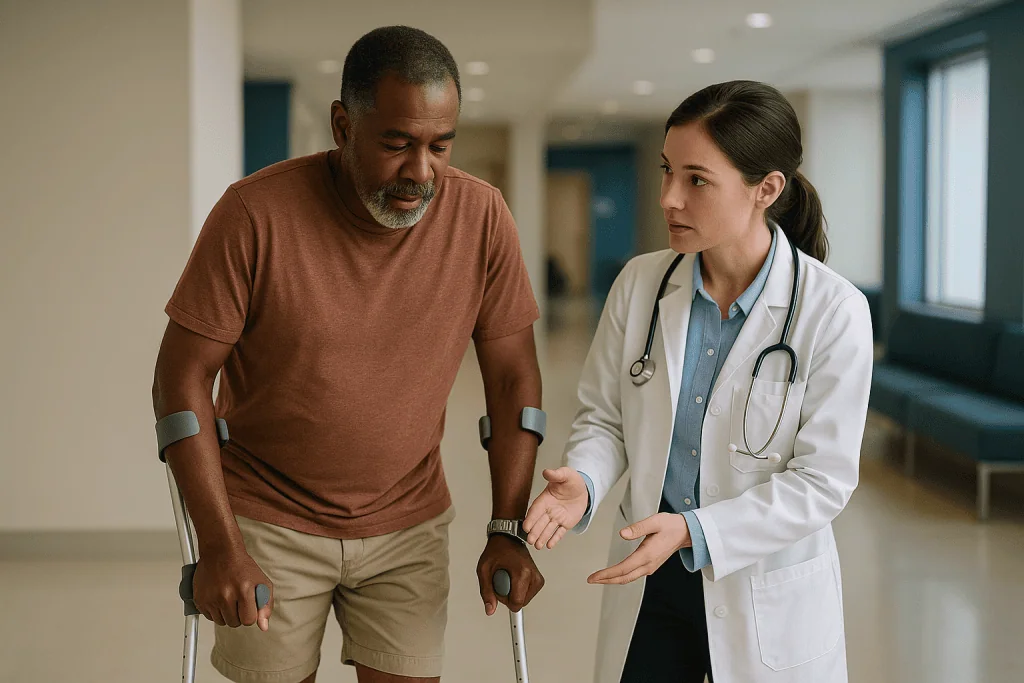
Movement starts almost immediately. The NHS notes that people are encouraged to get up and walk, with help, on the day of surgery or the day after, because early loading helps bone bond to the implant and lowers the chance of blood clots. Physical therapy begins with the unglamorous basics: bending and straightening the knee, sliding the heel, tightening the thigh, learning stairs with a rail.
Clot prevention is part of the routine. Most people are prescribed a blood-thinning medicine for a period after surgery; these drugs work by slowing the clotting cascade so a clot is less likely to form in the deep leg veins while mobility is reduced. Duration and type are decided by the surgical team, and no one should adjust that plan on their own.
The NHS knee guidance gives a useful scaffold for the early weeks: most people can stop using crutches or a frame and resume ordinary leisure activities around 6 weeks after surgery, pain and swelling can take up to 3 months to settle, and mild leg swelling may linger for up to a year. The Mayo Clinic puts a return to most daily activities after knee replacement at roughly three to six weeks. For hips, the NHS describes a return to light activities and office work in the range of about 6 to 12 weeks.
Sport sits beyond those milestones. Stationary cycling often enters early because it moves the joint without impact; swimming waits until the wound is fully sealed. Golf, hiking and gentler racket sports are usually reintroduced later and only with the surgeon’s agreement. Each of those timeframes is a typical range, not a target to beat.
High impact activities after knee replacement vs. low-impact: the usual sorting
Surgeons tend to sort activities into three buckets: encouraged, allowed for people with prior experience once cleared, and generally discouraged. The table reflects the pattern in Mayo Clinic and Cleveland Clinic patient guidance and common surgical-society advice. It is a starting point for a conversation, not a permission slip.
| Usually encouraged | Often allowed with prior experience and clearance | Generally discouraged |
|---|---|---|
| Walking and hiking on even ground | Doubles tennis, pickleball | Running and jogging |
| Cycling, stationary or road | Downhill skiing on groomed runs | Basketball, soccer, football |
| Swimming and water exercise | Cross-country skiing | Sports with jumping or cutting |
| Golf | Rowing | Singles tennis, squash |
| Elliptical trainer | Light weight training with good form | Martial arts, contact sports |
| Ballroom or low-impact dance | Ice skating | Heavy plyometrics |
The logic behind the columns is consistent. Activities in the first column load the joint in a smooth, predictable arc with the foot supported or the body partly buoyant. Those in the middle involve pivoting, speed or fall risk that an experienced body can manage but a novice cannot. The third column combines high impact, unpredictable landings and collisions, all of which drive wear and fracture risk.
Notice what is not in the discouraged column: strength training. Lifting is often mistaken for high impact. It is not. Controlled loading builds the muscle that protects the implant, and it belongs in most programs once the team signs off on technique and progression.
Running after knee replacement: what the evidence actually shows
This is the question the former half-marathoner really wanted to ask, so it deserves a straight answer rather than a brush-off.
Some people do run on replaced knees. Small follow-up studies and surgeon surveys describe patients who return to jogging, often those who ran before surgery, are relatively light and have well-fixed implants. Most report doing so without early problems. That is the encouraging half of the picture.
The discouraging half is what those studies cannot yet tell us. They are small, they follow people for years rather than decades, and they rarely compare wear or revision rates between runners and non-runners in a controlled way. Laboratory simulators show that higher loads and more cycles produce more polyethylene wear, and implants in runners see both. The Mayo Clinic’s patient guidance therefore lists jogging among the higher-impact activities generally to be avoided after knee replacement, and that remains the mainstream position.
So the honest summary is this: the evidence does not prove that running will wreck a modern knee replacement, and it does not prove it is safe over an implant’s expected lifespan either. Surgeons weigh that uncertainty against the cost of being wrong, which is revision surgery, and most advise against distance running.
People who feel strongly about running are best served by raising it openly. Some surgeons will discuss compromises such as short, infrequent runs on soft surfaces, or a shift to trail walking with poles that preserves the outdoors and the effort without the pounding. Whether any of that fits a particular knee is a decision for the person who put it in.
Sports after hip replacement: what changes when the joint is a hip
Hips and knees are lumped together under adult reconstruction, but they behave differently once the operation is over, and the sport advice shifts with them.
The hip’s ball-and-socket design is inherently stable in compression, and the deep muscles around it soak up load well. That is why many people describe a replaced hip as feeling more like their own joint than a replaced knee ever does. The trade-off is dislocation. In the first weeks, while the capsule and muscles heal, certain positions can lever the ball out of the cup. Which positions depends on the surgical approach: posterior approaches traditionally come with cautions about deep hip flexion and crossing the legs, while anterior approaches often carry fewer early restrictions. The surgeon sets those rules and the timeline for relaxing them.
Once healed, the pattern of sport advice mirrors the knee. The Mayo Clinic recommends low-impact options such as walking, swimming, golf and cycling after hip replacement and advises against running, basketball and similar high-impact pursuits, citing wear and loosening. Skiing is a recurring gray area; experienced skiers on groomed runs are sometimes cleared, beginners are not.
Range of motion is the hip-specific wrinkle. Yoga and some dance forms push hips to extremes that can stress the liner edge or, rarely, provoke instability. Modified poses are common and instructors used to working with joint replacements exist in many communities.
Durability is comparable. The NHS notes that a hip replacement can last for 15 years or more, and how a person loads it over those years is one of the few variables they control.
Exercise after joint replacement: building a week that still feels like training
The loss people grieve after surgery is rarely the specific sport. It is the identity of being someone who trains hard, sweats, tracks progress and feels spent afterward. Low-impact does not have to mean low-effort, and this is where the replacement plan earns its name.
Start with a benchmark. The CDC recommends that adults accumulate at least 150 minutes of moderate-intensity aerobic activity each week, or 75 minutes of vigorous activity, plus muscle-strengthening work on 2 or more days. Nothing about a replaced joint changes that target, and every activity in the encouraged column can meet it.
Intensity moves from the legs’ impact to the heart and lungs. A hard interval session on a stationary bike raises heart rate as high as a tempo run does, with none of the landing forces. Swimming laps with a pull buoy builds the shoulders and back while the legs rest. A rowing machine, once the hip and knee bend comfortably through the stroke, is a full-body effort that many former runners adopt as their new hard day.
A representative week for someone fully cleared might look like this: two bike or rowing sessions with intervals, one long walk or hike on gentle terrain, two strength sessions covering legs, hips and trunk, one swim, and a rest day. Golf or doubles tennis slots in where the person’s history and clearance allow.
The point is not to copy that template. It is to see that a week can still have hard days, easy days and measurable progress. Progress just gets measured in watts, meters and load lifted instead of miles pounded.
The muscles that protect the implant: why strength and balance work matters most
If there is one opinion this article holds firmly, it is that strength and balance training matter more than any single sport decision. The reasoning is mechanical and the evidence base for it is broad.
Muscle is the implant’s shock absorber. When the quadriceps and hamstrings are strong and fire on time, they slow the leg before the foot strikes and cushion the load that reaches the bearing. Weak muscles let force arrive as a jolt. The same holds at the hip, where the gluteal and abductor muscles keep the pelvis level and the ball centered. Months of pre-surgical limping usually leave these muscles smaller and slower on the operated side, and that deficit does not fix itself.
Balance is the other half. The most serious late complications after joint replacement, periprosthetic fracture and dislocation, most often follow a fall. Single-leg stance work, step-ups, tandem walking and controlled sit-to-stand drills train the reflexes that catch a stumble. The CDC’s adult activity guidance folds balance training into its recommendations for older adults for exactly this reason.
Progression follows ordinary rules. Bodyweight first, then resistance bands, then external load. Two to three sets of eight to fifteen repetitions is a conventional starting structure that a physical therapist can adjust. Squats to a box, lunges within a comfortable range, hip bridges, calf raises and lateral band walks cover most of what a replaced joint needs.
Form outranks weight, and pain that lingers into the next day is the signal to back off. A therapist who watches the movement once or twice is worth more than any online program.
Activity after adult reconstruction surgery in the long term: how implants age
The first year gets all the attention. The next fifteen are where activity choices quietly compound.
The Mayo Clinic states that most knee replacements can be expected to last more than 15 years, and the NHS gives a similar 15-years-or-more expectation for hips. Those are population figures, not guarantees, and the spread around them is wide. Some implants are still fine at twenty-five years; a minority need revision much sooner because of infection, loosening or instability.
Wear is cumulative and mostly silent. Plastic thinning does not hurt until enough bone has been lost for the component to shift. That is why surgeons ask for periodic follow-up visits with X-rays even when the joint feels perfect. Thin lines around a component or an off-center ball in a hip cup can be seen years before symptoms appear, and finding them early keeps the eventual revision smaller.
Body weight is a load factor that deserves a neutral mention. Every additional kilogram carried adds to the force crossing the joint with each step, so maintaining a stable weight is part of protecting the implant, alongside staying strong and choosing low-impact activity. This is a mechanical fact about levers, not a judgment about anyone’s body.
Infection is the other long-term risk, and it can arrive from elsewhere in the body years later. Dental infections and skin infections are classic sources. Most surgeons want to know about significant infections anywhere so they can weigh whether any precaution is needed, a decision that has grown more selective as evidence has evolved.
Long-term life with a replaced joint is not about fear. It is about periodic checks, steady strength and loading the joint in ways it was designed to take.
What people often get wrong about life after joint replacement
Misconceptions cluster at two extremes, and both cause harm.
The first is the bionic myth: the joint is titanium, therefore it is stronger than the original and limits are for the timid. Metal alloys are indeed strong. The plastic between them is not, and the bone holding everything in place is living tissue that responds to overload by giving way. A replaced joint is a well-engineered repair, not an upgrade.
The opposite myth is that the implant must be protected by doing as little as possible. Inactivity weakens the muscles that shield it, raises fall risk, and worsens the cardiovascular and metabolic conditions that surgery was meant to make easier to manage. The NHS and Mayo Clinic are explicit that regular low-impact activity is part of recovery, not a threat to it.
Kneeling attracts its own folklore. Many people avoid it for life, believing it will damage a knee replacement. The NHS notes that kneeling is often uncomfortable after knee replacement because of numbness or scar sensitivity, but discomfort is not damage, and there is no good evidence that kneeling on a healed joint shortens its life. People can practice on a cushion and stop if it hurts.
Clicking is another worry. A soft click as the plastic and metal meet during walking or stair descent is common and usually harmless. New grinding, a sense of the joint giving way, or clicking paired with pain and swelling is different and warrants a call.
Finally, no one should assume that one hard run or one misstep has ruined the implant. Damage is overwhelmingly cumulative. A single lapse is a reason to recommit to the plan, not to panic.
Questions to ask your care team
Good conversations about activity start before surgery and continue at every follow-up. These questions tend to produce useful answers because they ask about specifics rather than general permission.
- Which type of implant and fixation did you use, and does that change what you advise about impact?
- Which surgical approach was used, and are there positions or movements I should still avoid, and until when?
- What do you want me to be able to do, in strength and balance terms, before I start cycling, swimming, golf or racket sports?
- I used to run. What is your view on running with this implant, and is there any middle ground you would consider?
- Are there activities I did before surgery that you would rather I not return to at all?
- How will we monitor wear and loosening over the years, and how often do you want to see me or take X-rays?
- What symptoms should make me call sooner than my next scheduled visit?
- Do I need to tell you or my dentist about infections elsewhere in my body in the future?
- Who on the team can review my exercise technique as I progress?
Bring a written list, and bring the person who will be helping you at home. Answers about activity are easy to hear optimistically in a clinic room and misremember later. Some people ask permission to record the conversation; many clinicians are comfortable with that.
One question worth asking of yourself rather than the team: what did the sport give me that I most want back? For most people the answer is effort, outdoors, company or competition. All four can be rebuilt on a joint that never has to leave the ground.
When to call your doctor
Most of life after joint replacement involves ordinary aches that respond to rest and a little ice. Some signs are different and should prompt a prompt call to the surgical team or, for the urgent ones, emergency care.
Seek emergency help without delay for sudden shortness of breath, chest pain, coughing up blood, or a sudden feeling of faintness after surgery, because these can signal a clot that has traveled to the lungs. Call the same day for new calf pain, swelling, warmth or redness in either leg, which can indicate a deep vein clot, particularly in the first weeks when the risk is highest.
Contact the surgical team quickly for fever alongside a warm, red, increasingly painful or draining wound, since a joint infection needs urgent assessment. Do the same for a sudden inability to bear weight, a leg that looks shortened or rotated after a fall or twist, or a hip that feels as if it has popped out of place, which may mean a fracture or dislocation.
Less dramatic but still important: pain that was improving and then steadily worsens over weeks, new grinding or a sense of the joint giving way, night pain that was not there before, or a limp that returns after it had resolved. These can be early signs of loosening or wear and are exactly what follow-up visits are designed to catch.
None of this list is meant for self-diagnosis. It exists so that the right symptom reaches the right clinician quickly, and every decision about what to do next rests with the team that knows your implant.
Frequently asked questions
Can I ever go running after knee replacement?
Most surgeons advise against regular running after knee replacement, and the Mayo Clinic lists jogging among higher-impact activities to avoid. Some experienced runners with well-fixed implants do run in small follow-up studies without early problems, but long-term data comparing wear in runners and non-runners are lacking. If running matters to you, raise it directly with your surgeon, who knows your implant, bone quality and fixation method.
What sports after hip replacement are usually considered safe?
Walking, swimming, cycling, golf and water exercise are the activities most commonly encouraged after hip replacement, according to Mayo Clinic guidance. Doubles tennis, cross-country skiing and groomed downhill skiing are often allowed for people who did them before surgery once the team clears them. Running, basketball and contact sports are generally discouraged because of wear, loosening and fall-related fracture or dislocation risk.
Is strength training a high impact activity after knee replacement?
No. Controlled resistance training loads the joint smoothly and is usually encouraged because strong thigh and hip muscles absorb shock before it reaches the implant. High impact refers to landing forces from running, jumping and cutting, not to lifting. Physical therapists typically progress from bodyweight to bands to external load, prioritizing form, and adjust anything that leaves pain lingering into the next day.
How long after surgery can I start exercise after joint replacement?
Gentle exercise starts within a day of surgery under physical therapy guidance, and the NHS notes people are encouraged to walk with help almost immediately. Stationary cycling often begins in the early weeks, swimming waits until the wound has fully sealed, and sports such as golf or gentle racket play come later with surgeon clearance. Exact timing depends on healing, strength and balance rather than a fixed date.
Why does my new knee click when I walk?
A soft click as the metal and plastic components meet during walking or stair descent is common after knee replacement and is usually harmless. It tends to become less noticeable as the muscles strengthen and swelling settles. New grinding, a sense of the knee giving way, or clicking accompanied by pain, warmth or swelling is different and should be reported to your surgical team for assessment.
Will kneeling damage my knee replacement?
There is no good evidence that kneeling on a healed knee replacement shortens its life. The NHS notes that many people find kneeling uncomfortable after surgery because of numbness around the scar or pressure sensitivity, but discomfort is not damage. Practicing on a cushion and stopping if it hurts is a reasonable approach, and your physical therapist can suggest ways to build tolerance gradually.
How long do hip and knee replacements usually last?
The Mayo Clinic states that most knee replacements can be expected to last more than 15 years, and the NHS gives a similar expectation of 15 years or more for hip replacements. These are population averages with wide variation; some implants last well beyond twenty years while a minority need earlier revision for infection, loosening or instability. Activity choices, weight and periodic follow-up all influence how an individual implant ages.
Does being heavier affect what I can do after joint replacement?
Body weight is one of several load factors on a replaced joint, because every step transmits a multiple of body weight through the bearing. Keeping weight stable, staying strong and choosing low-impact activity are all part of protecting the implant. This is a mechanical point, not a judgment, and heavier people are still encouraged to be active. Your team can tailor activity and any weight goals to your situation.
Can I do yoga or dance after adult reconstruction surgery?
Often yes, with modifications. Low-impact dance is commonly encouraged, and many people return to yoga with adjusted poses. After hip replacement, extreme flexion, deep rotation and certain crossed-leg positions may stress the liner or, rarely, risk dislocation, particularly early on. Ask your surgeon which positions to modify and for how long, and look for instructors experienced in working with people who have joint replacements.
What are the warning signs that my implant is loosening?
Pain that had improved and then steadily worsens, new grinding, a sense of the joint giving way, a returning limp or new night pain can all suggest loosening or wear and should be reported to your surgical team. Loosening is often visible on X-rays before symptoms appear, which is why periodic follow-up visits are recommended even when the joint feels fine. Sudden inability to bear weight after a fall needs urgent assessment.
References
- NHS: Knee replacement
- NHS: Hip replacement
- Cleveland Clinic: Knee replacement
- CDC: Adult activity: an overview
This article is for general information only and is not a substitute for professional medical advice. Please consult a qualified doctor about your individual situation.

More from the Blog

Knee Pain Causes: Why Knees Hurt (and Why It Differs in Women)
Knee pain in women most often comes from patellofemoral (front-of-knee) pain, osteoarthritis, tendon or bursa irritation, meniscus wear, or ligament injury. Women see certain…

Shoulder, Elbow, Wrist or Hand: How Upper Limb Surgery Is Planned for Each Joint
Upper limb surgery covers operations on the shoulder, elbow, wrist and hand, from nerve releases and tendon repairs to fracture fixation and joint replacement.…
How Foot Surgery Is Performed: Bunion Correction, Fusion and Tendon Repair Step by Step
Foot surgery is usually performed as a day procedure under a nerve block, spinal or general anesthetic. The surgeon makes one or more small…

Which Scans Come Before Deformity Correction? Standing X-Rays, CT and Gait Analysis
Before a limb deformity correction, surgeons usually order full-length standing X-rays of both legs to measure alignment under body weight, and add a CT…
Hallux Rigidus Surgery Recovery: Surgical Boots, Weight-Bearing Rules and Back to Shoes
Hallux rigidus surgery recovery time depends on the operation. After a cheilectomy, which trims bone spurs, most people wear a stiff-soled boot for about…
Anatomic vs Reverse Shoulder Prosthesis: How the Rotator Cuff Decides the Design
An anatomic shoulder prosthesis reproduces the natural ball-and-socket and relies on an intact rotator cuff to center and move the joint. A reverse shoulder…