

Life in the Boots-and-Bar Brace After Ponseti Casting: Sleep, Play and Sticking With It

Key Takeaways
- Clubfoot affects about 1 in 1,000 babies and involves both feet in roughly half of cases, according to the NHS and Mayo Clinic.
- The boots and bar do not correct the foot; the weekly casts do that, and the brace holds the result while the child grows.
- Published guidance describes full-time wear of about 23 hours a day for roughly three months, then nights and naps until about age four or five.
- Stopping or shortening brace wear is the most common reason a corrected clubfoot returns toward its original shape.
- A heel that sits flat in the back of the boot is the single most important fit check, and most skin sores trace back to a lifted heel or an outgrown boot.
- Children in the night-only phase walk, run and play on their own schedule, and the brace is not expected to delay milestones.
After Ponseti casting for clubfoot, the boots-and-bar brace keeps the corrected foot from drifting back. Guidelines describe full-time wear (about 23 hours a day) for roughly three months, then nights and naps until about age four or five. Most babies settle within days; keeping to the schedule is the single biggest factor in holding the correction. The treating orthopedic team sets each child's plan.
The last cast comes off, and for a moment the nursery is quiet. The little foot that curled inward at birth now points the way feet are supposed to point. Then the physical therapist opens a small box, lifts out two leather boots joined by a metal bar, and the real question arrives: how is a baby supposed to sleep in that?
Families meet the Ponseti brace boots and bar at exactly the point when the hardest-looking part seems to be over. The casts were visible, dramatic, changed weekly. The brace is quieter, slower and, by most accounts, the part that decides whether the correction lasts.
This explainer walks through what the brace actually does, what the first nights tend to look like, how play and milestones fit around it, and why the months of night-and-nap wear matter so much. Every schedule here is a typical range from published guidance, not a promise; your child’s orthopedic team sets the plan.
What is the Ponseti brace boots and bar, and why does it follow casting?
Clubfoot, known clinically as congenital talipes equinovarus, is a condition present at birth in which the foot is twisted downward and inward because the tendons on the inside and back of the leg are shorter and tighter than usual. It affects about 1 in every 1,000 babies, and roughly half of those have both feet involved, according to the NHS and Mayo Clinic.
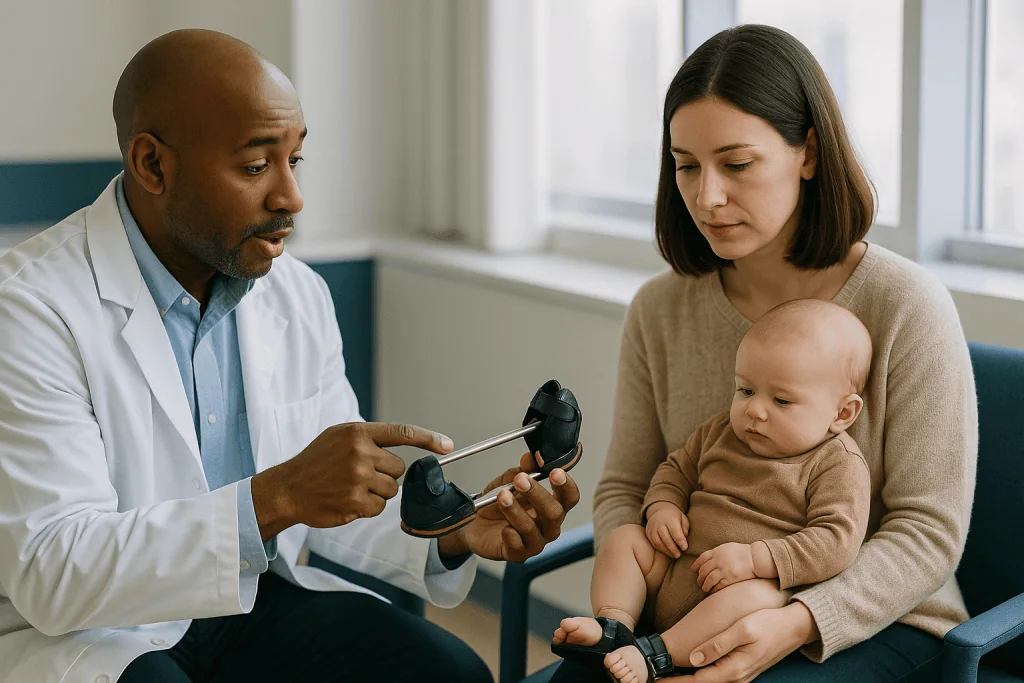
The Ponseti method treats it in two stages. First, a series of gentle manipulations and plaster casts stretches the soft tissues and gradually moves the foot into a corrected position. Second, a brace holds that position while the child grows. The brace is where the boots and bar come in: two open-toed, high-topped boots or sandals, each clipped to a bar that keeps the feet about shoulder-width apart and turned outward.
Why not stop at the casts? Because the tissues that were stretched have a strong tendency to tighten again. The Ponseti brace does not correct anything new. Its job is maintenance: it keeps the foot stretched outward and upward during the hours when a baby would otherwise lie with feet relaxed and turned in. Mayo Clinic and the NHS both state plainly that without the brace, the foot is likely to return to its original shape.
The mechanics are simple on purpose. The bar links the two feet so that one cannot drift independently. The outward rotation on the affected side is set greater than on the unaffected side, and the boots hold the ankle bent upward. A soft strap across the ankle, often with a padded tongue, keeps the heel seated down in the boot. Everything about the design aims at one thing: preserving a correction that took weeks to achieve.
How the Ponseti casting phase gets a baby to brace day
It helps to understand what the brace is protecting. In the Ponseti method, treatment usually begins in the first weeks of life, when the baby’s ligaments and tendons are at their most pliable. A clinician manipulates the foot for a few minutes, then applies a long-leg plaster cast from toes to upper thigh to hold the new position. The cast is changed about once a week, each time moving the foot a little further toward correction. The NHS describes this phase as typically lasting around 5 to 8 weeks.
Before the final cast, most children need a small procedure called an Achilles tenotomy: a tiny cut in the tendon at the back of the heel that allows the foot to bend fully upward. The NHS notes that this is usually done under local anesthetic and that the tendon regrows in the lengthened position while the last cast is in place, generally for about three weeks.
The day that final cast is removed is brace day. The foot has been in a fixed position for weeks, so it can look a little pale, dry or flaky. The skin often sheds in the first days; a gentle bath and plain moisturizer, if the team approves, usually settles it.
Timing matters here. The brace is fitted the same day the cast comes off, or as soon as possible afterward, because even a short gap lets the tissues begin to tighten. If you are told to go straight from the cast room to the brace fitting, that is the standard pathway, not an alarm.
Two points are worth holding onto from the start. The casts did the correcting. The brace is not a sign that something went wrong; it is the second half of the same plan, and the team expects every child who completes casting to wear it.
How long to wear the Ponseti brace: the typical schedule
Parents ask this before almost anything else, and the answer has two parts. Guidelines from the NHS, Mayo Clinic and MedlinePlus describe an initial full-time phase, about 23 hours a day, lasting roughly three months. After that, the brace moves to nights and naps only, and that phase continues until the child is around four or five years old according to the NHS; Mayo Clinic describes night wear continuing for up to three years. Your team will tell you where your child’s plan sits within that range.
Here is how the typical pattern looks in practice.
| Phase | Typical wear (per published guidance) | What daily life usually involves |
|---|---|---|
| Full-time phase | About 23 hours a day for roughly 3 months (NHS) | Brace stays on for feeds, naps, car trips and play; off for one bath or skin check and dressing |
| Night-and-nap phase | Nights and daytime sleep until about age 4 to 5 (NHS); up to 3 years by Mayo Clinic’s description | Brace goes on at bedtime and nap time; feet are free for crawling, cruising and walking |
| Follow-up | Regular clinic reviews through childhood | Fit checks, foot position checks, new boots as feet grow |
The jump from 23 hours to nights only is a genuine relief, and it is also the moment when adherence quietly slips in many families, because the brace stops feeling essential once the child is up and moving. Clinicians generally advise treating night wear as non-negotiable rather than optional, for reasons the relapse section below explains.
Some teams count the hours slightly differently or taper over a longer stretch. A schedule that differs from the table is not wrong; it is the one written for your child. Ask the team to write the hours down, and keep that note on the refrigerator.
Who the brace is usually for, and who is asked to wait
The boots and bar are prescribed for a specific situation: a clubfoot that has been fully corrected by casting and, where needed, tenotomy. The brace is a maintenance tool, so it is only fitted once the foot can be held comfortably in the corrected position. A foot that is not yet fully corrected cannot be forced into the boot without pain and skin damage, and a team will delay bracing, and sometimes add casts, rather than fit a brace to a foot that is not ready.

Most children treated with the Ponseti method have what clinicians call idiopathic clubfoot, meaning no other cause has been found. These children follow the standard pathway described here. Children whose clubfoot is linked to another condition, for example spina bifida or certain muscle or nerve disorders, may still be treated with casting and bracing, but their teams often adapt the schedule and watch more closely, because the underlying condition can make the foot stiffer or more likely to relapse. Mayo Clinic notes that these non-idiopathic cases can be harder to treat.
A few circumstances lead teams to pause rather than start. A raw patch of skin after cast removal may need a day or two to heal first. An infant with an unrelated illness may be reviewed before a long day in the brace. A child who has grown out of the boots will be fitted with a new pair rather than squeezed into the old size, because tight boots are a common cause of sores and slipping heels.
Older children who missed early treatment, or whose feet relapsed after bracing stopped, may be offered repeat casting followed by a return to the brace. Whether that is appropriate, and for how long, is a decision for the treating orthopedic team based on how flexible the foot is and how the child is growing.
The first week in the brace: what the early days usually look like
Expect a rough couple of nights, then a turn. That pattern comes up again and again in clinic conversations, and it fits what the NHS tells families: babies usually get used to the brace within a few days.
On day one, the feet are suddenly joined. A baby who had been kicking freely, or who had grown used to the weight of casts, now finds that moving one leg moves the other. The usual response is protest, mostly in the evening. This is frustration with a new sensation, not pain from the foot itself; the foot was already held in this position inside the last cast.
By the second or third day, most babies begin to kick the legs together as a single unit. Some discover that pushing both feet against the mattress gives them a satisfying thump. That is a good sign. It means the child is learning to use the brace rather than fight it.
Skin takes a few days to adjust as well. Mild pinkness over the heel, the top of the foot or the ankle bone is common when the brace comes off for a bath; it should fade within a short while. Redness that stays, or any blister or broken skin, needs a call to the clinic, because fit problems are easiest to fix early.
Build the daily hour of brace-free time into a routine. Many families use it for the bath, a slow massage of the calves and feet, a nappy change and a fresh pair of thin cotton socks. Put the brace back on before the baby is fully asleep, since a drowsy baby is easier to fit than a sleeping one who startles.
By the end of the first week, the brace has usually become part of the furniture. If it has not, and the baby is still inconsolable with it on, ask for a fit check sooner rather than later.
Clubfoot brace sleep tips: safe sleep, settling and night waking
Sleep is where the brace earns its keep, and where families do most of their worrying. The reassuring part first: the standard safe sleep advice does not change. Babies in the brace should still be placed on their back, on a firm flat mattress, in their own sleep space, with no loose bedding, pillows or bumpers, in line with CDC and NIH safe sleep guidance. The bar does not require a special cot or a propped position.
A few practical adjustments help. A sleep sack or wearable blanket that is wide enough at the bottom keeps the baby warm without restricting the bar; some families choose a larger size so the feet and bar sit comfortably inside. Avoid swaddling the legs together over the brace, since that adds pressure to the ankles. If the bar catches the cot slats when the baby scoots, some parents fit a mesh cot liner that meets safe sleep standards; check with your team before adding anything to the sleep space.
Night waking in the first weeks is common and tends to settle as the baby learns to roll with the bar. A baby who wakes crying can often be soothed without removing the brace: a hand on the chest, a feed, a quiet word. Removing the brace to settle a cry is understandable at 3 a.m., but it teaches the child that crying brings the brace off, and that lesson is hard to unlearn in the toddler years.
Temperature deserves attention. Leather boots hold warmth, so dress the baby in one fewer layer than you might otherwise choose, and feel the back of the neck rather than the feet to judge whether the baby is too warm.
One more sleep tip from experienced parents: put the brace on as the last step of the bedtime routine, every time, so it becomes the signal that sleep is coming rather than an interruption.
Play, tummy time and milestones with the bar on
The brace looks as though it should hold a baby back. In the full-time phase, it does limit some movements, but far less than most parents fear, and clinicians generally encourage normal play from the first day.
Tummy time works with the bar. Lay the baby on a firm mat; the bar rests on the floor behind and the baby can push up on the forearms as usual. Rolling comes a little later for some babies in the brace, because the legs move as one unit, but most learn to swing both legs together and flip over. Kicking a soft toy suspended above the feet is a favorite, since both feet hit it at once.
Sitting is unaffected. Many babies in the full-time phase sit with the bar out in front, feet turned outward, and reach for toys quite happily. Lifting a baby in the brace is easier with one hand under the bottom and the other behind the back, rather than scooping under the legs, which can twist the ankles against the boot straps.
Once night-and-nap wear begins, the feet are free during the day, and crawling, pulling up, cruising and walking proceed on the child’s own timetable. The NHS and Mayo Clinic both note that children treated with the Ponseti method usually go on to walk, run and play normally, and that most can join in ordinary sports. A child in the night-only phase is not expected to miss milestones because of the brace.
In the brace itself, standing is possible and some children in the full-time phase learn to stand holding furniture with the bar on. Let them. Weight through the feet in the corrected position is not harmful, and the bar is designed to bear it.
What to avoid is simple: hanging the baby by the bar, using the bar as a handle, and any play that bends the bar.
Skin, fit and comfort: the daily foot check that prevents most problems
Most brace trouble is fit trouble, and most fit trouble shows up on the skin first. A short check every time the brace comes off, during the brace-free hour or at bath time, catches issues while they are still small.
Look at the heel, the top of the foot where the strap crosses, the ankle bones on both sides, and the little toe. Mild pinkness that fades within about 20 minutes is ordinary. Redness that lasts, a shiny or dented patch, a blister or any break in the skin is not, and it means the boot is rubbing or the heel is not sitting flat.
Heel position is the single most important fit check. With the boot on and strapped, the heel should be right down in the back of the boot, with no gap. Many boots have a small window or a line on the heel cup so you can see this. A heel that rides up tells you one of three things: the strap is too loose, the boot is too small or too large, or the foot was not fully pushed down before buckling.
A reliable routine for putting the boot on goes like this: hold the foot with the ankle bent upward, press the heel down into the back of the boot, fasten the ankle strap firmly first, then the other straps, then check the heel through the window. Thin, seamless cotton socks that come above the boot line reduce rubbing; thick or bunched socks cause it.
Boots need replacing as the child grows. Clinics usually check size at each visit, but a boot that was fine last month can be tight this month. Toes touching the end, new red marks, or a heel that suddenly will not seat are reasons to ask for a review rather than wait for the next scheduled appointment.
If the baby’s toes look pale, bluish or swollen with the brace on, loosen the straps and call the team the same day.
Why sticking with it matters: clubfoot relapse after bracing stops early
Here is the opinion this article holds most firmly, because the evidence supports it: the hours in the brace are the treatment, not an add-on. Guidance from the NHS, Mayo Clinic and MedlinePlus is consistent that stopping the brace too early, or wearing it for fewer hours than prescribed, is the most common reason a corrected clubfoot drifts back.
Relapse means the foot begins to turn inward and downward again after it had been corrected. It rarely happens overnight. The usual story is a child who stops night wear at two or three because the feet look perfect, followed by a slow return of tightness at the back of the ankle and a tendency to walk on the outer edge of the foot. By the time a parent notices, the soft tissues have shortened again.
The biology explains it. The ligaments and tendons stretched during casting retain a memory of their original length, and a growing child adds new tissue in whichever position the foot spends most of its time. Night wear keeps that position outward and upward for a third or more of each day during the years when growth is fastest. Mayo Clinic puts it directly: the brace is needed because the foot can return to its original position without it.
Relapse can be treated. Teams commonly offer repeat casting, a return to the brace, and in some cases a minor tendon procedure, which is why regular follow-up continues through early childhood even when everything looks fine. But treatment after relapse is longer and harder on the family than the night wear that would have prevented it.
None of this is meant to frighten. It is meant to give the night-and-nap months their proper weight, so that the brace sitting by the bed is understood as the thing holding the correction in place.
Toddlers, bedtime battles and keeping the brace on past age two
The full-time phase tests parents’ nerves; the night-only phase tests their persistence. Around eighteen months to two years, many children discover the buckles, learn the word no, and begin to treat the brace as the final stand of the bedtime negotiation.
Consistency works better than argument. Children accept routines they can predict, so the brace goes on at the same point every night, after the story and before the last song, whether the family is at home, at a grandparent’s or on holiday. Skipping it for a special occasion once tends to become twice.
Give the child some control over the parts that do not matter. Choosing the sock color, deciding which boot goes on first, or pressing the strap closed themselves lets a toddler feel in charge without changing the outcome. A small sticker chart or a brief celebration when the brace stays on all night turns the routine into something to be proud of.
Name the brace plainly and positively. Children borrow their attitude from the adults around them; if parents treat the boots as ordinary pajama gear rather than a punishment, the child usually does too. Some families keep a favorite soft toy in a matching pair of toy boots, which is as effective as it is charming.
If a child wakes and removes the brace, put it back on calmly and without a lecture. For determined buckle-openers, ask the clinic whether a boot design with a harder-to-open fastening is available, or whether a thin layer of clothing over the straps is advised.
Nap wear can be the first casualty once a child drops daytime sleep altogether; tell the team when that happens so the plan can be updated, rather than quietly dropping hours.
A toddler who suddenly refuses the brace after months of acceptance deserves a fit check before a behavior plan. Growth spurts make boots tight, and tight boots hurt.
Daily life around the brace: feeding, car seats, child care and clothes
The brace fits into ordinary life with a few small workarounds, most of which families invent within the first fortnight.
Feeding is unchanged in position, though a baby across the lap in the full-time phase will have the bar resting against the parent’s other leg. Many parents find a nursing pillow or a wide chair more comfortable. For bottle feeding, a semi-upright position with the bar on the floor or a footstool works well.
Car seats take the brace without modification in most cases. The bar sits across the front of the seat and the harness goes over the shoulders and between the legs as usual. Check that the straps are not pushed up by the boots and that the bar is not pressing against the seat shell; if it is, ask the clinic whether the bar width can be adjusted slightly within the prescription. Never route the harness over or around the bar.
Clothing is easier than it looks. In the full-time phase, trousers with wide or snap-open legs go on before the brace; footed sleepsuits are set aside until the night-only phase, when loose pajama bottoms over the socks work fine. Leggings that stop at the ankle keep the boots free.
Child care providers and relatives need a short briefing, ideally in writing: the hours the brace is worn, how to put it on with the heel seated, what mild pinkness looks like versus a sore, and who to call. A photograph of the correctly fitted boot on the phone saves a lot of explaining. Most caregivers manage well once they have done it twice with a parent watching.
Travel is possible throughout. Pack the brace in hand luggage, carry the clinic’s letter, and keep the wear schedule in the destination time zone so the hours are not lost.
What people often get wrong about the Ponseti brace
Myths about the boots and bar travel fast, partly because the brace looks severe. Correcting a few of them makes the months ahead easier.
The brace hurts. It should not. The foot is already in the corrected position when the brace is fitted; the brace holds it, it does not force it. Crying in the first days is almost always frustration with the new sensation of joined legs. Pain, or crying that does not settle after the first week, points to a fit problem and needs a check.
The feet look straight, so the brace can stop. This is the most consequential misunderstanding. The NHS and Mayo Clinic both describe night wear continuing for years after the feet look normal, precisely because the tissues can tighten again while the foot looks fine.
The brace delays walking. Children in the night-only phase walk on their own schedule. In the full-time phase, standing and cruising with the bar on are possible and are not harmful.
A tighter boot holds better. A boot that is too tight lifts the heel and causes sores; a boot that fits snugly with the heel seated holds well. Size matters more than strap force.
Only severe clubfoot needs the brace. Every foot corrected by the Ponseti method is braced, regardless of how severe it started, because relapse risk comes from stopping bracing, not from the initial severity alone.
Something went wrong if a tenotomy was needed. The NHS notes that most children need this small procedure; it is part of the standard pathway.
Skipping a few nights now and then does no harm. The evidence cannot quantify a safe number of missed nights, which is why clinicians advise treating every night as part of the plan.
The brace is a cast. It is not. It comes off every day for washing, checking and, in the night-only phase, for the whole day. That daily freedom is one reason adherence is realistic.
Risks, alternatives and what happens if the correction slips
The brace itself carries few risks, and most are minor and fixable. Skin irritation, blisters and pressure sores from a poorly seated heel or an outgrown boot are the most common, and they resolve once the fit is corrected. Occasionally a child develops a rash from the leather or strap material, which the team can address with a change of sock or lining. The bar can catch on furniture or a cot, which is a reason to check the sleep space rather than a reason to stop bracing.
The larger risk is the one already described: the foot returning toward its original shape if bracing stops early. Mayo Clinic and MedlinePlus list this as the main reason treatment fails. Relapse is usually treated with further casting and a return to the brace, and in some children a small procedure to release or transfer a tendon. These steps are decided by the orthopedic team after examining how flexible the foot has become.
Alternatives to the Ponseti pathway exist but are used less often. Mayo Clinic describes surgery to lengthen tendons and reposition the foot as an option when casting and bracing have not held the correction or when the foot is unusually stiff, with the caveat that surgery can leave the foot stiffer and more prone to arthritis later in life. Some centers use a different stretching-and-splinting approach in infancy. Neither is a reason to bypass the brace in a child whose foot has already been corrected by casting.
Doing nothing is also an alternative in the strict sense, and the NHS describes the outcome: a child who walks on the side or top of the foot, with pain and difficulty finding shoes. That is the comparison the brace should be measured against.
Whether to add casts, change the schedule or consider a procedure is never a parent’s decision to carry alone. The treating team weighs the examination findings, the child’s age and the family’s circumstances together.
Questions to ask your care team about the boots and bar
Clinic appointments are short and babies are loud, so it helps to arrive with questions written down. These are the ones that tend to prevent problems later.
- How many hours a day should the brace be worn right now, and when do you expect that to change?
- How will I know when it is time to move from full-time to night-and-nap wear, and who makes that call?
- Until roughly what age do you anticipate night wear continuing for my child?
- Can you show me how to seat the heel and fasten the straps, and can I take a photograph of the correct fit?
- What does normal skin pinkness look like, and what would make you want to see us before the next appointment?
- How often will the boots be resized, and how do I arrange a new pair between visits if they become tight?
- What should I do if the foot slips out of the boot during the night?
- Is there a specific bar width or boot angle prescribed for my child, and can I check that it has not changed?
- What signs would suggest the foot is starting to relapse, and how often will you examine for them?
- If my child becomes unwell or has a skin sore, should the brace come off, and for how long?
- Who do I contact out of hours, and what counts as urgent?
- Is there anything about my child’s foot, or any other condition, that makes the standard schedule different for us?
Write the answers down, especially the hours and the age range the team expects. The schedule will be revised at follow-up visits as the foot and the child change, and having the current version in your own handwriting makes it easier to brief relatives and child care providers.
Ask, too, whether the clinic can connect you with other families who have been through the brace years. Peer support is not a substitute for clinical advice, but on a bad night it can be exactly what a parent needs.
When to call your doctor: red-flag signs in the brace
Most days in the brace are uneventful, and most concerns can wait for the next scheduled visit. A few cannot. Contact the orthopedic team or your child’s doctor promptly, the same day where possible, if you notice any of the following.
Toes that look pale, blue, dusky or swollen while the brace is on, or that stay cold after the straps are loosened, suggest the boot is too tight or badly positioned and need urgent review. Any blister, open sore, bleeding or broken skin on the foot or ankle should be seen before the brace goes back on. Redness that has not faded within about 20 minutes of removing the brace, or that is worsening day by day, is a fit problem that will not fix itself.
A foot that repeatedly slips out of the boot, or a heel that will not seat even when the straps are fastened correctly, means the brace is no longer holding the correction and the child needs a fitting appointment. Crying that is persistent and inconsolable every time the brace goes on, after the first week of adjustment, points to pain rather than protest.
Signs that the foot itself may be changing also warrant a call: the foot or heel appearing to turn inward again, difficulty bending the foot upward that was not there before, a child who has started walking on the outer edge of the foot or on the toes, or a visible difference between the two feet that is new.
Seek urgent care the same day if the foot or lower leg becomes hot, red and swollen, if there is pus or a foul smell from a sore, or if the child has a fever alongside a skin wound, since these can indicate infection. Seek emergency care for any injury involving the bar, such as a fall where the bar struck the child or became bent while on the feet.
When in doubt, call. Fit problems caught early are usually a ten-minute adjustment.
Frequently asked questions
How long do children wear the Ponseti brace boots and bar?
Guidance from the NHS describes about 23 hours a day for roughly three months, then nights and naps until around age four or five; Mayo Clinic describes night wear continuing for up to three years. The exact schedule depends on the child’s foot, growth and examination findings, and the treating orthopedic team sets and revises it at follow-up visits. Ask for the current hours in writing.
What are the best clubfoot brace sleep tips for a newborn?
Keep to standard safe sleep guidance: on the back, on a firm flat mattress, in the child’s own sleep space, with no loose bedding. A wide-bottomed sleep sack keeps the baby warm without pressing on the bar. Put the brace on as the last step of the bedtime routine every night, and settle crying with a hand on the chest or a feed rather than by removing the brace.
Does the Ponseti brace hurt my baby?
It should not. The brace holds a foot that the casts have already corrected; it does not force the foot into a new position. Crying in the first few days is usually frustration with having the legs joined, and the NHS notes that babies typically adjust within days. Pain, persistent crying after the first week, or skin redness that does not fade suggests a fit problem that the clinic should check.
Can my baby roll over, crawl and play in the boots and bar?
Yes, with some adaptation during the full-time phase. Babies learn to kick and roll with both legs moving as one unit, and tummy time and sitting work normally. Once the brace moves to nights and naps, the feet are free all day, so crawling, pulling up and walking proceed on the child’s own timetable. Standing with the bar on is not harmful.
What causes clubfoot relapse after bracing, and can it be treated?
The most common cause is stopping brace wear early or wearing it fewer hours than prescribed, because the stretched tissues tend to tighten again during growth. Relapse is usually treated with repeat casting and a return to the brace; some children need a minor tendon procedure. The orthopedic team decides the approach after examining how flexible the foot has become.
What should I do if the boots and bar are not fitting and the heel keeps slipping?
Check that the ankle is bent upward and the heel is pushed fully down before fastening the ankle strap first, then look through the heel window to confirm there is no gap. If the heel still lifts, the boot is likely the wrong size or the strap has stretched. Contact the clinic for a fitting rather than tightening the straps harder, which causes sores.
Why does my child still need the brace at night when the feet look completely normal?
Because the ligaments and tendons that were stretched during casting can shorten again while the foot still looks fine from the outside. Night wear keeps the foot stretched outward and upward for a large part of each day during the years of fastest growth. The NHS and Mayo Clinic both describe night bracing continuing for years after the feet appear corrected.
What does the daily brace-free hour look like during full-time wear?
Most families use it for a bath, a skin check of the heel, ankle bones and strap line, a gentle calf and foot massage, a nappy change and fresh thin cotton socks. The brace goes back on before the baby is fully asleep. Keeping the hour at the same time each day makes the routine predictable for the child and easier to hand to other caregivers.
How do I know if the boots have become too small?
Toes touching the end of the boot, new red marks on the top of the foot or little toe, a heel that suddenly will not seat, or a child who starts resisting a brace they previously accepted are all signs of outgrown boots. Clinics check size at each visit, but growth spurts happen between appointments, so ask for a review rather than waiting.
When should I call the doctor about the Ponseti brace?
Call the same day for pale, blue or swollen toes, any blister or broken skin, redness that does not fade within about 20 minutes of removing the brace, a foot that repeatedly slips out, or persistent inconsolable crying after the first week. Seek urgent care for a hot, red, swollen leg, pus or fever with a sore, or any injury involving the bar.
References
This article is for general information only and is not a substitute for professional medical advice. Please consult a qualified doctor about your individual situation.

More from the Blog

Neck Pain on One Side: Muscle, Nerve and Joint Causes on the Left or Right and When to Check
Neck pain on one side most often comes from a strained muscle, an awkward sleeping position or a stiff facet joint, and it usually…

When Can You Walk After Robotic Hip Replacement? From Walker to Crutches to Unaided
Most people stand and take their first supported steps within 24 hours of robotic hip replacement, often the same day, using a walker or…

Flying Home After Joint Replacement: Timing, Clot Precautions and Airport Metal Detectors
Most people can fly after joint replacement once they are walking independently, their wound is settled and their surgical team has cleared them, which…

What Does Foot Deformity Surgery Recovery Involve? From Cast to Special Shoe to Walking
Foot deformity surgery recovery usually moves through stages: a cast, splint or boot that protects healing bone for the first weeks, then a stiff…

Diaper Changes, Bathing and Dressing With a Pavlik Harness: A Daily Care Guide for Parents
During Pavlik harness diaper changes, the harness stays on and the diaper goes underneath the leg straps. Lift your baby by sliding a hand…

How Is Hip Replacement Surgery Performed? The Operation Explained From Incision to Closure
Hip replacement surgery is done by removing the worn ball-and-socket joint and fitting an artificial one. Under spinal or general anesthesia, the surgeon makes…