

Limb Lengthening as an International Patient: Stay Length, Follow-Up X-Rays and Flying Home

Key Takeaways
- Limb lengthening separates a surgically cut bone at roughly a millimeter a day and then waits months for the new bone to harden, so the operation is the shortest part of the process.
- Most surgical teams want international patients nearby for at least part of the distraction phase, because the daily rate is calibrated from serial X-rays and adjusted when nerves or regenerate look strained.
- The CDC identifies travel longer than about four hours, recent surgery, and an immobilized limb as additive risk factors for deep vein thrombosis, which is why the flight home needs a clot-prevention plan from the treating team.
- The NHS advises arranging aftercare before traveling for treatment because follow-up for privately arranged surgery abroad is not automatically provided at home.
- The practical limit on how much a bone can be lengthened is set by muscles, nerves, and blood vessels, not by bone, which is why very large targets carry disproportionate complication risk.
- A discharge letter stating the device, target length, distraction rate, weight-bearing plan, and requested X-ray views is what allows a clinician at home to safely take over your care.
Patients who travel for limb lengthening usually need to stay near the surgical team well beyond the operation itself, because the bone is lengthened gradually over weeks and monitored with serial X-rays. How long to remain, when flying is reasonable, and how to lower the risk of travel-related blood clots are decisions for the treating surgeon, and follow-up imaging must be arranged in advance with a clinician at home.
There is a moment that catches almost everyone who considers limb lengthening abroad: the return flight. The outbound ticket is easy. The one home sits blank in the spreadsheet, because nobody can tell you with confidence whether it belongs two weeks after surgery, two months, or somewhere in between. A woman I spoke with kept three tabs open for weeks: a surgeon’s video, a forum thread, and an airline’s medical clearance form she did not yet know how to answer.
That blank cell is the honest heart of this topic. Limb lengthening is not a single operation you recover from and leave. It is a process with a slow middle, measured in millimeters and X-rays, and the geography of that middle matters more than the geography of the operating room.
What follows is what the mainstream evidence and guideline-level guidance actually say about stay length, imaging, and flying home, without a destination attached.
What limb lengthening abroad actually involves, phase by phase
Start with the biology, because everything about timing flows from it. Limb lengthening relies on distraction osteogenesis, which simply means that if you cut a bone and then pull the two ends apart very slowly, new bone grows into the widening gap. The controlled surgical cut is called an osteotomy. The soft new bone bridging the gap is called the regenerate.
Two families of hardware do the pulling. An external fixator is a frame outside the leg, attached to the bone with pins or wires that pass through the skin. An intramedullary nail is a telescoping rod placed inside the hollow of the bone; many modern versions are lengthened with an external magnet held against the leg. Some surgeons combine the two. Which device is used is a surgical decision based on your anatomy, the bone involved, and the reason for lengthening.
The process runs in four phases. First comes the operation and a short inpatient stay. Then a latency period of days while early healing tissue forms. Then distraction, when the device is adjusted in small increments, commonly totaling around a millimeter a day according to MedlinePlus. Finally consolidation, the long stretch in which the regenerate hardens enough to bear your weight without the device doing the work.
For someone traveling for limb lengthening abroad, each phase maps onto a practical question: where will you physically be, and who will be checking the bone? The operation is a few hours. Distraction runs for weeks. Consolidation runs for months. The stay-length conversation is really a conversation about which of those phases your surgeon wants to supervise in person, and how the rest will be supervised at home.
Who is usually offered limb lengthening, and who is usually asked to wait
Lengthening began as a reconstructive tool. MedlinePlus lists its classic uses: a leg length difference caused by a fracture that healed short, a bone infection, a congenital condition, or damage to a growth plate in childhood. In those cases the goal is function: even hips, a level pelvis, a spine that is not compensating for a limp.

A second group seeks lengthening to increase overall height with no underlying discrepancy. This is often described as cosmetic or stature lengthening. It is legal and performed in many countries, but it sits in a different ethical category because the person starts out healthy and the procedure carries the same complications as reconstructive lengthening. Most reputable teams apply extra scrutiny here, and many involve a mental health professional in the assessment.
Who tends to be asked to pause? Patterns recur across orthopedic practice:
- People whose growth plates are still open, for whom certain devices and plans are not suitable.
- Anyone with an active infection anywhere in the body, since hardware and open pin sites raise the stakes.
- Smokers and vapers, because nicotine impairs bone healing; many surgeons ask for a period of complete abstinence first.
- People with poorly controlled diabetes, significant vascular disease, or bone-density problems that the team has not yet evaluated.
- Anyone who cannot commit to months of daily physiotherapy, or who has no clinician at home willing to take over follow-up imaging.
- People in the middle of an untreated mental health crisis, or whose expectations about height, pain, or timing do not match what the team can honestly offer.
None of these are moral judgments. They are the conditions under which the biology cooperates. The final call always rests with the surgical team assessing you in person.
Is there a best country for limb lengthening abroad?
People type this question into search engines every day, and the honest answer is no. There is no country that produces better bone. The variables that predict a smoother course are attached to the team and the plan, not to a flag. The CDC’s medical tourism guidance makes the same point in reverse: complications from surgery abroad are usually linked to the facility, the communication, and the follow-up arrangements, not to the destination itself.
What is worth evaluating, wherever the surgeon happens to work:
- How many lengthening procedures the specific surgeon performs, and how many of your type (femur versus tibia, nail versus frame).
- Whether the facility holds a recognized accreditation and how it handles infection control, since the CDC highlights antibiotic-resistant infections as a documented medical-tourism risk.
- Whether you and the team share a language fluently enough to discuss a wound at two in the morning, not just a consultation with an interpreter present.
- Who manages your distraction adjustments if something goes off-schedule, and who reads your X-rays once you fly home.
- What happens legally and financially if a complication needs a second operation.
The CDC also advises seeing a travel medicine provider four to six weeks before any trip for care abroad, which doubles as a useful forcing function: it makes you write down the plan for pre-existing conditions, vaccinations, and clot risk before you commit.
You will notice this article does not discuss cost, and that is deliberate. Headline figures for limb lengthening rarely include the long tail: the extended accommodation during distraction, serial imaging, physiotherapy for months, possible hardware removal, and the cost of treating a complication. A number without that tail is not a price. It is an advertisement.
How long to stay after limb lengthening when you are an international patient
Nobody can give you a universal number, and you should be cautious of anyone who does. What can be described is how surgeons think about the question.
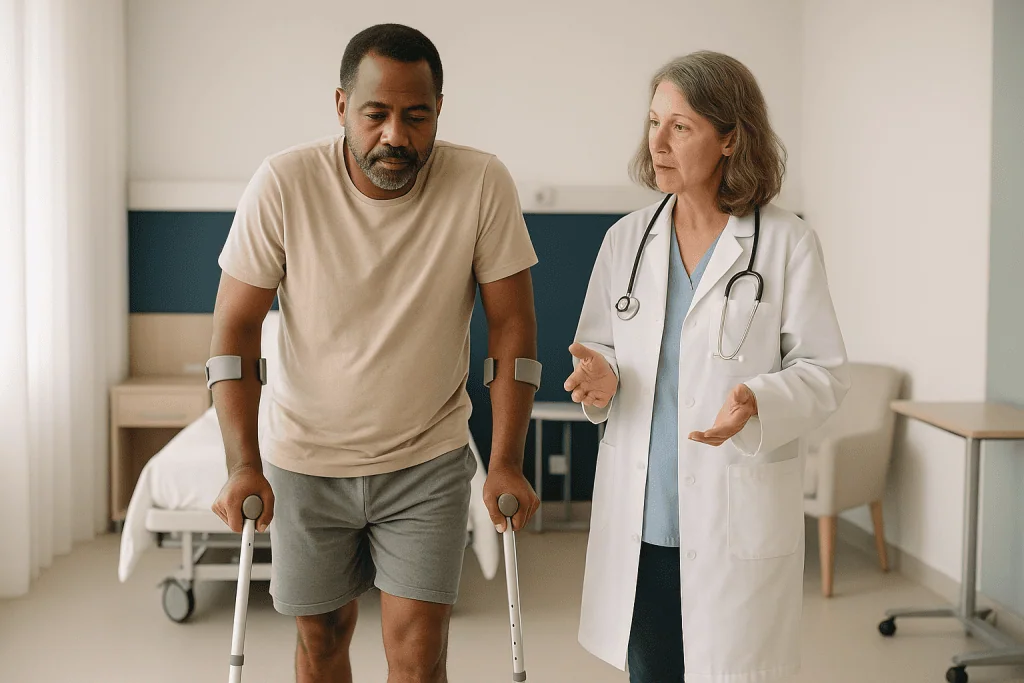
The inpatient portion is the shortest part. Most people are up with a walker or crutches within the first days and discharged once pain is controlled with the regimen their team has chosen, the wound is settled, and they can manage basic transfers. That is not the moment most surgeons want you on a plane.
The real variable is the distraction phase. During those weeks the device is adjusted daily, and the surgeon uses X-rays to check that the gap is widening at the intended pace and that the regenerate looks healthy. Adjust too fast and the new bone can be thin and slow to harden, or a nerve can be stretched. Adjust too slowly and the gap can bridge early, a problem called premature consolidation that may need another procedure. Because of this, many teams prefer international patients to remain nearby for at least the early part of distraction, when the pace is being calibrated and pin sites or incisions are most vulnerable. Some prefer patients stay for the entire distraction phase.
MedlinePlus frames the whole process, lengthening plus healing, as something measured in months rather than weeks. The stay decision is a negotiation between that biological timeline and your life, and it is made by the surgeon after looking at your imaging, your wounds, your mobility, and the quality of the follow-up waiting at home.
Practically, that means booking flexible travel, budgeting time rather than just money, and asking before surgery: what exactly do you need to see on my X-ray and in my clinic exam before you are comfortable with me leaving?
Why the lengthening phase is the part people underestimate
Ask patients afterward which part surprised them and the answer is rarely the operation. It is the weeks of distraction. The bone is being separated a fraction of a millimeter at a time, but the muscles, tendons, nerves, and skin do not grow on the same schedule. They are stretched.
That stretch is why physiotherapy is not optional. As the bone lengthens, the calf and hamstring muscles tighten. Without daily stretching and joint work, a contracture can develop: a muscle or tendon that has shortened so much the joint can no longer move through its full range. In tibial lengthening the classic version is the foot drifting into a pointed-down position; in femoral lengthening it is a knee that will not fully straighten or a hip that stiffens. Physiotherapists working with lengthening teams see patients several times a week during this phase, sometimes daily, and the exercises continue at home in between.
Pain during distraction is real and different from surgical pain. It is often described as deep, aching, and worst in the hours after an adjustment or at night. Nerve symptoms, such as tingling or burning in the foot, can signal that a nerve is being stretched faster than it can tolerate, and they are one of the reasons surgeons slow the rate or pause. Pain is managed by the prescribing team with a plan tailored to you; this article does not discuss medicines or amounts.
Sleep suffers, mood dips, and daily life shrinks to the leg. People who planned to work remotely often find their capacity smaller than expected. Being physically near the team during this phase is not about convenience. It is about a surgeon being able to look at the leg, not a photograph of it, when something changes.
Limb lengthening follow-up X-rays: what they check and why they cannot be skipped
X-rays are the steering wheel of this procedure. They are how the surgeon knows whether to speed up, slow down, pause, or intervene. Understanding what they show helps you understand why a clinician at home must be lined up before you leave.
Each set of images typically answers several questions at once. Is the gap between the bone ends the width the schedule predicts? Is the regenerate forming across the whole gap, or is one side lagging? Is the bone still straight, or is it drifting into an angle as it lengthens? Are the joints above and below sitting where they should? Is the hardware intact, and for frames, are the pins loosening or tracking infection into the bone? In consolidation, the images track how the regenerate is hardening: how many of the bone’s walls, seen from front and side, show mature cortex.
Frequency is set by your surgeon. Many teams image at short intervals during distraction, when decisions change most often, and space imaging out during consolidation. The pattern matters more than the exact count, and no article can substitute for your team’s schedule.
For an international patient, three practical details follow:
- The images must be comparable. Ask your surgeon to write down the views and positioning they want so the imaging center at home can reproduce them.
- The files must travel. Ask how images will be transferred; modern radiology exports standard digital files that another clinician can open.
- Someone must read them and act. A report in your inbox is not follow-up. A clinician who will call your surgeon when the regenerate looks thin is.
Radiation from plain leg X-rays is modest, but this is still a question to raise if you have concerns, particularly for pediatric patients.
The lengthening journey at a glance
People remember shapes better than paragraphs, so here is the process laid out as a table. The phase names are standard orthopedic terms; the timing column deliberately avoids numbers, because the ranges belong to your surgeon, not to a magazine.
| Phase | What is happening in the bone | What the X-ray is checking | Travel and follow-up considerations |
|---|---|---|---|
| Surgery and inpatient stay | Osteotomy performed; device placed | Position of the cut and hardware | Days, not weeks; not the moment for a long flight |
| Latency | Early healing tissue forms in the gap | Baseline images for later comparison | Wound checks; mobility with aids begins |
| Distraction | Device adjusted in small daily increments; regenerate forms | Gap width, regenerate quality, alignment, nerve and joint position | Frequent imaging and daily physiotherapy; many teams prefer patients nearby for part or all of this phase |
| Consolidation | Regenerate hardens; weight-bearing increases as directed | Cortex maturing across the gap; hardware intact | Longest phase; usually completed at home with a named local clinician reading images |
| Hardware removal (when planned) | Nail or frame removed once bone is judged strong | Full healing before and after removal | May require another trip or a local surgeon; clarify before the first operation |
Two things stand out when the process is seen whole. The operation, the part most marketing focuses on, is the smallest box. And the two longest phases, distraction and consolidation, are precisely the ones where geography becomes a medical variable. The MedlinePlus overview of leg lengthening describes the total course as lasting months, which is why experienced teams talk about it as a season of life rather than a trip.
Flying after limb lengthening surgery: clots, swelling and the long-haul question
Flying home is where two risk factors meet. Recent orthopedic surgery on a leg is one of the strongest triggers for a deep vein thrombosis, a clot in the deep veins, usually of the calf or thigh. Prolonged sitting is another. The CDC notes that clot risk rises with travel lasting longer than about four hours, and that recent surgery, limited mobility, and a cast or immobilized limb each add to it. If part of a clot breaks off and lodges in the lungs, it is called a pulmonary embolism, and it can be fatal.
The basics of prevention are not complicated, but they need planning:
- Move. The NHS advises getting up and walking around every thirty minutes or so on long journeys when it is safe to do so. If walking the aisle is difficult with a frame, calf pumps, ankle circles, and pressing your heels and toes into the floor keep blood moving.
- Drink water and go easy on alcohol, which dehydrates and encourages you to sit still.
- Ask about compression stockings. They are useful for many post-surgical travelers but must be fitted correctly and may be inappropriate around pin sites or heavy swelling; your team decides.
- Ask whether an anticoagulant, a class of medicine often called a blood thinner, is part of your travel plan. Many surgeons prescribe one for a period after leg surgery. Whether, which, and for how long are decisions for the prescribing clinician, and nothing here should change a prescription.
Then the logistics. Airlines have medical clearance forms for recent surgery and for external frames, and they need notice. Book an aisle seat, or bulkhead if a frame needs room. Arrange wheelchair assistance at both airports; the walk from gate to curb is longer than most people remember. Keep medicines, a summary letter from your surgeon, and a copy of your latest images in your hand luggage. And time the flight so that a clinician at home sees you soon after landing, not weeks later.
What the following weeks usually look like once you are home
Consolidation is quieter than distraction and, in its own way, harder. The daily ritual of adjusting the device stops. The visible progress stops with it. What remains is a long campaign of protecting new bone while coaxing the muscles around it back to full strength.
Weight-bearing increases in stages set by the surgeon based on what the X-rays show. Early on, a nail carries much of the load and the regenerate is still soft; too much weight too soon can bend or break it. As the cortex matures, restrictions ease. Patients often describe the frustration of feeling fine while being told the bone is not ready. The X-ray, not the feeling, is the arbiter.
Physiotherapy continues, now focused on restoring the range that distraction stole, rebuilding thigh and calf strength, and relearning a normal gait. Contractures that were held at bay during lengthening can still tighten in these weeks if the exercises lapse. For frame patients, pin-site care continues daily until removal, and the skin around each pin remains a possible entry point for infection.
Everyday life returns unevenly. Desk work is often possible before physical work. Driving depends on which leg was lengthened, the device, and local law. Sleep improves as adjustment pain fades. Mood often dips in this phase because the goal has been reached on paper but not yet in the body; that is common, and worth naming to your team if it deepens.
MedlinePlus describes the healing after lengthening as extending across months, and hardware removal, when it is planned, adds a further procedure at the end. Knowing that the finish line is a matured X-ray rather than a calendar date makes the middle easier to live in.
Who reads your X-rays at home? Arranging follow-up before you leave
Here is the sentence that should be on the first page of any plan for limb lengthening abroad: follow-up does not arrange itself. The NHS, in its guidance on going abroad for treatment, tells patients to establish before they travel who will provide aftercare and to be aware that routine follow-up for privately arranged treatment is not automatically provided at home. Health systems elsewhere behave similarly. A surgeon who did not perform your operation may be reluctant to take over its complications without a clear handover.
Build the handover deliberately:
- Find a named orthopedic clinician near home, ideally one with experience in lengthening or external fixation, and get a written agreement that they will see you and read your images.
- Ask your operating surgeon for a discharge letter that states the device, the target length, the distraction rate, the current phase, the weight-bearing plan, the medicines prescribed and why, and the imaging views and interval they want.
- Confirm how the two clinicians will communicate. A direct line for the home team to reach the operating surgeon when a film looks wrong is worth more than any brochure.
- Identify an imaging center that can reproduce the requested views and export files you can forward.
- Clarify who removes hardware later and who treats an infection or a delayed union if one occurs, and whether that is covered by any insurance or agreement you hold.
Patients sometimes feel awkward asking a home clinician to inherit their care. The awkward conversation before surgery is far better than an emergency department visit afterward with an unfamiliar frame and no records. If you cannot secure a home clinician, that is not a detail to work around. It is a reason to pause and tell your surgical team, who may reconsider the plan or the timing of your return.
What people often get wrong about limb lengthening abroad
Forums and promotional pages have created a folklore around this procedure. Some of it is harmless. Some of it lands people on planes too early or with expectations the biology cannot honor.
“You can gain seven inches.” The limit on lengthening is set by soft tissue, not bone. Muscles, nerves, and blood vessels tolerate only so much stretch before contracture, nerve injury, or joint problems become likely. Surgeons generally describe per-segment gains in the range of a few centimeters, and pushing further, or lengthening both the femur and the tibia in sequence to chase a large total, multiplies the complication risk and the time. A number chosen for its psychological appeal rather than from an examination is a warning sign.
“There is a best country.” Covered above; there is a suitable team and plan for you, not a suitable nation.
“The surgery is the hard part.” The operation is hours. Distraction and consolidation are months. Most complications and most regret arise in the long middle.
“Internal nails mean it is painless and you can fly home in a week.” Nails avoid pin sites and are easier to live with, but the bone is still being cut and stretched, the nerves still stretch, and the X-ray schedule is the same. The surgeon, not the device, decides when you travel.
“X-rays are a formality.” They are how the rate is set and how premature consolidation, thin regenerate, or drifting alignment are caught while they are still fixable.
“Cosmetic lengthening is safer because the patient is healthy.” Healthy tissue heals well, but the mechanics and the complication list are identical to reconstructive cases. Health lowers some risks; it does not remove them.
Limb lengthening complications, explained in plain language
This is a major operation followed by months of controlled injury to bone and soft tissue. MedlinePlus lists the recognized risks, and it is worth understanding each in ordinary words rather than as a bullet on a consent form. No percentages appear here, because reliable figures vary widely by device, bone, amount lengthened, and patient group, and quoting one number would mislead.
- Infection. Around pin sites with a frame, or deep in the bone with either device. Deep infection can require hardware removal and prolonged treatment.
- Nerve injury. Stretching a nerve faster than it tolerates can cause numbness, burning, or weakness; a foot that cannot be lifted at the ankle is a recognized pattern in tibial lengthening.
- Joint stiffness and contracture. Shortened muscles pulling a joint out of its normal range, sometimes needing further surgery to release.
- Premature consolidation. The gap bridges before the target is reached, which may require re-cutting the bone.
- Delayed union or nonunion. The regenerate hardens too slowly or fails to bridge the gap, meaning the bone does not knit into one piece.
- Regenerate fracture or hardware failure. New bone breaks under load applied too early, or a nail bends or fails.
- Malalignment. The bone drifts into an angle or rotation as it lengthens.
- Blood clots. Deep vein thrombosis and pulmonary embolism, with risk amplified by travel.
- Fat embolism. Fat from the marrow entering the bloodstream during surgery on the bone canal, a rare but serious event.
- Chronic pain and altered gait. Some people never return fully to their previous comfort or stride.
For an international patient, every one of these carries a second question: who treats it, where, and at whose expense. Neutral clinical language does not soften that reality. It is meant to help you plan for it.
Alternatives to limb lengthening, and reasons a team may suggest them
A good consultation includes the option of not lengthening. The alternatives depend entirely on why lengthening was raised in the first place.
For a leg length difference, the simplest approach is a shoe lift or custom orthotic inside or built onto the shoe. MedlinePlus describes small differences as often manageable this way, with no surgery, no downtime, and no bone at risk. It is not glamorous, and it is often the right answer.
For a growing child with a discrepancy, surgeons may consider slowing or stopping growth in the longer leg rather than lengthening the shorter one. This is called epiphysiodesis, a procedure on the growth plate, and it is timed to remaining growth. In adults, a shortening osteotomy of the longer bone is another option in selected cases. Each trades the risks of lengthening for a different, usually smaller, set of risks.
For someone seeking stature lengthening without a discrepancy, the alternative is not a different operation. It is time with a clinician who can explore what the height is expected to change, whether body image concerns are driving the request, and whether those concerns would be better served by counseling than by a bone saw. Reputable lengthening teams raise this themselves. It is not a brush-off; it is part of protecting a healthy person from a long and risky course they may not need.
A team may also suggest waiting: to stop smoking, to stabilize another condition, to finish growing, to build the follow-up network at home, or simply to sit with the decision for a few more months. Waiting is a legitimate clinical recommendation, and a surgeon who offers it is showing you something about how they weigh your interests against their schedule.
Questions to ask your care team before you book anything
Write these down and bring them to the consultation. Notice which ones get a specific answer and which get a reassuring generality. Specificity is what you are paying attention for.
- Which bone, which device, and how much lengthening are you recommending for me, and what would make you stop short of that target?
- What exactly do you need to see on my X-rays and in clinic before you are comfortable with me leaving the area?
- How long do you expect me to stay nearby, and what would extend that?
- How often will I be imaged during distraction and during consolidation, and what views do you want a home imaging center to reproduce?
- Who will read my images at home, and how will you and that clinician communicate?
- What is your plan to lower my risk of blood clots on the flight home, and who manages that plan once I land?
- What is your specific protocol if I develop a pin-site infection, nerve symptoms, or premature consolidation after I have left?
- Who removes the hardware, where, and when?
- How many of this exact procedure do you personally perform in a year, and how do you track your complications?
- What written records will I receive, and in what language?
- Which of my medications, health conditions, or habits would you want changed or stabilized before surgery?
- What is the honest range of outcomes for someone like me, including the ones you would consider disappointing?
Ask, too, for the name of a former patient who had a complication, not a success story. How a team talks about the case that went sideways tells you more about how they will treat you than any gallery of results ever could. And if a question makes the room uncomfortable, that discomfort is information.
When to call your doctor: red-flag signs during and after limb lengthening
Two sets of numbers belong on your phone before surgery: the operating team’s emergency line and the number of the clinician taking over at home. Then know what deserves a call, and what deserves an ambulance.
Seek emergency care immediately for chest pain, sudden breathlessness, coughing up blood, or collapse. These can signal a pulmonary embolism. Do the same for a leg that becomes suddenly, severely painful, tight, and swollen with numbness or an inability to move the toes, which can indicate a compartment syndrome, a dangerous build-up of pressure inside the muscle compartments, or a major clot.
Call your surgical team or home clinician the same day if you notice:
- New or worsening calf or thigh pain, swelling, warmth, or redness, particularly in the days after a flight.
- Fever, chills, or feeling suddenly unwell.
- Spreading redness, increasing pain, thick discharge, or an odor around a pin site or incision, or a wound edge that has opened.
- New numbness, tingling, burning, or weakness in the foot or toes, or a foot you cannot lift at the ankle.
- Sudden severe pain in the lengthened bone, a snapping sensation, or a visible change in the shape or angle of the leg.
- A device that will not adjust, a pin that feels loose, or a frame that has shifted.
- Inability to bear the weight you were previously allowed to.
- Persistent low mood, hopelessness, or thoughts of harming yourself; the psychological weight of this process is real and treatable.
When you are abroad, the operating team is the first call. Once home, both should know about any of the above, and your home clinician should feel free to send you to an emergency department if in doubt. Delay is the enemy of every complication on the list. Nobody on a good team will ever be annoyed that you called.
Frequently asked questions
How long do international patients usually stay after limb lengthening surgery?
There is no fixed number; the surgeon decides after reviewing your X-rays, wounds, and mobility. The inpatient stay is typically days, but many teams ask international patients to remain nearby for at least the early distraction weeks, when the lengthening rate is being set and pin sites or incisions are most vulnerable. MedlinePlus describes the whole process, including healing, as lasting months, so flexible travel plans are essential.
Is flying after limb lengthening surgery safe?
It can be reasonable when the surgeon judges the bone, wounds, and clot risk acceptable, but it is never risk-free. Recent leg surgery and long-haul sitting both raise the risk of deep vein thrombosis, and the CDC notes travel over about four hours adds to it. Move regularly, stay hydrated, and follow whatever compression or anticoagulant plan the prescribing clinician has set. Arrange a clinical review soon after landing.
Can you gain 7 inches from limb lengthening?
Not from a single bone, and chasing that total is where risk climbs steeply. Soft tissues, meaning muscles, nerves, and blood vessels, set the limit, and surgeons generally describe per-segment gains of a few centimeters. Reaching a very large total would require lengthening both the femur and the tibia, often in separate operations, multiplying time, pain, contracture risk, and the chance of nerve injury. Targets should come from an examination, not a wish.
Which country is best for limb lengthening surgery?
No country produces better bone; the variables that matter belong to the team and the plan. Assess the individual surgeon’s volume with your specific procedure, the facility’s accreditation and infection control, shared language, a written protocol for complications, and, above all, who will read your X-rays and manage problems once you are home. The CDC’s medical tourism guidance frames risk in exactly these terms rather than by destination.
How much does limb lengthening surgery cost abroad?
This article does not publish cost figures for any procedure or country. What can be said is that headline quotes rarely include the long tail: extended accommodation through distraction, serial imaging, months of physiotherapy, hardware removal, and treatment of any complication, which may fall on your home health system or on you. Ask any provider for a written breakdown of everything the quoted figure excludes.
How often are limb lengthening follow-up X-rays needed?
Your surgeon sets the schedule, and it changes by phase. Imaging is usually more frequent during distraction, when the rate may need adjusting, and spaced out during consolidation as the regenerate hardens. Each set checks gap width, regenerate quality, alignment, joint position, and hardware. Before leaving, ask for the exact views required so a home imaging center can reproduce comparable images, and confirm who will read them.
What are the most common limb lengthening complications?
MedlinePlus lists infection, nerve injury, joint stiffness or contracture, premature consolidation, delayed healing or nonunion, malalignment, hardware failure, and blood clots. Fat embolism is rare but serious. Reliable percentages vary widely by device, bone, amount lengthened, and patient group, so any single figure is misleading. For international patients, each complication carries a second question: who treats it, where, and under what agreement.
Is an internal nail easier than an external frame for traveling home?
A nail avoids pin sites, is easier to dress and sit with, and reduces one infection route, so travel logistics are simpler. It does not change the biology: the bone is still cut and stretched, nerves and muscles still tighten, and the X-ray schedule is the same. The surgeon, not the device, decides when travel is appropriate. Device choice depends on anatomy, the bone involved, and the reason for lengthening.
Why is physiotherapy so important during limb lengthening?
Because bone lengthens on schedule and soft tissue does not. As the gap widens, calf and hamstring muscles tighten, and without daily stretching a contracture can form, leaving a joint unable to move fully; a foot drifting into a pointed-down position is the classic tibial example. Physiotherapy during distraction and consolidation preserves range, rebuilds strength, and relearns gait. Lapsing exercises is one of the most preventable causes of a poor result.
Will my home health service provide aftercare for surgery done abroad?
Do not assume so. The NHS explicitly advises patients to arrange aftercare before traveling and warns that routine follow-up for privately arranged treatment abroad is not automatically provided; other systems behave similarly. Secure a named orthopedic clinician at home in writing, obtain a detailed discharge letter and digital copies of your images, and clarify who will treat infections, delayed healing, or hardware issues, and whether any insurance covers it.
References
This article is for general information only and is not a substitute for professional medical advice. Please consult a qualified doctor about your individual situation.

More from the Blog

How Cubital Tunnel Surgery Is Performed: Releasing the Ulnar Nerve at the Elbow
A cubital tunnel release procedure frees the ulnar nerve where it passes behind the inner elbow. Through an incision along the inside of the…

What a Walking Assessment and Weight-Bearing X-Rays Reveal Before Foot Deformity Treatment
A walking assessment and weight-bearing X-rays together show how a foot deformity behaves under real load. The walking exam reveals whether the shape is…

Bunion Surgery Cost in the UK: Private Pricing and the Abroad Comparison
Private bunion (hallux valgus) surgery in the UK typically costs £4,200–£8,000 per foot, depending on the technique, type of anaesthesia and hospital location. In…

Returning to Sport After a Fracture: How Surgeons and Physios Judge When Bone Is Ready
Returning to sport after a fracture is usually judged on three things together: imaging that shows bridging bone, a pain-free examination of the healed…
After Trauma Surgery: Circulation and Nerve Checks, Infection Signs and When to Call
After trauma surgery, the complications most worth watching are poor circulation or nerve function in the operated limb, compartment syndrome, surgical site infection, blood…

Clubfoot Treatment Timeline: Weekly Casts, the Tendon Release and the Bracing Years
The clubfoot treatment timeline usually begins in the first one to two weeks of life with the Ponseti method: gentle weekly manipulation and plaster…