

Male Breast Reduction (Gynaecomastia Treatment) Recovery: Day One to Week Six Milestones

Key Takeaways
- Most people go home the same day or the next after male breast reduction, and the NHS advises against driving for 24 to 48 hours after a general anesthetic.
- Pain is usually described as bruised soreness and tightness that peaks in the first three days and eases through the first week rather than severe pain.
- The compression garment is worn for a few weeks to limit fluid collections and help stretched skin re-drape, and it should be exactly as tight as fitted, not tighter.
- Desk-based work commonly resumes after about a week, while strenuous exercise and heavy lifting wait for the first few weeks and are reintroduced in stages, chest work last.
- Swelling settles largely by six weeks, but the NHS notes the final chest shape can take up to six months, so judge results at six months, not six weeks.
- Pubertal gynecomastia usually resolves on its own within six months to two years, which is why adolescents are typically asked to wait before surgery is considered.
Male breast reduction recovery time typically runs in stages: most people go home the same day or the next, take about a week off work, wear a compression garment for a few weeks, and avoid strenuous exercise for the first few weeks, according to the NHS. Swelling settles gradually, and the final chest shape can take up to six months to appear. Your surgical team sets your individual timeline.
He has the surgery booked, the day off work approved, and a compression vest still in its packaging on the bedroom chair. What he cannot picture is the morning after: how the chest will feel, whether he can lift a kettle, when he can get back to the gym without undoing everything. The operation itself is a couple of hours in someone else’s hands. The recovery is his.
That is why the honest question behind most searches is not what the surgeon does, but what the male breast reduction recovery time actually feels like, day by day, once the anesthetic wears off. Glossy summaries tend to compress six weeks into a sentence. This explainer stretches it back out.
What follows is the sequence most people experience after gynecomastia surgery, the plain mechanics behind each milestone, the myths that trip people up, and the warning signs that should never be waited out.
What actually happens during male breast reduction surgery
Gynecomastia, spelled gynaecomastia in British English, is benign enlargement of the glandular breast tissue in men, driven by an imbalance between estrogen and testosterone activity, as Mayo Clinic describes it. It is different from pseudogynecomastia, which is chest fullness made of fat alone. The distinction matters because it dictates the operation.
Surgeons use two tools, often together. Liposuction is the removal of fat through a thin hollow tube, called a cannula, inserted through incisions only a few millimeters long, usually tucked at the side of the chest or the edge of the areola. Excision is the direct removal of the firm, rubbery gland through a short incision along the lower border of the areola, the darker skin around the nipple. Fat responds to suction; true gland does not, so most chests with a palpable disc of tissue need at least some excision.
When the skin has been stretched for years and has lost its recoil, a third step may be added: removing excess skin, which leaves longer scars and sometimes involves moving the nipple to a higher position. Your surgeon should tell you before the day which of these three components your plan includes, because it changes how the first weeks feel.
The NHS describes male breast reduction as a procedure done under general anesthetic or local anesthetic with sedation, with most people going home the same day or the day after. Before you wake, the team closes the incisions with stitches, applies dressings, may place a thin drain to carry off fluid, and fits the compression garment. The physical work of surgery is finished at that point. The biological work of healing has just started, and the timeline below belongs to that second process.
Who male breast reduction is usually for, and who is asked to wait
Surgery is generally considered once two conditions are met: the breast tissue has been evaluated for an underlying cause, and it has stayed stable for a period rather than still changing. Mayo Clinic lists the causes worth ruling out, including certain medicines, anabolic steroids, liver or kidney disease, thyroid disorders, and, uncommonly, hormone-producing tumors. If a cause is found and treatable, addressing it comes first, because removing tissue while the driver continues is a recipe for recurrence.

The people most often asked to wait are adolescents. Mayo Clinic notes that gynecomastia during puberty usually goes away on its own within six months to two years, without treatment. Cleveland Clinic describes it as common in this age group. Operating on a chest that may still resolve, or that is still growing, is rarely sensible, so most teams want puberty complete and the tissue unchanged for a sustained stretch before discussing an operation. Asked what the best age is, most clinicians answer with a state rather than a number: hormonally settled, weight stable, and free of an active cause.
Adults are also asked to wait when weight is fluctuating, when smoking is ongoing, when steroid or certain drug use continues, or when another health problem makes anesthesia riskier. None of these are judgments; they are attempts to give the tissue the best chance of healing predictably.
Alternatives deserve a plain mention. Watchful waiting works for many adolescents. Weight management is the main approach for pseudogynecomastia, since fat is what is being carried. Mayo Clinic also describes medicines called selective estrogen receptor modulators, which block estrogen signaling in breast tissue, being used in some early cases, while noting that evidence is limited and that this use is not formally approved. Whether any of these routes suits you is a decision for your treating team.
Is male breast reduction a big operation?
It sits in the middle of the scale. It is not a keyhole procedure with a bandage and a shrug, and it is not a multi-hour reconstruction with a hospital stay measured in days. The NHS classifies it as a day-case or overnight operation performed under general anesthetic or sedation, which places it alongside many common elective procedures.
What makes it feel bigger than the incision count suggests is the anesthetic and the location. General anesthesia leaves most people foggy, dry-mouthed, and sometimes nauseated for a day, and the NHS advises that an adult stays with you for the first 24 hours afterward. The chest also moves with every breath, every reach, every roll in bed, so even small wounds announce themselves constantly in the first week.
Risks should be named plainly. The NHS and Mayo Clinic list the recognized complications: bleeding into the tissue, called a hematoma; a collection of clear fluid under the skin, called a seroma; infection; numbness or altered sensation around the nipple that can be temporary or lasting; uneven contour or asymmetry between the two sides; visible scarring; and, rarely, loss of blood supply to the nipple. Any operation under anesthesia carries a small risk of blood clots and reactions to anesthetic drugs. A proportion of people need a second, smaller procedure to refine a contour irregularity or drain fluid; your surgeon can tell you how often that happens in their own practice.
The honest framing is this: the operation is routine for an experienced team, and the recovery is genuinely manageable for most people, but it asks for a week of real downtime and several weeks of restraint. Treating it as minor is how people end up with setbacks.
Male breast reduction recovery time: what the first 24 hours are really like
You wake in recovery with your chest wrapped and a sensation many people describe as having done far too many push-ups while wearing a jacket two sizes too small. The tightness comes from the compression garment doing its job, the ache from disturbed tissue, and the odd numbness from local anesthetic the surgeon may have infiltrated during the operation. That numb window is why the first few hours can feel deceptively easy, and why the first evening is often more uncomfortable than the first afternoon.
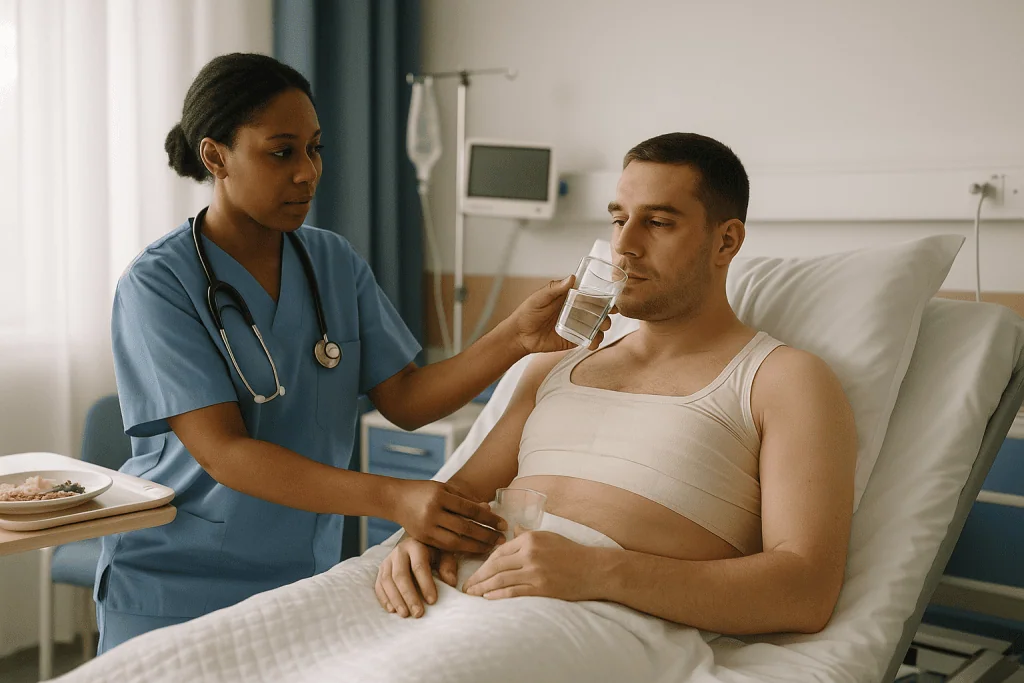
If drains were placed, you will see one or two thin tubes leading to small bulbs or bottles that collect pinkish fluid. Nurses show you how to empty and record them before you leave. Drains are not universal; many liposuction-dominant procedures go without.
The anesthetic itself dominates the day. Grogginess, a sore throat from the breathing tube, and nausea are common, and the NHS advises against driving, drinking alcohol, or signing legal documents for 24 to 48 hours afterward, with a responsible adult staying with you overnight. Sip fluids, eat light food when you feel able, and expect to feel more tired than the size of the incisions seems to justify.
Movement is encouraged early, in a specific way. Short walks around the house every couple of hours keep blood moving in the legs, which is the everyday defense against clots. What you should not do is reach overhead, push up from a chair with your arms, or lift anything that makes you brace your chest. Many people sleep propped on pillows or in a recliner for the first nights, partly for comfort and partly because rolling onto the side pulls on the incisions.
By the time you fall asleep that first night, the surgical part of the male breast reduction recovery time is behind you. Everything from here is healing.
How painful is male breast reduction, honestly?
Most people describe it as soreness rather than pain: a deep bruised feeling across the chest, sharper twinges at the incision lines, and a raw, sunburn-like sensitivity over the nipples that can make a shirt collar brushing past feel exaggerated. Liposuction areas tend to ache diffusely, because the cannula has passed back and forth through the fat layer. Excision sites feel more focused. Days one to three are usually the peak, with a steady easing through the rest of the first week. Discomfort rarely stops people sleeping after the first couple of nights, though finding a position takes patience.
Pain relief, when prescribed, generally comes from familiar classes. Acetaminophen works centrally on pain signaling and is often the backbone. Non-steroidal anti-inflammatory drugs reduce the inflammatory chemicals that make swollen tissue tender, but some surgeons ask people to avoid them in the early days because they can slightly increase bleeding tendency. A short course of an opioid is sometimes offered for the first days, with the trade-offs of drowsiness, constipation, and an absolute ban on driving. Which of these you take, in what combination and for how long, is a decision for your prescribing clinician, and the plan is often tapered quickly as the soreness fades.
Two sensations surprise people. The first is itching and tingling as nerves in the skin recover, which can come and go for weeks. The second is numbness of the nipple or a patch of chest skin, which Mayo Clinic and the NHS list as a recognized effect that usually improves over months and occasionally persists.
Simple measures help alongside medicine: keeping the garment on so tissue is not jostled, walking gently, avoiding hunching, and using cool packs over the garment if your team agrees. Pain that climbs rather than falls after day three is a signal to phone, not to endure.
Can you drive home after gynecomastia surgery?
No. Not on the day, and not the next morning either in most cases. The NHS is explicit that after a general anesthetic you should not drive for at least 24 to 48 hours, and that someone should take you home and stay with you. Even under sedation rather than full anesthesia, reaction time and judgment are impaired for longer than people feel they are. Hospitals will not discharge you to drive yourself, and an insurer would take a dim view if something went wrong.
The more useful question is when you can drive after that. There is no single figure in the guidelines, so surgeons apply a functional test. You need to be off any medicine that causes drowsiness, which rules out the days when an opioid is in play. You need to be able to turn the steering wheel through a full lock, look over both shoulders, and perform an emergency stop without your chest making you flinch. If the seatbelt across the incisions would make you hesitate, you are not ready. For many people that point arrives during the first or second week, but your surgeon will tell you when it applies to you, and it is worth checking your own insurer’s wording about recent surgery.
Plan the logistics before the day. Someone to collect you, ideally in a car where the seat can be reclined a little and the belt padded with a folded towel. Someone at home for the first night, as the NHS advises. Prescriptions collected in advance, pillows arranged, a shirt that buttons at the front rather than one that has to be pulled over your head.
Public transport is not a shortcut either in the first day or two; the jostling and the standing are more than most people want, and you should not be alone if you feel faint.
Gynecomastia surgery recovery week by week: the milestone table
Recovery is less a straight line than a set of thresholds you cross in roughly predictable order. The ranges below reflect the general timelines described by the NHS for male breast reduction. Your own team may lengthen or shorten any of them based on how much tissue was removed, whether skin was excised, and how your wounds behave.
| Milestone | Typical timing | What most people notice | Usual restrictions |
|---|---|---|---|
| Discharge home | Same day or next day | Tight, numb-then-sore chest; anesthetic grogginess | No driving; adult stays overnight; short walks only |
| Drains out, first wound check | Within the first few days, if drains used | Bruising spreading downward; swelling at its peak | Garment on nearly all the time; no lifting or reaching overhead |
| Return to desk-type work | About one week | Soreness easing; fatigue lingers | Light duties; garment continues |
| Stitches dissolve or removed | Around one to two weeks | Firmness and lumpiness under skin | Gentle walking; no chest strain |
| Strenuous exercise and heavy lifting resume | After the first few weeks, with clearance | Swelling largely settled but shape still changing | Reintroduce chest and upper-body work last |
| Final contour | Up to about six months | Scars soften and fade gradually | Sun protection for scars |
Notice how the physical milestones cluster in the first three weeks while the visual ones stretch out for months. That gap is where most disappointment lives. People feel recovered at week three and expect the mirror to agree, but the tissue is still remodeling and residual swelling still hides the final line of the chest. Read the table as two overlapping timelines: one for how you feel, another for how you look.
Days two to seven: the compression vest after gynecomastia surgery, drains and showering
The compression vest is the least glamorous and most important piece of equipment in the first weeks. It is a firm, stretchy garment that presses the skin evenly against the underlying muscle. That pressure limits how much fluid can pool in the space the surgeon has just emptied, which lowers the chance of a seroma, and it encourages the loosened skin to shrink back and stick down smoothly rather than rippling. The NHS advises wearing an elastic compression garment for a few weeks; most surgeons ask for near-continuous wear at first, removed only for washing, then a reduced schedule later. Do not improvise with a tighter garment in the hope of a faster result; excessive pressure can bruise skin and even compromise its blood supply.
Drains, if you have them, are usually removed at the first clinic visit within the first few days, once the daily volume of fluid has fallen. Removal is quick, more odd than painful, and it makes dressing and sleeping noticeably easier.
Bruising migrates. Gravity pulls blood that has leaked into the tissue downward, so a chest that looked mildly purple on day two can produce dramatic yellow-green streaks across the upper abdomen by day five. This is expected. What is not expected is one side swelling suddenly and becoming tense and painful, which is the picture of a hematoma and needs a same-day call.
Showering depends on your dressings. Many modern dressings are waterproof and can be left on for the first week; others must stay dry until the first review. Your team’s written instructions override anything you read online, including this. When you are allowed to wash, pat the incisions dry rather than rubbing, avoid soaking in a bath, and put the vest straight back on.
By day seven, most people are moving around the house freely, sleeping more normally, and starting to feel bored, which is a good sign.
Weeks two and three: back to work, stitches, and the swelling plateau
The NHS puts return to work at about a week for most people, and that holds well for desk-based roles. Sitting, typing, and taking calls are all fine; the limiting factors are fatigue, which lingers longer than soreness, and the practical awkwardness of the vest under a shirt. Anyone whose job involves lifting, reaching overhead, or driving for long stretches should expect a longer absence and a phased return agreed with the surgeon and employer.
Stitches are either dissolvable, in which case they soften and disappear on their own over one to two weeks, or non-absorbable and removed at a clinic visit in the same window. Either way, the incision lines will look raised and pink at this stage. That is immature scar, not a problem.
Underneath the skin, a different process is under way. Run your hand across the chest and you may feel firm ridges, small lumps, or a general woodiness. This is organizing scar tissue and residual swelling in the layer where fat and gland were removed. It is one of the most common causes of anxious phone calls at week two, and it is almost always normal. It softens over subsequent months, sometimes with the help of gentle massage that your team may show you once the wounds are fully closed.
Swelling reaches a kind of plateau in this period. It has fallen from its peak but is no longer dropping visibly day to day, which can feel like stalling. It is not; the remaining fluid clears slowly through the lymphatic system, a network of fine vessels that drain tissue fluid, and that network was disrupted by the surgery and needs time to reconnect.
Walking is encouraged and can lengthen. Anything that raises the heart rate hard or engages the chest stays off the menu a little longer.
Weeks four to six: when can I exercise after gynecomastia surgery?
The NHS advises avoiding strenuous exercise and heavy lifting for the first few weeks after male breast reduction, and most surgical teams translate that into a staged return that begins in earnest around this point, with clearance at a follow-up visit rather than on a date circled at home.
The order matters more than the date. Walking has been fine since day one. Lower-body cardio that does not swing the arms hard, such as a stationary bike or an incline walk, is typically the next step, because it raises the heart rate without loading the chest. Upper-body resistance work, and anything involving the pectoral muscles specifically, comes last. Pressing movements, pull-ups, and heavy rows all tension the exact layer that is still knitting together, and a sharp increase in blood pressure across healing vessels is how late bleeds and seromas happen.
Swimming waits until every incision is completely sealed, since pool and open water carry infection risk to an open wound. Contact sports and anything with a risk of a blow to the chest sit at the far end of the queue.
Listen to two signals when you do restart. The first is swelling: a chest that looks puffier the morning after a workout is telling you the load was too much, too soon. The second is asymmetry: if one side swells or aches more than the other after exertion, stop and call rather than pushing through. Neither means you have ruined anything, but both mean the tissue wants another week.
People who trained hard before surgery often find this phase the most frustrating part of the whole male breast reduction recovery time. The consolation is that the pectoral muscle is untouched by the operation; strength returns quickly once you are allowed to use it, and a leaner overlying layer tends to show that muscle more clearly than before.
Gynecomastia surgery swelling timeline: why week six is not the finish line
By six weeks, most of the acute swelling has gone, the vest is usually being phased out, and the chest feels like yours again. It is a real milestone. It is not, however, the result. The NHS notes that it can take up to six months to see the final outcome of male breast reduction, and the reasons are mechanical rather than mysterious.
Three things are still changing. Residual fluid in the deep tissue continues to clear as lymphatic drainage recovers. Scar tissue in the operated layer, which is firm and slightly bulky at week six, gradually softens and contracts, which is what finally lets the skin lie flat against the muscle. And the skin itself, if it was stretched for years, keeps tightening slowly for months; how much it retracts depends heavily on age, sun damage, and how long the enlargement was present, which is why some people are told at the outset that skin removal may be needed.
Scars follow their own schedule. They are usually at their most visible, red and slightly raised, in the first couple of months, then fade over the following year. Sun exposure darkens immature scar permanently, so covering or protecting the lines whenever the chest is exposed is one of the few things you can actively do to influence the final look. Silicone-based products and massage are commonly suggested by surgical teams; the evidence for their benefit is modest, and your team will advise what fits your incisions.
Sensation can be the slowest of all. Numbness or oversensitivity around the nipple may persist beyond six weeks and, in a minority of people, becomes permanent, as both Mayo Clinic and the NHS acknowledge.
The practical advice is to judge the operation at six months, not six weeks, and to book photographs at both points so you are comparing evidence rather than memory.
What people often get wrong about male breast reduction recovery time
The first misconception is that a small incision means a small recovery. The wounds are short, but the working area under the skin spans the whole chest, and the body treats that as a substantial injury. Planning for a weekend off and a Monday commute is how people end up back in clinic with a fluid collection.
The second is the opposite: that the pain will be severe. For most people it is soreness and tightness, peaking in the first three days and fading through the first week. Fear of pain leads some to postpone an operation they have already decided on for years.
The third is that the compression vest is optional, or that a tighter one works better. Neither is true. The garment is doing measurable work against seroma and skin irregularity, and it should be exactly as tight as the team fitted it, no more.
The fourth is that what you see when the dressings come off is the result. It is a swollen, bruised, partly numb version of the result. The NHS timeline for the final shape runs to six months.
The fifth is that surgery is a permanent guarantee. Gland that has been excised does not grow back, but gynecomastia can recur if the cause persists, which is why Mayo Clinic emphasizes identifying medicines, anabolic steroid use, or medical conditions before treatment. Significant weight gain can also refill the fat layer.
The sixth is that gynecomastia is simply fat, and that enough exercise would have removed it. Glandular tissue does not respond to diet or training; that is the whole reason excision exists. People who have been told to just work out harder often carry unnecessary shame about a condition Cleveland Clinic describes as common and hormonal.
The last is that recovery timelines online apply to everyone. They describe typical ranges. Your surgeon’s instructions describe you.
Questions to ask your care team before the day
The most useful conversations happen before the anesthetic, while you can still change plans. Bring a written list; most people forget half of what they meant to ask once they are in the room. These questions map directly onto the recovery you will actually live through.
- Which components does my operation include: liposuction, gland excision, skin removal, or nipple repositioning? Each changes the scar pattern and the timeline.
- Will I go home the same day or stay overnight, and what determines that?
- Will I have drains, and when do you expect to remove them?
- How long do you want the compression garment worn each day, and for how many weeks in total?
- When can I shower, and are my dressings waterproof?
- What is your specific rule on driving, and what should I be able to do before I get behind the wheel?
- When do you expect me to return to my particular job, given what it involves physically?
- In what order should I reintroduce exercise, and at which appointment will you clear each stage?
- How often do people in your practice need a second procedure for fluid or contour, and how is that handled?
- What sensation changes should I expect at the nipple, and how long do they usually last?
- Which symptoms should make me call the ward the same day, and which should send me to an emergency department?
- Who do I contact out of hours, and what number do I use?
Ask, too, what the team would consider a reason to postpone: a cold on the day, a change in a regular medicine, a recent change in weight. Knowing the answer removes the temptation to hide something small that turns out to matter. A team that welcomes this list is telling you something about how they will handle your questions at week two, when they matter most.
When to call your doctor
Most of what you feel in the first six weeks is expected: soreness, tightness, bruising that travels, lumpiness under the skin, and patches of numbness or tingling. A few things are not, and the rule is simple. If something changes suddenly, affects one side much more than the other, or gets worse when the trend should be improvement, phone the team that day rather than waiting for the next scheduled visit.
Call your surgical team the same day if one side of the chest swells rapidly and becomes tense, hard, or intensely painful, which can indicate bleeding under the skin; if you develop a fever, chills, or feel generally unwell; if redness spreads outward from an incision, the skin feels hot, or the wound leaks pus or smells unpleasant; if an incision opens or the edges separate; if the nipple or surrounding skin turns dusky, purple, or black, which can signal compromised blood supply; if a drain stops working, falls out, or fills with bright red blood; if you cannot keep fluids down or pain is climbing despite the medicines you have been prescribed; or if you notice a soft, sloshing swelling that keeps enlarging, which may be a seroma needing drainage.
Call emergency services immediately, rather than the clinic, for sudden shortness of breath, chest pain that is different from the surgical soreness, coughing up blood, or a calf that becomes painful, swollen, or warm on one side. These can be signs of a blood clot in the leg or lung, which any operation under anesthesia carries a small risk of, and which is treatable when caught quickly.
The people answering the ward or clinic phone would far rather hear about a false alarm at week one than a complication at week three. Nothing in this article replaces their judgment, and every decision about your care, from garments to exercise to whether a swelling needs a needle, sits with the team looking after you.
Frequently asked questions
How long is male breast reduction recovery time overall?
Most people are home within a day, back at desk work after about a week, and free of major restrictions after the first few weeks, according to NHS guidance, but the final shape can take up to six months to settle. The physical recovery is measured in weeks; the visual one is measured in months. Your surgeon’s instructions define your own timeline, which may differ from these typical ranges.
How painful is male breast reduction surgery?
It is generally described as deep soreness and tightness rather than severe pain, similar to heavy bruising across the chest, with sharper twinges at incision lines and a sunburn-like sensitivity over the nipples. Discomfort usually peaks in the first three days and eases through the first week. Prescribed pain relief, decided by your clinician, typically tapers quickly. Pain that increases after day three should prompt a call to your team.
Is breast reduction a big op?
It is a moderate operation: performed under general anesthetic or sedation, usually as a day case or with one overnight stay, according to the NHS. The incisions are small, but the treated area covers the whole chest, so the body responds as it would to a significant injury. Recognized risks include bleeding, fluid collections, infection, altered nipple sensation, asymmetry, and scarring, which your surgeon will discuss before consent.
Can you drive home after gynecomastia surgery?
No. The NHS advises not driving for at least 24 to 48 hours after a general anesthetic, and hospitals require someone to take you home and stay with you overnight. After that, you can drive once you are off sedating medicines and can turn the wheel fully, check mirrors, and brake hard without chest pain. For many people that is during the first or second week, but your surgeon decides.
What is the best age for gynecomastia surgery?
There is no fixed best age; surgeons look for a stable state instead. Mayo Clinic notes that pubertal gynecomastia usually resolves within six months to two years, so adolescents are typically asked to wait until puberty is complete and the tissue has stopped changing. In adults, the ideal candidate has had underlying causes evaluated, a stable weight, and no ongoing driver such as anabolic steroid use.
How long do you wear a compression vest after gynecomastia surgery?
The NHS describes wearing an elastic compression garment for a few weeks after male breast reduction. Most teams ask for near-continuous wear in the early period, removed only for washing, then a reduced daily schedule as swelling settles. The vest limits fluid collections and helps stretched skin adhere smoothly. Wear it exactly as fitted; a tighter garment does not speed healing and can damage skin.
When can I exercise after gynecomastia surgery?
Gentle walking starts the day of surgery, but the NHS advises avoiding strenuous exercise and heavy lifting for the first few weeks. Teams usually reintroduce activity in stages: lower-body cardio first, then general resistance work, and chest or pressing exercises last, each cleared at a follow-up visit. Increased swelling or one-sided ache after a session means the load came too soon.
What does the gynecomastia surgery swelling timeline look like?
Swelling peaks in the first few days, falls noticeably over the first two weeks, then plateaus and clears slowly as lymphatic drainage recovers. Bruising often migrates downward to the abdomen, which is normal. By six weeks most acute swelling has gone, but the NHS notes the final contour can take up to six months as scar tissue softens and skin tightens. Sudden one-sided swelling is not part of this pattern and needs a call.
Will gynecomastia come back after surgery?
Excised glandular tissue does not regrow, but enlargement can recur if the underlying cause continues. Mayo Clinic highlights medicines, anabolic steroids, and medical conditions that drive gynecomastia, which is why evaluation comes before surgery. Significant weight gain can also refill the fat layer of the chest. Keeping weight stable and addressing any identified cause with your clinician gives the result the best chance of lasting.
When will I see the final result of male breast reduction?
The NHS states that it can take up to six months to see the final result. At six weeks the chest feels recovered, but residual deep swelling, firm scar tissue under the skin, and gradual skin tightening are all still changing the shape. Scars fade over the following year. Taking photographs at six weeks and six months lets you compare evidence rather than memory.
References
- NHS: General anaesthesia
- Cleveland Clinic: Enlarged Male Breast Tissue (Gynecomastia)
- MedlinePlus: Breast enlargement in males
This article is for general information only and is not a substitute for professional medical advice. Please consult a qualified doctor about your individual situation.

More from the Blog

How Is Discomfort Managed After Breast Reduction? Tightness, Drains and Sleeping Positions
Breast reduction pain after surgery is usually described as soreness and tightness rather than sharp pain, and it is typically most noticeable in the…

What Breasts Look Like After Prosthesis Removal: Volume, Skin and When a Lift Is Discussed
After implant removal without replacement, breasts usually look smaller and softer at first, with loose or deflated-looking skin, a lower nipple position and some…

Who Is a Candidate for Breast Fat Transfer? Donor Fat, Breast Volume Goals and Skin Quality
A good fat transfer breast augmentation candidate is a healthy adult who wants a modest increase in size or fullness, has enough spare fat…

Anesthesia for Aesthetic Breast Surgery: General vs Sedation and What Recovery Feels Like
Most implant-based aesthetic breast surgery is performed under general anesthesia, where you are fully unconscious and your breathing is supported; smaller procedures, such as…

Flying Home After Breast Augmentation: Stay Length, Lifting Limits and Comfort en Route
There is no fixed medical rule for flying after breast augmentation. Most surgical teams prefer that patients stay near the clinic until the first…

Nipple Reconstruction Results: Why Projection Softens Over Time and What Can Be Adjusted
Reconstructed nipples almost always lose some height in the first year because the small skin flap or graft has no ducts, muscle or firm…