

Recovering From Accessory Breast Treatment: Arm Movement, Garments and Return to Work

Key Takeaways
- Accessory breast tissue is a leftover of the embryonic milk line that responds to hormones, which is why it swells before periods and during pregnancy and often shrinks after breastfeeding.
- Liposuction removes the fatty component but not dense glandular tissue, so many procedures combine suction with excision through an incision hidden in the armpit fold.
- Gentle hand, elbow and shoulder movement from the first day is standard advice; what is avoided early is forceful overhead reaching and carrying on the operated side, not motion itself.
- Compression garments limit fluid collection and help skin redrape but do not sculpt, and a garment that causes tingling, a cold hand or skin grooves is too tight.
- Desk work often resumes within one to two weeks, while physically demanding jobs typically wait several weeks and need a date set by the surgeon after checking the wound.
- The NHS notes final contour after liposuction can take up to six months, so firm, lumpy tissue in the early weeks reflects healing rather than a failed operation.
Recovery after accessory breast removal usually means a few days of underarm soreness and swelling, gentle arm movement from the first day, a compression garment worn for several weeks, and a return to desk-based work within roughly one to two weeks, with lifting and vigorous exercise delayed longer. Final contour can take up to six months to settle. Exact timings depend on the technique used and on your surgeon's instructions.
The first thing many people notice, sitting up in the recovery bay, is not the incision. It is the strange tightness when they reach for a cup of water and their armpit refuses to stretch the way it did that morning. Someone kindly reminds them that this is normal, that the tissue underneath has been rearranged, and that the goal now is patience with a plan.
Accessory breast removal recovery is, in most cases, a short story with a slow last chapter. The sore, swollen phase is measured in days. The garment phase is measured in weeks. The shape you will eventually see in the mirror takes months to arrive, and that mismatch between how quickly you feel fine and how slowly the contour settles is where most anxiety lives.
This explainer walks through what actually happens under the skin, how to move your arm without hurting the healing, what compression garments do and do not do, when work tends to become realistic, and which warning signs mean a phone call rather than a wait.
What is accessory breast tissue, and why does anyone need it treated?
Accessory breast tissue, also called axillary or supernumerary breast tissue, is breast tissue that developed somewhere other than the two usual breasts, most often high in the armpit. The word axillary simply means relating to the armpit.
The reason it exists is a leftover from early development. Before birth, a ridge of tissue runs from each armpit down toward the groin, sometimes called the milk line. Normally that ridge shrinks away everywhere except the chest. When a small fragment persists, it keeps behaving like breast tissue for life: it responds to the same hormones, so it can feel fuller and more tender before a period, and it often enlarges noticeably during pregnancy and breastfeeding. Some people also have an extra nipple along the same line, with or without underlying glandular tissue.
This is a variation of normal anatomy rather than a disease. Many people live with it comfortably and never seek treatment. Others find that it rubs against clothing, aches in the second half of the menstrual cycle, makes bra straps sit awkwardly, or causes distress in sleeveless clothing. Occasionally a firm lump within the tissue needs assessment in its own right, because anything that is breast tissue can develop the same conditions that ordinary breast tissue can.
Treatment, therefore, is usually a quality-of-life decision made jointly with a surgeon after imaging has confirmed what the tissue is. The evidence base for removal is built on observational surgical series rather than large randomized trials, which is typical for procedures addressing discomfort and appearance. That is worth knowing up front: the outcomes discussed here describe what usually happens, not what is guaranteed to happen.
How accessory breast tissue surgery actually works: excision, liposuction or both
There are two basic tools, and the choice between them shapes the recovery that follows.
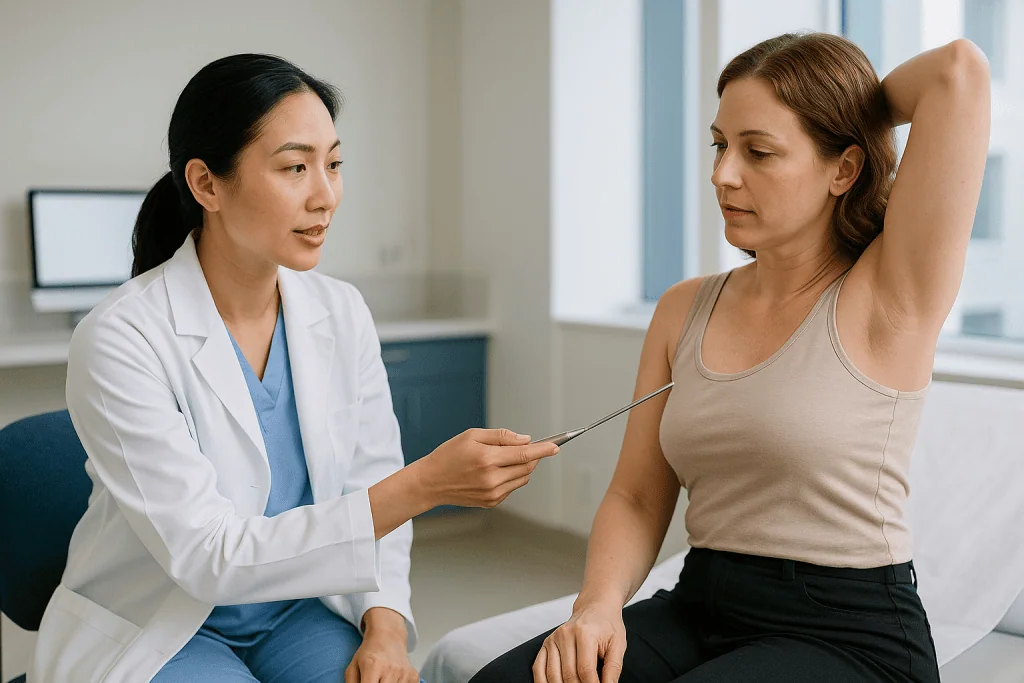
Excision means cutting the tissue out. The surgeon places an incision in a natural fold of the armpit, lifts the skin, removes the glandular tissue and any excess skin, and closes with stitches that are usually dissolvable. Because glandular breast tissue is firm and fibrous, excision is the reliable way to remove it completely. Removed tissue is routinely sent to a pathology laboratory, where a specialist examines it under a microscope to confirm what it is; this is standard practice for any breast tissue removed surgically, as MedlinePlus describes for breast lump removal generally.
Liposuction uses a thin hollow tube called a cannula, inserted through a few tiny incisions, to suction out fat. It works well when the bulge is mostly fatty and the skin is elastic enough to shrink back over the new contour. It cannot remove dense glandular tissue efficiently, which is why many surgeons combine the two: liposuction to feather the edges and thin the fat, excision to take out the gland and tighten skin. The Mayo Clinic notes that liposuction leaves swelling that settles over several weeks and that a compression garment is generally worn afterward; the same principles carry into combined procedures.
Anesthesia may be local with sedation or general, and most people go home the same day. A small drain, a soft tube that lets fluid escape into a bulb, is sometimes placed for a few days when a larger pocket of tissue has been removed.
Alternatives are real and legitimate: doing nothing, supportive bras, and watchful waiting with repeat imaging. A good consultation lays these side by side rather than assuming surgery is the only path.
Who is usually offered axillary breast tissue removal, and who is asked to wait
Surgeons tend to offer removal to adults whose tissue has been confirmed on imaging, whose symptoms have persisted across several menstrual cycles rather than flaring once, and whose expectations match what surgery can deliver: less bulk and fewer symptoms, not a perfectly flat, scar-free armpit.
Several groups are commonly asked to wait, and the reasons are practical rather than dismissive.
- People who are pregnant or breastfeeding. Hormones enlarge the tissue and operating on engorged, milk-producing tissue raises the risk of fluid leakage and infection. Surgeons generally prefer to reassess once feeding has finished and the tissue has settled, because it often shrinks on its own.
- Anyone with an unexplained new lump. A lump needs imaging, and sometimes a needle biopsy, before any removal is planned, so the operation addresses the right problem.
- Teenagers, whose tissue may still be changing with normal development.
- People in the middle of significant weight change, since the fat component will shift again.
- Those with an active skin infection or rash in the armpit, uncontrolled diabetes, or a bleeding tendency that has not yet been evaluated.
- Smokers are typically asked to stop well beforehand, because nicotine narrows small blood vessels and slows wound healing.
Some people are advised against surgery altogether when symptoms are mild and the risks, including permanent numbness and visible scarring, outweigh the likely benefit. That conversation can feel disappointing, but it reflects the same evidence-first weighing that applies to any elective operation. The decision, and its timing, rests with the treating team who have examined you and seen your scans.
The first 48 hours: drains, dressings and what the soreness actually is
The underarm is a busy neighborhood of skin, nerves and lymph channels, so the early soreness is a mix of three sensations. There is incision pain, sharp when you stretch. There is a deep bruised ache from where fat or gland was removed. And there is a curious tight, wooden numbness across the inner upper arm, which comes from a small sensory nerve, the intercostobrachial nerve, that crosses this area and is often stretched or divided. That numbness is expected and usually improves over months, though not always fully.

Pain control follows the same stepwise logic used after most day-case surgery. A simple analgesic such as acetaminophen is often the foundation; it acts centrally to dampen pain signals and has no effect on bleeding. Anti-inflammatory medicines, a class that reduces the chemical messengers driving swelling, may or may not be advised depending on your bleeding risk and other conditions, so follow the prescribing clinician rather than a friend’s leftover bottle. Stronger medicines, if given at all, are typically for a very short window. Never adjust anything you have been prescribed without asking the team.
If a drain was placed, you will be shown how to empty the bulb and record the volume. Falling output over a few days is what the team looks for before removing it, usually in clinic. Dressings vary: some are waterproof, some are not. MedlinePlus advises keeping surgical wounds clean and dry as instructed and washing your hands before touching the area. A light bruise spreading down the arm is common and follows gravity; a rapidly enlarging, tense, painful swelling on one side is not, and belongs in the red-flag section later.
Accessory breast removal recovery week by week: a realistic timeline
Recovery is easier to tolerate when you know which phase you are in. The table below summarizes what most people experience; the ranges come from general guidance on breast lump removal and liposuction recovery from MedlinePlus, the Mayo Clinic and the NHS, and your surgeon may quote different figures based on how much tissue was removed and which technique was used.
| Phase | What is usually happening | What is usually allowed |
|---|---|---|
| Days 1–3 | Peak swelling and bruising; drain in place if used; numbness along inner arm | Walking, gentle shoulder shrugs and elbow bends; garment on almost continuously |
| Days 4–7 | Drain often removed; soreness shifting from sharp to dull; dressings changed or removed | Showering as instructed; light desk work from home for some |
| Weeks 2–3 | Bruising fading; swelling still present and sometimes firm or lumpy | Return to many desk jobs; raising the arm to shoulder height; driving once off strong painkillers and able to steer safely |
| Weeks 4–6 | Incision sealed; internal healing continuing; garment often being weaned | Progressive stretching; light aerobic exercise; heavier lifting only when cleared |
| Months 2–6 | Firmness softening; scar maturing from red to pale; contour settling | Full activity; scar care as advised |
Two points in that table deserve emphasis. First, the NHS notes that it can take up to six months to see the final result after liposuction, and the same is true here because the swelling under the skin resolves slowly. Second, the moment you feel well, often around the end of week two, is not the moment your tissues are strong. Tendons and skin regain strength over weeks, which is why lifting restrictions outlast the pain.
Progress is not perfectly linear. Many people describe a good day followed by a puffier one after a longer walk or a busy afternoon. That pattern is expected and settles.
Arm movement after underarm surgery: what to move, what to rest
The armpit is a joint’s front porch. Every time you reach overhead, the skin and fat there stretch by several centimeters, and freshly stitched tissue does not appreciate sudden demands. Yet the opposite error, keeping the arm pinned to the side for weeks, carries its own price: the shoulder capsule can tighten, and a stiff, painful shoulder can take far longer to fix than the surgery took to heal.
The balance most surgeons recommend looks like this. From the first day, keep the elbow, wrist and hand fully moving; make a fist, bend and straighten the elbow, roll the shoulders. Let the arm hang and swing gently when you walk. Bring the hand to your mouth and to the back of your head if it is comfortable. What you avoid early is forceful reaching above shoulder height, pushing up out of a chair with that arm, and carrying bags on that side.
From roughly the second week, if the incision is quiet, most teams introduce gentle wall walks: standing facing a wall, fingertips creeping upward until you feel a stretch, not pain, holding briefly, then coming down. Progress a little each day. If the armpit feels like a tight cord when you lift, that is often a healing lymph channel or scar band; it usually softens with gradual stretching, and a physical therapist can help if it persists.
Because removal of accessory tissue generally does not involve removing lymph nodes, the risk of lymphedema, a chronic swelling of the arm from disrupted lymph drainage, is low compared with cancer surgery that samples or clears nodes. Even so, report any persistent arm swelling. Ask your surgeon for the specific movement plan that matches what was done, because a large excision and a small liposuction session deserve different pacing.
Compression garments after axillary breast tissue removal: why, how long and what they cannot do
A compression garment is a firm, stretchy vest, band or sleeve that presses evenly over the operated area. It earns its place for three mechanical reasons. Surgery leaves a small empty space where tissue used to be; gentle pressure holds skin against the underlying layers so they can knit together. That same pressure discourages fluid from pooling into a seroma, a soft collection of clear fluid under the skin, or a hematoma, a collection of blood. After liposuction, compression also helps the skin redrape smoothly over its new, thinner base.
How long? The Mayo Clinic and the NHS both describe wearing a compression garment for a few weeks after liposuction, and surgeons commonly extend that for combined procedures. Many ask for near-continuous wear in the first weeks, removing it only to shower, then daytime-only wear as swelling drops. Take the schedule from your team, not from a forum.
What a garment cannot do is just as important. It does not shrink glandular tissue, tighten loose skin permanently, or improve a result beyond what the surgery achieved. Tighter is not better: a garment that digs in, leaves deep grooves, causes tingling in the fingers, or creates blisters is doing harm. Signs it is too tight include a cold or pale hand, pins and needles, or a new fold of swelling bulging out above or below the edge.
Practical points make wear easier. Put it on lying down when swelling is lowest. Wear a thin cotton layer underneath if the seams chafe. Wash it as instructed so it keeps its elasticity. If you have two, alternate. A garment that has stretched out after weeks of use is not doing much, and many people are moved to a lighter support bra or tank for the last stretch.
When can I go back to work after accessory breast removal?
This is the question people most often ask, and the honest answer depends less on the calendar than on what your job asks of your arm.
For seated, desk-based work, many people manage light tasks from home within the first week and return in person at around one to two weeks, once they are off stronger painkillers and can sit at a keyboard without their armpit protesting. Typing itself is rarely the problem; carrying a laptop bag, reaching across a desk and commuting on crowded transport are. MedlinePlus notes that people generally return to usual activities within a week or so after minor breast surgery such as lump removal, while the NHS describes liposuction recovery in terms of weeks, so a combined axillary procedure sits somewhere in between.
For work involving lifting, reaching overhead, repetitive arm motion or heavy physical effort, think in terms of several weeks, and expect your surgeon to set a specific date after checking the wound. Returning too early to this kind of work raises the risk of seroma, wound stretching and prolonged swelling. Some employers can offer a phased return or modified duties; a letter from the surgical team specifying the restriction, for example no lifting above a certain weight or above shoulder height, is more useful than a vague sick note.
Uniforms and personal protective equipment matter more than people expect. Tight underarm seams, shoulder straps and harnesses press on exactly the area that is healing. Plan for a looser top or a strap pad for the first few weeks back.
Fatigue is the quiet variable. Even a short anesthetic and a week of disturbed sleep leave many people flat by mid-afternoon in the first week or two back. If you can, schedule the heavier meetings or shifts later in the return.
Driving, showering, exercise, sleep and deodorant: the everyday questions
The details nobody remembers to ask in clinic are the ones that fill the first fortnight.
Driving is safe when you can steer, check mirrors and perform an emergency stop without hesitation, and when you are no longer taking medicines that impair alertness. For many people that is around one to two weeks, but the test is functional, not numerical. Some insurers also want to know about recent surgery, so a quick check avoids surprises.
Showering depends on your dressing. Waterproof dressings often allow showering within a day or two; others require waiting until the dressing is changed. Let water run over the area rather than scrubbing it, pat dry, and avoid soaking in a bath or swimming until the incision has fully sealed, which usually takes a few weeks. MedlinePlus wound-care guidance stresses clean hands and gentle handling above all.
Deodorant and antiperspirant should stay off the incision until it is closed and no longer scabbed, because the ingredients can irritate raw skin and trap bacteria. Shaving the area can wait similarly; numb skin is easy to nick without noticing.
Sleep is easiest on your back with a pillow under the operated arm so it rests slightly forward and away from the body. Side-sleepers who roll onto the surgical side usually wake up quickly; a pillow behind the back helps.
Exercise follows a simple ladder. Walking starts on day one and doubles as clot prevention: moving the calf muscles keeps blood flowing, and the NHS lists reduced mobility after surgery among the factors that raise deep vein thrombosis risk. Brisk walking and stationary cycling can follow once the drain is out and you are comfortable. Running, swimming, upper-body weights, yoga poses that load the arms and racket sports wait for explicit clearance, typically in the weeks-four-to-six window, because bouncing and overhead loading pull on exactly the healing plane.
Scars, numbness and contour: what settles and what tends to stay
Three things change slowly after this surgery, and each has its own timetable.
The scar sits in the armpit fold, where skin creases hide it well once mature. Early on it is red, slightly raised and can feel tight. Over months it flattens and fades toward skin tone as the collagen fibers reorganize. Scar maturation is a long process, and while it is happening, sun exposure can darken the line permanently, so covering it or using sun protection once the wound is closed is reasonable advice. Some people, particularly those with darker skin tones or a personal history of thick scars, are more prone to raised keloid or hypertrophic scars; mention that history before surgery so the team can plan.
Numbness along the inner arm and the back of the armpit comes from the small sensory nerve mentioned earlier. Sensation often returns gradually as nerve fibers regrow, sometimes with odd tingling or hypersensitivity along the way, but a patch of permanent altered sensation is a recognized outcome and should be part of any honest pre-operative conversation.
Contour is where patience is tested most. Under the skin, the body lays down temporary scar tissue that feels firm, lumpy or ridged; people sometimes worry that the surgeon left tissue behind, when in fact they are feeling healing. Gentle massage, once the team approves it, and time soften this. The NHS notes it can take up to six months to see the final result after liposuction, and combined procedures behave similarly. Minor asymmetry between the two armpits is common because the two sides rarely start identical.
What tends to stay: the scar itself, some altered sensation, and any residual fullness if the surgeon deliberately left tissue to avoid a hollow. What usually settles: firmness, ridges, bruising and the tight-cord feeling on stretching.
Does accessory breast tissue go away, grow back, or turn cancerous?
Three related worries, three different answers.
Does it go away on its own? Fully formed glandular tissue does not disappear, but its size fluctuates with hormones. Many people first notice it during pregnancy or breastfeeding, when it swells, and find it shrinks afterward without ever needing treatment. Fat within the bulge also rises and falls with body weight. So the tissue does not vanish, but its prominence genuinely can.
Does it grow back after removal? Gland that has been excised does not regenerate. What can happen is that a small amount of tissue left behind, either deliberately to avoid a dent or because it blended into surrounding fat, enlarges later under hormonal influence, especially in a subsequent pregnancy. Weight gain can also refill the fatty layer. This is why surgeons are careful to describe the result as reduction of bulk rather than a guarantee of permanent flatness, and why timing the operation after completing a family is sometimes suggested.
Can it be cancerous? Accessory breast tissue is breast tissue, so in principle the same benign and malignant conditions can arise there, including cysts, fibroadenomas and, rarely, breast cancer. This is uncommon, and most accessory tissue causes nothing more than discomfort. It is the reason imaging is done before removal and the reason removed tissue is examined by a pathologist afterward, as MedlinePlus describes for breast tissue removed surgically in general. Removal of accessory tissue does not change the need for routine breast screening of the ordinary breasts, and a new lump anywhere along the milk line, before or after surgery, deserves a clinical check rather than reassurance from a search engine.
What people often get wrong about accessory breast removal recovery
Recovery forums are generous with confidence and stingy with context. A few corrections, grounded in how the tissue behaves.
Myth: liposuction alone always does the job. Liposuction removes fat efficiently and gland poorly. If imaging shows dense glandular tissue, suction alone tends to leave a firm residual bump. Technique choice should follow anatomy, not preference for fewer scars.
Myth: it is just fat, so diet and exercise will clear it. Weight loss can slim the fatty portion and make the bulge less noticeable, but glandular tissue does not respond to calories. Expecting the gym to remove a gland leads to frustration.
Myth: keep the arm completely still so the stitches hold. Early gentle movement of the hand, elbow and shoulder is part of standard advice; what you avoid is force and overhead reaching, not motion itself. Weeks of immobility invite a stiff shoulder.
Myth: a tighter garment gives a better result. Garments limit fluid collection and support skin redraping; they do not sculpt. Overly tight compression causes skin damage and, in the extreme, impairs circulation.
Myth: lumpiness at three weeks means the surgery failed. Firm, uneven tissue under the skin during early healing is scar formation, and the NHS timeline of up to six months for final liposuction results applies here. Judging the outcome before then judges the swelling, not the surgery.
Myth: the scar will be invisible. It is placed to hide in a fold and usually fades well, but it is a scar.
Myth: once removed, the area can never enlarge again. Residual tissue can respond to pregnancy or weight change. Understanding that in advance prevents a sense of betrayal later.
Myth: before-and-after photographs show what you will get. They show one person, one anatomy, one moment in healing, often with favorable lighting.
Questions to ask your care team before and after surgery
A good consultation is a two-way exchange, and the most useful questions are the specific ones. Take these, edit them, and write the answers down, because the details blur once you are home.
- Which technique are you planning for me, excision, liposuction or both, and why does my imaging point that way?
- Roughly how much tissue do you expect to remove, and will you deliberately leave some to avoid a hollow?
- Where exactly will the incision sit, and how long is it likely to be?
- Will I have a drain, and if so, who removes it and when?
- Will the removed tissue be sent for pathology, and how will I get the result?
- What compression garment do you want me to wear, for how many hours a day, and for how many weeks?
- What arm movements are allowed in week one, week two and beyond, and when would you refer me to a physical therapist?
- When can I drive, shower, swim and lift my child or a suitcase?
- What is your expected return-to-work window for my specific job, and can you write the restrictions down for my employer?
- Which pain medicines do you recommend for me, and which should I avoid because of bleeding risk or my other conditions?
- What numbness should I expect, and how likely is it to be permanent?
- What does a normal amount of swelling and bruising look like at one week, and what would worry you?
- How do I reach the team out of hours, and which symptoms mean emergency care rather than a message?
- If I become pregnant later, what might happen to the area?
- When are my follow-up appointments, and at what point will you judge the final result?
Asking these questions is not doubting the surgeon; it is doing your part of the shared decision. Teams generally welcome a patient who knows the plan.
When to call your doctor: red-flag signs after accessory breast removal
Most recoveries are uneventful, but a handful of problems benefit from early attention, and knowing them in advance takes the guesswork out of a worrying evening.
Call your surgical team the same day if you notice a swelling under the arm that is rapidly enlarging, tense and painful, particularly on one side only; this can signal a hematoma, a collection of blood that sometimes needs draining. Call too for spreading redness around the incision, increasing rather than decreasing pain after the first few days, warmth, thick or foul-smelling discharge, a wound edge that has opened, or a fever. The NHS lists fever, chills and feeling generally unwell among early signs of a wound infection that may need antibiotics; only the prescribing clinician should decide that.
Watch the whole arm as well as the armpit. New swelling, heaviness or persistent aching along the arm, a hand that feels cold, pale or blue, or pins and needles that do not ease when the garment is loosened all warrant a call.
Some symptoms are emergencies. Seek urgent care immediately for chest pain, sudden breathlessness, coughing up blood, or a painful, swollen, warm calf; the NHS and the Mayo Clinic describe these as possible signs of a blood clot in the leg or lung, a rare but serious complication after any surgery. Likewise treat confusion, a racing heartbeat, mottled or very pale skin, or feeling extremely unwell with a fever as reasons to call emergency services rather than wait for clinic hours, since these can indicate sepsis, the body’s dangerous overreaction to infection.
Beyond the acute phase, book a routine appointment if numbness comes with weakness in the hand, if the shoulder is becoming stiffer rather than freer by the third week, if a lump persists or grows after several months, or if the scar thickens and itches persistently. None of these is an emergency, but each is a decision for the treating team, not for waiting out.
Frequently asked questions
How long does underarm breast tissue removal recovery take?
Most people are past the sore, swollen phase within about a week and back to desk-based routines in one to two weeks, but the tissue keeps changing for months. Compression is typically worn for several weeks, lifting and vigorous exercise wait for clearance, and the NHS notes that the final shape after liposuction can take up to six months to appear. Your surgeon’s timeline overrides any general figure.
Does accessory breast tissue go away on its own?
Glandular accessory tissue does not disappear, but it changes size with hormones and body weight. It commonly enlarges during pregnancy and breastfeeding and then shrinks afterward, sometimes enough that people no longer feel bothered by it. The fatty portion also follows weight change. If the tissue is confirmed and symptoms are mild, watchful waiting is a legitimate option to discuss with your care team.
Can accessory breast tissue be cancerous?
It can, though this is uncommon. Because accessory tissue is genuine breast tissue, the same benign conditions and, rarely, breast cancer can occur within it. This is why imaging is done before removal and why removed tissue is examined by a pathologist, as is standard for breast tissue taken out surgically. Any new or changing lump in the armpit, before or after surgery, should be checked by a clinician.
Can axillary breast tissue increase during pregnancy?
Yes, and it often does. Pregnancy hormones prepare all breast tissue for milk production, including accessory tissue, so the armpit bulge may become larger, tender and occasionally leak milk after delivery. It usually settles once breastfeeding ends. Surgeons generally prefer to operate after pregnancy and feeding have finished, both because the tissue is engorged and because residual tissue may enlarge again in a later pregnancy.
What are the possible side effects of accessory breast tissue surgery?
Common effects include bruising, swelling, temporary firmness or lumpiness under the skin, a visible scar in the armpit fold, and numbness along the inner arm that may be partial or permanent. Less common problems include seroma, hematoma, wound infection, contour irregularity or asymmetry, and, rarely, a blood clot. Your surgeon should explain how these risks apply to your anatomy and the technique planned.
When can I lift my arm above my head after axillary breast tissue removal?
Gentle movement to shoulder height is usually encouraged from the first days, with progressive stretching, such as fingertips walking up a wall, introduced around the second week if the incision is quiet. Full, forceful overhead reaching and lifting weight overhead typically wait until the surgeon clears you, often in the weeks-four-to-six window. The exact plan depends on how much tissue was removed and how the wound is healing.
How long do I wear a compression garment after accessory breast removal?
The Mayo Clinic and the NHS describe wearing compression for a few weeks after liposuction, and surgeons often extend this for combined excision and suction. A common pattern is near-continuous wear at first, removing it only to shower, then daytime-only wear as swelling drops, then a lighter support bra or tank. Follow your team’s schedule, and report any tingling, numb fingers or skin grooves, which suggest it is too tight.
Is it normal to feel hard lumps under the skin weeks after surgery?
Usually, yes. During healing the body lays down temporary scar tissue that can feel firm, ridged or lumpy, especially after liposuction. This softens over months, and the NHS notes that the final result after liposuction can take up to six months. A lump that is rapidly growing, hot, red or very painful is different and should be reported promptly to the surgical team.
Will accessory breast tissue grow back after removal?
Tissue that has been excised does not regenerate. However, small remnants left behind, sometimes deliberately to avoid a hollow, can enlarge with hormonal changes such as pregnancy, and the fatty layer can refill with weight gain. Surgeons therefore describe the outcome as a reduction in bulk rather than guaranteed permanent flatness, and some suggest timing surgery after completing a family.
How is recovery from accessory breast removal different from breast cancer surgery?
Accessory breast removal generally does not involve removing lymph nodes, radiotherapy or drug treatment, so recovery is shorter and the risk of chronic arm swelling, or lymphedema, is much lower. Recovery from breast cancer surgery varies widely with the operation and any additional treatment, and can extend over many weeks or months. The two share early principles: gentle arm movement, wound care, and watching for infection or clots.
References
- MedlinePlus: Breast lump removal
- MedlinePlus: Surgical wound care – open
- NHS: Liposuction
- NHS: Deep vein thrombosis (DVT)
This article is for general information only and is not a substitute for professional medical advice. Please consult a qualified doctor about your individual situation.

More from the Blog

Warning Signs After Breast Reconstruction: Redness, Swelling and Flap Changes to Report Fast
After breast reconstruction, report spreading redness, new warmth, swelling that grows rather than settles, pain that worsens after day three, cloudy or foul-smelling drainage,…

Which Breast Lift (Mastopexy) Technique Suits You? Crescent, Donut, Lollipop and Anchor
Breast lift techniques are named for their incision shapes. A crescent lift removes a sliver of skin above the areola, a donut lift circles…
Liposuction Alone or Gland Excision? How Gynecomastia Surgery Is Matched to Tissue Type
Liposuction removes fatty tissue, while surgical excision removes the firmer glandular disc behind the nipple, so surgeons choose based on what the chest actually…

Breast Imaging Around Fat Transfer: Why Scans Are Taken First and Reviewed Later
A mammogram after fat transfer is usually arranged so radiologists can compare the new images with a baseline scan taken before surgery. Grafted fat…

Gynecomastia Surgery Prep: Smoking, Supplements and the Tests Booked Beforehand
Preparing for gynecomastia surgery usually means stopping all nicotine for the period your surgeon sets, giving the team a complete list of medicines and…

How Does the Chest Settle After Gynaecomastia Treatment? Results Over the First Months
After gynaecomastia treatment, the chest settles in stages rather than all at once. Swelling and bruising are most noticeable in the first one to…