

Male Reproduction Testing Prep: The Abstinence Window and What to Bring to the Visit

Key Takeaways
- Mayo Clinic and Cleveland Clinic describe the usual abstinence window before a semen analysis as two to seven days, and a longer wait tends to increase volume while lowering motility.
- Sperm take roughly two to three months to mature, according to Cleveland Clinic, so a single sample reflects conditions from weeks earlier and fevers in that period can lower the result.
- Mayo Clinic advises delivering a home-collected sample within 30 to 60 minutes, kept near body temperature, because cooled sperm lose motility for reasons unrelated to the patient.
- The first portion of the ejaculate carries the highest sperm concentration, so losing it during collection can make a normal count read low and must be reported to the lab.
- Commonly used lower reference limits are 15 million sperm per milliliter, 40 percent total motility, and 4 percent normal morphology, but these are population statistics rather than fertility thresholds.
- Ordinary lubricants, saliva, lotions, and latex condoms damage sperm on contact, and laboratories routinely reject samples exposed to them.
To prepare for a semen analysis, most laboratories ask for two to seven days without ejaculation, no lubricants or saliva during collection, and delivery of the sample to the lab within about 30 to 60 minutes, kept close to body temperature. Bring photo identification, the request form, a list of medicines and recent illnesses, and the exact time of collection. Your care team confirms the specifics.
The instruction sheet is one page long, and he has read it four times on the train. Two to seven days. No lubricant. Sterile container. Deliver within the hour. Somewhere between the second and third reading, a test that sounded routine at the appointment has started to feel like an exam he might fail.
That reaction is common, and it is worth naming, because a semen analysis is one of the few medical tests where the patient produces the sample himself, on a schedule, under mild pressure. Knowing how to prepare for semen analysis takes most of that pressure off. The steps are simple; what trips people up is the reasoning behind them, and the small logistical details nobody mentions until the day arrives.
This guide walks through the abstinence window, what to avoid in the days before, how to collect and transport the sample, what to bring to the visit, and how to read the report you will eventually be handed. The decisions along the way stay with the clinician who ordered the test.
How to prepare for semen analysis: the short version before the details
A semen analysis is a laboratory examination of ejaculated fluid that measures how much fluid is present, how many sperm it contains, how well they move, and what shape they take. It is the first-line test when a couple has not conceived after a year of trying, and it is also used after a vasectomy to confirm the procedure worked. MedlinePlus describes it as a test that helps find out whether a problem with sperm may be contributing to difficulty conceiving.
Preparation rests on four ideas. First, timing: the lab wants a sample that reflects your usual output, which is why the abstinence window matters. Second, contamination: anything that touches the sample other than the sterile container can kill sperm or dilute the result. Third, temperature and speed: sperm begin to change soon after ejaculation, so the lab needs the sample quickly and kept warm. Fourth, context: fever, medicines, and recent stress can alter the numbers, so the clinician interpreting the report needs to know about them.
Everything else in this article is an expansion of those four points. If you only remember one thing, remember that the test is a snapshot, not a verdict. Sperm take roughly two to three months to develop, according to Cleveland Clinic, so a single result reflects conditions from several weeks ago as much as it reflects today. That is also why clinicians usually ask for more than one sample before drawing conclusions.
The instructions your own laboratory gives you take precedence over anything written here. Labs differ slightly in the abstinence range they request and in how they want the sample delivered, and following their sheet exactly is the most useful thing you can do.
What actually happens during a semen analysis
The patient’s part of the test takes a few minutes. The laboratory’s part takes considerably longer and is where the real work happens.
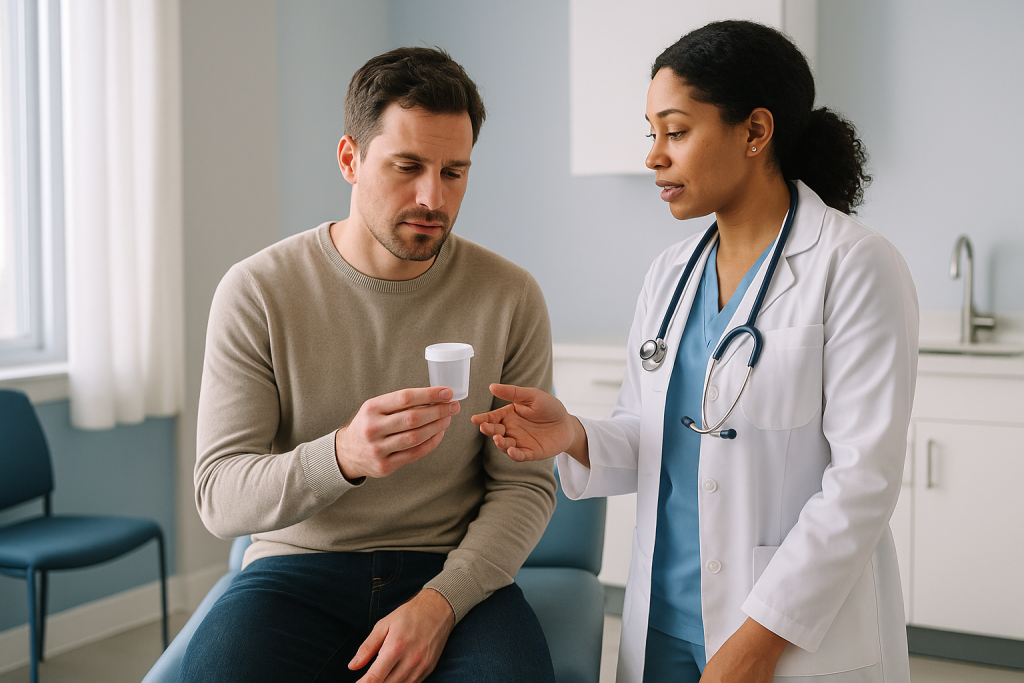
Collection is done by masturbation into a sterile, wide-mouthed container provided by the lab. Most facilities have a private room for this, though some allow home collection when the sample can be delivered fast enough. The whole ejaculate has to go into the cup: Cleveland Clinic notes that the first portion of the ejaculate carries the highest concentration of sperm, so losing even a small amount at the start can lower the measured count.
Once received, the sample sits at body temperature for about 20 to 30 minutes so it can liquefy. Freshly ejaculated semen is thick and gel-like; a normal sample thins on its own within an hour. A technician then measures the volume, checks the pH (a measure of acidity), and places a small drop under a microscope. Sperm are counted in a calibrated chamber to estimate concentration, meaning the number of sperm per milliliter. Motility, the proportion of sperm that move and how purposefully they move, is graded by watching them. Morphology, meaning the shape of the head, midpiece, and tail, is assessed on a stained slide. Some labs also test vitality, which distinguishes live but non-moving sperm from dead ones, and look for white blood cells that might suggest inflammation.
Results are typically available within a few days to a week, depending on the laboratory. The report lists each measurement alongside a reference range so the clinician can see where the sample falls. Interpreting that pattern, rather than any single number, is the clinician’s job and the subject of the follow-up conversation.
Who is usually asked to do this test, and who is asked to wait
Infertility is common. The World Health Organization estimates that roughly one in six people of reproductive age worldwide experience it at some point in their lives. Because male factors contribute in a substantial share of couples, most guidelines recommend that both partners are evaluated at the same time rather than in sequence. The NHS describes semen analysis as one of the first tests offered when a couple seeks help for infertility.
You will usually be asked to do the test if:
- You and your partner have been trying to conceive for about a year without success, or six months if your partner is over 35, according to Mayo Clinic’s guidance on when to seek evaluation.
- You are being assessed before assisted reproduction so the team can plan the approach.
- You have had a vasectomy and need to confirm that no sperm remain, which the NHS advises checking with a sample around 12 weeks after the procedure.
- You have a known condition, such as undescended testicles in childhood, a history of chemotherapy, or a genital infection, that could affect sperm production.
You may be asked to wait if you have had a fever or significant illness in the past couple of months, because a raised body temperature can temporarily suppress sperm production. The effect may not show up until weeks later, which is why the lab asks about recent illness. Some clinicians also delay testing after a recent course of certain medicines, after a major surgical procedure, or when a man has just started or stopped a treatment that affects hormones. In these cases the wait is about getting a representative sample, not a sign that anything is wrong. The ordering clinician makes that call.
Abstinence before semen analysis: why the window is two to seven days
The abstinence window means the number of days without any ejaculation, whether from intercourse, masturbation, or nocturnal emission, before the sample is produced. Mayo Clinic and Cleveland Clinic both describe the usual request as two to seven days, and many laboratories narrow that to two to five.
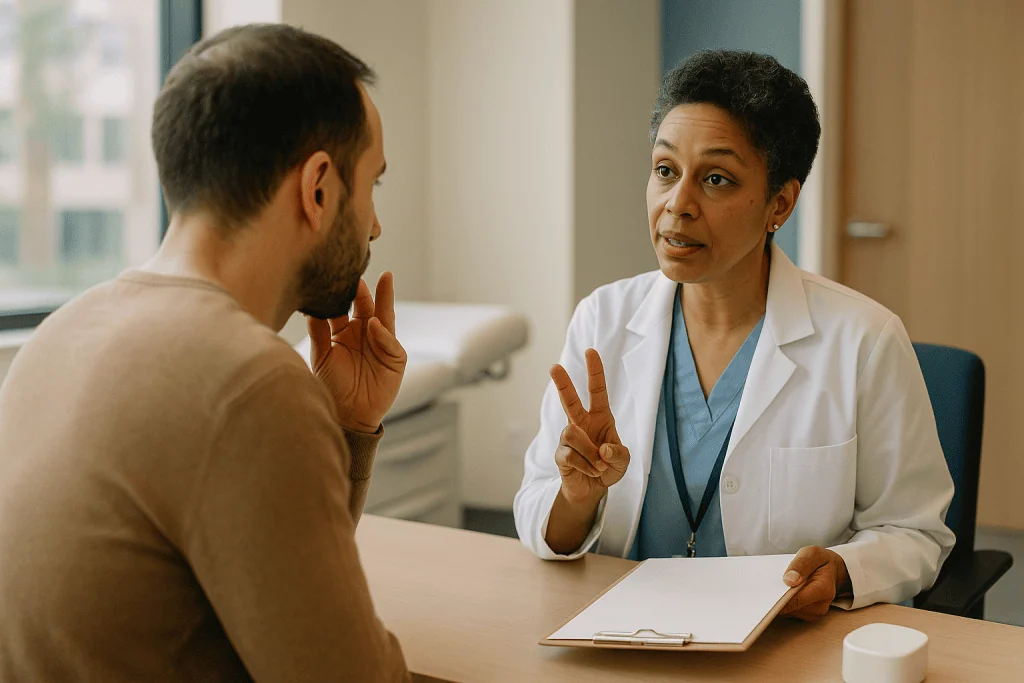
The logic runs in two directions. Too short a gap, and the sample reflects a partially emptied reservoir: volume and total sperm count tend to be lower simply because the body has not had time to rebuild its store. Too long a gap, and sperm that have been sitting in the epididymis, the coiled tube behind each testicle where mature sperm are stored, begin to age. Motility and the proportion of live sperm can fall, and the number of misshapen sperm may rise. Neither situation tells the clinician what your typical output looks like.
The window is a range rather than a single day because people differ. What matters more than hitting a specific number is consistency. If you produce a second sample weeks later, aim for roughly the same abstinence period so the two results can be compared fairly. Write down when your last ejaculation occurred and report it on the day; most collection forms have a line for it.
A few practical notes. Nocturnal emissions count as ejaculation, so if one happens the night before, tell the lab rather than guessing whether it matters. If you accidentally fall outside the window, call before you attend; the lab may prefer to reschedule rather than analyze a sample it cannot interpret. And longer is not better. Some men assume a two-week wait will produce an impressive count. It usually produces a sample the lab has to flag.
What not to do before a sperm test: heat, alcohol, and the lubricant problem
Most of the pre-test cautions are about not distorting the picture rather than about improving it.
Heat is the clearest example. The testicles sit outside the body because sperm production works best a few degrees below core temperature. Mayo Clinic lists hot tubs, saunas, and long hot baths among the factors that can lower sperm counts, and the effect can persist for weeks because of the length of the production cycle. Skipping the sauna in the days before a test will not undo earlier exposure, but it avoids adding to it and gives the clinician a cleaner baseline.
Alcohol, caffeine, and recreational drugs are the second group. Mayo Clinic advises avoiding alcohol, caffeine, and drugs such as cocaine and marijuana for two to five days before the sample. Heavy alcohol use is linked to lower testosterone and reduced sperm quality; marijuana has been associated with reduced counts and motility in several studies, though the evidence is mixed. Tobacco is worth stopping for its own reasons, but a few days off will not change the sample much.
The lubricant problem is the one that catches people out on the day. Ordinary lubricants, lotions, soaps, and saliva can all damage sperm or interfere with the analysis, and the lab may reject a sample that has been in contact with them. If dryness is a real obstacle, ask the lab in advance; some can supply or recommend a product designed not to harm sperm. Do not improvise.
Finally, do not collect into an ordinary condom. Latex and spermicide both kill sperm. If collection during intercourse is the only realistic option for you, the lab can advise on special non-toxic collection condoms; this route is used less often because it is harder to capture the full sample.
Illness, fever, and medicines: what the lab needs to know beforehand
A semen analysis is interpreted in context, and the person best placed to supply that context is you.
Fever comes first. A high temperature, even from a short viral illness, can disturb sperm production, and because sperm take roughly two to three months to mature, the dip may appear in a sample taken weeks after you felt better. Cleveland Clinic advises telling your provider about any recent illness. If you had a significant fever within the past three months, mention it when booking; the clinician may prefer to wait or may simply note it on the report so a low result is not over-interpreted.
Medicines are second. Several classes can affect sperm production or ejaculation, including some antidepressants, certain blood pressure medicines, anabolic steroids and testosterone products, some anti-inflammatory drugs, and chemotherapy agents. This is not a list of things to stop. Changing a prescribed medicine on your own can be harmful and can make the test harder to interpret, not easier. The right move is to bring a complete written list, including over-the-counter products, so the clinician can factor them in. Cleveland Clinic also notes that some herbal supplements have been associated with sperm changes in laboratory studies; the evidence in people is thin, but the lab will want to know what you take.
Third, recent events that raise scrotal temperature or cause injury: a groin injury, prolonged high fever, a recent surgery under general anesthesia, or several weeks of long-distance cycling or hot-environment work. None of these automatically invalidates a test. They are simply details that belong in the notes so the report is read fairly. Write them down before the visit rather than trying to recall them at the counter.
Semen analysis at home collection versus the clinic, and how long a sample stays valid
Most laboratories prefer collection on site, in a private room adjacent to the lab, because it removes the transport variable entirely. Some will accept a sample produced at home if it can be delivered quickly. Ask which applies to you before the day; do not assume.
If home collection is allowed, three rules govern it. The container must be the sterile one the lab supplied, or an equivalent it has approved; household jars can contain residues that harm sperm. The sample must arrive fast: Mayo Clinic advises delivering it within 30 to 60 minutes of collection. And it must be kept close to body temperature during the trip, which in practice means an inside pocket against the skin rather than a bag, a car seat, or a cool box. Sperm exposed to cold slow down or die, and a sample that has chilled will read as poorly motile for reasons that have nothing to do with you.
The container needs to be labeled with your name, date of birth, and the exact time of collection. The lab uses the collection time to judge liquefaction and motility, both of which change minute by minute. Also note whether any of the sample was lost. Losing the first portion matters more than losing the last, and the technician will record it.
A sample that arrives after the window, has been in contact with lubricant or a condom, or has been left in a cold car is usually not analyzed. Labs turn down samples for these reasons regularly, and the reason is always the same: they would rather ask you to repeat than report a result that misleads. If something goes wrong in transit, call ahead rather than hoping for the best.
Can a partner help collect the sample?
This is one of the most searched questions about the test, and the honest answer is: sometimes, within limits the laboratory sets.
Many clinics allow a partner into the collection room, and for men who find the setting difficult, a partner’s presence can make the difference between producing a sample and giving up. Ask when you book. Policies vary, and some facilities restrict the room to the patient for privacy and infection-control reasons.
Where a partner is present, the same contamination rules apply. Saliva is a problem: oral contact introduces bacteria and enzymes that damage sperm and can change the acidity of the sample, and most labs will ask you to avoid it. Hand lotions, massage oils, and ordinary lubricants carry the same risk. Fingers should be clean and dry. The container should be handled as little as possible, and nothing other than the ejaculate should go into it.
Collection through intercourse is a separate matter. Withdrawal before ejaculation, sometimes suggested as an alternative, tends to lose the sperm-rich first portion and mixes the sample with vaginal fluid, which is acidic and hostile to sperm. If intercourse is the only feasible route, for religious or personal reasons or because masturbation is not possible, the laboratory can advise on a purpose-made, non-spermicidal collection condom. Cleveland Clinic notes this option exists but that it is less commonly used because complete collection is harder.
The larger point is that reproductive testing is a shared undertaking. Whether or not a partner is physically present in the room, the visit tends to go more smoothly when the couple has planned it together: agreed on the abstinence dates, arranged the time off, and talked through what happens next.
What to bring to the visit: the practical checklist
The instruction sheet tells you how to collect. It rarely tells you what to carry, and the omissions cause avoidable delays at the reception desk.
- Photo identification. Laboratories match samples to patients carefully, and most will not accept a specimen without confirming who you are.
- The test request or referral form, on paper or on your phone, showing who ordered the test and what they asked for. Some requests include additional tests, such as a culture for infection, that need a separate container or handling.
- Your abstinence dates. The date and approximate time of your last ejaculation, written down.
- A medicine list covering prescriptions, over-the-counter products, supplements, and anything used for bodybuilding or hair loss.
- Recent health notes: any fever, infection, injury, or surgery in the past three months, with approximate dates.
- The sterile container, if the lab gave you one to bring back, unopened and clean.
- Your calendar, because you may be asked to book a second sample several weeks out before you leave.
A few things not to bring: lubricants, lotions, or your own container substitute. Phones and reading material are usually fine in the collection room, and some facilities provide visual material; ask if you are unsure.
If you are collecting at home, add to the list a plan for the journey. Know the route and the traffic, keep the container in an inside pocket, and note the time on the label the moment you finish. Arriving on time with a labeled, warm sample and a complete history is most of what good preparation looks like. Everything after that is the laboratory’s work and the clinician’s interpretation.
What the report measures and how the reference values are read
Reports list several parameters against reference limits drawn largely from the World Health Organization’s laboratory manual. Cleveland Clinic summarizes the commonly used lower reference limits, and they are reproduced below. A lower reference limit is the value below which roughly the lowest 5 percent of men who recently fathered children fell. It is a statistical boundary, not a fertility threshold.
| Parameter | What it measures | Commonly used lower reference limit |
|---|---|---|
| Volume | Amount of fluid ejaculated | 1.5 mL or more |
| Concentration | Sperm per milliliter | 15 million per mL or more |
| Total sperm number | Sperm in the whole ejaculate | 39 million or more |
| Total motility | Proportion of sperm moving at all | 40 percent or more |
| Progressive motility | Proportion moving forward purposefully | 32 percent or more |
| Morphology | Proportion with normal shape | 4 percent or more |
| Vitality | Proportion of live sperm | 58 percent or more |
| pH | Acidity of the fluid | 7.2 or higher |
Two things about this table matter more than any row in it. First, men with values below a limit do father children, and men with values above every limit sometimes do not; the limits describe populations, not individuals. Second, the parameters interact. A modest concentration with strong progressive motility may be read quite differently from a high concentration with very few moving sperm. Clinicians look at the pattern, at the abstinence interval, at anything you reported about illness or medicines, and at the result of a second sample before forming a view. A single number on a single day is the beginning of an assessment, not the end of one.
Why one test is rarely the final word: what the following weeks usually look like
Sperm output varies from week to week in the same man, sometimes considerably, and a single sample can be pulled up or down by abstinence length, a cold, a stressful fortnight, or a hot summer. For that reason Mayo Clinic notes that clinicians generally take several samples over a period of time before drawing conclusions, and a common approach is to request a second analysis a few weeks after the first, particularly if any value fell below the reference limit.
What happens after the first visit therefore tends to follow one of a few paths. If the report is within reference ranges and the clinical picture fits, attention may turn to other parts of the couple’s evaluation. If one or more values are low, the usual next step is a repeat sample, ideally with the same abstinence interval, so the two can be compared. The clinician may also arrange a physical examination, blood tests for hormones such as testosterone and follicle-stimulating hormone, or an ultrasound of the scrotum, depending on the pattern. Occasionally a test for infection or a genetic test is added.
Timeframes here are typical, not promised. Results usually return within a few days to a week. A repeat sample is commonly scheduled two to twelve weeks later; the longer end of that range is chosen when a recent fever or illness might have affected the first result, because it allows a new cohort of sperm to mature. Cleveland Clinic gives the production cycle as roughly two to three months, which is also why any lifestyle change, such as cooling down heat exposure or stopping smoking, takes at least that long to show up in a sample.
Between tests, the useful things are unglamorous: keep the same habits, avoid new heat exposure, write down any illness, and keep the appointment.
Preparing for a sperm count test when nerves get in the way
A surprising number of men leave the collection room without a sample, not because anything is medically wrong but because producing one to order in a clinical setting is hard. Laboratories know this, and most have quiet procedures for it. Knowing that in advance can defuse the pressure that causes the problem.
Practical steps help more than reassurance does. Ask, when booking, whether you can have extra time in the room, whether a partner may attend, and whether home collection is permitted for your test. Choose an appointment slot when you are not rushing from or to something else. Eat normally, sleep as well as you can the night before, and keep caffeine low on the day if it makes you jittery, though the main reason to limit it is the lab’s own guidance. Arrive early enough to sit for a few minutes rather than walking straight from the reception desk to the cup.
Inside the room, there is no time limit that matters clinically; the constraint is the lab’s schedule, and staff will tell you if it is a concern. Phones are usually allowed. If nothing happens, say so plainly. Staff have heard it many times, and the standard response is to rebook, sometimes for home collection.
Erectile difficulty or a physical inability to ejaculate is a different situation and worth raising with the ordering clinician rather than the front desk, because it may itself be part of the evaluation. Some men with spinal injuries or certain conditions cannot ejaculate normally and are offered alternative methods of sperm retrieval; that is a specialist conversation and outside the scope of a preparation guide.
The point is that difficulty on the day is a logistical event, not a diagnosis of anything.
What people often get wrong about preparing for a semen analysis
Some myths about this test are harmless. Others produce samples the lab has to discard or results that mislead. The common ones, corrected:
Longer abstinence gives a better result. It gives a bigger volume and often a higher count, alongside older, slower sperm and more abnormal shapes. The two to seven day window exists to balance those effects; a two-week wait pushes the sample outside what the reference values describe.
A quick shower or a bit of lotion will not matter. Soap residue, lotions, saliva, and most lubricants damage sperm on contact. Clean, dry hands and nothing in the container but semen is the rule.
Any clean jar will do. Household containers can hold detergent traces or plastics that affect sperm. Use the sterile cup the lab provides.
It is fine to leave the sample in the car and drop it off later. Sperm lose motility as they cool and as time passes. The 30 to 60 minute delivery window Mayo Clinic describes is not optional.
Losing a little of the sample is no big deal. The first part of the ejaculate carries most of the sperm; losing it can make a normal count look low. Tell the lab if it happens.
One normal result means everything is fine, and one low result means infertility. Neither follows. Values swing between samples, and reference limits are population statistics rather than fertility cut-offs. Clinicians repeat the test for exactly this reason.
Stopping a medicine for a few days will clean up the result. It will not, given the two to three month production cycle, and it can be dangerous. Bring the list and let the prescriber decide.
Supplements sold for sperm health will boost the numbers before the test. The evidence for most such products is weak, and none has a proven effect within days. The lab wants to know what you take, not to see it work overnight.
Questions to ask your care team before and after the test
The visit tends to go better when you arrive with specific questions rather than general worry. These are the ones that most often matter, grouped by when to ask them.
Before the test:
- How many days of abstinence does this laboratory want, and does it prefer the short or long end of the range?
- Can I collect at home, and if so, how long do I have to deliver the sample and how should I keep it warm?
- May my partner be present in the collection room?
- Is there an approved lubricant if I need one, or a non-spermicidal collection condom if masturbation is not possible for me?
- Should I postpone because of a recent fever, illness, or a medicine I have started?
- Are any other tests being run on the same sample that need different handling?
After the result:
- Which values, if any, fell outside the reference range, and how much weight do you place on that given my abstinence interval and recent health?
- Do you want a repeat sample, and how far apart should the two be for a fair comparison?
- Does anything in the result point toward a specific cause, or is the next step a broader evaluation?
- Are there blood tests, an examination, or imaging you would add, and what would each tell us?
- Are any of my current medicines relevant, and if so, what are the options, on your advice, rather than mine?
- What lifestyle factors are worth changing, and how long before they could show up in a sample?
- How does my result fit with my partner’s evaluation, and what does the combined picture suggest about next steps?
Write the answers down. The conversation after a semen analysis often covers more ground than expected, and a page of notes is easier to discuss at home than a memory of it.
When to call your doctor
A semen analysis itself carries no physical risk; collection is not a procedure in any medical sense, and there is nothing to recover from. The reasons to contact your care team relate to the circumstances around the test and to symptoms that deserve attention in their own right.
Call before the test if you develop a fever or significant illness in the days beforehand, if you accidentally fall outside the abstinence window, if a nocturnal emission occurs the night before, or if a sample is spilled, contaminated, or delayed in transit. In each case the laboratory would rather reschedule than analyze a sample it cannot interpret.
Seek prompt medical advice, regardless of the test schedule, if you notice any of the following:
- A new lump, swelling, or hardness in a testicle, or a change in its size or feel.
- Sudden or severe pain in a testicle or the groin, which can signal torsion or infection and needs urgent assessment.
- Blood in the semen or urine.
- Pain or burning on urination, discharge from the penis, or sores in the genital area.
- Fever with scrotal pain or swelling.
- Difficulty achieving erection or ejaculation that is new or worsening.
After the result, call your clinician if you are unsure what the report means, if you were told to book a repeat and have not heard back, or if you are struggling with the emotional weight of the process. The NHS notes that fertility problems can be distressing for both partners, and support is part of the evaluation rather than an afterthought.
None of these signs means a particular diagnosis. They are reasons to be examined by someone who can decide what, if anything, needs to happen next. That decision rests with the treating team.
Frequently asked questions
What should you not do before a sperm analysis?
Avoid ejaculating for the abstinence period your laboratory specifies, usually two to seven days, and avoid hot tubs, saunas, alcohol, caffeine, and recreational drugs in the days beforehand, as Mayo Clinic advises. On the day, do not use lubricants, lotions, saliva, or an ordinary condom, and do not use a household container. Do not stop a prescribed medicine on your own; bring a list instead so the clinician can interpret the result with it in mind.
How long should I abstain before a semen analysis?
Most laboratories ask for two to seven days without any ejaculation, and many narrow that to two to five, according to Mayo Clinic and Cleveland Clinic. Shorter gaps lower volume and count; longer gaps age the stored sperm and reduce motility. Follow your own lab’s instruction sheet, record the date of your last ejaculation, and aim for the same interval before any repeat sample so the results can be compared.
Can my wife help me collect a sperm sample?
Often yes, if the laboratory allows a partner in the collection room, so ask when booking. The same rules apply: no saliva, lotions, or ordinary lubricants, and nothing but the ejaculate in the sterile container. Collection through intercourse with withdrawal is discouraged because it loses the sperm-rich first portion. Where masturbation is not possible, the lab can advise on a special non-spermicidal collection condom.
How should I prepare for a seminal fluid analysis if I am collecting at home?
Confirm the lab accepts home samples, use only the sterile container it provides, and collect after the requested abstinence period without lubricant. Label the cup with your name, date of birth, and exact collection time. Keep it in an inside pocket against the skin and deliver it within 30 to 60 minutes, per Mayo Clinic. Tell the lab if any of the sample was lost.
What should I do before a sperm count test to get an accurate result?
Keep your habits steady rather than trying to improve them at the last minute, since sperm take roughly two to three months to develop. Observe the abstinence window, avoid heat exposure and alcohol for a few days, note any fever or illness in the past three months, and write down every medicine and supplement you take. Bring identification, the request form, and your abstinence dates to the visit.
How long is a semen sample valid after collection?
Laboratories generally want the sample within 30 to 60 minutes of collection, kept close to body temperature, according to Mayo Clinic. Semen liquefies over the first 20 to 30 minutes and motility is assessed soon after, so timing affects the measurements directly. A sample that has cooled, been delayed, or been in contact with lubricant or a condom is usually not analyzed, and the lab will ask you to repeat it.
Does a fever affect semen analysis results?
It can. A significant fever raises testicular temperature and may suppress sperm production, and because of the two to three month development cycle the effect may only appear in a sample taken weeks later. Cleveland Clinic advises telling your provider about recent illness. The clinician may postpone the test or note the fever on the report so a low value is not over-interpreted.
What is a normal sperm count on a semen analysis?
The commonly used lower reference limit is 15 million sperm per milliliter, or 39 million in the whole ejaculate, as summarized by Cleveland Clinic. These figures mark the lowest 5 percent of recent fathers rather than a line between fertile and infertile. Motility, morphology, and volume are read alongside count, and clinicians usually want a second sample before drawing conclusions from any single value.
Why does the lab want a second semen sample?
Because sperm output varies from week to week in the same man, and one sample can be affected by abstinence length, a recent cold, stress, or heat exposure. Mayo Clinic notes clinicians typically take several samples over time. A repeat is commonly arranged a few weeks after the first, longer if a fever may have influenced the result, and ideally with the same abstinence interval for a fair comparison.
Should I stop my medicines before a semen analysis?
No, not without your prescriber’s direction. Some medicine classes can influence sperm production or ejaculation, but stopping them abruptly can be harmful and will not change a sample within days given the length of the production cycle. Bring a complete list, including supplements and over-the-counter products, so the clinician can interpret the result and decide whether any change is appropriate.
References
- Cleveland Clinic: Semen Analysis
- MedlinePlus: Semen Analysis
- NHS: Infertility: Diagnosis
- World Health Organization: Infertility fact sheet
This article is for general information only and is not a substitute for professional medical advice. Please consult a qualified doctor about your individual situation.

More from the Blog

Who Is ICSI Recommended For? Male-Factor Infertility, Prior Fertilization Failure and More
ICSI is usually recommended when sperm are unlikely to fertilize an egg on their own: severe male-factor infertility such as very low sperm count,…

GIFT (Gamete Intrafallopian Transfer) Step by Step: Eggs, Sperm and the Laparoscopic Placement
GIFT, or gamete intrafallopian transfer, is an assisted reproduction technique in which eggs are collected after ovarian stimulation, mixed with prepared sperm, and placed…

GIFT vs IVF: Why Fertilization Location Matters and How Fertility Teams Choose Between Them
GIFT (gamete intrafallopian transfer) places eggs and sperm together into a fallopian tube so fertilization happens inside the body, while IVF fertilizes eggs in…
Ovulation Pain (Mittelschmerz): Why It Happens and When It Is Something Else
Ovulation pain, also called mittelschmerz, is a one-sided lower abdominal ache or twinge that occurs around the middle of the menstrual cycle when a…

Tracking Ovulation: Basal Temperature, Cervical Mucus and the Fertility Window Explained
Cervical mucus changes with estrogen: scant and sticky after a period, then wetter, and finally clear, stretchy and slippery in the days before ovulation,…
Cramping or Spotting After Insemination: What Is Expected and When to Contact Your Clinic
Mild cramping after IUI is common and usually expected. The thin catheter passing through the cervix, the fluid placed in the uterus, and the…