

Meditation Benefits: What Randomized Trials Actually Show for Blood Pressure, Pain and Sleep

Key Takeaways
- A 2014 pooled analysis of 47 randomized trials found meditation reduces anxiety, depression and pain with effect sizes of 0.38, 0.30 and 0.33 at eight weeks, similar to the size of antidepressant effects over placebo.
- The American Heart Association grades meditation for cardiovascular risk as Class IIb, Level of Evidence C, meaning it 'may be considered' as an adjunct, with typical systolic blood pressure reductions near 4 mmHg versus 10 mmHg or more for a single first-line medicine.
- In a 342-person back pain trial, 61 percent of the mindfulness group had meaningful improvement in function at six months versus 44 percent with usual care, matching cognitive behavioral therapy.
- In a 2015 trial of adults aged 55 and older, six weeks of mindfulness improved sleep quality by 2.8 points on a 21-point scale versus 1.1 points for sleep education, though CBT-I remains the first-line insomnia treatment.
- A preregistered 2022 study of more than 200 people found no measurable brain structure changes after a standard eight-week course, overturning a widely shared 2011 finding based on 16 participants.
- About 8 percent of participants across 83 studies reported unwanted effects such as anxiety or dissociation, concentrated in intensive retreats and in people with trauma or psychosis histories.
Randomized trials show meditation produces small to moderate benefits: anxiety, depression and pain scores fall by roughly a third of a standard deviation after eight weeks, systolic blood pressure drops by a few mmHg in some studies, and sleep quality improves modestly. The evidence is strongest for mood and pain, weakest for blood pressure, and meditation works best alongside standard medical care, never as a replacement for it.
The clip is thirty seconds long. A man in a park closes his eyes, breathes slowly, and a caption promises that ten minutes a day will lower blood pressure ‘as much as a pill’. As of September 2026 it has been shared millions of times, and search traffic for meditation benefits has climbed with it, alongside the usual back-to-work surge in people hunting for better sleep and a quieter head.
The claim is not pure invention, which is what makes it slippery. There are randomized trials of meditation for blood pressure, chronic pain, insomnia and mood: dozens of them, some decades old. What the clip leaves out is the size of the effects, the quality of the studies, and the plain fact that no cardiology guideline treats meditation as a substitute for standard care.
So this piece does something the viral version cannot. It reads the trials, grades the evidence, and tells you where meditation genuinely earns its reputation and where it is still coasting on hope.
What changed recently: why meditation benefits are trending
Three things sit behind the current spike, and only one of them is new.
The new one is attention. Short videos have compressed a decade of research into a single sentence about blood pressure, and the sentence travels faster than the footnotes. Searches for meditation benefits now peak in the same week as searches for back-to-school stress and sleep apps, which tells you as much about the calendar as about the science.
The older two are the evidence base itself and the way medical institutions have slowly stamped it. In January 2014, a systematic review in JAMA Internal Medicine pooled 47 randomized trials with 3,515 participants and found moderate evidence that mindfulness programs improve anxiety, depression and pain, with no evidence that they beat active treatments such as exercise or medication. In September 2017, the American Heart Association published its first scientific statement on meditation and cardiovascular risk. It concluded that meditation ‘possibly’ reduces risk and may be considered as an adjunct to, not a replacement for, guideline-directed care. The recommendation was graded Class IIb, the AHA’s wording for ‘may be reasonable’, resting on Level of Evidence C, the weakest tier. The same year, a systematic review of 38 trials for chronic pain found a small benefit on pain intensity and rated the overall evidence low quality.
The National Center for Complementary and Integrative Health, part of the NIH, keeps a plain-language summary of this literature that it last revised in 2022, and its bottom line has barely moved: helpful for some symptoms, not a stand-alone treatment, with safety data still thin.
Nothing in that record justifies the word ‘pill’. Plenty in it justifies a closer look, which is what the rest of this article does, outcome by outcome.
What the evidence actually says: grading meditation benefits
Medical evidence comes in tiers, and meditation research spans all of them. Randomized controlled trials, where participants are assigned by chance to meditate or to a comparison group, sit at the top because chance assignment cancels out the enthusiasm of people who would have meditated anyway. Observational studies, which compare meditators with non-meditators in everyday life, sit lower because meditators also tend to sleep more, drink less and exercise, and no statistical adjustment fully untangles that. Expert opinion sits at the bottom, however eminent the expert.
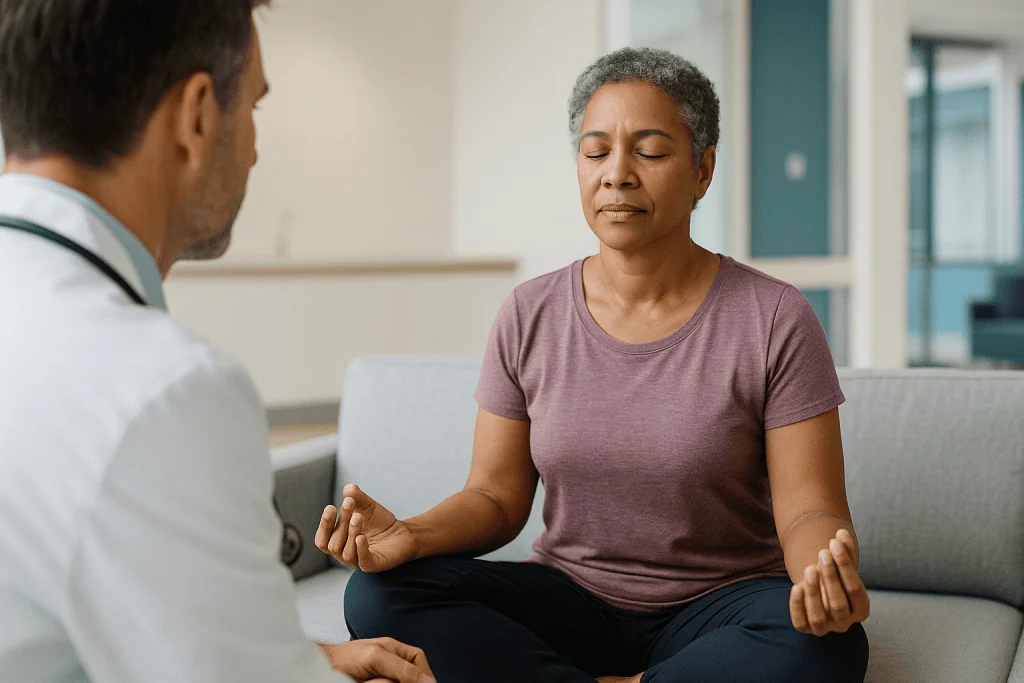
Within trials, the comparison group matters enormously. Early studies compared meditation with a waiting list, which is roughly like judging a new restaurant against no dinner at all. Later trials used active controls: health education classes, stretching, or a relaxation program with the same number of contact hours. Effects often shrink by half when the control group gets attention too.
The number most reviews report is the standardized effect size, which expresses how far the meditation group moved relative to the natural spread of scores. By convention 0.2 is small, 0.5 moderate and 0.8 large. The 2014 pooled estimates landed at 0.38 for anxiety, 0.30 for depression and 0.33 for pain at eight weeks: real, reproducible and modest. For context, antidepressant medication against placebo in trials typically shows an effect size near 0.3 as well, which is why ‘small’ should never be read as ‘useless’.
Graded honestly, then: moderate-quality evidence for anxiety, depressive symptoms and pain; low-quality evidence for sleep and quality of life; low to very low quality evidence for blood pressure; and essentially no high-quality evidence for anything involving brain structure, immunity or longevity. That ranking, not the headlines, should shape your expectations.
What are the 5 benefits of meditation with the best evidence?
People ask for a top five, and the trials can supply one, provided each item carries its evidence grade like a label on a jar.
- Less anxiety. The best-supported benefit. Across dozens of randomized trials, eight-week mindfulness programs reduce anxiety symptoms with a moderate effect, and the benefit holds at three to six months of follow-up. Moderate-quality evidence.
- Fewer depressive symptoms. Effects are slightly smaller than for anxiety but consistent. Mindfulness-based cognitive therapy, an eight-week program that blends meditation with cognitive therapy techniques, has trial evidence for reducing relapse in people with recurrent depression who are already under medical care. Moderate-quality evidence.
- Better coping with chronic pain. Pain intensity falls a little; what changes more is how much the pain interferes with daily life and mood. Low to moderate quality evidence.
- Lower perceived stress. Almost every trial measures this and almost every trial finds it, but stress scales are self-reported and easily nudged by expectation. Low-quality evidence for the symptom; weaker still for stress hormones such as cortisol.
- Improved sleep quality. Modest gains on sleep questionnaires, mostly in people whose poor sleep is driven by a racing mind rather than a medical sleep disorder. Low-quality evidence.
Notice what is missing. Blood pressure does not make the top five on evidence quality, even though it dominates the viral claims. Weight loss, memory, immunity and ‘anti-aging’ do not appear because the trials either do not exist or are too small and inconsistent to grade.
Notice, too, the common thread. Every item on the list is a symptom experienced in the mind, which is exactly where a training program for attention would be expected to act first. That is not a weakness; it is the mechanism showing itself.
Does meditation for blood pressure work? The trials, honestly read
Blood pressure is where meditation research started, back in the 1970s, and where the gap between hope and data remains widest.

The older trials mostly tested mantra meditation, a style in which you silently repeat a word or sound to anchor attention. A 2013 American Heart Association review of non-drug approaches to high blood pressure concluded that this style produced small reductions in systolic pressure, in the range of a few mmHg, and rated the evidence Class IIb, meaning the approach ‘may be considered’. Mindfulness-based programs were judged to have insufficient evidence at that time. Newer mindfulness trials designed specifically around blood pressure have reported systolic reductions of roughly 4 to 6 mmHg at six months compared with usual care, but they are small, unblinded, and partly explained by participants also eating better and moving more as the program encouraged.
Put that against standard care. The DASH eating pattern lowered systolic pressure by about 11 mmHg in people with hypertension in its landmark trial. Losing weight trims roughly 1 mmHg per kilogram. A single first-line blood pressure medicine typically lowers systolic pressure by around 10 mmHg or more. Meditation’s 4 mmHg is real enough to matter at a population level, since even small shifts reduce stroke risk across millions of people, yet far too small to replace treatment in any individual.
There is also a measurement wrinkle. Blood pressure read immediately after a calm session is lower than blood pressure read mid-commute, so trials that measure in the clinic may capture a transient relaxation effect rather than a lasting change. Studies using 24-hour ambulatory monitoring, which records pressure during ordinary life, show smaller and less consistent effects.
The AHA’s 2017 statement put it carefully: meditation may be a reasonable adjunct for people who are interested, alongside, never instead of, guideline-directed treatment. If you take blood pressure medicine and want to meditate, do both, and let your prescribing clinician see the readings.
Mindfulness for chronic pain: what the trials found
Chronic pain, meaning pain that persists for three months or longer, is the second area where meditation has been studied in earnest, and the results are more interesting than a single number suggests.
The headline figure comes from a 2017 systematic review of 38 randomized trials covering low back pain, fibromyalgia, headache and mixed chronic pain. Mindfulness programs produced a small, statistically significant reduction in pain intensity compared with all control groups combined, and the authors rated the evidence low quality because of small samples and inconsistent results. Improvements in depressive symptoms and quality of life were more robust than the change in pain itself.
The most rigorous single trial, published in JAMA in 2016, randomized 342 adults with chronic low back pain to an eight-week mindfulness-based stress reduction course, cognitive behavioral therapy, or usual care. At six months, 61 percent of the mindfulness group and 58 percent of the cognitive therapy group reported clinically meaningful improvement in how much pain limited their function, against 44 percent of the usual-care group. Mindfulness matched an established psychological treatment and beat doing nothing extra; it did not abolish pain.
Why would attention training touch pain at all? Pain has two components that the brain processes separately: the raw sensory intensity, and the unpleasantness and alarm attached to it. Small imaging studies suggest meditation mainly dampens the second. People still feel the signal; they are less hijacked by it. That is also why benefit shows up first in function and mood rather than on a 0-to-10 intensity scale.
For anyone managing chronic pain under medical supervision, the practical reading is this: mindfulness is a reasonable addition to a plan that already includes movement, sleep, and whatever your clinician has prescribed. It is not a reason to change prescribed treatment on your own, and the decision about where it fits belongs with the clinician who knows your case.
Meditation for better sleep: does it help insomnia?
Insomnia, defined as trouble falling or staying asleep at least three nights a week for three months with daytime consequences, has a first-line treatment that is not a medicine and not meditation. It is cognitive behavioral therapy for insomnia, a structured program that resets sleep habits and beliefs, and every major sleep body recommends it first. Meditation enters as a supporting player, and in that role it holds up reasonably well.
The best-known trial, published in JAMA Internal Medicine in 2015, enrolled 49 adults aged 55 and older with moderate sleep disturbance. Half took a six-week mindful awareness program; half took a sleep hygiene education class with identical contact time. On the Pittsburgh Sleep Quality Index, a 21-point questionnaire where lower is better, the meditation group improved by 2.8 points versus 1.1 for the education group. A three-point change on that scale is about the threshold people notice. The sample was small, the follow-up short, and the outcome self-reported, which keeps the evidence grade low despite the encouraging direction.
Larger pooled analyses since then point the same way: moderate improvements in sleep quality questionnaires, smaller and less consistent changes in objectively measured sleep time. The likely mechanism is pre-sleep arousal. People with insomnia typically carry a high-alert nervous system into bed, and a practice that trains you to notice thoughts without chasing them lowers the mental volume at exactly the wrong-time-of-night moment.
Two cautions. First, if poor sleep comes with loud snoring, witnessed pauses in breathing or gasping awake, the problem may be obstructive sleep apnea, a mechanical airway condition that meditation cannot address and that needs medical assessment. Second, meditating in bed as a way to force sleep can backfire; the trials taught practice during the day and used brief, non-striving techniques at night.
Benefits of meditation for the brain: what is real and what is hype
If one claim has done more than any other to sell meditation, it is that eight weeks of practice physically rewires the brain. The story deserves a careful retelling.
It began with a 2011 imaging study of 16 people who completed a mindfulness course. Scans before and after suggested increased gray matter density in the hippocampus, a region involved in memory and emotion regulation, and in several other areas. Sixteen participants is a tiny sample for brain imaging, where measurement noise is substantial, but the finding was striking and it spread.
In 2022, a far larger and better-controlled study put the claim to the test: more than 200 participants, two independent trials, an active control group, and preregistered hypotheses, which means the researchers stated in advance what they expected to find. After eight weeks of mindfulness-based stress reduction there were no detectable changes in brain structure compared with controls. The authors did not conclude that meditation never changes the brain. They concluded that a standard eight-week course does not produce structural change large enough to measure, and that the earlier small studies were likely picking up noise.
Functional findings are on firmer, if still modest, ground. Trials and smaller experiments report improved performance on sustained attention tasks, reduced reactivity in the amygdala, the brain’s threat detector, when viewing emotional images, and quieter activity in the default mode network, a set of regions active during self-focused mind-wandering. These are consistent with what practitioners describe, and consistent with the symptom improvements in the clinical trials. They are also small effects from small studies, graded low quality.
So: does meditation train the brain? In the sense that any repeated skill does, almost certainly. Does it measurably remodel brain tissue in two months? The best evidence says no, and a magazine that promised otherwise would be repeating a sixteen-person study over a two-hundred-person correction.
Meditation benefits compared: a summary table by outcome
The sections above are easier to hold in the head as a single grid. The table below summarizes what the randomized evidence shows for each outcome, how large the typical effect is, and how much confidence the evidence quality allows. Effect sizes are standardized unless a clinical unit is given. Grades follow the convention used by the NIH and major reviews: high, moderate, low or very low, reflecting how likely further research is to change the estimate.
| Outcome | Best evidence | Typical effect | Evidence grade | Plain verdict |
|---|---|---|---|---|
| Anxiety symptoms | 47-trial pooled analysis, 2014 | 0.38 at 8 weeks | Moderate | Most reliable benefit |
| Depressive symptoms | Same review; relapse-prevention trials | 0.30 at 8 weeks | Moderate | Useful alongside care |
| Chronic pain intensity | 38-trial review, 2017; 342-person back pain trial, 2016 | Small; 61% vs 44% improved function | Low to moderate | Helps coping more than intensity |
| Sleep quality | 49-person older-adult trial, 2015; pooled analyses | About 2.8 vs 1.1 points on a 21-point scale | Low | Supporting role; CBT-I first |
| Systolic blood pressure | AHA statements 2013 and 2017 | Roughly 4 mmHg in some trials | Low to very low | Adjunct only; never a substitute |
| Perceived stress | Most trials, self-report | Small to moderate | Low | Consistent but expectation-prone |
| Brain structure | Preregistered 200-plus person study, 2022 | None detected at 8 weeks | Low (for change) | Viral claim not supported |
Two patterns jump out. The outcomes with the best grades are the ones experienced directly in the mind, which is where a mental training program would plausibly act. The outcomes with the loudest marketing, blood pressure and brain remodeling, have the weakest support. If you remember nothing else from this article, remember that inversion: the evidence runs almost exactly opposite to the hype.
What happens after 1 month of meditation?
One month is an awkward timescale for the research, because the standard trial program runs eight weeks. Still, there is enough mid-course and short-program data to sketch a realistic picture of week four.
In the shorter trials, including several that tested brief daily sessions delivered through audio recordings or apps, perceived stress and anxiety scores begin to separate from the control group by the third or fourth week. The separation is small at that point, roughly half of what the eight-week programs eventually show, and it is noisy. Some participants report a clear shift; a good share report nothing at all yet. Trials that tracked outcomes week by week find that the people who eventually benefit most are often not the ones who felt dramatic effects early.
Sleep tends to lag. In the sleep trials, questionnaire scores moved most between weeks four and six, which fits the idea that a quieter mind at bedtime has to become a habit before it changes the night.
Pain and blood pressure, where effects are small to begin with, are unlikely to show anything measurable at one month in an individual. A home blood pressure monitor will mostly register normal day-to-day variation, which can be 10 mmHg or more, far larger than any meditation effect.
What people reliably notice at one month is something the questionnaires capture poorly: a growing ability to catch the mind wandering and return it. In trials that measured attention lapses, that skill improves within weeks and may be the actual engine behind the later symptom gains.
The honest summary of month one is a slightly calmer baseline, better awareness of your own mental weather, perhaps earlier sleep onset, and a practice that is finally feeling less effortful. Anyone promising more than that at four weeks is selling the eight-week result on a four-week schedule.
How to meditate correctly, according to the trials
‘Correctly’ is a loaded word for a practice that comes in dozens of traditions, so the useful question is narrower: what did participants in the positive trials actually do?
Most were enrolled in mindfulness-based stress reduction, a secular eight-week program developed in a medical setting in 1979. It involves a weekly group class of about two and a half hours, a single longer practice day near week six, and assigned home practice of up to 45 minutes a day using guided recordings. The core techniques are three. The body scan, in which attention moves slowly through the body noticing sensation without trying to change it. Focused attention on the breath, returning each time the mind wanders. And open monitoring, a later stage in which you observe whatever arises, thoughts included, without following any of it.
A few points from the protocols cut against popular assumptions. Participants were told that noticing the mind has wandered is the exercise, not a failure of it; a session with fifty wanderings and fifty returns is fifty repetitions of the skill. Posture was whatever kept them alert but not tense, which for many people meant a chair rather than the floor. Eyes could be open or closed. No one was asked to stop thinking, empty the mind or achieve any particular state.
Group support and a trained instructor were part of every strong trial, and reviews consistently find that fully self-guided practice produces smaller effects. That does not make solo practice worthless; it means the trial results describe a supported program, and a person following a recording alone should expect a somewhat smaller version of them.
If a single rule distills the research, it is consistency over intensity. Daily practice of modest length, done imperfectly, is what the evidence was built on.
Is 30 minutes of meditation a day enough?
Thirty minutes is, by the standards of the research, generous.
The flagship eight-week programs assign up to 45 minutes of daily home practice, but assignment and reality diverge. When trials actually logged what participants did, average home practice typically fell somewhere between 20 and 30 minutes on the days people practiced, with plenty of skipped days. A 2017 pooled analysis of 28 studies that recorded practice time found a small positive association between minutes practiced and symptom improvement, small enough that doubling your practice would not be expected to double your benefit. Thirty minutes a day therefore sits at or above the dose that produced the published results.
At the other end, trials of brief practice, around 10 to 15 minutes daily for a few weeks, also show measurable reductions in stress and anxiety, though smaller and less durable. The relationship looks like most exercise curves: the steepest gains come from going from zero to something, the slope flattens after that, and the biggest predictor of benefit is still showing up.
Two refinements matter more than the exact minute count. Spreading practice across the week beats cramming it; a trial participant who practiced five days for 20 minutes generally fared better on outcome measures than one who did a single 100-minute session on Sunday. And the kind of attention matters more than the duration of sitting. Thirty minutes of drowsy half-attention trains drowsy half-attention.
For most adults asking this question, 20 to 30 minutes on most days is a well-supported target, and 10 minutes on a crowded day keeps the habit alive. Pushing past 45 minutes daily, or into multi-hour sessions, moves beyond the clinical trial evidence and into the territory where, as the side-effects section explains, unwanted experiences become more common.
Common myths about meditation benefits, corrected
Viral health content thrives on compression, and meditation has been compressed into a handful of claims that the trials do not support. Here are the most persistent ones, each set against what the evidence shows.
‘Meditation lowers blood pressure as much as medication.’ The better trials show reductions of roughly 4 mmHg systolic, versus 10 mmHg or more for a single first-line medicine. The American Heart Association grades meditation as a possible adjunct, Class IIb, Level of Evidence C. No guideline anywhere lists it as a treatment for hypertension on its own.
‘Eight weeks rewires your brain.’ The claim rests on a 16-person imaging study from 2011. A preregistered study of more than 200 people in 2022 found no structural brain changes after a standard eight-week course. Functional changes in attention and emotional reactivity are plausible and modestly supported; tissue remodeling is not.
‘The goal is to empty your mind.’ No trial protocol asks for this. Participants are taught to notice wandering and return attention; the wandering is expected and is the raw material of the practice.
‘More is always better.’ Practice time correlates only weakly with benefit in pooled analyses, and intensive retreat-style practice is where most reports of unpleasant effects cluster.
‘It works for everyone.’ Trials report averages. Within them, a meaningful minority show no change, and a smaller group feel worse. Non-response is normal and not a personal failing.
‘It is a religious practice in disguise.’ The programs tested in medical trials are secular by design, with no doctrinal content. Meditation does exist within many religious traditions, and people of faith may prefer contemplative practice from their own; the clinical evidence simply concerns the secular versions.
‘It replaces therapy or medication.’ The 2014 review found no evidence that meditation outperforms active treatments. Every major body frames it as a complement to care decided with a clinician.
Can meditation have side effects? What the safety data show
A wellness practice marketed as universally gentle rarely gets asked about harm, and for decades meditation trials barely recorded adverse events at all. That has changed, and the picture is reassuring for most people while genuinely important for some.
A 2020 review examined 83 studies covering more than 6,700 participants and found that about 8 percent reported at least one unwanted effect during or after meditation. The most common were increased anxiety, low mood, and episodes of depersonalization or dissociation, meaning a sense of detachment from oneself or from surroundings. A smaller number reported intrusive memories or, rarely, psychotic-like symptoms. Most effects were mild and short-lived. The rate is comparable to that reported for psychotherapy, which puts it in context: any intervention powerful enough to help is powerful enough to unsettle.
Risk was not evenly spread. Unwanted experiences were more frequent in intensive settings such as silent multi-day retreats, in people with a history of trauma, and in people with a personal or family history of psychosis or bipolar disorder. Sitting quietly with one’s own mind for long stretches can surface material that a person has, for good reasons, kept at a distance. Programs run by trained instructors in medical settings reported fewer problems than unguided intensive practice.
The NIH summary says plainly that meditation is generally considered safe for healthy people but that the evidence on safety is incomplete, and that people with existing mental health conditions should discuss it with their clinician first. That is sound guidance, and it applies equally to anyone who notices that practice is making them feel worse rather than steadier.
The practical reading: for most adults, short daily practice carries little risk. For anyone with the risk factors above, or anyone drawn to intensive formats, an informed conversation with a clinician before starting is the evidence-based move.
When to see a doctor
Meditation sits comfortably alongside medical care, and the trials that found benefit all kept participants under their usual treatment. Certain situations call for a clinician promptly, whether or not you meditate.
Blood pressure. Seek urgent care for a reading of 180/120 mmHg or higher, especially with chest pain, shortness of breath, severe headache, vision changes, confusion or weakness on one side of the body. Never stop, skip or adjust a prescribed blood pressure medicine because home readings look better after meditating; bring the readings to the prescriber and let them decide.
Pain. Pain that is new and severe, that wakes you from sleep, or that comes with fever, unexplained weight loss, numbness or weakness in the legs, or changes in bladder or bowel control needs medical assessment before any self-help approach.
Sleep. Loud snoring with pauses in breathing, gasping awake, falling asleep while driving, or insomnia lasting more than three months despite good habits should be evaluated. Sleep apnea and other sleep disorders are medical conditions with specific treatments.
Mood and mind. If meditation repeatedly triggers panic, flashbacks, a sense of unreality that lingers after the session, or a darkening of mood, stop the practice and talk to a clinician. Anyone with thoughts of self-harm or suicide should contact emergency services or a crisis line immediately; in the US, calling or texting 988 reaches the Suicide and Crisis Lifeline.
Existing conditions. People with a history of psychosis, bipolar disorder, severe depression or post-traumatic stress disorder should discuss meditation with their treating clinician before starting, and should be cautious about intensive formats such as retreats.
Finally, every decision about adding, continuing or combining meditation with treatment for any medical condition belongs with the clinician who knows your history. The trials offer averages; your clinician knows you.
Frequently asked questions
What are the 5 benefits of meditation that trials support?
Reduced anxiety, fewer depressive symptoms, better coping with chronic pain, lower perceived stress and modestly improved sleep quality. Anxiety and depression carry moderate-quality evidence from dozens of randomized trials; pain, stress and sleep carry low to moderate quality evidence. Blood pressure, memory and brain remodeling do not make the list because their evidence is weak or absent.
What happens after 1 month of meditation?
Most people notice a slightly calmer baseline and a growing ability to catch the mind wandering, with small reductions in stress and anxiety scores beginning to appear in trials around week three or four. Sleep changes tend to lag until weeks four to six. Pain and blood pressure effects are too small to detect individually at one month.
How to meditate correctly for the benefits seen in studies?
Follow what trial participants did: daily practice of roughly 20 to 45 minutes using a body scan, focused attention on the breath, or open monitoring of thoughts, ideally with guided recordings or a trained instructor. Notice when the mind wanders and return; that return is the skill. No protocol asks you to empty your mind or sit in a special posture.
Is 30 minutes of meditation a day enough?
Yes; 30 minutes daily meets or exceeds the practice time most trial participants actually logged, which averaged 20 to 30 minutes on practice days. Pooled analyses show only a weak link between extra minutes and extra benefit. Even 10 to 15 minutes daily produces smaller but measurable reductions in stress. Consistency across the week matters more than session length.
Can meditation for blood pressure replace medication?
No. Trials show systolic reductions of roughly 4 mmHg at best, compared with 10 mmHg or more from a single first-line medicine, and the American Heart Association grades meditation only as a possible adjunct with low-level evidence. Anyone taking blood pressure medicine should continue it and discuss meditation and home readings with their prescribing clinician.
Does mindfulness for chronic pain actually reduce pain?
It reduces pain intensity a little and improves daily function and mood more. A 2016 trial of 342 adults with chronic low back pain found 61 percent of the mindfulness group had meaningful functional improvement at six months versus 44 percent with usual care. A 2017 review of 38 trials rated the overall evidence low quality but consistently positive.
Which type of meditation works best for sleep?
Mindfulness-based programs have the most trial support for sleep quality, with a 2015 study showing a 2.8-point improvement on a 21-point scale over six weeks in older adults. Mantra-based styles also show modest benefit. Cognitive behavioral therapy for insomnia remains the recommended first-line treatment, with meditation best used as a supplement to it.
Is meditation safe if I have anxiety, PTSD or a history of psychosis?
Usually, with precautions. Trials show meditation reduces anxiety for most people, but about 8 percent of participants report unwanted effects, more often among those with trauma or psychosis histories and in intensive retreat settings. Discuss it with your treating clinician first, start with brief guided sessions, and stop and seek advice if practice worsens symptoms.
Does meditation really change the brain?
Not structurally in eight weeks, according to the best evidence. A preregistered 2022 study of more than 200 people found no measurable changes in brain tissue after a standard course, contradicting a 2011 study of 16 participants. Smaller studies do suggest functional changes in attention and emotional reactivity, which fit the symptom improvements seen in trials.
How long does it take to notice meditation benefits for sleep?
In trials, sleep questionnaire scores moved most between weeks four and six of daily practice, and the strongest sleep trial ran six weeks. Expect earlier noticeable changes in daytime stress than in nighttime sleep. If poor sleep persists beyond three months, or comes with loud snoring or gasping, see a clinician to rule out a sleep disorder.
This article is for general information only and is not a substitute for professional medical advice. Please consult a qualified doctor about your individual situation.

More from the Blog

Dopamine Detox: What the Trend Gets Wrong About Your Brain
A dopamine detox cannot lower or reset dopamine, because the brain never stops producing this essential chemical, which also controls movement and motivation. What…

Anxiety Stomach Pain: What It Feels Like and Why the Gut Reacts
Anxiety stomach pain usually feels like a tight knot or fluttering high in the belly, cramping or churning lower down, nausea, or a sudden…

Vagus Nerve Exercises: What Stimulating the ‘Rest and Digest’ Nerve Can and Cannot Do
Vagus nerve exercises such as slow breathing, cold water on the face, humming, and gentle movement can briefly increase parasympathetic activity, which is why…

Stress Hormones Explained: Cortisol, Adrenaline and What Chronic Stress Does Over Years
Stress hormones are chemical messengers, chiefly cortisol and adrenaline, that the brain and adrenal glands release to ready the body for a threat. Short…

Can OCD Be Cured, and What Makes It Worse?
OCD is not usually described as curable, but it is highly treatable, and many people reach a point where symptoms are mild or absent…

Low Cortisol: What Happens When the Stress Hormone Runs Short, and Why It Is Not ‘Adrenal Fatigue’
Low cortisol means the adrenal glands are not making enough of the hormone the body needs to hold up blood pressure, steady blood sugar,…