

Meningitis Vaccines: Types, Who Needs Them and Why University Age Matters

Key Takeaways
- About 1 in 10 people carry the meningococcus harmlessly in the throat, but carriage peaks at roughly 24 percent around age 19, which is why university entry is the critical window.
- CDC recommends MenACWY at 11 to 12 with a booster at 16, while the NHS gives it in school year 9 and to anyone under 25 who missed it, including first-time university students.
- MenB vaccines protect the person who receives them but, unlike conjugate MenACWY, have not been shown to reduce throat carriage or create herd protection.
- Combined MenABCWY vaccines have been licensed in the United States since October 2023 and may be used when MenACWY and MenB are due at the same visit.
- The 2023 rise in US cases to 422, the highest since 2014, was concentrated in adults aged 30 to 60, not in teenagers.
- A sore throat is not a recognised common side effect of any meningococcal vaccine; the usual reactions are a sore arm, tiredness, headache and brief low-grade fever.
Meningitis vaccines protect against the bacteria behind most sudden bacterial meningitis, chiefly Neisseria meningitidis. The main types are MenACWY, MenB and newer combined MenABCWY products. CDC recommends MenACWY for all adolescents with a booster at 16 and offers MenB from 16 to 23; the NHS gives MenACWY in school and to anyone under 25 who missed it. University age matters because throat carriage and close-contact spread peak around 19.
The car is packed to the roof, the mini fridge is wedged behind the passenger seat, and somewhere in a folder is a university health form with a box that reads ‘meningococcal vaccination: date’. Every September that box sends thousands of families to search engines, and as of September 2025 the question ‘which meningitis vaccine does my teenager need?’ is trending harder than usual.
Two things are driving it. In the United States, combined MenABCWY products that cover five serogroups in one injection have been licensed since late 2023, and the CDC’s advisory committee has been openly reviewing whether the adolescent schedule should be simplified around them. At the same time, CDC surveillance recorded more confirmed meningococcal cases in 2023 than in any year since 2014, with numbers staying high into 2024.
So the timing is right for a calm, evidence-first explainer: what these vaccines are, who the guidelines actually say should have them, what the side effects really look like, and why the years between 16 and 25 are the ones that matter most.
What is the meningococcal vaccine, and is it the same as a meningitis vaccine?
Meningitis is inflammation of the meninges, the thin membranes wrapped around the brain and spinal cord. Viruses cause most cases and those are usually mild. Bacteria cause fewer cases but far more deaths and disability, and the bacterium people fear most is Neisseria meningitidis, the meningococcus. When someone says ‘meningitis vaccine’ in everyday conversation, they almost always mean a meningococcal vaccine aimed at this one organism.
The meningococcus is an odd enemy. Roughly 1 in 10 people carry it harmlessly in the back of the throat at any moment. Occasionally, for reasons that are still only partly understood, it crosses into the bloodstream, where it can cause meningitis, septicaemia (a life-threatening bloodstream infection) or both. CDC data put the death rate at 10 to 15 percent even with prompt antibiotics, and up to 1 in 5 survivors is left with hearing loss, limb loss, kidney damage or learning difficulties. The illness can move from first symptom to intensive care within hours.
The bacterium comes in 12 serogroups. A serogroup is a family defined by the sugar coat on the bacterial surface, and six of them, A, B, C, W, X and Y, cause nearly all disease worldwide. Vaccines are named after the letters they cover, which is why you see MenACWY, MenB and MenABCWY on health forms.
Most of these are conjugate vaccines: the sugar coat is chemically attached to a carrier protein so that even an infant immune system learns to recognise it and builds lasting memory. Serogroup B is the exception. Its sugar coat looks too much like human nerve tissue to be a safe target, so MenB vaccines are built from bacterial surface proteins instead. That single technical difference explains a surprising amount of what follows, from side-effect profiles to why MenB protects the individual but not the crowd.
What changed recently in meningitis vaccination (as of September 2025)
The meningococcal landscape has shifted more in the past two years than in the previous ten, and most of the changes are good news.
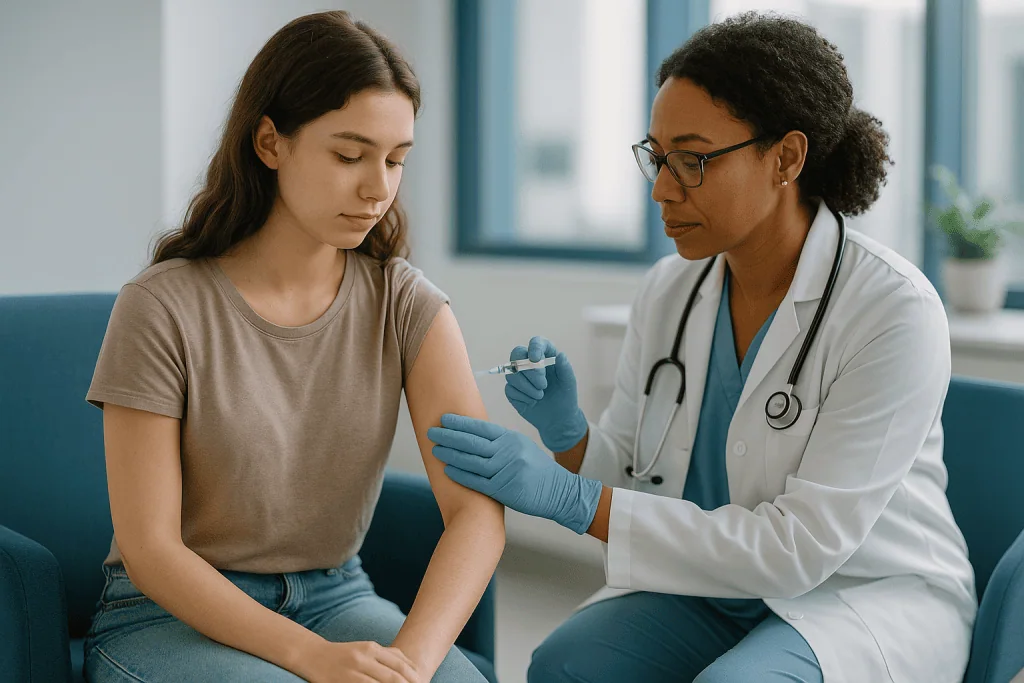
In the United States, the first combined MenABCWY vaccine received FDA licensure in October 2023, and a second combined product followed in February 2025. CDC’s Advisory Committee on Immunization Practices now lists MenABCWY as an acceptable option when a person is due for both MenACWY and MenB at the same visit. The committee has also been reviewing whether the whole adolescent schedule could be anchored around a combined product given in the late teens; no final change has been adopted at the time of writing, so current recommendations stand.
The epidemiology moved too. In March 2024 CDC issued a health alert after 422 confirmed cases in 2023, the highest annual total since 2014, driven largely by a serogroup Y strain and concentrated, unusually, in adults aged 30 to 60, in Black Americans and in people living with HIV. That pattern is a reminder that this is not only a disease of babies and students.
Across the Atlantic, the NHS updated its childhood schedule in 2025 and dropped the standalone Hib/MenC dose at one year, because serogroup C disease has become rare after a quarter-century of vaccination. MenACWY remains a school-age vaccine, and the NHS continues to offer it to anyone under 25 who missed it, with first-time university students singled out.
Globally, the World Health Organization reports that Nigeria became the first country to roll out Men5CV in 2024, a new conjugate vaccine covering A, C, W, Y and X that was designed specifically for the African meningitis belt. It is a milestone on the WHO roadmap ‘Defeating meningitis by 2030’, which aims to end bacterial meningitis epidemics and cut vaccine-preventable cases by half.
Which types of meningitis vaccine exist, and what do the letters mean?
Reading a vaccine record can feel like decoding a licence plate. The table below sets out the main families, what they cover and who they are mainly for under current CDC and NHS guidance. Dose numbers and intervals vary by product and age, and the prescribing clinician sets them.
| Vaccine family | Serogroups covered | How it works | Main use (CDC / NHS) |
|---|---|---|---|
| MenACWY | A, C, W, Y | Conjugate (sugar coat linked to carrier protein) | US: all 11 to 12 year olds, booster at 16; UK: school year 9, catch-up to age 25; travel and high-risk groups in both |
| MenB | B only | Protein-based, two non-interchangeable products | US: ages 16 to 23 by shared clinical decision-making, preferred 16 to 18, plus high-risk groups from age 10; UK: routine infant programme since 2015 |
| MenABCWY | A, B, C, W, Y | Combined conjugate plus protein | US: option when MenACWY and MenB are both due at the same visit |
| MenA conjugate (MenAfriVac) and Men5CV | A; or A, C, W, X, Y | Conjugate | African meningitis belt campaigns and routine programmes |
| MenC and Hib/MenC | C | Conjugate | Historical UK infant vaccine; largely replaced |
Two practical points fall out of the table. First, no single product covers every serogroup; X is only in Men5CV, and B is absent from the standard MenACWY given at school. Second, the two licensed MenB vaccines are built from different proteins and cannot be mixed within a course, which is why a clinic will ask which one you had before.
Older polysaccharide vaccines, made from the sugar coat alone without a carrier protein, still exist in some parts of the world. They work poorly in young children and do not reduce carriage, so high-income countries have retired them from routine use.
Who needs the MenACWY vaccine, and at what meningococcal vaccine age?
The short version: nearly every adolescent, plus specific groups at any age. The details differ slightly between the United States and the United Kingdom, and the differences are deliberate.
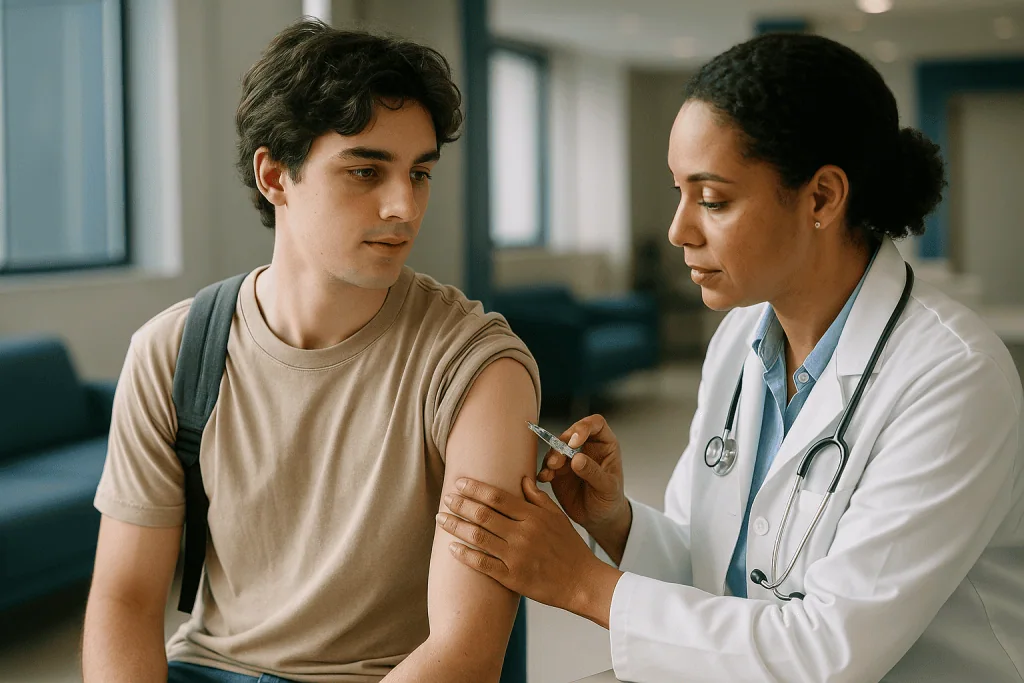
CDC recommends MenACWY for all children at 11 to 12 years, with a booster at 16. Teenagers who missed it should catch up between 13 and 18. First-year college students aged 19 to 21 who live in residence halls should receive it if their last dose was before their 16th birthday. The 16-year-old booster is not an afterthought: antibody levels from a conjugate vaccine fall meaningfully within about five years, and the booster is timed so protection peaks across the highest-risk window of 16 to 23. Children as young as 2 months with certain medical conditions can receive MenACWY, with the product and timing chosen by their paediatrician.
The NHS takes a single-shot approach at a later age. MenACWY is offered in school year 9 or 10, around age 13 to 14, which carries most teenagers through sixth form and into university without a booster. Anyone who missed it can have it from their GP up to their 25th birthday, and the NHS specifically urges students starting university for the first time to be vaccinated before term begins, ideally with a couple of weeks to spare.
Beyond adolescence, CDC and NHS guidance converge on the same higher-risk groups: people without a working spleen, including those with sickle cell disease; people with rare complement deficiencies or taking complement inhibitor medicines; people with HIV; microbiologists who handle the bacterium; travellers to the meningitis belt or Hajj pilgrims; military recruits; and anyone identified during an outbreak. For these groups, repeat boosters are advised while the risk persists, on a schedule the clinician determines.
Who should consider the meningitis B vaccine?
Serogroup B is the awkward one. It causes the largest share of meningococcal disease in American teenagers and in British children, yet the vaccines against it arrived decades after the conjugates, behave differently, and are recommended differently on each side of the Atlantic.
In the United States, CDC places MenB for healthy 16 to 23 year olds under shared clinical decision-making. That phrase means the vaccine is not on the universal schedule but should be actively discussed between clinician, patient and family, with the decision resting on individual circumstances. The preferred age is 16 to 18, which lines the protection up with college entry. For people aged 10 and over at increased risk, which includes those without a spleen, those with complement deficiency or on complement inhibitors, laboratory microbiologists and anyone exposed during a serogroup B outbreak, CDC recommends MenB outright rather than as an option.
The NHS went the other way and made MenB a routine infant vaccine in September 2015, the first country to do so, starting at 8 weeks of age with a booster at one year. British teenagers are not routinely offered MenB, although it is available for high-risk groups and during outbreaks.
Why the split? Three reasons. MenB vaccines produce more fever, especially in babies, so infant programmes need careful counselling. Protection appears to wane faster than with conjugates, which complicates one-and-done planning. And a large Australian trial found that MenB vaccination did not reduce throat carriage in teenagers, meaning it protects the vaccinated person but does not build herd protection. That makes it a personal-protection decision, and a reasonable one for anyone heading into shared housing.
Why university age matters: the meningitis vaccine for college students
Picture carriage of the meningococcus as a curve plotted against age. In a pooled analysis of carriage studies, about 4 to 5 percent of infants carry the bacterium in the throat. The line climbs steadily through childhood, rises sharply in the mid-teens, and peaks at roughly 24 percent around age 19 before drifting down to under 10 percent by middle age. That peak is not a coincidence; it is a map of human behaviour.
Nineteen-year-olds live close together, share drinks and cutlery, kiss new people, stay up late, pick up colds and are more likely to be around tobacco smoke, all of which help a throat bacterium move from one person to the next. Put several thousand of them into residence halls in the same week and you have the conditions outbreaks favour. Studies of American campuses have consistently found that first-year students in dormitories face higher rates of meningococcal disease than classmates living off campus or peers who are not students.
Serogroup B has caused most of the publicised US campus outbreaks since 2013, which is one reason the MenB conversation is timed to the late teens. Serogroup Y and W have caused clusters too. In the UK, a rise in a particularly aggressive W strain among teenagers in 2015 prompted the school-age MenACWY programme and the university catch-up offer that still runs today.
Timing is practical as well as biological. Protective antibodies take about 10 to 14 days to develop after vaccination, so the NHS advises students to be vaccinated before they leave home rather than in the first chaotic week of term. Many US universities and several states require documented MenACWY for residence-hall students; some also ask about MenB. The incubation period for meningococcal disease is typically 3 to 4 days, with a range of 2 to 10, which is exactly the window in which a new arrival is meeting everyone.
Who else is at higher risk of meningococcal disease?
Age is the most visible risk factor, but it is not the only one, and some of the strongest risks are medical rather than behavioural.
The spleen filters encapsulated bacteria out of the blood, so people whose spleen has been removed or does not function, including most adults with sickle cell disease, are far more vulnerable to the meningococcus. The complement system, a cascade of blood proteins that punches holes in bacterial membranes, is the body’s main weapon against this particular organism; people born with a persistent deficiency in a complement component can face risks hundreds of times higher than average.
Modern medicine has created a new high-risk group. Complement inhibitor medicines, used for a handful of rare blood and kidney disorders, deliberately switch off part of that same cascade. Patients taking them are advised to have both MenACWY and MenB, and clinicians often add preventive antibiotics, because vaccination lowers but does not remove the risk. Anyone on these medicines should treat a fever as an emergency and will have been told so by their specialist.
People living with HIV are at increased risk of serogroups C, W and Y, and CDC recommends MenACWY for them at any age. Microbiologists who routinely handle meningococcal cultures have had laboratory-acquired infections and are vaccinated as an occupational measure. Military recruits, who recreate the dormitory environment, have been routinely vaccinated for decades. Close household and intimate contacts of a confirmed case are a special category: they are offered a short course of preventive antibiotics urgently, with vaccination added if the strain is vaccine-preventable.
The 2023 to 2024 rise in US cases among adults in their 30s to 50s, many with HIV or without obvious risk factors, is a reminder that risk is a spectrum rather than a checklist, which is why recognising symptoms matters for everyone.
What the evidence actually says, and how strong it is
Meningococcal disease is rare enough that no randomised trial has ever been large enough to count cases as its main outcome. That shapes how the evidence should be read, and it is worth being candid about it.
For the conjugate vaccines, MenC and MenACWY, licensure rested on randomised trials showing antibody levels known to correlate with protection, a method called immunobridging. Real-world confirmation then came from population programmes. After the UK introduced MenC in 1999, disease in vaccinated age groups fell by more than 90 percent and throat carriage of serogroup C dropped by about two-thirds, producing protection in unvaccinated age groups too. Similar findings followed in the Netherlands, Canada and Australia. This is observational evidence, but it is large, consistent, biologically coherent and repeated across countries, which puts it near the top of what observational data can offer.
Serogroup A in Africa tells the same story at larger scale. WHO reports that since MenAfriVac campaigns began in 2010, serogroup A disease has all but disappeared from the countries that used it.
MenB evidence is more mixed. The UK infant programme was followed by a roughly 75 percent fall in serogroup B cases in eligible babies within three years, a strong observational signal. By contrast, a cluster-randomised trial of about 35,000 South Australian students found no reduction in carriage, the best-quality evidence we have that MenB protects individuals without producing herd protection. Effectiveness during US campus outbreaks has been estimated from small numbers and should be read as supportive rather than definitive.
Safety data come from randomised trials and from surveillance of tens of millions of doses. Early concern about Guillain-Barré syndrome after MenACWY was not confirmed in larger studies, and CDC removed it as a precaution. Durability estimates, and therefore booster timing, lean partly on antibody studies and expert judgement rather than on disease counts.
What are the MenACWY vaccine side effects, and is a sore throat one of them?
The honest answer is that most people get a sore arm and feel slightly flat for a day, and that is about it.
For MenACWY, CDC and NHS patient information list the common reactions as pain, redness or swelling where the needle went in, affecting roughly half of recipients, followed by tiredness, headache, muscle or joint aches, a low-grade fever, chills and occasionally nausea. These typically begin within a day and clear within one to two days. Teenagers are prone to fainting after any injection, which is why clinics ask them to sit for 15 minutes afterwards; the faint is a reflex, not a reaction to the vaccine itself.
MenB vaccines are more reactogenic, a word that simply means they provoke more of these short-lived symptoms. Injection-site pain is near universal, and fever is noticeably more common, particularly in infants, which is why the NHS nurse will discuss fever management with parents at the appointment. Follow that advice rather than improvising.
Sore throat does not appear on the standard list of common reactions for any meningococcal vaccine. If it turns up in the days afterwards it is most likely a coincidence, which is plausible in autumn when colds circulate freely, especially on campus. The reverse matters more: a sore throat with high fever, severe headache and a stiff neck should never be dismissed as a vaccine reaction, because vaccination does not cover every strain.
Serious allergic reactions, including anaphylaxis, are reported at roughly one per million doses across vaccines generally. They almost always begin within minutes, which is the other reason for the waiting period. Anyone with a history of severe allergy should mention it beforehand so the clinic can plan accordingly.
What are the reasons someone should avoid or delay the MenACWY vaccine?
The list is short, and it is shorter than it used to be.
The one firm contraindication, meaning a reason the vaccine should not be given, is a previous severe allergic reaction either to a dose of the same vaccine or to one of its components. The components include the carrier protein, which depending on the product is a diphtheria toxoid, a tetanus toxoid or a modified diphtheria protein. A clinician who knows your allergy history can check the specific ingredient list.
The main precaution, meaning a reason to pause and reconsider timing, is a moderate or severe acute illness, with or without fever. The vaccine is not dangerous in that situation; the issue is that symptoms of the illness could be confused with vaccine reactions, and a very unwell person may respond less well. A mild cold, a runny nose or a low-grade temperature is not a reason to postpone, and both CDC and the NHS say so explicitly.
A history of Guillain-Barré syndrome, a rare nerve condition, was listed as a precaution for MenACWY in the late 2000s after a possible signal. Larger studies did not confirm the association, and CDC no longer lists it. Pregnancy is not a reason to avoid MenACWY when there is a clear indication such as travel or a medical risk; MenB in pregnancy is usually deferred unless the risk is high, a judgement for the obstetrician. People with weakened immune systems can safely receive these vaccines because none of them contain live bacteria, although their antibody response may be lower. Bleeding disorders call for an adjusted injection technique rather than avoidance.
In every one of these situations the decision belongs to the prescribing clinician, who can weigh the individual’s history against local risk.
Does being vaccinated protect the people around me?
It depends on which vaccine, and the distinction is one of the most useful things to understand about meningococcal prevention.
Conjugate vaccines against A, C, W and Y do something remarkable: they reduce the chance that a vaccinated person carries the bacterium in the throat at all. Fewer carriers means fewer transmissions, and that protects babies too young to be vaccinated, older adults and people whose immune systems respond poorly. This is herd protection, and it is why the UK deliberately aimed its MenACWY programme at 13 to 14 year olds rather than at infants: teenagers are the age group that spreads the organism, so vaccinating them cut disease in every other age group as well. The Dutch and British MenC programmes showed the same ripple effect within a few years.
MenB vaccines, as far as current evidence shows, do not reduce carriage. The Australian cluster-randomised trial tested this directly in tens of thousands of students and found no difference between vaccinated and unvaccinated schools. That means MenB protection is a private good: it shields the person who had it, and nobody else. It is still worth having for someone moving into shared housing, but it should not be chosen on the assumption that it protects a roommate.
There is a second limit. A person fully vaccinated against A, B, C, W and Y can still carry and transmit serogroup X, and can still catch meningitis from pneumococcus, Haemophilus influenzae type b or a virus. Those are covered, where vaccines exist, by separate childhood immunisations. No single injection makes anyone meningitis-proof, which is the plain reason every section of this article circles back to recognising symptoms.
Do I need a meningitis vaccine for travel, Hajj or the African meningitis belt?
For most holidays the answer is no. For two specific destinations the answer is a clear yes, and in one of them it is a legal requirement.
Saudi Arabia requires every pilgrim arriving for Hajj or Umrah to show proof of MenACWY vaccination given within the previous few years and at least 10 days before arrival. The rule exists because of real history: in 2000 and 2001, pilgrims returning home seeded serogroup W outbreaks across several continents. Travel clinics and GPs are familiar with the certificate requirement, and the vaccine is the same conjugate MenACWY used in adolescent programmes.
The African meningitis belt is a band of 26 countries stretching from Senegal in the west to Ethiopia in the east. During the dry season, roughly December to June, dust and dry air damage the lining of the throat and the bacterium spreads with frightening efficiency; the 1996 epidemic caused more than 250,000 cases and about 25,000 deaths in a single season. MenAfriVac campaigns have since all but eliminated serogroup A, but C, W, X and Y still cause outbreaks, which is why the newer Men5CV matters. CDC recommends MenACWY for travellers to belt countries during the dry season, and at any time for those who will have prolonged close contact with local populations, such as healthcare volunteers or people staying with families.
Travellers heading to a region with an active outbreak should check current CDC or WHO travel notices, since recommendations shift with the epidemiology. Vaccination should be completed at least two weeks before departure to allow antibodies to form. Travel clinics will also want to know which meningococcal vaccines were given in adolescence, because a recent dose may already cover the trip.
Common myths about meningitis vaccines, corrected
Viral posts about vaccines tend to recycle the same handful of claims. Here is what the evidence says about the ones that circulate most around meningococcal vaccines.
‘The vaccine can give you meningitis.’ It cannot. Every licensed meningococcal vaccine is made from purified sugar or protein fragments, or synthetic copies of them; none contains live or whole bacteria. A fever in the first day or two is the immune system responding to the fragments, not an infection.
‘One meningitis jab covers everything.’ Not true. MenACWY leaves out serogroup B; MenB leaves out the others; neither touches pneumococcal, Hib or viral meningitis. Knowing which letters you have had is genuinely useful information.
‘Only babies and students get it.’ The 2023 to 2024 rise in the United States was concentrated in adults aged 30 to 60. Age shifts the odds; it does not cancel them.
‘MenACWY causes Guillain-Barré syndrome.’ A possible signal was investigated in the late 2000s, larger studies found no increased risk, and CDC removed the precaution.
‘If I am vaccinated I can ignore the symptoms.’ Vaccinated people have a much lower risk, not zero risk, and no vaccine covers every strain. Fever, severe headache, stiff neck and a rash that does not fade under pressure need urgent assessment regardless of vaccine status.
‘Antibiotics after exposure make vaccination pointless.’ Preventive antibiotics protect close contacts of a known case for a matter of days. They do nothing for the next exposure, and most people who fall ill never knew they were exposed.
‘These vaccines are new and untested.’ Conjugate meningococcal vaccines have been in national programmes since 1999 and have been given in the hundreds of millions of doses with continuous safety monitoring. The combined MenABCWY products are newer, but they are built from components already in long use.
When to see a doctor: red flags after vaccination and the signs of meningitis itself
Two very different situations deserve attention, and it helps to keep them separate in your mind.
After a meningococcal vaccine, seek urgent help if any of the following appear: hives, swelling of the face, lips or throat, wheeze, difficulty breathing, a racing heart or faintness in the minutes to hours after the injection, which can signal anaphylaxis. Contact a clinician the same day if a fever climbs high or lasts beyond two to three days, if the injection site becomes increasingly red, hot and swollen after the first 48 hours, or if a child is unusually drowsy, inconsolable or refusing fluids. Report any suspected serious reaction to the clinic that gave the vaccine so it can be logged with national surveillance.
Suspected meningitis or septicaemia is an emergency at any age and regardless of vaccination. Call emergency services or go to the nearest emergency department if someone develops a combination of sudden high fever, severe headache, a stiff neck, dislike of bright light, confusion or unusual drowsiness, repeated vomiting, cold hands and feet with a high temperature, rapid breathing, severe limb or joint pain, or a rash of small red or purple spots that does not fade when a glass is pressed firmly against the skin. Do not wait for the rash; it is often a late sign and in some patients never appears. In babies, watch for a high-pitched or moaning cry, a bulging soft spot on the head, floppiness, refusal to feed and a blotchy or pale complexion.
Anyone who has been in close contact with a confirmed case, especially a household member, partner or roommate, should contact their doctor or public health service the same day, because preventive antibiotics work best when started quickly.
Every question about which vaccine, when, and whether a medical condition changes the plan belongs with the prescribing clinician, who has the full history in front of them.
Frequently asked questions
What is the meningococcal vaccine?
The meningococcal vaccine protects against Neisseria meningitidis, the bacterium responsible for most sudden, severe bacterial meningitis and septicaemia. It comes in several forms named after the serogroups they cover: MenACWY, MenB and the combined MenABCWY. None contains live bacteria. It does not protect against viral meningitis or against pneumococcal or Hib meningitis, which have their own vaccines.
How much does the meningitis vaccine cost?
This article does not cover prices, because costs vary widely by country, health system and insurance arrangement. In the UK, vaccines on the NHS schedule, including MenACWY for eligible under-25s, are provided through the health service. In the United States, eligibility and coverage are questions for your clinician or health plan, who can confirm what applies to your situation.
Is a sore throat a common side effect of the meningitis vaccine?
No. Sore throat is not listed among the common reactions to MenACWY or MenB vaccines by CDC or the NHS. Expected effects are a sore, red arm, tiredness, headache, muscle aches and sometimes a brief fever. A sore throat afterwards is usually a coincidental cold, but a sore throat with high fever, severe headache or stiff neck needs urgent medical assessment.
What are the reasons someone should avoid getting the MenACWY vaccine?
The only firm reason is a previous severe allergic reaction to the same vaccine or one of its components, such as the carrier protein. A moderate or severe acute illness is a reason to delay, not to avoid. A past history of Guillain-Barré syndrome is no longer considered a precaution by CDC. Pregnancy and weakened immunity are discussions with the clinician, not automatic exclusions.
Do college students need the meningitis B vaccine as well as MenACWY?
In the United States, CDC places MenB for healthy 16 to 23 year olds under shared clinical decision-making, with 16 to 18 the preferred age, so it is an active choice rather than a universal recommendation. Serogroup B has caused most recent US campus outbreaks. In the UK, MenB is given in infancy and is not routinely offered to students unless they are at higher risk.
What is the right meningococcal vaccine age for the first dose?
For healthy children, CDC recommends MenACWY at 11 to 12 years with a booster at 16, and the NHS gives it at 13 to 14 in school. MenB is given from 8 weeks in the UK and from 16 in the US. Children with high-risk conditions can start MenACWY as early as 2 months, with the product chosen by their paediatrician.
Can you still get meningitis if you have been vaccinated?
Yes, although the risk is much lower. No vaccine covers every serogroup; standard MenACWY leaves out serogroup B, and no product in routine use covers serogroup X outside Africa. Viral, pneumococcal and Hib meningitis are separate illnesses. That is why recognising fever, severe headache, stiff neck and a non-fading rash matters even for fully vaccinated people.
How long does protection from the meningitis vaccine last?
Antibody levels after conjugate MenACWY fall meaningfully within about five years, which is why CDC schedules a booster at 16 and the NHS times its single school dose to carry students through university. MenB protection appears to wane faster. People with ongoing medical risk receive repeat boosters on a schedule set by their clinician rather than relying on one course.
Is the meningitis vaccine for college required before moving into a dorm?
Many US states and universities require documented MenACWY for students living in residence halls, and some ask about MenB; check the specific institution’s health form. The NHS does not make it a requirement but strongly advises first-time university students under 25 to be vaccinated before term starts, ideally two weeks ahead, because antibodies take about 10 to 14 days to develop.
Can MenACWY and MenB be given at the same appointment?
Yes. Both can be given at the same visit in different arms, and in the United States a combined MenABCWY vaccine is an option when a person is due for both at once. The clinician will check which MenB product was used previously, because the two licensed MenB vaccines are not interchangeable within a course.
References
This article is for general information only and is not a substitute for professional medical advice. Please consult a qualified doctor about your individual situation.

More from the Blog

Lyme Disease Follow-Up: Why Doctors Check Joints, Heart Rhythm and Nerves After Treatment
After treatment for Lyme disease, doctors follow up on joints, heart rhythm and nerves because these are the systems the infection can affect weeks…
RSV Symptoms in Adults: How to Tell It From Flu and COVID, and Who Is at Risk
RSV symptoms in adults usually look like a heavy cold: runny nose, cough, sneezing, sore throat, mild fever and sometimes wheezing, building over several…

Ringworm: The Fungal Infection That Is Not a Worm: Symptoms and Treatment
Ringworm is a common skin infection caused by fungi called dermatophytes, not by any worm. It usually appears as a red or pink, scaly,…

Why the Days After a Dengue Fever Breaks Need Close Monitoring: Warning Signs Doctors Look For
Dengue is often most dangerous in the 24 to 48 hours after the fever settles, when fluid can leak out of small blood vessels…

Does a Rapid Test Confirm Malaria? Blood Smears, Parasite Species and How Treatment Is Chosen
A rapid diagnostic test can strongly suggest malaria, but it does not fully confirm it on its own. Guidelines from the CDC and WHO…

Typhoid, Yellow Fever and Rabies Vaccines: When Travelers Need Them
Travelers need a yellow fever vaccine when visiting parts of sub-Saharan Africa or South America where the virus circulates, or when a country requires…