

Online Dental Consultation: What Can Be Assessed Remotely, and What Cannot
Key Takeaways
- Cavities most often start between teeth, where no phone camera can see, bitewing X-rays detect them years before they become visible, which is why a video call can never confirm your mouth is healthy.
- Most toothaches need a procedure, not a pill: mainstream guidance reserves antibiotics for spreading infection with fever or swelling, so a teledentist who declines to prescribe is usually practicing good medicine.
- Gum disease is measured in millimeters with a probe, meaning gums can look perfectly pink on camera while pockets deepen underneath.
- A knocked-out adult tooth has its best survival odds if reimplanted within roughly 30 to 60 minutes, transport it in milk or inside the cheek and skip the video call entirely.
- Dental tourism quotes built from photos routinely change after in-person X-rays and 3D scans, so get itemized estimates with a written revision policy before booking travel.
- Facial swelling combined with fever or any difficulty swallowing or breathing is an emergency-department situation, because dental infections can spread to the tissues of the neck within hours.
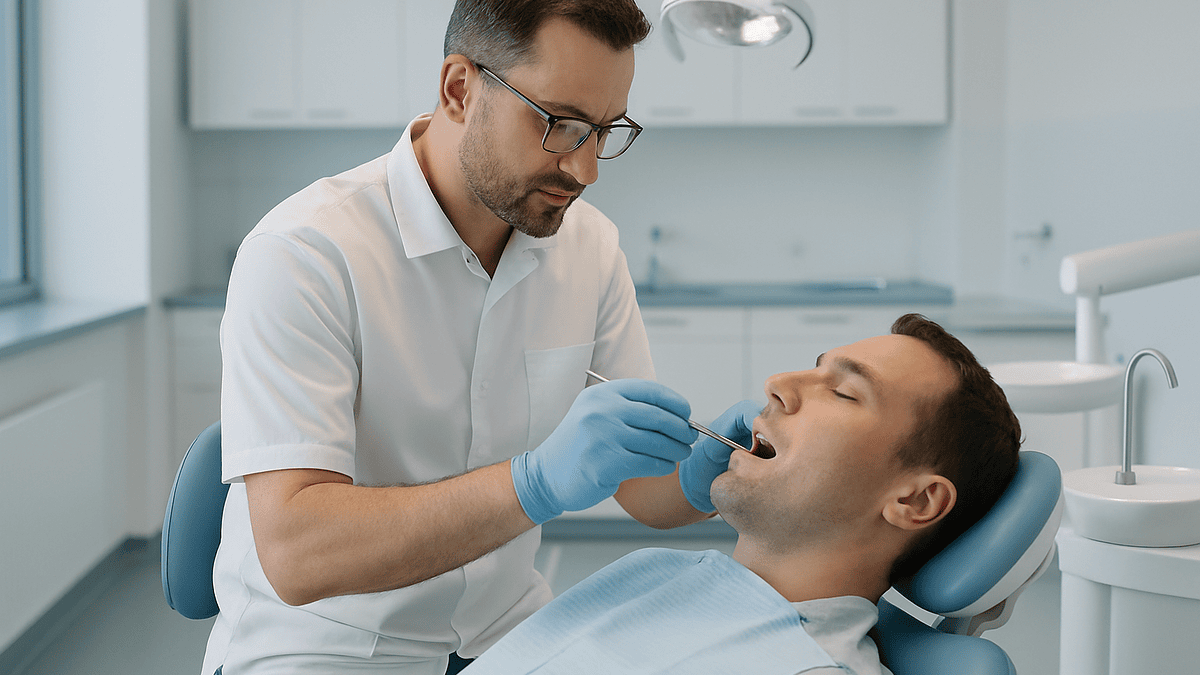
An online dental consultation works well for triage, visual checks of visible teeth and gums, second opinions on existing records, cost discussions, and post-treatment follow-up. It cannot replace X-rays, gum-pocket probing, tapping or cold-testing a tooth to check the nerve, or any hands-on care such as cleaning or fillings. Treat it as an informed first conversation that guides your next step, not a final diagnosis.
It usually starts at an awkward hour. A molar that behaved all week begins throbbing at 11 p.m., and suddenly you are in the bathroom, phone flashlight in one hand, trying to photograph the back of your own mouth like a contortionist. The photo is blurry. The pain is not. And the nearest open dental chair is nine hours away.
This is the moment teledentistry was built for. Video consultations with licensed dentists have moved from pandemic workaround to permanent fixture, and for people comparing treatment abroad, they have become the standard first step before booking a flight. The convenience is real. So are the limits.
The honest question is not whether a dentist can help you through a screen, often they can, but which parts of dentistry survive the trip through a phone camera and which quietly do not. The gap between the two is wider than most booking pages admit.
What actually happens during an online dental consultation?
Strip away the app interfaces and most virtual dental visits follow the same arc. You book a slot, fill in a health questionnaire, and often upload photos in advance. The call itself typically runs 10 to 20 minutes: the dentist takes a history, when the pain started, what triggers it, what dental work you have had, then asks you to angle your camera around your mouth, sometimes with a spoon handle pulling your cheek aside.
What you get at the end falls into a handful of outcomes. The dentist may offer reassurance and self-care guidance, recommend an in-person exam on a specific timeline, refer you urgently if something looks concerning, issue a prescription where regulations allow, or draft a preliminary treatment estimate if you asked about planned work such as crowns or implants.
Notice what is missing from that list: a definitive diagnosis. A careful teledentist will say something like this pattern is consistent with rather than you have, because the tools that confirm most dental diagnoses, radiographs, probing, vitality testing, do not exist on your side of the call. Mayo Clinic makes the same point about telehealth generally: it excels at triage, follow-up, and access, and it hands off to in-person care when examination or testing is required.
That framing matters most for anyone using a video call to plan major treatment. The consultation is the opening chapter, and a good one. It is not the book.
What can a dentist genuinely see through your phone camera?
More than skeptics assume. A modern phone camera in decent light shows a dentist chipped or fractured teeth, lost fillings, obvious large cavities, gum redness and swelling, visible tartar buildup, mouth ulcers, white or red patches on the tongue and cheeks, and how your teeth line up when you bite. Facial asymmetry from swelling is often easier to judge on video than a patient realizes.
Just as valuable is what the dentist hears. Dental diagnosis leans heavily on history, and history transmits perfectly over video. Pain that arrives with cold drinks and vanishes in seconds tells a different story from pain that wakes you at 3 a.m. and throbs with your pulse. Pain when you bite down points one direction; pain that migrates between upper teeth and worsens when you lean forward may point toward the sinuses rather than a tooth at all, a pattern the NHS notes can mimic toothache.
Remote consultations also shine at things that never required hands in the first place:
- Second opinions on treatment plans, X-rays, and scans you already have
- Post-operative check-ins, is this healing normally after an extraction or implant?
- Sorting urgent from non-urgent, so you know whether you need a dentist today or next month
- Cost and options conversations before committing to major work
For these tasks, the screen is not a compromise. It is simply a shorter distance between you and someone qualified.
What no camera can replace: the honest list
Dentistry is a tactile, radiographic profession, and several of its core diagnostic tools flatly do not work remotely. This is the part most marketing pages skip, so here it is plainly.
| Diagnostic tool | Possible remotely? | What it finds |
|---|---|---|
| Bitewing and periapical X-rays | No | Decay between teeth, infection at the root tip, bone loss, decay under old fillings |
| Periodontal probing | No | Gum pocket depths in millimeters: the defining measurement of gum disease |
| Percussion and cold testing | No | Whether a tooth’s nerve is inflamed, dying, or already dead |
| Tactile examination | No | Soft or sticky enamel, crack lines, loose crowns, mobile teeth |
| Head and neck palpation | No | Swollen lymph nodes, lumps, jaw-joint problems, oral cancer screening by feel |
| 3D imaging (CBCT) | No | Bone volume and nerve position for implant planning |
| Visual inspection of visible surfaces | Partially | Front-facing surfaces reasonably well; back molars and inner surfaces poorly |
The X-ray line deserves emphasis. Cavities most often begin on the surfaces where teeth touch each other, exactly where no camera can look. By the time decay is visible on video, it is usually well established. Bitewing radiographs catch these lesions years earlier, which is a large part of why in-person checkups exist at all.
The same logic applies to gum disease. Gums can look pink and calm on camera while pockets deepen underneath. Only a probe, measuring millimeter by millimeter, tells that story.
My tooth hurts, can a video call figure out why?
Often it can narrow the field, which is genuinely useful even without a confirmed answer. Dentists are trained to read pain patterns, and the pattern travels through a screen intact.
Brief, sharp sensitivity to cold that fades within seconds frequently points to exposed root surfaces, a leaky filling, or early enamel wear, irritating, but rarely an emergency. Pain that lingers long after the cold stimulus is gone, arrives spontaneously, or throbs at night suggests the nerve inside the tooth is significantly inflamed and unlikely to settle on its own. Pain sharply localized to biting on one spot raises suspicion of a crack or a problem at the root. Cleveland Clinic’s overview of toothache causes maps to exactly these distinctions.
A teledentist will also screen for the signs that change everything: swelling of the face or jaw, fever, a bad taste from a draining gum boil, or difficulty opening the mouth. Any of those shifts the conversation from book an appointment to be seen today, because they suggest infection spreading beyond the tooth, something Mayo Clinic flags as capable of becoming serious, and occasionally life-threatening, when it reaches the tissues of the neck.
What video triage cannot do is tell you which tooth is the culprit with certainty. Dental pain refers notoriously: an upper molar can announce itself as lower jaw pain, and vice versa. Pinpointing the source takes cold tests, percussion, and an X-ray. Expect a good remote dentist to give you a probability and a plan, not a verdict.
Can a virtual dentist prescribe antibiotics?
Sometimes, but a careful dentist will often decline, and that refusal is a sign of quality, not stinginess.
Legally, it depends on where you and the dentist are. In the United States, prescribing rules are set state by state, and most states permit dentists to prescribe certain medications after a legitimate telehealth evaluation, while controlled substances face far stricter limits. Other countries have their own frameworks. Any reputable platform will be transparent about what its dentists can and cannot issue in your location.
Clinically, the more important truth is this: most tooth pain is not an antibiotic problem. If the nerve inside a tooth is inflamed or dying, the fix is procedural: a filling, a root canal, a drainage procedure, or an extraction. Antibiotics do not reach the dead tissue inside a tooth in any meaningful way, and mainstream guidance reserves them for situations where infection is spreading: facial swelling, fever, feeling systemically unwell. Prescribing them for routine toothache delays real treatment, breeds resistance, and often just postpones the same pain by a couple of weeks.
So the realistic expectations are:
- A teledentist may prescribe when there are genuine signs of spreading infection and local law allows it
- Even then, the prescription is a bridge to urgent in-person treatment, not a substitute for it
- A dentist who says you need a chair, not a prescription is practicing good medicine
If a service advertises easy prescriptions as its main selling point, read that as a warning label.
Can I chat with a dentist online for free?
Yes, with an asterisk the size of a molar. Free options exist in several forms, and each buys you something different.
Q-and-A forums and ask-a-dentist chat features give you general educational answers, what a symptom might mean, whether something sounds urgent. Useful for orientation, but the dentist answering has never seen your mouth, and responses are necessarily generic. Some dental schools and community health programs offer free or low-cost screening, including tele-triage in some regions; these are legitimate access points, particularly if cost is the barrier to care. MedlinePlus and the NHS both maintain free, reliable symptom guidance that answers many of the questions people bring to paid chats.
Then there is the largest category: the free consultation offered by clinics, especially in dental tourism. Understand what it is: a screening and sales conversation. The clinic invests fifteen minutes hoping you will book thousands of dollars of treatment. That does not make it dishonest, and many are conducted by skilled clinicians, but the incentive structure tilts toward recommending treatment. The advice you receive is a proposal, not a neutral opinion.
A practical rule: use free channels to get oriented and to compare, then consider paying a modest fee for an independent second opinion from a dentist with no stake in your treatment decision. That fee is often the cheapest insurance in the entire process.
How much should a dental consultation cost?
Prices scatter widely, but the landscape has a recognizable shape.
In the United States, an in-person new-patient exam commonly runs somewhere in the range of $50 to $200 without insurance, and the X-rays that usually accompany it add more. Virtual consultations tend to sit lower, many platforms and practices charge somewhere between roughly $30 and $100 for a scheduled video visit, and some waive the fee entirely if you proceed with treatment. Dental insurance increasingly covers teledentistry visits on similar terms to in-person exams, though coverage varies by plan and state, so a two-minute call to your insurer before booking is worth the trouble.
In dental tourism, remote consultations are almost universally free, for the reasons covered above: they are the clinic’s front door. Independent second-opinion services, where a dentist reviews your X-rays and treatment plan for a flat fee, typically charge somewhere between the cost of a movie ticket and a nice dinner, and they occupy a genuinely useful niche.
What should govern your judgment is not the sticker price but what the fee includes. Ask three questions before paying:
- Will I speak with a licensed dentist, and can I verify the license?
- Do I receive a written summary or record of the consultation afterward?
- Is the fee credited toward treatment if I proceed, and does that create pressure to proceed?
A $40 consult with a documented summary from a verifiable dentist beats a free chat that evaporates when you close the tab.
Why online consultations became the front door of dental tourism
Nobody flies to another country for a filling. People travel for full-mouth rehabilitation, multiple implants, or a set of veneers, treatment plans that can differ by five figures between countries. Before committing to that scale of work abroad, patients understandably want a plan and a price first, and video consultations made that possible without a scouting trip.
The typical sequence: you send photos and, ideally, recent X-rays or a panoramic image to one or more overseas clinics. Each responds with a proposed plan and quote, sometimes followed by a video call with the treating dentist. Done well, this process is genuinely valuable. You can compare clinical reasoning, not just prices. You can hear how a dentist explains trade-offs, implant versus bridge, crown versus veneer, and whether they mention risks unprompted. You can ask about qualifications, materials, and what happens if something fails after you fly home.
The World Health Organization estimates oral diseases affect close to 3.5 billion people worldwide, and cost is a dominant reason care gets delayed; medical travel exists because that math is real for ordinary households. Remote consultation lowers the riskiest part of the equation, committing blind.
But the front door is not the house. Every reputable clinic will re-examine you in person on arrival, take its own imaging, and frequently revise the plan. The remote consultation’s job is to shortlist honest, competent providers and set realistic expectations. Clinics that promise a fixed, final plan from photos alone are telling you something about themselves.
A remote quote is an estimate, treat it that way
Here is the scenario that fills patient forums: a traveler receives a photo-based quote for six implants, flies out, and learns after a 3D scan that bone loss requires grafting, sinus work, and two extra visits, at meaningful extra cost. Nobody lied. The camera simply could not see bone.
Implant planning depends on cone-beam CT imaging to measure bone height, width, and density and to map nerve pathways. Gum disease severity depends on probing depths. Whether a tooth can hold a crown depends on how much sound structure remains under old fillings, visible only on radiographs or once the old work is removed. None of this survives a video call, so every remote quote is built on incomplete data by definition.
Protect yourself with paperwork rather than optimism:
- Request an itemized quote, per tooth and per procedure, not a package total
- Ask which items are contingent on imaging: a good clinic will name them readily
- Ask for a written range: best case and realistic worst case
- Confirm the revision policy in writing before booking travel, including your right to decline added work
- Send recent X-rays if you have them; a quote built on radiographs is meaningfully more stable than one built on selfies
The clinics most comfortable with these questions tend to be the ones whose final bills match their first estimates. Evasiveness at the quoting stage rarely improves once you are in the chair, in another country, with a flight home already booked.
How to prepare so the dentist actually sees something useful
Ten minutes of preparation roughly doubles the value of a remote consult. Dentists who work by video say the same things fail every time: dim bathrooms, shaky cameras, and patients trying to describe a tooth by feel alone.
Lighting first. Face a window in daylight or have someone aim a lamp or a second phone’s flashlight into your mouth. Overhead bathroom lighting throws shadows exactly where the dentist needs to look.
Then retraction. Lips and cheeks hide most teeth. The handle of a clean spoon, pressed gently to pull your cheek outward, exposes the back molars far better than fingers do. If someone can hold the camera while you hold the spoon, better still.
Photos taken in advance beat live video for detail. A useful set includes:
- Front view, teeth together, lips retracted
- Left and right side views, teeth together
- Upper teeth from below and lower teeth from above (a mirror helps)
- A close-up of the specific tooth or area that concerns you
Paperwork completes the picture. Have ready: a list of medications and health conditions, any recent dental X-rays (clinics can email these on request: you are entitled to your records), and a short symptom timeline. Started two weeks ago, cold-sensitive at first, now aches at night is diagnostic gold; it hurts sometimes is not.
One more habit worth adopting: take notes or ask for a written summary. Consultations move fast, and the plan you half-remember is the plan you cannot compare against a second opinion.
Cosmetic and smile assessments: where photos help most
If any corner of dentistry suits remote assessment, it is the cosmetic conversation, because the thing being evaluated, your smile’s appearance, is exactly what a photograph captures.
From good images, a dentist can discuss tooth shade and staining patterns, gaps and crowding, gum-line symmetry, tooth proportions, and how much of your teeth and gums show when you smile. Whitening candidacy, the difference between bonding and veneers for a chipped front tooth, whether alignment issues suggest orthodontics before cosmetic work, all of these are legitimate video-call topics, and clinics offering smile makeovers lean on photo assessment heavily for this reason.
The caveat sits underneath the enamel. Cosmetic dentistry performed on unhealthy foundations fails, sometimes expensively. Veneers over inflamed gums, whitening over unfilled cavities, crowns on teeth with quiet root infections, each is a known way to convert a cosmetic budget into an emergency. So even the most photogenic treatment plan requires the unglamorous groundwork: an in-person exam, radiographs, and gum assessment before anyone touches a front tooth.
Be alert, too, to digital smile previews. Simulation software that shows your future smile is a communication tool and a sales tool simultaneously. The rendering is not a guarantee; it is an artist’s impression constrained by your actual anatomy. Ask to see photographs of the dentist’s real completed cases, including ones several years old, rather than judging by simulations alone. Ceramics age; software does not.
What is the best app for online dental consultations?
There is no single best app, and any article naming one is describing an advertising budget as much as a product. What exists instead is a short list of features that separate credible services from slick ones, and the list works in any country.
Verify the humans first. A trustworthy platform names its dentists, states where they are licensed, and makes license numbers checkable against a public dental board registry. If you cannot find out who you will be speaking to, keep scrolling. Licensing matters practically as well as legally: a dentist licensed in your state or country can prescribe and refer within your system; one licensed elsewhere generally cannot.
Then check the plumbing:
- Transparent pricing published before booking, not revealed mid-call
- Secure, privacy-compliant video rather than generic consumer chat apps
- A written record of the consultation that you receive and can share with another dentist
- A clear pathway to in-person care, good telehealth knows its own limits and says so
- The ability to upload photos and existing X-rays before the visit
Mayo Clinic’s guidance on choosing telehealth services applies neatly here: the technology is secondary to the clinical governance behind it. A plain video call with a verifiable, local, well-documented dentist beats a beautiful app wrapped around anonymous clinicians.
For dental tourism specifically, the platform is usually the clinic’s own system. The same checklist applies, with extra weight on the written record, since that document becomes your baseline if the in-person plan later grows.
What does the research say about teledentistry's accuracy?
The evidence base is young but consistent in its shape: teledentistry performs respectably at screening and triage, and less well the more subtle the diagnosis becomes.
Studies indexed on PubMed comparing photographic or video assessment against in-person examination generally find good agreement for detecting obvious problems, large cavities, visible swelling, clearly urgent cases, and for the fundamental triage question of does this person need to be seen, and how soon? That is precisely the question a remote consultation is usually asked to answer, which is why the format earned a permanent place after 2020 rather than fading with the emergency that popularized it.
Where remote assessment reliably underperforms is early disease: small lesions between teeth, decay beneath existing restorations, early gum disease, and hairline cracks. These conditions are largely invisible without radiographs and probing, so no improvement in camera technology fixes the gap: the missing data simply is not optical.
Reviewers also note honest limitations in the literature itself: studies vary widely in image quality, clinician training, and which conditions they test, so precise accuracy percentages should be quoted cautiously. The fair summary is qualitative, not numeric, good for sorting, weak for confirming.
For patients, the practical translation is simple. Trust a remote consultation to tell you whether and how urgently to act. Do not trust it, and do not let anyone sell it to you, as confirmation that your mouth is healthy. A screen can rule things in far more reliably than it can rule things out.
When to skip the screen: seeing a dentist, or the emergency department
Some situations should never wait for a video slot. Knowing them is the most useful thing this article can leave you with.
Go to an emergency department, not a dentist’s inbox, if tooth or jaw pain comes with facial swelling plus fever, difficulty swallowing or breathing, swelling spreading toward the eye or down the neck, or trauma involving possible jaw fracture. Mayo Clinic is unambiguous that a dental abscess with these features can spread to deeper tissues and become life-threatening; hours matter.
A knocked-out adult tooth is its own emergency with a stopwatch attached. The best chance of saving it comes from reimplantation within roughly 30 to 60 minutes. Handle it by the crown only, rinse briefly without scrubbing, reinsert it into the socket if you can, or transport it in milk or held inside the cheek, then get to a dentist immediately. No video call improves those odds; it only spends the minutes.
See a dentist promptly, in person, within a day or two for: toothache lasting more than two days (the NHS threshold for booking care), pain with swelling of the gum or face, a broken tooth with a sharp or exposed surface, lost crowns or fillings causing pain, or bleeding that does not stop after an extraction.
And book a routine exam, not a call, for the quiet signs: gums that bleed when brushing, persistent bad breath, a mouth ulcer or patch that has not healed within three weeks, or sensitivity that keeps returning. These are exactly the problems that look fine on camera while progressing underneath, which is why the in-person checkup, radiographs and all, remains the one appointment telehealth cannot retire.
Frequently asked questions
Can I chat with a dentist online for free?
Yes, through Q-and-A forums, some dental school and community programs, and free consultations offered by clinics, especially dental tourism clinics. Free forum answers are general education, not personal diagnosis, and clinic freebies double as sales screenings. They are fine for orientation, but for decisions about major treatment, a modestly priced independent second opinion from a dentist with no financial stake is usually worth far more than any free chat.
Can a virtual dentist prescribe antibiotics?
Sometimes, depending on your state or country’s telehealth prescribing rules and whether the dentist is licensed where you live. More important: most tooth pain does not need antibiotics at all. Guidelines reserve them for spreading infection, facial swelling, fever, feeling unwell, because the underlying fix is procedural, such as drainage, a root canal, or extraction. Even when prescribed remotely, antibiotics are a bridge to urgent in-person treatment, not a replacement for it.
How much should a dental consultation cost?
In the US, in-person new-patient exams commonly run roughly $50 to $200 without insurance, before X-rays. Virtual consultations often cost between about $30 and $100, and dental tourism clinics typically offer them free as a sales channel. Insurance increasingly covers teledentistry, though plans vary. Judge value by what is included: a verifiable licensed dentist, a written summary you keep, and no pressure created by fees credited toward treatment.
What is the best app for online dental consultations?
No single app is objectively best, and rankings often reflect marketing spend. Choose by checklist instead: dentists named and licensed where you live, license numbers verifiable through a public registry, transparent pricing before booking, secure video, the ability to upload photos and X-rays in advance, a written consultation record you receive afterward, and a clear referral pathway to in-person care. A plain platform with verifiable clinicians beats a polished app with anonymous ones.
Can a dentist diagnose a cavity from a photo?
Only sometimes, and usually only when decay is already advanced. Large, visible cavities on front-facing surfaces show up in good photos, but most decay begins between teeth or under existing fillings, where cameras cannot look. Bitewing X-rays detect those lesions years earlier. A photo assessment can raise suspicion and set urgency, but confirming a cavity, or ruling one out, requires radiographs and a tactile exam in the chair.
Do I always need X-rays before dental treatment?
For anything beyond the most superficial work, effectively yes. X-rays reveal decay between teeth, infection at root tips, bone levels, and what lies beneath old fillings, while 3D cone-beam scans are standard for implant planning because they measure bone volume and map nerve positions. Any clinic proposing crowns, root canals, or implants from photos alone is planning on incomplete data, and the plan should be expected to change after imaging.
How accurate is teledentistry compared with an in-person exam?
Research indexed on PubMed shows good agreement for triage and for spotting obvious problems, large cavities, swelling, clearly urgent cases. Accuracy drops sharply for early disease: small lesions between teeth, early gum disease, and hairline cracks, which are invisible without radiographs and probing. The fair summary is that remote assessment sorts patients well but confirms diagnoses poorly, so use it to decide your next step, not to declare your mouth healthy.
How reliable are dental tourism quotes given over video?
Treat them as estimates built on incomplete data, because bone volume, gum pocket depths, and decay under old fillings cannot be assessed remotely. Plans commonly change after in-person X-rays and 3D scans, sometimes adding grafting or extra visits. Protect yourself by sending recent radiographs with your inquiry, requesting itemized best-case and worst-case pricing, and getting the clinic’s revision policy in writing before booking any travel.
When is tooth pain an emergency rather than a video call?
Seek emergency care immediately if pain comes with facial swelling plus fever, difficulty swallowing or breathing, swelling spreading toward the eye or neck, or significant trauma. A knocked-out adult tooth is also time-critical, reimplantation works best within about 30 to 60 minutes, so transport the tooth in milk or inside the cheek and go straight to a dentist. For toothache lasting more than two days without these signs, book prompt in-person care.
What should I prepare before an online dental consultation?
Good lighting, ideally daylight or a helper aiming a flashlight; a clean spoon handle to retract your cheek so back teeth are visible; and a set of photos taken in advance, front, both sides, upper and lower arches, plus a close-up of the problem area. Add a medication list, any recent dental X-rays, and a short symptom timeline. Ask for a written summary afterward so you can compare opinions accurately.
References
- NHS: Toothache
- Cleveland Clinic: Toothache
- World Health Organization: Oral health fact sheet
- MedlinePlus: Tooth Disorders
This article is for general information only and is not a substitute for professional medical advice. Please consult a qualified doctor about your individual situation.

More from the Blog
Veneers Abroad: What to Verify Before You Book: a Patient Checklist
Before booking veneers abroad, verify the dentist's license and training with the country's dental registry, get a written treatment plan naming the material and…
Full Mouth Dental Implants in Turkey: Transparent Cost Breakdown for International Patients
Full-arch implant treatment in Turkey typically runs EUR 3,250-8,450 per jaw for All-on-4 and EUR 3,900-10,400 per jaw for All-on-6 (our guide range for…
Dental Treatment in Turkey: Honest Costs, What Packages Include, and Red Flags
Dental treatment in Turkey typically costs 50-70% less than in the UK or US. Guide ranges for international patients: a porcelain veneer runs EUR…
Choosing a Country for Dental Implants: The Criteria That Actually Matter
There is no single best country for dental implants. Mexico, Turkey, Hungary, Costa Rica, and Thailand all have skilled implant dentists at lower prices,…
Is It Safe to Get Your Teeth Done in Turkey? The Questions That Separate Clinics
Dental work in Turkey can be done safely, but safety depends on the clinic, not the country. Turkey has skilled, well-trained dentists alongside high-volume…
Dental Implants Abroad: Costs, Accreditation Checks and Aftercare Planning
Dental implants abroad can cost substantially less than at home: a single implant including its crown falls in our guide range of EUR 500-1,800,…